Showing posts with label differences. Show all posts

March 27, 2025

No Huddles for Heloise

Written by Deborah Kerbel
Illustrated by Udayana Lugo
Orca Book Publishers
978-1-4598-3910-6
32 pp.
Ages 4-7
March 2025 

I like Heloise. Heloise knows what she likes and doesn't like. She likes sledding and fish popsicles, sharing rocks with friends, and her own space. 
From No Huddles for Heloise, written by Deborah Kerbel, illustrated by Udayana Lugo
What she doesn't like, other than the leopard seals that no penguins like, are crowds and hullabaloo and those huddles that penguins do for warmth and protection. Those huddles that are just too close.
Huddles give Heloise the heebie-jeebies.
The jim-jams.
The willies.
And the collywobbles.
From No Huddles for Heloise, written by Deborah Kerbel, illustrated by Udayana Lugo
But how can she say no to the other penguins and not hurt their feelings? Typically, she has a number of excuses from taking her fish for a walk or polishing her rock collection. Heloise is perfectly happy on her own, enjoying her things, her space, and her own thoughts. 
From No Huddles for Heloise, written by Deborah Kerbel, illustrated by Udayana Lugo
But then the other penguins stop asking her to join them in huddles and Heloise begins to question her own wants and needs, and seeks companions elsewhere. Unfortunately, her travels are disappointing and even dangerous on her own and she returns home to find that her friends have found a way to accommodate her need for personal space while offering her the protection that huddles provide.

It's lovely to read a story about an introverted character who doesn't feel compelled to fit in with the extroverts or have the extroverts demand that their way of socializing and gregarious behaviour is preferable and, worse, the norm. I'm so glad Deborah Kerbel, an accomplished writer of picture books, middle grade and YA, demonstrates an acceptance of the introverted Heloise rather than sympathy for her nature. (The sympathy should be towards the attitude she experiences from those who are not introverted.) Instead, Deborah Kerbel validates the fullness of Heloise's life without the partying and closeness demanded or even just requested by her penguin peers. Heloise is a happy penguin, accepting of her nature and choices. She's never rude but she is true to her herself. Too bad that she feels like she doesn't belong because belonging does not mean being the same as others.
From No Huddles for Heloise, written by Deborah Kerbel, illustrated by Udayana Lugo
I love the positive messages that Deborah Kerbel gives us in No Huddles for Heloise, and BC's Udayana Lugo gives us the whimsy of that message in Heloise and her friends. From their accessories, like pom-pom hats, scarves, and bandanas, to props like a rock polisher or a whale stuffed animal, Udayana Lugo demonstrates the differences among the penguins are the norm and Heloise's introversion is just another manifestation of wonderful diversity. She created her art primarily using gouache and coloured pencils, which gives a bright and rich portrayal of the penguins and the landscape in which they live and play.
 
I'm with Heloise–except for the fish popsicles–that quiet and solitary activities offer comfort in ways that many extroverts will never understand. While we all must engage with others for safety, for work, or for other needs, it's lovely to see Heloise be accepted and even accommodated for her needs, not chastised for being different.

February 05, 2025

Steve, a Pretty Exceptional Horse

Written and illustrated by Kelly Collier
Kids Can Press
978-1-5253-1299-1
64 pp.
Ages 6-9
September 2024
 
We all want to feel special at some point. For some, having a shining moment is enough. For others, like Steve the Horse, it's all about being the centre of attention and perceived as exceptional. Thing is, what makes him exceptional?

Author-illustrator Kelly Collier first introduced Steve in her picture books A Horse named Steve (2017) and Team Steve (2018) but this time Steve gets to show off his exceptionality in this first of an early graphic novel series. (The next books in the series, Steve, a Rare Egg and Steve, Born to Run, are slated for release in June and September respectively.) With a little more story and a lot more illustrations, Kelly Collier gives Steve the opportunity to shine, sort of.
From Steve, a Pretty Exceptional Horse, written and illustrated by Kelly Collier
While hanging with his bestie Bob, the raccoon, Steve witnesses the grandeur of a peacock when it spreads its feathers. Steve, ever the self-absorbed horse, asks Bob, "I know I'm special, Bob, but am I exceptional?" Unfortunately, Bob's reply, citing Steve's nice coat and ability to run fast, isn't sufficient to allay Steve's concerns. 
From Steve, a Pretty Exceptional Horse, written and illustrated by Kelly Collier
But when Steve discovers a golden horn that he can tie onto his head, he believes it will be just the thing to make him exceptionally beautiful. Still, when he approaches his friends to recognize his exceptionality, they seem unimpressed. (It doesn't help that the horn is starting to creep off his head until it's hanging under his chin.) And then the horn is lost.

How is Steve supposed to feel special without his golden horn? And will he still be special if his friends find their own ways to stand out?
From Steve, a Pretty Exceptional Horse, written and illustrated by Kelly Collier
While Kelly Collier could have made Steve tiresome with his self-centeredness, she actually makes him more lovable than annoying. He just wants to stand out. Problem is that he wants to always be seen as exceptional. It's all about him. Still, there are moments of caring for others, like helping Bob reach the apples high in the trees. Steve might not like it but he's a lot like everyone, showing moments of the extraordinary and a lot of ordinary. So, Kelly Collier's Steve will help young children see the flaws of ego when it gets in the way of supporting others. She also brings attention to Steve's friends who, similarly, choosing to be extraordinary, are willing to copy the horse's head decoration with their own, using everything from an acorn to a branch or a leaf.  

As an early graphic novel, Steve, a Pretty Exceptional Horse, has the right elements for encouraging reading. It's got terrific illustrations that are both simple and detailed enough that everyone and everything is recognizable, thereby allowing kids to focus on meaning and enjoying the humour. While there are subtle messages about being egocentric and being a follower, Kelly Collier will just get kids reading and laughing in a pretty exceptional story.

July 08, 2024

Jacinta's Orderly World

Written by Margaret Sullivan
Illustrated by Scot Ritchie 
Plumleaf Press
978-1-73889827-5
32 pp.
Ages 3-7
May 2024
 
We  all like to have our things where can find them. For some, like Jacinta, having routines and things in order makes all the difference to having her day so smoothly. But then she meets someone who does things a little differently and still makes it work for them.
From Jacinta's Orderly World, written by Margaret Sullivan, illus. by Scot Ritchie
Jacinta likes order in her life, whether it's how her socks are organized in a drawer or using an egg carton to house her 12 most special rocks. (She's also very good at repurposing objects.) That control over what she does and how she does it brings her contentment. But outside of her control, things are always different and sometimes difficult.
From Jacinta's Orderly World, written by Margaret Sullivan, illus. by Scot Ritchie
Jacinta finds it stressful when her grandmother comes over to babysit and throws off Jacinta's order. Doesn't Grandma Nancy know that the cereal and cookie boxes are organized according to the colour spectrum ROY G BIV? And what is she supposed to do with the new stuff Grandma Nancy brings that don't fit in to her organization scheme?
From Jacinta's Orderly World, written by Margaret Sullivan, illus. by Scot Ritchie
But a trip to Kenny's garage to pick up their car gives Jacinta a new perspective. Without knowing it, she finds the beauty of her order in the chaos outside of her home. Whether it's the rainbow she discovers in spilled oil or a tiny mouse that resides in Kenny's garage, Jacinta finds that she can appreciate that which initially seems disorganized.
 
Margaret Sullivan, a poet and writer from Salt Spring Island, shares her experiences of seeking comfort in organizing her room via Jacinta whose own quest for order gives her satisfaction. Growing up in a military family who often moved locations, Margaret Sullivan found stability in the organization of her own space. Most young children feel a lack of control in their lives, having their activities from eating to sleeping, learning and play dictated by the adults in their lives so for Jacinta to be able to exercise some level of authority over her surroundings is important.  But, while Margaret Sullivan could have made Jacinta an anxious child, she made her one who appreciates order but could see beyond that which appears disorganized. She gives us a character that is multi-dimensional, who knows what she likes and how to get it but is open to others who may want something different.
From Jacinta's Orderly World, written by Margaret Sullivan, illus. by Scot Ritchie
Scot Ritchie's illustrations depict both the order and the chaos effectively and with kindness. His art shows the complexity of colour in our lives but also that it's up to us how we live with all that colour. He makes sure we don't see Jacinta's life as anything less than full. She doesn't live in a world of black and white, or even grays. Her life has everything she needs and likes and she still is able to look beyond herself. Her openness to new experiences and to the needs of others demonstrates that the richness of her life reaches beyond herself.

I like Jacinta. She's a cool kid. I like how she organizes and repurposes objects and how she opens her heart. She could have closed herself off to protect herself from that which might disturb her but, from her grandmother and mishaps and meeting Kenny, Jacinta takes it all in stride to find a way to cope. In fact, she does better than cope. She finds a way to appreciate them all. Life can be jumbled but Jacinta shows us that there is a way to see within and beyond and give it an order that works for us.

August 12, 2023

A Tale of Two Kitties

Written and illustrated by Judith Graves
Acorn Press
978-1-773661179
32 pp.
Ages 2-4
August 2023

It may have been National Cat Day on August 8th but for some of us every day is National Cat Day.
From A Tale of Two Kitties by Judith Graves
Mittens and Boots are two cats who look amazingly similar except for the distinct white markings that define them. Though they are treated the same in terms of their food and their sleeping preferences–their own chairs on opposite sides of a fireplace–they differ in their interests–singing vs. painting–and like to be kept separated. Then the chairs are gone, and a loveseat takes their stead. 
 
Mittens and Boots are not happy, convinced this is payback for all the things cats do, like hacking up in unusual places, enthusiastic use of their litter boxes, and late-night yowling. But, when sleep times comes, the two are forced to share the loveseat, albeit with some annoyance. Still, it seems the loveseat has a mind of its own and determined to bring the two felines together, maybe even with a new friend.
From A Tale of Two Kitties by Judith Graves
Anyone who has ever had multiple cats in a home knows that they can be best buddies or warily tolerant. Sometimes their humans are successful in bringing them together and sometimes less so. Obviously author-illustrator Judith Graves–whose YA novel Exposed is the only book I've reviewed here–knows about cats and living with them. Their personalities are so distinct and yet they share commonalities that make us wonder why they aren't better friends or at least companionable. But, cats will be cats and forcing them together, even as a loveseat did, doesn't always work. But, when options are limited, they can be compelled to accept and even endure the other, overriding their innate territorial instincts.
From A Tale of Two Kitties by Judith Graves
A Tale of Two Kitties
is Judith Graves's debut picture book as the author and the illustrator, and as an artist (see her website at https://judithgraves.com/ or her etsy shop at https://www.etsy.com/ca/shop/SassyLassieDesignsCA) with designs in acrylic as well as watercolour, I hoping we'll be seeing more of her work in children's book illustration. The story of Boots and Mittens is sweet and familiar, and we might be able to anticipate the next story with the arrival of Snowball (!). But it's Judith Graves's art of expressive cats, colourful wallpapers, and homey furnishings that brings life to her story. I love the colours, primarily teal and orange, and the warmth of that palette because, let's face it, with cats in the home, there's always a softness of spirit. 

Embedded in Judith Graves's art and story is an endearing cheekiness. "Purrhaps" it's her use of feline-inspired puns or the playfulness of her art, but regardless A Tale of Two Kitties is a whole package of sweet fun, lively art and feline reality.

August 07, 2023

Dear Elsa

Written by Marco Fraticelli
Red Deer Press
978-0-889956865
240 pp.
Ages 8-12
May/July 2023
 

looking out the window
in his new school
the sad student (pg. 32)
 
As part of a school assignment, 10-year-olds Elsa of Boston and Leo newly of Toronto must write emails to each other as pen pals. Neither is initially keen, and Leo is especially so when he learns his pen pal is a girl. But, through revealing messages from September through the following August, the two go from strangers to something deeper.

At the outset, the differences between the two middle-graders are pronounced. Leo, who has newly moved from Montreal to Toronto for his parents' jobs as teachers, complains about everything, from not having any friends, his teacher, following rules, sending emails to Elsa of at least 250 words, and schoolwork writing poetry. Elsa, on the other hand, loves rules, has divorced parents, and, though Leo suggests she must be one of the popular kids based on the advice she gives him, calls herself an in-between kid who has a few good friends and is relatively quiet. But as she allows him to vent while still offering him a different perspective, Leo discovers some things about himself, like that he really likes writing poetry, especially haiku, which he often shares with her. Elsa is slower to reveal herself, probably because Leo is so busy complaining, but she too begins to divulge what her life is like, rather than just giving Leo the opportunity to share. Readers, and Leo, learn of her parents' relationship, her trip to Cancun, her aspirations, her prowess as an archer, and eventually her wheelchair. While Leo broadcasts about everything, Elsa holds back much about her own situation, and is delighted to be treated like she isn't someone with a disability.

Dear Elsa may be author Marco Fraticelli's first children's book but his decades of experience as a Grade 5 teacher as well as an award-winning poet have given him a strong foundation for an irresistible story of two children exploring their differences and finding common ground to be the friend the other needs at that time. Their writing relationship may continue past their Grade 5 year–that is not revealed at the book's conclusion–but it's almost irrelevant as the two derived safety, perspective, opportunity, and solicitude from their relationship.

In 2015, I prepared a post titled, Dearest readers...: A Letters in youngCanLit book list, which provided a list of books that featured characters writing letters or emails or texts as the vehicle for the plot. I will definitely be adding Dear Elsa to that list now to ensure that middle-grade readers (and perhaps their teachers) have an opportunity to visit with Leo and Elsa and witness how a friendship can develop from afar and with seemingly different individuals. All it takes is opening oneself up the opportunity, as Leo learns both in emails and at school, and perhaps some heartfelt poetry.

March 13, 2023

Biindigen! Amik Says Welcome

Written by Nancy Cooper
Illustrated by Joshua Mangeshig Pawis-Steckley
Owlkids Books
 978-1-77147-515-0
32 pp.
Ages 3-7
March 2023
 
It may be a reunion of beavers, but Amik's little sister Nishiime is a little anxious. What should she expect from all these beavers coming from far and wide?
From Biindigen! Amik Says Welcome by Nancy Cooper, illus. by Joshua Mangeshig Pawis-Steckley
From the East and the far West, from the North and the South, Amik's cousins arrive and are welcomed. They bring gifts from their regions, whether a woven headband or berries in a basket, all generous and all received with gratitude. But Nishiime is nowhere to be found.
From Biindigen! Amik Says Welcome by Nancy Cooper, illus. by Joshua Mangeshig Pawis-Steckley
As the beavers go looking for Nishiime, Amik asks the deer, fish, fox, and otters if they've seen her. Though none have seen her, they all acknowledge the help that the beavers' activities have fortuitously provided them. Whether it's being able to reach the leaves of felled trees, or channels to swim in, a bridge to cross, or feeding in shallow waters created by dams, all the animals are appreciative.
From Biindigen! Amik Says Welcome by Nancy Cooper, illus. by Joshua Mangeshig Pawis-Steckley
It's not until the cousins are preparing to head home that Nishiime comes out of hiding, revealing the reason for her apprehension, and recognizing it as unfounded.

Using beavers to tell her tale, Nancy Cooper reminds us that, though we might come from different places and have different families, we are more alike than we might expect. Nishiime almost misses out on meeting her beaver cousins because of her fears; fortunately, she finally recognizes that though they might wear different markings, jewelry, and clothes, and all have different names–Amik is Anishinaabe, Amisk is Cree, Gopit is Mi'kmaq, Amicos is Algonquin, Kigiaq is Inuktitut, Qowut is Ayajuthum and Tsyennìto is Kanyen-kéha Mohawk–they are all beavers. Moreover, Amik and her family have been making everyone feel welcome, including the different species of animals. In a story about diversity and acceptance of differences, Nancy Cooper also reminds us of the interrelationship of living things. The message of connectedness and acceptance may be subtle and very organic, but it is convincing. 
 
The Woodland illustrations of Joshua Mangeshig Pawis-Steckley, an Ojibwe artist, take us into that woodland to see these stylized animals in lush beaver habitats of land and water. From forests of birch and poplar, to dammed waters below striking sunsets of orange and turquoise, the artwork of Joshua Mangeshig Pawis-Steckley, whose earlier book Mii maanda ezhi-gkendmaanh/This is How I Know made an enormous splash with its Woodland style, brings an appreciation of the natural world of the beaver and other animals. Still, Joshua Mangeshig Pawis-Steckley always reminds us with small details like beaded bracelets, a Mi'kmaq peaked cap or a medicine pouch that this is a story based in Indigenous cultures and its teachings are even more profound because of its heritage.
 
Biindigen! Amik Says Welcome is a fresh picture book in language (a glossary of Anishinaabe and other words is included) and art, and its messages about acceptance and gratitude will make it a welcome addition to any bookshelf.

March 03, 2023

Smile So Big

Written by Sunshine Quem Tenasco
Illustrated by Chief Lady Bird
North Winds Press (Scholastic Canada)
978-1-4431-8767-1
32 pp.
Ages 4-8
March 2023

Most of us, adult and child alike, will see something less than perfect in our appearance: too wide, too short, too white, too dark, nose or teeth too big, eyes too widely-spaced. There’s always seems to something that we see that others may or may not. How to see the truth?
From Smile So Big by Sunshine Quem Tenasco, illus. by Chief Lady Bird
Challa has a big, toothy smile and when she gets teased about it, her mom reassures her and shows Challa a beautiful mirror with a thunderbird design and fringe. Her mother tells her that this family heirloom would show the holder's true self, but the rule was that they "had to say what they saw in the reflection." Challa looks into the mirror and sees all her attributes and says, "I'm smiling so big. I sure do look cute." With that, the beads around the mirror light up. Challa is delighted.

From Smile So Big by Sunshine Quem Tenasco, illus. by Chief Lady Bird
When she shows her friend Neebin, who was always being teased about his long hair, Challa notices how he smiles and looks so cute when looking in the mirror. When he acknowledges aloud that he loves his long braid hair, not only do the beads light up, but the whole playground shakes and sparkles with magic! The same happens when her cousin Keggy recognizes how much she loves her dark skin and the house shakes and sparkles as it's enveloped in the magic of the thunderbird. When her friend Kiniw sees his own beauty and accepts his small size, the magic is revealed again.
From Smile So Big by Sunshine Quem Tenasco, illus. by Chief Lady Bird
Challa is perplexed why she only saw the beads light up, not the magic that came with it. She tries again to acknowledge her eyes, her nose, her hair, and her dimple but the magic doesn't appear until she feels and expresses real love for her smile.

Sunshine Quem Tenasco, Anishinaabe from Kitigan Zibi Anishinabeg, brings young readers to an Indigenous community and yet the story she tells will be understood by all of us who may be teased, or worse, about some aspect of our physical nature. With a little help from a magic mirror and the support of those who love us and came before us, we can all see, accept, and appreciate who we really are. Whether there's a magical mirror in your life or not, there are those who help you see the beauty within and those people, whether in our lives now or gone already, are our greatest champions. It's not because of validating who we are; it's because they reflect who we are through their love. Sunshine Quem Tenasco's dedication includes the following words: "To all the Indigenous kids on Turtle Island and to all the boys with braids, you are so loved. You are important. You are powerful." Her words lift those to whom she has dedicated her book but also to every child who has the good fortune to read this picture book.

Chief Lady Bird, a Chippewa and Potawatomi artist who collaborated with Sunshine Quem Tenasco on Nibi's Water Song (2019), gives us both the realism and the magic in her illustrations. The boldness of her colour and shapes impress with their power of message about beauty and self, encouragement, and heritage. Chief Lady Bird gives life and context to Sunshine Quem Tenasco's words, and together Smile So Big is as enchanting as it is grounded.

For every smile hidden because of unease, and for every cruel teasing endured, Smile So Big gives young readers the courage to see their beauty as reflected in their own mirrors, magical or not, as held by themselves and those who love them.

January 17, 2023

Crescent Moon Friends

Written by Wadia Samadi and Mo Duffy Cobb
Illustrated by Lisa Lypowy
Acorn Press
978 -1-773660967
32 pp.
Ages 4-8
2022
 
Two girls. Two cultures. Two families. Two sets of traditions. One moon under which their differences are more similar than at first seen.
From Crescent Moon Friends by Wadia Samadi and Mo Duffy Cobb, illustrated by Lisa Lypowy
Aisha joins Amelia's class in Canada after leaving war-torn Afghanistan. When they become reading partners, they also become friends, sharing traditions of their cultures from games and food to celebrations and beliefs.

As they share, they also learn. Amelia's family follows Islamic traditions of peace and prayer while Amelia's teaches compassion and kindness. The two girls also have different dispositions, Aisha leaning to the maths and sciences and Amelia to the arts. One has the heart and mind of a scientist while the other one of a dreamer and a poet. And though they both love the moon, they see it differently.
From Crescent Moon Friends by Wadia Samadi and Mo Duffy Cobb, illustrated by Lisa Lypowy
It's relevant that the crescent moon, an important symbol of Islam, draws the attention of both girls. Still even in their different relationships with the celestial body, they appreciate how it is seen by the other. 

Afghanistan-born Wadia Samadi and P.E.I.'s Mo Duffy Cobb wanted to tell a story of two different girls who find commonalities in their differences. And young readers will learn how being different is okay but also will recognize that the differences aren't as contrary as some might expect. Amelia and Aisha are just to girls who have been brought up in different traditions and, with the sharing of those traditions, their friendship is strengthened.
From Crescent Moon Friends by Wadia Samadi and Mo Duffy Cobb, illustrated by Lisa Lypowy
Whether she's depicting Canada or Afghanistan in her illustrations, Edmonton's Lisa Lypowy uses watercolours to keep them bright and atmospheric. Even with her colours and shapes, Lisa Lypowy shows how similar the girls and their lives are while different in temperaments, landscapes and weather, clothing and customs. 

Wadia Samadi and Mo Duffy Cobb end their book with blurbs about Prince Edward Island and Kabul, Afghanistan. In one last manifestation, they compare and contrast the two locations and help young readers see, yet again, that separating ourselves along lines of differences hurts us but finding our connections makes us better.

October 03, 2022

Lana Llama

Written and illustrated by Lori Doody
Running the Goat, Books & Broadsides
978-1-927917-81-7
32 pp.
Ages 3-7
July 2022
 
Lana Llama looks similar to her flock. She is wooly like the sheep and she has four legs and two ears and a fuzzy tail. But she still notices that her legs and neck are longer and she can't bleat.
From Lana Llama by Lori Doody
As with any creature who wants to fit in, Lana tries to emulate the sheep of her flock. But it's awkward and she is unsuccessful.
From Lana Llama by Lori Doody
Still, when a barnyard bully, also with the same attributes of wooliness, four legs, two ears and a fuzzy tail, comes along, Lana Llama uses her differences to stand up to it and be accepted by her flock exactly as she is.

Now she's happy to stand up for others,
just by standing out.
 
From Lana Llama by Lori Doody
Every Lori Doody picture book that comes out is a treat for the heart and the eyes. Her folk art consists of simple lines and bold colours but it is more. It's both subtle and striking, and still cozy and true. She doesn't overwhelm with details in her characters or landscapes but the farm and its animals are definitive and real. Based in that reality is always a story that will resonate with young readers (and old ones too). Here it's about trying to fit in but finding the best fit comes from being oneself. Of course, Lana Llama wants to be like the sheep of her flock. They are her people, her community, and she believes that they give her her identity too. But Lori Doody reminds us that what makes us different makes us unique and valuable, with Lana Llama being the only one who can stand up to a barking bully by virtue of those very differences.

Whether you're a bleater, a hummer, a clucker or a barker, Lori Doody will find you the right community as she did for Lana Llama. After all, we all belong.

September 28, 2022

The Line in the Sand

Written and illustrated by Thao Lam
Owlkids Books
978-1-77147-570-9
48 pp.
Ages 5-8
September 2022
 
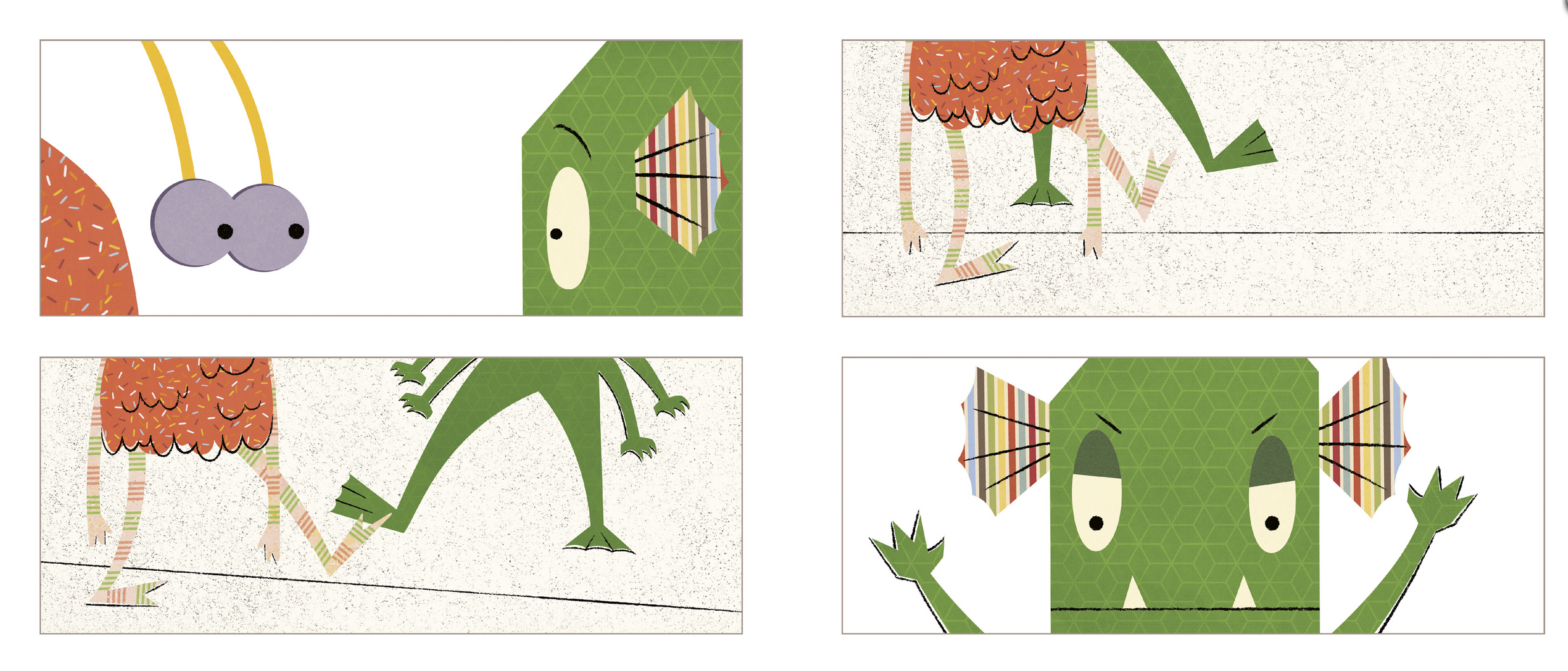
When a monster drags a stick behind them and creates a line in the sand, they are unaware of the conflict that results. But how that conflict is resolved is up to those who perceive it.
From The Line in the Sand by Thao Lam
A varied assortment of monsters are playing at the beach: collecting shells, playing games, flying kites and building sand structures. One seven-eyed and four-limbed creature amuses itself by dragging a stick behind itself. (Haven't we all dragged sticks through sand and dirt to create shapes?) But several of the other monsters notice this line. It divides them. And when one tries to step over the line, another gets distressed and directs it back.
From The Line in the Sand by Thao Lam
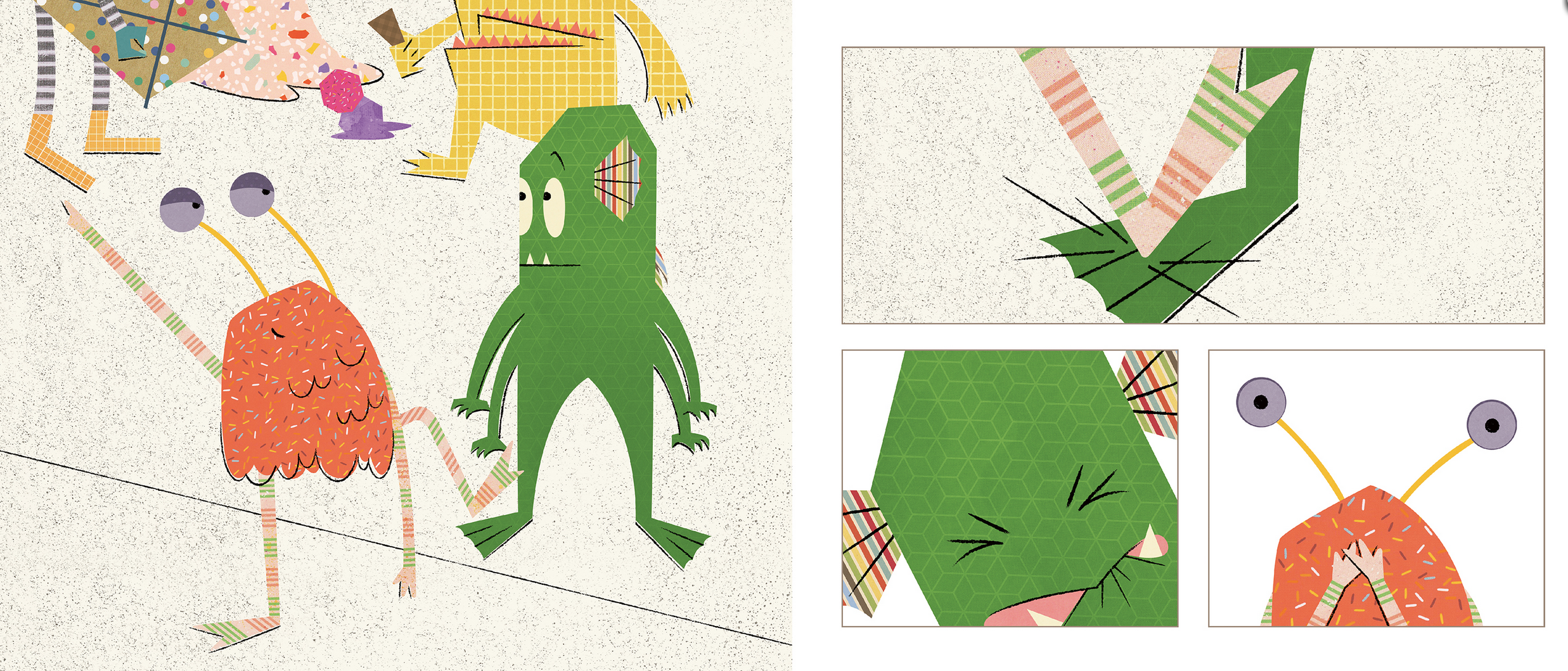
This does not please the purple-eyes-on-antennae creature who promptly lifts its foot across the line and stomps on the green webbed foot of the other. Though it is deliberate, the purple-eyed monster does not realize the impact it would have, causing the green one to stumble and fall across the line and into its assailant, blurring the line in the sand.
From The Line in the Sand by Thao Lam
Then a bee flies into the mix.  Both monsters are thrown into a tizzy trying to evade the insect and in the process kick up the sand, obliterating the line. Looking up to see the roughened sand, the two creatures realize that beyond their interaction are numerous more lines, all drawn by the same stick-dragging monster. But, no one is reacting to those lines at all. They walk across them, they ignore them, or they are oblivious. The lines are present but of no concern.  Soon enough, our two rivals recognize the emptiness of their conflict, especially as they'd already joined forces to try to defeat a bee.

Conflict is often borne of words so it's meaningful that Thao Lam wrote a picture book about conflict as a wordless story. That just tells you how much words can get in the way. (They can also work wonders when used well.) In The Line in the Sand, no words are needed to convey distress, discord, territoriality, shock or even rage. These creatures, though their morphologies suggest otherwise, are as human as Thao Lam's readers.  (Don't we all differ to some degree in our shapes, colour, limbs and more?) Like all of us, they can be protective and defensive if they perceive a slight, intentional or not. And intention is key here because the creature with the stick intended nothing except play. Sadly, that line in the sand was the basis for some inadvertent conflict. Only when the two come together in a common goal–ridding themselves of a bee–do they see their squabble as insignificant.
From The Line in the Sand by Thao Lam
From her very quirky characters, that vary in colour from green to orange, yellow, pink and blue, with or without stripes or dots or other patterns, and with various limbs, eyes and more, Thao Lam includes everyone and spotlights no one. In their peculiarities, they are us. And we are them, drawing lines accidentally, taking offence indiscriminately, and coming together only when we see our similarities, not our differences. 

The Line in the Sand reminds us that conflict can be borne of misunderstanding or disregard but with communication, even without words, and awareness, resolution is possible.

September 18, 2022

Made 4 You

Written by Eric Walters
DCB
978-1-77086-661-4
296 pp.
Ages 13+
September 2022
 
Except for the headaches which have started plaguing her–and for which she has had multiple MRIs–seventeen-year-old Becky James's senior year is mapped out as getting good grades, prepping for the SATs, volunteering at a seniors' residence, and partaking in extracurricular activities like school band and social justice club and managing the boys' basketball team.  Then she meets Gene Newman, a previously-homeschooled student from New York state whom she will host and offer assistance.

As smart as Gene is, he needs support to fit in at their Nobleton, Indiana high school. His first-day blue suit and shiny brief case, as well as his formal speech, make him a standout. But he's a fast learner, following Becky's advice with respect to dress and more. Soon he's not just fitting in but he's attracting attention as an exceptional student, saxophone musician and basketball player. As they spend more and more time together, and Gene reveals the research his adoptive parents have been conducting on human intelligence and strategies for learning, the two teens become closer. But it's not smooth sailing for the young couple as there are secrets that could put them both in danger and perhaps keep them separated forever.

When science fiction is written well, it becomes less fantasy and more possibility, and Made 4 You is so plausible that readers will wonder if the story is based in reality. (Of course, that's also the finesse that is Eric Walters's writing.) Research on human intelligence is vast and expanding, as scientists look to how we learn, apply and adapt, so raising a young man like Gene who can learn anything quickly and thoroughly is not surprising. However, the depth of his learning, from math to sports and social interactions, is astounding, especially as it is coupled with empathy and love. Because Eric Walters takes Gene beyond the genius he is and makes him into a teen in love, Gene is a complete, albeit extraordinary, human.  And with dangerous adversaries looking to exploit the science behind Gene's intellectual development, Made 4 You goes beyond a sci fi romance into a thriller and action adventure. It's a story that has it all: sweet moments of falling in love, mysterious scientific research, and chase scenes across land and sky. Moreover, with Eric Walters at the writing helm, not only is it a story made for any middle-grader or teen who reads across genres, Made 4 You is also complex, nuanced and full of heart. (Even the dedication will give readers an "Awww" moment of pause.)

January 25, 2022

Eight Days

Written by Teresa Toten
Scholastic Canada
978-1-4431-9002-2
312 pp.
Ages 10-14
January 2022

A lot can happen in eight days. Death, love, journeys and change. And, like it or not, it is what it is.

At almost 14, Sami Stanic has lived through a lot. Since she was three, she has lived with her grandfather Carl in the White Towers apartment building at Thorncliffe Park in Toronto. Carl is a recovering alcoholic, having stopped drinking when he brought Sami to live with him, and Sami is determined to keep it that way. She works at ensuring he stays sober by attending AA meetings with him and by keeping herself apprised of all the programs and readings, and she is determined to prove herself useful. In her own way, she does not want to be abandoned again. But, without knowing it, Sami has become part of the community, regardless of Carl's intolerance to the diverse community that is the Towers now. Her best friends are Nilofer and Tarek (also her crush) and there are lots of people watching out for her, though she doesn't realize it. So when she learns that her mother has died, a woman she'd always thought of as gone already, Sami is both perplexed and ashamed.
 
Within days, Sami, Carl and their neighbour Aggie are heading to Chicago in Carl's '77 Olds, affectionately known as Sophie, to deal with Shannon's funeral arrangements. But the journey becomes an opportunity for truths to finally emerge about all their stories: Sami's first few years, Shannon's issues, and Carl's despair. And their return to Canada may just be a new pilgrimage for all.

Teresa Toten may be better known for her extraordinary young adult novels (e.g., Beware That Girl, Shattered Glass, and The Unlikely Hero of Room 13B) but her voice shines just as brightly in this middle-grade novel. Perhaps it's because Teresa Toten has still focused her story on the foundation of most children's lives: their relationships. For Sami, it's her many relationships that drive her. Her relationships with Carl, with Nilofer, with Tarek, with Aggie, with her mother, and with so many in her community offer some security and comfort, but also some worry and angst, while often leaving her questioning her memories and her feelings.
I'd been whiplashed by every possible human emotion in the past few hours. I liked me better before. Clamped down, in charge. (pg. 253)
Teresa Toten makes sure that Sami's journey does not start and stop with a road trip. It becomes one of self-discovery and tenacity in which Sami sees and hears more from those around her and allows herself to be more. As alone as she may feel, living with a dry alcoholic who could relapse at any time, Sami learns she's part of a big community and one so diverse in its cultures that there is more than enough offering to be the family she needs.

Eight Days may have a road trip story line at its core but the journey is more one of life. But, as with any journey, where you come from is just one part. Where you're heading and where you end up are just as meaningful.

January 04, 2022

A Long Way Home

Written by Jean Little
Illustrated by Gabrielle Grimard
North Winds Press (Scholastic Canada)
978-1-4431-7091-8
32 pp.
All ages
February 2022
 
No matter how different they are, Maya and Jane become fast friends after Maya moves into the apartment building next to Jane's house. When they learn about animals like whales and polar bears under threat, the two girls vow to do something together.
From A Long Way Home by Jean Little, illus. by Gabrielle Grimard
Jane's grandfather suggests they start close to home and do what they can for the monarch butterflies.
"...wishes don't come true without help..."
Learning of the monarchs' need for milkweed plants, the girls decide to start some plants in Jane's grandfather's community garden. Like good gardeners, they choose their site carefully, plant the seeds and tend to them. The waiting is tough but the girls fill their summer days with cycling and swimming until one day "A bright orange-and-black butterfly was fluttering flower to flower." With new watching and waiting, the girls see an egg become a caterpillar and then a chrysalis.
From A Long Way Home by Jean Little, illus. by Gabrielle Grimard
Though they are anxious for the butterfly to emerge from the chrysalis and Jane considers helping it get out, they have learned that it will appear when it is strong enough to begin its long journey. It is then that Maya reveals that she knows about long journeys. And when the butterfly does emerge and the girls send it off with hearty goodbyes, anticipating its arduous migration to Mexico, Maya bravely discloses that she and her family traveled a long way over many years to escape hardships that threatened their lives. Her own experiences give them hope that their butterflies and others, including those they might save the following year, will arrive safely to their destination just as Maya did.
From A Long Way Home by Jean Little, illus. by Gabrielle Grimard
For many lovers of Canadian children's books, Jean Little is a legend. When she passed in 2020, there was a great sense of loss for her relentless spirit and for any new books, resplendent in their compassion and heart-warming plots. With A Long Way Home, we get Jean Little back for a little while in this story that parallels the plight of the monarch butterfly with that of an immigrant family. While A Long Way Home will be a useful book for teaching STEM with its emphasis on the butterfly's life cycle, it goes beyond the science and evokes compassion for those who must escape troubling worlds and find refuge elsewhere and far away, often after much waiting. But in her inimitable style, Jean Little juxtaposes the story of the butterfly and of Maya's family without being too obvious or deliberate, letting young readers find the connection themselves, so they might understand what both have had to endure.

Gabrielle Grimard's artwork, which has graced many picture books including The Library Bus (2020), Stolen Words (2017), and  Not My Girl (2014), uses a mix of watercolours, gouache and oil to create warm and inviting scenes of children learning, playing and gardening. Her children are very real, with their fly-away hair, joyful camaraderie, and empathetic demeanours, and their efforts to help the monarch butterfly are just as honest. 

A Long Way Home is a triumphant story of a friendship born of acceptance for differences, of a compulsion to learn and help a threatened species, and of journeys taken. Moreover, with A Long Way Home, we are graced once more with a story from Jean Little whose vision is given colour and shape by Gabrielle Grimard. How wonderful for all young readers.

September 17, 2021

Valley of the Rats

Written by Mahtab Narsimhan
DCB
978-1-77086-628-7
232 pp.
Ages 9-12
September 2021

Twelve-year-old Krish Roy has taken himself out of his comfort zone of the indoors, books and cleanliness when he suggests (or perhaps agrees) to an outdoor camping trip with his nature photographer father. Always cognizant of what a disappointment he is to his father who holds Krish's cousin Anjali as an example of how he wishes Krish would be i.e., optimistic, adventurous, outdoorsy, Krish is determined to bond with his dad, even if he has to arm himself with plenty of hand-sanitizer and candies to calm him.

But from the onset, everything seems to go wrong. In the bamboo forests of the Ladakh Range (India), their GPS gets busted and they get lost, they can't get a cell signal, Krish loses his pocket hand sanitizer, a thunderstorm hits and there are rats. Oh, there are rats, and plenty of them. Hopeful that the rats will lead them to people, Krish and his Dad follow them to a village of huts. There they are given shelter by the villagers of Imdur but warned not to leave their guest house or wander the village. In fact, they are adamant that Dad cannot take photos as they do not want people knowing of them.

However, Krish learns soon enough that this camping trip is actually an assignment Kabir Roy has undertaken, hopeful of a blockbuster photo story about a rumoured village of rat worshippers. But all Krish wants to do is fix their radio and get out of Imdur, a community rife with rats and unhygienic conditions. As Krish and his father both try to meet their own needs, the villagers of Imdur, lead by the shaman Imma and her daughter Tashi, try to maintain their secretive community. With a clash of cultures, between father and son, and the reclusive Imdur and those beyond its borders, there may be no happy ending here.

Each time Mahtab Narsimhan takes us into India as she did in several of her earlier middle-grade novels, including her Silver Birch award-winning The Third Eye (2007), The Tiffin (2011) and Mission Mumbai (2016), she drops us into cultures resplendent in myths, food, celebrations, and even superstitions. In Valley of the Rats, she again takes us into a world that is different and even surreal (there is an element of the fantastic in Imdur) and makes it credible. Because Mahtab Narsimhan's fictional village of Imdur was founded after the ecological event called Mautam, there is plausibility to communities like it finding unusual means of survival. Whether or not there really is an Imdur, perhaps by a different name, Mahtab Narsimhan has taken us there, to live with these people who wear rat-skin coats and feed what we consider vermin as if they are their pets or deities. As such, readers should know that they will truly be entering the valley of the rats, and there are no shortage of the creatures.

Still, Valley of the Rats is about survival. It's about the villages of Imdur seeking to survive in a world that gave them famine and rats and no government help. And it's about Krish enduring incredible anxiety to make his father accept him as he is–imagine a germaphobe in a community of rats–and the two of them surviving their encounter with a community that has secreted itself away from the world. Survival by its very nature is precarious; if it was easy, it wouldn't be so uncertain. Who survives and how in Mahtab Narsimhan's story is yet another secret–the plot is rife with them–that will only be revealed in the climatic last few pages but it's worth the wild adventure that is Valley of the Rats.