Showing posts with label wordless. Show all posts

December 15, 2025

Community Snowman

Written by Deborah Kerbel
Illustrated by Tine Modeweg-Hansen
Groundwood Books
978-1-77306-951-7
32 pp.
Ages 3-7
October 2025 
 
There's snow out there and loads more coming. Whether it's in a yard, in a park, or in a schoolyard, there will be snow persons being built. (Actually, there will be snowmen, snow women, snow friends, snow dinosaurs, snow bears, and more.) And what's better than building a snow person? It's building it with others.
From Community Snowman, written by Deborah Kerbel, illustrated by Tine Modeweg-Hansen
After an ordinary night of sleep, a child awakens groggily to their routines. But when they look out the winter, everything changes from ordinary to amazing because the world outside is coated with deep, fluffy snow. Soon it's a race to get dressed and bundled up and head outside with their caregiver, perhaps a grandfather, following with similar enthusiasm, albeit a little more slowly and carrying a satchel with his knitting. So, as the child make snowballs and snow angels and starts making a snowman, their grandfather clears a bit of bench and gets to his sock knitting.
From Community Snowman, written by Deborah Kerbel, illustrated by Tine Modeweg-Hansen
All around people are bustling. Some trudge through the snow, heads down, oblivious to the snow joy in this child and in other children. Maybe they're going to work or to school, or walking their dogs, or going for groceries. But our child is busy too. Now they are starting to build a snowman. The bottom ball is always easy because you just roll it in to place. But the next ball, still large and needing to be lifted, is far more challenging, especially when another kid throws our child off balance with a snowball. No worries. He comes to help them. Two children then become three children at work and then a couple of teens join in to create the three-ball shape. 
From Community Snowman, written by Deborah Kerbel, illustrated by Tine Modeweg-Hansen
Now everyone gets in on the creation, with food stuffs like a pickle, chocolates, and bagels being added, and then with bits and bobs of clothing: a hat, work gloves, a shawl, and earmuffs. Everyone contributes something. But what does a man without a coat, socks, or gloves have to give? A poppy.
 
Without words, Deborah Kerbel tells a story of a community coming together to build a snowman and building kindness and compassion. It's a powerful story of how a small thing can become a meaningful moment. What's starts as play leads to friendship, to acceptance, and to benevolence. That's tough to get all that into a story that is wordless. But, with Deborah Kerbel as the storyteller, I'm not surprised by the strength of her story to draw her readers in, touch them, and make them feel the fellowship of the moment. But Tine Modeweg-Hansen, a Copenhagen-born illustrator who lives in Montreal, gives Deborah Kerbel's story the life of colour and community. In watercolour and ink, Tine Modeweg-Hansen's art, very reminiscent of the award-winning Quentin Blake, fills in those words with activity and detail. The cold and the wetness of the snow, the movement of the characters, human and animal, and the diversity of people makes the story spirited. Everyone and everything becomes part of a story that could only be described as feel-good.
 
At this time of year, with snow on the ground and holiday cheer ringing out, let's remember that community can come together spontaneously and with the greatest of heart without the giving of expensive gifts or conspicuous charity. It can happen naturally from a child's delight with snow and not overlooking those who might need help, whether it's lifting a ball of snow or providing a pair of socks.
From Community Snowman, written by Deborah Kerbel, illustrated by Tine Modeweg-Hansen

March 15, 2024

One Giant Leap


Written and illustrated by Thao Lam
Owlkids Books
978-1-77147-599-0
48 pp.
Ages 3-7
March 2024
 
Getting a child dressed, especially in winter, is akin to the prep required to outfit an astronaut. Each step must follow another to ensure coverage, safety, and fit. But when you're venturing out into that wide world of possibilities, it's best to be prepared.
From One Giant Leap, written and illustrated by Thao Lam
Zippers pulled up on a suit, boots tugged onto feet, gloves wrenched on, and a hat stretched down low on a forehead are just the first steps of venturing outside. But as the child is transported in an elevator to the 1st floor, an imaginative transformation occurs. What was a child in a snowsuit is now an astronaut in a spacesuit. So, when they finally venture outside, it isn't into the snow, it's onto the moon.
From One Giant Leap, written and illustrated by Thao Lam
Everything now is an exploration of a new land of shapes and structures. There's climbing and falling, searching and anticipating, and following footsteps. Are those aliens or something else? Is there peril? Can they communicate? Should they? What should they say?
From One Giant Leap, written and illustrated by Thao Lam
Can the astronaut reach their destination and fulfill their mission? Only by following their trek across barren landscapes of inhospitable structures and unusually-garbed creatures can readers even know whether they make it to...the coatroom at school.

As a wordless picture book, One Giant Leap has a story that is driven by the cut-paper collage of Thao Lam's artwork. The story which is immense comes from the reader seeing and interpreting the visuals. Is that a rocket launch pad or an apartment elevator? Are those aliens or children in colourful snowsuits? Are those buildings or mountains, man-made structures or lunar landforms? Vietnamese-Canadian author-illustrator Thao Lam, known for her complex and meaningful books including The Paper Boat: A Refugee Story and The Line in the Sand, still knows how to do playful. Dressing in a snowsuit and venturing out into the greater universe, this child embarks on an other-worldly adventure, fueled only by imagination. What they experience is all up to them, and Thao Lam lets us see what they see. It's a textured landscape of dull grays and blacks, with only a dash of colour from an orange spacesuit or when other bizarre creatures appear. But in that lunar landscape, it is all about starkness, with the energy provided only through the child's imagination.
From One Giant Leap, written and illustrated by Thao Lam
Whether stepping onto an unknown space body or onto a frozen city street, it's a giant leap of daring that must come from within. It's knowing what to expect and never knowing what could be found. For this little one, it's One Giant Leap into inventiveness and creative thought, and it looks like they had a great flight.

December 08, 2023

Once, a Bird

Written by Rina Singh
Illustrated by Nathalie Dion
Orca Book Publishers
978-1-4598-3143-8
32 pp.
Ages 3-6
September 2023 
 
I know many people are trying to forget a time of lockdowns and restricted movements during the early years of the pandemic. But Rina Singh and Nathalie Dion's story reminds us of the gifts of nature and community that were revealed during those tenuous times. And though their story takes us out of those times, it never lets us forget what discoveries were made when tensions were high, isolation was the norm, and health was insecure.
From Once, a Bird, written by Rina Singh, illustrated by Nathalie Dion
Without words, Rina Singh tells a story of the arrival of a robin to a land of complexity and quiet. There may be snow on the ground but as the bird travels over parks, highways, and agricultural fields, there is no one to be seen. It is people-less and still. It could be a dystopian landscape, but Nathalie Dion gives us hope and light in the greenness of the fields, the blues of the skies and the unscathed infrastructure.
From Once, a Bird, written by Rina Singh, illustrated by Nathalie Dion
The bird finds its way to a budding tree outside a walk-up apartment building where an elderly woman spots it. She alone is looking out her windows as her neighbours keep their blinds and curtains closed. But then others take in the sight of the robin, each in their own way. Whether it be a grandson and grandfather watching it with binoculars, or a young person taking photos with her phone, or two children chatting between windows. Even a new puppy dog is held up to witness the bird.
 
As life goes on for the bird, building its nest, laying its eggs, and feeding its young, the neighbourhood begins to open up: a door, a window, a walk with the dog. And, with time, the neighbourhood returns to normal as the bird and its young fly off, having taken the people through the tough times.
From Once, a Bird, written by Rina Singh, illustrated by Nathalie Dion
Although the audience for Once, a Bird is listed as 3-5 years of age, the depth of the storytelling is far greater, and could be for all ages. Rina Singh has given a nuanced story of isolation and connection with nature that may have been born of a pandemic, and all who have been living with solitude and/or withdrawal, whether because of distance, mental health, or even personality, will also understand. She offers hope that separation does not mean desolation, and that opening oneself to the natural world can help sustain us.

I've reviewed a number of picture books illustrated by Montreal's Nathalie Dion (e.g., The Big Bad Wolf in My House, I Found Hope in a Cherry Tree, The Dog's Gardener) and her watercolour and gouache art lends itself well to contemplative stories such as Once, a Bird. There is an intangible, almost divine, sense of beauty that comes from both introspection and deep relationships depicted in her illustrations. Her art is sensitive to the ephemeral nature of challenges, keeping her colours subdued but calm, and introducing brighter colours, initially only on the robin, as the people emerge, and the neighbourhood returns to life.
 
For hope through difficult times, take note of how once a bird brought a community together, and how Rina Singh and Nathalie Dion were able to do the same to tell its and our story.
 
• • • • • • • 

A French-language edition is also available as Il était une fois un oiseau.


November 24, 2023

Next Door

Written by Deborah Kerbel
Illustrated by Isaac Liang
Kids Can Press
978-1-5253-0658-7
32 pp.
Ages 3-7
October 2023
 
Wordless picture books have a general hush about them. In wordless books, i.e., ones in which the stories are told through illustrations alone, no one is speaking and there is no text to distract. It's all rather subdued. In fact, it's a perfect reflection of what the main character, a young boy with hearing aids, must experience much of the time. But don't be fooled into thinking that there is no story to be told or personal connection to be made.
From Next Door, written by Deborah Kerbel, illustrated by Isaac Liang
A boy and his mother head out from their home just as a moving van arrives and begins unloading boxes. It's evident these are not their goods as the boy is familiar with the places and people he encounters on their walk. Though he may have limited hearing, as evidenced by his hearing aids, he notices everything, from the musician busking, the construction workers at work, and even baby birds in a high nest. It's unfortunate when a cyclist races past the boy, startling him into dropping his teddy bear. But, after confirming he is okay, communicating via American Sign Language, his mother settles the boy.
From Next Door, written by Deborah Kerbel, illustrated by Isaac Liang
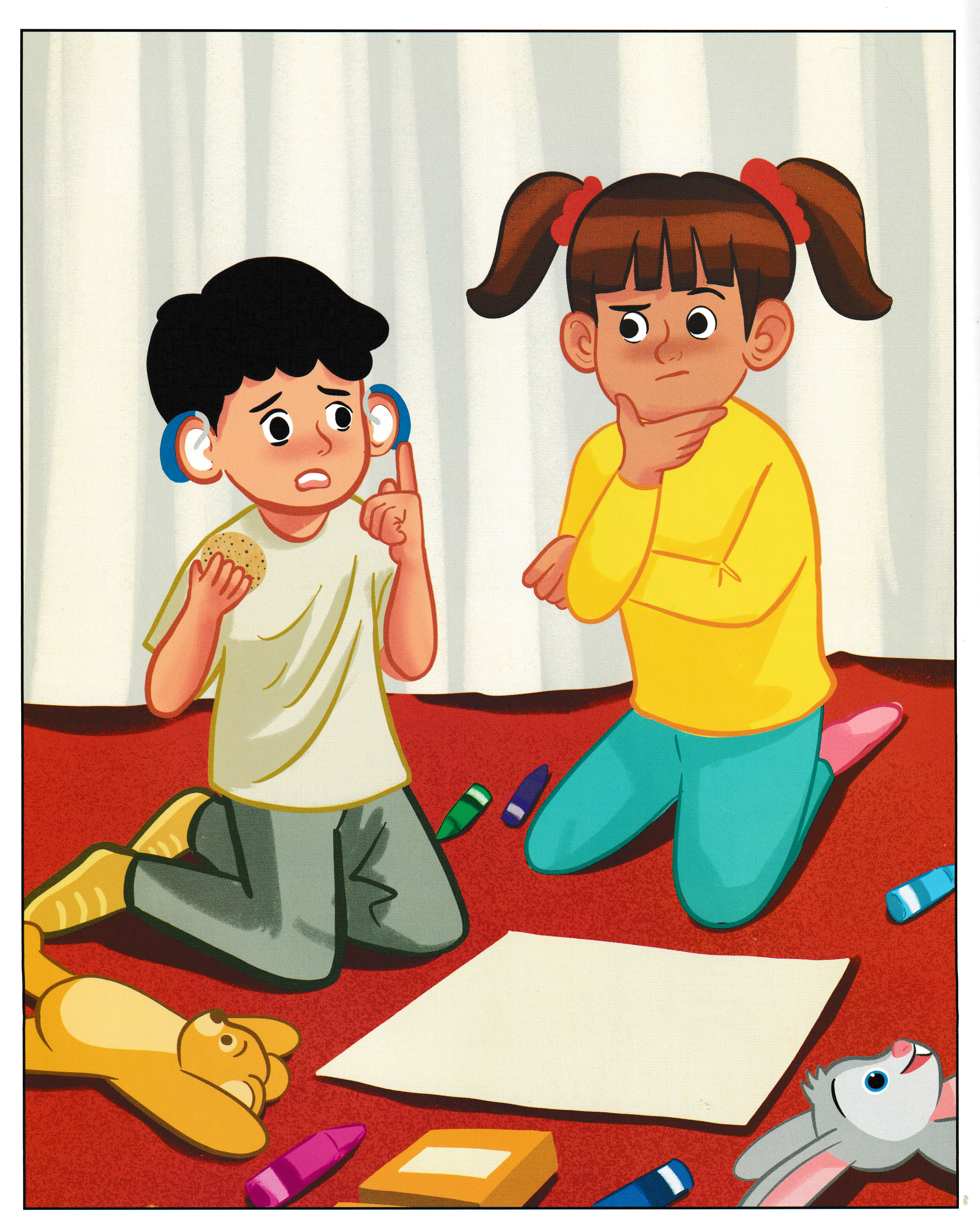
Returning to their building, they visit their new neighbours in the apartment next door. Using her own way of communicating, with hand movements and an Arabic/English dictionary, the woman welcomes them. But the boy spies a little girl hiding from them. When he approaches her, it is evident that neither can understand the other. But through the sharing of food and art, the two children find their own way to communicate.
 
This story is deeply personal for Toronto author Deborah Kerbel whose own sister had been born profoundly deaf. Deborah Kerbel's Author's Note speaks of her sister's abilities to connect, and Next Door's story reflects that ability for children who find different ways to communicate because of hearing and language differences. Undoubtedly a child who has a hearing impairment and one whose language is different than those around them may both feel at a disadvantage when trying to communicate. But, as the boy demonstrates, his disability is not a hindrance to living a good life, one in which he communicates with others, just in his own way. He successfully uses American Sign Language and his hearing aids to enable connection with others. But, when he meets the new little girl next door, he's on an equal playing field as she struggles to get him to understand her. But, with some effort and the common ground of art, along with a tasty cookie, a connection is made.
From Next Door, written by Deborah Kerbel, illustrated by Isaac Liang
Deborah Kerbel opens up about her sister's story to help convey the possibility that communication does not cease with hearing or a different language. We find new ways to communicate when the customary route is not available. By juxtaposing the boy's circumstances with that of his new young neighbour, Deborah Kerbel has found a way for any child for whom communication is challenging, because of, for example, cultural differences, emotional barriers, or physical barriers, to accept that different can still be effective. 
 
Isaac Liang is a deaf illustrator from Singapore who imbues the art of Next Door with knowledge and sensitivity. Because of his personal experiences with hearing impairment, Isaac Liang has found a way to bring the quiet and the connection for the children through his digital art. Because comprehension through the sense of hearing is compromised, his emboldens the story with colour and shape. Perhaps words are unnecessary but meaning still comes through with every building, person, and detail. 

Next Door is a great picture book for helping children develop their visual literacy skills and their empathy and acceptance for those who communicate differently. Hopefully it will help them to recognize that we do not all hear or see or understand the same way–the cyclist who almost collides with the child assumed the boy could hear him coming–and to find new ways of communicating that might work better for others. And, when it all comes down to it, kindness always works.

April 03, 2023

Afikomen

Written by Tziporah Cohen
Illustrated by Yaara Eshet
Groundwood Books
978-1-77306-606-6
32 pp.
Ages 3-6
March 2023
 
Soon the Jewish community will be celebrating Passover (April 5-13 this year) and many non-Jews know little of the traditions or stories that accompany the holiday. With no words, Afikomen invites us to attend a Passover Seder and witness Tziporah Cohen's family's traditions, but it also transports readers to ancient Egypt via time slip to witness Moses' beginnings.
From Afikomen by Tziporah Cohen, illus. by Yaara Eshet
As the family gathers at the table to read the Haggadah, the guidebook to the Passover Seder, i.e., the Passover religious service and dinner, the three matzah breads rest in front of the host. He takes the middle one, breaks it in half, and places the larger piece in a special bag to become the afikomen. The afikomen will be the last food eaten at the seder meal but, depending on the traditions of the family, the afikomen will play a big role before that end. In this family, the children "steal" the afikomen, and will return it for small gifts. First, though, these three children and their dog, hide beneath the table skirt and are transported to ancient Egypt.
From Afikomen by Tziporah Cohen, illus. by Yaara Eshet


There they become part of the Jewish story of the Exodus from Egypt, the basis for Passover. As Pharaoh had decreed that all Jewish baby boys were to be killed, Moses' mother saved him by placing him in a wicker basket and sending him down the Nile. The contemporary children witness this, and like Moses' sister who watches over him as he travels down the river, they ensure that he is safe from calamity like getting stuck in the reeds, taken by playing Egyptian boys, or accosted by a crocodile, so that he might be found by the Pharaoh's daughter and saved. It is only at this point that the children return to their own time and deliver the afikomen–with an unexpected twist–to end the Seder.
From Afikomen by Tziporah Cohen, illus. by Yaara Eshet
I knew so little of the story of Passover and nothing of the afikomen, so I am grateful to Toronto's Tziporah Cohen for giving us a wordless story and an extensive Author's Note to help educate. While a time slip story is unusual for a picture book and especially one with a non-fiction element, Tziporah Cohen makes it work. Not only did I learn about the afikomen and the Passover Seder, but I also learned that Jews of different origins, e.g., Ashkenazic and Sephardic, may differ in their traditions regarding the afikomen. 
 
Moreover,  I learned that even a holy celebration with a sombre history can have joy, and even playfulness. That comes through in Yaara Eshet's watercolour and ink illustrations which show us family who come together. The table laden with wine, the Seder plates, and texts, and the extended family members of varying ages makes for a colourful and textured display. With the expressive kids and dog, registering both the fun of stealing the afikomen and their surprise once dropped in ancient Egypt, as well as the bright landscapes of flowing water, golden sand, and lush riparian vegetation, Yaara Eshet gives a richness to the wordless story. Tziporah Cohen may give us story without words, but Yaara Eshet gives the content colour and texture, and together they give us a visual narrative that teaches and captivates.

November 21, 2022

Night Runners

Written and illustrated by Geraldo Valério
Groundwood Books
978-1-77306-569-4
52 pp.
Ages 3-6
October 2022

Who needs words when art can say so much? Geraldo Valério is one of our most accomplished wordless picture book author-illustrators, telling rich stories in the natural world with a luxuriance of colour and shape and teeming with interaction that supersedes words. Night Runners is his newest.
From Night Runners by Geraldo Valério
In Night Runners, a stag–with a messenger bag–bounds across a field into a coniferous forest, lured by a shining circlet of stars in the sky. There are many downed trees and just as the stag turns to check out the possibility of wolves, he stumbles on a fallen tree and injures its leg. As the tearful deer lays there, waiting for the wolves to come and slay it, something amazing happens. The wolves do arrive, but they encircle the deer, and bring it water and foraged food, and even wrap the wound with leaves. 
From Night Runners by Geraldo Valério
Together they follow the beacon of stars to a gathering of animals around a fire. All animals are represented, from moose and beaver, dragonfly and rooster, snake and skunk, and they all welcome the wolves and stag to their company. But when the stag opens his bag, the gathering becomes a true party of song and dance, and the circle of stars becomes a sky filled with brilliant stellar orbs.

Geraldo Valério's message of finding unexpected friends, even among those most feared, is a compelling one, especially for our times. The deer expects the worst when faced with a potential enemy but instead finds compassion and companionship. And together they discover something even more powerful and add to it with their presence.
From Night Runners by Geraldo Valério
Geraldo Valério's story fills the reader with hope for respect and humanity, something desperately needed nowadays. We need to know that good can happen in the midst of tragedy and Geraldo Valério makes us feel that promise for goodness and empathy. His striking artwork, rendered in acrylic paint and coloured pencil on watercolour paper, gives us that hope, with the boldness of colour and line bringing the power of his story to the eyes.  The stars that shine are for everyone and, with his diversity of animals, both domestic and not, Geraldo Valério makes sure that everyone can be part of this story.

September 28, 2022

The Line in the Sand

Written and illustrated by Thao Lam
Owlkids Books
978-1-77147-570-9
48 pp.
Ages 5-8
September 2022
 
When a monster drags a stick behind them and creates a line in the sand, they are unaware of the conflict that results. But how that conflict is resolved is up to those who perceive it.
From The Line in the Sand by Thao Lam
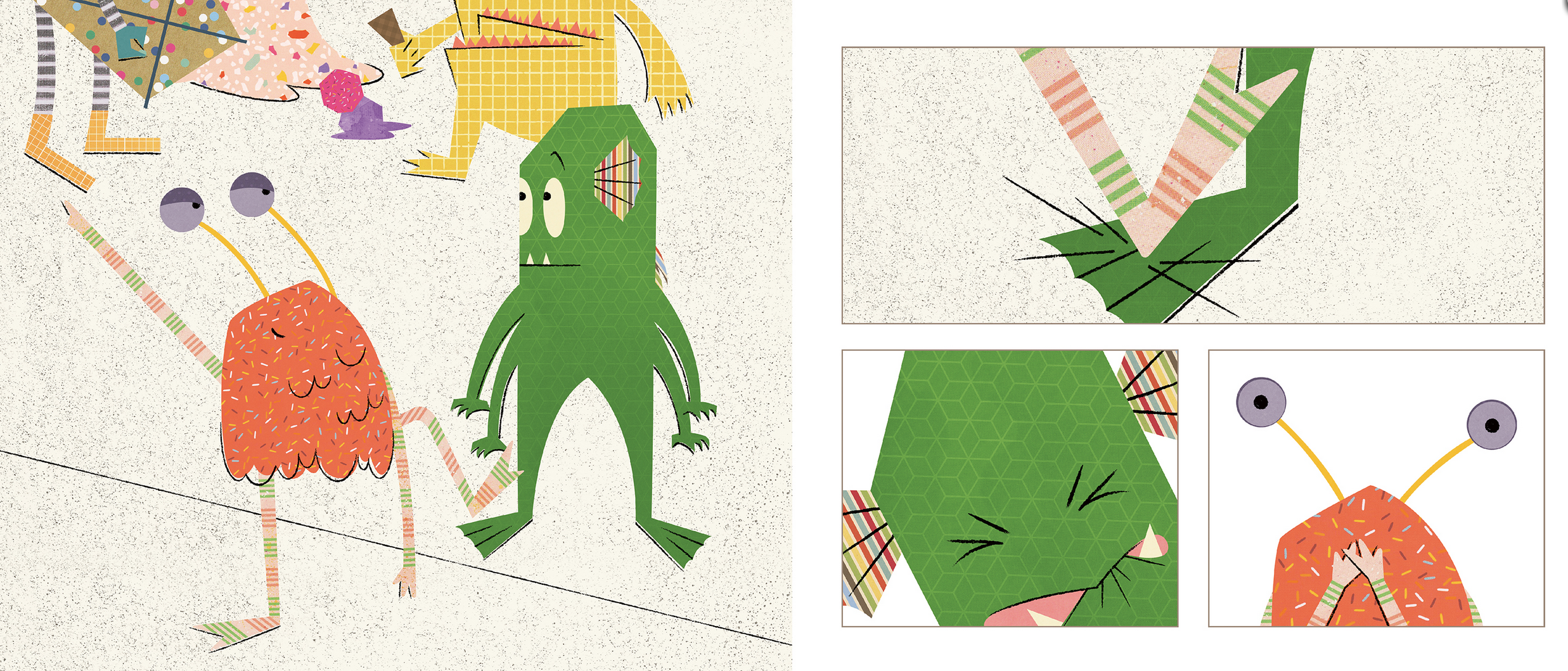
A varied assortment of monsters are playing at the beach: collecting shells, playing games, flying kites and building sand structures. One seven-eyed and four-limbed creature amuses itself by dragging a stick behind itself. (Haven't we all dragged sticks through sand and dirt to create shapes?) But several of the other monsters notice this line. It divides them. And when one tries to step over the line, another gets distressed and directs it back.
From The Line in the Sand by Thao Lam
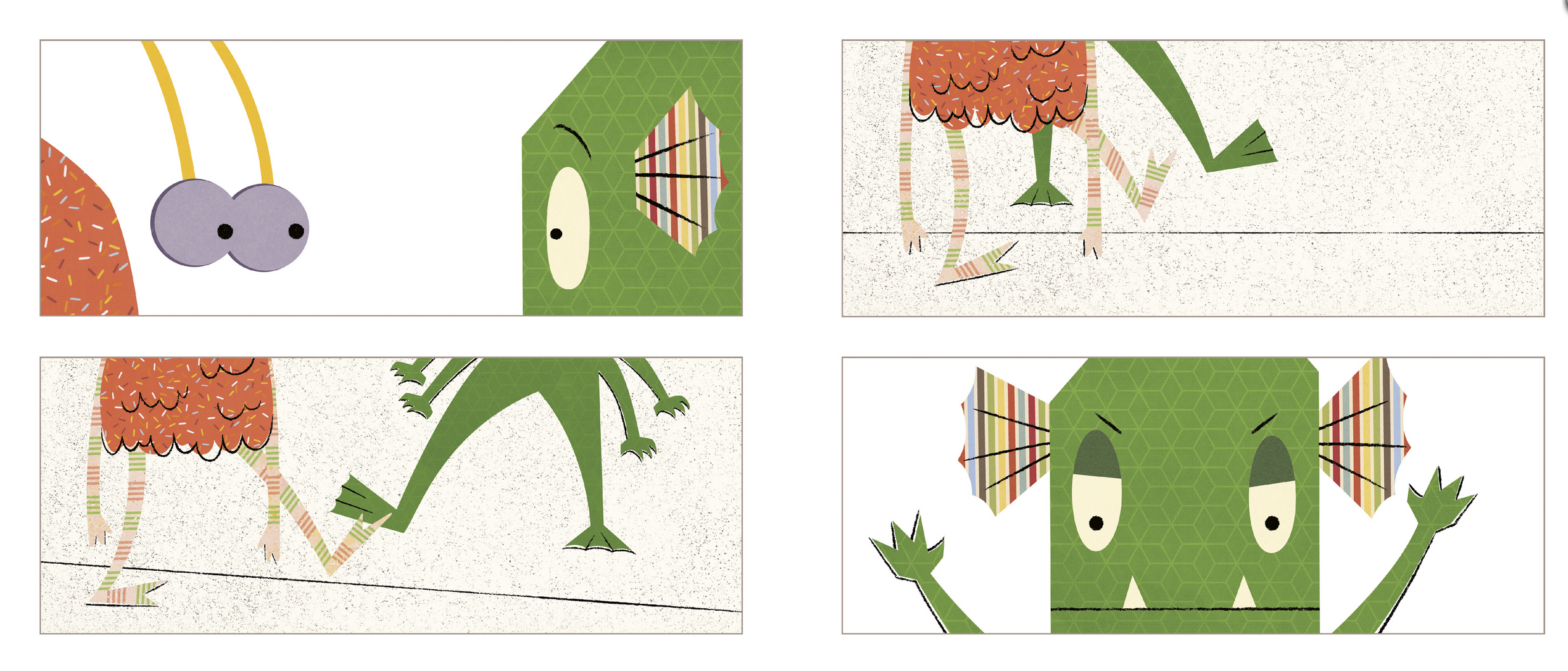
This does not please the purple-eyes-on-antennae creature who promptly lifts its foot across the line and stomps on the green webbed foot of the other. Though it is deliberate, the purple-eyed monster does not realize the impact it would have, causing the green one to stumble and fall across the line and into its assailant, blurring the line in the sand.
From The Line in the Sand by Thao Lam
Then a bee flies into the mix.  Both monsters are thrown into a tizzy trying to evade the insect and in the process kick up the sand, obliterating the line. Looking up to see the roughened sand, the two creatures realize that beyond their interaction are numerous more lines, all drawn by the same stick-dragging monster. But, no one is reacting to those lines at all. They walk across them, they ignore them, or they are oblivious. The lines are present but of no concern.  Soon enough, our two rivals recognize the emptiness of their conflict, especially as they'd already joined forces to try to defeat a bee.

Conflict is often borne of words so it's meaningful that Thao Lam wrote a picture book about conflict as a wordless story. That just tells you how much words can get in the way. (They can also work wonders when used well.) In The Line in the Sand, no words are needed to convey distress, discord, territoriality, shock or even rage. These creatures, though their morphologies suggest otherwise, are as human as Thao Lam's readers.  (Don't we all differ to some degree in our shapes, colour, limbs and more?) Like all of us, they can be protective and defensive if they perceive a slight, intentional or not. And intention is key here because the creature with the stick intended nothing except play. Sadly, that line in the sand was the basis for some inadvertent conflict. Only when the two come together in a common goal–ridding themselves of a bee–do they see their squabble as insignificant.
From The Line in the Sand by Thao Lam
From her very quirky characters, that vary in colour from green to orange, yellow, pink and blue, with or without stripes or dots or other patterns, and with various limbs, eyes and more, Thao Lam includes everyone and spotlights no one. In their peculiarities, they are us. And we are them, drawing lines accidentally, taking offence indiscriminately, and coming together only when we see our similarities, not our differences. 

The Line in the Sand reminds us that conflict can be borne of misunderstanding or disregard but with communication, even without words, and awareness, resolution is possible.

August 16, 2022

Blanket

Written and illustrated by Ruth Ohi
Groundwood Books
978-1-77306-614-1
32 pp.
Ages 3-6
August 2022 
 
Readers and writers know the power of words. Words can evoke and reassure, anger and subdue, and enlighten and confuse. They can do it all, or it would seem. But sometimes words aren't needed for an impact to be made. Author and illustrator Ruth Ohi makes this subtle and powerful point with her first wordless picture book, Blanket.
From Blanket by Ruth Ohi
Sometimes it doesn't matter if it's sunny outside and the birds are chirping and the flowers are blooming. Inside, really deep inside, is where it can still be grey and that sunshine cannot reach. Yet.
From Blanket by Ruth Ohi
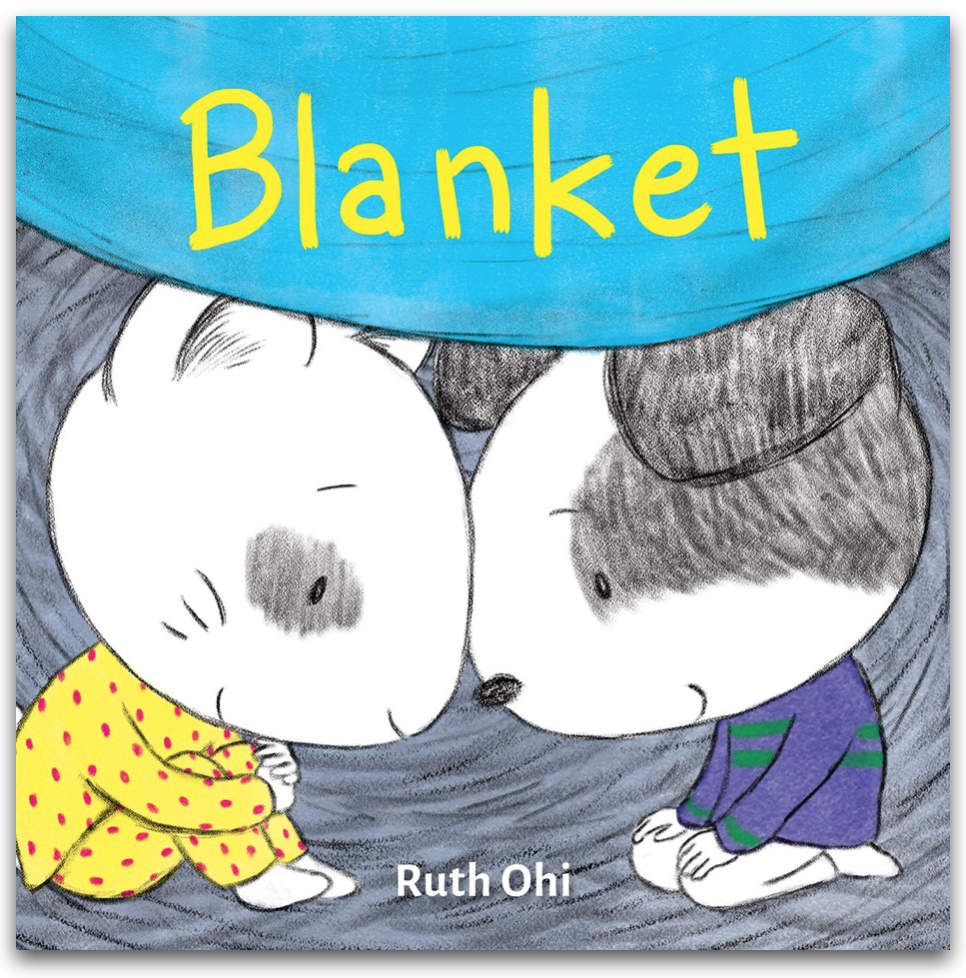
When Cat awakens to the grey inside, they take their turquoise blanket and burrow under it. When Dog shows up, they see the lump that is Cat beneath the blanket, but Dog does not demand anything of Cat. Dog sits down nearby and quietly reads. With time and still beneath the blanket, Cat snuggles over to Dog. Eventually, Cat lifts the blanket and allows Dog to enter and share their protected space.

It's obvious that, while the darkness beneath the blanket offers Cat security, it is also a place where fears can grow and take over. But Dog has a flashlight and the two play with the light before Dog suggests using the blanket to create a shelter over two chairs. It gives Cat the security they need but offers more light and something else. It's a first step to feeling safe enough to venture outside and transform the blanket from shield to shared comforter.
From Blanket by Ruth Ohi

While Ruth Ohi's charming animals are easily recognizable for their sweetness and emotional depth, Blanket is so different from her earlier picture books because of its wordless nature. I've always been delighted with Ruth Ohi's books (e.g., No Help Wanted; Fox and Squirrel, The Best Christmas Ever; Kenta and the Big Wave); still, Blanket is so impressive in its story and messaging that it will sit with me for a very long time. (Though I love sharing books with others, I'll be holding on to Blanket for myself.) Blanket reminds us that, if someone is dealing with sadness or depression, it is not up to others to decide how to help them. When an individual is dealing with an internal greyness, everyone wants to help but seldom–only in dire circumstances–should another decide what is needed. Dog knows this. With time and patience, a flashlight and some playfulness, Dog is able to offer Cat opportunities to come out from the shadows of the blanket. It's still up to Cat when they are ready to move from beneath the blanket into the light. And with few colours and strategic lines of smiles and eyes that are dim and then bright, Ruth Ohi tells us all this in her moving illustrations. Even in the darkness of Cat's sadness, Ruth Ohi has given us light through her art.

A blanket can be so much more than a coverlet for a bed. It can be shelter and armour, defense and offense, and love and fear. It can hide and reveal. This is Cat's blanket. It offers them the opportunity to hide from the world but also reveals Cat as they are to Dog. There is power in that blanket for good and I'm so glad that Cat used it as they needed and that Dog was there to take their cues from Cat.

June 15, 2022

A Day for Sandcastles


Written by JonArno Lawson
Illustrated by Qin Leng
Candlewick Press
978-1-5362-0842-9
48 pp.
Ages 4-8
May 2022
 
JonArno Lawson has the words, as his picture books like The Playgrounds of Babel and  Leap! have demonstrated, but he doesn't need the words. As his award-winning Sidewalk Flowers and now A Day for Sandcastles show us, his storytelling can go beyond text and, with the skill of an amazing artist like Qin Leng, a story rich in characters, activity and feeling is told.

From A Day for Sandcastles by JonArno Lawson, illus. by Qin Leng

It's a day at the beach for this family of five. As they disembark from a bus, mum and dad coming up the rear, the three children race to through the grassy dunes, arms raised in cheer. There's a red-haired girl in a red-striped bathing suit, and older brother in navy patterned board shorts and a small child in green T-shirt and yellow shorts. Having found the remnants of a washed out sandcastle, they retrieve their pails and shovel and begin to work on their own.
 
But, as focused as they are on their creative endeavour, beach life teems around them. There are the swimmers and the sunbathers, the runners and the volleyball players. There are older women and toddlers, lovers walking hand-in-hand, and friends taking selfies. And there's also the splash of water and a wind-blown sun hat that damage their multi-castle structure with moat, compelling them to take a break and join their parents for lunch.
From A Day for Sandcastles by JonArno Lawson, illus. by Qin Leng
The children, though, are determined and look to rebuild their sandcastle. Together they fill buckets, mould turrets and dig out shapes. Even a toddler who sits herself down in the midst of their creation does not deter them from their work and adding flourishes of shells, twigs and other found objects.
From A Day for Sandcastles by JonArno Lawson, illus. by Qin Leng

But time and a tide wait for no one, and the children's numerous efforts must ultimately be left behind as they take their weary and sun-kissed bodies back to the bus for the trek back home.

For those who know the pleasure of a day at the beach, whether outside their own door or a bus ride away, A Day for Sandcastles is a day of possibilities. It's a day filled with play and family togetherness, cooperative fun and creative building. It's enjoying the positives and accepting the setbacks as natural and moving forward–or backward from the tide!–to dream of what sandcastles might be. JonArno Lawson gives us a full day at the beach with the companionship of siblings and the quiet but never-failing support of parents. He gives us the promise of a wide-open day as they step from the bus and the satisfying fatigue of a day well lived. We're there for the lapping cool water, the mild frustration of an errant sunhat, and the warmth of the sun on our backs. It's a day bursting with life and JonArno Lawson has given it to us without words.

Of course, without Qin Leng's watercolour and ink artwork, we couldn't envision this beach or these children on this day. Her media are perfection for a day at beach, giving us the fluidity of splashing water, the summer bustle of a diverse group of people and animals on a beach, and the heat of a sun warming sand and people. Qin Leng's skilled artistry transports us to this beach with this family and these strangers to share in a day of outdoor recreation.

There is far too much in A Day for Sandcastles to share in a single review. It will be up to you to visit that beach with your own children, students or family, and discover the minutiae of one day with these people at this one beach to build your own sandcastles, with sand or otherwise.

June 04, 2021

Sonata for Fish and Boy

Written and illustrated by Milan Pavlović
Groundwood Books
978-1-77306-161-0
32 pp.
Ages 4-7
May 2021

I love a good wordless picture book and Sonata for Fish and Boy is a good one. In the hands of illustrator Milan Pavlović, Sonata for Fish and Boy rejoices in the ability of music to endow our spirits and transport us to other worlds.
 
A fish in the water catches a musical note coming from a child playing a violin on a bench beside the water. In their watery and terrestrial worlds of rose taupe hues with minimal splashes of pale teal, the two are together but separate.

From Sonata for Fish and Boy by Milan Pavlović
When the child puts down his violin and lays down on the bench to sleep, the fish catapults itself out of the water and hovering around the child, draws him into the air to journey from the darkness to the colours of new worlds. In a city of buildings and a tall red poppy, the boy and fish witness the liveliness of a community playing, dancing, singing and listening to music. Bold reds and pinks, orange and blues, green and purples create a glowing landscape of song and energy.
From Sonata for Fish and Boy by Milan Pavlović
Then they continue to travel through flocks of singing and mesmerized birds to the planets, bouncing from one to another as the music accompanies them. Next they enjoy a crossing through a park with people flying balloons, children eating ice cream, and a musician playing a concertina. Finally a trip through a field of giant dandelions leads the boy and fish to a cottage where an orchestra of animals plays with relish, before leading them into a storm that tosses both in its darkness.
From Sonata for Fish and Boy by Milan Pavlović
In the end, an old man discovers his violin at the bench from the story's beginning and, playing it once again, is reunited with his piscine friend.

Artist Milan Pavlović needs no words to tell this story of the transformative nature of music, how it enriches our lives and moves us through and to places hitherto unknown. I know that Milan Pavlović has embedded clues to several important pieces of music such as Gustav Holst's "The Planets", Camille Saint-Saëns's "The Carnival of the Animals", and Bohuslav Martinů's "The Romance of the Dandelions", but I challenge young readers, especially music students, and the adults in their lives to discover the Easter eggs that may hint at other important classical works. (The park scene with the balloons stumped me completely.) 
From Sonata for Fish and Boy by Milan Pavlović
With sound conveyed in the colours and shapes, Milan Pavlović allows the movements of this sonata to carry readers through quiet reveries and joyous exuberance, imaginative frolics, and tempestuous storms (perhaps Tchaikovsky's "The Tempest"). This sonata may have started for a child soloist but it becomes one for a duo of friends, taking them through time and place, and bringing new joys into their lives, just as music has always done.

September 25, 2020

The Paper Boat: A Refugee Story

Written and illustrated by Thao Lam
Owlkids Books
978-1-77147-363-7
40 pp.
Ages 6-10
September 2020
 
Told exclusively in the glorious collage art of Thao Lam, The Paper Boat follows the flight of a little girl and her mother away from Vietnam, a journey paralleled by an army of ants who strive for their own survival.

From The Paper Boat by Thao Lam

As the front endpapers illustrate, The Paper Boat begins amidst a history of the war in Vietnam. The conflict between South Vietnam and the North Vietnamese escalates until April 30, 1975 when Saigon falls and the South Vietnamese surrender. While a family tries to curtail an invasion of ants with sugar water, and a little girl uses her chopsticks to rescue them and send them on their way, the Vietcong tanks roll past their window. Soon the family is packing up and saying their goodbyes, with mother tearing her daughter away from her father and grandparents who have their own journeys.
From The Paper Boat by Thao Lam

As mother and daughter escape through long grass, hiding from soldiers, they follow a parade of ants in the moonlight to the water's edge. But while they wait for Vietcong patrols to leave, the mother distracts the child by fashioning a paper boat from the wrapping around their food. When their escape boat arrives, the paper boat is left behind but discovered by ants who will begin their own escape by boat.

From The Paper Boat by Thao Lam


The ants endure a multitude of hardships–undoubtedly mirroring what the child and her family bear on their own boat–from limited food and water, to calamitous weather and the capsizing of the boat before making landfall. Even as they help each other, some are lost, before they come together at a new table in a new place.

From the clues in Thao Lam's story, as well as her "Author's Note," it becomes evident that The Paper Boat is based on the author-illustrator's own family history of escape from Vietnam. This tale of migration is laced with trauma and danger and, by telling it through the parallel story about the ants, Thao Lam tells us so much without the reader witnessing the horrors of their fleeing. They, like the ants, come to make a new home, with the child together with both parents and even a new little one–though a photograph with incense on a side table suggests a grandmother who did not survive–in a city teeming with families undoubtedly with some of their own stories of migration.

By creating her story without text, Thao Lam invites the reader to delve into the story and make connections between the two families, one ant and one human, finding the similarities and differences in their plights and the relationships between and within. By using her collage art with images on cut paper layered to create depth and texture, Thao Lam brings us to a table, onto a boat, and into a city. Moreover, by using a limited palette, mostly sombre colours like dark blues and black with splashes of pink and golden for hopeful elements like the sun, the boats and food, Thao Lam makes us see where hope lies. Reassuringly, their new home is filled with the colour of promise.

From The Paper Boat by Thao Lam