Showing posts with label pandemic. Show all posts

April 25, 2025

Jackie's Drawing

Written by Andrew Katz
Illustrated by Tony Luzano
CrackBoom! Books (An imprint of Chouette Publishing)
978-2-898025679
32 pp.
Ages 3-6
May 2025 

There have been more than several novels, picture books, and short story collections that have been based during in the early months of the COVID-19 pandemic with its lockdowns (stay-at-home orders) and other measures. Though never mentioning the pandemic, Jackie's Drawing sees a child's perspective on the resulting isolation and a rebound to normal in terms of nature's response and her own inspiration for creativity.
From Jackie's Drawing, written by Andrew Katz, illustrated by Tony Luzano
Jackie's story begins with a rusty haze befalling her community. This haze forces everyone to stay indoors and to isolate from everyone and everything, including the mountain she'd often visit for inspiration for her art. At first, Jackie is still able to draw, gathering ideas from memory and her own experience. But, with time, it becomes more difficult as she had "lost the heart to do anything."
From Jackie's Drawing, written by Andrew Katz, illustrated by Tony Luzano
But one day a flash of silver in the canal beneath her window gets her attention. An unexpected dolphin has appeared, and with it a menagerie of other animals, from a bald eagle to moose and deer and foxes who have begun to make their way onto the streets, into the air, and into the water where only people had ventured. Jackie is enthralled and takes up her drawing pencils, determined to draw them all.
From Jackie's Drawing, written by Andrew Katz, illustrated by Tony Luzano
But as she draws them all, a wonderful dragon with antlers, a tail fin and feathers appears and transports her to the mountain where her drawing inspiration always lived.
From Jackie's Drawing, written by Andrew Katz, illustrated by Tony Luzano
While Jackie's Drawing speaks to a child's loss of enthusiasm for her drawing with her separation from nature, Andrew Katz's note at the conclusion of the story reminds us that the natural world too responded to the pandemic or could have. So, as Jackie had lost her creative muse the longer the "haze" drenched her community, the animals who normally would have been relegated to outside that community were able to find their way onto the quiet waterways, skies and land within. And for Jackie to find that nature was coming to her to awaken her imagination was a lovely positive during a dark time. Of course, it is still Jackie's imagination that helps her create a chimera–Andrew Katz discusses this in his appended note too–of the animals she sees, allowing her to travel in a flight of fancy to her beloved mountain to re-experience the joy of drawing outdoors.
 
Andrew Katz and Tony Luzano have previously collaborated on a picture book, I Want to Be Super!, so there seems to be a harmony of styles that works. Jackie's Drawing is again about an imaginative kid and Tony Luzano's digital art reflects every nuance of a child who is enthusiastic but then loses that enthusiasm when troubled with isolation and then finds a way to regain that passion for her art. His use of bold colours and distinct animals places the emphasis on the wonders outside and in Jackie's artwork, not on the grim haze that permeates their world for such a long time. He finds the light for her and for the reader to get beyond that haze of bleakness. 

The first year of the pandemic was especially difficult for many people but for children whose creativity was stifled, it might have been more challenging. Finding new things to do helped many but only coming after feeling the loss of their routines and familiar activities. Finding their new normal involved grief, courage, and imagination. Thankfully for Jackie, she found her ability to express herself from the very same source of encouragement she'd always relied upon, just in a different configuration.

January 22, 2024

People Are My Favorite Places

 
Written and illustrated by Ani Castillo
Little, Brown Books for Young Readers
978-0-316424660
40 pp.
Ages 4-9
January 2024 

While we are still living with a pandemic, we are no longer subjected to lockdowns and the isolation that came with them. For many, the inability to go places had more to do with not seeing people: family, friends, and newly-met acquaintances. As she did in her earlier picture books Ping and Spark, Ani Castillo shares an important message about appreciating those who are part of our lives, whether we know them or not. 

From People Are My Favorite Places, written and illustrated by Ani Castillo
Although a young girl recognizes all the things which she can no longer do or see when "I was stuck in my room, all alone, forever and ever," she realizes that it's the people involved in those activities that she really misses. Visiting places like her grandparents' house or the movie theatre or travelling is not about the place but the people with whom she spends time.
From People Are My Favorite Places, written and illustrated by Ani Castillo
She recognizes that there are a lot of people she knows and missed, from her piano teacher to her friends and the locals she meets when travelling. It's all the "sweet, lovely people who were once there with me" with whom she laughed, ate noodles, chatted, held hands, and more. And she recognizes the people she missed came in all shapes, colours, ages, and textures, but she missed them all for their touch, their smell, their warmth and so much more.
From People Are My Favorite Places, written and illustrated by Ani Castillo
But most of all, she realizes that she had learned an important lesson during that time:
Because now
I see clearly
that the landscape, the place
most precious to me
is the world inside someone
I love
very dearly.
From People Are My Favorite Places, written and illustrated by Ani Castillo
The innocence of the child in expressing how she feels will be very familiar to children who missed out on a lot of things during lockdowns, from schooling, and family visits, to travel and socializing. They will all remember how isolated they felt and how much they craved being somewhere other than their rooms or their homes. But this child has the insight to realize it wasn't just being someplace, it was being with someone that made it all that it was: rich in experience, embracing in affection, uniting in companionship. That insightful innocence comes through in Ani Castillo's artwork. Using black coloured pencil, watercolour, and gouache, Ani Castillo makes us see every one of those people who are the landscape of this child's life.  There are her peers, her teachers, her family, and those people that she might meet when travelling. Known or unknown, these people are what make those places vibrant and significant.

Though I worry that too many people have forgotten what it was like to be without the people in their lives, I hope that People Are My Favorite Places will remind them so that we don't have to go through further isolation such as lockdowns to appreciate the magnitude of their contributions to the fabric of our lives. They take our landscapes from barren to lush and vibrant, and even if we don't want to partake in that vibrancy every moment, knowing that we can reach out to it any time is important.

December 08, 2023

Once, a Bird

Written by Rina Singh
Illustrated by Nathalie Dion
Orca Book Publishers
978-1-4598-3143-8
32 pp.
Ages 3-6
September 2023 
 
I know many people are trying to forget a time of lockdowns and restricted movements during the early years of the pandemic. But Rina Singh and Nathalie Dion's story reminds us of the gifts of nature and community that were revealed during those tenuous times. And though their story takes us out of those times, it never lets us forget what discoveries were made when tensions were high, isolation was the norm, and health was insecure.
From Once, a Bird, written by Rina Singh, illustrated by Nathalie Dion
Without words, Rina Singh tells a story of the arrival of a robin to a land of complexity and quiet. There may be snow on the ground but as the bird travels over parks, highways, and agricultural fields, there is no one to be seen. It is people-less and still. It could be a dystopian landscape, but Nathalie Dion gives us hope and light in the greenness of the fields, the blues of the skies and the unscathed infrastructure.
From Once, a Bird, written by Rina Singh, illustrated by Nathalie Dion
The bird finds its way to a budding tree outside a walk-up apartment building where an elderly woman spots it. She alone is looking out her windows as her neighbours keep their blinds and curtains closed. But then others take in the sight of the robin, each in their own way. Whether it be a grandson and grandfather watching it with binoculars, or a young person taking photos with her phone, or two children chatting between windows. Even a new puppy dog is held up to witness the bird.
 
As life goes on for the bird, building its nest, laying its eggs, and feeding its young, the neighbourhood begins to open up: a door, a window, a walk with the dog. And, with time, the neighbourhood returns to normal as the bird and its young fly off, having taken the people through the tough times.
From Once, a Bird, written by Rina Singh, illustrated by Nathalie Dion
Although the audience for Once, a Bird is listed as 3-5 years of age, the depth of the storytelling is far greater, and could be for all ages. Rina Singh has given a nuanced story of isolation and connection with nature that may have been born of a pandemic, and all who have been living with solitude and/or withdrawal, whether because of distance, mental health, or even personality, will also understand. She offers hope that separation does not mean desolation, and that opening oneself to the natural world can help sustain us.

I've reviewed a number of picture books illustrated by Montreal's Nathalie Dion (e.g., The Big Bad Wolf in My House, I Found Hope in a Cherry Tree, The Dog's Gardener) and her watercolour and gouache art lends itself well to contemplative stories such as Once, a Bird. There is an intangible, almost divine, sense of beauty that comes from both introspection and deep relationships depicted in her illustrations. Her art is sensitive to the ephemeral nature of challenges, keeping her colours subdued but calm, and introducing brighter colours, initially only on the robin, as the people emerge, and the neighbourhood returns to life.
 
For hope through difficult times, take note of how once a bird brought a community together, and how Rina Singh and Nathalie Dion were able to do the same to tell its and our story.
 
• • • • • • • 

A French-language edition is also available as Il était une fois un oiseau.


August 04, 2022

Jasper's Road

Written by Susan White
Acorn Press
978-1-773660981
164 pp.
Ages 8-12
May 2022

There are families by birth and those by invention. And sometimes, because of the families of birth, better families are created from disparate parts. The story of Jasper's Road is about such families.
 
When Jasper's Road begins, a large extended family is gathering to celebrate Amelia's day. Amelia Walton, who passed five years earlier, started taking in kids after she was struck with a neurological disease which motivated her to become a recluse. Opening her home to more than 100 kids over the years, for short- or long-terms, Amelia Walton left her mark with her heart, her wisdom, and her compassion. Now each year, many of those she fostered along with their own families gathered to share food, memories and trivia as Amelia would have liked.

Thirteen-year-old Jasper, who'd come to Amelia as a baby and now was part of Jodie and Zac Williams's family, had always felt welcomed but, because of a recent fostering of fourteen-year-old Jake Turner by his Aunt Rachel and Uncle Ryan, Jasper is feeling more vulnerable, especially about a facial abnormality that Jake ridicules as "Zipper Lip." But as Jasper tries to figure out how to deal with Jake, Jake himself is struggling with finding himself as a part of yet another foster family and without his little brother Tommy. Then near tragedy strikes and Jake forces Jasper and Jasper's 12-year-old brother Anderson to lie. Add to that the COVID-19 pandemic and the April 2020 mass killing in Nova Scotia and it would seem that everyone has some baggage that they're carrying around that confuses and confounds their relationships with partners and with their families, foster and birth.

New Brunswick writer Susan White, who has written YA and middle grade books including The Year Mrs. Montague Cried, winner of the Ann Connor Brimer Award, brings us into a complicated world of foster children, past and present, as they struggle and learn to make lives for themselves in the context of ever-changing relationships. Whether from abandonment or abuse, neglect or health concerns–including death of a parent–children enter foster care for a variety of reasons and just as varied is the care that they may receive. Some will find forever homes through adoption while others will bounce from one residence to another. In Jasper's Road, those fortunate enough to be taken in by Amelia Walton and subsequently by her "heirs" became part of something significant. And while it took me awhile to figure out all the characters and their relationships, including which were biological or otherwise, I realized it really didn't matter. Susan White gave us a rich community much like the one Amelia endeavoured to create, both complex and natural, saving herself and others in the process, and building something bigger than just a joining of individuals.

While this journey down Jasper's Road is complete, for now, I suspect that there are more travels ahead for Jasper, Jake, Tommy and their families, perhaps in New Brunswick or not, and I really hope that Susan White takes us down a few more of those roads by gifting us with their stories too.

March 30, 2022

Josie's Busy Calendar

Written by Jenn Wint
Illustrated by Allison Arndt
East 26th Publishing
978-1-955077323
42 pp.
Ages 3-7
October 2021
 
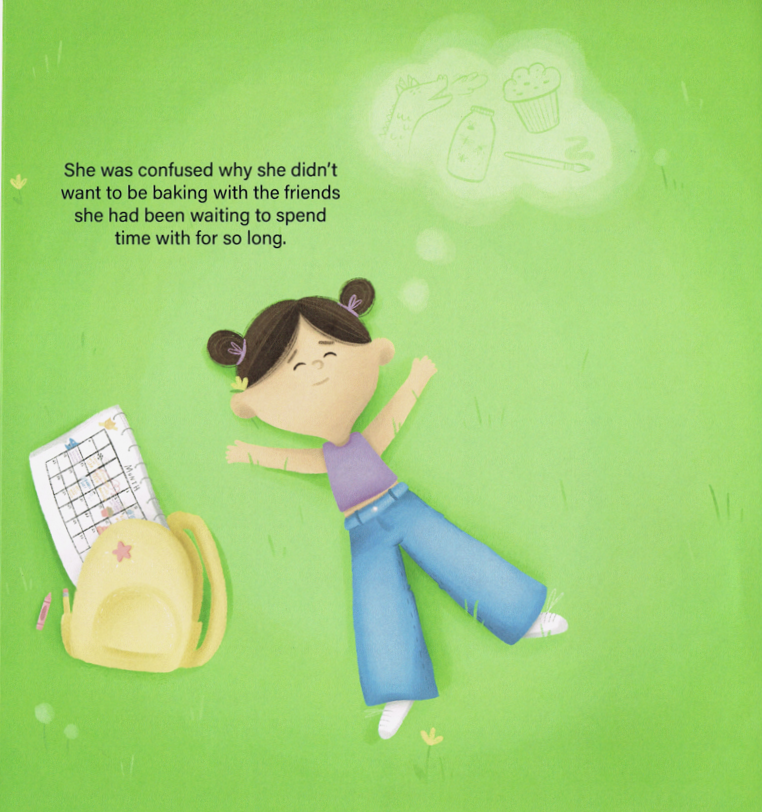
Like many children in Canada, Josie has had to endure the challenge of staying at home and away from school and friends and activities that have always added to her life. She has found many things to do, from creating art to running laps, watching TV to baking, but she misses her old life.
But, after weeks of playing on her own, Josie was officially lonely.
From Josie's Busy Calendar by Jenn Wint, illus. by Allison Arndt
But, then things open up again and Josie is able to return to school. The little girl is thrilled. Once she reconnects with her friends, she is filling her calendar with play dates for soccer and baking, riding bikes and swimming. But, like anything, too much of a good thing can be just as onerous, and Josie finds that "her tummy was in knots" though she doesn't understand why.
From Josie's Busy Calendar by Jenn Wint, illus. by Allison Arndt
Realizing that she misses her alone time, Josie schedules herself into that calendar and finds that a balance of commitments to others and herself is what makes her feel calm enough to do it all.
From Josie's Busy Calendar by Jenn Wint, illus. by Allison Arndt
Vancouver's Jenn Wint knows that, like adults such as herself, children experience anxiety but probably don't understand it, and coming out of this pandemic–fingers crossed–there will be many children who have and will experience anxiety to some degree. After years of restricted social activities–a source of anxiety for some–many children will go overboard and want to do everything: sports, music, play, etc. But, if Josie’s Busy Calendar teaches us anything it’s that there is always a limit. Too little opportunity for interaction and activity is just as bad as too much. Down time is also important. In fact, for many, it’s the only means by which they can recharge to do those activities in the first place. 
From Josie's Busy Calendar by Jenn Wint, illus. by Allison Arndt
With Allison Arndt's whimsical illustrations, Josie comes across as a typical child whose life is filled with people and activities but who has learned to appreciate quiet time, whether it's for reflection, for the clean fun of bubble baths or creating art. So, for your children and your students, consider that busy calendar as a potential source of both fatigue and fun and schedule in some time for quiet, whether to look inward with self-reflection or to daydream about what could be.

December 03, 2021

I'm Good and Other Lies

Written by Bev Katz Rosenbaum
DCB
978-1-77086-632-4
211 pp.
Ages 13+
September 2021 
 
It doesn't take long for me to start feeling a constant pit of dread in my stomach. The future... (pg. 108) 
 
Seventeen-year-old Kelsey Kendler has every right to be anxious about her life. If the recent past is any indication, things are not heading in the right direction. And the COVID-19 pandemic hasn't even hit yet. There will be lots more to set her off kilter and how she manages is only partly up to her. Parents, friends, school, work and social media will all have a hand in taking her down or bringing her up.

Kelsey and her parents Hannah and Mark have just moved from fashionable and wealthy Rosedale to transitional Parkdale because of Kelsey's celebrity comedian mom's fall from grace. Perennially stoned, drunk or abusing her pain meds, Hannah Kendler, a former participant on "Those Crazy Comics" TV show, is now unemployable and a raging, confused mess. Sadly, Kelsey's dad is less than helpful, either arguing with his wife or avoiding the household altogether. Not surprisingly, Kelsey vows to make some meaningful connections outside of their rat-infested house. There's Molly, a classmate whose perfect family doesn't prepare her for meeting the out-of-control Hannah, and crush Luca, which whom Kelsey begins a textlashionship. But, best of all, Kelsey gets a part-time job at an ice-cream place called Soft Spot. There she meets Chelsea, Veer, Quinn, Ruby, and Lee in addition to Kira, the owner's stoned niece and ineffective manager. Except for the rats in the house, her sleep paralysis that turns her nights into terrors, her warring and oblivious parents, and missing her only friend from before, Makayla, now in LA, things are stable. Then the pandemic hits.

They'd all been hearing about the virus. Makayla's mom, an actress, gets sick, as do others on her film set, and Kelsey worries that her mom's coughing could be it too. But when school is cancelled after spring break and then returns in some mishmash of independent learning and then virtual lessons, and Soft Spot is closed, and she's stuck at home with her worthless parents, Kelsey is left untethered. She may be saying she's fine but dealing with a tenuous support system and mental health during the trauma of a pandemic with lockdowns is just a lie.

We all know how difficult living through this pandemic has been but it's more than just difficult for some. For a teen, when life is in flux as they transition from dependence to independence, it's even more challenging. And for someone like Kelsey, whose home life is painful, she has no respite from the stress. Couple that with sleep paralysis that pervades her nights, this girl has trauma upon trauma with which to deal. I'm surprised she's as sane as she is. Maybe that's the hope that Bev Katz Rosenbaum has written into her story, reassuring her readers that as crappy as things are, there are glimmers of normalcy and even brightness that can help pull you through and out. Whether it's a socially-distanced get-together, texting with a new friend, connecting with a psychologist or being honest about what you're going through, there is hope even while "learning to accept uncertainty" (pg. 182). I'm Good and Other Lies is a powerfully authentic account of a teen living with a multitude of challenges, both before and during the COVID-19 pandemic. Sometimes Kelsey accepts the challenge and puts it down and sometimes she buckles, but it is always real and enlightening. With I'm Good and Other Lies, Bev Katz Rosenbaum has told us a story of not being fine but finding a way to make it so.

• • • • • • •

If you would like to hear author Bev Katz Rosenbaum talk about I'm Good and Other Lies, register for Future Shock (and Future Hope), a webinar with authors Wesley King and Eric Walters.

Date:  Wednesday, December 8, 2021
Time:  11 AM-12 PM, 1-2 PM
Registration costs:  School ($150), Class ($65), Home ($10)

June 03, 2020

Don't Stand So Close to Me: Q & A with author Eric Walters

Don't Stand So Close to Me
Written by Eric Walters
Orca Book Publishers
978-1-4598-2788-2 (pdf)
978-1-4598-2789-9 (epub)
116 pp.
Ages 9-14
June 2020

Yesterday author Eric Walter and publisher Orca Book Publishers launched an extraordinary middle grade novel and I was pleased to review Don't Stand So Close to Me here on CanLit for LittleCanadians.  Today I'm pleased to share with you some background into this unprecedented publication and launch via this Q & A with author Eric Walters.  Enjoy!

Eric Walters


HK:  If there was one thing that compelled you to write a story based on the ongoing COVID-19 pandemic, what was it?

EW:  Almost immediately I started receiving emails and twitter comments from students, teachers and teacher/librarians asking me if I was going to write a story about the pandemic.  At first, I simply told them it wasn’t something I was contemplating.  As those contacts reached over a hundred, I began to realize that there was both a desire and a need.  Young people needed to see something that reflected their present lives, to understand their situations, and teachers needed something to get their students engaged.


HK:  Though literature can be solely for entertainment and not harbour hidden messages to illuminate or educate, Don’t Stand So Close to Me cannot help but facilitate young readers’ understanding of the circumstances. If there was one message for them to take away from reading the book, what would you like it to be?

EW:  There were some very important pieces of information I wanted incorporated into the narrative including ‘flattening the curve’ and ‘exponential growth’.  I wanted these to be explained in a way that they could understand.  The overall message, however, is about changes, adapting, understanding what’s lost, acknowledging the anxiety of uncertainty, and perhaps more important, remembering what is still with us – family, friendship, human connection and hope.


HK:  Don’t Stand So Close to Me is more than “just” a book. It is an undertaking to involve young people in tackling the pandemic at their own level. It doesn’t require action but it certainly empowers them to look beyond the inconvenience and see the big picture of how they might help reduce the impact of this dangerous virus. If you could choose 3 actions that you would encourage them to take, what would they be?

EW:  It all stems from a basic understanding that, while we’re certainly not in the same boat, we are in the same ocean.  We have a deep connection, and need for that connection, with those around us.  Be kind.  Have faith.  Have hope.
a)    What can you do to show kindness to those in your family?
b)    How can you connect with others in your community to make their lives better?
c)    Change always starts with one person.  Be the person that helps to change your part of the world.


HK:  I applaud your characters who seem to follow the saying that when the going gets tough, the tough get going. But, we know that there are many for whom this pandemic is a struggle. As a former social worker and teacher, do you have any guidance for young people who might be struggling emotionally?

EW:  This pandemic has helped to expose the fault lines in our society.  We are not all blessed with the same support systems – either internally or externally.  Share a gentle word, encourage, make a phone call, a donation. Be kind to each other – and be kind to yourself.  Being kind to yourself may be the hardest.  Don’t judge – support.
    If you’re having problems, reach out to your parents, teachers and friends. It’s a sign of strength to know when you need help.  Be strong enough to reach out.


HK:  The book’s dedication is to your grandchildren whose names are coincidentally that of the three main young characters. But your grandchildren are far younger than Quinn, Isaac and Reese in Don’t Stand So Close to Me. Do the characters share any characters with your grandchildren or are they modelled after other young people you know or have known?

EW:  I love being a grandfather.  My grandchildren are all 2 or under.  Someday they’ll look at this story, see their names, and this will be part of my gift to them, to help bind them together.  You always invest bits of yourself or people you know in your stories.  I REALLY like these characters.  They are caring, capable, funny and thoughtful.  


HK:  Getting a book written and to press is usually a lengthy process. How were you able to complete this process so quickly, especially under the circumstances of everyone working remotely?

EW:  From the very beginning this was an act of trust and partnership.  With just a rough outline my publisher trusted me to craft and complete a novel on a tight schedule. While I was writing they were simultaneously editing, marketing, working on digital strategies, designing a cover and doing all the things necessary to publish a book.  We not only published in record time but created a marketing and promotion path that was more comprehensive than any plan previously attempted with any of my books – or any of their previous books!


HK:  Fingers crossed that this pandemic will be over, some time. Would you consider a sequel to reveal how Quinn, Isaac and Reese and their peers and families managed and look back at how this event has shaped them? Or would you perhaps write another book that addresses life in the aftermath of the pandemic? Or are you just as happy to let Don’t Stand So Close to Me be the end of this story?

EW:  Until you asked this question, I hadn’t thought about it at all!  Maybe I better call Orca before I answer. 
          This story ends with hope.  It’s the best possible place for any of us right now.  I’ve always believed in the power of hope.  At the same time, I strongly believe that you prepare for the worst and pray for the best. 
           I enjoyed those characters so much I would like to revisit them in another story.  I think what the story might be well be dictated by what’s going to transpire in the world.  I choose to believe it will be better. 
          You have to have hope.

•••••••••••••••

Many thanks to author Eric Walters for inviting me to be part of the process of getting Don't Stand So Close to Me to young readers during this challenging time.  

Thank you also to Leslie Bootle at Orca Book Publishers for allowing me to share in this amazing journey to launch.

June 02, 2020

Don't Stand So Close to Me

Written by Eric Walters
Orca Book Publishers
978-1-4598-2788-2 (pdf)
978-1-4598-2789-9 (epub)
116 pp.
Ages 9-16
June 2, 2020

978-1-4598-2787-5 (pb) 
Available September 22, 2020


In a novel for right now, Eric Walters has found a way to reassure, inform, educate and entertain about life during the COVID-19 pandemic, and all within the safety of a new digital book for middle grade readers.

Thirteen-year-old Quinn along with her neighbour and best friend Isaac and their classmates in Grade 8 are anticipating their spring break and planning their spring dance when the COVID-19 pandemic hits North America. The young teens show a variety of responses to the news that spring break will start a little early and last for three weeks: ambivalence, concern, joy and anxiety. Not unlike most young people, their responses are varied and often contingent about what they hear from family and on the news. Because Quinn’s dad is a doctor and Isaac’s mom is a police chief, these two friends get a very different perspective on staying out of school. 

As the kids begin to accept their new reality which includes online schooling and social distancing, all the COVID-19 related issues are touched upon in a meaningful and authentic way in Eric Walters's story. We read about Dad’s need for PPE and consequent skin reactions, his long working hours and the need to isolate from Mom and Quinn. The very social Isaac must deal with the loneliness of staying at home by himself and find safe ways to connect with others. Their friend Reese is unable to visit with her grandmother in a long-term care facility but the kids find a way to reach out after learning how to make masks. The young people learn of the positives of social distancing and strategies for keeping spirits up and bodies healthy. They are exposed to misinformation and those who disregard protocols and protesters who want to reopen businesses.

When the rest of the school year is cancelled except online, the kids decide to stage a spring dance on their street that abides by the rules of social distancing (chalk drawn boxes on road, with kids bringing their own phones, ear buds, water and snacks), and made possible with a little help from parent chaperones, police, and a neighbourhood that gets on board with making it special. With a highly appropriate playlist including the titular "Don't Stand So Close to Me," Isaac DJ’s the night away, saving one final dance with Quinn.

I loved this story. It covers everything middle graders might be experiencing right now, especially the confusion with different perspectives about the COVID-19 pandemic, from parents, peers, news, social media, etc. and their anxiety for their new routines. Their concerns are very real though they are so different from those of the adults in their lives. Still the kids find a way to do the right thing time and time again and I applaud these fictional characters for their responsibility and humanity. I wondered how the story would end, knowing that we don’t really know how this pandemic will ultimately play out. But Eric Walters's ending was more sweet than bitter and I even cried when Quinn’s dad tells her:
...Don’t underestimate what you did. It was much more than a dance. Tonight, wasn’t normal, but somehow you made it work, and for a few hours, you gave hundreds of people some happiness.  You gave them joy.  You helped them to forget for a little while. And, not just your classmates, but hundreds and hundreds of people on our street.  You gave them hope. You gave me hope.  (pg. 114)
Don't Stand So Close to Me is a positive story about a very negative event. It will take middle grade readers into the pandemic of their experiences, offering them reassurance and hope while educating them about helping everyone survive this pandemic. (The discussion about what flattening the curve means is especially brilliant.) I suggest parents and teachers help bring this novel to the young readers in their lives to offer them the hope and wisdom we all need to get through this.

 ðŸ˜ŠðŸ˜ŠðŸ˜ŠðŸ˜ŠðŸ˜ŠðŸ˜ŠðŸ˜Š

Look for my interview with author Eric Walters next here on CanLit for LittleCanadians and learn more about Don't Stand So Close to Me and getting this relevant book written and to press with remarkable efficiency.

😊😊😊😊😊😊😊

Information for teachers and schools:
Orca Book Publishers is offering classroom and school licenses to accompany the ebooks. A teacher who wants to use this book in their Google Classroom platform or enable their whole class to access it from home can buy one copy of the book with a classroom license for $29.99. A school license (so multiple classes in one school would have access to the book) is available for $59.99.  See details at the publisher's website at https://www.orcabook.com