Showing posts with label memories. Show all posts

March 24, 2025

What's in the Cookie Tin?

Written by Yolanda T. Marshall
Illustrated by Golnoush Moini
Chalkboard Publishing
978-1-77105-884-1
36 pp.
Ages 3-8
2024 
 
Who doesn't have an assortment of cookie tins kicking around the house? Whether they were the packaging in which biscuits were purchased or tins specifically purchased to store cookies, most people have at least a couple. But what is inside a cookie tin cannot be discerned until that lid is removed. And when a tin displays an assortment of tasty treats, what would most children anticipate? 
From What's in the Cookie Tin?, written by Yolanda T. Marshall, illustrated by Golnoush Moini
Olivia and Benjamin head over to their grandparents' home, looking forward to their grandfather's wacky pranks and the hugs they get from Grandma. But they are especially keen to go through their father's childhood toys in the guest bedroom. That is, until Benjamin spots a blue and gold cookie tin on a shelf. Their struggle to open the tin–those tins can be a struggle for little hands–is interrupted by lunch.
From What's in the Cookie Tin?, written by Yolanda T. Marshall, illustrated by Golnoush Moini
Surprisingly, they revisit that cookie tin when Grandma goes to mend a tear in Olivia's dress. But why would Grandma want cookies to repair a torn dress? The surprise is on Grandma, though, much to the delight of the children because Grandpa had another trick up his sleeve.
From What's in the Cookie Tin?, written by Yolanda T. Marshall, illustrated by Golnoush Moini
Yolanda T. Marshall speaks to so many with this playful and yet innocent story of a cookie tin. That cookie tin, with which many who have ever enjoyed butter cookies from a tin will be familiar, brings joy and laughter through a little fun, a lot of tastiness, and a family-load of affection.  And Yolanda T. Marshall, who also wrote the recently reviewed Hot Cross Buns for Everyone!, not only tells a charming intergenerational story, but she also gives us a story of a black family. Though the number of stories with persons of colour are ever increasing, it's lovely to read a story that would allow black children to see themselves and their families as typical and sweet and lighthearted, as every child should.
 
Golnoush Moini, an illustrator and 2D animator from Vancouver, keeps that playfulness in her prominent colours and well-defined shapes. It's also refreshing how dark-skinned Golnoush Moini makes her characters, not trying to appease non-BIPOC who narrow-mindedly expect families of lighter skin. From the grandparents to the grandkids, the characters in What's in the Cookie Tin? are convincing real in appearance and activities.

This cookie tin is busy, getting opened by grandparents, children and parents, and swapped between cookie vessel and sewing kit. And yet it's a bigger story. Yolanda T. Marshall includes "Cookie Tin Memories" at the conclusion of her story in which educators share their own fond remembrances of cookie tins that held everything from buttons to craft supplies to loose change and even baked goods. (Butter cookies were often housed in these blue tins and Yolanda T. Marshall includes a recipe for them too.) But no one knows what's in the cookie tin until that lid is pried off and the secrets within revealed and share. So, what's in your family's cookie tins?

January 06, 2025

My Grammie's House

Written by Lana Button
Illustrated by Skye Ali
Tundra Books
978-1-774880784
40 pp.
Ages 3-7
September 2024
 
Over the holidays, many children will have visited the home of their Grammie or Grandpa, Baba or Opa. Hopefully, with those visits came many great memories. But what if Grammie is no longer there? What happens to those memories? For this child, those memories are still intact and significantly linked to their Grammie's house.

As a couple drive up to a house for sale, they are met by a child who has lots to tell them. 
You're going to love my Grammie's house.
You'll love every single thing about it.  
From My Grammie's House by Lana Button, illustrated by Skye Ali
So begins the most personal house tour ever. The child takes them through the house and yard, showing them everything that they did with their Grammie and how Grammie lived there. (Skye Ali's illustrations brilliantly depict what had been in place, now gone, with light pink sketches of plants and picture frames, lamps and furniture.) The house hunters learn how the kitchen floor is great for skating, where Grammie used to sit to do her sitting exercises, and where the cranberry juice and cereal were kept, and where Jethro, the cat, likes to hide.
From My Grammie's House by Lana Button, illustrated by Skye Ali
They find Grammie's old sweater, and they play in Grammie's yard on the old swings and in the climbing tree. There is nothing this child doesn't about this house.
 
Even with all the attributes of Grammie's house laid out to them–the child calls it, "The best house ever. You are so lucky!"–there is still one thing they'll need and the child is happy to fill it.
From My Grammie's House by Lana Button, illustrated by Skye Ali
For many children, visiting a grandparent at their home will be as much about the place as it is the person. Their memories are what they saw and did there are as crucial as the feelings evoked by the grandparent. For this child, Grammie's house is a bundle of memories of food and smells, activities and sounds. Grammie may no longer live there, whether by a move or a death, but that house is still filled with her and continues to evoke wonderful memories for this child. Better yet, Lana Button does not convey any sadness or anger from the child at other people moving into Grammie's house. She tells it as the grandest of all welcomes, a sharing of memories and an invitation of appreciation. Lana Button makes this child the best real estate agent on the planet. (No surprise how the story ends.)

From My Grammie's House by Lana Button, illustrated by Skye Ali
Skye Ali, an American illustrator who works in gouache and coloured pencils, keeps the house tour by the child bright and inviting, using bold colours and lines that evoke movement and expectation. As they walk (or run) room to room and outside, Skye Ali brings us with them to experience a shag rug, cold water out of the hose outdoors, and flying to the clouds on a swing singing, "Weebly Womp. Weebly Womp."

Though Grammie no longer lives in this house, she still lives in this child through their memories of the time spent in Grammie's house. The connection of child and grandmother with place is almost tangible, palpable in the cookies that were eaten, the texture of the flooring, the warmth of the sun through a window, and the comfort of a climbing tree. This was and always will be Grammie's house, with or without Grammie.

BTW we need the recipe for those scotch cake cookies. The child promised to share.

April 30, 2024

Otis & Peanut: Forever and Ever

Words by Naseem Hrab
Drawings by Kelly Collier
Owlkids Books
978-1-77147-497-9
80 pp.
Ages 6-8
April 2024 
 
Like the classic early readers about Frog and Toad, Otis and Peanut have many stories to tell. The unlikely friendship of the long-haired guinea pig (Otis) and the naked mole rat (Peanut) is fodder for three more stories in Otis & Peanut: Forever and Ever that cover everything from cake to memories, gardening and absent sisters.
From Otis & Peanut: Forever and Ever, written by Naseem Hrab, illustrated by Kelly Collier
In the story titled "The Cake," Peanut surprises Otis with a luscious three-layer strawberry cake based on his sister Pearl's recipe. Though Peanut wants to dig in, Otis wonders what they are celebrating. Apparently, Peanut's answer of "celebrating cake with cake" doesn't cut it and is determined to save it for a special occasion. But would there ever be a good enough reason to eat cake?
From Otis & Peanut: Forever and Ever, written by Naseem Hrab, illustrated by Kelly Collier
The second story, "The Dream," has Peanut at home enjoying a breakfast of toast and jam when he discovers his last jar of strawberry jam made by Pearl. After eating, he is inspired to plant some strawberry seeds his sister had given him. After watching some kids play in the sprinkler and dreaming of when he and Pearl did the same, Peanut retrieves his own sprinkler to water his garden but to also reminisce and enjoy.

"The Collection" is Naseem Hrab's final story for Otis & Peanut: Forever and Ever, and says more about memories than the earlier chapters. While Peanut grieves the loss of his sister Pearl and finds himself remembering her in everything from baking to eating and playing, it is Otis who helps him to see the value in keeping memories as tangible objects. Otis himself keeps scrapbooks of memories and demonstrates to Peanut that, no matter how important the memories are, sometimes you can forget them. So, Peanut finds a way to keep his own memories, both happy and sad, safe and make new memories with his friend.
From Otis & Peanut: Forever and Ever, written by Naseem Hrab, illustrated by Kelly Collier
There is a gentleness to Naseem Hrab's stories of Otis and Peanut that invites young readers to see their own lives within the stories of the guinea pig and the mole rat. Children will be familiar with celebrating with cakes, planting a garden, playing in a sprinkler, and keeping bits and bobs of photos, ticket stubs, etc. as memories. They'll also know what it is to be a friend and have a friend. So, by nature of these stories, not only will they practise their reading and make connections between text and illustrations, they'll be making meaningful connections between the story and their own lives, learning about empathy, acceptance, cooperation and more.

Kelly Collier, who illustrated the first Otis & Peanut book, uses the same colour palette of turquoise and chartreuse with splashes of pink as she did in the first. It works to keep the overall effect uncomplicated but focused. Whether it's the cake or the jam and the garden or the keeping of memories, one emphasis is evident and not the background of detailed characters and settings or the jibber jabber of extraneous text. Together Kelly Collier and Naseem Hrab remember who their audience is and ensure that their reading and storytelling needs are met.

Because children have so much happening in their lives, whether it's a daily occurrence like picking clothes or reading books, or special events like a birthday party or performing at a recital, there are loads of stories that Naseem Hrab and Kelly Collier can share through Otis and Peanut. Whether it's to teach them about being a good friend, or to reflect the young lives of these readers, Otis and Peanut are there, as are we, to watch and learn. 

Otis & Peanut: Forever and Ever (2024)

December 18, 2023

How to Decorate a Christmas Tree

Written by Vikki VanSickle
Illustrated by Miki Sato
Tundra Books
978-0-735268586
40 pp.
Ages 4-8
October 2023
 
We always decorate our tree about a week before Christmas so I'm right on target for my family for the reading of this book. But Vikki VanSickle and Miki Sato's picture book How to Decorate a Christmas Tree will resonate with anyone who has ever decorated a tree at Christmas, whether early or late, because of the familiarity of the task and the heart which is embedded in it.
From How to Decorate a Christmas Tree, written by Vikki VanSickle, illustrated by Miki Sato
We may all have our own way of preparing a Christmas tree for the holidays, but certain steps are always needed.  First, the tree must be gotten, whether from a forest, a store, or a storage area. This family waits until it's cold to pick up their tree but, depending on where you live, this might or might not be feasible. Inside, the tree is released from its bindings, placed in the cleared area, and the first sensory experience begins. Ah, that fresh scent!
From How to Decorate a Christmas Tree, written by Vikki VanSickle, illustrated by Miki Sato
With each new step, from unravelling the strings of lights, to retrieving the ornaments and placing them one at a time on the tree, the family must be cautious of the tabby cat that likes to get into things and under things. And as the family places each ornament on the tree, some handmade, some store-bought, there is a memory and an emotion that comes with it. It could be a memory of a time, or a place, or a person, or a feeling, but each ornament touches them as they place them gingerly and strategically upon the tree. And each story is told to a little one in a playpen too young for this year's endeavour but included just the same.
From How to Decorate a Christmas Tree, written by Vikki VanSickle, illustrated by Miki Sato
You could Google "how to decorate a Christmas tree" online and you would probably find hundreds if not thousands of sites to help. But, Vikki VanSickle, who has written everything from picture books to middle grade and young adult, whether humourous, realistic fiction, romance, or speculative fiction, doesn't make this a one-size-fits-all story. She's not telling you how you must decorate. Instead, she lets us glimpse in the window of one family as a little girl tells her baby brother everything that they do and why and what it means. She's sharing and making a Christmas for all to remember.
From How to Decorate a Christmas Tree, written by Vikki VanSickle, illustrated by Miki Sato
Illustrator Miki Sato's watercolour and cut-paper art gives the texture that makes How to Decorate a Christmas Tree something more special. Whether she makes the ornaments that appear tactile though in only two dimensions or gives us a popcorn strand so real that we can smell its popping in the air, Miki Sato brings us into that living room to open boxes, delicately handle fragile memories, and to enjoy the comfort of family.

Whether you decorate your Christmas tree with a cat in attendance or a dog, with popcorn or tinsel, with homemade ornaments or store-bought bling, your tree will be perfect because it's yours, created with love and memories of Christmases past and future, and always family, whether present or not. Merry Christmas!
 
From How to Decorate a Christmas Tree, written by Vikki VanSickle, illustrated by Miki Sato

October 13, 2023

Do You Remember?

Written and illustrated by Sydney Smith
Groundwood Books
978-1-77306-986-9
40 pp.
Ages 3-6
October 2023
 
Remembering someone who is gone, whether through death, divorce, or moving, is a mix of grief and comfort. It's remembering the good times but never forgetting that loss. Do You Remember? is the sensory experience of a young boy and his mother remembering times when his father was still with them.
From Do You Remember?, written and illus. by Sydney Smith
Lying in bed in the dark, a mother asks her son whether he remembers a picnic in a field. She recalls the bugs and snakes the child looked for, but he remembers the sweet berries. They continue to trade remembrances, always asking, "Do you remember..." He recalls when his parents gave him his bicycle and he lost control, falling into a haypile. Then she recalls "the rainstorm" of the hard rain and leaking roof, thunder and lightning, and then the loss of power which led to the burning of Grandpa's old oil lamp.
From Do You Remember?, written and illus. by Sydney Smith
With each memory, there is that beginning idea, and then a multitude of vignettes involved in that memory. Perhaps most significant for them is when they left their home behind, and travelled further than they ever had, and got lost. That's the memory but the vignettes shows us the boy's dad handing him a teddy bear through the truck's open window, then waving to them, and the child holding the bear as they enter traffic and get lost. The memory is not just one of leaving: it is one of carrying boxes, a dad's face, a dad's wave, the many cars, watching from the back seat, holding his bear, and then seeing the source of all those memories stacked against the wall in their new place. The bear, the oil lamp, the bicycle, the picnic blanket–they're all there.

But do their memories have to remain in the past? Or are there new memories to be made?

A memory may be but a moment in time but it's a complex amalgamation of spoken words, foods tasted, textures touched, emotions felt, and images processed. It's seeing and feeling everything and incorporating them into a memory. It could be a sad memory or a joyous one, but it's all wrapped up and available to return the one remembering to another time and place. But, as Sydney Smith demonstrates, these memories are just part of the whole, of the past and future, of good times gone and future experiences still to be had. And loss and pain can play with those memories. In the case of this child and his mother, there has been a separation of his parents, and the consequent moving to a new home. Whatever rift has contributed to his parents' separation, his mother encourages him to remember times with his dad. She has not put her animosity, if she has any, ahead of the needs of her child. Instead, she encourages him to remember and to share in his remembrances too. There is tenderness in their exchange, understanding that there may be hurt below the surface and caution to not create more discomfort. They are tentative but honest, and that sincerity obviously comes from love.

Sydney Smith's illustrations, primarily watercolour and gouache, show a sensitivity for what the family is going through while demonstrating the strength of connection between mother and child even under these circumstances. They neither ignore nor rail at their heartache for their losses of father, husband, home, and established family. They look back but still forward. There is darkness–they are speaking at night in bed in their new apartment–but there are moments of lightness both in the past and in their future–as the child opens the window to the light–and Sydney Smith gives them that in his soft and thoughtful art.
From Do You Remember?, written and illus. by Sydney Smith
Sydney Smith dedicates this book to his mom, and his words and art honour parents who must move forward with a different family configuration. This mother, and undoubtedly many others, had to find ways to help their children accept new circumstances while not giving up on everything from the past. They remember and are loving enough to ensure their children do too.

October 06, 2023

Mira and Baku

Written by Sara Truuvert
Illustrated by Michelle Theodore
Annick Press
978-1-77321-756-7
44 pp.
Ages 4-7
September 2023

Mira can think of nothing other than her birthday is days away and her father is not with her and her mother. Will he miss her birthday for the first time ever? Perhaps with her imaginary friend Baku, a creature of Japanese mythology who is said to eat nightmares, Mira can find her father.
From Mira and Baku, written by Sara Truuvert, illus. by Michelle Theodore
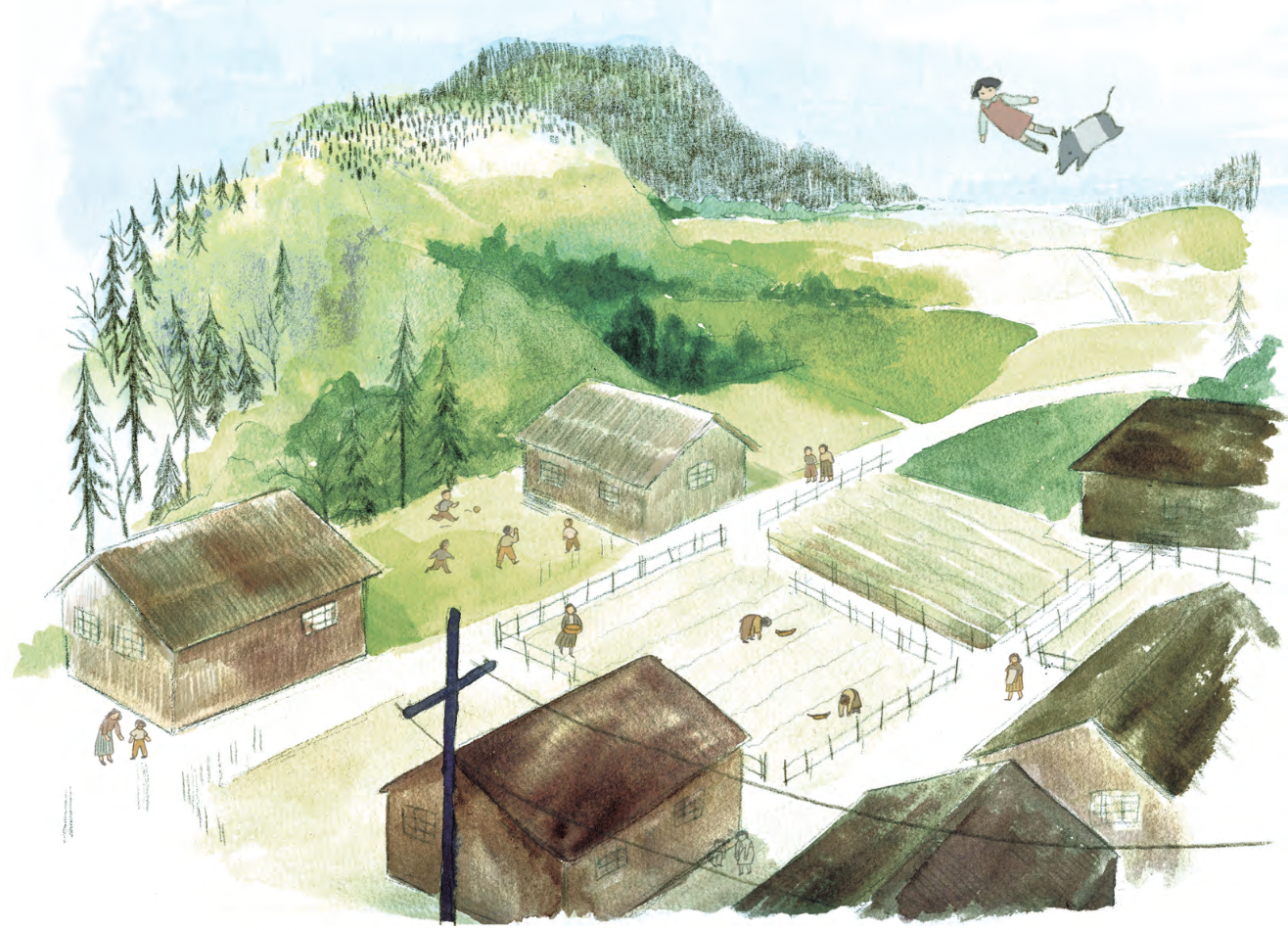
But, as consequential as the issue of an absentee father is for a child, there is greater depth to Sara Truuvert's story because Mira and her mother are being detained at an internment camp. It's the 1940s when Japanese Canadians were forced to relocate, losing homes and businesses, and separating families. But Mira does not know all this. What she knows is that her father received a letter and then he was gone, and that Mira and her mother are now confined to an isolated community of internees, mostly women and children. 
From Mira and Baku, written by Sara Truuvert, illus. by Michelle Theodore
Still Mira holds on to the good things from before, especially the stones she and her father collected which she keeps in a sock. She remembers finding stones with him and the stories that came with them. There's the stone that turns green when wet that he'd melodramatically presented to Mira's mother. There's the glittery white one that came from a box of fresh salmon her dad was unpacking for his store.
From Mira and Baku, written by Sara Truuvert, illus. by Michelle Theodore
Worried her father has forgotten about her, Mira flies away with Baku to look for him. Together, she and Baku visit the family business, now deserted, and their old house. Disappointed in not finding her father, she begins to give up hope. And though she doesn't get exactly what she wants for her birthday, the day brings a surprise that reassures and reinforces the connection she has with her father.

Without making this a story of the Japanese internment, debut author Sara Truuvert has written a story that embodies the hardship and loss experienced by Japanese Canadians because of that unjust treatment. Sara Truuvert gives us the unique perspective of a child wishing to see her father on her birthday, as she always had, and coping with that anguish by creating an imaginary friend from a mythological creature. Baku, who is a hybrid creature of parts of an elephant, rhino, cow, bear, and tiger, allows Mira to speak her worries, feel her sadness, and imagine better. Baku gives her the opportunity to do something in a situation where she can do nothing. As such, Sara Truuvert's approach is sensitive and yet very complex, allowing Mira to be a child in a very grave situation and offer her hope through her imagination and memory.
From Mira and Baku, written by Sara Truuvert, illus. by Michelle Theodore
 That sensitivity is seen in the illustrations of Edmonton artist Michelle Theodore, who gives us the historical perspective of the internment, both of the camp where Mira and her mother live, as well as the work camp where her father has been incarcerated, and reminiscences of the family's life before internment. Memories from before are presented in pale yellows, appropriate considering how faint they might seem to Mira. The camps themselves are dreary and utilitarian, and Michelle Theodore keeps the best for the world outside the camps and for Mira's stones. The forests over which Mira and Baku fly are green and lush, and her stones are multicoloured. Within those elements, there is true spirit that will vitalize Mira, with a little help from her imaginary friend who is both soulful and calming.

Sara Truuvert provides an author's note that delves into the internment of Japanese Canadians as well as an appeal to reject fear of those who are different. With Mira and Baku, Sara Truuvert and Michelle Theodore give young readers an opportunity to see the misjudgments from our history and how children may be impacted. They also offer the promise that relief can come in an unexpected form, including imaginary.

June 20, 2023

Granny Left Me a Rocket Ship

Written by Heather Smith
Illustrated by Ashley Barron
Kids Can Press
978-1-5253-0552-8
32 pp.
Ages 4-7
June 2023
 
This is a story of what is left after a grandparent passes. Many think of the tangible bequests. This child's inheritance is so much more.
From Granny Left Me a Rocket Ship, written by Heather Smith, illus. by Ashley Barron
When Granny dies, there was a hole in our family.
Remembering her helped us fill it.
After a boy's grandmother dies, his family deals with their grief in different ways. There's the sharing of stories and photos, and there's reminiscing about the items she bequeathed them. But what did she leave him? It wasn't one thing. She's left him an abundance of memories of adventures that they'd created together. 
From Granny Left Me a Rocket Ship, written by Heather Smith, illus. by Ashley Barron
Whether it's the memory of creating a tent with blankets or a flying broomstick, a knight's sword on which marshmallows were roasted, or a rocket ship, often using Granny's blue cane, this child has a lifetime of memories of fantastic exploits.

Grief and loss are handled differently for everyone and will definitely vary between adults and children. The adults in this household must get on with the task of sorting out Granny's home and cherishing unique gifts bestowed on them, as do the two older children. But what the narrator gets is far greater and this child knows it. Heather Smith, author of everything from picture books like Annie's Cat is Sad to middle-grade novels in verse (e.g., Ebb & Flow) and YA like The Agony of Bun O'Keefe, always gets into the heart of feelings. She finds a way to see something positive and uplifting even in the challenging times. Here, a child is dealing with the loss of a beloved grandparents, and he finds a way to be grateful for the experiences he had with his grandmother. We've all heard of or experienced how a family loss can become a struggle of disputes with who got what, but this child sees beyond the material things his parents and siblings got and knows that he got so much more. He didn't get the tuba or the record collection or the microscope but he got everything he wanted in adventures and time and imaginative play with an elder he loved. In few words, Heather Smith lets us feel the adoration and gratitude.
From Granny Left Me a Rocket Ship, written by Heather Smith, illus. by Ashley Barron
From Ashley Barron's cut-paper collage with watercolour, and acrylic and pencil crayon, readers will never experience the grief that is the reason that the child was left something at all. There is no somberness to Ashley Barron's illustrations and that's because, while this boy and his family have experienced a loss, they are grateful for the gifts and time and  relationships they've had with their mother and grandmother. For the narrator, the gift of time and connection takes him from Granny's very real living room into his imagination with palm trees and teal waters to dragons and owls.
When Granny died,
she left me a world of adventure...
that I can take with me wherever I go.
What a gift.

June 01, 2023

The Remembering Stone

Written and illustrated by Carey Sookocheff
Groundwood Books
978-1-77306-589-2
40 pp.
Ages 3-6
March 2023

Sometimes a stone is more than a stone. Sometimes it's a memory, sometimes it's a connection, and sometimes it's an opportunity.

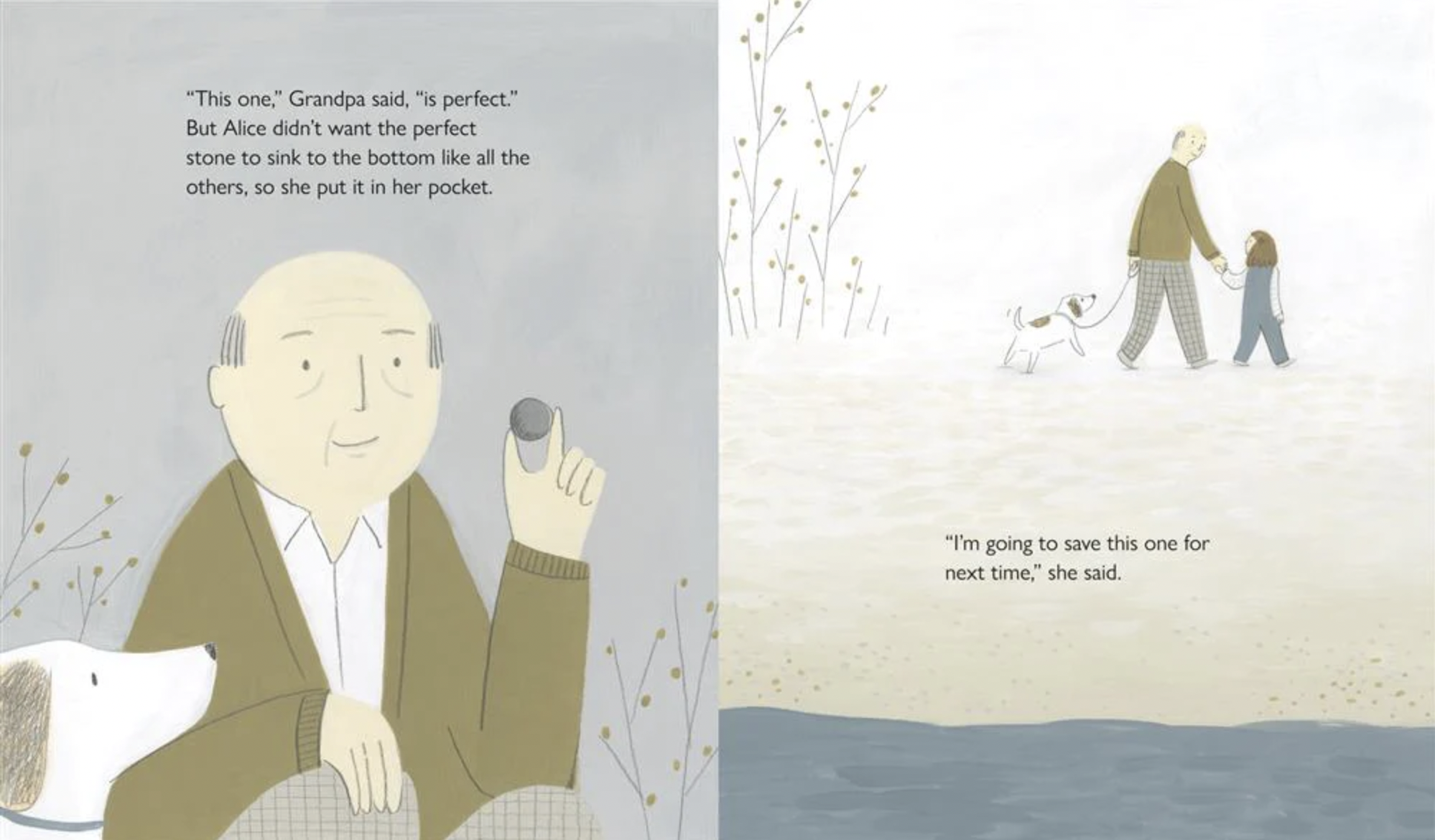
Alice has brought a stone for show-and-tell. Of course, her classmates see it as a stone. A rock. A piece of earth. Though she has lots of stories about using it to trick her dad or as a shape for tracing, it's the memory of skipping stones with her grandpa that is most important. Her grandpa knew how to skip stones and pick out the perfect ones. When he'd found this perfect stone, Alice had kept it in her pocket, probably for their next outing but perhaps because she didn't want to give it up to the water.
From The Remembering Stone by Carey Sookocheff
But when her grandpa got sick and passed away, the stone became something more.
From The Remembering Stone by Carey Sookocheff
The response to her show-and-tell stone may not have been what Alice expected but, when she realizes she's lost her stone on the playground, her classmates understand how important it is to her and they all start looking. They find a lot of stones, though not her special stone. Still, her new stones become something more too.
From The Remembering Stone by Carey Sookocheff
Carey Sookocheff's story is as deceptively simple as her illustrations. It may appear only to be about a girl and a stone which connects her to her grandfather. But Carey Sookocheff uses that stone as a bridge beyond that intergenerational relationship and allows Alice to see that it is both something special and something ordinary. The stone's value is what she places on it. It can remind her of her grandpa or help make new connections with her classmates or it can be just a skipping stone. Regardless of what the stone or stones have been or become, they have meaning, even when they're gone. 

The Remembering Stone truly becomes Carey Sookocheff's story because she illustrates it. Using acrylic gouache and graphite, she embeds the story in reality. Her art is clean and smooth and gives a calmness to being with others. It's the reality of going to school, participating in show-and-tell, spending time with a grandparent, and losing a grandparent. It's all about what a child might experience so it will speak to many children. But, while the story connects with young readers, it will also give them an opportunity to see that there are opportunities beyond the obvious. A skipping stone becomes a memory first but then it transforms both in its presence and in its absence. It's a remembering stone even when it's not.

February 02, 2023

The Grace of Wild Things

Written by Heather Fawcett
Balzer + Bray (HarperCollins)
978-0-06-314262-6
360 pp.
Ages 8-13
February, 2023

Grace Greene, who has been raised in the Rose & Ivy Home for Unwarded Children in Charlottetown since being abandoned by her parents, is determined to find a home with the witch who lives in the woods at Brook-By-the-Sea. The freckled twelve-year-old with a great imagination and love of words and reading is sure the witch will help her develop her own magical gifts. Grace just needs some guidance, especially as she is convinced she is the bad kind of witch because she can make people's see their worst memories. Though the witch, known to her neighbours as Miss Evelyn Puddlestone, is reluctant to have anything to do with Grace, she gives in when Grace shows some skills. She agrees to train Grace if the child can prove her gift is great, casting every spell in the witch's grimoire before the next blooming of an old cherry tree in spring. That leaves the child only nine to ten months to cast one hundred and a half spells or the witch would claim of all Grace's magic for her own.

With her poetry-loving crow Windweaver and the accidental help of a fairy she calls Rum, Grace begins to make herself at home at the witch's cottage. She is befriended by Sareena Khalil who lives at the farm next door with her parents and four-year-old sister invisible-pretending Daisy Bean. With the help of the children, her crow, and the fairy, Grace begins to make her way through the challenging grimoire. 

But, like a famous red-haired orphan of PEI to whom Heather Fawcett pays homage, Grace runs into trouble time and time again. She always intends to do good and behave but her temper sometimes gets the better of her, especially when she is criticized for her looks or behaviour. There's the snarky Mrs. Charity Crumley upon whom she spills ice cream that is now milked from their cow. There's the bully Poppy whom Grace goes after for making younger children cry. And there's the unfortunate brewing of a potion that spills on Sareena and leaves her drunk. 
 
Still, Grace is tenacious about making a home for herself at Brook-By-the-Sea. With her big heart and good intentions like helping heal the ill witch and deal with a woman claiming the witch as a squatter on her land, Grace has much work ahead of her.

For fans of Anne of Green Gables, the story of The Grace of Wild Things is rich with familiar elements of L. M. Montgomery's classic novel of the PEI orphan looking for a true home. She's freckled and imaginative, talkative, passionate, and sensitive. She has altercations with a local busybody, puts her friendship at risk by accident, and makes a friend of a former bully. But The Grace of Wild Things is much more than just an homage to Anne of Green Gables as those unfamiliar with the classic Canadian novel will instantly recognize. Heather Fawcett writes a fantastic story of magic, challenges, friendship, and home. The writing is superb, eloquent in its heart and richness of language.
Do you think one can have too much imagination? It seems to me it's rather like having too much lemon shortbread or too many flowers in your garden. After all, if you have too little imagination, you'd spend your life finding fault with everything, like Mrs. Spencer does, instead of noticing that there are beautiful things in the world alongside the horrible ones. (pg. 17)
Heather Fawcett, the acclaimed author of The Language of Ghosts and Ember and the Ice Dragons, blends fantasy with the mundane and creates a world in which an orphan seeks home and magical guidance. Forget the parallels with Anne of Green Gables and you still have an extraordinary story of courage and friendship, albeit swaddled in magic. With complex characters who are neither good nor bad and whose demeanours speak of human frailties and strengths, Heather Fawcett helps readers see themselves in those characters. Grace's story may be her own–unique from Anne herself–but, like the rest of us, she is looking for connection and purpose. With the help of the witch, her new friends and even an adversary or two, Grace becomes the witch she was always meant to be.

October 05, 2022

Pebbles to the Sea

Written by Marie-Andrée Arsenault
Illustrated by Dominique Leroux
Translated by Shelley Tanaka
Groundwood Books
978-1-77306-824-4
40 pp.
Ages 3-6
October 2022
 
Les ÃŽles de la Madeleine, a Quebec archipelago, is a truly unique maritime community in the Gulf of St. Lawrence. And La Grave, a heritage site on les ÃŽles de la Madeleine, is the center of life for sisters Flo and Fée. It is quiet and lively, a solitude and a community, and it is home. 
From Pebbles to the Sea by Marie-Andrée Arsenault, illus. by Dominique Leroux
On a gray day, the two girls are told to stay put as their parents, separated in marriage and residence, head to work: Papa to the marina, and Maman to her workshop. Along the shore, Flo and Fée collect pebbles and decorate them with bits of colour. But, when a dot flies across the sky, they know it's Henri using his giant trebuchet and venture away to investigate, leaving their coloured pebbles to mark their path. They pass the marina, and then the café where Jean-Marc plays the piano that makes them dance. While they eat a large piece of three-layer cake, Jean-Marc heads out with a pot of paint.
From Pebbles to the Sea by Marie-Andrée Arsenault, illus. by Dominique Leroux
Another dot across the sky and Flo and Fée continue on their journey, stopping to visit with artist Francine at her shop, and admire her art that reflects their community, including Maman's house and Papa's, and share in her ice cream. Francine too takes off with a pot of paint and a brush as the two girls leave another pebble and move on. At Henri's giant trebuchet, the girls look out over the water and islands and learn of the ice bridge that once connected their own island–Havre-Aubert–with l'île de'Entrée.

The bridge between the two islands can never be broken, the same way you two will always link your mother and father.

When the two finally are returned home by their parents, there is a surprise for them that could only come from the many who united as one for them. 
 
Though artist Dominique Leroux gives Pebbles to the Sea a cool and damp feel, appropriate for a maritime landscape in which lined rubber books, thick woolen tights and hats are needed for outdoor play, the story is one of warmth and community. Marie-Andrée Arsenault's words, translated with honesty and heart by Shelley Tanaka, gives the story that spirit, even as the girls recognize the separation that is part of their family now. Still, they are reminded by everyone that they are part of something bigger. They are part of a community that will teach them, feed them, entertain them and watch over them. And they will do it with colour and affection.  The illustrations, multi-media created with paint and collage of photos, torn paper and lace, may mirror the same, seeming to be pervasively cool, as the girls might feel their circumstances may be, but brightened with colour and textures that cheer.

Des Couleurs sur la Grave (2019), the original French-language edition of Pebbles to the Sea, won the 2020 Le Prix Harry Black de l'album jeunesse for the best French-language Canadian picture book for children. Pebbles to the Sea will now introduce La Grave, les ÃŽles de la Madeleine and creators Marie-Andrée Arsenault and Dominique Leroux to English-language young readers and perhaps reassure them that parental separation is not necessarily familial separation, and that family can go beyond the nuclear family.  Like Jean-Marc says of La Grave, Pebbles to the Sea is "the perfect playground for a happy life."
From Pebbles to the Sea by Marie-Andrée Arsenault, illus. by Dominique Leroux

August 04, 2022

Jasper's Road

Written by Susan White
Acorn Press
978-1-773660981
164 pp.
Ages 8-12
May 2022

There are families by birth and those by invention. And sometimes, because of the families of birth, better families are created from disparate parts. The story of Jasper's Road is about such families.
 
When Jasper's Road begins, a large extended family is gathering to celebrate Amelia's day. Amelia Walton, who passed five years earlier, started taking in kids after she was struck with a neurological disease which motivated her to become a recluse. Opening her home to more than 100 kids over the years, for short- or long-terms, Amelia Walton left her mark with her heart, her wisdom, and her compassion. Now each year, many of those she fostered along with their own families gathered to share food, memories and trivia as Amelia would have liked.

Thirteen-year-old Jasper, who'd come to Amelia as a baby and now was part of Jodie and Zac Williams's family, had always felt welcomed but, because of a recent fostering of fourteen-year-old Jake Turner by his Aunt Rachel and Uncle Ryan, Jasper is feeling more vulnerable, especially about a facial abnormality that Jake ridicules as "Zipper Lip." But as Jasper tries to figure out how to deal with Jake, Jake himself is struggling with finding himself as a part of yet another foster family and without his little brother Tommy. Then near tragedy strikes and Jake forces Jasper and Jasper's 12-year-old brother Anderson to lie. Add to that the COVID-19 pandemic and the April 2020 mass killing in Nova Scotia and it would seem that everyone has some baggage that they're carrying around that confuses and confounds their relationships with partners and with their families, foster and birth.

New Brunswick writer Susan White, who has written YA and middle grade books including The Year Mrs. Montague Cried, winner of the Ann Connor Brimer Award, brings us into a complicated world of foster children, past and present, as they struggle and learn to make lives for themselves in the context of ever-changing relationships. Whether from abandonment or abuse, neglect or health concerns–including death of a parent–children enter foster care for a variety of reasons and just as varied is the care that they may receive. Some will find forever homes through adoption while others will bounce from one residence to another. In Jasper's Road, those fortunate enough to be taken in by Amelia Walton and subsequently by her "heirs" became part of something significant. And while it took me awhile to figure out all the characters and their relationships, including which were biological or otherwise, I realized it really didn't matter. Susan White gave us a rich community much like the one Amelia endeavoured to create, both complex and natural, saving herself and others in the process, and building something bigger than just a joining of individuals.

While this journey down Jasper's Road is complete, for now, I suspect that there are more travels ahead for Jasper, Jake, Tommy and their families, perhaps in New Brunswick or not, and I really hope that Susan White takes us down a few more of those roads by gifting us with their stories too.

March 09, 2022

Giju's Gift (Adventures of the Pugulatmu'j)

Written by Brandon Mitchell
Illustrated by Veronika Barinova
HighWater Press
978-1-55379-947-4
88 pp.
Ages 6-9
February 2022

In a new series of graphic novels inspired by traditional stories, author Brandon Mitchell draws on his Mi'kmaq heritage and introduces the pugulatmu'j, the Little People who are guardians of the land.
From Giju's Gift by Brandon Mitchell, illus. by Veronika Barinova
While out strawberry picking, young Mali trips and loses her precious beaded hair clip that once belong to her grandmother (Giju'). But, though it seems no one believes her, Mali knows it was stolen, seeing a little person grab it as well as a basket of strawberries. Her auntie tells her of the pugulatmu'j, the Little People who live high in the mountains and like to play tricks on people to keep them alert. 
 
When she goes outside to play, she catches a little person about to steal a cooling pie. Puug, as he is called, is surprised that she can see him but promises to return her hair clip if she helps him gather some much needed supplies. During their scavenging, they see a jenu, a giant who is consumed by anger and determined to destroy all. 
 
With a little help from Mali's grandfather (Nemijgami) and an important, though chilling, stop at an abandoned residential school, the two new friends are able to put the spirit of jenu at rest and allow Puug his intention to protect the memories of the past.

It's our goal to collect as many moments as we can. (pg. 52)

From Giju's Gift by Brandon Mitchell, illus. by Veronika Barinova
Writing for early readers or early middle graders is a tough job in trying to tell a complete story while being sensitive and cognizant of the readers. Brandon Mitchell is able to create a story that shares elements of Mi'kmaq culture, including its folklore and history, as well as touching on the tragedy of residential schools. But, more than anything, Brandon Mitchell emphasizes the importance of holding onto the memories, whether it's by gathering items as the pugulatmu'j did or cherishing those inherited from our ancestors. To that end, Brandon Mitchell even includes instructions for young readers to create their own memories boxes to commemorate important times. 

Because Brandon Mitchell's story is told as a graphic novel, the visuals are important in conveying more of the story that cannot be told in the limited text of Giju's Gift. This is especially valuable for young readers as they transition from picture books to chapter books. Artist Veronika Barinova makes sure that her illustrations are relatively plain and uncomplicated, with the emphasis on the characters and their actions and vocalizations. She gives the right balance of creepy (jenu) and innocent (Mali) with settings of house and outdoors that are general enough to be familiar. 

With this easy blend of text and art, Brandon Mitchell and Veronika Barinova ensure that young readers will be coaxed to read more about the Adventures of the Pugulatmu'j (this is only the first book in the series) and perhaps learn about the Mi'kmaq, as well as appreciate the importance of memories and traditional stories.