Showing posts with label Carey Sookocheff. Show all posts

June 01, 2023

The Remembering Stone

Written and illustrated by Carey Sookocheff
Groundwood Books
978-1-77306-589-2
40 pp.
Ages 3-6
March 2023

Sometimes a stone is more than a stone. Sometimes it's a memory, sometimes it's a connection, and sometimes it's an opportunity.

Alice has brought a stone for show-and-tell. Of course, her classmates see it as a stone. A rock. A piece of earth. Though she has lots of stories about using it to trick her dad or as a shape for tracing, it's the memory of skipping stones with her grandpa that is most important. Her grandpa knew how to skip stones and pick out the perfect ones. When he'd found this perfect stone, Alice had kept it in her pocket, probably for their next outing but perhaps because she didn't want to give it up to the water.
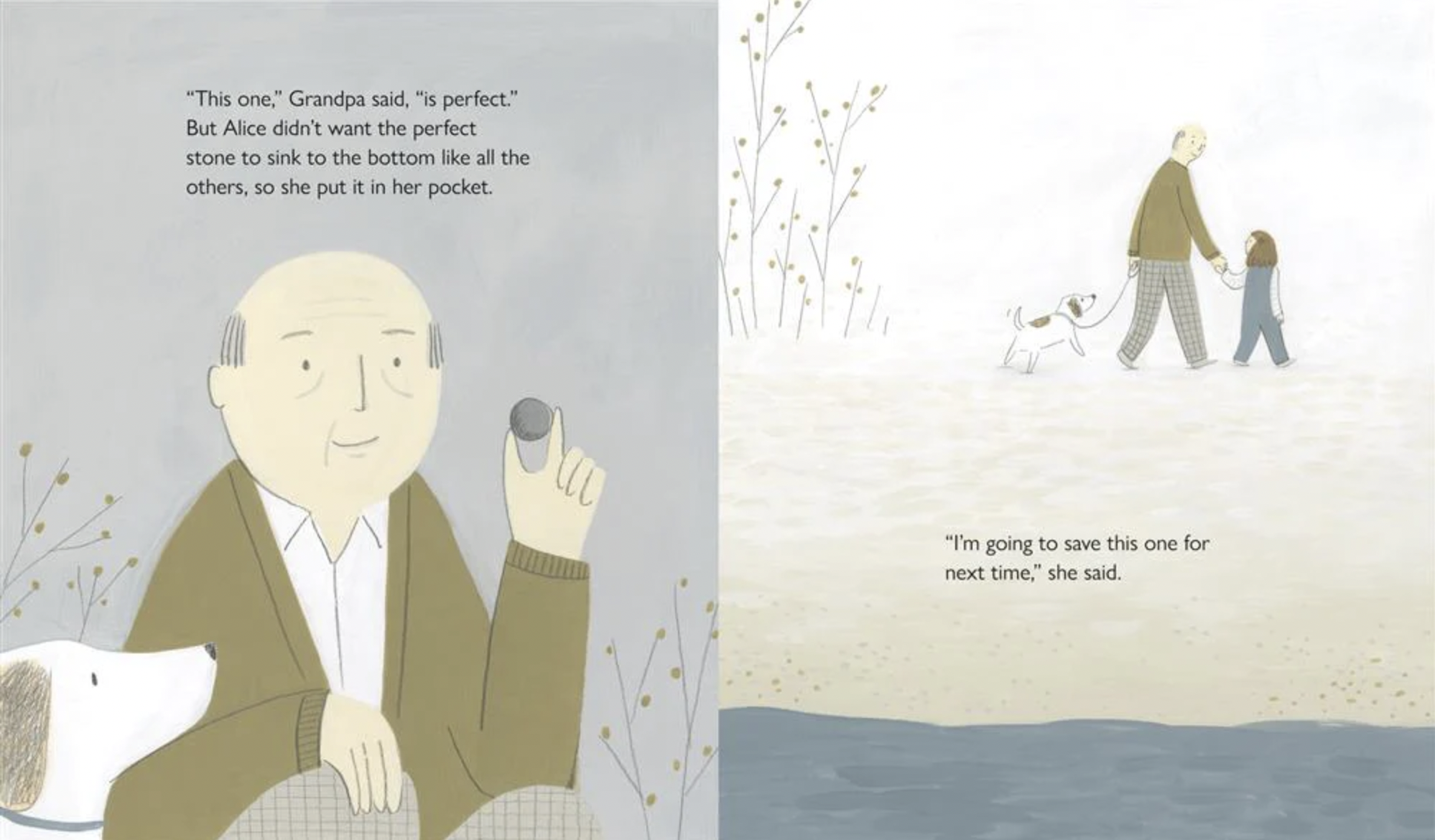
From The Remembering Stone by Carey Sookocheff
But when her grandpa got sick and passed away, the stone became something more.
From The Remembering Stone by Carey Sookocheff
The response to her show-and-tell stone may not have been what Alice expected but, when she realizes she's lost her stone on the playground, her classmates understand how important it is to her and they all start looking. They find a lot of stones, though not her special stone. Still, her new stones become something more too.
From The Remembering Stone by Carey Sookocheff
Carey Sookocheff's story is as deceptively simple as her illustrations. It may appear only to be about a girl and a stone which connects her to her grandfather. But Carey Sookocheff uses that stone as a bridge beyond that intergenerational relationship and allows Alice to see that it is both something special and something ordinary. The stone's value is what she places on it. It can remind her of her grandpa or help make new connections with her classmates or it can be just a skipping stone. Regardless of what the stone or stones have been or become, they have meaning, even when they're gone. 

The Remembering Stone truly becomes Carey Sookocheff's story because she illustrates it. Using acrylic gouache and graphite, she embeds the story in reality. Her art is clean and smooth and gives a calmness to being with others. It's the reality of going to school, participating in show-and-tell, spending time with a grandparent, and losing a grandparent. It's all about what a child might experience so it will speak to many children. But, while the story connects with young readers, it will also give them an opportunity to see that there are opportunities beyond the obvious. A skipping stone becomes a memory first but then it transforms both in its presence and in its absence. It's a remembering stone even when it's not.

September 03, 2020

I Do Not Like Stories

Written by Andrew Larsen
Illustrated by Carey Sookocheff
Owlkids Books
978-1-77147-378-1
32 pp.
Ages 3-7
September 2020

Like many children, this child has very definite preferences, especially about the types of stories he likes. Actually he is more adamant about the types of stories he doesn't like than those he likes. But does he really know what he doesn't like?

From I Do Not Like Stories by Andrew Larsen, illus. by Carey Sookocheff
From waking up to his cat pawing his face to getting dressed, feeding his fish, heading to school and participating in his school day, the child is reminded about all the stories he doesn't like i.e., stories about fish and buildings, numbers and fruit, and buses and bikes. As the day goes on, everything remind him of the stories he doesn't like.

From I Do Not Like Stories by Andrew Larsen, illus. by Carey Sookocheff
But as the boy relates all the stories he does not like, his cat, a lovely tuxedo, lives those stories. The boy doesn't like stories about numbers or letters but his cat races by a parking meter and surprises the postal carrier with his bag of mail. The boy languishes over his lunch fruit and thinks about how much he does not like stories about apples or pears or peaches or plums while his feline friend visits a fruit stand, toppling produce after a dog chases it away. For each experience for which the child recounts his dislike of stories, his cat is creating its own stories about that same set of circumstances. From trees to going home and doing things, the boy dislikes the stories and the cat lives them.

From I Do Not Like Stories by Andrew Larsen, illus. by Carey Sookocheff


In the end, the boy relents that he might like a story about a cat.

Without establishing the fact that the child has been wrong all along and that he, in fact, does like stories, Andrew Larsen delivers that message with a tongue-in-cheek approach. It's like a parent who smiles, knowing that the child who insists that they don't like something will like it once they try it. It's accepting a child's assertions as true but allowing for leeway in the actuality of those pronouncements. By allowing the child to come to that realization himself, Andrew Larsen takes the adult out of the equation and makes it all about the growth of the child in learning what he might like for himself.

As in her earlier books (see What Happens Next, Wet and Buddy and Earl for other samples), Carey Sookocheff's illustrations play on the author's important message and elevates it with subtlety of colour and line for greater impact. Her artwork plays on that juxtaposition of child and cat, what one affirms and the other experiences. Same circumstances but different perspectives and appreciation for those circumstances. Carey Sookocheff's minimalist palette, primarily pale blue-greys with splashes of yellow and orange, keeps the reader focused on the darkest elements of her illustrations: the cat and the child's head. So, while it is the child's head only that has decided what he doesn't like, it's the whole cat that lives life, pursuing adventures and involving itself in its day fully.

For any child who cannot see beyond a pervasive opinion that may or may not be valid, I Do Not Like Stories will make them think twice and perhaps even consider a different perspective to the story.

From I Do Not Like Stories by Andrew Larsen, illus. by Carey Sookocheff

April 12, 2018

What Happens Next

Written by Susan Hughes
Illustrated by Carey Sookocheff
Owlkids Books
978-1-77147-165-7
40 pp.
Ages 4+
March 2018

Carey Sookocheff's understated illustrations may give the impression of a simple story but Susan Hughes' What Happens Next is nothing less than a compelling revelation about the secretive and debilitating nature of bullying and the sharing of an inspired strategy for resolution which begins with empathy.
From What Happens Next by Susan Hughes, illus. by Carey Sookocheff
The story of What Happens Next follows a child who is bullied by another child at school with name-calling ("Weirdo") and hurtful comments and physical acts like blocking their way and shoving at their books.  Sadly, there are children who are bystanders who either laugh or ignore the bullying.  Even though the child who is bullied has many positives at home like a playful and loving dog and a caring parent, this child carries the burden of the bullying which affects their sleep and behaviour. 
From What Happens Next by Susan Hughes, illus. by Carey Sookocheff
Finally the child, encouraged by their love of books and science, feels strong enough to share with Mom what has been going on with Bully B.
What I Say about Bully B. When Mom Comes to Kiss Me Good Night:
Everything.

What Mom Says:
That I'm brave for telling her.
That she's sorry I feel scared and hurt.
That she'll help.
But it's the mother's intensity of empathetic insight that should be included in every handbook on dealing with bullies.
What Mom Says Next:
That everyone has their own way of looking at things and people.  That each person's way of looking is made up of where they're standing and how they got there.  It's made up of what's in their mind, what's in their heart, and what's in their imagination.
From What Happens Next by Susan Hughes, illus. by Carey Sookocheff
And with that, Mom shows her child that, by sharing things they like with Bully B., they may be able to help change Bully B.'s way of looking. With courage and some trepidation, and ignoring Bully B.'s habitual meanness, the child tells Bully B. about genomes, water on the Earth's surface and Earth in the orbit around the Sun.
What's Different Now:
Not everything. But enough.
In fact, I'll let you read What Happens Next for yourself to see that enough is pretty darn good.

You'll notice that Susan Hughes' text takes on a form similar to a script with bolded directives and plain-text responses that gives an organic texture to the story.  In fact, when the child is being bullied or worried about the bullying, the text is very terse, like punches.  When involved with their books and the science within, as well as when Mom shares her insight into bullying, the text is softer, like blankets.  Illustrator Carey Sookocheff's artwork reflects this imbalance through her choice of colours and simple lines and shapes.  Everything is understated from her limited palette of pale grey and yellow with white, against grey-blue, green and red-orange to her simple scenes at home and playground.  But simple here is meaningful, as substantial as a careless case of  bullying.

What Happens Next is like nothing I've ever read for opening up discussions about bullying with our youngest readers to those in middle grades. To that end, Owlkids Books has created discussion guides for using the book with children. There is one for Grades 1-3 and one for Grades 4-6 and both are available at the Owlkids Books website. I encourage everyone, from educators and school administrators to parents and child and youth care workers to make What Happens Next a part of their programming to encourage meaningful lessons and dialogue about this perennial issue.

🌎🌎🌎🌎🌎🌎

Copies of the illustrations from within What Happens Next were retrieved from Carey Sookocheff's website, specifically at http://careysookocheff.com/what-happens-next/ on April 9, 2018, as they afford clarity of image that my own scans of the book could not.

February 05, 2018

What Happens Next: Book launch (Toronto, ON)

Join 

author Susan Hughes 

and

 illustrator Carey Sookocheff 


for the launch of their first book together


What Happens Next
Written by Susan Hughes
Illustrated by Carey Sookocheff
Owlkids Books
9781771471657
40 pp.
Ages 4+
March 2018

on

  Saturday, March 3, 2018

2-4 p.m.

at

Queen Books
914 Queen Street East
Toronto, ON


It is a book about the bullied, the bully, the bystander and family.


This will be an important book
 for children to read, 
with which educators can teach and 
which can help parents relate to the emotions of one who is being bullied.


This trailer from Owlkids Books captures a glimpse of the book's message.

What Happens Next book trailer

 Uploaded by Owlkids to YouTube on December 22, 2017.


August 10, 2017

Wet

Written and illustrated by Carey Sookocheff
Henry Holt and Company
978-1-62779-775-7
32 pp.
Ages 4-8
June 2017

Wet is about being wet, about getting wet, about the manner of getting wet and about the gratification or annoyance of being wet.  Wet may be all about wetness but it certainly isn't all wet as topics go.

From Wet by Carey Sookocheff
Through a series of single- and double-spread illustrations, author and illustrator Carey Sookocheff has a boy recollecting how he becomes wet at a pool and elsewhere: quickly or slowly, with friends or by himself, deliberately and accidentally. He also talks of cats, fish, and dogs, floors, painted park benches and more.  He makes note of washing hands and splashed shirts, puddles and spills, and tears, baths and laundry.  But he ends his day in the dryness of a safe, warm bed with only kisses to moisten his face.
From Wet by Carey Sookocheff
Carey Sookocheff, who has illustrated her own Solutions for Cold Feet and Other Little Problems (Tundra, 2016) as well as Maureen Fergus' Buddy and Earl series of picture books, creates a child-like ambiance to her illustrations that serves the text wonderfully. There's a simplicity in spirit, recounting how wetness happens and what it looks like.

Wet is a fun little book that doesn't have to be taken as lesson-building material but it could be used so effectively for preschool and kindergarteners learning about emotions and even states of matter or the water cycle.  Because Wet is so familiar in its circumstances relating to swimming, baths, rain, pets and bedtime, children will have no problem relating to this boy's activities as they change and affect his state of dryness.  Whether soaking wet or lightly dampened, it's not so bad being wet.  And Wet, the book, is neither a wet blanket nor a damp squib, and summer is definitely a time to relish being wet.
From Wet by Carey Sookocheff

August 15, 2016

Buddy and Earl and the Great Big Baby

Written by Maureen Fergus
Illustrated by Carey Sookocheff
Groundwood Books
978-1-55498-716-0
32 pp.
Ages 4-7
August 2016

Our dynamic duo of Buddy, the dog, and Earl, the hedgehog, introduced in Buddy and Earl (Groundwood, 2015) and revisited in Buddy and Earl Go Exploring (Groundwood, 2016) have a new adventure afoot when it is announced that Mrs. Cunningham and her baby are coming for a visit. Meredith, the young girl in the family, seems excited, and the two pets follow suit. But what’s a baby? Earl questions, and makes all manner of speculation from a mode of transportation to an electrical appliance or something to eat, while Buddy adds his modest knowledge to the discussion.

The arrival of the child leaves them both chagrined as the baby pays no attention to anyone and leaves of swath of destruction as it ambles through the house, tasting, eating, breaking. A consequent delivery to its cage i.e., playpen has the baby making friends with Earl who then appoints himself guardian when the great big baby escapes to new and wild adventures in bedrooms of snakes and lava and dinosaurs and, the deadliest of all, water.
From Buddy and Earl and the Great Big Baby 
by Maureen Fergus, illus. by Carey Sookocheff
Buddy’s faithfulness is only surpassed by Earl’s joie de vivre making the two a duo of contrasts and congeniality. In facing a new encounter, Buddy and Earl work together to understand, mitigate and even appreciate the complication that is the great big baby. By giving voice to Buddy and Earl and even Meredith as they handle the baby, Maureen Fergus covers a variety of sentiments, recognizing that babies, like pets, aren’t always small and adorable but still “make the world a happier place” (pg. 31).

Again Carey Sookocheff illustrates Buddy and Earl’s adventure with the right feel of simplicity and wonder. There is sparseness to the artwork that is brilliantly appropriate for a story told from the perspective of a dog and a hedgehog, undoubtedly less concerned with the material excessiveness of our world. Imaginative play and exploration are emphasized, not things, and Carey Sookocheff makes sure that, with her minimal colour palette and attention to shape and line, Buddy and Earl remain the stars of this story, nothwithstanding a great big baby, that is.

Buddy and Earl 
From Buddy and Earl and the Great Big Baby 
by Maureen Fergus, illus. by Carey Sookocheff

March 24, 2016

Buddy and Earl Go Exploring

by Maureen Fergus
Illustrated by Carey Sookocheff
Groundwood Books
978-1-55498-714-6
32 pp.
Ages 4-7
March, 2016

Buddy the dog and Earl the hedgehog from Buddy and Earl (Groundwood Books, 2015) are back and this time the fast friends are on the move.  Okay, they stay in the house but there’s so much to explore in their home, especially when everyone is asleep. And it all starts with Earl declaring a simple “Bon voyage” when they should be settling down to sleep.

Earl is essentially a Zen-kind of traveller, going “Wherever the road leads me” and “However long it takes” (pg. 8), but he’s surprised when his fast and furious running leads him nowhere, having never left the wheel in his cage.  Everything changes when somehow Earl gets Buddy to go exploring with him.

Everything is new and, in the imaginative mind of the little hedgehog, something to be investigated.  Their first stop is “a silvery lake in the shadow of a great mountain” (pg. 15) a.k.a. Buddy’s water bowl and the garbage pail, where Earl enjoys a lazy soak while Buddy discovers some tasty leftovers in the can he upturned.  But spotting a hairbrush in Mom’s purse, Earl sees a lady hedgehog in the jaws of a monster and enlists Buddy’s largesse to save his sweetie from being devoured. Reciprocating, because that’s what friends do, Earl stands up to a monster of Buddy’s world, the vacuum cleaner.

With declarations of friendship and heroism, the two finally settle down amidst the mayhem of their night’s exploration with a resounding “Bon soir.”

Maureen Fergus again offers up the unlikely friends as a story of contrasts: the little hedgehog with the massive imagination and courage to see outside his box, and the tall dog with the staid attitude of familiarity who understands more about the real world and still goes along with his prickly friend.  Buddy and Earl Go Exploring is  a sweet tale of travels to new worlds without ever leaving home.  The simplicity of their friendship and endeavours are balanced with the unfussy illustrations of Carey Sookocheff who also provided the artwork for Buddy and Earl.  Carey Sookocheff has created the ideal representations of the two animals in their physical appearances and their manners–petite and large, bold and cautious–and completed Maureen Fergus’ textual characters in such a way that the two will always be recognizable.  There’s Stella and Sam, Max and Ruby, and Frog and Toad, and now there’s Buddy and Earl.
From Buddy and Earl Go Exploring
by Maureen Fergus, illus. by Carey Sookocheff (pg. 30)

Nota Bene: More adventures to come, starting with Buddy and Earl and the Great Big Baby in August, 2016.

November 10, 2015

Groundwood Books' Book Party: November 21, 2015 (Toronto)

Groundwood Books 
is having a party!

Join authors and illustrators

Maureen Fergus and Carey Sookocheff


Monica Kulling and Sydney Smith


Deborah Hodge

and


Danielle Daniel


for an afternoon of activities and presentations for children ages 4-9

on Saturday, November 21, 2015

from 1 to 4 p.m.

at

the Koffler Center of the Arts
180 Shaw Street
Toronto, ON

In addition to the fun activities, 
Another Story Bookshop will have the books available for purchase.


September 23, 2015

Buddy and Earl

by Maureen Fergus
Illustrated by Carey Sookocheff
Groundwood Books
978-1-55498-712-2
32 pp.
Ages 4-7
August 2015

I’m sure that most friendships don’t start out that way.  There may be those encounters by which individuals become “fast friends” but I suspect many friendships  begin slowly as each tries to figure the other out. Friend? Foe? Agenda? Danger?  In fact, in Maureen Fergus' Buddy and Earl, when Meredith brings a mysterious open box in, Buddy the dog probably wasn't thinking "friend" at all but rather "what?"

A few pokes  and an amiable introduction between Buddy and the rounded creature who identifies himself as Earl has the two chatting away.  But still Buddy doesn't know the "what" that is Earl.  He asks but Earl has an odd assortment of answers to, "And what are you, Earl?" He could be a race car, or a giraffe, or a sea urchin, a talking hairbrush–definitely plausible–or a skyscraper, rhino or mouse.  Nothing seems to work for Buddy who is clever enough to know what Earl isn't.  But when Earl suggests that he is a pirate and Buddy his first mate, the two go off on an adventure that has Mom shaking her head and the two bonded with friendship.

I've adored Maureen Fergus' YA books (The Gypsy King, Razorbill, 2012; A Fool's Errand, Razorbill, 2013; Tomorrow's Kingdom, Razorbill, 2014) but she's showing her versatility in writing picture books, recently winning the Ontario Library Association's Blue Spruce readers' choice award for The Day My Mom Came to Kindergarten (Kids Can Press, 2013), and Buddy and Earl displays the same wonderful voice of innocence and discovery, with a touch of parental attitude.  Whether Buddy is a real dog and Earl another family member, I have no doubt but it really doesn't matter.  The two dissimilar pets demonstrate the ability to make friends no matter where and no matter with whom just by being themselves.  It doesn't really matter whether Earl is a hedgehog, though I suspect he is, and prone to imaginative bursts of creative play or steadfast and thoughtful like the loyal Buddy. The two come together and make something better and bigger:  a friendship.  And that's all it takes to identify Earl in the end and to add a new moniker to Buddy beyond "dog".

I don't know Carey Sookocheff's work but I think we all will soon.  Buddy and Earl is her first picture book and I believe the simplicity and retro style of her artwork, here in muted creams, khaki, orange and powder blue, will endear her work to many.  It has the effortless ambience of child's play to which young children will be drawn.  I imagine that the young will be as charmed by Carey Sookocheff's illustrations as they are to the guessing game that Buddy and Earl play whilst the two strut into their new friendship.  Even better, we've got more adventures to which we can look forward with the two new friends getting into new situations in Buddy and Earl Go Exploring (March, 2016) and Buddy and Earl and the Baby, both from Groundwood Books.