Showing posts with label dogs. Show all posts

July 24, 2026

The Old Man, the Boy, and the Dog: An Inuit Retelling of an Aesop's Fable

Book cover of The Old Man, the Boy, and the Dog: An Inuit Retelling of an Aesop’s Fable shows a boy and an older man with a dog pulling a sled through the snow in an Artic community.
Written by Kevin Kaukuarjuk Qamaniq-Mason 
Illustrated by Vienno (Vinicius Xavier)
Inhabit Media
978-1772276411 
28 pp.
Ages 6–8
June, 2026 
 
When Aesop wrote his fable titled "The Miller, His Son, and the Donkey," he wouldn't have been writing about a northern setting such as Nunavut, the home of author Kevin Kaukuarjuk Qamaniq-Mason (though perhaps more like the home of Brazilian illustrator Vienno). By adapting one of Aesop's fables to a northern landscape, Kevin Kaukuarjuk Qamaniq-Mason is able to teach an important moral lesson in a fresh and northernly way.
A boy helps his grandfather raise sled dogs in a northern environment of snow. Scenes show the dog as a pup, and growing up and learning to obey and to pull a sled.
Illustration by Vienno from The Old Man, the Boy, and the Dog, written by Kevin Kaukuarjuk Qamaniq-Mason
Anguti is a boy who helps his grandfather, Ittuq, raise sled dogs. When Anguti's aunt needs a dog to help her with her work, they select one of their most promising sled dogs, hitch him to a small qamutiik (sled) and head off to deliver the animal.
Two women sew skins outdoors, as an older man sits on a sled being pulled by a sled dog. A young boy speaks to the man on the sled.
Illustration by Vienno from The Old Man, the Boy, and the Dog, written by Kevin Kaukuarjuk Qamaniq-Mason
But, as proud as Anguti is of this strong and clever animal, he listens to others they pass who all have something to say. First, a man building an iglu questions why the dog isn't pulling anyone on the sled. When Anguti gets on the sled, two women comment that the older grandfather shouldn't be walking while Anguti sits. So, at Anguti's urging, his grandfather gets on the qamutiik instead. Of course, someone has another opinion about the dog and how much it can pull, and Anguti gives in again. His grandfather has some wise words about not being able to please everyone—“Grandson,” said Ittuq, “when you try to please everyone, you please no one.” (pg. 13)—which is a lesson his grandson learns too late.
A boy, alongside an older man, both wearing parkas, pulls a sled dog who sits on a sled. Others in the snow, all in winter outer clothing, play or work.
Illustration by Vienno from The Old Man, the Boy, and the Dog, written by Kevin Kaukuarjuk Qamaniq-Mason
As with all Aesop's Fables, Kevin Kaukuarjuk Qamaniq-Mason wraps an important message in the story. It doesn't matter whether the story is told in Ancient Greece, in Nunavut, or in Toronto, because everyone knows how common it is to have others impose their opinions on us and for us to want to please them. Often we trust others before that which we already know to be true. (Anguti knew the dog was smart and strong but continued to feel the need to prove it to others.) But, by setting the story in Nunavut, Kevin Kaukuarjuk Qamaniq-Mason speaks to those children for whom the Arctic is home and familiarizes others with its landscape and its people. 
Speaking to an older man in a winter parka, a small boy, also in a parka, points to a sled and a brown and white sled dog. They all stand in a snowy landscape.
Illustration by Vienno from The Old Man, the Boy, and the Dog, written by Kevin Kaukuarjuk Qamaniq-Mason
Illustrator Vienno (a.k.a. Vinicius Xavier) puts the reader directly into that wintery landscape of snow and cold. But, even more so, he puts us into an Indigenous community where a man uses a pana (snow knife) to build an iglu, where a girl dries fish, and where boys chip ice for drinking water. These are people who are just going about their day, and Vienno's bright art helps the reader feel part of it.
 
With a timeless lesson about trusting your own judgement and disregarding opinions that may be harmful, The Old Man, the Boy, and the Dog respects the classic while giving it new life with a northern setting, with an Indigenous community, and with a handsome dog that will captivate children.
 

May 25, 2026

Still Friends

Book cover of "Still Friends" by Troy Wilson and illustrated by Mike Deas shows a dog on top of a statue of a sitting woman
Written by Troy Wilson
Illustrated by Mike Deas
Orca Book Publishers 
978-1-4598-4257-1
32 pp.
Ages 3–5
May 2026 
 
When a dog makes a new friend in the park, he can't help but compare her to his old friend. But is that really fair? After all, maybe his new friend has different stuff to offer.
A woman with a kite, coffee, and newspaper heads with her beagle towards a stone statue of a woman sitting
From Still Friends, written by Troy Wilson, illustrated by Mike Deas
When we first meet this adorable beagle, he's with a wonderfully quirky woman with a red ball cap who plays with him, speaks to him, walks him on a long retractable leash, and gives him treats and lots of scratches. But his new friend is a little different. She sits stoically on a bench-like plinth, never speaking and never moving. Just "stone-cold silence."
A dog looks up at a stone statue of a woman sitting beneath a tree in autumn
From Still Friends, written by Troy Wilson, illustrated by Mike Deas
He's a little put off by her silent treatment and soon realizes that she offers a different kind of friendship, to him and a group of pigeons. She offers shelter and support. She never scolds or frowns at him. She definitely doesn't dress him up in silly costumes. And she always listen.
A stone statue of a woman sits with a dog nearby beneath a tree as it changes through the four seasons
From Still Friends, written by Troy Wilson, illustrated by Mike Deas
This little beagle learns soon enough that none of them is perfect, including himself, and each offers something that makes them a dependable friend to have.

Troy Wilson, author of Liam Takes a Stand (2017), Little Red Reading Hood and the Misread Wolf (2019) and Goldibooks and the Wee Bear (2021), has written a picture book that is both subtle and candid. It reminds me of the old saying by Joseph Parry (and later adapted into a Girl Guide song) to "Make new friends, but keep the old; Those are silver, these are gold." This beagle has a person who is with him all the time, doing the fun stuff and the discipline stuff too. They are the friend and parent, companion and teacher. But for the beagle to expect his new friend, a stone statue of a girl or young woman seated with her hands in her lap, to be the same is just an innocent confusion of what makes a friend. With observation and insight, the beagle realizes that his still friend could still be his friend regardless of how different she is from his old friend. (Hope you're picking up on the puns and word play in Still Friends.) 
A park bustles with activity, including a stone bridge over a river, and a dog watching a stone statue
From Still Friends, written by Troy Wilson, illustrated by Mike Deas
Even though Troy Wilson likes to play with words, adding some humour to a story about accepting friends as they are, Still Friends asks readers to reflect on their own friendships, just as this beagle has. Because he has done so, through observation and with insight, his life is richer for his awareness. That same lightness and delicacy with a shade of circumspection comes through in Mike Deas's artwork which was created with pastel and pencil crayons with ink outlines. As in his many books in the Scholastic Canada Biography series (written by Elizabeth MacLeod), the early reader Two Tales of Twenty-Six: Liam and the Letters, Walter and the World (written by Stephanie Simpson McLellan, 2024), and his own SueƱo Bay Adventures with Nancy Deas), Mike Deas gives us texture and life, even in a story that has to balance brightness with gravitas. He is an illustrator whose style can give us the playfulness but with a sheen of weight in the messaging. It's that same juxtaposition of the beagle's two friends that shows up in Mike Deas's art and complements Troy Wilson's story so well.
 
Next time your child or a student is struggling with friends and wondering if they can be friends with others, give Still Friends a read. It will help them understand that there are many friends out there and by appreciating our differences, including our own imperfections, it will help us establish rock-solid relationships, not just win popularity contests.

February 23, 2026

Ellis on Guard

Written by Sal Sawler
Illustrated by Nandita Ratan
Second Story Press
978-1-77260-444-3
24 pp.
Ages 6–8
February 2026 
 
Ellis had so many worries that if they wrote them all down, the list would wrap around their house three times. (pg. 2) 
That single line explains a lot about how Ellis conducts themself. It's not what defines them—they are far more than their worries—but they are a child who makes a lot of decisions based on those concerns. And Ellis is worried about a lot of things, from meeting new people to catching colds, and losing their puppy Peanut. To their benefit, Ellis notices a lot, because they are always aware or worried that danger is present.
From Ellis on Guard, written by Sal Sawler, illustrated by Nandita Ratan
When Ellis sees a poster about a missing dog named Walter, their worries are intensified. They become Big Worries. Now they have to worry about a dognapper, about Peanut being taken, and where Peanut might go. So, Ellis devises a plan to catch the dognapper with a trap. But now there are more worries because they needs supplies from the Creepy Closet and the Frightening Forest, and they have to talk to the Noisy Neighbor. With some support from Peanut and their mom, Ellis creates a trap. But what Ellis finds is that there is more to discover than a dognapper. There is more beyond worries. In fact, there is goodness.
From Ellis on Guard, written by Sal Sawler, illustrated by Nandita Ratan
Sal Sawler, the Nova Scotia writer of When the Ocean Came to Town (Nimbus, 2023), seems to understand a child's worries and how they can spiral out of control to the point at which they impact activities and thought. Worries are protective. They are there to help us avoid injury, dangerous circumstances, and bad people. Whether it's our own traumas or those of our ancestor, our bodies remember. But when they misremember, seeing peril everywhere, life is negatively impacted, and this is especially concerning for children. This child obviously knows some strategies for dealing with their anxieties like making a plan, putting on imaginary armour, or asking for help, but worries can be inescapable when they overwhelm. Still Sal Sawler sensitively takes Ellis in small steps from worrisome to attentive beyond the worries. Once Ellis realizes that they can do good, they put aside the worry and step up to be the protector they envision themself to be. I think kids would gain from discussions of how Ellis changes their outlook and sets aside a worry, perhaps helping to cope with their own concerns and see the positives where they exist.
From Ellis on Guard, written by Sal Sawler, illustrated by Nandita Ratan
Nandita Ratan is a Vancouver-based artist whose digital art keeps with the playful rather than the threatening nature of worries. Even when Ellis fears monsters or a dognapper or a  Spiky Shrub, Nandita Ratan does not make it scary. Instead, she makes the child's fears simple but embedded in the realism of a dark closet or a shaded forest. She keeps most of the illustrations light and colourful, never terrifying, and thus helps to convey the message that worries can be dispelled by not catastrophizing and with a change in perspective.
 
While Ellis on Guard is not a how-to story about dealing with worries, it is a picture book that might help a few children understand their own worries. Child have worries, as do the rest of us, and some of those worries don't disappear because we will them to do so. It might be enough for children to learn that there are positive thoughts that can help prevent over-the-top worries that anticipate the worst and turn things around enough to do good and see goodness beyond the worries.
 
 • • • • • • • 
 

January 06, 2026

To Be With You

Words by Dave Gunning
Illustrated by Meaghan Smith
Nimbus Publishing
978-1-77471-405-8
32 pp.
Ages 3–7
September 2025 
 
Based on Canadian singer-songwriter Dave Gunning's song of the same title, To Be With You is a love song. It's the love of a dog for their child, and the unbreakable bond that connects them every moment of every day and every night.
From To Be With You, words by Dave Gunning, art by Meaghan Smith
In very simple rhyming text that young children will adore and repeat easily, the song (listen to it here) speaks to different dogs spending time with their children: playing, sleeping, eating together, going for walks, and touching. Its refrain, "All I want is to be with you," repeats over and over again, though the children and dogs vary. There's a girl in a wheelchair hugging a dog as big as herself, and a dachshund excited for a walk with their child who wears yellow rain gear. There's a girl with a leg brace running through a wildflower meadow with a large floppy dog, and a husky-like dog chasing bubbles that a small boy is blowing. All children are here as are all the dogs that bring them companionship, love, and safety. And Dave Gunning's words make it clear that,
All I want is to be with you
All day long and all night too
All I want is to be with you
All I want is to be with you 
From To Be With You, words by Dave Gunning, art by Meaghan Smith
Much of the sweetness in To Be With You comes from Meaghan Smith's illustrations. She may also be an East Coast singer-songwriter, but her art is what defines this book. (The first book I've reviewed that included her art was It Snowed (2025) which she wrote and illustrated.) She brings great softness and affection to her art. Most notably, though, we notice that we rarely see the child's full face. The emphasis is on each dog, speaking to the child about what they are feeling, demonstrating exuberance, love, and togetherness with every flick of a tail, tongue hanging out, and eyes wide open anticipating their next moment together. Meaghan Smith makes the story, and Dave Gunning's words, about the dog, and it's a joyous perspective.
From To Be With You, words by Dave Gunning, art by Meaghan Smith
For the child who loves their dog, and who loves them right back, To Be With You will become a lovely accompaniment to a bedtime routine, a walk in the park, or a wind-down song before a nap. Moreover, the words could just as easily be a love song between a parent and child—do listen to the song (link here again) because its melody is very catchy—and could become a new lullaby to share  in your home.

November 05, 2025

Bark Twice for Murder (Orca Currents)

Written by John Lekich
Orca Book Publishers
978-1-4598-4148-2
120 pp.
Ages 9-12
RL 3.0
August 2025 
 
There may be a murder and some nefarious actions in John Lekich's latest hi-lo novel but, rest assured, regardless of the title, no dogs are injured, abused, or killed in Bark Twice for Murder. And though it may not be important to many readers, for this reader, it's critical. Instead, Bark Twice for Murder has food, humour, a mystery to solve, and a talking dog. See? Lots to love and nothing to fear.
 
Fourteen-year-old Harry lives with his grandmother Elinor since his parents were killed in a plane crash a few years earlier. His dad was a chef with a food truck named "Pasta Express," and his mom loved to bake. No surprise that Harry finds comfort—maybe a bit too much comfort, says his therapist—in cooking for others. Fortunately, he has lots of people to talk to after Elinor, who took over the food truck business and expanded it, has set up one truck outside of Vancouver's New Day Shelter to provide breakfasts and lunches for the unhoused. A lonely Harry likes getting to know the people there and becomes friendly with Stanley and his dog Waffles. The duo are noteworthy in several respects. First, Stanley was once a chef and begins to teach Harry how to cook and improve service. Second, he has conversations with Waffles who is a dog that hates being a dog. And when Rudy "the Worm" Carelli, a regular at their small takeout restaurant, tells Harry that Stanley has stolen a portrait from Rudy's father, and that Stanley is in danger, Harry gets involved.
 
But when Stanley is murdered, and Harry hears a voice in his head saying, "Somebody murdered my best friend" (p. 29), Harry is compelled to partner with Waffles to find Stanley's murderer and solve the mystery of the missing portrait of Rudy's grandmother.

John Lekich who first provided this reader with great laughs and characters in The Prisoner of Snowflake Falls (Orca, 2012) does so again in Bark Twice for Murder. His young protagonists always seem to get mixed up in some criminal activity but it's generally due to circumstances beyond their control and with them really trying to do good. And with some supernatural elements involving Waffles, both in his origin story and his ability to communicate with Stanley and then Harry, John Lekich surprises readers as well as makes them laugh. Add in characters named Jimmy the Fork, Carmine "the Cobra" Carelli, Shaky Sam, Rudy "the Worm" and, of course, Waffles the dog, and you've got a cast of quirky or unnerving personalities that take Harry out of his comfort zone and make him feel like he belongs.  
 
Don't be surprised if you can't figure out the mystery of the missing portrait or who murdered Stanley. John Lekich doesn't make it an easy solve, but he does let Harry solve it. Bark Twice for Murder may be a hi-lo story written at a third grade reading level, but John Lekich ensures that the story is intricate enough for older middle-grade readers to become invested in Harry's story and in solving the mystery. They might even get wrapped up in learning to cook risotto, lasagna, or minestrone. That's because John Lekich has seasoned this book with so much richness of story that they'll be barking—with laughter—for another. 

November 28, 2024

Good Boy Timmy

Written by Eric Walters
Illustrated by Eugenie Fernandes
DCB Young Readers
978-1-77086-736-9
24 pp.
Ages 3-5
November 2024
 
Who is Timmy the dog? Is he the old dog who is too old to act badly? Or is he the dog who can get into trouble when no one is around?  Or is he the good dog this little girl and her dad believe him to be?
From Good Boy Timmy, written by Eric Walters, illustrated by Eugenie Fernandes
Timmy loves going to the park. He gets to see all the other dogs and the kids at play, but Dad is convinced Timmy loves being at home. So, when they must leave Timmy alone, well provided with food and water, they are convinced he'll be a good boy since, after all, he's too old to misbehave.
From Good Boy Timmy, written by Eric Walters, illustrated by Eugenie Fernandes
Timmy is offended by what he hears, knowing that he is a relative of wild wolves and a descendant of daring dingoes, and he knows how to be rambunctious. He's watched "Animal Planet" on TV! So, Timmy chooses to be Bad Boy Timmy, ripping things apart including the girl's favourite pink sweater, getting into cupboards, and spilling the goldfish bowl. Or does he?
From Good Boy Timmy, written by Eric Walters, illustrated by Eugenie Fernandes
From the text to the illustrations, Good Boy Timmy has a familiar feel to the innocent stories of mid-century primers but with more heart. Instead of the stereotypical characters of those early stories, Eric Walters has given us a family of father and daughter with Timmy and a story about choosing our best behaviours. Just because you can do something doesn't mean you should do it. And by making the behaviour of that of a dog, Eric Walters doesn't judge children who will all experience different and difficult choices in their lives. His story is instead a gentle reminder to choose well even when tempted to do otherwise.

Eugenie Fernandes also illustrated Eric Walters's picture book Today is the Day as well as her own books including When Rabbit Was a Lion and Finding Lucy. She has a light touch, keeping the stories about the characters and their connections to each other. She gives them life and light and a sense of fun. Timmy may be the star of the book, and Eugenie Fernandes makes him an adorable star, but the little girl and dad are just as captivating, especially in their affection for him.

For a charming story that reminds us all why we should make good choices, Good Boy Timmy is the read. It's also a gentle reminder that dogs will be dogs, as is their nature, but even an old dog can remember important lessons learned.
 

December 11, 2023

The Imposter

Written and illustrated by Kelly Collier
Clarion Books (An imprint of HarperCollins)
978-0-358697060
40 pp.
Ages 4-8
November  2023
 
In her newest picture book, author-illustrator Kelly Collier addresses the efforts we go to in order to belong, whether to a family or a peer group.  And it doesn't matter if you're human, dog, or skunk, belonging brings comfort, protection, and even resilience. It's no wonder that Skunk doesn't like being alone.
 
From The Imposter, written and illustrated by Kelly Collier
Skunk sees all the love and attention dogs get at the park and he is envious of them and their relationships with their people and other dogs. When he sees a notice for a lost dog, he's flummoxed that a dog, Max, would run away from the very life for which Skunk yearns. Although he is chastised by a squirrel, a raccoon, and a cat for even wanting to be a dog, they agree to help him pretend to be the missing dog.
From The Imposter, written and illustrated by Kelly Collier
First they paint away his stripe, and dress him up with fake ears, a collar and more. Then they teach him how to act like Max. But just as he's on the threshold of presenting himself to Max's family, his conscience takes over and he thinks about Max being lost. Not only does he blow his chance for a family in a very skunky way, but he also decides that he must find Max and return him to his people. Together the quartet of new friends find a happy ending for Max and Skunk and his new friends.
From The Imposter, written and illustrated by Kelly Collier
Why do we always think that being something else or attaining something will make us happier? Why do we believe the grass is always greener on the other side? Skunk truly believes that dogs have better lives, being loved and cared for. It's no surprise he wishes for that same comfort and affection. But Skunk has a conscience that prevents him from usurping Max's role. He has empathy and compassion. He realizes what he is doing is wrong and, instead of taking advantage of Max's disappearance, Skunk tries to make things right by finding the missing pooch. As such, Kelly Collier has given us a skunk with heart.
 
From The Imposter, written and illustrated by Kelly Collier
Even though Skunk was looking for a better life, not unlike the lead character in Kelly Collier's first book, A Horse Named Steve, Skunk lacks Steve's hubris. Skunk can see beyond himself and thus recognize the need to give rather than just take. He could've stepped into Max's comfortable doggie boots–though we know it would never have worked–but instead gave up his chance in a big and smelly way when he realizes he wasn't being honest or true to himself. And though it looks like he's given up on his dream, Kelly Collier makes us feel for Skunk through her illustrations. She makes us see him sagging in posture and spirit until he finds a purpose and friends with whom he can work for that purpose. She's gives us the greens of hope and the softness of line and colour in her artwork as she takes Skunk on his journey from desperation to contentment.

Self-acceptance is a tough concept for young people when they see others living what may appear to be better lives. Skunk just needed to be accepted by others to see his own self-worth, though his new friends already knew that he was a creature who mattered. He is no imposter and never was. He was always the real thing.

January 27, 2023

When Sally Met Harry


Written by Paulette Bourgeois
Illustrated by Brooke Kerrigan
North Winds Press (Scholastic Canada)
978-1-4431-7508-1
32 pp.
Ages 2-8
January 2023

Whether you're an adult, a child or a dog, change can be difficult. Even when the status quo is challenging, it's familiar. But when the norm is wonderful, filled with love and attention, adoration and praise, change can be especially effortful, as Sally a goldendoodle learns.
I was a bundle of absolute puppy adorableness.
Sally can do no wrong. She sleeps on their bed, chases squirrels, plays and is cuddled. Even when she does do something inappropriate, like getting into their underwear, chewing it and getting sick, she is consoled with, "Poor baby." And then Sally learns that her people are having a baby. 
From When Sally Met Harry by Paulette Bourgeois, illus. by Brooke Kerrigan
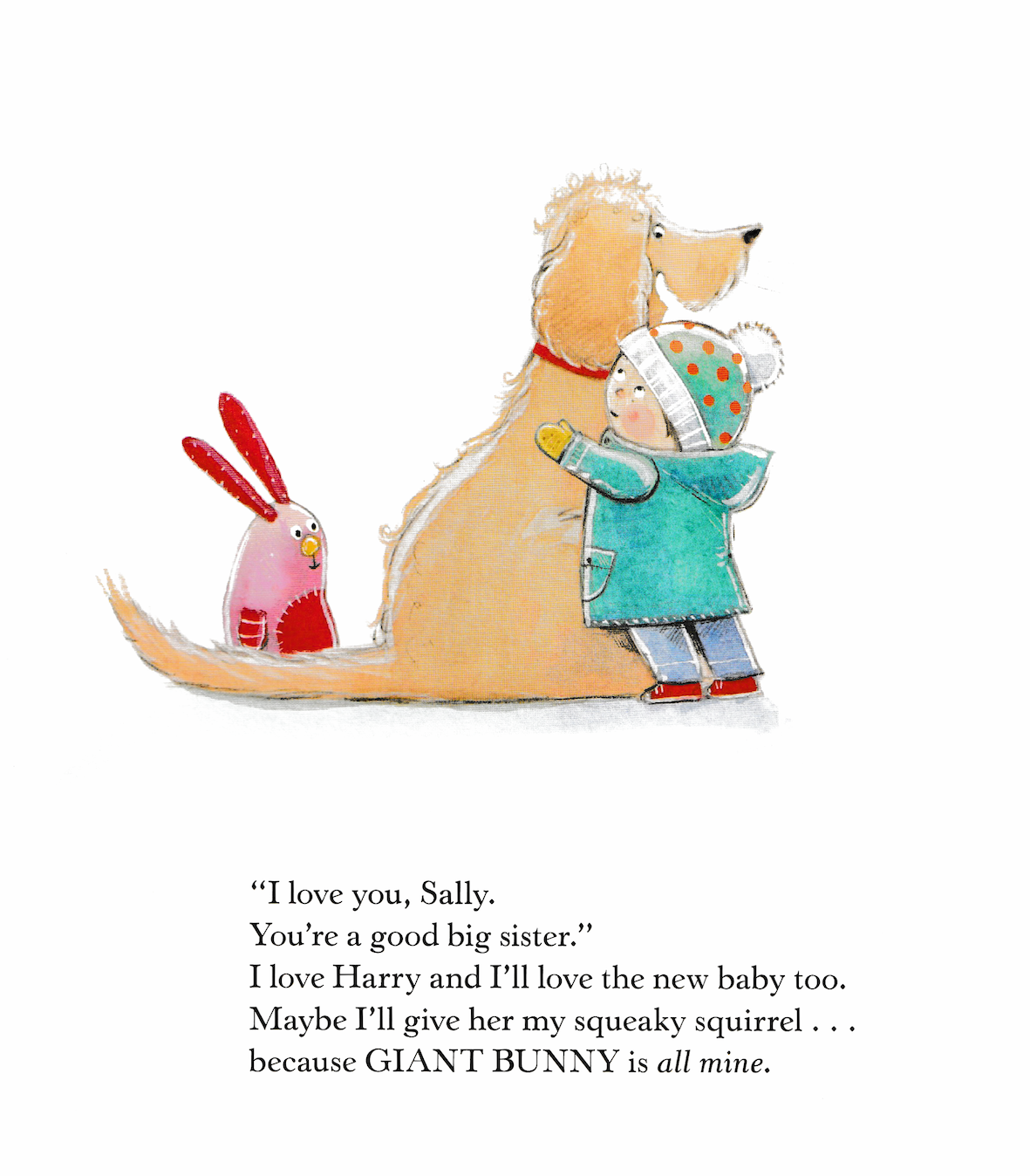
Immediately after Harry arrives, Sally knows things are going to change. She lets herself out when her people are too engrossed with the noisy baby.  Sure, she gets a blanket and a new squeaky squirrel, but Harry gets a giant red bunny! And when Sally tries to show affection for Harry as she would her own pup, they yell at her to get away and she is told, "No." Now Sally has a dog walker, and she sleeps in a basket because Harry sleeps with them. 
From When Sally Met Harry by Paulette Bourgeois, illus. by Brooke Kerrigan
Though Sally tries to think of a way to make her people love her again, she really doesn't have to do anything special. Sally's specialness comes through with the simplest of acts and makes Harry realize that Sally is part of his loving family.
I look deep into Harry's eyes.
I let him know that I love him.
From When Sally Met Harry by Paulette Bourgeois, illus. by Brooke Kerrigan
Many will recognize the name of Paulette Bourgeois as the author of the Franklin the Turtle series but it's obvious she knows more than turtles. She knows babies and children and dogs. She knows the confusion of a new baby in a home with a pet who has been the only "child" and used to getting all the attention and love. But, Paulette Bourgeois, a grandmother herself, also probably knows about finding a way to make all feel appreciated and loved–which will be all the more important when Baby #2 comes along–while bringing seemingly unconnected family members to becoming part of the whole. Telling the story from Sally's perspective, feeling what she does, hearing from others, and seeing for herself, Paulette Bourgeois makes Sally the star of When Sally Met Harry and restores her place of importance when we all know that a helpless baby must become the center of his parents' attention, at least for a time. And then when that baby is a toddler and can be a little brother to big sister Sally, the family circle is complete again.

That sweetness of story and familial bonding comes through in Brooke Kerrigan's illustrations. Rendered in watercolour, pencil crayon and gouache on paper before digitally enhanced, the artwork screams cuteness. From the playful and loving Sally to the cherubic Harry–look at that round head!–and all the little details of toys, squirrels, cats, and other dogs, When Sally Met Harry depicts many a household in which a baby is introduced to a family pet. Still, with Paulette Bourgeois's words and Brooke Kerrigan's illustrations, When Sally Met Harry tells the story of a one-of-a-kind relationship that could earn a cinematic rendering of its own.

September 16, 2022

Harvey Takes the Lead: Guest review

This review was prepared by Gr. 9 student Bronte L.
 
Written by Colleen Nelson
Illustrated by Tara Anderson
Pajama Press
978-1-77278-240-0 
288 pp.
Ages 8-12
May 2022

In Colleen Nelson’s book, Harvey Takes the Lead, Maggie and her friend Austin and their adventurous dogs Harvey and Bertie (respectively) volunteer at Brayside Retirement home. But there is much worry at the home with its new management, rules, and the possibility of Harvey’s dismissal as a comfort dog. For one couple, Mr. and Mrs. Kowalski, there is even more anxiety as Mrs. Kowalski is sick in hospital and her husband is anxious for her return, especially with the upcoming Valentine's Day dance. Ever the good listener, Austin does his very best to help the senior cope by listening to accounts of how the couple met in their youth.

Meanwhile, Maggie and Austin have troubles of their own, mostly dealing with friends and school. Maggie is dealing with not getting the part she wanted in her school play and instead getting the role of the understudy to Ndidi, a girl who Maggie doesn't think deserves the lead. Austin, on the other hand, is too embarrassed to tell his best friend that he can't afford to go on a school trip. And Harvey? He's determined to drive out the rodent nest at Brayside, even if it means breaking a few rules.

Harvey Takes the Lead by Colleen Nelson is a good fit for readers in grades 3-6, but can certainly be enjoyed by people of all ages. It's a heartwarming story about balancing school, family and friends, and giving second chances. The short chapters alternate between perspectives of Maggie, Austin, and Harvey, giving you a look at each of their unique  experiences. Every single character has a vibrant personality and backstory, including Harvey and Bertie, the beloved canines!

Out of 10, I would give Harvey Takes the Lead a 9. If you think retirement homes are dull, you certainly have not heard about Brayside! I absolutely loved the spunk and courage of the seniors, and Maggie and Austin were such relatable and likeable characters. It is far from the genres I usually read, but I enjoyed it a whole lot more than I thought I would! The story was fast paced, and the short chapters made it a quick and enjoyable read. After finishing this book, you’ll want nothing more than to have a chat with the Brayside residents over coffee and Mrs. O’Brian’s blueberry muffins! 
 
~ Written by Bronte L.
 
• • • • • • • 
 
Harvey Takes the Lead (2022)

August 19, 2022

Ballewiena

Written and illustrated by Rebecca Bender
Pajama Press
978-1-77278-137-3
32 pp.
Ages 4-7
June 2022

Let's get some joy in our lives. Dance, dogs, and fulfillment will do just the trick with Rebecca Bender's Ballewiena.
From Ballewiena by Rebecca Bender
Dotty dreamed of being a ballet dancer. She knew how to pliĆ©, assemblĆ© and pirouette. She could chassĆ©, glissĆ© and do a pas de chat (even though she was a dog). But Ms. Austere did not appreciate Dotty's moves and, while she trained Dotty's poodle sibs Jazzebelle and Miffy for the upcoming Golden Bow Talent Show, she took the dachshund to the Canine School of Obedience. 
From Ballewiena by Rebecca Bender
But obedience school was not for Dotty who "tried, she really did, but something inside her made her spring up into an elegant entrechat." Despondent, Dotty runs into the park after class and meets Louis-Pierre, a squirrel and an acrobat. Louis-Pierre invites Dotty, whom he calls Pitou, to work out with him and teaches her, by some unusual pedagogical means, the value of practice in gaining skills.  
From Ballewiena by Rebecca Bender
Still, when the Golden Bow Talent Show comes around, Dotty is expected only to watch from the audience. But, Louis-Pierre has other ideas and liberates Dotty to show off her skills and reveal her true ballerina self.

Young readers will know Rebecca Bender's storytelling from her award-winning Giraffe and Bird series (e.g., Giraffe Meets Bird; Giraffe and Bird Together Again; Don't Laugh at Giraffe) but she does as well by dogs as she does with giraffes, birds, hedgehogs and ducklings (e.g., How Do You Feel?) and more. She makes us care about her characters who are all expressive and one-of-a-kind, whether they are pets or wild. That's because her stories are those lived by children. Dotty may be a dog but she could be any child who feels her dream is being stifled and who wants to express herself through dance. I suspect that Rebecca Bender is a herself ballet parent, one who has learned much from attending classes with little ones. In fact, I myself learned much about ballet through the text of Ballewiena but also in her incredible endpapers that depict a variety of ballet movements and their phonetic pronunciations. Yes, Ballewiena is about ballet, and would make a great gift for any child who enjoys dance classes, but it has important messages about following your aspirations and being true to yourself while ensuring that you put the work in so it becomes a goal and not a pipe-dream.  

Rebecca Bender's illustrations, created with gouache, watercolour, pen and ink, as well as digital media, carry those messages through worlds of colour, shape and attitude. Her assortment of canine and other characters conveys a depth of personality beyond the dance. (I was especially taken with Louis-Pierre who, with his sweatband and drawstring workout pants, has a je ne sais quoi quality that is adorable, even as he coaches Dotty through rigorous training.)

Whether you're a dancer, an appreciative fan or neither, Ballewiena reminds us to follow our passions and dance fully in our lives.

June 28, 2022

Pugs Cause Traffic Jams

Written by Jennifer McGrath
Illustrated by Kathryn Durst
Kids Can Press
978-1-5253-0340-1
32 pp.
Ages 3-7
May 2022
 
When Kirby, her pug, goes missing, this child searches all over town, inquiring of others with their own dogs, as to any sightings. There's Mrs. Gossman with her golden retriever and Mr. McCraig the crossing guard with his helpful border collie. Then there's Casey with his ball-playing lab and Jo and Jan with their Doberman. There are countless dogs and their people all over town and, while she politely asks for help finding her chubby pug with his macaroni-shaped tail, Kirby is out on the road causing mayhem for drivers and then the police and the community as a whole.
From Pugs Cause Traffic James by Jennifer McGrath, illus. by Kathryn Durst
There are poodles and chihuahuas, huskies and terriers, German shepherds, afghans and basenjis. But no Kirby, the pug, who has left the comforts of his home to follow a butterfly.
From Pugs Cause Traffic James by Jennifer McGrath, illus. by Kathryn Durst
And, oh, the chaos while Kirby plays with the butterfly, oblivious to everyone around him trying to avoid him and instead having collisions and dropping their loads and getting snarled in traffic. But, it's with that attention–in fact, Kirby becomes a bit of a celebrity–that the child is able to finally be reunited with her beloved pooch.
From Pugs Cause Traffic James by Jennifer McGrath, illus. by Kathryn Durst
My, my, my! Kirby may be unaware of the pandemonium and subsequent distinction given to him–there is a sign "Pug 4 Prez" and pugarazzi wanting his pawtograph–but he has always been a star to his girl. His household toys, treats, food and sleeping accommodations suggest a well-loved dog, not unlike the plethora of other breeds that ride in cars with their people, play and work and offer companionship. So, while New Brunswick author Jennifer McGrath introduces young readers to many, many dog breeds and their characteristics, she puts her tongue firmly in cheek, makes a few puns, and lets us join Kirby on his adventure, ultimately a safe one, to be the playful rover of Pugs Cause Traffic Jams. Moreover, Jennifer McGrath shows us the absurdity of those who declare celebrity for trifling matters, with photographers, police, podcasters, news people and fans pursuing the latest trend without question. It's only the children who notice Kirby for the lost dog that he is.

While there's a lot of accuracy in Toronto artist Kathryn Durst's illustrations, easily distinguishing the various dog breeds with their colourings, temperaments and morphologies, she keeps the artwork playful and energized, suitable for a story of an AWOL dog who unknowingly creates havoc. As bold as Kirby's spirit for adventure are Kathryn Durst's art created in pencil and pencil crayon with digital graphic apps Procreate and Photoshop. The illustrations are striking in their colour and shape, offering semi-realism with cartoon sass.

For young readers and especially those who are dog-lovers, Pugs Cause Traffic Jams will make them think twice about dropping their guard around their audacious pets, especially those special pugs, but also recognize that celebrating their pets' uniqueness doesn't require the spotlight of social media. Just being their canine selves should be enough to afford love and attention.

December 30, 2021

Catalina

Written and illustrated by Lori Doody
Running the Goat, Books & Broadsides
978-1-927917411
40 pp.
Ages 3-7
August 2021
 
If I have to close out the year with one book with a positive message, let it be Lori Doody's Catalina, a picture book about acceptance and adaptation. Isn't that one that needs to be told as we enter a second year of a pandemic? And it all comes from a tale of a cat and three puppies.
From Catalina by Lori Doody
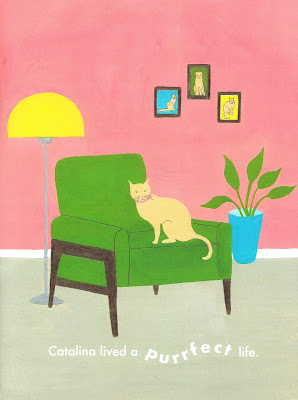
Catalina is a contented cat. She's happy in that she loves her life as it is. Her life is her own. She eats, plays and sleeps when and where she wants. Of course, there are times when she's a little lonely when her people aren't at home and she's alone but still "Catalina lived a purrfect life." And then everything changes.
From Catalina by Lori Doody
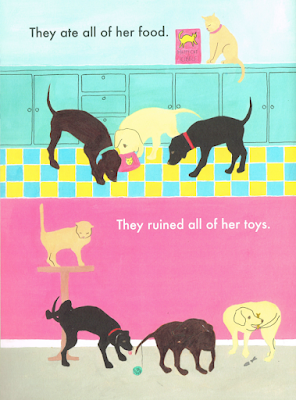
Her people bring home three Labrador Retriever puppies. Catalina is not amused. They are everywhere in her house: where she eats, what she plays with and where she sleeps. They're bigger than her, louder than her and rambunctious. She just can't get away from them and she doesn't like the way she feels: crooked (Newfoundland-speak for in a bad mood, according to the glossary).
From Catalina by Lori Doody
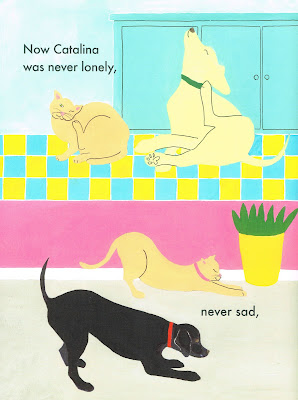
And then she notices a few things. The pups are willing to share with her and keep her company and she was no longer lonely.

Lori Doody gives us a quaint story of introducing new pets into a household already established for another. Many pet owners know the potential difficulties of doing so, whether with the same or different species. Catalina was content with the status quo even if there were things missing for her, like friends. It wasn't until she met the new dogs that she realized what it was that was missing in her life: companionship. But Lori Doody has given us more than a story about a cat and three dogs. In her folk art style, Lori Doody has given us a metaphor for accepting change and adapting to it, even if the benefits cannot be perceived initially. Catalina thought her life was "purrfect." It wasn't though. That became obvious once she embraced the Labs as there to stay, and she gained friends, playmates, cuddle buddies and more. If she'd closed herself off from the unfamiliar, she would have never realized the gifts the puppies brought into her life.

It's a simple story: cat meets dogs, cat is annoyed with dogs, cat learns to love dogs, and everybody is happy. But Lori Doody tells it as a lesson in colour and affection. She does it with softness of line, a landscape of patterns, and the warmth of a hospitable palette. As Catalina learned to love something new, so should we try when presented with something new. Different is not always bad, as we may anticipate. It's just different, and, as Catalina learns, it may even be wonderful.