Showing posts with label Newfoundland. Show all posts

June 11, 2026

Gander: The Town That Welcomed the World

Book cover of Gander: The Town That Welcomed the World shows a child looking out over the water at colourful boathouses and docks
Written by Nikki Bergstresser 
Illustrated by Reilly Fitzgerald 
Plumleaf Press 
978-1-997872047
36 pp.
Ages 9–9
Releases June 30, 2026 
 
Explaining to children the terrorism of 9/11 is a big ask. But by focusing on the kindness of a community instead of wicked intentions, the message is one of positivity and not hatred. Gander did welcome the world and Gander: The Town That Welcomed the World tells that story. 
People disembark from a plane in Gander, Newfoundland
From Gander: The Town That Welcomed the World, written by Nikki Bergstresser, illustrated by Reilly Fitzgerald
What Nikki Bergstresser does is take the story of those stranded in Gander on September 11, 2001 down to the level of the people. Readers won't read about the events that prompted these extraordinary landings but rather see what they see and what they feel, only getting a vague picture of something big happening elsewhere.
The skies grew silent. Air travel around the world
came to a sudden stop. (pg. 5)
Who did know about what was happening were those in Gander who, seeing the news, jumped into action. They gathered supplies like bedding and towels, and toys for the children, and brought the passengers, who'd waited on their planes for upwards of 24 hours, to churches, schools, community halls, and home. They fed them, helped them make phone calls, comforted them, and showed them the heart of Gander.
Map shown to visitors of where Gander, Newfoundland is located
From Gander: The Town That Welcomed the World, written by Nikki Bergstresser, illustrated by Reilly Fitzgerald
Though those who found safety in Gander are not named—more than 6,000 people on 38 planes arrived—there is one little girl with long dark braids who is often seen: listless on a plane, resting on a cot, or exploring the land and waters of Gander with her hosts. Nikki Bergstresser and Reilly Fitzgerald help personalize these experiences without making anyone a main character. After all, it's Gander that's the star.
Illustration shows shows 9/11 guests welcomed into homes ad helped with making phone calls
From Gander: The Town That Welcomed the World, written by Nikki Bergstresser, illustrated by Reilly Fitzgerald
When Gander's guests finally get to continue their journeys six days after the first plane landed there, there's a rainbow casting the glow of good will. 
 
Many young children, particularly in Canada, may not be aware of the events of 9/11. Unless they were directly impacted by a relative who was there or by perhaps a parent who was pilot or a resident of Gander, most adults will not discuss the events of the day with them. But there is a way to speak to them about it with sensitivity, and Nikki Bergstresser's Gander: The Town That Welcomed the World would be a tasteful and enlightening way to do so. BC's Nikki Bergstresser packs a lot of depth in her words, conveying easily the exceptionality of this day with the natural response of these Ganderites and Newfoundlanders in general. Her words take us through those days by balancing the fears and confusion with action and kindness.  
Illustration by Reilly Fitzgerald shows plane leaving Gander with rainbow behind it
From Gander: The Town That Welcomed the World, written by Nikki Bergstresser, illustrated by Reilly Fitzgerald
Reilly Fitzgerald's artwork relies on the authentic, much like the response of the community of Gander. Reminiscent of the artwork of Ted Harrison, Newfoundland's Reilly Fitzgerald uses acrylics to create bold illustrations, with elements heavily outlined in white or black. The impact is extraordinary in its confidence. He gives us scenes of people arriving, confused and frightened, and of people joyous in their heartwarming drive to help. And he gives us a Newfoundland that is expansive and welcoming.
 
Nikki Bergstresser and Reilly Fitzgerald have brought young readers a non-musical and more colourful version of "Come From Away." The complexity of emotions, from fear and confusion to compassion and determination, are all there, and tell the story of Gander stepping up to help those waylaid by the events of September 11. Whether used as a jumping off point for teaching a historical event or for character education, Gander: The Town That Welcomed the World will be a notable story for its retelling of a remarkable act of humanity.

April 25, 2024

The Pig and the Dumpling

Written by Bonnie Johnstone
Illustrated by Veselina Tomova
Running the Goat, Books & Broadsides
978-1-998802081
40 pp.
Ages 4-8
March 2024 
 
In a tale from a Newfoundland outport, Bonnie Johnstone tells a story of a pig, a dumpling, and mayhem. It's a story that could only come from a small rural community in which everyone knows everyone else, and their actions are noted and intertwined for good and with misfortune.
From The Pig and the Dumpling, written by Bonnie Johnstone, illustrated by Veselina Tomova
After three fishermen tend to the garden belonging to the local convent, they are compensated with a hearty meal of stew with dumplings. As one of the men was not fond of dumplings, he tossed it towards the pig pen of Ignatius, Tulip, and their piglets. To his delight, Ignatius grabs that dumpling. To his horror, it scalds his throat and lodges there.
                                      The scalding hot lump
                                    of gluey dough
                                  plopped down
                                into his throat
                              like
                           a cork
                        in
                  a
            bottle.
In desperation, Ignatius makes a mad dash to the ocean, the ocean with icy cold water that would be sure to soothe his burning throat. But there is much activity in the outport, and it seems everyone is out and about and unknowingly in Ignatius's path. There's Tommy and Gussie who've gotten their kite stuck in Father McGettigan's rose bush. Then there's Father McGettigan and Reeni Puddicombe delivering pies for the church supper. Of course, Ignatius runs through and into Lizzie Carey's laundry hanging on the line, and, though he was able to miss the elderly Mrs. Maddigan and her cow Maude, the peddler Nellis was not as lucky. 
From The Pig and the Dumpling, written by Bonnie Johnstone, illustrated by Veselina Tomova
Ignatius's misfortune continues with more encounters with an accordion, drying fish, and a cart of kelp. And all for relief from a perilous dumpling.

Perhaps The Pig and the Dumpling is a cautionary tale about gluttony or perhaps about chewing one's food, but maybe it's just a story about a community in which everyone is an important part, from a pig at a convent's farm to the kelp farmers, children, the elderly, and everyone in between. It's a community of life and living, in which neighbours help each other, in which fish is dried and kelp is collected, and laundry is hung out to dry, and pies are made for a church supper. That little dumpling may have stoppered poor Ignatius's throat temporarily, but it gave him the opportunity to get out and interact with others in the community. His interactions may have been problematic for many, including poor Ignatius, but Bonnie Johnstone gives us a happy ending and a glimpse into a rural Newfoundland community as it may have been in the 1800s. (Bonnie Johnstone's "A Note About the Story" gives a little more background.)
From The Pig and the Dumpling, written by Bonnie Johnstone, illustrated by Veselina Tomova
Veselina Tomova's art is highly textured, not unlike the story, with acrylic brushstrokes on canvas giving movement to Ignatius's quest for cooling and chaos along that crusade. As she demonstrated in earlier books like Spirited Away: Fairy Tales of Old Newfoundland, PB's Comet and Daphne's Bees, Veselina Tomova knows how to get the atmosphere appropriate for the story, from light and airy, to dark and brooding, or silly and chaotic. With the colours, the shapes, the application of paint, Veselina Tomova gives The Pig and the Dumpling the realism with the nonsense and will have readers wondering whether there was an Ignatius to whom this really happened. With a quick visit to this outport of days gone by, they'll all know soon enough.

December 30, 2021

Catalina

Written and illustrated by Lori Doody
Running the Goat, Books & Broadsides
978-1-927917411
40 pp.
Ages 3-7
August 2021
 
If I have to close out the year with one book with a positive message, let it be Lori Doody's Catalina, a picture book about acceptance and adaptation. Isn't that one that needs to be told as we enter a second year of a pandemic? And it all comes from a tale of a cat and three puppies.
From Catalina by Lori Doody
Catalina is a contented cat. She's happy in that she loves her life as it is. Her life is her own. She eats, plays and sleeps when and where she wants. Of course, there are times when she's a little lonely when her people aren't at home and she's alone but still "Catalina lived a purrfect life." And then everything changes.
From Catalina by Lori Doody
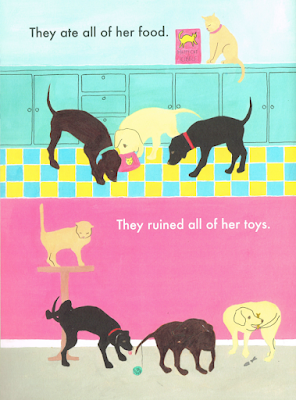
Her people bring home three Labrador Retriever puppies. Catalina is not amused. They are everywhere in her house: where she eats, what she plays with and where she sleeps. They're bigger than her, louder than her and rambunctious. She just can't get away from them and she doesn't like the way she feels: crooked (Newfoundland-speak for in a bad mood, according to the glossary).
From Catalina by Lori Doody
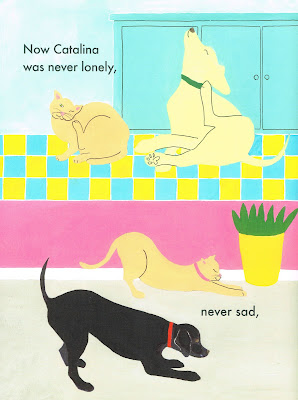
And then she notices a few things. The pups are willing to share with her and keep her company and she was no longer lonely.

Lori Doody gives us a quaint story of introducing new pets into a household already established for another. Many pet owners know the potential difficulties of doing so, whether with the same or different species. Catalina was content with the status quo even if there were things missing for her, like friends. It wasn't until she met the new dogs that she realized what it was that was missing in her life: companionship. But Lori Doody has given us more than a story about a cat and three dogs. In her folk art style, Lori Doody has given us a metaphor for accepting change and adapting to it, even if the benefits cannot be perceived initially. Catalina thought her life was "purrfect." It wasn't though. That became obvious once she embraced the Labs as there to stay, and she gained friends, playmates, cuddle buddies and more. If she'd closed herself off from the unfamiliar, she would have never realized the gifts the puppies brought into her life.

It's a simple story: cat meets dogs, cat is annoyed with dogs, cat learns to love dogs, and everybody is happy. But Lori Doody tells it as a lesson in colour and affection. She does it with softness of line, a landscape of patterns, and the warmth of a hospitable palette. As Catalina learned to love something new, so should we try when presented with something new. Different is not always bad, as we may anticipate. It's just different, and, as Catalina learns, it may even be wonderful.

July 20, 2020

Footsteps in Bay de Verde: A mysterious tale

Written by Charis Cotter
Illustrated by Jenny Dwyer
Running the Goat, Books & Broadsides
978-1-927917282
44 pp.
All ages
May 2020

From the extraordinary teller of ghost stories, Charis Cotter, comes another haunting tale of old Newfoundland from a time when listening to adults talk was entertainment for children and mysterious tales weren't from the imagination alone.
From Footsteps in Bay de Verde: A mysterious tale by Charis Cotter, illus. by Jenny Dwyer
An hour past their bedtime, children John, Bridie and Theresa–8, 6 and 4 respectively–sit squished on a daybed with others, trying to stay invisible to the adults who visited, sharing news of the fishing, the union, and the weather. They also speak of the health of Mother's cousin, Jim Keye, ever known as Poor Keye, who'd gone to hospital in St. John's. Poor Keye who was already afflicted with cataracts and a bad leg that gave him a recognizable "step–shuffle–thump" footstep was a favourite of Birdie's for his jokes and candy in his pockets.
From Footsteps in Bay de Verde: A mysterious tale by Charis Cotter, illus. by Jenny Dwyer
Just as Mr. Fleming begins his story about Billy Cotter going stark raving made one night, "screaming bloody and foaming around the mouth," the front door crashes open with a bang and they all hear the familiar shambling footsteps coming down the hall. As they wait for the returned Poor Keye, Mr. Fleming continues his story. They all hear the footsteps but no one comes in. Bridie's mother even takes the lamp and goes to check on him, sure that he'd lost his way because of his cataracts.
There was a moment of silence that seemed to fill the whole house. Bridie could feel her heart thumping under her sweater. The wind was picking up now, rattling the windows furiously.
     Suddenly there was a loud crash from the back kitchen, and the sound of breaking glass.
When their mother returns without Jim and sees her children still up at quarter past nine, she shuffles them off to bed, leaving a candle for the three children who huddle in their bed in darkness of their room.
From Footsteps in Bay de Verde: A mysterious tale by Charis Cotter, illus. by Jenny Dwyer
But it's in the brightness of the next morning that brings the scariest of news when a telegram arrives from St. John's that confirms that last night's visit was not limited to those seen in the kitchen.

Charis Cotter is a ghost storyteller. From her award-winning The Swallow to her The Ferryland Visitor, Charis Cotter, who lives by the sea in Western Bay, Newfoundland and Labrador, paints wildly spooky stories from the mundane. It’s the wind and the rain and a road or a picture. It's friends gathering to chat and a soul far away and right at hand. She tells it as it was, placing the reader in a house pounded by a wind, chilled and dark by weather and something else. From little Theresa whimpering to Mr. Brady spitting out his chewing tobacco to the wind trying to get in, Footsteps in Bay de Verde recreates a story told to Charis Cotter by Brian Walsh, a Newfoundland storyteller himself, of a story his mother experienced in the 1920s and makes us believe what the characters saw and heard.
"It could've been the wind."
"Well, if it was, it's the first time I've ever heard the wind make footsteps."
This is Newfoundlander Jenny Dwyer's first picture book and she gives powerful imagery to Charis Cotter's words. That wind, the cold, the dark and the haunting atmosphere of Bridie's family home on that night is delivered with a starkness and an authority. Through her limited palette of cool blues, greys and black, with just the mere touch of red–in a ribbon, on a candy, a stamp on a telegram–Jenny Dwyer upholds the eeriness of the night and the revelation of the next morning. Even on this hot summer day as I review this story, I feel that chill and the mysteriousness of something experienced but unexplained.

For another haunting picture book, set in old Newfoundland, Footsteps in Bay de Verde makes the real just a little bit dark and a whole lot mysterious.

May 02, 2019

Peg Bearskin: A traditional Newfoundland folktale

As told by Mrs. Elizabeth Brewer
Adapted by Philip Dinn and Andy Jones
Illustrated by Denise Gallagher
Running the Goat, Books & Broadsides
978-1-927917-19-0
44 pp.
All ages
February 2019

Peg Bearskin may be big and ugly and hairy but she's clever and that gumption and canniness make all the difference to her life and those of others.
From Peg Bearskin, illus. by Denise Gallagher
Peg Bearskin is one of three daughters but, alas, her sisters are "pretty as ever the sun shined on" and Peg Bearskin is not. As they grow older, her sisters, like many people, want nothing to do with Peg but she persists in following them. It's lucky for them that she does as, when they spend the night at the home of an old woman, Peg's instincts and exploration lead her to discover the woman to be a witch who possesses a decanter that never empties, a lantern that shines for half a mile without fuel, and a swift horse with magic bells for wishing. Realizing that the witch intends to kill her sisters, Peg tricks the old woman and the three escape. 

When the three siblings get older, Peg goes to see a king with three marriageable sons. She promises the decanter to him if he'd allow her oldest sister to marry his oldest son. She only asks for a handful of pepper to achieve her task of acquiring the decanter for him. While the witch's old man uses the decanter, Peg throws the pepper at him and grabs the pitcher.  Similarly, she steals the lantern to secure a husband for her other sister. Finally, she does the same for herself, using a knife and saw to steal the horse with its magical bells.
From Peg Bearskin, illus. by Denise Gallagher
But, the third son is distraught to be married to Peg. Recognizing that perhaps making a wish on a bell might give him what he wants, Peg shares with him the secret of the bells, upon which he wishes for Peg to be beautiful. And, though the reader will see that Peg does not appear to be any different, the prince, who has turned big, ugly and hairy himself, sees Peg as "the most beautiful woman that water ever wet or the sun ever shined on."

Peg Bearskin may focus on Peg's appearance as defining how she is seen but it supersedes that characterization by showcasing how clever she is. She doesn't need to be beautiful in the same terms of her sisters, and Peg Bearskin justifies the phrase that beauty is in the eyes of the beholder because Peg is beautiful by her astuteness. Even in the end, when her husband wishes her to be beautiful, it's not her that must change. 
From Peg Bearskin, illus. by Denise Gallagher
This traditional Newfoundland folktale is derived from Mrs. Elizabeth Brewer's story told to a folklore student in 1976 and is part of the Memorial University of Newfoundland Folklore and Language Archive (MUNFLA) and shared in multiple editions of books on the folktales of Newfoundland. Philip Dinn and Andy Jones adapted it for a storytelling play in the late 1990s and several versions have been published over the years. This edition, illustrated by Louisiana artist Denise Gallagher, lends a folk art feel to the story. With its earthy green tones and beet red touches, Peg Bearskin becomes a true reflection of the folklife of Newfoundland while continuing to focus on the message that beauty should be accepted in its different manifestations. It's storytelling that can be heard in the Newfoundland vernacular of "mudder" and "et" and "spose" and in the supernatural elements of wishing for children, an evil witch, and magical phenomena. There is beauty in all of it and most of all in Peg Bearskin herself.

February 18, 2019

The Sound of Drowning: Book launch (St. John's, Newfoundland)

Because I failed to include this book in my post
about upcoming winter and spring releases of youngCanLit
(now amended),
let me promote the book launch for

Katherine Fleet

and 

her new young adult novel

The Sound of Drowning
Written by Katherine Fleet
Page Street Kids
978-1624147111
384 pp.
Ages 14-18
March 2019


on

 March 26, 2019

at

7 p.m.

at

Chapters
70 Kenmount Road
St. John's, Newfoundland

About the book:
Meredith Hall has a secret. Every night she takes the ferry to meet Ben, her best friend and first love. Though their relationship must remain a secret, they’ve been given a second chance, and Mer's determined to make it work. She lost Ben once before and discovered the awful reality: she doesn't know how to be happy without him…

Until Wyatt washes ashore―a brash new guy with a Texas twang and a personality bigger than his home state. He makes her feel reckless, excited, and alive in ways that cut through her perpetual gloom. The deeper they delve into each other’s pasts, the more Wyatt’s charms become impossible to ignore.

But a storm is brewing in the Outer Banks. When it hits, Mer finds her heart tearing in half and her carefully constructed reality slipping back into the surf. As she discovers that even the most deeply buried secrets have a way of surfacing, she’ll have to learn that nothing is forever―especially second chances.

Retrieved from Goodreads at https://www.goodreads.com/book/show/40046016-the-sound-of-drowning on February 17, 2019.

November 28, 2018

Seasons Before the War

Written by Bernice Morgan
Illustrated by Brita Granström
Running the Goat, Books & Broadsides, Inc.
978-1-927917183
44 pp.
Ages 7+
October 2018

Though the war mentioned in the title refers to World War II, it seems only appropriate to review Seasons Before the War in the same month as the 100th anniversary of the Armistice, when peace was declared and life would no longer revolve around war. Newfoundlander Bernice Morgan's first children's book, Seasons Before the War, speaks of that different time, a time between wars, when children of St. John's, Newfoundland lived lives full of play, family and community. It was a distant time and disparate from today but also distinct because of its Newfoundland setting. This is Bernice Morgan's story from that time.
From Seasons Before the War by Bernice Morgan, illus. by Brita Granström
Seasons Before the War reads like a bundle of warm but forthright reminiscences. Starting with Spring, Bernice Morgan speaks of the freedom to play in the many open spaces shared with children from various neighbourhoods. There were games, pretend tea parties, skipping and the freedom to venture out, though family made sure that children overheard stories about those who'd gone farther than permitted and "were never seen again." (pg. 9) Mealtimes were times to reinforce those cautionary tales but also to teach manners and the need for frugality.
From Seasons Before the War by Bernice Morgan, illus. by Brita Granström
In Summer, little Bernice–clearly identifiable from her glasses–and her big brother Charlie and other playmates would venture out on the streets filled with water pumps, horses, and farmers selling their produce and local merchants like the grocer, drug store, meat market and bulls-eye shop (candy shop). There was a blacksmith and  dressmaker or two and workshops, including her own father's carpentry shop, where the children could watch men at work. But it was the dump, source of the occasional great find, that entertained them most.
It was not as scavengers we went to the dump but as spectators, as people might go to a movie or concert. The place was not fenced, but surrounded by a kind of berm where we could sit for hours watching horse and box carts being backed up to the edge, appraising how each ashman would slowly manoeuver his animal into place, drop the back gate, and tip his load into the inferno of glowing ash. (pg. 23)
And when there was a fire at the dump, a weekly occurrence, and the firemen came with their firetruck, the entertainment surged.

In Fall, it was time for school and, for Bernice beginning kindergarten, the excitement of new shoes and a school uniform, her first book bag, exercise book and pencils. But school becomes a disappointment for Bernice who is shocked to find "that I was not the smartest or the prettiest child in the world" (pg. 26) and that her glasses and inability to tell left from right set her apart from her classmates. Fortunately, a gift of an extraordinary pencil box from her Aunt Sophie helped ease some of that discomfort.

And then Winter came, and venturing outside of the home was no longer the norm.
Inside the house we children did a lot of watching: watching our father mend footwear, fix furniture, or melt molten lead to solder a pot; watching the women bake, make jam, paper walls, knit, or pin patterns onto beautiful cloth to make dresses, pajamas, and even coats. Unlike scrubbing floors or washing clothes, there were interesting jobs that a youngster could help with. Holding skeins of wool, stirring batter, licking spoons clean, passing tacks, holding down flimsy patterns, carefully cutting the edge off wallpaper, even picking up scraps of leather or cloth, made a child feel important. (pg. 31)
But Christmas brought new excitement and fears, as Toylands in the local stores were opened (toys were not regularly displayed) and children worried whether they'd been good enough through the year. But it was a glorious evening when the whole family traipsed down to view the displays in the windows and point and smile and enjoy a treat of chips.
From Seasons Before the War by Bernice Morgan, illus. by Brita Granström
Oh, it was a different time. It was a time when it was unusual for a woman like Aunt Sophie to have her own money. When those who moved from Cape Breton to Newfoundland were considered immigrants. When play could be arranging glass marbles in the holes of the sewing machine's foot pedal. When words like bulls eye (for candy) and sooking (being a crybaby) were part of the vernacular.

Bernice Morgan's story unfolds like the seasons: inevitable, expected and full of promise. It's refreshing and invigorating to see the rosy-cheeked children playing and living without reliance on electronic devices. Bernice Morgan's words breathe life into these memories, true or modified as memories may be, with affection and with a lyricism found only in great storytellers. With Swedish-born artist Brita Granström's paintings, detailed in people and landscape, award-winning novelist Bernice Morgan's nostalgic anecdotes are given second breath and transport readers, young and old alike, to a time and place that has disappeared and remains forgotten until shared as in Seasons Before the War.
For good and for ill much of that long ago world was about to vanish: the children's chants, the horses, the small workshops and unpaved streets, the seamen with their songs, the open fields, our guileless assumption of safety–all of that would soon disappear from our world. (pg. 40)

July 23, 2018

PB's Comet

Written by Marnie Parsons
Illustrated by Veselina Tomova
Running the Goat Books & Broadsides
978-1-927917-12-1
32 pp.
Ages 4-9
March 2018

While stories that support children's interests in the sciences, tech, math and engineering are becoming more and more common, I don't think there is one out there anything like PB's Comet which promotes the idea of following one's STEM dreams, even if ridiculed or ignored by others, with sheep and and a goat and Newfoundland flair.

PB is a lamb of Toads Cove (the original name of Tors Cove, NFLD) who, with other sheep and a goat, is taken over to Fox Island for summer grazing. While the others bide their time, grazing and watching tourists and whales, PB is reading about astronomer Edmond Halley, studying star charts and staying up at night to ponder the night sky. Her focus is on calculating when the next comet might stream across the sky.  But the old goat "who was inclined to be grumpy and rather remote" (pg. 12) does not appreciate her efforts.
From PB's Comet by Marnie Parsons, illus. by Veselina Tomova
So he'd hide PB's spyglass and munch on her maps
and jumble her numbers while poor PB napped.
But no matter the ills of the old goat's devising,
PB maintained an extremely surprising
insistence that soon her comet would come,
and with every assurance that goat seemed more glum. (pg. 15)
But when that old goat glimpses the night sky, which he'd been missing because of heading to bed earlier than most, PB's pest becomes her protege, joining her to watch the night sky and learn.
From PB's Comet by Marnie Parsons, illus. by Veselina Tomova
Though a picture book which many people incorrectly assume to be only for the very young, PB's Comet is sophisticated in its text and artwork and probably better suited to early and middle grade students who will be able to delve deeper into the science and history of the story. (The endpapers have a colourful timeline of possible sightings of Halley's Comet from 3 c. BC through 1986.) Still, though Marnie Parson's appended notes tell the story of Edmond Halley's 1700 visit to Toads Cove as well as the practice of Tors Cove farmers to take their sheep over to Fox and Ship Islands for summer grazing, PB's Comet is a story even bigger than these elements.

Marnie Parson's rhyming text is rich in word choice and mood. In fact, the rhythms propel the reader through PB's story easily with the text's rhyming scheme (AABBCC) and Marnie Parson's choice of vocabulary. But the text is neither simplistic nor contrived. It has a depth of language that seems of another time and place and perhaps that is what it is supposed to convey. Veselina Tomova's artwork supports that spirit including such elements as a sextant and old-fashioned telescope in PB's scientific tools. Veselina Tomova's etchings also have a grittiness of a time and place less sterile than today, more earthy and humble, and totally appropriate for the story of PB's Comet.

PB's Comet has an important message about following your own path and passions, even those not supported by your community. The reader can feel PB's intention and passion for the stars and elements of the night sky, as well as the old goat's indignation, perhaps because it feels threatened, with a young sheep who doesn't follow the path of the others. Still, young readers will realize that the lamb can do astronomy, even if there are those who oppose her efforts and even sabotage them, and it's this message that should be heeded.

PB's Comet is funny, rhythmic and imaginative, but more than that, for lambs, girls and those pursuing their passions, PB's Comet has an important message about self-actualization that teachers and parents would do well to share.

June 15, 2018

Mallard, Mallard, Moose

Written and illustrated by Lori Doody
Running the Goat Books & Broadsides
978-1-927917-16-9
44 pp.
Ages 3-7
April 2018

The title sounds like the game Duck-Duck-Goose but, although there are ducks and a goose, the hero of the story is a moose and this is no game. It's about finding a home.
From Mallard, Mallard, Moose by Lori Doody
A moose is wandering the streets of St. John's, Newfoundland. It happens. But, he's accompanied by two mallards who follow him everywhere. He's perplexed by their attentions and "It was beginning to put him in a foul mood." His wanderings are not aimless: he's looking for a new home for his ducks. But, like Goldilocks, somethings just don't fit. A park has swans that make the mallards nervous. The downtown has pigeons. The harbourside has seagulls and even a menacing chicken. Location after location don't seem to work for the ducks. Even the restaurant Mallard Cottage looks to have potential until they check out the menu which apparently highlights wild game. (Oh dear!) It's not until a goose, which Lori Doody identifies as a Graylag Goose, a Eurasian species that is only rarely found in North America, agrees "to take the mallards under his wing" that the moose know his quest is complete.
From Mallard, Mallard, Moose by Lori Doody
Like her previous picture books Capelin Weather and The Puffin Problem (Running the Goat Books & Broadsides,  2017), Lori Doody embeds the reader in a Newfoundland setting of hilly streets, buildings of colourful clapboard siding, shorelines, animals and whimsically-named businesses. Her art is the centrepiece of Mallard, Mallard, Moose though the story itself is charming and feasible. That's the thing with Mallard, Mallard, Moose.  You know the story could be true. Moose in Newfoundland? Yep. Mallards too? Yes. One species imprinting on another? It's happened. And the Graylag Goose, which extraordinarily was a resident of St. John's for ten years, probably encountered more than a few mallards. This could be their story, and Lori Doody makes it all the more authentic with her folksy fine art. The mixed media on paper allows her to emphasize the depth of colour and the simple lines of a St. John's landscape and transport readers to a storefront window or park bench to observe the goings-on. It's bold and humble and concrete and pragmatic, and it works so well.  I love the drama and the earthiness of the story and art in Mallard, Mallard, Moose and I expect and hope that we'll continue to see Newfoundland in Lori Doody's picture books in the future.

November 20, 2017

Spirited Away: Fairy Stories of Old Newfoundland

Written by Tom Dawe
Illustrated by Veselina Tomova
Running the Goat, Books & Broadsides Inc.
978-1-927917-13-8
60 pp.
Ages 9+
October 2017

If the cover of Spirited Away leaves you with a feeling of dark and foreboding forces at play, then artist Veselina Tomova has done her job admirably because the stories that Tom Dawe recounts from family members and others about the nefarious fairies of old Newfoundland are truly spooky and frightening, if they are to be believed.  Tom Dawe and those who tell and listen believe, and so do I.
From Spirited Away 
by Tom Dawe
 illus. by Veselina Tomova
Nine stories, addended with a glossary and notes about each story's derivation, recall stories of children, a war bride, a visiting nurse, grandmothers and more as they were touched by fairies or were witness to such encounters.  In the first story In a Place Like This, a girl recalls an abandoned house near a pool where her grandfather gathered eels.  She'd heard the warnings of it being a place of spirits and evil fairies and the tales of a man in green dancing upon the house's door ledge.  But her story relates to evil done to the baby sister she watched over as her family cut hay in the adjacent fields.  Only the baby and a green butterfly know how her arm was broken as she lay on a blanket.

Paddy the Hermit, called the Music Man, often told scary stories but they became reality when walking home he is encircled by a group of little fairies who put a spell on him to play his harmonica until he collapses.
From Spirited Away 
by Tom Dawe
 illus. by Veselina Tomova
In several stories, people seek shelter inside at night when fairies seek to harm them outside.  In The Marsh, floating lights, said to portend death, follow two young men on their return from a dance.  Only shelter in a church all night with the light hoovering outside kept the men safe. Where Water Ran the Other Way tells of trapper Solomon finds refuge in a small cabin when caught at dusk.  Though feeling compelled to open the door to those calling him, he wills himself not to listen or look out the windows at the strange goings-on.

There's the story of The Fairy Funeral, Bones and Fallen Angels (from which the cover illustration is derived)  but the other two most compelling stories for me were Spirited Away and The Changeling.  In Spirited Away, a grandmother disappears from a family outing of blueberry-picking.  She recalls being lured deep into the forest by drumming and hours later being found but without memory of her extraordinary walk including the crossing of major rivers. The Changeling is perhaps the most disturbing.  It is the story of a visiting nurse called in the night to the home where less than two months earlier little Gracie was born.  Fearing the only child of John and Sally was ill, she discovers a mother declaring that there was something in the crib but not her child.
Finally, I found the courage to approach the crib. I pulled back the sheet.  And then, God protect us all! I'll never forget the sight. (pg. 46)
It's a chilling story of fairies taking babies and leaving something in its place but it's the certainty of what that nurse saw that was the most compelling.
I know what I saw.  And I know what happened.  John and Sally lost their only child. And that night in an outport years ago, I witnessed an evil transformation.  Something ugly and strange was left in the cot where Gracie was supposed to be. (pg. 49)
Tom Dawe tells some disturbing stories in Spirited Away, enhancing the atmosphere with the flavour of Newfoundland and coastal Labrador.  From the music to blueberry picking and the vocabulary much unknown to me (you may not need to look up duckish, emper, fetch, livyers and herts but I did), these are the stories of the people of Newfoundland.  Veselina Tomova's woodcut illustrations, in dark tones and snatches of light, reflect the very settings in which the fairies appear.  These are not your Disney fairies.  These are frightening, and Tom Dawe ensures that we know that they are real.
From Spirited Away 
by Tom Dawe 
illus. by Veselina Tomova

August 11, 2017

The Puffin Problem

Written and illustrated by Lori Doody
Running the Goat Books & Broadsides
978-1-927917-14-5
44 pp.
Ages 3-8
July 2017

Puffins! They're everywhere!  They're on the roofs and on the street.  They're on doorsteps and at store fronts. They're at the museum and art gallery and at the playgrounds.  They may be cute, but they have become The Puffin Problem.

Though there has never been a puffin problem to date, Lori Doody creates a scenario in St. John's whereby the city is overrun with puffins.  It is a quaint problem, though with puffins sidling up to people wherever and whenever, not everyone thinks they're all that cute.  Apparently all the puffins are affecting the people of St. John's as well as their pets and other birds.
From The Puffin Problem by Lori Doody
Birders, of course, love the opportunity to take in the plethora of puffins (actually a collection of puffins is called an improbability, a parliament or a circus) but most people feel otherwise.  The idea of shipping them off to Iceland doesn't fare very well.  However, a child's proposal of luring the puffins with food–with all manner of fish coming from Mudder's Fish Cakes, Ise The By, Me Ole Trout Fish Shop, Fish Out of Water Street, Anyfin Goes and Taiyō Sushi–finally gets the birds out to sea, at least for this year.
From The Puffin Problem by Lori Doody
Only in Newfoundland could this story be had.  And Lori Doody ensures that the reader recognizes the streets and landscapes of St. John's, from their colourful buildings, rocky cliffs and St. John's Harbour to The Rooms and the whimsical store names (like The Picture Plant and The Chocolate Lab).  As in her recently released Capelin Weather, also from Running the Goat Books & Broadsides, the art is fundamental to the story, providing a folksy flavour.  The colours are bold and the lines and shapes are rugged, reflective of the culture of Newfoundland.  The flattened perspective is typical of folk art and Lori Doody produces that feature with strength and distinct design.  The puffin problem may be identified as that by the residents of Lori Doody's story but for readers it's a charming tale of what can happen when cuteness overtakes everyday life.
From The Puffin Problem by Lori Doody

August 04, 2017

Capelin Weather

Written and illustrated by Lori Doody
Running the Goat Books & Broadsides
978-1-927917-09-1
32 pp.
Ages 3-7
July 2017

When the small fish known as capelin are rolling, it's a sight to behold and one with which many Newfoundlanders and some others on the Gaspé and in Nova Scotia are familiar.  Normally the capelin arrive to spawn on the beaches sometime between June and July, at the onset of summer, and grey, cold, wet weather is referred to as capelin weather.  But for Kate, the end to Capelin Weather can't come soon enough!
From Capelin Weather by Lori Doody
Like many children, summer holidays means the freedom to be outside playing in the sun and warmth.  For Kate, it means picnics and swimming and soccer and bonfires on the beach.  But not this year.  This year it is cold and overcast and rainy.  All the things she wants to do can't be done.  Her bingo-playing grandmother explains that when this "capelin weather" passes i.e., when the capelin arrive and people have collected their fill, a hot and sunny summer will be left behind.  Kate tries to make the connection between the small fish and the weather, imagining them falling from the sky like rain.  That is until the capelin do roll in.  Then the people come out to catch some, as does Kate, heralding the true beginning to summer.
From Capelin Weather by Lori Doody
Lori Doody's story is quintessential Newfoundland with its rocky beaches, summer past times, icebergs, lupines, lighthouses and more.  From the paintings on the wall of Kate's room and where her grandmother plays bingo–pictures of the Queen and a Newfoundlander dog– to the landscapes of shores and sea, Capelin Weather is a folk artist's rendering of the province affectionately known as the Rock.  The story is not an unusual one–a child wishing for warmer weather to have some outdoor summer fun–but it is unique in the context of that summer weather being signalled by the arrival of some fish and a fishing expedition like no other.  Of course children who've participated in this summer ritual and live in Newfoundland will love this story. But I'm sure other young ones will enjoy it as well, fascinated by the practice, the scenery and the weather lore within.  From her story to her boldly-coloured art, Lori Doody gets the flavour just right (though I do wonder what capelin taste like!)

March 04, 2017

Moose's Roof: Book launch (St. John's, NL)

Join 

author  Jennifer Maruno


and 

illustrator  Laurel Keating


for the launch of their first picture book collaboration

Moose's Roof
Written by Jennifer Maruno
Illustrated by Laurel Keating
Creative Book Publishing
978-1-771031004
32 pp.
Ages 4-7
March 2017


on

  Saturday, March 25, 2017

11 a.m. to 1 p.m.

at

Chapters
70 Kenmount Road
St. John's, Newfoundland


There will be a reading, signings and refreshments.

You can guess there's a moose and a roof but here's a little bit more about Moose's Roof as described on the Creative Book Publishing website at https://alllitup.ca/books/M/Moose-s-Roof#overview:

Until he discovered a park pavilion, Moose never knew life beneath a roof. His friends Beaver, Bear and Squirrel, however, all seemed to be roof experts. Moose decides to put his antlers to good use. With his friends' help, he soon has a permanent roof over his head. But it becomes more trouble than worth. Moose can't lie down to sleep, can't balance when he walks and can't reach the tender weeds at the bottom of the pond. His friends can only offer advice from the life they know, which is no help at all to tired, cranky Moose.When a sudden storm blows his roof away, his aches and pains disappear. Moose gets a good night sleep and eats a wonderful weedy breakfast. He realizes the sky over his head is roof enough for him.