Showing posts with label biography. Show all posts

April 08, 2026

The Man In Motion: How Rick Hansen's World Tour Helped Break Down Barriers for People with Disabilities

Written by Lorna Schultz Nicholson with Rick Hansen
Illustrated by Emma Fitzgerald
Owlkids Books
978-1-77147-677-5
40 pp.
Ages 5–8
April 2026 
 
While people of my generation will remember Rick Hansen and his World Tour, many younger readers will know little of this extraordinary Canadian and his determination to help the world become more accessible for persons with disabilities. Now, Lorna Schultz Nicholson with Rick Hansen are bringing his story to inform young readers of his heroic accomplishments. 
From The Man In Motion: How Rick Hansen's World Tour Helped Break Down Barriers for People with Disabilities, written by Lorna Schultz Nicholson with Rick Hansen, illustrated by Emma Fitzgerald
Rick Hansen's story is told from his accident at age 15 when he'd broken his back and required use of a wheelchair. But in the 1970s, many buildings lacked accessibility features like ramps. Moreover, Rick noticed that people treated him differently, now seeing "his chair without seeing him." (pg. 5) Though he'd won wheelchair marathons and Paralympic events, he wanted to do more. With the help of some friends, he planned the Man In Motion World Tour with the aim of travelling by wheelchair over four continents to thirty-four countries. He set out on March 21, 1985 with his team.
From The Man In Motion: How Rick Hansen's World Tour Helped Break Down Barriers for People with Disabilities, written by Lorna Schultz Nicholson with Rick Hansen, illustrated by Emma Fitzgerald
From the onset, the road was long and challenging, and Rick faced potential setbacks like a smashed spare wheelchair, as well as inclement weather. Getting media attention and donations was arduous. But Rick and his team continued pushing through the United States, and then into Europe, Asia, and Oceania. He visited numerous countries, saw wondrous things, and often wondered if he'd done enough. 
From The Man In Motion: How Rick Hansen's World Tour Helped Break Down Barriers for People with Disabilities, written by Lorna Schultz Nicholson with Rick Hansen, illustrated by Emma Fitzgerald
Rick had been on his World Tour for over a year when he returned to North America. After being interviewed on The Today Show, more people became aware of Rick and the Tour. Finally, Rick had become famous enough to bring attention and get donations to support his tour and spinal cord research.
 
His final section of the Tour was across Canada, and he was given a hero's welcome everywhere. When his journey ended on May 22, 1987, he'd "raised $26 million and showed the world that people with disabilities have extraordinary potential." (pg. 35)
From The Man In Motion: How Rick Hansen's World Tour Helped Break Down Barriers for People with Disabilities, written by Lorna Schultz Nicholson with Rick Hansen, illustrated by Emma Fitzgerald
Lorna Schultz Nicholson gives us the hero of Rick Hansen without minimizing the struggles he faced on his tour. Her text, as well as a "Fun Facts" section, a summary of his story, and a note from Rick, remind us of the extraordinary efforts required to complete the Man In Motion World Tour. (For example, Rick travelled 40,075 km, wore out 160 tires, and burned through 94 pairs of gloves.) This is a story of the extraordinary by an extraordinary person, and Lorna Schultz Nicholson emphasizes this always. And she does it with a quiet fascination and casual storytelling that may make the reader forget that this is non-fiction. It's an amazing story and she tells it very well.
 
Emma Fitzgerald's pen and ink illustrations, later coloured digitally, give incredible detail to the story, whether it's the textures of a forest, the busyness of a street scene, or the toil of harsh weather. This Nova Scotia artist delivers the vastness of Rick Hansen's tour, from people and place to weather and hassles. And even though there is little detail in Rick and others, there is enough to see joy, apprehension, warmth, and even muscle-building. 

Forty years ago, Rick Hansen was in the middle of his Man In Motion World Tour. His aspiration to bring awareness to persons with disabilities, and the need for accessibility and spinal cord research was fulfilled but not finished. Even his "Note from Rick" invites young readers to think more deeply about persons with disabilities and about accessibility issues so that they too might help make a difference. By asking them to think about his story and those of other persons with disabilities, Lorna Schultz Nicholson and Rick Hansen have taken his story from one of then to one of now and into one of potential action. 

February 04, 2026

Shirley: An Indian Residential School Story

Written and illustrated by Joanne Robertson with Shirley (Fletcher) Horn
Second Story Press
978-1772604542
70 pp.
Ages 9–12
Releases February 10, 2026 
 
Shirley, who originally came from Moose Factory, before moving with her family to the southern area of Treaty 9, on the Missinaibi River, remembers being happy. They hunted, fished, trapped, gathered food, and grew food in their garden. But when she was five, the Indian agent came, declaring that since her parents had separated, she and her siblings, which included three-year-old Billy and older sister Frances, would be going with him.  
From Shirley: An Indian Residential School Story, written by Joanne Robertson with Shirley (Fletcher) Horn, illustrated by Joanne Robertson
They were taken by canoe to St. John's Indian Residential School in Chapleau. The first order of business was separating the children into different areas, and Shirley declares that "separating us was their first act of cruelty." (pg. 11) As Shirley and her little brother were too young for school, she became the companion for the minister's young daughter, and Billy was kept outside with the chickens.
From Shirley: An Indian Residential School Story, written by Joanne Robertson with Shirley (Fletcher) Horn, illustrated by Joanne Robertson
When she was finally able to go to school, Shirley loved learning and felt that "being in the classroom took away some of the loneliness." (pg. 17) She saw her siblings at church and at mealtimes, but never being allowed to speak to them was difficult. 
From Shirley: An Indian Residential School Story, written by Joanne Robertson with Shirley (Fletcher) Horn, illustrated by Joanne Robertson
When St. John's Residential School was condemned, the children were moved to Shingwauk Indian Residential School in Sault Ste. Marie. They were able to see their father again, who presented them with generous bags of apples and oranges—which the supervisors took to oversee—and their aunt and uncle who "filled up more than our bellies in our brief visit. They filled up our spirits with good feelings." (pg. 18)
 
At their new school, their routines were quite strict. (The inside front and back covers display "Pupils' 'Timetable,' Shingwauk Home" with times, bells and activities, from workers to work  to the marching to dormitories and the saying of grace, laid out.) And, though Shirley and her friends find ways to endure the rigorous nature of their lives—having competitions, daring each other, and grabbing moments of joy when possible—Shirley missed her family very much. Not surprising that Shirley with others attempted several escapes, though hers were not successful being children so far from home. 
From Shirley: An Indian Residential School Story, written by Joanne Robertson with Shirley (Fletcher) Horn, illustrated by Joanne Robertson
The stories of residential schools are plentiful and always horrific. For children to be taken from those who loved them and to be forced to dissociate from family and their culture and heritage is heartbreaking. Shirley (Fletcher) Horn's story, as shared with Joanne Robertson (who wrote and illustrated The Water Walker, 2017), is an honest portrayal of her experiences, but still told in an age-appropriate tone. Enough stories of survivors of residential schools and of those who were victimized in those schools are plentiful and tragic. But, because Joanne Robertson and Shirley (Fletcher) Horn take Shirley's reminiscences, good and bad, and focus on her perspective on them and how she dealt with everything, what comes across most importantly is her resilience. As a child, she made herself think of other things, to delve into her learning, and to "shut off my loneliness." (pg. 30) She fought off bullies, fear, and, most of all, that loneliness. She is strong and gutsy, and she endured.
 
The images in Shirley: An Indian Residential School Story are a unique blend of photographs, many from Algoma University archives of Shingwauk Residential School Centre and from Joanne Robertson, and drawings by Joanne Robertson. By mixing two media, she helps us focus on Shirley and the other children, and less on their grim circumstances. By limiting colour to the children and any positive circumstances they appreciated like a confirmation dress, or the river banked by trees, Joanne Robertson reminds us of where the goodness is. 
 
Shirley: An Indian Residential School Story is an important addition to all compilations of middle grade stories about Indigenous children in residential schools. By telling her story, just as she did to the Truth and Reconciliation Commission, Shirley (Fletcher) Horn's has found a way to share for those who endured the same and for those who cannot imagine it and need to be informed. 

August 11, 2025

Reach for the Sky: How Two Brothers Built an Airplane in Chinatown

Written by Evelyn Sue Wong
Illustrated by  Sarah Ang
Plumleaf Press
978-1069093554
40 pp.
Ages 6–9
Releases August 21, 2025 
 
For most people in the 1930s, airline travel was the stuff of dreams. It was expensive and pretty much limited to those in the military, the very rich, or businessmen. For Robert Wong, even purchasing his much-loved model airplane kits only happened because he saved his lunch money. But those kits were his first steps to making his aviation dreams come true.
From Reach for the Sky, written by Evelyn Sue Wong, illustrated by Sarah Ang
Robert would build model airplanes and, with his younger brother Tommy in tow, would fly them until they ended in broken wings. But he kept building them until the toy department manager offered him free kits if he built them at the store. The two brothers enjoyed flying these models, but this was just a prelude to the dream: flying real planes.
From Reach for the Sky, written by Evelyn Sue Wong, illustrated by Sarah Ang
Robert studied books about flying and completed an aviator's course but, before he could attend aviation college, he would need a pilot's license which would require many hours of flying. His solution: build his own plane. Using the plans for the Pietenpol Sky Scout, Robert along with Tommy scouted for the materials he would need to adapt and enlisted the help of his family. When his wooden-framed fuselage with wings stretched twenty-seven feet tip to tip and covered with fabric was completed, his flying instructor took it out for a spin. Though the instructor was pleased with the result, there were some changes that needed to be made. With the help of some experts in aviation and a lot of work, two years after the brothers started this project, Robert took to the skies in a plane that they had built themselves.
From Reach for the Sky, written by Evelyn Sue Wong, illustrated by Sarah Ang
This story is amazing for a number of reasons. One, it is a true story about Robert and Tommy Wong. Secondly, what they were able to accomplish with limited resources at a time when aviation was not a common practice for the majority of the population is extraordinary. Finally, building their own plane was one step in the brothers' careers which led them to further study, work with the air force, opening a civilian flying school, and being inducted as the first Asian Canadians into the Canadian Aviation Hall of Fame. Their story, told by Robert's daughter Evelyn Sue Wong, is a testament to not just reaching for the sky but following a passion with determination and perseverance. Evelyn Sue Wong tells their story as an illustrated biography and includes photographs of the brothers, family, and more to not just inspire others to chase their dreams, but to encourage them that, with hard work and support, success is possible.
From Reach for the Sky, written by Evelyn Sue Wong, illustrated by Sarah Ang
Reach for the Sky is illustrated by Singapore's Sarah Ang, who uses Chinese ink and watercolours in a style comparable to traditional Chinese art of landscapes and street scenes. While Sarah Ang emphasizes the logistics of planes and flight and the efforts of the two brothers, there is still a leaning towards the spirit of their work and the promise that much can be accomplished with heart and tenacity.
 
As an illustrated biography, Reach for the Sky honours two Chinese brothers who dreamed of flying in 1930s BC and achieved greatness beyond building a plane. Their story is one of aviation greatness and will inspire those who think they can't or shouldn't or won't be able to do what they aspire to do because of prejudices or limitations in opportunities. Robert and Tommy Wong pursued the almost unimaginable, and others can try too.

July 30, 2025

T Is for Terry: An ABC of Courage

Written by Denise Dias
Illustrated by Noémie Gionet Landry
North Winds Press (Scholastic Canada)
978-1-0397-0679-8
32 pp.
Ages 3–8
July 2025 
 
Terry Fox's story of his cancer and of his Marathon of Hope is one that is firmly established in Canadian history. When he embarked on his cross-country run in 1980 in support of cancer research, he could not have imagined the impact his story and his undertaking would have on the world. For us, he was a champion and a warrior. And now his story is told in such a way that our youngest children, perhaps those who will still be having this book read to them, will understand who he was and what he accomplished. 
From T is for Terry, written by Denise Dias, illustrated by Noémie Gionet Landry
Denise Dias who is involved with the Terry Fox Foundation tells Terry's story using the alphabet as her guide. She begins pre-diagnosis with Terry enjoying play with his siblings and sports. With the letter C, readers learn that Terry became ill and had the courage to face losing part of one leg. (Thank you, Denise Dias, for not making Cc for cancer.) Then there is his treatment and his training, but the text is all about the positives: the dream, the effort, his friends, and his gratitude. 
From T is for Terry, written by Denise Dias, illustrated by Noémie Gionet Landry
With the letter H, Denise Dias begins Terry's Marathon of Hope, still always emphasizing the positives of the kindness people showed him, the pride they felt sharing in his marathon, and the example he was by inspiring people everywhere to carry on his dream. Sure, there were some details about his shoes and how tired he was, but the highlights of T is for Terry is the young man and his worthwhile efforts to help others who were sick through fundraising for cancer research.
From T is for Terry, written by Denise Dias, illustrated by Noémie Gionet Landry
T Is for Terry is a complete illustrated biography for young children, introducing them to this extraordinary young man and his mission in a way that is not scary and very inclusive.  Denise Dias may keep the text inspiring rather than disheartening but she gives everything to his story so it is thorough. What Denise Dias leaves out in the text New Brunswick's Noémie Gionet Landry includes but with care. Her digital artwork blends realism with cheerful illustrations that both inform and amuse. We see Terry and other cancer patients receiving chemo treatment, the solitude of his running through all kinds of weather, and his distinctive running gait. We also see the landscapes of Canada that Terry ran through, from the Atlantic Ocean through forests and neighbourhoods. Noémie Gionet Landry keeps the story but makes it more Terry.
 
I am often wary of themed alphabet books as they can seem contrived, trying to fit a story into the alphabet. T Is for Terry is not forced in its alphabetical storytelling. Terry's story is complete as an illustrated biography in T Is for Terry; it just happens that it is told with the use of the alphabet to organize information. With great honesty and philanthropy, Denise Dias tells how Terry Fox and his Marathon of Hope united a nation and committed us to working to fund cancer research. With all author royalties being donated to the Terry Fox Foundation—in fact, the text and illustrations copyrights are held by the Terry Fox Family—Denise Dias furthers that support now and in perpetuity. By encouraging discussions through T Is for Terry, I hope that teachers and parents will grab this book and further the support for the Terry Fox Foundation and the good work they do, and thus move us all closer to finding all the cures for cancer.

June 11, 2025

Meet Frederick Banting (Scholastic Canada Biography)

Written by Elizabeth MacLeod
Illustrated by Mike Deas
Scholastic Canada
978-1-0397-0785-6
32 pp.
Ages 6-10
June 2025 

I get excited with the release of each new addition to the Scholastic Canada Biography, and this is just so with Meet Frederick Banting, which came out last week. Elizabeth MacLeod and Mike Deas collaborate so well that I know that young readers will come away having learned and be inspired by another great Canadian.
 
While many will know the names Banting and Best for their discovery of insulin, the full story of Frederick Grant Banting, born on an Ontario farm in 1891, will be less well known to many. Banting's story, beyond a Heritage Minute of Historica Canada, is far less familiar, though, within his childhood, education, and work beyond the discovery of insulin, he is a man of great accomplishment, humanity, and charity.
From Meet Frederick Banting, written by Elizabeth MacLeod, illustrated by Mike Deas
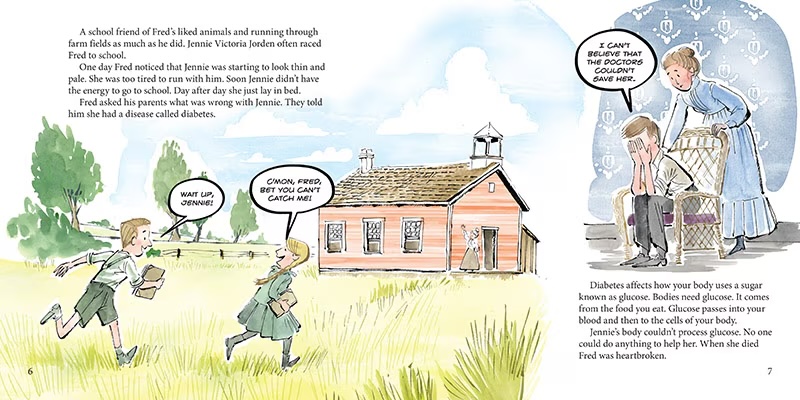
Living on a farm at the turn of the twentieth century would have been fairly typical though Fred was encouraged early on to really study the animals to help determine why they were sick and how to help them get better. However, it was his friendship with Jennie Victoria Jorden, a young diabetic, that probably was most critical to compelling him to consider why diabetics got sick and died and how he might help them.
From Meet Frederick Banting, written by Elizabeth MacLeod, illustrated by Mike Deas
At university, Fred studied medicine and, after working as a doctor in Britain and France during World War 1, he returned to Canada and started a family practice in London, Ontario. He also taught at the nearby university, and it was during his prep for an upcoming lecture on the pancreas, which was known to be involved with diabetes, Fred had an important realization. He took his idea to a professor at the University of Toronto who provided him with a lab and assistant, Charles Herbert Best. Their research into isletin which was renamed to insulin is well established, and the accolades he received, along with others, are firmly rooted in the history books.
From Meet Frederick Banting, written by Elizabeth MacLeod, illustrated by Mike Deas
But Elizabeth MacLeod tells us more about the man and his nature beyond his discovery. He didn't want to make money from his discovery and sold the rights to make the medicine for a single dollar. When he won the Nobel Prize in 1923, he split his prize money with Charley Best. And he continued to work for others, opening a diabetic clinic and helping the Canadian government by conducting research during World War 2. This extraordinary man lived a life of service and Elizabeth MacLeod makes sure to tell his story more completely. (She includes a timeline of his life at the conclusion of her story.)
 
The reason I love the Scholastic Canada Biography books is because I always learn something new. Elizabeth MacLeod goes beyond the obvious or the known and gives us a fuller picture of the individual. Here, Frederick Banting becomes a humanitarian and a researcher, more than just a Nobel Prize laureate or a celebrity to be lauded on a Walk of Fame, though he is both of those. And she tells his story with passion and directness, probably not unlike the man. This is his story and his life, and Elizabeth MacLeod tells it effectively for her audience.
 
That simplicity of message comes through in Mike Deas's illustrations that look like they were effortlessly created, but they are far more than just sketches. In a complex process of creating sketches digitally, with a Wacom tablet and Photoshop, Mike Deas traces them onto watercolour paper and then applies gouache and watercolour paints before using black ink to finish the illustration. But with that process, Mike Deas creates art that is both direct and detailed, has heart and authenticity, and is perfect for a story of a selfless man who worked to help others and not enrich his own life with money or accolades. 
 
Meet Frederick Banting may take longer than a single minute of recounting history, but Frederick Banting deserves more, and Elizabeth MacLeod and Mike Deas have given his legacy that which he is due. They have relayed to young readers that he was a great man and that all his work justifiably earned him the recognition as a great Canadian.
 
• • • • • • •

I know that readers always like to check out more of these books so here is a smattering of volumes from the Scholastic Canada Biography series:
 
Meet Viola Desmond (2018)
Meet Chris Hadfield (2018)
Meet Tom Longboat (2019)
Meet Elsie MacGill (2019)
Meet Willie O'Ree (2020)
Meet Terry Fox (2020)
Meet Thérèse Casgrain (2021)
Meet David Suzuki (2021)
Meet Mary Ann Shadd (2022)
Meet J. Armand Bombardier (2022)
Meet Buffy Sainte-Marie (2023)
Meet Jim Egan (2024) 
Meet Frederick Banting (2025)

September 03, 2024

Maud of Green Gables: How L. M. Montgomery's Anne Enchanted the World

Written and illustrated by Janet Wilson 
978-1-0688776-0-5
39 pp.
All ages
September 2024 
 
While the world knows the story of Anne of Green Gables, in whatever configuration they may have enjoyed–so many adaptations!–the story of her creator, Lucy Maud Montgomery, is less known to most of us. Was her story that of Anne's? Did she write from personal experiences? Was there really a Green Gables? And how did a freckled and red-haired girl enchant the world so completely?
From Maud of Green Gables: How L. M. Montgomery's Anne Enchanted the World, written and illustrated by Janet Wilson
The story within Maud of Green Gables is about the writer and her story. It's about being brought up by her grandparents, trying to get an education at a time when women were often relegated to housework, and finding her passion in writing. It is
about Maud's writing, from childhood and throughout her life, and the process of getting Anne's story rejected and accepted and then lauded globally. It's about how she felt about her book and the world. It's about how she saw herself and her place in the world, whether living on Prince Edward Island or in Ontario, whether as a freelance writer or a novelist.
 
“But oh, I love my work! I love spinning stories,
and I love to sit by the window of my room
and shape some ‘airy fairy’ fancy into verse.”
 
And, though Janet Wilson peppers her story with photographs and direct quotes from Montgomery's diaries and from her novel, reminding us that Maud of Green Gables is a biography of Lucy Maud Montgomery, it is the artwork that makes the story sing.
From Maud of Green Gables: How L. M. Montgomery's Anne Enchanted the World, written and illustrated by Janet Wilson
 Janet Wilson's oil paintings do more than just captivate. First, they let us see Anne of Green Gables again and in a different light. (And the light in Janet Wilson's art is brilliant!) We see Anne as she dreams, as she imagines, as she takes in the wonders of her world, and as she treasures moments with those she loves.
From Maud of Green Gables: How L. M. Montgomery's Anne Enchanted the World, written and illustrated by Janet Wilson
But Janet Wilson also lets us see Lucy Maud Montgomery beyond the images recorded in photographs. Those images of her as a child or as a woman, or of her homes and those in her life are static. They captured a person or a place in one moment. Janet Wilson's paintings give us heart and always radiant light. Whether Maud is reading with a cat on her lap, playing with a camera, or walking along a shore, there is a radiance that comes from within.
From Maud of Green Gables: How L. M. Montgomery's Anne Enchanted the World, written and illustrated by Janet Wilson
Maud of Green Gables could have been a dry biography about L. M. Montgomery's story, from early life and family to education and writing and then to her marriage and death. But anyone could tell that story. Telling it with the richness of this art could only be done by the likes of Janet Wilson, the artist whose realism brought In Flanders Fields: The Story of the Poem by John McCrae, written by Linda Granfield, to life. Here her art recreates Maud and Anne with light and life. Moreover, by quoting from Maud's diaries and from Anne's story, Janet Wilson connects the two women on a deeper level, reaching into the hearts of Anne and Maud simultaneously and making us feel for both writer and character and know them both a little better.
 
• • • • • • • 
 
Janet Wilson launches Maud of Green Gables: How L. M. Montgomery's Anne Enchanted the World this Saturday (September 7, 2024) in Eden Mills, Ontario. Check here for details, including how to purchase her new book.
 
 • • • • • • •

June 17, 2024

Meet Jim Egan (Scholastic Canada Biography)

Written by Elizabeth MacLeod
Illustrated by Mike Deas
Scholastic Canada
978-1-4431-9725-0
32 pp.
Ages 6-9
May 2024
 
I didn't know who Jim Egan was. But, like all Elizabeth MacLeod and Mike Deas's books in this illustrated biography series from Scholastic Canada, Meet Jim Egan gives readers the opportunity to be introduced to extraordinary Canadians and learn of their historical impact in civil rights, athletics, science, business, the arts, activism, and more. With a season of Pride starting in June for several Canadian provinces, including the two in which Jim Egan lived, it is only fitting to celebrate the life of this LGBTQ+ activist now.
From Meet Jim Egan, written by Elizabeth MacLeod, illustrated by Mike Deas
Jim Egan was born in 1921 Toronto. He enjoyed many things, like science and nature and reading, but he figured out that he liked boys, not girls. When he had to leave school at age sixteen, rather than pursue a career in medicine, he took on a variety of jobs, from farm work and working in a lab, to joining the merchant marines during World War II. It was during this last endeavour, travelling around the world to transport soldiers and supplies, that Jim Egan discovered places where gay men could gather and be themselves. For the first time, he realized he was not alone in his feelings for other men.
From Meet Jim Egan, written by Elizabeth MacLeod, illustrated by Mike Deas
But, in many parts of the world, and certainly in Canada at that time, being gay was illegal. Fearing arrest and rejection from their families, their friends, their employers, and even landlords, many kept this part of their lives secret. But there were places where they could feel safe, and it was at one such place in 1948 that Jim Egan met his future life partner Jack Nesbit.

As a reader, Jim had always realized the discrimination that gay people endured but he was especially unhappy with the hurtful language used against LGBTQ+ people. He started writing letters to magazines and papers to educate them about gay people. It took a few years before his writing would be published but he got people talking and thinking about them. This started his activism and fight for gay rights, including his biggest fight: the right for equality in spousal recognition for gay couples. Gay people could not marry, adopt children, or receive government financial support like old age security as spouses. After being together with Jack for almost 40 years, Jim knew they had a new fight on their hands.
From Meet Jim Egan, written by Elizabeth MacLeod, illustrated by Mike Deas
Although the two men had been together for over 50 years when they died in 2000, they never saw the landmark changes that Jim's activism pushed to happen, like making same-sex marriage legal in 2005. Still, Jim Egan's drive for equal rights for gay people was instrumental in making others aware of gay people and their right to equality.

From Meet Jim Egan, written by Elizabeth MacLeod, illustrated by Mike Dea

Elizabeth MacLeod may give us the salient facts of Jim Egan's life, from his birth and employment, as well as milestones in LGBTQ+ history in Canada–see the timeline of his life complete with photographs–but she always keeps the heart of the man and his drive for equality at the center of his story. It is clear that Jim Egan was a passionate and sensitive individual who cared deeply for his partner and for equal rights for gay persons, and he had the determination to try to make things happen. Without his efforts, people would not have had the conversations about gay people and the baby steps towards legal equality would not have been possible.
 
As always, Mike Deas's illustrations keep a lightness to a life's story that is rife with struggles. His technique of blending digital with traditional media–sketches created digitally were painted with watercolour and gouache on watercolour paper and inked with black lines–easily takes us from a farm to the city, from the 1940s to the late 1990s. We see communities of gay people together but separate, embraced but also shunned, as well as the worlds in which Jim Egan lived and fought for his right to be himself and with his partner.
 
Meet Jim Egan is another wonderful addition to Elizabeth MacLeod and Mike Deas's Scholastic Canada Biography, now totalling thirteen books. As always, they've introduced us to a significant Canadian whose story reminds us that doing the right thing for yourself and others may not be easy or always fruitful but it's always the best thing to do.
 
Meet Viola Desmond (2018)
Meet Chris Hadfield (2018)
Meet Tom Longboat (2019)
Meet Elsie MacGill (2019)
Meet Willie O'Ree (2020)
Meet Terry Fox (2020)
Meet Thérèse Casgrain (2021)
Meet David Suzuki (2021)
Meet Mary Ann Shadd (2022)
Meet J. Armand Bombardier (2022)
Meet Buffy Sainte-Marie (2023)
Meet Jim Egan (2024)


January 05, 2024

Meet Clara Hughes (Scholastic Canada Biography)

Written by Elizabeth MacLeod
Illustrated by Mike Deas
Scholastic Canada
978-1-4431-9772-4
32 pp.
Ages 6-10
January 2023
 
Just out this week is Meet Clara Hughes, the newest addition to Elizabeth MacLeod and Mike Deas's fabulous illustrated book series, Scholastic Canada Biography. They've covered important historical and contemporary figures in Canada, including athletes like Tom Longboat and Willie O'Ree–see the listing below for those titles–who dealt with issues of racism and discrimination. But, by showcasing a contemporary athlete who has dealt with mental health and turned that into advocacy for others, Elizabeth MacLeod and Mike Deas have championed Clara Hughes as much for her athleticism as her good work.

Born in 1972 in Winnipeg, Clara Hughes loved to read, do crafts, cook, ride her bike, and do sports like hockey and ringette. But when things got tough at home, with her parents arguing, Clara acted out, by shoplifting, partying, and staying out all night. Things changed after seeing Gaétan Boucher speed skate at the 1988 Calgary Winter Olympics. Taking up speed skating changed everything for Clara, focusing her energy on positive things, working hard, and having fun. As part of her training, she also cycled, and when the province of Manitoba encouraged more women to try that sport, Clara switched, eventually making Canada's cycling team for the 1996 Olympics, and then medalling.
From Meet Clara Hughes, written by Elizabeth MacLeod, illus. by Mike Deas
Still, Clara experienced depression. After she was able to ask for help and find ways to help her cope with her depression, she challenged herself to return to speed skating. By focusing on doing her best and the joy of her pursuits rather than winning, she achieved great success in her sports, becoming the only Canadian who has ever won medals at both the Winter and Summer Olympics.

But Clara Hughes's successes have reached beyond the Olympics and the podia. Her work with Right to Play, an organization that helps kids in conflict zones and poverty learn important life skills through sports, and her mental health awareness advocacy work that includes Bell Canada's Let's Talk campaign have extended her impact beyond her athleticism and into the realm of public service, touching many in ways we might not even understand.
From Meet Clara Hughes, written by Elizabeth MacLeod, illus. by Mike Deas
I'm so delighted that Elizabeth MacLeod chose to showcase Clara Hughes in this latest book of Scholastic Canada Biography. Elizabeth MacLeod has always told the stories of exemplary persons (see the list below) who've achieved much, though sometimes inconspicuously during their lifetimes. They come from a variety of backgrounds, whether in the fields of science, business, the arts, or sports, but their achievements have led them to greater societal impacts than may have been recognized at the time. For many, Clara Hughes is a successful speed skater and cyclist, achieving gold, silver, and bronze medals at multiple Olympics. (In fact, she's the only Olympian to win multiple medals in both winter and summer sports.) But her advocacy work, particularly with regards to raising awareness about mental health, must be recognized as significant, taking discussions about mental illness from inner thoughts and doctors' offices to public forums and educational campaigns. By telling Clara Hughes's story of becoming a successful athlete alongside her challenges with depression and efforts to cope with it, Elizabeth MacLeod has made Clara Hughes more real.
From Meet Clara Hughes, written by Elizabeth MacLeod, illus. by Mike Deas
Because of the complexity of Mike Deas's art, using digital tools with watercolour and gouache paints as well as ink, the illustrations of the Scholastic Canada Biography series always set the right tone. While emphasizing the biographical, showing the Clara Hughes that we all recognize from her Olympic events like carrying the flag at the 2010 Winter Olympics or raising the Canadian flag after a winning race, Mike Deas gives us more than just that which could have been seen in photographs. We also see her hanging out with other troubled teens in a parking lot, overwhelmed by a black cloud of depression as she speaks to her doctor, and finding solace in nature with her partner Peter Guzman. Mike Deas helps us see the child, the athlete, and the advocate, through all her triumphs and her challenges. 
 
For many, Meet Clara Hughes will give them a new perspective on an athlete whose prowess in cycling and speed skating are just a fraction of her achievements. By going beyond the Olympic medals and showing us how Clara got to be the outstanding athlete and how her personal and sports challenges led her to further accomplishments in mental health education and awareness, Elizabeth MacLeod and Mike Deas have given us the true and complete Clara Hughes.
 
 
 • • • • • • •

Scholastic Canada Biography (to date)

Meet Viola Desmond (2018)
Meet Chris Hadfield (2018)
Meet Tom Longboat (2019)
Meet Elsie MacGill (2019)
Meet Willie O'Ree (2020)
Meet Terry Fox (2020)
Meet Thérèse Casgrain (2021)
Meet David Suzuki (2021)
Meet Mary Ann Shadd (2022)
Meet J. Armand Bombardier (2022)
Meet Buffy Sainte-Marie (2023)
Meet Clara Hughes (2024)

November 01, 2023

The Little Books of the Little Brontës

Written by Sara O'Leary
Illustrated by Briony May Smith
Tundra Books
978-0-7352-6369-7
40 pp.
Ages 5-9
October 2023
 
This is the story of four siblings who lived about 200 years ago. Their names were Charlotte, Bramwell, Emily, and the youngest was Anne. After their mother had died, as well as their two older sisters, they lived with their father, their Aunt Bramwell, a housekeeper named Tabby, and many pets. And they loved to read and tell stories.
From The Little Books of the Little Brontës, written by Sara O'Leary, illustrated by Briony May Smith
They read everything they could, from novels and poetry, to geography, the dictionary, and the Bible. And when they weren't reading, they were making up stories, creating characters, and acting out plays. And they wrote their own little books to share with each other. What a special gift to have a sister who would paint pictures and hand-stitch pages and give their lives a happily-ever-after. When Bramwell received a set of toy soldiers, which he shared with his sisters, they created even smaller books that would fit into the hands of the toy soldiers. These books were tiny but the worlds within were colossal.
They contain continents and oceans, love stories and battles. There are heroes and antiheroes. And sometimes those who die in one story are brought back to life in another.
Their little books and their stories sustained them and inspired them all to write, taking them to new worlds.
From The Little Books of the Little Brontës, written by Sara O'Leary, illustrated by Briony May Smith
The Little Books of the Little Brontës is not necessarily an illustrated biography of the four Brontë siblings though it does contain key biographical information about their home, the people in their lives, and their occupation with writing and books. But Sara O'Leary has not written this picture book to tell their biographies. She has written it to speak to the power of storytelling and the imagination to sustain us through challenges. There is much still left to tell of the Brontës' stories but those details can just as easily be discovered through research. Like the power of the Brontës' stories, Sara O'Leary takes the reader to see a different world, one in which travel to unknown places is possible, in which struggles are won, and in which lives may be happier, easier, and more exciting. That's the true story of the stories that the Brontës told. Their stories comforted them and fostered their creativity.

Briony May Smith, a British illustrator, uses mixed media to take us into the long-ago world of the Brontë children. She gives their world both historical accuracy but a sweetness of siblings reliant on each other for support and love. The softness of her pencil and digital media take away the austerity of the Brontës' lives and makes them rich in family and togetherness and, of course, literary creativity.
From The Little Books of the Little Brontës, written by Sara O'Leary, illustrated by Briony May Smith
I have reviewed a number of Sara O'Leary's earlier books (including When I Was Small, 2011; A Family is a Family, 2016; Night Walk, 2020; and  Percy's Museum, 2021) and, regardless of the story, there is a gentleness in her storytelling. It's in the choice of her words and the structure of her phrasing and in the choices she makes to tell or not tell. The timeline that appends The Little Books of the Little Brontës cannot help but speak to the losses the Brontës experienced in their short lives–the four who are featured in this book all passed in their 20s or 30s–but, though Sara O'Leary mentions the loss of the children's mother and their older sisters, she makes this story about the wonders of books and storytelling.

The Little Books of the Little Brontës will surely inspire young readers to delve a little deeper into the history of the Brontës but also to create their own little books–instructions provided–and find the wonder in making worlds for themselves and others.
From The Little Books of the Little Brontës, written by Sara O'Leary, illustrated by Briony May Smith