Showing posts with label Scholastic Canada Biography. Show all posts

June 11, 2025

Meet Frederick Banting (Scholastic Canada Biography)

Written by Elizabeth MacLeod
Illustrated by Mike Deas
Scholastic Canada
978-1-0397-0785-6
32 pp.
Ages 6-10
June 2025 

I get excited with the release of each new addition to the Scholastic Canada Biography, and this is just so with Meet Frederick Banting, which came out last week. Elizabeth MacLeod and Mike Deas collaborate so well that I know that young readers will come away having learned and be inspired by another great Canadian.
 
While many will know the names Banting and Best for their discovery of insulin, the full story of Frederick Grant Banting, born on an Ontario farm in 1891, will be less well known to many. Banting's story, beyond a Heritage Minute of Historica Canada, is far less familiar, though, within his childhood, education, and work beyond the discovery of insulin, he is a man of great accomplishment, humanity, and charity.
From Meet Frederick Banting, written by Elizabeth MacLeod, illustrated by Mike Deas
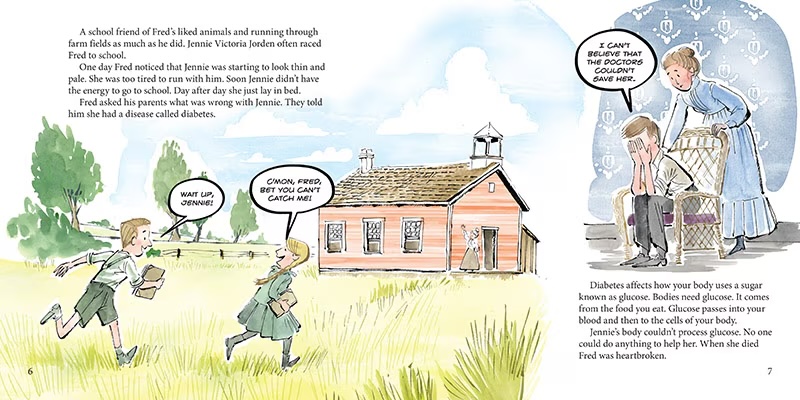
Living on a farm at the turn of the twentieth century would have been fairly typical though Fred was encouraged early on to really study the animals to help determine why they were sick and how to help them get better. However, it was his friendship with Jennie Victoria Jorden, a young diabetic, that probably was most critical to compelling him to consider why diabetics got sick and died and how he might help them.
From Meet Frederick Banting, written by Elizabeth MacLeod, illustrated by Mike Deas
At university, Fred studied medicine and, after working as a doctor in Britain and France during World War 1, he returned to Canada and started a family practice in London, Ontario. He also taught at the nearby university, and it was during his prep for an upcoming lecture on the pancreas, which was known to be involved with diabetes, Fred had an important realization. He took his idea to a professor at the University of Toronto who provided him with a lab and assistant, Charles Herbert Best. Their research into isletin which was renamed to insulin is well established, and the accolades he received, along with others, are firmly rooted in the history books.
From Meet Frederick Banting, written by Elizabeth MacLeod, illustrated by Mike Deas
But Elizabeth MacLeod tells us more about the man and his nature beyond his discovery. He didn't want to make money from his discovery and sold the rights to make the medicine for a single dollar. When he won the Nobel Prize in 1923, he split his prize money with Charley Best. And he continued to work for others, opening a diabetic clinic and helping the Canadian government by conducting research during World War 2. This extraordinary man lived a life of service and Elizabeth MacLeod makes sure to tell his story more completely. (She includes a timeline of his life at the conclusion of her story.)
 
The reason I love the Scholastic Canada Biography books is because I always learn something new. Elizabeth MacLeod goes beyond the obvious or the known and gives us a fuller picture of the individual. Here, Frederick Banting becomes a humanitarian and a researcher, more than just a Nobel Prize laureate or a celebrity to be lauded on a Walk of Fame, though he is both of those. And she tells his story with passion and directness, probably not unlike the man. This is his story and his life, and Elizabeth MacLeod tells it effectively for her audience.
 
That simplicity of message comes through in Mike Deas's illustrations that look like they were effortlessly created, but they are far more than just sketches. In a complex process of creating sketches digitally, with a Wacom tablet and Photoshop, Mike Deas traces them onto watercolour paper and then applies gouache and watercolour paints before using black ink to finish the illustration. But with that process, Mike Deas creates art that is both direct and detailed, has heart and authenticity, and is perfect for a story of a selfless man who worked to help others and not enrich his own life with money or accolades. 
 
Meet Frederick Banting may take longer than a single minute of recounting history, but Frederick Banting deserves more, and Elizabeth MacLeod and Mike Deas have given his legacy that which he is due. They have relayed to young readers that he was a great man and that all his work justifiably earned him the recognition as a great Canadian.
 
• • • • • • •

I know that readers always like to check out more of these books so here is a smattering of volumes from the Scholastic Canada Biography series:
 
Meet Viola Desmond (2018)
Meet Chris Hadfield (2018)
Meet Tom Longboat (2019)
Meet Elsie MacGill (2019)
Meet Willie O'Ree (2020)
Meet Terry Fox (2020)
Meet Thérèse Casgrain (2021)
Meet David Suzuki (2021)
Meet Mary Ann Shadd (2022)
Meet J. Armand Bombardier (2022)
Meet Buffy Sainte-Marie (2023)
Meet Jim Egan (2024) 
Meet Frederick Banting (2025)

June 17, 2024

Meet Jim Egan (Scholastic Canada Biography)

Written by Elizabeth MacLeod
Illustrated by Mike Deas
Scholastic Canada
978-1-4431-9725-0
32 pp.
Ages 6-9
May 2024
 
I didn't know who Jim Egan was. But, like all Elizabeth MacLeod and Mike Deas's books in this illustrated biography series from Scholastic Canada, Meet Jim Egan gives readers the opportunity to be introduced to extraordinary Canadians and learn of their historical impact in civil rights, athletics, science, business, the arts, activism, and more. With a season of Pride starting in June for several Canadian provinces, including the two in which Jim Egan lived, it is only fitting to celebrate the life of this LGBTQ+ activist now.
From Meet Jim Egan, written by Elizabeth MacLeod, illustrated by Mike Deas
Jim Egan was born in 1921 Toronto. He enjoyed many things, like science and nature and reading, but he figured out that he liked boys, not girls. When he had to leave school at age sixteen, rather than pursue a career in medicine, he took on a variety of jobs, from farm work and working in a lab, to joining the merchant marines during World War II. It was during this last endeavour, travelling around the world to transport soldiers and supplies, that Jim Egan discovered places where gay men could gather and be themselves. For the first time, he realized he was not alone in his feelings for other men.
From Meet Jim Egan, written by Elizabeth MacLeod, illustrated by Mike Deas
But, in many parts of the world, and certainly in Canada at that time, being gay was illegal. Fearing arrest and rejection from their families, their friends, their employers, and even landlords, many kept this part of their lives secret. But there were places where they could feel safe, and it was at one such place in 1948 that Jim Egan met his future life partner Jack Nesbit.

As a reader, Jim had always realized the discrimination that gay people endured but he was especially unhappy with the hurtful language used against LGBTQ+ people. He started writing letters to magazines and papers to educate them about gay people. It took a few years before his writing would be published but he got people talking and thinking about them. This started his activism and fight for gay rights, including his biggest fight: the right for equality in spousal recognition for gay couples. Gay people could not marry, adopt children, or receive government financial support like old age security as spouses. After being together with Jack for almost 40 years, Jim knew they had a new fight on their hands.
From Meet Jim Egan, written by Elizabeth MacLeod, illustrated by Mike Deas
Although the two men had been together for over 50 years when they died in 2000, they never saw the landmark changes that Jim's activism pushed to happen, like making same-sex marriage legal in 2005. Still, Jim Egan's drive for equal rights for gay people was instrumental in making others aware of gay people and their right to equality.

From Meet Jim Egan, written by Elizabeth MacLeod, illustrated by Mike Dea

Elizabeth MacLeod may give us the salient facts of Jim Egan's life, from his birth and employment, as well as milestones in LGBTQ+ history in Canada–see the timeline of his life complete with photographs–but she always keeps the heart of the man and his drive for equality at the center of his story. It is clear that Jim Egan was a passionate and sensitive individual who cared deeply for his partner and for equal rights for gay persons, and he had the determination to try to make things happen. Without his efforts, people would not have had the conversations about gay people and the baby steps towards legal equality would not have been possible.
 
As always, Mike Deas's illustrations keep a lightness to a life's story that is rife with struggles. His technique of blending digital with traditional media–sketches created digitally were painted with watercolour and gouache on watercolour paper and inked with black lines–easily takes us from a farm to the city, from the 1940s to the late 1990s. We see communities of gay people together but separate, embraced but also shunned, as well as the worlds in which Jim Egan lived and fought for his right to be himself and with his partner.
 
Meet Jim Egan is another wonderful addition to Elizabeth MacLeod and Mike Deas's Scholastic Canada Biography, now totalling thirteen books. As always, they've introduced us to a significant Canadian whose story reminds us that doing the right thing for yourself and others may not be easy or always fruitful but it's always the best thing to do.
 
Meet Viola Desmond (2018)
Meet Chris Hadfield (2018)
Meet Tom Longboat (2019)
Meet Elsie MacGill (2019)
Meet Willie O'Ree (2020)
Meet Terry Fox (2020)
Meet Thérèse Casgrain (2021)
Meet David Suzuki (2021)
Meet Mary Ann Shadd (2022)
Meet J. Armand Bombardier (2022)
Meet Buffy Sainte-Marie (2023)
Meet Jim Egan (2024)


January 05, 2024

Meet Clara Hughes (Scholastic Canada Biography)

Written by Elizabeth MacLeod
Illustrated by Mike Deas
Scholastic Canada
978-1-4431-9772-4
32 pp.
Ages 6-10
January 2023
 
Just out this week is Meet Clara Hughes, the newest addition to Elizabeth MacLeod and Mike Deas's fabulous illustrated book series, Scholastic Canada Biography. They've covered important historical and contemporary figures in Canada, including athletes like Tom Longboat and Willie O'Ree–see the listing below for those titles–who dealt with issues of racism and discrimination. But, by showcasing a contemporary athlete who has dealt with mental health and turned that into advocacy for others, Elizabeth MacLeod and Mike Deas have championed Clara Hughes as much for her athleticism as her good work.

Born in 1972 in Winnipeg, Clara Hughes loved to read, do crafts, cook, ride her bike, and do sports like hockey and ringette. But when things got tough at home, with her parents arguing, Clara acted out, by shoplifting, partying, and staying out all night. Things changed after seeing Gaétan Boucher speed skate at the 1988 Calgary Winter Olympics. Taking up speed skating changed everything for Clara, focusing her energy on positive things, working hard, and having fun. As part of her training, she also cycled, and when the province of Manitoba encouraged more women to try that sport, Clara switched, eventually making Canada's cycling team for the 1996 Olympics, and then medalling.
From Meet Clara Hughes, written by Elizabeth MacLeod, illus. by Mike Deas
Still, Clara experienced depression. After she was able to ask for help and find ways to help her cope with her depression, she challenged herself to return to speed skating. By focusing on doing her best and the joy of her pursuits rather than winning, she achieved great success in her sports, becoming the only Canadian who has ever won medals at both the Winter and Summer Olympics.

But Clara Hughes's successes have reached beyond the Olympics and the podia. Her work with Right to Play, an organization that helps kids in conflict zones and poverty learn important life skills through sports, and her mental health awareness advocacy work that includes Bell Canada's Let's Talk campaign have extended her impact beyond her athleticism and into the realm of public service, touching many in ways we might not even understand.
From Meet Clara Hughes, written by Elizabeth MacLeod, illus. by Mike Deas
I'm so delighted that Elizabeth MacLeod chose to showcase Clara Hughes in this latest book of Scholastic Canada Biography. Elizabeth MacLeod has always told the stories of exemplary persons (see the list below) who've achieved much, though sometimes inconspicuously during their lifetimes. They come from a variety of backgrounds, whether in the fields of science, business, the arts, or sports, but their achievements have led them to greater societal impacts than may have been recognized at the time. For many, Clara Hughes is a successful speed skater and cyclist, achieving gold, silver, and bronze medals at multiple Olympics. (In fact, she's the only Olympian to win multiple medals in both winter and summer sports.) But her advocacy work, particularly with regards to raising awareness about mental health, must be recognized as significant, taking discussions about mental illness from inner thoughts and doctors' offices to public forums and educational campaigns. By telling Clara Hughes's story of becoming a successful athlete alongside her challenges with depression and efforts to cope with it, Elizabeth MacLeod has made Clara Hughes more real.
From Meet Clara Hughes, written by Elizabeth MacLeod, illus. by Mike Deas
Because of the complexity of Mike Deas's art, using digital tools with watercolour and gouache paints as well as ink, the illustrations of the Scholastic Canada Biography series always set the right tone. While emphasizing the biographical, showing the Clara Hughes that we all recognize from her Olympic events like carrying the flag at the 2010 Winter Olympics or raising the Canadian flag after a winning race, Mike Deas gives us more than just that which could have been seen in photographs. We also see her hanging out with other troubled teens in a parking lot, overwhelmed by a black cloud of depression as she speaks to her doctor, and finding solace in nature with her partner Peter Guzman. Mike Deas helps us see the child, the athlete, and the advocate, through all her triumphs and her challenges. 
 
For many, Meet Clara Hughes will give them a new perspective on an athlete whose prowess in cycling and speed skating are just a fraction of her achievements. By going beyond the Olympic medals and showing us how Clara got to be the outstanding athlete and how her personal and sports challenges led her to further accomplishments in mental health education and awareness, Elizabeth MacLeod and Mike Deas have given us the true and complete Clara Hughes.
 
 
 • • • • • • •

Scholastic Canada Biography (to date)

Meet Viola Desmond (2018)
Meet Chris Hadfield (2018)
Meet Tom Longboat (2019)
Meet Elsie MacGill (2019)
Meet Willie O'Ree (2020)
Meet Terry Fox (2020)
Meet Thérèse Casgrain (2021)
Meet David Suzuki (2021)
Meet Mary Ann Shadd (2022)
Meet J. Armand Bombardier (2022)
Meet Buffy Sainte-Marie (2023)
Meet Clara Hughes (2024)

June 05, 2023

Meet Buffy Sainte-Marie (Scholastic Canada Biography)

Written by Elizabeth MacLeod
Illustrated by Mike Deas
Scholastic Canada
978-1-4431-9612-3
32 pp.
Ages 6–10
May 2023

I can't think of a more accomplished person to highlight during National Indigenous History Month and every month than Buffy Sainte-Marie. Though many know her as a singer-songwriter and young readers may be familiar with her Silver Birch-nominated book Tâpwê and the Magic Hat (2022), this latest illustrated biography from Elizabeth MacLeod and Mike Deas testifies to Buffy Sainte-Marie's varied and good work.
From Meet Buffy Sainte-Marie by Elizabeth MacLeod, illus. by Mike Deas
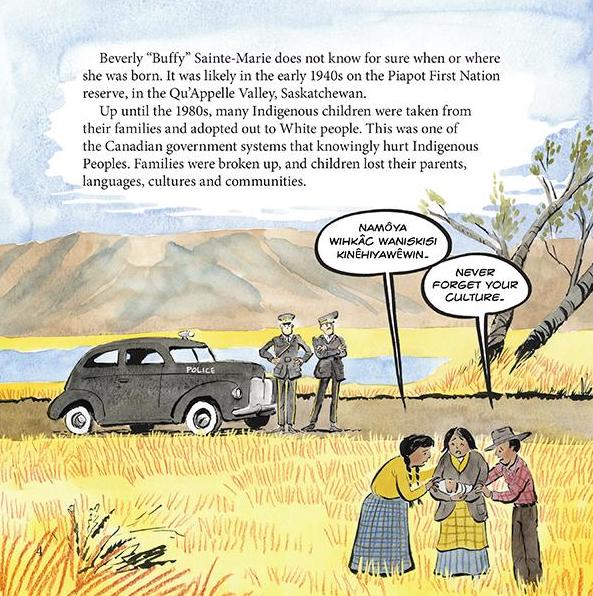
Buffy Sainte-Marie was probably born in the 1940s on the Piapot First National reserve in Saskatchewan but was taken and adopted by the Sainte-Maries of the northeastern U.S.A. Her childhood, often spent alone, was filled with music, with Buffy starting to play the piano at age 3, and learning music by ear. At 16, she taught herself to play guitar, and, while at university, she started playing at small clubs and then larger ones. After graduation, she became a full-time musician.
From Meet Buffy Sainte-Marie by Elizabeth MacLeod, illus. by Mike Deas
As her songs were garnering much attention, from her "Universal Soldier" as a protest song, and "Until It's Time for You to Go" as recorded by countless famous artists, she was noticing how Indigenous roles were depicted on the screen. When she was asked to take a lead rode in an episode of "The Virginian," she maintained the need to hire Indigenous actors for Indigenous roles, leading the action for diversity.
From Meet Buffy Sainte-Marie by Elizabeth MacLeod, illus. by Mike Deas
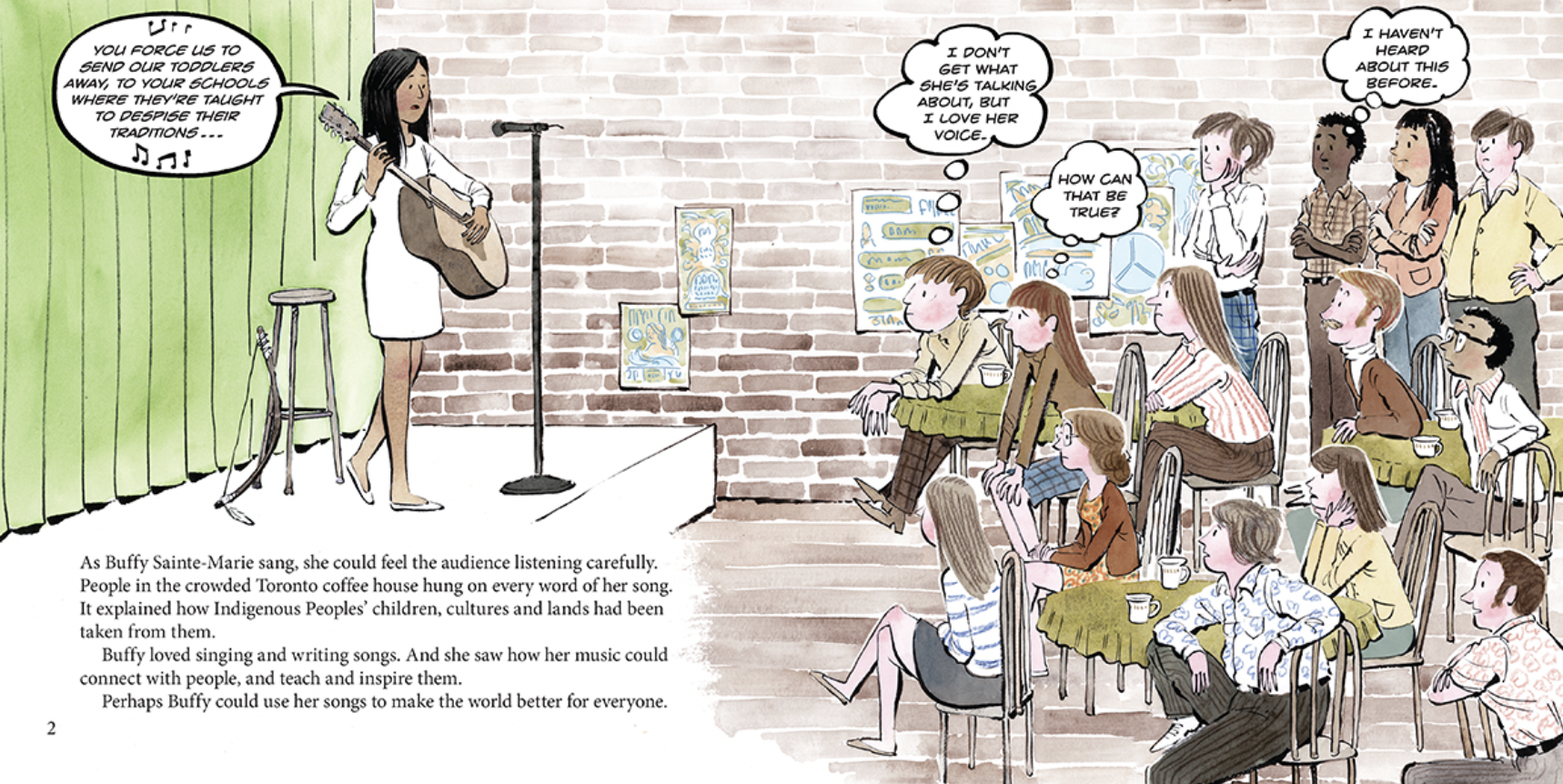
Her other initiatives included starting the Nihewan Foundation for Native American Education which supported Indigenous teens going to university. She has spoken globally about Indigenous Peoples to further understanding. And even though her music was snubbed in the late 1960s and 1970s by radio stations and more for her political messages, she persevered, continuing to extend her activism to championing the rights of Indigenous Peoples. Along the way she won an Oscar, made several important appearances on "Sesame Street," and used new technology for creating visual art and music. She lent her support to the Idle No More movement and was awarded everything from the Polaris Music Prize to Junos and the Spirit of Americana/Free Speech in Music Award.

With her art fuelling her activism, whether it involved Indigenous Peoples, anti-war protests, missing and murdered Indigenous women, or shelter animals, Buffy Sainte-Marie's story in Meet Buffy Sainte-Marie will provide inspiration to young readers. She defies labelling as she is everything from a singer and a songwriter to a humanitarian, a protester, a teacher, a speaker, an advocate, and more. But by letting her heart and passions lead her, she has accomplished so much and done so much good work
Using the power of positivity, Buffy shares her messages with her songs and through art, education and the organizations she supports. Buffy teaches that we can all work together to help make the world a better place. (p. 29)
Elizabeth MacLeod makes sure that readers will learn about Buffy Sainte-Marie's achievements–a timeline of key events appends the illustrated story–but also about her spirit, and her spirit is great, both broad and deep. Buffy uses it, with her voice in music and art, to educate, to mobilize to action, to inspire, and to give voice. Mike Deas's artwork, which involves gouache and watercolour paints and ink, along with digital tools, supports the story with detailed illustrations from Buffy's personal and professional life, from childhood to the 2020s. He takes her story from being taken from her Cree parents as a baby to performing on stage with a red dress–a symbol of missing and murdered Indigenous women. With that, Mike Deas carries readers through nine decades of Buffy Sainte-Marie living and performing and inspiriting. 

There are many stirring reads of important Indigenous activists and leaders but, as an illustrated biography, Meet Buffy Sainte-Marie gives us a comprehensive and unequivocal depiction of an amazing woman, a woman of talents, of courage, of conviction and of spirit. The story, as the woman, touches, and impresses.
 
• • • • • • 

Scholastic Canada Biography series by Elizabeth MacLeod and Mike Deas:
 
Meet Thérèse Casgrain (2021)
Meet David Suzuki (2021)
Meet Buffy Sainte-Marie (2023)

February 28, 2023

Meet J. Armand Bombardier (Scholastic Canada Biography)

Written by Elizabeth MacLeod
Illustrated by Mike Deas
Scholastic Canada
978-1-4431-9133-3
32 pp.
Ages 6-10
2022
 
Learning and teaching about amazing scientists, athletes, activists and other important persons who have helped shape Canada's history have been made all the easier and captivating with Elizabeth MacLeod and Mike Deas's illustrated biography series, Scholastic Canada Biography. Their latest collaboration highlights the inventiveness and achievements of Quebec's Joseph-Armand Bombardier, inventor of the snowmobile.
From Meet J. Armand Bombardier by Elizabeth MacLeod, illus. by Mike Deas
Born in 1907 Valcourt, Quebec, Joseph-Armand Bombardier loved tinkering with machines and building things from a young age. At fifteen, he invented his first snow machine, though its success was very limited. Not surprising he apprenticed with a mechanic to develop his skills before studying mechanical and electrical engineering. But the idea of a machine that could float over the snow was always in the back of his mind.
From Meet J. Armand Bombardier by Elizabeth MacLeod, illus. by Mike Deas
As he grew older and established his own garage, married and had kids, Armand found a new reason to pursue his snow machine when his young son could not get to hospital because of the snow. Using skis instead of wheels, repositioning the engine, and adding special toothed gear wheels, Armand's machine finally worked. It may not have looked like the snowmobile we know today, but it was the foundation for numerous other machines, from tractor track attachments and muskeg tractors to the famous Ski-Doo (only named this because of a typo of Ski-Dog).
 
When Joseph-Armand Bombardier died in 1964, he left a legacy of extraordinary invention and Elizabeth MacLeod makes sure to tell that story in addition to his personal details. It's a rich legacy of vision and pursuit that impacted the individual as well as commercial enterprises from the oil fields and resource development to the military. Yet Elizabeth MacLeod still makes sure to give us the personal side of Bombardier's story, particularly the home life and education and tragedies that compelled him to invent a snow machine. (A timeline of key events in Joseph-Armand Bombardier's life and afterwards is appended to the story, along with several photos.)
From Meet J. Armand Bombardier by Elizabeth MacLeod, illus. by Mike Deas
Though Mike Deas creates sketch-like illustrations, they are actually sophisticated art that blend watercolour, gouache and ink with digital means. As such, he gives both a gravitas and lightness to the story with his artistry. From Bombardier taking apart the family car as a child to children using a school snowmobile bus in the 1950s, Mike Deas gives his art some playfulness. But, recognizing the seriousness of a child's illness and the implementation of Bombardier's designs for all manner of machines, he also gives his art an authentic quality, as recording important milestones in Bombardier's life and inventing history. The illustrations help tell the story but never overwhelm or trample it with realism.

I recall teaching students about Canadian scientists and including the story of Joseph-Armand Bombardier but my students' learning would have been far greater if they'd had access to Elizabeth MacLeod and Mike Deas's Scholastic Canada Biography of this inventor. They make him human and tell his story with completeness and consideration, and remind us of the heritage of the Bombardier name and his legacy.

• • • • • • •

With Meet J. Armand Bombardier, the Scholastic Canada Biography series by Elizabeth MacLeod and Mike Deas now includes ten titles with an eleventh (Meet Buffy Sainte-Marie) scheduled for May of this year. I encourage schools and young readers to check out the whole series.
Meet Thérèse Casgrain (2021)
Meet David Suzuki (2021)
Meet J. Armand Bombardier (2022)
Meet Buffy Sainte-Marie (for release May 2023)

February 09, 2022

Meet Mary Ann Shadd (Scholastic Canada Biography)

Written by Elizabeth MacLeod
Illustrated by Mike Deas
Scholastic Canada
978-1-4431-9130-2
32 pp.
Ages 6-10
March 2022
 
Although there are many Black historical figures, like Viola Desmond, whose accomplishment are celebrated regularly during Black History Month, Mary Ann Shadd should be one of them. This incredible woman, born in 1823 Delaware and immigrated to Canada in 1851 , was a teacher, a writer, an abolitionist, a lawyer, and the first female newspaper publisher in Canada. And all of that happened during the 1800s when slavery was still an issue and when women were disregarded and shoved into the background. Mary Ann Shadd was a Black woman whose conviction, determination and courage helped her to achieve great things, and this is her story, in words and pictures.
From Meet Mary Ann Shadd by Elizabeth MacLeod, illus. by Mike Deas
As a child, Mary Ann Shadd's family (who were not enslaved; her father was a successful shoemaker) were part of the Underground Railroad, helping freedom-seekers find safety. Mary Ann Shadd grew up understanding the need to abolish slavery and provide opportunities to Black people for learning. When the United States changed the law in 1851 to allow any Black person to be snatched and enslaved, Mary Ann and her brother moved to Canada from where she encouraged others to do the same. Eventually her whole family followed them.
From Meet Mary Ann Shadd by Elizabeth MacLeod, illus. by Mike Deas
Because there were few schools that allowed Black children to attend, she started an integrated school, though there were those who did not approve and she was forced to move onto other ventures, most notable starting the newspaper, the Provincial Freeman. However, even with this extraordinary achievement which included writing, editing and marketing, Mary Ann Shadd used M. J. Shadd to hide her gender. Still she spoke out about Black rights, returning to the US to encourage Black men to join the Union Army and help make slavery illegal.
From Meet Mary Ann Shadd by Elizabeth MacLeod, illus. by Mike Deas
But, even after the American Civil War and the abolish of slavery, racism was still rampant and Mary Ann Shadd's fight for equality compelled her to attend law school at Howard University and start "an organization for Black women to promote education, careers and the fight for the right to vote." (pg. 25)

Driven by her inherent desire for the rights of herself and others, Mary Ann Shadd pursued a variety of avenues both in Canada and the US to make people think and reconsider. She planted ideas about freedom and equal rights, education and suffrage, and she did so with perseverance and the strength of her convictions. Elizabeth MacLeod has introduced readers to an exceptional woman whose legacy is far-reaching, both across an international border and history, highlighting her story both anecdotally and with a timeline accompanied by several historic images. Moreover, with Mike Deas's illustrations, readers are treated to the visual of Mary Ann Shadd's life and story. We see times of racism, discrimination, tragedy and struggle. We also see triumphs and dedication, leadership and cooperation against a backdrop of the 1800s.

I've always appreciated the impact of Elizabeth MacLeod and Mike Deas's Scholastic Canada Biography series (there are now nine titles) in introducing young readers to important historical figures. But, with Meet Mary Ann Shadd, readers will get more than just a name and a story. From now on, whether it's Black History Month or not, young readers will remember a powerhouse of a woman who defied the times to make better the lives of Black people with herself as a shining example.

September 22, 2020

Meet Terry Fox (Scholastic Canada Biography)

Written by Elizabeth MacLeod
Illustrated by Mike Deas
Scholastic Canada
978-1-4431-8206-5
32 pp.
Ages 6-10
September 2020

This September marks the 40th anniversary of the end of Terry Fox's Marathon of Hope run across Canada. While there have been more than several Canadian books written for young people about this impressive young man, Meet Terry Fox, the sixth and newest volume in the Scholastic Canada Biography series by Elizabeth MacLeod and Mike Deas, is perhaps the most reader-friendly and comprehensive without being too weighty.

Though Elizabeth MacLeod begins with a snapshot of Terry's defining run, with the young man stepping and striding in pain towards his escort van, the author judiciously provides the starting points of Terry Fox's life to help young readers relate to a Canadian hero. Born in 1958, Terry was part of a sports-loving family. Terry's favourite sport was basketball and, though he was not the greatest when he started, he worked hard and excelled, sharing his school's Athlete of the Year award with his best friend, Doug Alward, who would later accompany him on his Marathon of Hope. 
 
From Meet Terry Fox by Elizabeth MacLeod, illus. by Mike Deas
 
While at university, Terry was diagnosed with a type of cancer called osteogenic sarcoma and had much of his right leg amputated. Though he was still taking chemotherapy which made him feel sick, within weeks, Terry was walking on a prosthetic. Seeing the other patients who were in pain or dying, and determined to not let the loss of his leg stop him, Terry decided to raise money for cancer research.
 
From Meet Terry Fox by Elizabeth MacLeod, illus. by Mike Deas
 
Regardless of the pain of blisters and sores and the need to develop a running gait that would work with his artificial leg, Terry was determined to run a marathon every day until he'd made it all the way across Canada, 8530 km. With support from the Canadian Cancer Society, a variety of sponsors, and Doug and Terry's family, Terry began his Marathon of Hope on April 12, 1980 with a step in the waters at St. John's, Newfoundland. Through there was little media attention at the onset, Terry appreciated all donations and kindnesses extended to him and Doug. But by the time he crossed from Quebec to Ontario, people knew about Terry Fox. He was honoured at countless events and the support, via donations, running companions and media, was growing.

On September 1, 1980, outside of Thunder Bay, after running 5373 km, Terry was forced to stop when the cancer spread to his lungs. He may have stopped running but Terry had not stopped dreaming of raising one dollar for every Canadian. He achieved that goal and more before he died on June 28, 1981.
 
From Meet Terry Fox by Elizabeth MacLeod, illus. by Mike Deas
 
By focusing on Terry's determination and his objectives for raising cancer research funds through his running, as well as the legacy of his work, Elizabeth MacLeod spotlights the heroism and achievement of this young man. She spends little text on the cancer or his death, though she acknowledges both, instead emphasizing the enormity of his accomplishments and of his impact.
 
Mike Deas, whose illustrations are a blend of digital with watercolour, gouache and ink, likewise emphasizes who Terry was and what he accomplished. The visual narrative by Mike Deas is about Terry the athlete and the young man who had the courage and stamina to endure so much to become a global hero. (Terry Fox is honoured world-wide with the annual Terry Fox Run which has raised hundreds of millions of dollars for cancer research and is held in many countries around the world.)
 
Though Meet Terry Fox will be a valuable addition to any home or school library as an illustrated biography for teaching character education, Elizabeth MacLeod and Mike Deas have given us a great story, albeit a true one, and one that inspires as well as teaches.
• • • • • • • • •
 
Terry Fox is also available in the French-language version Biographie en Images: Voici Terry Fox

• • • • • • • • •

To date, the Scholastic Canada Biography series by Elizabeth MacLeod and Mike Deas includes the following six volumes:

Meet Terry Fox (2020)

February 18, 2020

Meet Willie O'Ree (Scholastic Canada Biography)

Written by Elizabeth MacLeod
Illustrated by Mike Deas
Scholastic Canada
978-1-4431-7561-6
32 pp.
Ages 5-9
January 2020

Though there is still time to read this illustrated biography for Black History Month, Meet Willie O'Ree will become one of those books that will be a go-to story about civil rights, athleticism and perseverance that will resonate throughout the year.
From Meet Willie O'Ree by Elizabeth MacLeod, illus. by Mike Deas
Willie O'Ree was born on October 15, 1935 in Fredericton. By the time he was 5, he was already skating and playing hockey, though he liked all sports, including baseball, tennis, volleyball, rugby and swimming, and enjoyed school. Though the kids in his neighbourhood all played together regardless of skin colour, Willie and other black people had to deal with discrimination. But Willie knew that things had to change, and when, at thirteen, he defied the racist requirement that blacks get their hair cut outside the barbershop, he took an important step in saying "No" to discrimination.
From Meet Willie O'Ree by Elizabeth MacLeod, illus. by Mike Deas
Though a great hockey player, Willie also played baseball, even trying out for Milwaukee's minor league team. But, travelling in the Deep South, Willie was disgusted by the racism he endured at hotels, on buses and most everywhere, so he was pleased when he was let go and able to return to Canada and play hockey. He started playing in 1952 and made his way through different and progressively better leagues. However, when playing for a major junior league team, Willie took a puck in the eye and was blinded. Still, he never told his team, fearing it would prevent his rise to the NHL.
From Meet Willie O'Ree by Elizabeth MacLeod, illus. by Mike Deas 
Willie became the first black player in the NHL, playing for the Boston Bruins. He still endured racist comments from opposing players but he fought back. He was traded several times and ended up in pro leagues other than the NHL but he didn't retire until he was forty-three, and then went on to work for the NHL's Diversity Task Force, helping to encourage children of colour to play hockey.
From Meet Willie O'Ree by Elizabeth MacLeod, illus. by Mike Deas
The accolades and honours Willie O'Ree received were numerous but probably none as great as his induction into the Hockey Hall of Fame in 2018.
Willie reached his goal of playing in the NHL by believing in himself. He worked hard, even when he faced racism and serious injuries. And he never gave up on his dream. (pg. 29)
Author Elizabeth MacLeod and illustrator Mike Deas probably had a tough job telling Willie O'Ree's incredible story. From his childhood and experiences with racism to his athletic career with its ups and downs and more racism, Willie O'Ree endured much, accomplished more and persevered always. His story is one of effort and determination, and Elizabeth MacLeod makes sure to tell as much of his story as possible, including a timeline with photographs at the end of the story.

Mike Deas's illustrations, which are a blend of digital art with gouache, watercolour and ink, are animated, showing a kid with a love of sports and a young man determined to play a sport he loved. Though the art is cheerful, it finds a way to demonstrate Willie O'Ree's experiences with racial discrimination and hardship related to his injury without ever trivializing either.
 
It was a pleasure to meet Willie O'Ree, a pioneer of black achievement in hockey and a hero of sports dreams. 
•••••••••

With Meet Willie O'Ree, the Scholastic Canada Biography series now includes five volumes.

August 08, 2019

Meet Elsie MacGill (Scholastic Canada Biography)

Written by Elizabeth MacLeod
Illustrated by Mike Deas
Scholastic Canada
978-1-4431-7020-8
32 pp.
Ages 6-10
July 2019


Book 4 in the illustrated biography series Scholastic Canada Biography written by Elizabeth MacLeod and illustrated by Mike Deas focuses on Elizabeth (Elsie) MacGill, an aeronautical engineer–in fact, the first woman in the world to earn a master's degree in aeronautical engineering–and a staunch fighter for women's rights in Canada.
From Meet Elsie MacGill by Elizabeth MacLeod, illus. by Mike Deas
Though born in 1905, when many girls did not have the same schooling opportunities as boys, Elsie was encouraged, like her siblings, to study hard and get a good education. She became the first woman in Canada to graduate with a degree in electrical engineering, before becoming enamoured with aeronautics. Though stricken with polio, she earned her master's degree in aeronautical engineering and worked hard to recover and pursue her interest in planes. She tested airplanes and their designs before accepting the position as chief aeronautical engineer at the Canadian Car and Foundry Company.
From Meet Elsie MacGill by Elizabeth MacLeod, illus. by Mike Deas
Now Elsie MacGill was designing planes and helping to build the Hawker Hurricanes which were needed for the war effort, as well as helping train women in the job of manufacturing parts and assembling them into the fighter planes.
From Meet Elsie MacGill by Elizabeth MacLeod, illus. by Mike Deas
After World War II, Elsie continued to place her mark in history, working for women's rights in Canada, advising the UN International Civil Aviation Organization and earning numerous accolades and awards.

There is so much to recognize in Elsie MacGill's accomplishments to science and engineering and women's rights that author Elizabeth MacLeod might have been challenged where to focus her story. However, she captures the big picture that is Elsie MacGill, from her family's push for education and women's rights–her trail-blazing mother, Helen Gregory MacGill, was one of Canada's first woman judges and a suffragette–to her education, illness, employment and push for equality. Elsie MacGill's life was extraordinary, as was she, and her accomplishments are featured fittingly in Meet Elsie MacGill without excessive text, the downfall of many biographies for young readers. With Mike Deas's illustrations, a blending of gouache, watercolours and ink media and digital tools, Elsie MacGill's story is given colour and form. The aeronautical engineer, determined to follow her engineering dreams into the skies, regardless of her need for a cane, goes to work on every page, whether repairing a lamp, creating blueprints for planes or shouting down a male chauvinist to help ensure equal rights for women.

It's sad that almost 40 years after Elsie MacGill's death in 1980, we are still trying to promote women in the sciences and engineering and fighting for equality in the world, just as Elsie MacGill had in the mid-20th century. But, with Elizabeth MacLeod and Mike Deas's story of this exceptional woman, girls and young women will know about Elsie MacGill's accomplishments which were all based on her determination to make the world a better place through hard work and egalitarianism.


Check out the earlier volumes in the Scholastic Canada Biography series written by Elizabeth MacLeod and illustrated by Mike Deas: