Showing posts with label inventions. Show all posts

February 28, 2023

Meet J. Armand Bombardier (Scholastic Canada Biography)

Written by Elizabeth MacLeod
Illustrated by Mike Deas
Scholastic Canada
978-1-4431-9133-3
32 pp.
Ages 6-10
2022
 
Learning and teaching about amazing scientists, athletes, activists and other important persons who have helped shape Canada's history have been made all the easier and captivating with Elizabeth MacLeod and Mike Deas's illustrated biography series, Scholastic Canada Biography. Their latest collaboration highlights the inventiveness and achievements of Quebec's Joseph-Armand Bombardier, inventor of the snowmobile.
From Meet J. Armand Bombardier by Elizabeth MacLeod, illus. by Mike Deas
Born in 1907 Valcourt, Quebec, Joseph-Armand Bombardier loved tinkering with machines and building things from a young age. At fifteen, he invented his first snow machine, though its success was very limited. Not surprising he apprenticed with a mechanic to develop his skills before studying mechanical and electrical engineering. But the idea of a machine that could float over the snow was always in the back of his mind.
From Meet J. Armand Bombardier by Elizabeth MacLeod, illus. by Mike Deas
As he grew older and established his own garage, married and had kids, Armand found a new reason to pursue his snow machine when his young son could not get to hospital because of the snow. Using skis instead of wheels, repositioning the engine, and adding special toothed gear wheels, Armand's machine finally worked. It may not have looked like the snowmobile we know today, but it was the foundation for numerous other machines, from tractor track attachments and muskeg tractors to the famous Ski-Doo (only named this because of a typo of Ski-Dog).
 
When Joseph-Armand Bombardier died in 1964, he left a legacy of extraordinary invention and Elizabeth MacLeod makes sure to tell that story in addition to his personal details. It's a rich legacy of vision and pursuit that impacted the individual as well as commercial enterprises from the oil fields and resource development to the military. Yet Elizabeth MacLeod still makes sure to give us the personal side of Bombardier's story, particularly the home life and education and tragedies that compelled him to invent a snow machine. (A timeline of key events in Joseph-Armand Bombardier's life and afterwards is appended to the story, along with several photos.)
From Meet J. Armand Bombardier by Elizabeth MacLeod, illus. by Mike Deas
Though Mike Deas creates sketch-like illustrations, they are actually sophisticated art that blend watercolour, gouache and ink with digital means. As such, he gives both a gravitas and lightness to the story with his artistry. From Bombardier taking apart the family car as a child to children using a school snowmobile bus in the 1950s, Mike Deas gives his art some playfulness. But, recognizing the seriousness of a child's illness and the implementation of Bombardier's designs for all manner of machines, he also gives his art an authentic quality, as recording important milestones in Bombardier's life and inventing history. The illustrations help tell the story but never overwhelm or trample it with realism.

I recall teaching students about Canadian scientists and including the story of Joseph-Armand Bombardier but my students' learning would have been far greater if they'd had access to Elizabeth MacLeod and Mike Deas's Scholastic Canada Biography of this inventor. They make him human and tell his story with completeness and consideration, and remind us of the heritage of the Bombardier name and his legacy.

• • • • • • •

With Meet J. Armand Bombardier, the Scholastic Canada Biography series by Elizabeth MacLeod and Mike Deas now includes ten titles with an eleventh (Meet Buffy Sainte-Marie) scheduled for May of this year. I encourage schools and young readers to check out the whole series.
Meet Thérèse Casgrain (2021)
Meet David Suzuki (2021)
Meet J. Armand Bombardier (2022)
Meet Buffy Sainte-Marie (for release May 2023)

February 24, 2023

The Pancake Problem: Weenie Featuring Frank and Beans #2

Written by Maureen Fergus
Illustrated by Alexandra Bye
Tundra Books
978-0-7352-6794-7
48 pp.
Ages 6-9
January 2023
 
In this second Weenie Featuring Frank and Beans story from Maureen Fergus, a dachshund named Weenie, a cat named Frank and a guinea pig named Beans navigate a typical day but one in which their person, Bob, is more interested in sleeping than feeding the ever-hungry Weenie. But what will they do when Bob's #1 Rule is to "Never, ever, ever wake Bob up early on the weekend" and #2 is "Always follow Bob's number one rule." Certainly, it's certainly a dilemma for the trio.
From The Pancake Problem by Maureen Fergus, illus. by Alexandra Bye
Though Frank and Beans offer Weenie sage advice when Weenie contemplates breaking the rules, Weenie's enthusiasm for his breakfast supplants all wisdom. Eventually, Weenie realizing that Bob will not get up–and yes, he tries to encourage him to do so–Weenie brings out his Supersonic Pancake Maker, intent on making his own breakfast.
From The Pancake Problem by Maureen Fergus, illus. by Alexandra Bye
But, Weenie's very slick invention, using a multitude of Bob's things from his underwear and lightbulb to his car's steering wheel, doesn't exactly work as it might. Instead of pancakes, the invention pops out Brussels sprouts and a wagonload of them. Now, the ever-resourceful Weenie must come up with a plan to get rid of the Brussels sprouts. But one bad idea leads to another and another, though the Brussel sprouts eventually find a grateful recipient and Weenie and friends get their pancakes.
From The Pancake Problem by Maureen Fergus, illus. by Alexandra Bye
For a little dog, Weenie has big ideas, and he has no problem implementing them, whether it's inventing a machine to make pancakes, holding a yard sale, or passing off Brussels sprouts as art. He's a little over the top but Maureen Fergus makes him so lovable in his logic and attitude that readers will smile at his antics and wonder what he'll try next. Thankfully Maureen Fergus gives him the wisdom of his friends as Frank and Beans can see through much of his naivete though they never stop him from implementing his wacky plans. They do, however, question him and make pointed comments that suggest they always know better.

New Hampshire's Alexandra Bye brings the lightness and fun of an early reader graphic novel. Her animals are simple but quirky, and she keeps the backgrounds uncluttered, only including what is necessary to carry the story. That doesn't mean her illustrations are austere. No, she includes little details like a calendar which includes a haircut for the almost bald Bob, a mug for Frank that reads "Coffee Right Meow" and a pink and purple monster apparently hiding beneath Bob's bed covers.

The Pancake Problem is not meant to teach any lesson or send a message about following rules or eating in excess. It's just a fun read about a wiener dog who must deal with a typical problem–waiting to get fed–but who finds an atypical solution that causes more problems. Even with his sidekicks offering an opportunity for banter and insight, Weenie's problem is solved by a fluke, and he happily gets his pancakes in the end. Hopefully his machine will be fixed or redesigned as I suspect that, since The Pancake Problem is a sequel to Mad about Meatloaf, there will be more food calamities in Weenie's future, with Frank and Beans always there to offer their loyalty.

Weenie Featuring Frank and Beans series
#1 Mad about Meatloaf (2021)
#2 The Pancake Problem (2023)

January 30, 2023

Fox and Bear

Written and illustrated by Miriam Körner
Red Deer Press
978-0-889956469
32 pp.
Ages 5-8
January 2023
 
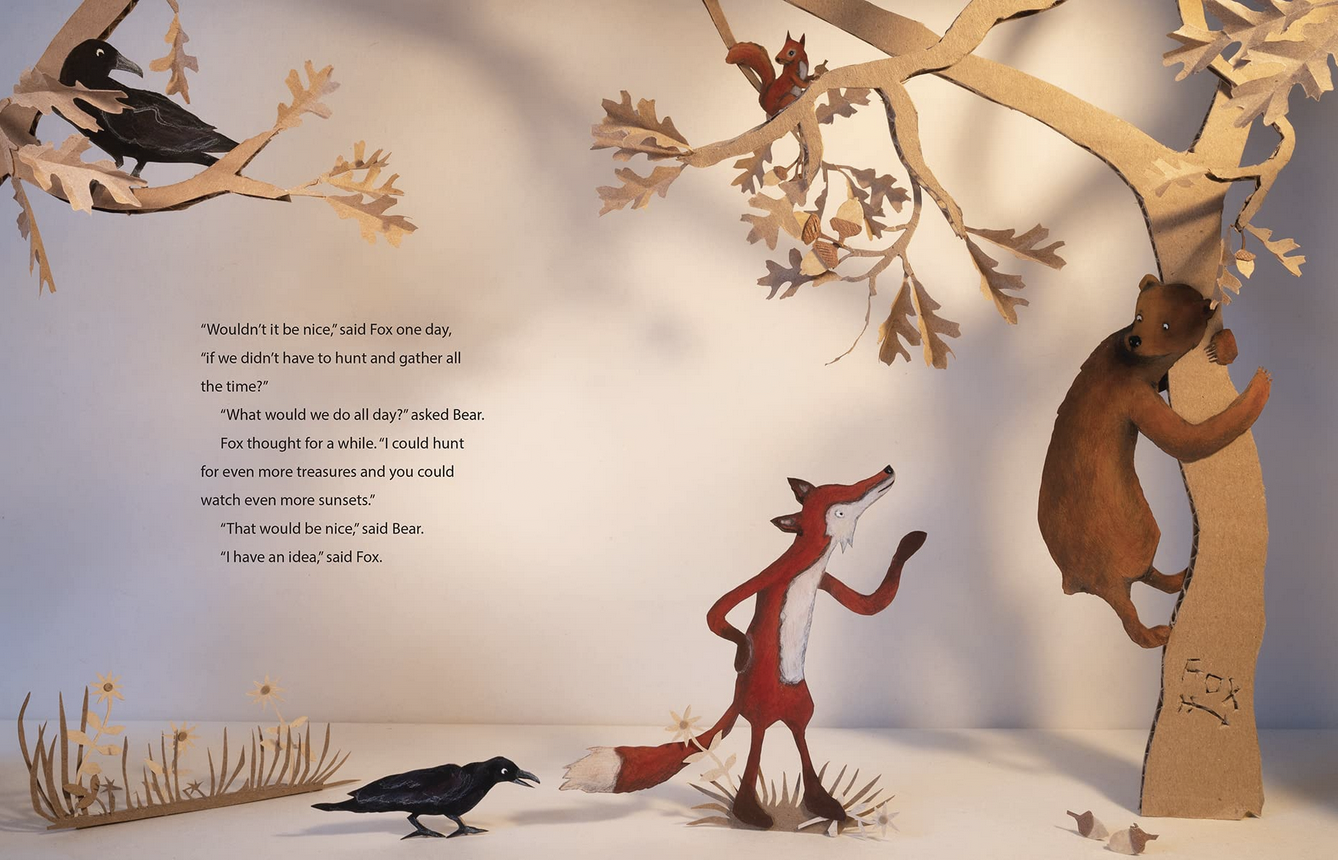
Though life for most animals revolves around the search for food and may seem mundane by human standards, Bear thinks life is pretty good. He loves picking berries while Fox hunts for eggs. And in between the search for food, Bear takes naps and enjoys the daily sunset while Fox searches for treasures and hides them. But then Fox has an idea. What if he could make their food forays more efficient?
From Fox and Bear by Miriam Körner
They start with cages to trap geese and keep them as egg-layers. They also gather more berries and seeds and plant them. Though their aim was to spend less time searching for food, all their chores require more effort, and Fox and Bear rarely have time for the pleasures of naps, treasure hunting and sunsets. So, Fox comes up with another idea.
 
This time, Fox draws up plans for a complex set of machines to gather eggs, feed the birds, water the plants, and pick the berries. Unfortunately, they have to dig up mountains and cut down trees for their contraption. And there were new jobs of gathering wood for the steam engines, filling the bird feeder and building more cages. As their work became more efficient, it became bigger and more involved and time-consuming. Eventually Bear realizes that their new efforts are greater than their past ones and their original daily tasks were the best of all.
From Fox and Bear by Miriam Körner
Fox and Bear could be an updated version of an Aesop's fable. Whether the message is about greed or ensuring that progress is actually an improvement, Fox and Bear remind us that bigger is not always best. A simple life of earnest food-searching and basic pleasures like napping and sunset-watching are not to be dismissed. Our world today is so focused on getting bigger and more that those who adhere to the principles of simple and meaningful are disregarded. It's reassuring to see that, although Bear goes along with Fox's plans, he eventually realizes what is best for him. What Fox decides is up to the reader as Miriam Körner leaves it open as to whether he too will return to his former life or stick with his new busy and overworked lifestyle. (This would be an interesting lesson for students to consider.)

Author-illustrator Miriam Körner lives in Northern Saskatchewan, and I suspect that the very landscape she sees outside her cabin's window is what has given her Fox and Bear's story. The destruction of forests for development must be seen in her northern community, whether for commercial farming, forestry, mining or settlements. Perhaps those behind all that economic planning should be reading Fox and Bear along with young readers.
From Fox and Bear by Miriam Körner
Behind her impactful story is Miriam Körner's artwork which is extraordinary. She has created dioramas from recycled paper and cardboard packaging painted with graphite pencils, soft pastels and acrylic paint. Through a limited palette of browns with red for fox and occasional hints of blue or black, Miriam Körner gives Fox and Bear an organic and very realistic feel to the natural world. Even when she introduces the machinery that Fox implements for efficiency, the cut of the paper and shape of her structures, though of the same colours, shouts of the manufactured and the synthetic. I'm a big fan of textures in picture book illustrations and, by photographing dioramas she has made of the paper and cardboard, Miriam Körner introduces even further textures with shadows and a three-dimensionality to the art. Miriam Körner's artwork presents a story of such quality that readers will be drawn in by the art but will stay for the fable that simple is sometimes actually best.

June 07, 2021

Snazzy Cat Capers series: Guest review

 This review was written by teacher Elizabeth Cook.
 
Written by Deanna Kent
Illustrated by Neil Hooson
Imprint (Macmillan)

This series has been sitting in my TBR pile for quite some time and I am regretting how long it has taken me to get to this treasure by Deanna Kent and Neil Hooson. This middle grade series, which blends the text of novels with black-and-white graphic novel artwork, focuses on cat burglar Ophelia Von Hairball V, a fun and fabulous character who is a fusion of master criminal (though she always returns the stolen goods), secret agent and glamorous diva. Because I was instantly hooked by the globetrotting cat adventures, entertaining characters, and witty word play, I devoured the first three books in the series (see details below) in just two days and am already hoping that at least one more book will follow. 

Snazzy Cat Capers 
(Book 1)
Written by Deanna Kent
Illustrated by Neil Hooson
Imprint (Macmillan)
978-1-250211149
240 pp.
Ages 7-10
2018
 
In the first book of the series, we are introduced to Ophelia Von Hairball V.  She is a classy cat burglar who steals only the most precious items from around the world to enjoy at her house. But, after she's played with the trinkets, she always returns them to their owners, since keeping them would make her a criminal! While she loves the glitz and glimmer of her sparkly treasures, it is the thrill of the chase that she enjoys most and she is quite good at it too!  Ophelia Von Hairball V is the #1 rated cat burglar in the FFBI (Furry Feline Burglary Institute). This title is hard earned as the dogs of CCIA (Central Canine Intelligence Agency) are always on her tail, as is her evil uni-browed cousin, Pierre, who regularly ranks at #2 because of his sloppy execution. Though the FFBI provides their agents with access to inventors, Ophelia prefers to work alone, though she finds inventor Oscar Fishgerald Gold, a hard-working goldfish, useful and so she keeps him around...but at a paw’s length. In this book, the FFBI have challenged their cats to steal a rare Himalayan diamond and deliver it to headquarters for the opportunity to earn the top spot. Using her cunning, Oscar's incredible gadgets, a good plan and the ability to think on her paws, Ophelia is determined to hold onto her top ranking, even if she has to evade the CCIA and her evil cousin Pierre to do so.
 

The Fast and the Furriest 
(Snazzy Cat Capers, Book 2)
Written by Deanna Kent
Illustrated by Neil Hooson
Imprint (Macmillan)
978-1-250143471
224 pp.
Ages 7-10
2019
 
The second book in the series starts with the theft of the valuable Secret Claw from FFBI’s vault. This device emits a red laser beam so strong that it can control all of the cats around the world. Naturally, the dogs of CCIA want control of this device to prevent thefts by the cats. Ophelia, as the FFBI's top cat burglar, is tasked with travelling the world to locate the three pieces of the device and return them safely to the Institute's vault. Ophelia plans to use her panache and global connections to help steal the components back, though she knows that the CCIA and her cousin Pierre will be out to thwart her efforts. Luckily, she has her fin-ventor, Oscar, and their loyal invention P.U.G. (Personal Ultra Gadget) to help her.
 

Meow or Never 
(Snazzy Cat Capers, Book 3)
Written by Deanna Kent
Illustrated by Neil Hooson
Imprint (Macmillan)
978-1-250143495
224 pp.
Ages 7-10
2020

In Ophelia Von Hairball V's third book, the feline burglar is presented with perhaps her greatest challenge yet.  Every cat burglar has been instructed to steal the most valuable item they can and bring it to FFBI headquarters for judging within seventy-two hours.  For a cat burglar of her calibre, stealing is the easy part. For Ophelia, though, the real challenge is working cooperatively in a team, as each burglar must work with an inventor to demonstrate that "teamwork makes the dream work." Having fired 16 previous inventors before Oscar Fishgerald Gold, and relentlessly trying to give Oscar the slip on every mission, Ophelia needs to learn how to cooperate with her team if she is to be successful on this mission. Fortunately, Oscar creates many fabulous disguises and inventions to keep Ophelia interested and readers entertained, including the O.M.G. (Ophelia Mew-bile Go) car which boasts endless modes, including pirate, cuppa-tea and leprechaun, and which comes in very handy as they travel across the globe to steal a jewelled purple sceptre. Now if Ophelia can out-manoeuvre her evil cousin Pierre and the CCIA, she is sure to win this competition paws down!


I highly recommend this series for its fun themes of cat and mouse, or should I say cat and dog! Young readers will enjoy delving into Snazzy Cat Capers themselves but older readers will also appreciate the humour and be encouraged to read them aloud to younger children.  I especially enjoyed the oodles of puns including “paw-rtner”, “fin-tastic”, and “hiss-tory.” In fact, almost every chapter title is a clever play on words that will make adults and astute young readers chuckle. Moreover, every chapter is preceded by a quote from Ophelia Von Hairball V that is a misappropriation of a famous line from history. A few of my favourites include: "To be fabulous or not to be fabulous? That is the question. Except it is a ridiculous question because we all know the answer" and "I came. I clawed. I conquered."  The clever wit embedded throughout the series will definitely entertain readers of all ages.
 
 
~ Reviewer Elizabeth Cook is a teacher in the Halton District School Board. She is an avid reader and fan of Canadian literature.  
 

August 16, 2016

Zap! Nikola Tesla Takes Charge

by Monica Kulling
Illustrated by Bill Slavin
Tundra Books
978-1-77049-522-7
32 pp.
Ages 6-10
August 2016

Sure everyone is talking about the Tesla car but this is the story of the great inventor who inspired that motor car’s name by devising a multitude of inventions, not the least of which was the alternating current useful for effective distribution of power across great distances.

The extraordinary Nikola Tesla was born in Croatia in 1856 and came to America in 1884 with a dream of finding a job with Thomas Edison, the “electrical wizard” who hired young men to help develop new ideas.  Though Niko Tesla showed astonishing prowess with motors and machinery, astounding even Edison, his idea of a motor that ran on alternating current electricity was discouraged by the famous man who was determined to continue to invest in his direct current systems.

It wasn’t until Tesla met the entrepreneur-engineer George Westinghouse (who founded Westinghouse Electric and Westinghouse Appliances) that he was able to put his ideas into practice.  And, though Thomas Edison waged a nasty smear campaign against Tesla’s efforts, the 1893 World’s Fair in Chicago proved to the world that alternating current was the more efficient system of providing electricity.  But it was the realization of Tesla’s dream to build a generator at Niagara Falls that sparked one of his greatest achievements, witnessed by the world in 1895.
From Zap! Nikola Tesla Takes Charge 
by Monica Kulling, illus. by Bill Slavin
Zap! Nikola Tesla Takes Charge is a great story of a young man with dreams and skills that even the malicious machinations of the celebrated Thomas Edison could not encumber.  Monica Kulling focuses on Tesla’s perseverance through repeated complications to stick to his aspirations, demonstrating that good ideas will not die.   It’s a positive message and an inspiring story of determination and engineering brilliance.

I’m saddened that Zap! Nikola Tesla Takes Charge is the final book in the Great Idea Series by Monica Kulling from Tundra Books.  Just as Zap! will undoubtedly do, these illustrated biographies have delighted young readers with the accomplishments of great inventors, from George Eastman to Elijah McCoy, covering cameras, paper bags, household management, the Zamboni, to steam engines, each story providing a glimpse into the lives of those who developed ideas that progressed our worlds in so many ways.  It’s especially gratifying that Bill Slavin, who was the original artist for the first book, It’s A Snap! (Tundra, 2009), has illustrated this final book.  His pen-and-ink artwork, coloured in PhotoShop (see images at http://www.billslavin.com/p/picture-book-illustration.html) enhance the story and bring the series full circle, electrifying Nikola Tesla’s story with a brightness and the authenticity so necessary in illustrated biographies. Congratulations to Monica Kulling and Bill Slavin on this culminating tome, a publishing achievement to rival those of the inventions in the Great Ideas Series.
From Zap! Nikola Tesla Takes Charge
by Monica Kulling, illus. by Bill Slavin

**Please check out Monica Kulling's comment below.  Seems one last book, #10, will be forthcoming.  Yippee!

April 12, 2016

Sky Pig

Written by Jan L. Coates
Illustrated by Suzanne Del Rizzo
Pajama Press
978-1-927485-98-9
32 pp.
Ages 4–7
April 2016


Ollie is a little pig with a big dream and, though he doesn’t speak (he is after all a pig and pigs can’t talk), his friend, Jack, a boy with a big heart and a bigger imagination, tries to help Ollie achieve his dream.

Ollie from Sky Pig by Jan L. Coates,
 illus. by Suzanne Del Rizzo
First Jack fastens leafy branches onto Ollie’s back and they climb to the top of a very high hill. Even though a fast run and a jump has Ollie believing that he’s flying, an “Oooooomph!” and a “Plop!” make it evident he did not.  Having Jack create a kite with some garden stakes, twine, a feed sack and scraps of fabric is Ollie’s next plan to become airborne.  A couple of oinks and another “Oooooomph!” and “Plop!” again foretell the futility of their endeavour. Finally, taking their cues from the geese, chickens and other birds, Jack fashions a set of wings for Ollie. Made from an assortment of papers, including maps and wrapping paper featuring airborne creatures, and miscellaneous gears and leather, Ollie takes to the sky like a kind of steampunk flyer.  Alas, that flight ends similarly.  Even a Mary Poppins-like contraption of umbrellas is unsuccessful.

It’s only when the two make use of an already-tried-and-true flying machine that Ollie is able to stay aloft and experience the joys of floating in the sky, even if only for a short time and at a cost of $5.

Dreamers can dream but, with a friend like Jack, Ollie’s dream that a pig could fly comes true.  It takes a little determination, a lot of imagination and being in the right place at the right time but Ollie’s dream, courtesy of Jack’s friendship and piggy bank, becomes a reality.  Jan L. Coates’ story is uplifting like much of her previous work including A Hare in the Elephant’s Trunk (Red Deer Press, 2010), The Power of Harmony (Red Deer Press, 2013), and The King of Keji (Nimbus, 2015), and even more so with Suzanne Del Rizzo’s spectacular art, previously enjoyed in Skink on the Brink (Fitzhenry & Whiteside, 2013) and Gerbil, Uncurled (Fitzhenry & Whiteside, 2015).  The doughy art (plasticine with polymer clay) with mixed media collage features adds the textures and colour to elevate the story even higher.  Beyond the cuteness of Ollie and Jack is a rich landscape of green pastures and trees, chickens and groundhogs, and flowers and dandelion fluff and sweet details of a chicken protecting her egg in a life-vest or basket and thwarting a mouse that tries to get too close.   There’s so much more to Sky Pig than making a pig fly and young readers will love going along for the ride.

From Sky Pig by Jan L. Coates, illus. by Suzanne Del Rizzo

_________________________________________

There will be two great opportunities to check out Sky Pig with author or illustrator.

Illustrator Suzanne Del Rizzo will be participating in the I Art Books Exhibit and Sale of Children's Book Illustration on April 30, 2016 at Blue Heron Books in Uxbridge, ON. Details here.

Author Jan L. Coates will be launching Sky Pig on May 7, 2016 at The Box of Delights Bookshop in Wolfville, NS. Details here.

January 28, 2016

Clean Sweep! Frank Zamboni’s Ice Machine (Great Ideas Series)

Written by Monica Kulling
Illustrated by Renné Benoit
Tundra Books
978-1-77049-795-5
32 pp.
Ages 5-8
January 2016

It’s always a great day when another of Monica Kulling’s Great Ideas Series books comes out.  These illustrated biographies, enhanced with artwork by an assortment of talented Canadian illustrators, highlight key individuals whose innovations we have come to rely upon but about whose stories we often know so little.  There’s been George Eastman’s photography, Elijah McCoy’s invention for oiling train engines, Elisha Otis’ elevator, Margaret Knight’s paper bags, Lillian Gilbreth’s efficient kitchen, Marconi’s wireless and now an invention dearly loved by hockey fans the world over, the Zamboni invented by Frank Zamboni.

Opening with a poem called Bone Blades that emphasizes “a way to fly around, when ice is on the ground”, Monica Kulling takes young readers to the early 1940s when Frank Zamboni and his brother and cousin opened their Iceland Skating Rink.  Resurfacing the ice, while skaters waited, was a time-consuming endeavour of a tractor levelling out the pits and grooves, a crew shovelling away the shavings, washing the surface and then spraying with fresh water, and all before a gleaming finish was added by hot water.

Having learned to tinker with trucks and tractors on their Idaho farm and working at his brother’s auto repair shop in California, as well as studying at an electrical school in Chicago, Frank was a busy man, working with his brother Lawrence doing electrical work, drilling wells, installing pumps and then making ice for home ice-boxes.  It wasn’t a big jump to making ice rinks with the smoothest surfaces ever.

But it wasn’t until after the war that Frank was able to buy military parts that became the foundation for his ice-resurfacing machine and a version of his famous Zamboni machine was created.

Oh, how I wish that the Zamboni had been a Canadian invention.  It seems so quintessentially Canadian.  But Monica Kulling still makes the reader applaud for the innovation and brilliance of Frank Zamboni to find a ground-breaking solution to a common problem.  By sweeping in details about his early years and training, as well as family and engineering development, in addition to some Zippity Zamboni! fun facts appended to the story, Monica Kulling again demonstrates how extraordinary developments can arise from very ordinary circumstances.

Having Renné Benoit, whose artwork has graced award-winning picture books such as Lily and the Paper Man (2007), Proud as a Peacock, Brave as a Lion (2009), and The Secret of the Village Fool (2012) as well as the recent A Year of Borrowed Men (2015), do the illustrations for Clean Sweep! seems intuitive, as she creates memorable work that feels like old photographs from a bygone era.  Her colours and lines are soft and sepia-like, both light and substantial, depicting people and places of a different time so naturally.

Clean Sweep! Frank Zamboni’s Ice Machine is a fresh take on a historic innovation told simply but with sparkle by Monica Kulling and perfected by Renné Benoit’s art.

********************************************
I encourage teachers to consider using this wonderful series for teaching biographies to young children.  Clean Sweep! and others in the series demonstrate an innovative way to share someone’s life story without the boring parts that are so often embedded in the teaching of biographical literature.

Here is a complete list of Great Ideas Series books, including upcoming releases:


  1. It’s a Snap! George Eastman’s First Photograph (Tundra, 2009)
  2. All Aboard! Elijah McCoy’s Steam Engine (Tundra, 2010)
  3. In the Bag! Margaret Knight Wraps It Up (Tundra, 2011)
  4. Going Up! Elisha Otis’s Trip to the Top (Tundra, 2012)
  5. Making Contact! Marconi Goes Wireless (Tundra, 2013)
  6. Spic-and-Span! Lillian Gilbreth’s Wonder Kitchen (Tundra, 2014)
  7. Clean Sweep! Frank Zamboni’s Ice Machine (Tundra, Jan/2016)
  8. To the Rescue! Garrett Morgan’s Underground (Tundra, Jan/2016)
  9. Zap! Nikola Tesla Takes Charge (Tundra, Aug/2016)

June 14, 2014

Lumière (The Illumination Paradox, Book One)

by Jacqueline E. Garlick
Amazemo Books
978-0-99216300-6
458 pp.
Ages 12+
December 2013


"How much do you trust me?"

When you have a secret that could lead to your hanging from the gallows, dipped in hot wax, or discarded with criminals and the Infirmed to a societal wasteland, you're very careful with whom you place your trust.  But at some time, everyone needs a little (or a lot!) of help and you need to trust someone.  

Fortunately for Eyelet Elsworth, her father, a famous inventor, who perished the Night of the Great Illumination, and her mother, who is put to death on the charge of being a shape-shifter and killing the royal baby, always looked for ways to protect her and even reverse her affliction.  Sadly, she lost her father when she was but eight years of age, and her mother nine years later.  Now at 17, Eyelet is running away from her home in Brethren, where she attends (attended!) the Academy of Scientific Delves and Discoveries, pursued by Professor Smrt and soldiers called Brigsmen.  Challenged as exhibiting madness but really hunted for her father's notebooks, Eyelet only has her mother's necklace with an hourglass-shaped vial containing an emerald light, and the location where her father's invention, The Illuminator, is stored.

Though Eyelet may not believe it, she is fortunate to discover her father's invention being  removed from the warehouse.  Grabbing hold on the carriage in which it's been taken, Eyelet is taken by Urlick Babbit to the safety of the home he shares with his father in the Ramshackle Follies, a scorned land beyond the limits of the Commonwealth.  Though Urlick is perennially focused on his face of raised purple scars and blemishes that he believes marks him as a monster, Eyelet sees beyond this, curious about the plethora of gadgets, the restrictions he places on her if she is to stay, and the location of her father's Illuminator. 

But both Eyelet and Urlick are keeping secrets and unknowingly creating misunderstandings that may put their relationship and even their lives in danger.  Neither can guess the other's intentions but each is convinced that they do. Readers will celebrate each forward step of Eyelet and Urlick's adventures, all the more so because they demonstrate great strength of purpose but are emotionally weakened by their perceived debilitations.  Fortunately, the intervention by a secondary cast of characters and a little honesty go a long way in bringing Eyelet and Urlick together, emotionally and strategically, to achieve something grand. Urlick's simple kindnesses towards Eyelet and Eyelet's disregard for his facial features will have you cheering for their inevitable romance so charmingly evoked by Jacqueline E. Garlick's rhythmic imagery.
"All the blood in my body tingles.  Not in the cool metallic way it does when I'm falling into an episode, but warm and cursive, like fancy handwriting over fine parchment paper, all loopy and beautiful, seeping in and out of every pore." (pg. 373)
The plot developments in Lumière will keep readers riveted, as will the imaginative gadgetry–a cigarette holder and flame thrower, for example–that enriches the steampunk genre. But, for me, sharing Eyelet's and Urlick's perspectives, usually in alternating chapters, and their witty repartée took me from beginning to end in two short readings.
"Ohmilord, ohmilord, ohmiLOOORD!" I scream.
"What are you doing?" Urlick shouts.
"Saving you?" I gulp as I swing past. "What does it look like I'm doing?"
"Have you lost your mind?"
"No, not yet. But soon, I suspect." (pg. 345)
Book Two in The Illumination Paradox series is set to be titled Noir (another title based on Eyelet's father's notebooks) though there is no ETA for it yet, though I will continue checking Jacqueline E. Garlick's website at http://jacquelinegarlick.com/, as I recommend you do, because Lumière leaves Urlick just about at his end.  And we wouldn't want anything to separate them when he's just found the "only girl I ever believed could understand me" (pg. 204), would we?

December 01, 2013

Quicksilver

by R. J. Anderson
Carolrhoda Lab
978-0-7613-8799-2
316 pp.
Ages 14+
2013

In Ultraviolet (reviewed here), R. J. Anderson's prequel to Quicksilver, teen Alison Jeffries had been hospitalized in a youth psych facility and receiving treatment after claiming to see a fellow student, Tori Beaugrand, disintegrate.  Though others saw her as acting out and a potential head case, Sebastian Faraday, who'd claimed to be a neuropsychologist, recognized Alison as a synesthete for whom the interconnectedness of her senses was overwhelming.  Moreover, Tori had disintegrated, when a relay (connecting to her embedded transmitter) transported her to a different world, from which both she and Faraday had come originally, and back to the experimentation of Mathis.  Ultraviolet ends with Alison and Faraday admitting that they cared for each other but Faraday staying behind to help Alison and Tori escape back to earth.

As Ultraviolet was primarily Alison's story, albeit contingent on Tori's existence, Quicksilver focuses on Tori and the need to keep her safe from those who would choose to study her "genetics".  Even with a change of name and appearance and a move far from Sudbury for Tori and her parents (who'd always known her history), trusting and staying inconspicuous are difficult.  This is especially so when Milo, a workmate of Tori's, witnesses Faraday's materializing into Tori's bedroom.  By concocting a scenario about an unethical company, Meridian, from which both Faraday and Tori are hiding, Faraday is able to enlist Milo's help in keeping Tori safe, and in helping to find the means to destroy the relay. Sadly but characteristically, there are the recurring misinterpretations of feelings, by Milo, Alison, Tori and others, as they attempt to understand new relationships. 

With layer upon layer of lies, coupled with the otherworldly truths regarding Faraday and Tori, Quicksilver becomes as complicated as Faraday and Tori's attempts to prevent Mathis from controlling them via the relay and its quicksilver, a programmable material.  Refreshingly R. J. Anderson keeps her characters from early success, choosing instead to demonstrate the need for creative thinking and perseverance.  Fans of engineering and inventions will love Tori's mechanical exploits, especially as she needs to use Milo as the male cover for her brilliance (apparently uncharacteristic of females).  And, if scientific intricacies and physics are not your strengths, then perhaps the schemes by which Tori, Faraday and Milo go to protect those for whom they care will have you considering their choices as effective or subterfuge.   Even the most brilliant of them aren't sure how to handle love and its often undecipherable messages. Regardless, Quicksilver has sophisticated plotting at its core, a prerequisite for complex speculative fiction.  Whether it be faeries or physics, R. J. Anderson has no qualms about synthesizing a tight weave of emotions, science and interpretation into a durable and unique story-telling fabric.

Look for my interview with author R. J. Anderson tomorrow, to commemorate the launch of her highly successful UK version of her Faery Rebels' series. 

November 04, 2013

The Creature Department

by Robert Paul Weston
Razorbill
978-1-59514-685-4
352 pp.
Ages 8-12
November, 2013
Reviewed from galley proof

Don't let the title or cover graphics deceive you into thinking The Creature Department is a horror story.  Remember that Robert Paul Weston, author of Zorgamazoo (Razorbill, 2008), Dust City (Puffin, 2010) and Prince Puggly of Spud and the Kingdom of Spiff (Puffin, 2013), has a wicked sense of humour and loves to embed fairytale-like stories with fantastical elements and the dark vices typical of humans.  Nothing terrifying there.  Just creative, whimsical, and full of rich characters and settings.  And original, captivating storylines!

The Creature Department is the name of the Research and Development Department which Elliot von Doppler's Uncle Archie heads at the tech company DENKi-3000.  When Quazicom Holdings International expresses its intent to purchase the company, Uncle Archie invites twelve-year-old Elliot and fellow student Leslie Fang (who tied with Elliot in a recent science fair) to help generate a new invention by which DENKi-3000 would regain its reputation for innovation. 

For the first time, Elliot (with Leslie) gets to visit his uncle's super-secret department which, surprisingly, is run by creatures! There's Gügor the Knucklecrumpler (an 8 ft. salamander-like creature) who's the head of Rickum Ruckery; Jean-Remy, a suave fairy-bat, in charge of Fiddly Bitology; Harrumphrey Grouseman, the Right-Hand Head;  Patti Mudmeyer, a bog nymph, who's in charge of design; and the lovable Colonel-Admiral Reginald T. Pusslegut a.k.a. Reggie, a bombastadon who is more than a glorified security guard.  When Uncle Archie disappears, and Quazicom sends their consultant, Chuck Brickwater, to learn DENKi-3000's secrets, it seems that Elliot and Leslie are the only hope for helping the creatures develop their next astounding invention. 

In a race against Quazicom and an unscrupulous VP at DENKi-3000, Elliot and Leslie learn some valuable lessons ("...ze troubles, more than anything else, zey make you who you are." pg 109), accept the value of having creativity and open-mindedness, and share some amazing experiences with their new friends. 

And the readers are treated to all the humour, wisdom, mystery, adventure and fantasy that Robert Paul Weston so effortlessly imbues his stories.  But, with the addition of wings, dreadlocks, knobbly hands, leathery skin, furry tails, cerebellows (for sucking ideas out of one's brain), leaky gills, sludge-dripping hair, greenish skins and blubberous physiques, the creatures of The Creature Department add a new graphic element to the story (though the illustrations in Robert Paul Weston's other books enhanced the stories well).  In fact, the creatures have gone beyond illustrator Zach Lydon's work on the page and into the realm of 3D creaturedom, courtesy of the visual effects studio, Framestone.   (Check them out at www.thecreaturedepartment.com)  Loveable, quirky, clever and kind – these creatures are more than cartoons characters.  They're the heart of The Creature Department.