Showing posts with label efficiency. Show all posts

January 30, 2023

Fox and Bear

Written and illustrated by Miriam Körner
Red Deer Press
978-0-889956469
32 pp.
Ages 5-8
January 2023
 
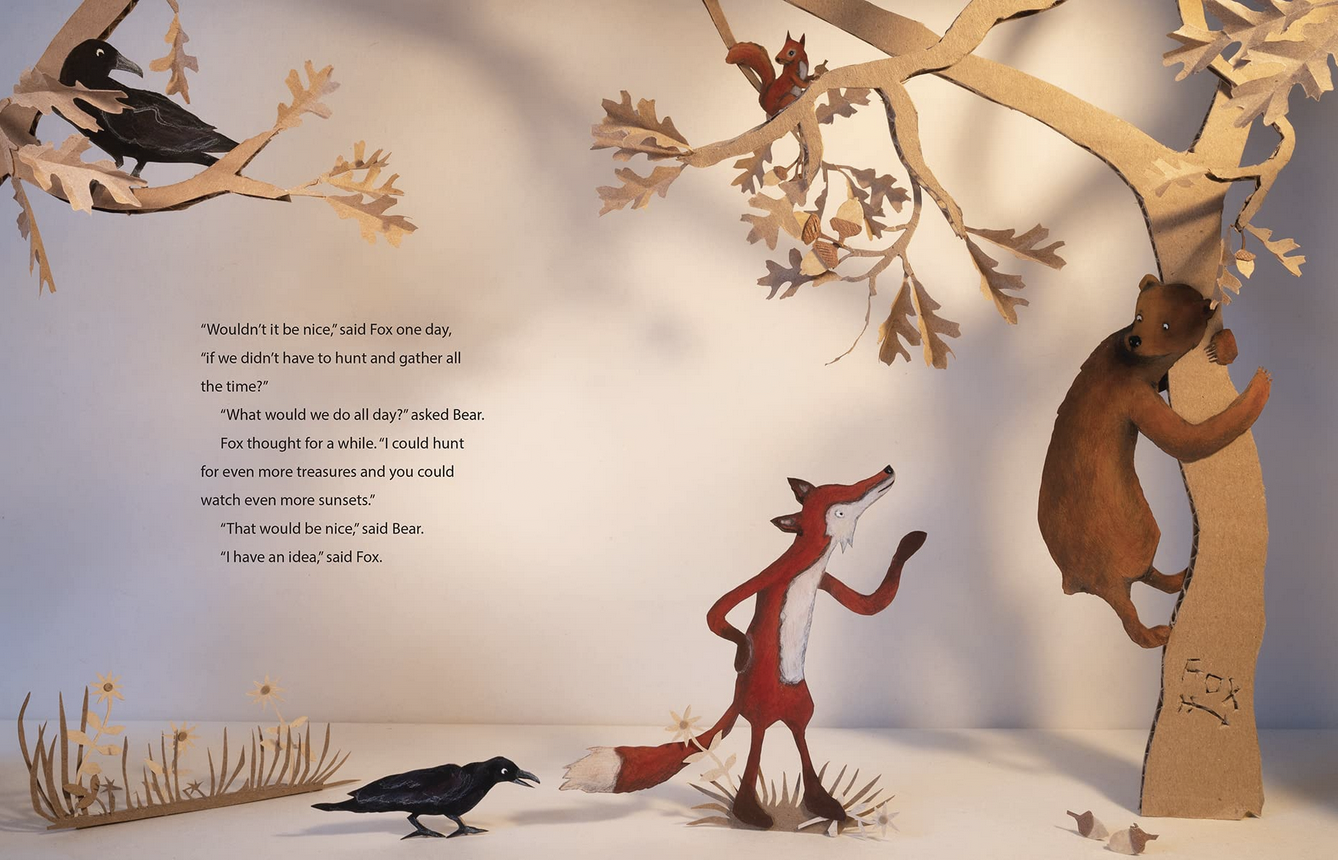
Though life for most animals revolves around the search for food and may seem mundane by human standards, Bear thinks life is pretty good. He loves picking berries while Fox hunts for eggs. And in between the search for food, Bear takes naps and enjoys the daily sunset while Fox searches for treasures and hides them. But then Fox has an idea. What if he could make their food forays more efficient?
From Fox and Bear by Miriam Körner
They start with cages to trap geese and keep them as egg-layers. They also gather more berries and seeds and plant them. Though their aim was to spend less time searching for food, all their chores require more effort, and Fox and Bear rarely have time for the pleasures of naps, treasure hunting and sunsets. So, Fox comes up with another idea.
 
This time, Fox draws up plans for a complex set of machines to gather eggs, feed the birds, water the plants, and pick the berries. Unfortunately, they have to dig up mountains and cut down trees for their contraption. And there were new jobs of gathering wood for the steam engines, filling the bird feeder and building more cages. As their work became more efficient, it became bigger and more involved and time-consuming. Eventually Bear realizes that their new efforts are greater than their past ones and their original daily tasks were the best of all.
From Fox and Bear by Miriam Körner
Fox and Bear could be an updated version of an Aesop's fable. Whether the message is about greed or ensuring that progress is actually an improvement, Fox and Bear remind us that bigger is not always best. A simple life of earnest food-searching and basic pleasures like napping and sunset-watching are not to be dismissed. Our world today is so focused on getting bigger and more that those who adhere to the principles of simple and meaningful are disregarded. It's reassuring to see that, although Bear goes along with Fox's plans, he eventually realizes what is best for him. What Fox decides is up to the reader as Miriam Körner leaves it open as to whether he too will return to his former life or stick with his new busy and overworked lifestyle. (This would be an interesting lesson for students to consider.)

Author-illustrator Miriam Körner lives in Northern Saskatchewan, and I suspect that the very landscape she sees outside her cabin's window is what has given her Fox and Bear's story. The destruction of forests for development must be seen in her northern community, whether for commercial farming, forestry, mining or settlements. Perhaps those behind all that economic planning should be reading Fox and Bear along with young readers.
From Fox and Bear by Miriam Körner
Behind her impactful story is Miriam Körner's artwork which is extraordinary. She has created dioramas from recycled paper and cardboard packaging painted with graphite pencils, soft pastels and acrylic paint. Through a limited palette of browns with red for fox and occasional hints of blue or black, Miriam Körner gives Fox and Bear an organic and very realistic feel to the natural world. Even when she introduces the machinery that Fox implements for efficiency, the cut of the paper and shape of her structures, though of the same colours, shouts of the manufactured and the synthetic. I'm a big fan of textures in picture book illustrations and, by photographing dioramas she has made of the paper and cardboard, Miriam Körner introduces even further textures with shadows and a three-dimensionality to the art. Miriam Körner's artwork presents a story of such quality that readers will be drawn in by the art but will stay for the fable that simple is sometimes actually best.

August 20, 2014

Spic-and-Span!: Lillian Gilbreth's Wonder Kitchen

by Monica Kulling
Illustrated by David Parkins
Tundra Books
978-1-77049-380-3
32 pp.
Ages 7-10
August, 2014

I join young readers regularly in the pleasure of reading the Great Idea Series, illustrated biographies of little-known but vastly-important innovators from history.  Monica Kulling's newest edition in the series focuses on American Lillian Gilbreth who was at the leading edge of workplace and household efficiency. 

Though she came from a wealthy California family, Lillian looked beyond an easy life, choosing first to attend university and then working as an industrial engineer and psychologist with her husband (whom she married in 1904).  Their company, Gilbreth Inc., used motion picture technology to assess the efficiency of workers at different tasks with the aim of increasing productivity and reducing worker fatigue.  With eleven children at home, the "Gilbreth System" helped keep the household running well and the children's tasks and progress charted.

But the unexpected death of her husband and partner in 1924 thrust new challenges upon Lillian, not the least of which was caring for her children.  Her eleven children.  But, because she was a woman, her vast experience meant little to those hiring industrial engineers, until Macy's department store hired her to improve their cash-room operations.   And the same principles that she applied there to save space and steps were implemented successfully into kitchen design. (We have Lillian Gilbreth to thank for the circular design of counters, appliances and sinks in most of our kitchens today.) By always examining how work could become more efficient, Lillian Gilbreth continued to innovate, even designing the first electric mixer.

Monica Kulling has again shared a fascinating individual, here Lillian Gilbreth, whose contribution to our world has been far-reaching and yet largely unrecognized.  And the wealth of that contribution is even more remarkable as it flourished at the turn of the twentieth century when women had fewer opportunities to extend themselves beyond work in homes and factories.  The busyness of the technologically advancing times and Lillian Gilbreth's large household are effectively depicted in David Parkins' illustrations, which are historically detailed, from the clothing, shoes and hairstyles to the kitchen appliances and flooring, and to the architecture at the time.  With Monica Kulling's illuminating text and David Parkins' comprehensive drawings, Spic-and-Span is a wonder in itself!  Lillian Gilbreth would be pleased with their collaborative efficacy in telling her story.