Showing posts with label progress. Show all posts

July 25, 2025

Soul Machine

Written and illustrated by Jordana Globerman
Annick Press
978-1-77321-959-2
228 pp.
Ages 12–16
June 2025 
 
In Chloe's world, souls are spun using wheels and the natural plant called breth. She and her family are in the business of soul making, though it's only her and her older sister Lacey since her father Morris left and her mother passed. And though Lacey still has to teach her younger sister all the steps to making souls, from getting the plants to spinning it, trimming it and packing it, Chloe has ambitions of becoming a CEO.
We just spin the threads, Chloe. As long as the mechanics of the soul remain a mystery, soul making stays an act of faith. (p. 8)
From Soul Machine, written and illustrated by Jordana Globerman
But their work has become more challenging. First, MCorp, a corporation led by Maya, a woman all aspire to be like, has been using a synthetic breth called Digibreth to make unlimited souls. Secondly, Lacey suspects that crops of breth are being poisoned by MCorp to force small businesses to become franchises of MCorp and weave Digibreth. Hoping to find a breth black market, Chloe heads to Metropolis, the busy city in which MCorp has its headquarters. There she is almost apprehended by the MCorp police for stealing but she is helped by Persie, one of the Nuspiritualist movement who protests against Maya and MCorp and works with others to heal and protect the natural breth.
From Soul Machine, written and illustrated by Jordana Globerman
Unbeknownst to Chloe, Maya has been watching Chloe and has her police follow her. As Maya and Persie travel towards the breth fields, including a stop at Paradise Found, a Digibreth test site where those test subjects promised spiritual optimization are now ghosts, Chloe becomes unwell. But when they reach their destination, parched and bereft of breth, Persie recognizes Chloe's father, from a photo in a locket, as the man who invented Digibreth.
 
While Persie is arrested, Chloe is taken to Maya. Maya, a cut-throat businesswoman, claims she  wants to help Chloe, asserting that she too needs Morris back as he is the only one who can fix the kinks in Digibreth. While Chloe appreciates the attention Maya pays her, she's starting to think there is much more to Maya's intentions, and she may be putting her family, both their business and their souls, at risk.
 
Soul Machine is Jordana Globerman's debut novel, and she's hit the scene with a powerful book of family and fantasy with a sampling of social commentary on choosing progress and celebrity over tradition and reliability. Chloe grapples with wanting success and fame but is challenged by what she sees in Maya and what she feels for her sister and family. In a society in which appearances are everything and better is best, Chloe is captivated, as many of our world are by popularity and fame. But Jordana Globerman has also given Chloe a soul that, when she must choose and act, she knows where her loyalties and her passions rest. And even though Maya sees the old world as deficient, she sees that as an opportunity for her.
"Your gen is all existential dread. It's a big market. (p. 110)

This new world has its own angst with the merging of state and self. The individual is becoming lost to those upheld as models of the best. Like many today, Maya is just capitalizing on it.

From Soul Machine, written and illustrated by Jordana Globerman
Jordana Globerman moves us through scenes of different atmospheres in Soul Machine with her colour choices, selecting one hue with different tints and shades for each set of circumstances. Metropolis and MCorp are all shown in pinks, perhaps reflecting those who see it all through rose-coloured glasses. The desolation of Paradise Found and the parched breth fields are depicted in a gold-puce-chartreuse. And home for Chloe and Lacey is teal. With her choice of colours and the strength of her illustrations that offer softness and harshness as appropriate, Jordana Globerman makes the reader think about our own society and the choices we make for ourselves and others. While many may not think about the metaphysics reflected in Soul Machine, Jordana Globerman actually presents opportunities to contemplate and discuss self and society, time and space, and reality as a whole—she appends her novel with "Questions with No Wrong Answers"—proving that her graphic novel, like many of other creators, is not "just" a comic book.

January 30, 2023

Fox and Bear

Written and illustrated by Miriam Körner
Red Deer Press
978-0-889956469
32 pp.
Ages 5-8
January 2023
 
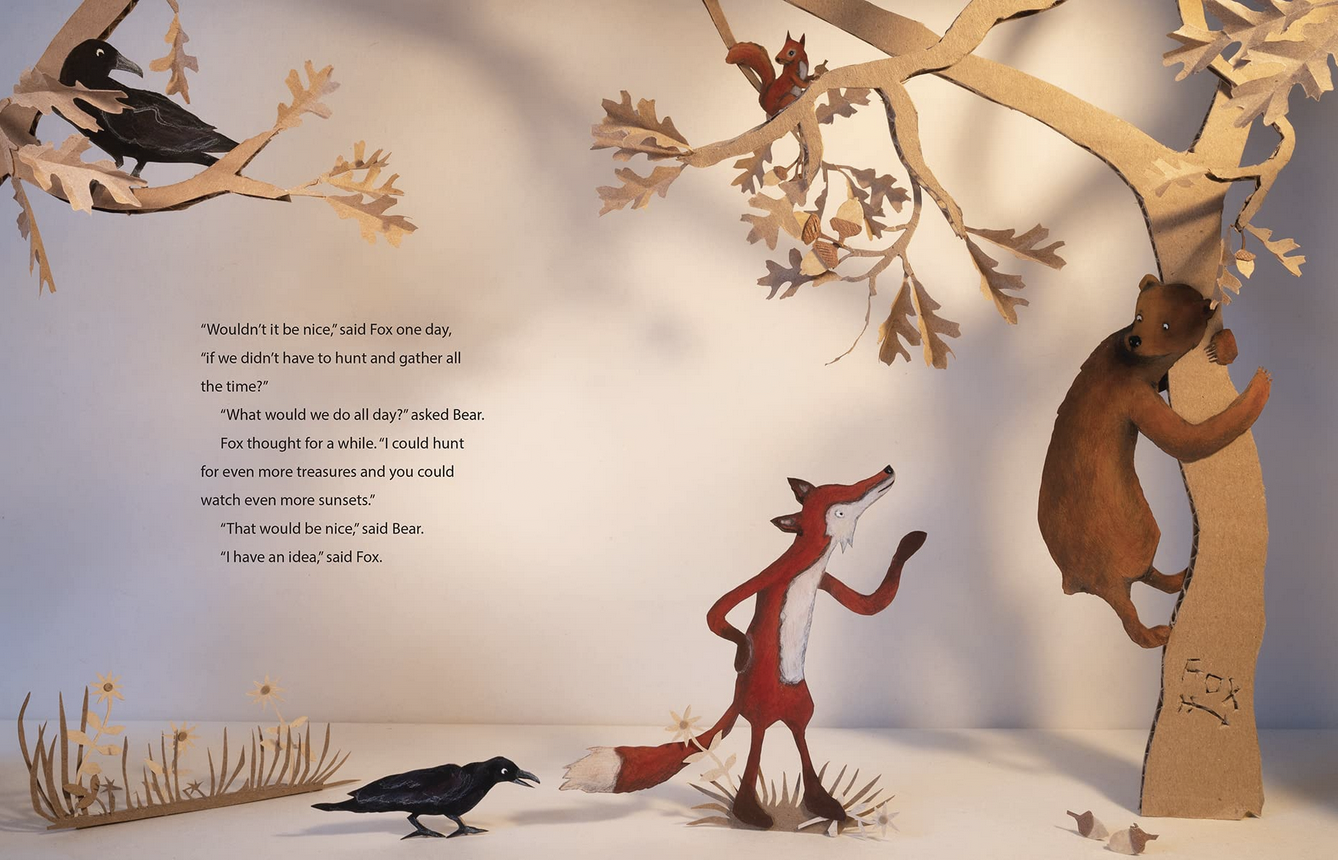
Though life for most animals revolves around the search for food and may seem mundane by human standards, Bear thinks life is pretty good. He loves picking berries while Fox hunts for eggs. And in between the search for food, Bear takes naps and enjoys the daily sunset while Fox searches for treasures and hides them. But then Fox has an idea. What if he could make their food forays more efficient?
From Fox and Bear by Miriam Körner
They start with cages to trap geese and keep them as egg-layers. They also gather more berries and seeds and plant them. Though their aim was to spend less time searching for food, all their chores require more effort, and Fox and Bear rarely have time for the pleasures of naps, treasure hunting and sunsets. So, Fox comes up with another idea.
 
This time, Fox draws up plans for a complex set of machines to gather eggs, feed the birds, water the plants, and pick the berries. Unfortunately, they have to dig up mountains and cut down trees for their contraption. And there were new jobs of gathering wood for the steam engines, filling the bird feeder and building more cages. As their work became more efficient, it became bigger and more involved and time-consuming. Eventually Bear realizes that their new efforts are greater than their past ones and their original daily tasks were the best of all.
From Fox and Bear by Miriam Körner
Fox and Bear could be an updated version of an Aesop's fable. Whether the message is about greed or ensuring that progress is actually an improvement, Fox and Bear remind us that bigger is not always best. A simple life of earnest food-searching and basic pleasures like napping and sunset-watching are not to be dismissed. Our world today is so focused on getting bigger and more that those who adhere to the principles of simple and meaningful are disregarded. It's reassuring to see that, although Bear goes along with Fox's plans, he eventually realizes what is best for him. What Fox decides is up to the reader as Miriam Körner leaves it open as to whether he too will return to his former life or stick with his new busy and overworked lifestyle. (This would be an interesting lesson for students to consider.)

Author-illustrator Miriam Körner lives in Northern Saskatchewan, and I suspect that the very landscape she sees outside her cabin's window is what has given her Fox and Bear's story. The destruction of forests for development must be seen in her northern community, whether for commercial farming, forestry, mining or settlements. Perhaps those behind all that economic planning should be reading Fox and Bear along with young readers.
From Fox and Bear by Miriam Körner
Behind her impactful story is Miriam Körner's artwork which is extraordinary. She has created dioramas from recycled paper and cardboard packaging painted with graphite pencils, soft pastels and acrylic paint. Through a limited palette of browns with red for fox and occasional hints of blue or black, Miriam Körner gives Fox and Bear an organic and very realistic feel to the natural world. Even when she introduces the machinery that Fox implements for efficiency, the cut of the paper and shape of her structures, though of the same colours, shouts of the manufactured and the synthetic. I'm a big fan of textures in picture book illustrations and, by photographing dioramas she has made of the paper and cardboard, Miriam Körner introduces even further textures with shadows and a three-dimensionality to the art. Miriam Körner's artwork presents a story of such quality that readers will be drawn in by the art but will stay for the fable that simple is sometimes actually best.

May 02, 2015

The Tweedles Go Online

Written by Monica Kulling
Illustrated by Marie Lafrance
Groundwood Books
978-1-55498-353-7
32 pp.
Ages 4-7
For release May 2015

Monica Kulling and Marie Lafrance's endearingly old-fashioned family, the Tweedles, has returned and this time they're looking to go online.  Telephone line, that is.
"I see we are going modern," sighed Papa. "Again."
First they moved from bicycles and horse and carriage to electric car in The Tweedles Go Electric (Groundwood, 2014).  Now Mama, with children Franny and Frankie, is ready to embrace the new technology that has their neighbour Mrs. Hamm raving about staying connected with her sister and friends, and about ordering her groceries online.  Papa still prefers the olds ways of getting about, i.e., walking and horses, and spending time with family playing crokinole.  And the noisy bells, the incessant chatter at all hours, and the time the new contraption takes away from their family time has him quietly resentful, though he says nothing. Papa is too much of a gentleman and wants to keep his family happy.  But when the telephone would surely have been useful in communicating an emergency, it falls short and the Tweedles recognize its limitations, with charming acceptance.

It seems the new developments of the first half of the 20th century produced similar effects to those of our 21st century: suspicion, caution, acceptance, overuse, disappointment, and finally comfort.  And how Monica Kulling is able to pack all that into a mere 32 pages, while still creating an engaging family of individuals—Papa, Mama, Franny and Frankie are completely unique and recognizable—with friends–Gladys Hamm is surely a woman we all know or knew–is astounding to me.  I said it before and I’ll say it again: I love the Tweedles!  They are refreshing, honest, unique and their take on all things new and 20th century is enchanting.

And Marie Lafrance puts colour and form to Monica Kulling’s Tweedles and story that I’m not sure anyone else could do so completely.  From their hair to their clothes, and the manner of their movements or even stances, Marie Lafrance has given life to the Tweedles and established a calming and rich environment–her colour palette is impeccable!– in which they can thrive, nay, progress.

April 08, 2014

The Tweedles Go Electric

by Monica Kulling
Illustrated by Marie Lafrance
Groundwood Books
978-1-55498-167-0
32 pp.
Ages 5-8
Released March 2014

With Earth Day 2014 soon upon us, and the world seemingly looking towards the future for greener technologies, Monica Kulling shows us that green was in our past and maybe we didn't always recognize it for its worth.  In The Tweedles Go Electric, the reader is taken back to the turn of the century–19th to 20th, that is–when the environment may not have been a focus but some wise people were looking beyond the popular when it came to transportation.

The Tweedles, an endearing family of Papa, Mama, twelve-year-old Franny and eight-year-old Frankie, are considered old-fashioned, even fuddy-duddies, because they still get around by walking or cycling, with an occasional foray into the country by horse and cart.  But everything changes (or does it?) with Papa's announcement that, "We're going modern.  We're buying a car!"

They buy a smart car.  A green car.  An electric car!  The family members' reactions to the new purchase are as varied as could be expected.  Papa is excited, though somewhat intimidated and needs to get used to it.  Mama is thrilled, just like Frankie, always having wanted a car.  Only the cerebral Franny takes it all in stride, less than engaged with their new purchase.  As with anything new and different, there are the critics.  However, when an emergency arises, the smart, green car impresses more than a few as to its indubitable value. 

The versatile Monica Kulling will delight readers with this newest book, just as she has with her illustrated biographies such as In the Bag! and Making Contact!, and her picture books of Mister Dash and Lumpito.  The text is fresh and lively, no matter whether the voice of a Tweedle or a salesperson or neighbour.  I love these Tweedles!  Marie Lafrance embodies her characters with the normalcy of members of a functional family but still with familial foibles and their own personalities. And the setting will easily transport the reader to a different time and capture that atmosphere of invention and growth.  With much kindness and no preaching, the Tweedles take the message of progress and fashion beyond the here and now (or there and then), and into the realm of open possibilities.

There is always a morsel of delightful learning in Monica Kulling's books, as there is in The Tweedles Go Electric. A little research reveals a plethora of electric cars were available in the early 1900's. In fact, in 1900 U.S., an astounding 38% of automobiles were powered by electricity. (1) Even though most of the vehicles were steam- or gasoline-powered at the time, and everyone's love of the automobile seemed to include the noise, consumption and pollution, it's easy to appreciate those who could see outside the box and open themselves to those new, albeit few, options. Definitely how we should always be seeing, wouldn't you say?


(1) Retrieved from http://www.edisontechcenter.org/ElectricCars.html on April 6, 2014.