Showing posts with label Annick Press. Show all posts

May 27, 2026

Soccerology: Unbelievable Facts and Stories About the Beautiful Game

Book cover of Soccerology: Unbelievable Facts and Stories About the Beautiful Game by Kevin Sylvester shows players playing soccer
Written and illustrated by Kevin Sylvester
Annick Press
978-1-8402-066-2
92 pp.
Ages 9–12 
April 2026 
 
With FIFA World Cup 2026 coming soon to cities across North America, excitement will be growing. For those who are just catching World Cup fever and for those who have always loved the game, Kevin Sylvester presents a lively and informative look at soccer, long known as the beautiful game.
Illustration of different versions of historical soccer games
From Soccerology: Unbelievable Facts and Stories About the Beautiful Game, written and illustrated by Kevin Sylvester
Super sports fan Kevin Sylvester takes young readers through everything about soccer, including why North Americans call it that. There's a lot about the history of the game, including variants that led to its current version and a timeline of where it was played, the rules that it used, associations established around the world, including women playing the sport, or not, throughout time, and trailblazers in the sport.
A boy stands holding a soccer ball on a pitch
From Soccerology: Unbelievable Facts and Stories About the Beautiful Game, written and illustrated by Kevin Sylvester
Next Kevin Sylvester gives us a primer about how the game is played, from the ball to the pitch (soccer field), and shoes (cleats) and protective wear. There are also discussions about how the game is played, including spin techniques, heading, cheating, and rule enforcement. Most fascinating are the sections in which Kevin Sylvester shares anecdotes about the game: the spectacles, good and bad; the victories and, sadly, tragedies too; the traditions; and becoming inclusive and being adapted to be even more so. There is so much to learn, and Kevin Sylvester always shares his knowledge with enthusiasm and lively illustrations. 
 
Young readers will already know that Kevin Sylvester can write anything: picture books, non-fiction, middle grade novels, speculative fiction, humour, and more. (He's even written a mockumentary for adults.) It's all captivating. But what makes the difference are the illustrations. The artwork in Soccerology is a mix of pen and ink with digital media to give colour and movement to the text. With every illustration, Kevin Sylvester takes us to the pitch, to a crowded stadium, or to different places and times. 
A child soccer fan looks at the destruction left after a soccer game
From Soccerology: Unbelievable Facts and Stories About the Beautiful Game, written and illustrated by Kevin Sylvester
Even after sharing that in-depth look at soccer, Kevin Sylvester gives young readers more from which to learn, including stats and an extensive list of references and sources for further reading. Soccerology may be comprehensive, but for the soccer fan, beginner or pro, it's a book that opens up more possibilities for learning. The beautiful game is even more beautiful with understanding about its history and complexities, and there's no better way to kickoff this year's World Cup excitement than by sharing Soccerology with young fans. 

May 04, 2026

Built Like a Bug: How Insects Inspire Everyday Inventions

Written by Anjali Joshi
Illustrated by Kathleen Ng
Annick Press
978-1-834020310
128 pp.
Ages 8–12
March 2026 
 
The natural world has always astounded. From within its plant and animal species, its landforms, its waters, and environmental factors like weather come examples for processes that work for adaptation, communication, farming, and more. In Built Like a BugAnjali Joshi, a science educator, focuses on insects and reveals all the ways they inspire important inventions and developments.
From Built Like a Bug: How Insects Inspire Everyday Inventions, written by Anjali Joshi, illustrated by Kathleen Ng
The table of contents to Built Like a Bug demonstrates the complexity of the book's content. It looks at mosquitoes and cockroaches, spiders and leafhoppers, termites and fireflies, ants, hawk moths, dung beetles, and bees and dragonflies. The assortment of insects is only matched by the contributions they have made to innovative research and development.
From Built Like a Bug: How Insects Inspire Everyday Inventions, written by Anjali Joshi, illustrated by Kathleen Ng
In addition to providing basic scientific information like common and scientific names, life and size, Anjali Joshi highlights key features of their behaviour that should be noted. For example, information on how the mosquito effectively jabs an animal and prevents clotting is being used by researchers to reduce pain from needles and to develop synthetic anti-coagulants.
From Built Like a Bug: How Insects Inspire Everyday Inventions, written by Anjali Joshi, illustrated by Kathleen Ng
Silk from spiders is inspiring researchers to develop sutures for stitches, to deliver medicines, to create bullet-proof materials, and to investigate it as a building material.
From Built Like a Bug: How Insects Inspire Everyday Inventions, written by Anjali Joshi, illustrated by Kathleen Ng
Insects are models for farming, for electricity, for flight, for navigation, for medicine, and so much more. They can inform us about engineering and building robots, as well as about energy efficiency and 
dealing with trash. There is so much information in Built Like a Bug that any reader—or teacher—will be able to get both a broad overview of how insects inspire innovation and the finer points about insects themselves and the research and development they generate. Regardless of the complexity of information, Built Like a Bug is organized so well that it is a pleasure to delve into the material. Tidbits of interesting facts are posted in info boxes called "Bug Bites" and the illustrations by Toronto-based artist Kathleen Ng give colour and details to strengthen the information and to keep the text from becoming overwhelming. Her digital art is specific enough to help convey key information, but it is not so detailed that a middle grade reader would get bored.
From Built Like a Bug: How Insects Inspire Everyday Inventions, written by Anjali Joshi, illustrated by Kathleen Ng
I know kids will enjoy this book, especially those interested in STEM activities, but teachers will adore it. Not only is it a prime example of a non-fiction book for middle-grade readers, offering opportunities for learning and creativity, teachers will appreciate the variety of features, from the glossary, full index, and references to the numerous experiments and activities. Built Like a Bug will give young readers lots to think about and to do, perhaps inspire them to see more within the natural world.
 

September 28, 2025

Never Silent: A Hiroshima Survivor's Story

Written by Setsuko Thurlow and Kathy Lowinger
Illustrated by Michelle Theodore
Annick Press
978-1-77321-985-1
64 pp.
Ages 11+
August 2025 
 
Setsuko Thurlow née Nakamura was born in Kojijn-machi, an eastern part of Hiroshima, in 1932. Her family had been samurai, and she'd had a rich childhood of family and education before the war came. With it, everything changed.
From Never Silent: A Hiroshima Survivor's Story, written by Setsuko Thurlow and Kathy Lowinger, illustrated by Michelle Theodore
As happened worldwide, daily life had to accommodate the threat of attack and the rationing to support military efforts. Hiroshima, a bustling city, was an important transportation and industrial hub and, with its port, it became a critical military harbour. Young children were sent away, food was rationed, and the people were encouraged to make sacrifices for "the glory of the country." (p. 25) As a thirteen-year-old, Setsuko and other girls were recruited to decode messages. August 6, 1945 was her first day as a decoder. She was at army headquarters in Hiroshima when the first atomic bomb was detonated on their city.
From Never Silent: A Hiroshima Survivor's Story, written by Setsuko Thurlow and Kathy Lowinger, illustrated by Michelle Theodore
Setsuko Thurlow's recollections of being buried in the rubble of a collapsed building, helping the countless burned and blinded, being reunited with some family and watching others suffer and die are horrific. And as a child, she lived this horror. Her parents set an unimaginable example of fortitude and courage. Still when those who had survived began to experience mysterious illnesses and die, there was new grief and confusion.
From Never Silent: A Hiroshima Survivor's Story, written by Setsuko Thurlow and Kathy Lowinger, illustrated by Michelle Theodore
Setsuko Thurlow's story does not end with the bombing of Hiroshima. She speaks of the aftermath including Japan's surrender and the occupation by U.S. and British Commonwealth forces, and the call for the abolition of nuclear weapons by herself and other Hibakusha (Japanese for explosion-affected persons) and activist groups worldwide.
 
The story of the bombing of Hiroshima and also Nagasaki is not an easy one. With so much suffering and devastation, any discussion would be brimming with tragedy, emotional distress, and worse. This story is even more so because it is told from the perspective of Setsuko Thurlow, herself a survivor. But Setsuko Thurlow and Kathy Lowinger go beyond the bombing itself and give the reader history of Hiroshima, of World War II, and of Setsuko Thurlow's activism and the awarding of the Nobel Peace Prize to the International Campaign for the Abolishment of Nuclear Weapons (ICAN) with which she is involved. (She delivered the Nobel lecture upon receiving the prize.) 
From Never Silent: A Hiroshima Survivor's Story, written by Setsuko Thurlow and Kathy Lowinger, illustrated by Michelle Theodore
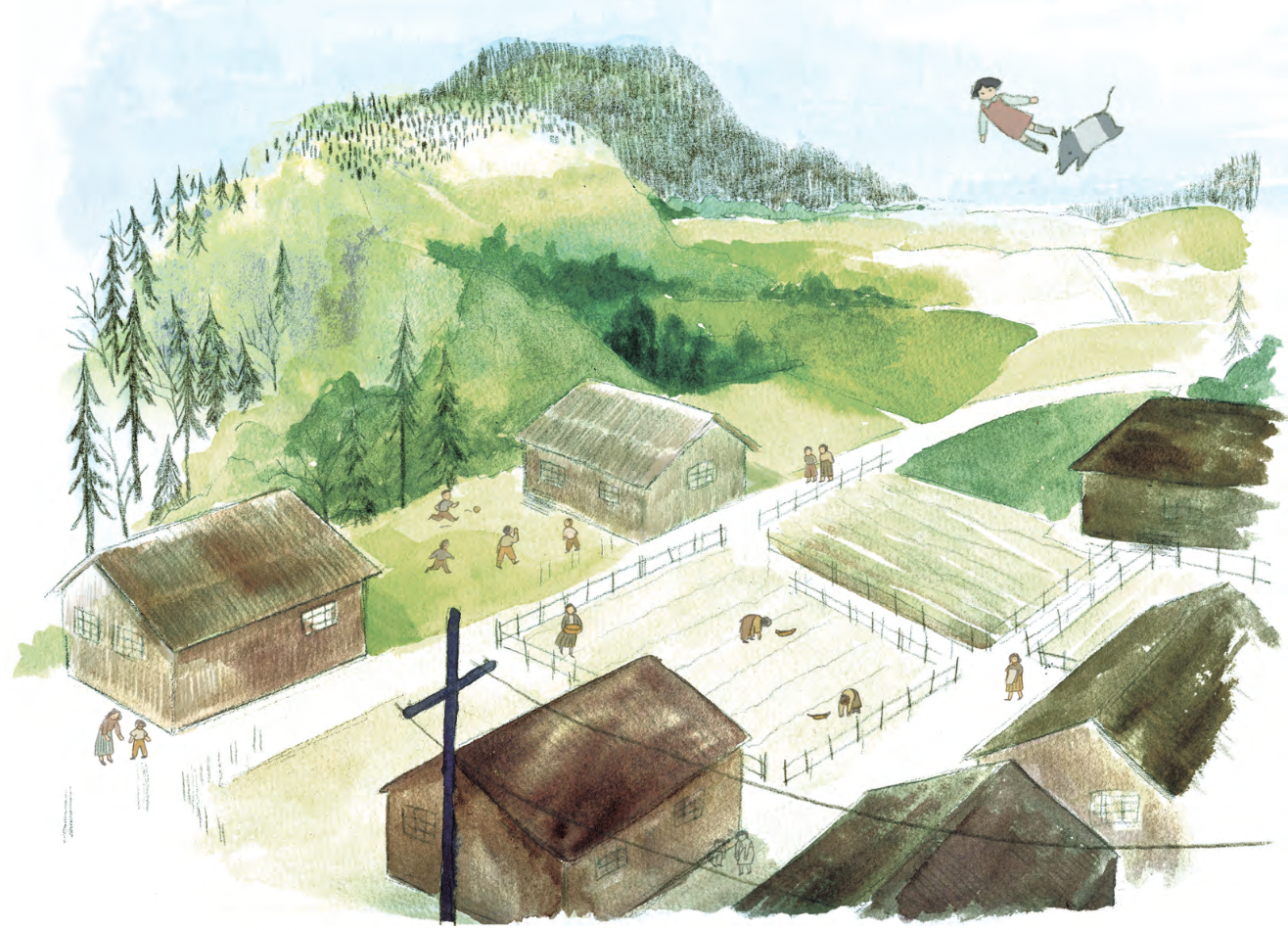
While much of Never Silent: A Hiroshima Survivor's Story is illustrated with countless photographs and images of newspapers and other documents, Edmonton's Michelle Theodore provides artwork that elevates the book from documentation to personal. She uses ink and watercolour markers to create sombre and evocative illustrations that depict both deeply personal and deeply poignant scenes. Her focus is on the Japanese setting and people, but all converges on what they are experiencing whether it be childhood joy, distress with tragedy, or compassion.
 
The 80th anniversary of the dropping of the atomic bomb on Hiroshima was commemorated this past August which is when this book was released. Because many of the Hibakusha are elderly, their stories are precious recollections to inform us and encourage action for peace. Setsuko Thurlow's story in Never Silent gives us a unique perspective but also a comprehensive one by embedding it in the history of Hiroshima, World War II, and the peace movements against nuclear weaponry. It is a touching and enlightening read, and it is one we would be wise from which to learn.

July 25, 2025

Soul Machine

Written and illustrated by Jordana Globerman
Annick Press
978-1-77321-959-2
228 pp.
Ages 12–16
June 2025 
 
In Chloe's world, souls are spun using wheels and the natural plant called breth. She and her family are in the business of soul making, though it's only her and her older sister Lacey since her father Morris left and her mother passed. And though Lacey still has to teach her younger sister all the steps to making souls, from getting the plants to spinning it, trimming it and packing it, Chloe has ambitions of becoming a CEO.
We just spin the threads, Chloe. As long as the mechanics of the soul remain a mystery, soul making stays an act of faith. (p. 8)
From Soul Machine, written and illustrated by Jordana Globerman
But their work has become more challenging. First, MCorp, a corporation led by Maya, a woman all aspire to be like, has been using a synthetic breth called Digibreth to make unlimited souls. Secondly, Lacey suspects that crops of breth are being poisoned by MCorp to force small businesses to become franchises of MCorp and weave Digibreth. Hoping to find a breth black market, Chloe heads to Metropolis, the busy city in which MCorp has its headquarters. There she is almost apprehended by the MCorp police for stealing but she is helped by Persie, one of the Nuspiritualist movement who protests against Maya and MCorp and works with others to heal and protect the natural breth.
From Soul Machine, written and illustrated by Jordana Globerman
Unbeknownst to Chloe, Maya has been watching Chloe and has her police follow her. As Maya and Persie travel towards the breth fields, including a stop at Paradise Found, a Digibreth test site where those test subjects promised spiritual optimization are now ghosts, Chloe becomes unwell. But when they reach their destination, parched and bereft of breth, Persie recognizes Chloe's father, from a photo in a locket, as the man who invented Digibreth.
 
While Persie is arrested, Chloe is taken to Maya. Maya, a cut-throat businesswoman, claims she  wants to help Chloe, asserting that she too needs Morris back as he is the only one who can fix the kinks in Digibreth. While Chloe appreciates the attention Maya pays her, she's starting to think there is much more to Maya's intentions, and she may be putting her family, both their business and their souls, at risk.
 
Soul Machine is Jordana Globerman's debut novel, and she's hit the scene with a powerful book of family and fantasy with a sampling of social commentary on choosing progress and celebrity over tradition and reliability. Chloe grapples with wanting success and fame but is challenged by what she sees in Maya and what she feels for her sister and family. In a society in which appearances are everything and better is best, Chloe is captivated, as many of our world are by popularity and fame. But Jordana Globerman has also given Chloe a soul that, when she must choose and act, she knows where her loyalties and her passions rest. And even though Maya sees the old world as deficient, she sees that as an opportunity for her.
"Your gen is all existential dread. It's a big market. (p. 110)

This new world has its own angst with the merging of state and self. The individual is becoming lost to those upheld as models of the best. Like many today, Maya is just capitalizing on it.

From Soul Machine, written and illustrated by Jordana Globerman
Jordana Globerman moves us through scenes of different atmospheres in Soul Machine with her colour choices, selecting one hue with different tints and shades for each set of circumstances. Metropolis and MCorp are all shown in pinks, perhaps reflecting those who see it all through rose-coloured glasses. The desolation of Paradise Found and the parched breth fields are depicted in a gold-puce-chartreuse. And home for Chloe and Lacey is teal. With her choice of colours and the strength of her illustrations that offer softness and harshness as appropriate, Jordana Globerman makes the reader think about our own society and the choices we make for ourselves and others. While many may not think about the metaphysics reflected in Soul Machine, Jordana Globerman actually presents opportunities to contemplate and discuss self and society, time and space, and reality as a whole—she appends her novel with "Questions with No Wrong Answers"—proving that her graphic novel, like many of other creators, is not "just" a comic book.

May 27, 2025

Astronautical!

Written and illustrated by Brooklin Stormie
Annick Press
978-1-77321-942-4
248 pp.
Ages 8-12
May 2025 
 
In the Zephyr Galaxy a long time ago, the planet Zephyr exploded into chucks. The inhabitants were ever hopeful that the great Cynosure would fix it and reunite the Chunk Planets but a hundred years later, nothing has changed. The Zephyrians, which include everything from parrot-like beings to human-like creatures and stars with appendages, travel by vessels that look like sailing boats and ships between Chunk Planets. In fact, it's on a visit to the Star Bird store that Max and Lari's dad, Robert Cherryhair, is apprehended by Cynosure's security Foxes while the brothers are inside the store. So begins the story of Astronautical! and the boys' mission to find their father.
From Astronautical! written and illustrated by Brooklin Stormie
With their own ship set aflame by Cynosure's Foxes, Max and Lari join twin yellow dwarf stars Dez and Ori on their ship, the Dove, intent on heading to Cynosure's hideout. But when you're travelling with twin stars one of whom rarely speak the truth and the other who believes almost everything–great lessons in fake news here–the journey is not a straightforward one. In fact, it is a drawn-out quest that takes them to different Chunk Planets, comets and more where they meet a blue supergiant star, a protostar and even a disguised black hole.
From Astronautical! written and illustrated by Brooklin Stormie
Even with obstacles thrown at them, the two boys, very different in their personalities, work together and discover that their differences are their strengths and would allow them to not only find their father but to also find a way to make things right for the Planet Zephyr.
From Astronautical! written and illustrated by Brooklin Stormie
Astronautical! is a rollicking middle-grade adventure for lovers of fantasy, astronomy, and good humour. The plot is wholly unpredictable, mostly because the characters range from human-like creatures to astronomical ones with the powers to alter their structures and abilities and interact with others. Brooklin Stormie, an artist from Peterborough, Ontario, has found an imaginative way to blend fantasy with science, merging a heroes' quest in a cosmic setting with legitimate elements of which young readers will want to learn more. (Brooklin Stormie includes extensive notes about sky-whales, black holes, star songs, and more in her appended notes called, "The Real Science (and Totally Not-Real Science) in Astronautical!") It's all very accessible, playful and captivating, and readers will never anticipate how it will end. 

Astronautical! is Brooklin Stormie's story but, as an illustrator, the artwork is what makes Astronautical! sparkle. Between weird characters and some strange abilities–though perhaps not really strange in an astronomical setting–as well as a variety of settings, from a convenience store to a desert, a planet separated into chunks, and more, Brooklin Stormie gives readers something fantastical and scientific. Quite extraordinary or, dare I say it, Astronautical!

May 14, 2025

Our Ancestors' Kitchen

Written by Willie Poll
Illustrated by Shaikara David 
Annick Press
978-1-77321-962-2
36 pp.
Ages 4-7
April 2025 
 
Our ancestors teach us that there are memories in our meals.
There is magic in our cooking.
There is culture in our food.
 
So begins Willie Poll's story of a child learning at the stove of her grandma. With each dish comes a story and an invitation to witness how their ancestors lived and her own memories of her Grandpa and her community.
From Our Ancestors' Kitchen, written by Willie Poll, illustrated by Shaikara David
First they cook the minoomin (wild rice) and the girl begins to see a different scene within the kitchen. She can smell the water in which the wild rice grows, and she can hear the frogs, and see her ancestors on the water harvesting the rice. 
From Our Ancestors' Kitchen, written by Willie Poll, illustrated by Shaikara David
Next, Grandma is cooking meat, and the child sees the kitchen transformed with the colours of fall and animals stocking food for winter, and she remembers hunting with her Grandpa. That meat brings memories of finding mooz (moose) with their moose calls, and the tradition of giving thanks with prayer and asemaa (tobacco) after the mooz's "spirit danced into the sky." As important is the sharing of the meat with their Elders so that they might also care for their community. Their cooking together continues with maple syrup (zhiiwaagamizigan) and sunchokes (ashkibwaa) and blueberries, each bringing memories of time with her Grandpa and with the lives of their ancestors. And when the family and friends gather to eat, their ancestors join them.
From Our Ancestors' Kitchen, written by Willie Poll, illustrated by Shaikara David
Willie Poll, a Métis writer from Sault Ste. Marie and now of Prince Edward Island, reminds us of the importance of food to culture and to connecting us with those who came before us. Whether we learned to cook the foods from their hands or how to harvest the ingredients from age-old practices, those culinary experiences are almost bred in the bone. And when connected to our ancestors, the experiences are almost spiritual, as this child recognizes in the richness of the memories and the awareness of her heritage. With each ingredient and dish, she is transported to places she has been and to people she may have never met. But still the sensory experiences of those foods have become a part of her, to share with others now and forever.
 
Shaikara David, an Indigenous Mohawk from Akwesáhsne, uses her double-spread illustrations to bridge the contemporary with the past seamlessly. On a single spread, the child and her grandmother cook in a modern kitchen which transitions to an outdoor setting of trees and water and include Woodland-style artwork on blue backgrounds for animals and more. (See the rabbit, fox, squirrel and birds in the illustration below.) Shaikara David creates an organic connection between the present and the past almost effortlessly but still with some whimsy like the presence of the water rising beneath the kitchen table upon which a frog sits.
From Our Ancestors' Kitchen, written by Willie Poll, illustrated by Shaikara David
Many of us know that connection with our heritage and our ancestors through food but Willie Poll and Shaikara David help us to see the one that comes through an intergenerational relationship and into a culture with which most of us are unfamiliar. Moreover, in her author's note, Willie Poll wants readers to think about Indigenous Peoples and their connection with the land, as well as other cultures and their connection to food and the land. It's a relationship that is borne from acknowledgement and appreciation, enduring generations even as things change around us.

October 06, 2023

Mira and Baku

Written by Sara Truuvert
Illustrated by Michelle Theodore
Annick Press
978-1-77321-756-7
44 pp.
Ages 4-7
September 2023

Mira can think of nothing other than her birthday is days away and her father is not with her and her mother. Will he miss her birthday for the first time ever? Perhaps with her imaginary friend Baku, a creature of Japanese mythology who is said to eat nightmares, Mira can find her father.
From Mira and Baku, written by Sara Truuvert, illus. by Michelle Theodore
But, as consequential as the issue of an absentee father is for a child, there is greater depth to Sara Truuvert's story because Mira and her mother are being detained at an internment camp. It's the 1940s when Japanese Canadians were forced to relocate, losing homes and businesses, and separating families. But Mira does not know all this. What she knows is that her father received a letter and then he was gone, and that Mira and her mother are now confined to an isolated community of internees, mostly women and children. 
From Mira and Baku, written by Sara Truuvert, illus. by Michelle Theodore
Still Mira holds on to the good things from before, especially the stones she and her father collected which she keeps in a sock. She remembers finding stones with him and the stories that came with them. There's the stone that turns green when wet that he'd melodramatically presented to Mira's mother. There's the glittery white one that came from a box of fresh salmon her dad was unpacking for his store.
From Mira and Baku, written by Sara Truuvert, illus. by Michelle Theodore
Worried her father has forgotten about her, Mira flies away with Baku to look for him. Together, she and Baku visit the family business, now deserted, and their old house. Disappointed in not finding her father, she begins to give up hope. And though she doesn't get exactly what she wants for her birthday, the day brings a surprise that reassures and reinforces the connection she has with her father.

Without making this a story of the Japanese internment, debut author Sara Truuvert has written a story that embodies the hardship and loss experienced by Japanese Canadians because of that unjust treatment. Sara Truuvert gives us the unique perspective of a child wishing to see her father on her birthday, as she always had, and coping with that anguish by creating an imaginary friend from a mythological creature. Baku, who is a hybrid creature of parts of an elephant, rhino, cow, bear, and tiger, allows Mira to speak her worries, feel her sadness, and imagine better. Baku gives her the opportunity to do something in a situation where she can do nothing. As such, Sara Truuvert's approach is sensitive and yet very complex, allowing Mira to be a child in a very grave situation and offer her hope through her imagination and memory.
From Mira and Baku, written by Sara Truuvert, illus. by Michelle Theodore
 That sensitivity is seen in the illustrations of Edmonton artist Michelle Theodore, who gives us the historical perspective of the internment, both of the camp where Mira and her mother live, as well as the work camp where her father has been incarcerated, and reminiscences of the family's life before internment. Memories from before are presented in pale yellows, appropriate considering how faint they might seem to Mira. The camps themselves are dreary and utilitarian, and Michelle Theodore keeps the best for the world outside the camps and for Mira's stones. The forests over which Mira and Baku fly are green and lush, and her stones are multicoloured. Within those elements, there is true spirit that will vitalize Mira, with a little help from her imaginary friend who is both soulful and calming.

Sara Truuvert provides an author's note that delves into the internment of Japanese Canadians as well as an appeal to reject fear of those who are different. With Mira and Baku, Sara Truuvert and Michelle Theodore give young readers an opportunity to see the misjudgments from our history and how children may be impacted. They also offer the promise that relief can come in an unexpected form, including imaginary.

September 29, 2023

Salma Writes a Book

Written by Danny Ramadan
Illustrated by Anna Bron
Annick Press
978-1-77321-803-8
120 pp.
Ages 6-9
 September 2023
 
Young Salma, whom we first met in Danny Ramadan and Anna Bron's first picture book Salma the Syrian Chef, is pretty excited to finally meet her uncle, Khalou Dawood, who'd left Syria before her own family to attend university in Toronto before moving to Vancouver. Now he's come to visit, and she is thrilled. But when Salma asks why he has never visited before, things get very tense, and Mama says they will not talk about it.
From Salma Writes a Book, written by Danny Ramadan, illus. by Anna Bron
Though he does not stay with them, her khalou takes her for outings and plays with her, and when her mother has a dizzy spell and Salma is worried, she calls Dawood who comes to help. He is a supportive younger brother, and Salma hopes she'll be a good sibling too when she learns her mother is expecting a baby.

Salma is determined to learn the right way to be a big sister and so she decides to do her research and write her own book titled, "Salma's Guide to Being The Best Older Sibling Ever." Not only does she need to learn how to write a book, but she must also find out from her classmates what is important about being a sibling. But Salma is confused when she sees her mother and her uncle interact. They seem to be close, but Salma wants to know why they have not visited before. Then Mama gets angry when Dawood brings his husband Michael to Salma's apartment for Eid al-Adha dinner. Michael choses to leave, as does Dawood, and Salma is perplexed. 

After a fiasco with her friend Riya's mother's shawl, which the girls cover up, Salma is convinced she doesn't know anything about being a sibling.
She has to learn how to make the right decisions, and how to teach her sibling the same. She has to learn how to guide her sibling, and how to be a role model. And worse of all, she still doesn't know when it is okay to be mad at your sibling, or how to fix things after a fight. (pg. 69)
It's only by understanding their mistakes, that Salma, and even her mother, can move forward and become the siblings they want to be.

While I don't know how many bits of writer Danny Ramadan's own story are the basis of Salma Writes a Book, I do know that there are lessons here that we all need to learn. From understanding "how confusion and fear can lead to mistakes" (pg. 81) and that sometimes it takes time to resolve them. It can mean reconciling confusion between what we've always been told and a new perspective. It could mean taking responsibility and fixing things. It could mean apologizing. Danny Ramadan makes us realize that mistakes can be little things or big things but fixing them is always worthwhile. And by helping Salma see the breadth of mistakes that can be made, from damaging someone else's property, to lying, or to being rude and intolerant, Danny Ramadan has given her opportunities to learn about correcting mistakes and hopefully help her become a more compassionate and supportive older sibling.

Though an early reader with fewer illustrations than Salma's first book, Salma Writes a Book still has more than two dozen black-and-white illustrations by Anna Bron that show us the extent of Salma's experiences, with meeting her khalou and his husband, interviewing her peers, struggling to write, and being part of her family. Young readers will appreciate seeing Salma in all her joys and frustrations, knowing how she might feel as she struggles trying to learn and understand through her own confusion and fears. Fortunately, with a fourth Salma book slated for 2024–Salma Joins the Team–we won't need to wait too long to learn the lessons Danny Ramadan has had Salma learn so that she might be a fabulous big sister to baby Nora.

• • • • • • •

Salma the Syrian Chef (2020)
Salma Makes a Home (2023)
Salma Writes a Book (2023)
Salma Joins the Team (coming in 2024)

April 22, 2023

Walking Together

Written by Elder Albert D. Marshall and Louise Zimanyi
Illustrated by Emily Kewageshig
Annick Press
978-1-77321-776-5
36 pp.
Ages 4-7
April 2023

Many will be undertaking Earth Day activities this weekend and next, whether picking up garbage, planting trees or setting up rain barrels. But Earth Day should be every day, as we look out for our planet, for its water, land and air, and its plants and animals. And Elder Albert D. Marshall and Louise Zimanyi promote a message of Two-Eyed Seeing in Walking Together so that perhaps we can see the big picture and ensure that caring for our world goes beyond a single day of environmental attention.
From Walking Together by Elder Albert D. Marshall and Louise Zimanyi, illus. by Emily Kewageshig
When we walk together in a good way...
...good things happen and that is the message that resonates throughout Walking Together. It's acknowledging the many gifts that Mother Earth shares. It's hearing the stories that come from the ancestors and paying attention to the song of the spring birds and the awakening of plants and animals who have lain seemingly dormant over winter. It's hearing nature as it talks, whether it's the deer or the beaver or the frog or the flowers. The teachings of Elder Albert D. Marshall of the Moose Clan of Eskasoni Mi'Kmaw Nation in Unama'ki-Cape Breton remind us that to see fully means to blend both the Indigenous lessons of the ancestors and the knowledge that comes from non-Indigenous ways. With Two-Eyed Seeing will come respect for the Land and Water, so that it may continue to sustain us.
We take only if there is enough.
We ask before we take
And we listen for the answer.
We share.
From Walking Together by Elder Albert D. Marshall and Louise Zimanyi, illus. by Emily Kewageshig
The message that Elder Albert D. Marshall offers with education professor Louise Zimanyi is that Mother Earth offers many gifts but gifts that must be respected, not just received. Walking Together is a thoughtful treatise in being grounded in the lessons of the past with those still to come for greater clarity and compassion. It's keeping both eyes and mind open to hearing and listening what lessons are being shared.
From Walking Together by Elder Albert D. Marshall and Louise Zimanyi, illus. by Emily Kewageshig
Those same important messages are conveyed in the Woodland art of Anishnaabe artist Emily Kewageshig who furthers the stories with her illustrations. The boldness of her lines and colours draw readers in to see, to witness, to walk together in landscapes through the seasons. There is a continuity of place and people that comes through Emily Kewageshig's illustrations, drawing from the past and moving to the future. She shows the sense of grounding that comes with connection and the life that comes with respect for Mother Earth.
 
Today, on a day when we celebrate Mother Earth and on every day on which she should be honoured, I recommend taking a walk under the guidance of Elder Albert D. Marshall, Louise Zimanyi and Emily Kewageshig as they remind us how to see best.

🌎 🌎 🌎 🌎 🌎

May 12, 2022

Bharatanatyam in Ballet Shoes

Written by Mahak Jain
Illustrated by Anu Chouhan
Annick Press
978-1-77321-615-7
36 pp.
Ages 4-7
March 2022

Palo loves doing Bharatanatyam, a classic Indian dance tradition, having learned from her mother whom she envisions as a queen of the dance. But when she heads to ballet class for the first time, she worries that she won't be able to dance and that her feet will fail her.
From Bharatanatyam in Ballet Shoes by Mahak Jain, illus. by Anu Chouhan
Though her toes seem eager to dance, Palo's apprehension grows as she meets young dancers Marco and Dana. They come from different backgrounds–Marco learned ballet as a baby and Dana learned to break dance from videos–and they are initially perplexed by Palo's unusual walk-dance. And when her Bharatanatyam moves get in the way of her ballet learning, Palo is not sure she'll be able to manage. Still Palo tells them about the Indian dance and about one of its most famous dancers, Rukmini Devi.

From Bharatanatyam in Ballet Shoes by Mahak Jain, illus. by Anu Chouhan

It's only when Palo can see, along with her new dance friends, that the glory is in the dance, whether Bharatanatyam or ballet or a blend of both, that she can accept that she really is a dancer.

While Bharatanatyam in Ballet Shoes will provide young readers with the inspiration to be themselves even if they worry that their differences will set them apart, I think that the picture book is more about the splendour of cultural diversity and inclusiveness of different art forms as both authentic and dynamic. How wonderful that a break dancer or a ballet dancer and a Bharatanatyam dancer can come together and learn, and even create something different. By doing so, Toronto's Mahak Jain, whose debut picture book Maya (Owlkids Books, 2016) gleaned her much positive attention, again brings her Indian culture to the forefront and introduces a classic dance tradition with its unique moves and costume (love the cross fan skirt). Moreover, she shows us that differences don't diminish who we are but rather enhance and that self-acceptance can mitigate any fears or worries about fitting in.

Anu Chouhan is a Punjabi-Canadian artist and game art director from BC whose artwork balances the boldness and brightness of Bharatanatyam with the soft and muted ballet. Whether it's the delicacy or the exotic, Anu Chouhan's artwork plays up that which defines them and unites them.
From Bharatanatyam in Ballet Shoes by Mahak Jain, illus. by Anu Chouhan
Palo may worry that Bharatanatyam and ballet are far too different to allow her to become a true dancer but Mahak Jain's afterword reveals a historical connection between two of the most famous dancers of each: Rukmini Devi and Anna Pavlova. If these two dancers could find a commonality that allowed them to blend elements of their dance with that of the other, then there's enough room for Bharatanatyam, and break dancing and ballroom and hip hop and more, to share any dance stage and studio around the world and bring dancing joy to those who move and those who watch.

May 28, 2021

48 Grasshopper Estates

Written by Sara de Waal
Illustrated by Erika Medina
Annick Press
978-1-77321-484-9
40 pp.
Ages 4-7
April 2021
 
Like walking through a new neighbourhood, checking out the houses and apartments, shops and services, heading to 48 Grasshopper Estates is an eye-opener of community, seeing the people who live there and make a home with their neighbours. But it's also about the children of 48 Grasshopper Estates, separate in their apartments, but united in common tasks, even if they don't know it.
From 48 Grasshopper Estates by Sara de Waal, illus. by Erika Medina
Sicily Bridges, who lives at 48 Grasshopper Estates, is a maker. She is a maker of cookies, music, crafts and imaginative play. In the care of Mrs. Rubenstein, after Sicily's mother has gone off to work with a "skirt swish, forehead kiss," Sicily begins writing down her ideas for the day's creations: a lake submarine, a unicorn castle, a spaceship with a built-in supersonic sandwich maker. But all her ideas tell her to add one more thing she'll need to make today: a friend.
From 48 Grasshopper Estates by Sara de Waal, illus. by Erika Medina
Focused on her making, Sicily is oblivious to a little boy and his family who have just moved into 48 Grasshopper Estates. As she gathers materials on the street, in the garbage and recycling area and elsewhere, he too scours his new home for bits and bobs.
 
Since one of her tasks today is to make a friend, Sicily creates them, including a fuzzy one, a freckle-speckled friend, one with four toes, one with big ears, and another with too-big pants. She makes even more friends, imaging them all to be lovers of soup, unlike Sicily who prefers a peanut butter and cheese sandwich for lunch. Meanwhile, the little boy works tirelessly on his own creation, solo.

Sadly Sicily's friends will be unable to accompany her in her spaceship to Mars as they are all afraid of heights. So she decides to give her friends to her neighbours, matching them with the attributes she has observed in each.
From 48 Grasshopper Estates by Sara de Waal, illus. by Erika Medina
Now devoid of her created-friends, Sicily sees a box of materials outside one apartment door. With a knock on a door and an introductory question, a collaboration is made and Sicily ticks more than one item off her maker list.

BC author Sara de Waal also ticks all the right boxes with her story of imaginative play and friendship. There are so many positives of a young girl who loves to make stuff and dream stuff up and who uses her community as fodder for her creations, whether it be the materials she can uncover or the inspiration for them. With the right bits, Sicily can create just about anything because her imagination tells her she can. She thinks outside the box and is encouraged by Mrs. Rubinstein to do so. Still when she decides that none of her newly-made friends will be able to accompany her to Mars because of their acrophobia, those creations are the means by which she truly does make friends, creating a positive impact on others and for herself.

This self-confidence of childhood exploits is affirmed by Erika Medina's illustrations of diverse and engaged characters who collect, construct, observe and interact. Her gouache artwork boldly invites the reader to peek into the worlds of a painter or a dog-walker, of the elderly and the children who turn visions into tangible projects. There is life in this neighbourhood of 48 Grasshopper Estates which feeds itself and creates more community.

The story of 48 Grasshopper Estates may be about a little girl who imagines and engineers and meets a friend and collaborator because of those enthusiasms but it's important to see beyond the obvious that opening oneself up to possibilities, including people, is what is truly creative.