Showing posts with label adaptation. Show all posts

May 04, 2026

Built Like a Bug: How Insects Inspire Everyday Inventions

Written by Anjali Joshi
Illustrated by Kathleen Ng
Annick Press
978-1-834020310
128 pp.
Ages 8–12
March 2026 
 
The natural world has always astounded. From within its plant and animal species, its landforms, its waters, and environmental factors like weather come examples for processes that work for adaptation, communication, farming, and more. In Built Like a BugAnjali Joshi, a science educator, focuses on insects and reveals all the ways they inspire important inventions and developments.
From Built Like a Bug: How Insects Inspire Everyday Inventions, written by Anjali Joshi, illustrated by Kathleen Ng
The table of contents to Built Like a Bug demonstrates the complexity of the book's content. It looks at mosquitoes and cockroaches, spiders and leafhoppers, termites and fireflies, ants, hawk moths, dung beetles, and bees and dragonflies. The assortment of insects is only matched by the contributions they have made to innovative research and development.
From Built Like a Bug: How Insects Inspire Everyday Inventions, written by Anjali Joshi, illustrated by Kathleen Ng
In addition to providing basic scientific information like common and scientific names, life and size, Anjali Joshi highlights key features of their behaviour that should be noted. For example, information on how the mosquito effectively jabs an animal and prevents clotting is being used by researchers to reduce pain from needles and to develop synthetic anti-coagulants.
From Built Like a Bug: How Insects Inspire Everyday Inventions, written by Anjali Joshi, illustrated by Kathleen Ng
Silk from spiders is inspiring researchers to develop sutures for stitches, to deliver medicines, to create bullet-proof materials, and to investigate it as a building material.
From Built Like a Bug: How Insects Inspire Everyday Inventions, written by Anjali Joshi, illustrated by Kathleen Ng
Insects are models for farming, for electricity, for flight, for navigation, for medicine, and so much more. They can inform us about engineering and building robots, as well as about energy efficiency and 
dealing with trash. There is so much information in Built Like a Bug that any reader—or teacher—will be able to get both a broad overview of how insects inspire innovation and the finer points about insects themselves and the research and development they generate. Regardless of the complexity of information, Built Like a Bug is organized so well that it is a pleasure to delve into the material. Tidbits of interesting facts are posted in info boxes called "Bug Bites" and the illustrations by Toronto-based artist Kathleen Ng give colour and details to strengthen the information and to keep the text from becoming overwhelming. Her digital art is specific enough to help convey key information, but it is not so detailed that a middle grade reader would get bored.
From Built Like a Bug: How Insects Inspire Everyday Inventions, written by Anjali Joshi, illustrated by Kathleen Ng
I know kids will enjoy this book, especially those interested in STEM activities, but teachers will adore it. Not only is it a prime example of a non-fiction book for middle-grade readers, offering opportunities for learning and creativity, teachers will appreciate the variety of features, from the glossary, full index, and references to the numerous experiments and activities. Built Like a Bug will give young readers lots to think about and to do, perhaps inspire them to see more within the natural world.
 

March 20, 2024

Is It Weather or Is It Climate Change? Answers to Your Questions about Extreme Weather

Written by Rachel Salt
Firefly Books
978-0-2281-0462-9 
64 pp.
Ages 12+
March 2024
 
With much in the media about climate change and extreme weather events that include droughts, floods, heatwaves, and fires, it's not surprising that young people may be confused about what is real and what is not. Because much of the information about climate change and extreme weather can be tainted with rhetoric, opinion, and even conspiracy, sorting the facts from the misinformation can be challenging. Environmental biologist Rachel Salt sifts through all the info out there and organizes it into an accurate STEM book that both clarifies and elaborates.
From Is It Weather or Is It Climate Change? by Rachel Salt
First, Rachel Salt introduces the concept of climate change and provides evidence for its existence, both historically and in current times. She then looks at extreme weather before taking a global tour of some events that provide evidence of climate change. These highlights begin with the wildfires, heatwaves, and rain (who knew there were things called atmospheric rivers?) in British Columbia. Also included are droughts in Mexico; winter storms in Texas; heatwaves and flooding in Germany; floods and droughts in Ethiopia; the melting glaciers and snowfields of the Third Pole, an extensive system of mountain ranges in Asia; and wildfires in Australia. In addition to these weather events, Rachel Salt addresses how they are impacting human life and what people are doing to adapt and even mitigate the impacts.
From Is It Weather or Is It Climate Change? by Rachel Salt
Is It Weather or Is It Climate Change? could be a rather depressing or distressing book but Rachel Salt consistently reminds young readers that there are people around the world taking action to fight climate change. She provides examples of adaptation that include Indigenous-led resistance to fossil-fuel projects, growing climate-resistant plants, replacing power sources with those without carbon emissions, and protecting and restoring wetlands.

While all the information is valuable and intrinsic to telling the big picture, several asides certainly caught my attention. One is the gender imbalance of climate change and climate-sensitive health impacts, both addressed in the exposé on Ethiopia but sadly applicable globally. Also, teachers will undoubtedly find an info box titled "Beware of Climate Lies" worthwhile for lessons in misinformation and fake news. Another relates to the "Confidence Meter" by which scientists measure how confident they are that climate change is influencing extreme weather, and demonstrates the complexity of discerning what extreme weather event constitutes evidence of climate change. Inclusion of all these help complete the story of climate change and extreme weather.
From Is It Weather or Is It Climate Change? by Rachel Salt
Is It Weather or Is It Climate Change? is best suited for a teen (or adult) audience as it is a comprehensive book of non-fiction that lays out everything from types of greenhouse gases (including carbon dioxide, methane, nitrous oxide, and chlorofluorocarbons) to the methods used to measure climate change (such as ice cores, marine sediment, ocean acidification and temperature records). The text is extensive and well-balanced with photographs, information boxes, graphs, and maps, and completed with important features of non-fiction books such as a glossary, an index, and a list of additional resources.
 
This will be a fabulous book for teaching climate change, media literacy, and weather events. Whether a teaching resource for educators of social studies, geography or science, or a reference for students, Is It Weather or Is It Climate Change? will answer questions, spark enquiry, and perhaps inspire action. With accurate knowledge such as this, good change can happen.

January 19, 2024

Zander Stays

Written by Maureen Fergus
Illustrated by Scot Ritchie
Pajama Press
978-1-77278-296-7
36 pp.
Ages 4-7
October 2023
 
Zander is a goose, a lovely white goose with bright orange legs and an orange bill. He's like the other geese except for this autumn when Zander decides to stay. While the other geese pack up to fly south for the winter, Zander decides he's going to try something different this year.
From Zander Stays, written by Maureen Fergus, illustrated by Scot Ritchie
After his compadres have left, Zander enjoys new endeavours like jumping in leaf piles, and racing the wind. He may be alone, but he never feels lonely. But then winter arrives. He's advised by a squirrel that he should prepare for winter by collecting and storing nuts. Too bad he doesn't eat nuts. The other animals have their own advice for surviving the winter, but none seem to quite work for Zander. And though he enjoys his first encounter with snow, he soon realizes that he is at a disadvantage, and there is no one to help him.
From Zander Stays, written by Maureen Fergus, illustrated by Scot Ritchie
Miraculously, when Zander is about to give up, a little girl named Grace finds him and shows him what she does to survive the winter. Finally, Zander finds some adaptive techniques that work for him. And won't he have some wonderful stories to tell his friends when they return!
From Zander Stays, written by Maureen Fergus, illustrated by Scot Ritchie
While it might not be recommended that wild geese like the snow goose not migrate as they normally would, Maureen Fergus has actually created a STEM story about migration and adaptation by having Zander stay. (Her "Author's Note" provides worthwhile information for young readers about how different animals adapt and what hibernation and migration mean.) It might be exciting to try something new but not migrating became a dangerous undertaking for Zander and one that he only survived with human help. With warm shelter and food, Zander learned from Grace that winter could be enjoyed but only with respite from the challenging conditions. Moreover, her compassion for Zander saves him, reminding children to be mindful of the needs of animals and their welfare.
From Zander Stays, written by Maureen Fergus, illustrated by Scot Ritchie
Scot Ritchie has illustrated both picture books and non-fiction texts (e.g., Federica; Dinos Driving; Follow That Map!; If You Can Dream It, You Can Do It; On the Line) and as such has demonstrated a deftness of touch for creating sweet and yet realistic artwork. In Zander Stays, Scot Ritchie gives us identifiable red squirrels, bats, a bear, a rabbit, and geese, but placed them in landscapes of lake shores, sunsets, and even a cozy home garnished with a fireplace, scattered winter clothing, artwork, and food. Any child reading this book will know the cool autumns of fallen leaves, the snowy cold winter days, and the warmth of being inside from Scot Ritchie's artwork. By using ink and digital watercolour art to give substance to Maureen Fergus's story, Scot Ritchie keeps it gentle–a story of a goose that might not survive the cold of winter definitely needs a light touch–and engaging, while still reminding us that survival is still an issue for animals in winter.
 
As different parts of Canada experience their own cold spells this winter,  help young children understand the basics of adaptation, about migration, and about animal welfare, while cheering for a silly goose who was fortunate to survive the winter with a little help from a friend.

December 07, 2022

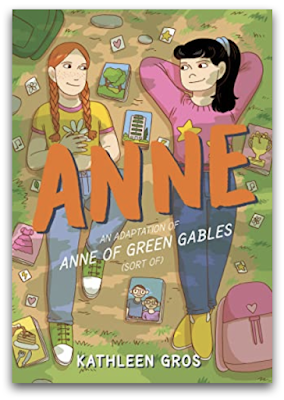
Anne: An Adaptation of Anne of Green Gables (Sort Of): Guest review

This review was written by Grade 8 student Hasini K.
 

Written and illustrated by Kathleen Gros
Quill Tree Books (HarperCollins)
978-0-06-305766-1
304 pp.
Ages 8-13
October 2022
 
From the classic story of Anne of Green Gables comes this incredible adaptation. This is a story that takes place in our modern world with the inclusion of LGBTQ+ characters and plot lines that improve the story and allows it to reach a wider audience in the present era.
From Anne: An Adaptation of Anne of Green Gables (Sort Of) by Kathleen Gros
Anne Shirley is a teenager in the foster system, and she’s sick of it. She’s already moved from one house to another, from one foster placement to the next. Anne is tired of starting over every time she has to move. So, when Alexandra, Anne's social worker, tells the girl the exciting news that she's about to move to another place, Anne has mixed feelings. She’s so grateful that someone wants her and really hopes it will work out but a part of her wonders if she'll just end up back in the system afterwards.
From Anne: An Adaptation of Anne of Green Gables (Sort Of) by Kathleen Gros
However, things don’t start off as she hopes. When she first meets Matthew Cuthbert, her new foster guardian, he seems confused. When they arrive at the Avon-lea, the apartment building where the Cuthberts live, we learn that Matthew and his sister Marilla had been expecting a younger kid. Anne is devastated and is sure that she'll be sent back, especially when Marilla calls Alexandra. Explaining about a glitch in the system, Alexandra asks them to keep Anne until they can arrange something else. Anne is determined to try her best to make sure the Cuthberts keep her.

But, Anne quickly finds herself in trouble, from physically hurting a classmate to accidentally dyeing her hair green. The Cuthberts may be cool, but Anne worries that she may be too much for them. Still, she has other worries, including developing feelings for her closest friend Diana. Anne wants to ask Diana to the winter dance but what if Diana doesn't feel the same way? You'll need to read Kathleen Gros's book to find out if Anne finally ends up finding her forever home.
From Anne: An Adaptation of Anne of Green Gables (Sort Of) by Kathleen Gros
Anne: An Adaptation of Anne of Green Gables (Sort Of) is not the kind of book I usually read, but I absolutely enjoyed reading it and would recommend it to readers in Grade 6 and up. In the book, Anne struggles a lot with embracing her appearance, and I love how she gained confidence throughout the story. Kathleen Gros turned the story into something which everyone could relate to, from being the new kid to trying to find friends and fitting in. Although I haven't read the original Anne of Green Gables–I'm very tempted to do so after finishing this book–I think Kathleen Gros's graphic novel version will appeal more to this generation of readers, especially with its diversity and gorgeous artwork and very appealing colours. But most important is Kathleen Gros's message that families come in different forms, and they are all worthy of love, no matter how crazy they may be.
 
~ Written by Hasini K., Age 13

November 04, 2022

The Basketball Game

Written by Hart Snider
Illustrated by Sean Covernton
Firefly Books
978-0-2281-0391-2
87 pp.
Ages 12+
October 2022

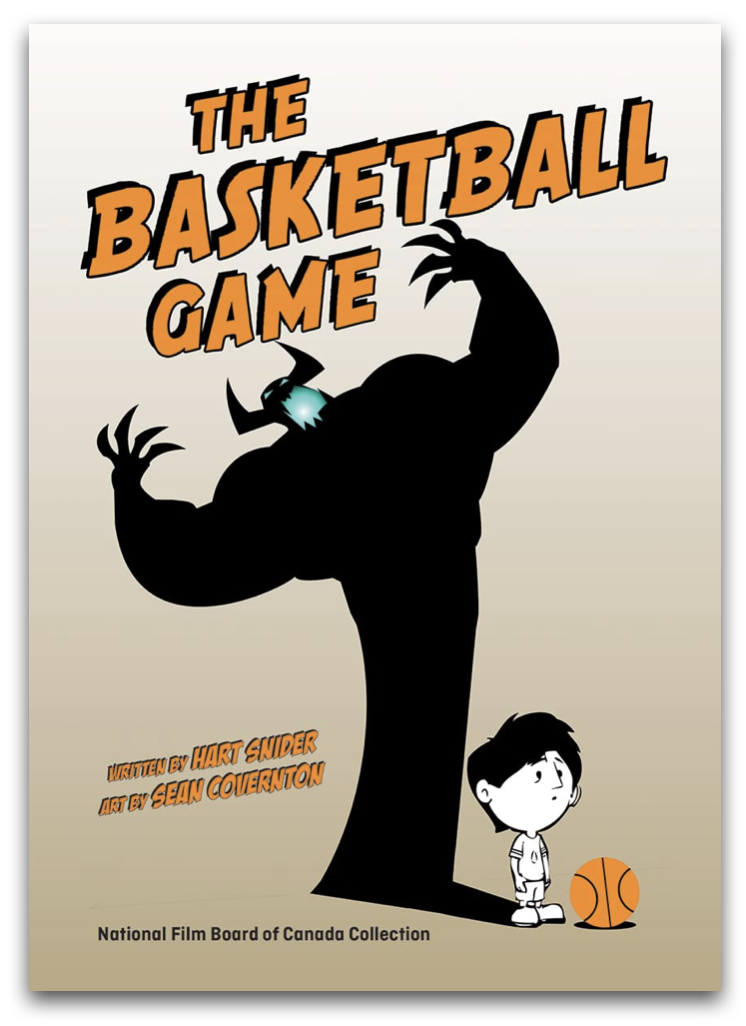
Although hate speech has been around since time immemorial, there seems to have been a deluge of it in recent years with the news inundated with misinformation, fake news, and bigotry. Sadly, with social media, the dissemination of hate speech has been especially facile. But hate seems to always be there, sometimes overt and sometimes less conspicuous, until it isn't. In 1983, one Alberta teacher who denied the Holocaust in his social studies teaching and promoted hatred of the Jewish people was called out by a parent, leading to dismissal, charges and more. And a basketball game.

Author Hart Snider was just a child in Edmonton when the story of teacher Jim Keegstra of Eckville, Alberta was headline news. However, he was a Jewish child who was attending Camp BB in Pine Lake when his world and that of the news came together. This story, based on a National Film Board of Canada animated short film of the same title, is his camp story from the summer of 1983.
From The Basketball Game by Hart Snider, illus. by Sean Covernton
It was Hart's first summer at Camp BB, and he was just as happy to sit under a tree and read comic books. But, distractedly, he signs up with a pretty camp counsellor for a "social mixer to encourage cultural understanding." When Bill, the larger-than-life camp director, tells them that their day of fun and fellowship, which would include a picnic and a basketball game, would be with Jim Keegstra's former Eckville students, Hart and others wonder how these kids would approach them. And when one boy asks Hart if he actually has horns, Hart wonders if the Jewish kids are all seen as demonic supervillains with horns, or global banking conspirators, or maybe even magical wizards. But then he looks at the Eckville kids and sees them as being no different from skinheads, Nazis or the KKK. Ultimately, it's just a basketball game between a bunch of kids, Jewish or not, having fun.

From The Basketball Game by Hart Snider, illus. by Sean Covernton

The Basketball Game may be a personal graphic memoir of Hart Snider, but it's also a compelling reminder of the impact of hate on children. From Jim Keegstra's antisemitic teachings, which coerced young people to adopt his opinions in order to pass, to the children of Camp BB who enjoyed the familiarity of their Jewish community but anticipated conflict because of it, the story of The Basketball Game is a sobering reminder how vulnerable they are to fake news, misinformation and worse. The stereotypes were embedded in their learning and, with no other basis, it's all they had to go on. The camp boys who are depicted as monstrous members of a blue team must compete against the equally scary members of the Eckville red team. Like the fear they pose, the team members are frightening and powerful. (And fully coloured.) In reality, they are a bunch of young boys, drawn in black-and-white, still open to colour and ideas and not quite grounded in themselves. Canadian animator Sean Covernton contrasts the innocent with the horrific, making the expected far scarier than the reality and reminding us that young children are open to suggestion and vulnerable to those who might mislead them with hateful opinions. He also shows them as kids who want to make friends, read comic books, play basketball, and enjoy the positive traditions of their community.

There is a warning that prefaces the book, cautioning the reader about hateful language and depictions of antisemitism. However, though the book is intended for those twelve years of age and older, The Basketball Game may offer an opportunity for discussion with younger kids with the right approach. (Discussion questions are appended to the story.) It helps children see that not all adults are right, that questioning and discussing difficult topics is worthwhile to ensure understanding, and that kids are kids, no matter what their backgrounds.
From The Basketball Game by Hart Snider, illus. by Sean Covernton

December 30, 2021

Catalina

Written and illustrated by Lori Doody
Running the Goat, Books & Broadsides
978-1-927917411
40 pp.
Ages 3-7
August 2021
 
If I have to close out the year with one book with a positive message, let it be Lori Doody's Catalina, a picture book about acceptance and adaptation. Isn't that one that needs to be told as we enter a second year of a pandemic? And it all comes from a tale of a cat and three puppies.
From Catalina by Lori Doody
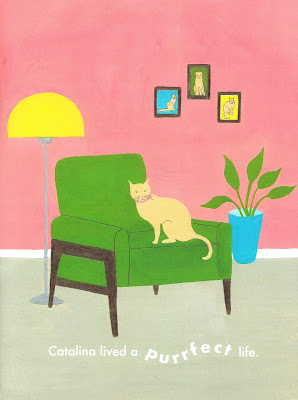
Catalina is a contented cat. She's happy in that she loves her life as it is. Her life is her own. She eats, plays and sleeps when and where she wants. Of course, there are times when she's a little lonely when her people aren't at home and she's alone but still "Catalina lived a purrfect life." And then everything changes.
From Catalina by Lori Doody
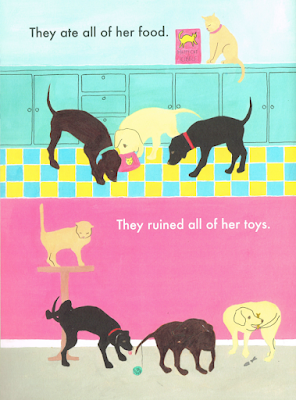
Her people bring home three Labrador Retriever puppies. Catalina is not amused. They are everywhere in her house: where she eats, what she plays with and where she sleeps. They're bigger than her, louder than her and rambunctious. She just can't get away from them and she doesn't like the way she feels: crooked (Newfoundland-speak for in a bad mood, according to the glossary).
From Catalina by Lori Doody
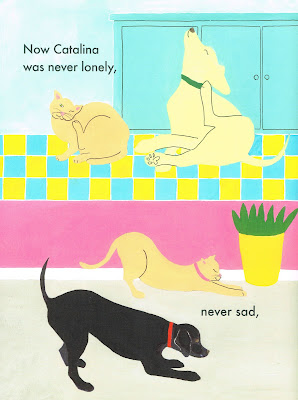
And then she notices a few things. The pups are willing to share with her and keep her company and she was no longer lonely.

Lori Doody gives us a quaint story of introducing new pets into a household already established for another. Many pet owners know the potential difficulties of doing so, whether with the same or different species. Catalina was content with the status quo even if there were things missing for her, like friends. It wasn't until she met the new dogs that she realized what it was that was missing in her life: companionship. But Lori Doody has given us more than a story about a cat and three dogs. In her folk art style, Lori Doody has given us a metaphor for accepting change and adapting to it, even if the benefits cannot be perceived initially. Catalina thought her life was "purrfect." It wasn't though. That became obvious once she embraced the Labs as there to stay, and she gained friends, playmates, cuddle buddies and more. If she'd closed herself off from the unfamiliar, she would have never realized the gifts the puppies brought into her life.

It's a simple story: cat meets dogs, cat is annoyed with dogs, cat learns to love dogs, and everybody is happy. But Lori Doody tells it as a lesson in colour and affection. She does it with softness of line, a landscape of patterns, and the warmth of a hospitable palette. As Catalina learned to love something new, so should we try when presented with something new. Different is not always bad, as we may anticipate. It's just different, and, as Catalina learns, it may even be wonderful.

November 30, 2018

Mary Poppins

Based on the novel by P. L. Travers
Adapted by Amy Novesky
Illustrated by Geneviève Godbout
Houghton Mifflin Harcourt
978-1-328-91677-8
32 pp.
Ages 5-8
October 2018

With the upcoming release of the movie Mary Poppins Returns, there will be much renewed interest in P. L. Travers's character who was introduced in her 1934 novel, Mary Poppins. Fortunately, a new picture book adaptation with a Canadian illustrator, Geneviève Godbout, will be a perfect introduction for young children to this magical nanny and her story.
From Mary Poppins illustrated by Geneviève Godbout
American Amy Novesky's adaptation of the original story is lovely yet condensed, as is necessary when taking a detailed work such as a novel and filtering it down to the text of a picture book. Still Amy Novesky ensures that the important details of the house at Number Seventeen Cherry Tree Lane, the East Wind bringing a hat-clad woman with parrot-headed umbrella and magically voluminous carpetbag, and the household of the Banks children–Jane, Michael and the twins–and their parents remain, as do key events and dialogue. There's Mary Poppins sliding up the banister; the floating Uncle Albert; Mrs. Corry and daughters Annie and Fannie adorning the night sky with stars; and a nighttime visit to the zoo, as well as Mary's familiar declarations of "Spit-spot to bed" and "I'll stay till the wind changes."
From Mary Poppins illustrated by Geneviève Godbout
But it's Geneviève Godbout's artwork that breathes life into Mary Poppins. The lovely young woman exudes grace and control, though always tempered with affection, charm and fairness. Geneviève Godbout makes Mary both attracting and disciplined, the perfect combination for caregiver, whether parent or nanny. From her easy topknot to her billowing black skirt and plain hose and shoes, she is the picture of efficiency. But her face, with rosy cheeks and bright eyes and delicate nose, Mary Poppins is beautiful and proper. Geneviève Godbout even gets her posture correct: strong but not overpowering, competent, and determined. It's such a shame that we all had to save "Au revoir!"

"Strike me pink," as Mary Poppins might say when pleased, because this new illustrated adaptation of her story flies above the rest and will charm all children, adults and animals and adorn the world with starry wonder.
From Mary Poppins illustrated by Geneviève Godbout

March 14, 2016

Tokyo Digs a Garden

by Jon-Erik Lappano
Illustrated by Kellen Hatanaka
Groundwood Books
978-1-55498-798-6
32 pp.
Ages 3-7
March 2016

Imagine a small house that was once part of a countryside lush with forests and meadows and wildlife now dwarfed by skyscrapers and hidden among the overdeveloped city buildings and billboards.  This is the house of Tokyo and his parents and his grandfather, the original owner of the country home, and Kevin the cat.

When an elderly woman on a bicycle hands Tokyo three seeds, telling him “…they will grow into whatever you wish”, the boy removes a brick from their yard and plants them in the soil beneath. The next day, there are three small wildflowers. After breakfast, there is moss covering the bricks.  By dinner, there are trees and shrubs and more wildflowers. And by the next day, “the garden had grown up and over the buldings, across the streets, dwon the road, over the cars and into the expressway.” With time, the city is made over into a wild entity of rivers and forests and wildlife and the people adapt to these changes because “Gardens have to grow somewhere, after all.

From Tokyo Digs a Garden
by Jon-Erik Lappano, illus. by Kellen Hatanaka
The message is clear.  Mother Nature will not be stopped and, no matter how much humans develop the land into unrecognizable entities, it will grow and become what it should.  Tokyo and his grandfather’s honest acceptance of this phenomenon is both educational and calming.  Jon-Erik Lappano gets the tone just right, never preachy, always intuitive, and even playful. (Kevin’s love of ice cream is quite clear.)  And Kellen Hatanaka, whose artwork first decorated Work: An Occupational ABC (Groundwood, 2014), dignifies that tone with his astute and beautiful illustrations.  Think of a Henri Rousseau jungle but with an art deco flair and you’ll get an idea of the lushness of Kellen Hatanaka’s garden in Tokyo Digs a Garden.  More brilliant in colour and stronger in line, the artwork carries the story from message to revelation.

Tokyo Digs a Garden plants the seeds for discussion of nature and land development and sows the dramatic beauty of transformation.

From Tokyo Digs a Garden by
Jon-Erik Lappano, illus. by Kellen Hatanaka

October 27, 2015

Gerbil, Uncurled

A Tell-Me-More Storybook
Written by Alison Hughes
Illustrated by Suzanne Del Rizzo
Fitzhenry & Whiteside
978-1-554-55332-7
32 pp.
Ages 4-7
September 2015

Fitzhenry & Whiteside have a new addition to their Tell-Me-More Storybook collection and young readers have a delightful story that will tell teach them about gerbils and working together to formulate the best rules for all.

All the gerbils know the Gerbil Mottos in Gerbil, Uncurled.  They are:
  • The Night is Short: Keep Busy
  • Always Keep Your Whiskers Clean
  • Celery Tops Come To Those Who Wait
  • Many Paws Make Quick Work
  • Curl Up Nose To Toes
Important rules to follow to live to a good long life like Grandpa Gerbil who is a five whole years old!

But Little Gerbil, try as she might, is not a curl-up-like-a-ball sleeper.  And though she promises Grandpa Gerbil to try, she panics, desperate for fresh air and to stretch out in the sunshine. So when day ends, she scrambles back to her family’s bedding to wake up with the rest, huddled as she should be.  However, Little Gerbil can’t handle the guilt of accepting congratulations while she “was living a gerbil lie.” (pg. 12)  Nonetheless making some careful observations helps Little Gerbil guide her elders and family to rethink the Gerbil Mottos so that all may be successful.

Alison Hughes shares important lessons about cooperation, family and being true to oneself in Gerbil, Uncurled but young readers will be just as charmed by Suzanne Del Rizzo’s polymer art of the little rodents and their environs.  Following in the artistic steps of Canada’s Grande Dame of plasticine, Barbara Reid, Suzanne Del Rizzo fashions warm hues of oranges and beiges, with touches of blue and turquoise as complementary colours, into gerbil life and details.  Her creatures are adorable and jump off the page with their curls and cedar shavings and braided textures.  I can’t possibly enumerate all the details in which children will delight–a teddy bear, a banana, celery, knitting, alphabet blocks–but they’ll be delighted that Suzanne Del Rizzo shares with them how to mold the dough into their own gerbils.  And everyone, teachers and parents included, will appreciate the additional information about different rodents and gerbil behaviour included in this Tell-Me-More Storybook appendix.


Gerbil, Uncurled will amuse and inform while providing a sweet vehicle for teaching about rules and coming together to make better ones that work for all.

May 10, 2015

Giraffe Meets Bird


Written and illustrated by Rebecca Bender
Pajama Press
978-1-927485-35-4
32 pp.
Ages 2-5
May, 2015

Rebecca Bender’s award-winning duo, Giraffe and Bird, from Giraffe and Bird (Dancing Cat Books, 2010) and Don’t Laugh at Giraffe (Pajama Press, 2012), have returned in Giraffe Meets Bird and young readers will finally learn how the two unlikely but perennial friends came to be.

When little Bird emerges from his shell in the very tree which Giraffe has enjoyed, the two begin the dance of friendship, a fascinating play of learning more about each other’s personality quirks.

Then, not unlike many a friendship, a conflict creates a turning point. Scratching himself against the tree, Giraffe accidentally pitches little Bird into the grass, not far from a reclining lion! Giraffe springs into action, saving Bird and ensconcing them safely back in the tree (I know!) to wait out the departure of their potential predator. But then what?

As a teacher I might be tempted to use the text of Giraffe Meets Bird to demonstrate the richness of synonyms (e.g., fascinated/tickled, surprised/amazed, cross/angry) as the pair of creatures respond similarly but differently to their circumstances. Or I might focus on the value of sharing and thinking of others. But as a reader and lover of children’s illustration, I prefer to revel in a charming story about an unlikely friendship. Rebecca Bender’s story is sweet and hopeful and enchanting. But it’s her artwork that would charm birds out of the trees. (Oh wait, it already has!) Bird is a bundle of lime fluff, with a singing stance worthy of any Idol wannabe, whereas Giraffe has the wide-eyed wonder–and gorgeous lashes!–of a lanky and clumsy juvenile. They are young and naïve and innocent and generous of heart. And the rich turquoise sky and the flirty acacia tree (I used the book's endpapers of acacia branches as a frame for the book cover above) will transport young readers to a very real savannah, even one with a lion and elephant or two.

Rebecca Bender could have taken Giraffe and Bird on another adventure with a life lesson about friendship, but I am so glad that first she made sure that Giraffe Meets Bird and had the two became the extraordinary friends they are today.

January 16, 2015

Winter's Coming: A Story of Seasonal Change

by Jan Thornhill
Illustrated by Josée Bisaillon
Owlkids
978-1-77147-002-5
32 pp.
Ages 5-8
October, 2014

Sure, reviewing a book called Winter's Coming before winter would have been more logical–hence Owlkids' October release for the book–but isn't it just as great to read a book about the changes that come with winter while in the throes of that season's cold and snow?  (Apparently I thought so.)

Lily, a young snowshoe hare, is surprised by the changes she sees in her surroundings, which she'd always enjoyed as green.  Now there are colour changes in the trees and massive flocks of birds heading south because Winter's coming.  If they have to escape, she wonders whether she should be evading this danger as well.  Luckily the squirrel who is preparing a cache of food tells her she won't need to do the same, and Lily is relieved to know that, "Whatever Winter was, at least it wasn't interested in her food." (pg. 9) Also inquiring of the chickadee, mosquito, tree frog, caterpillar, snapping turtle and black bear, Lily still finds Winter a mysterious entity.  
Would it be as tall as the trees and have humongous, smelly feet?  Or would it be stretched out like a weasel, with a hundred pointed teeth?  Would it have a bald head like a turkey vulture?  Or would it have hair so long that it swished along the ground?  Would it make noise like thunder? Or would it fly on silent wings like an owl?  Lily had no idea, but she was convinced that Winter would be big and powerful. (pg. 20)
It's not until she watches Winter arrive and the black bear points out Lily's own change for winter that Lily understands what all the animals have being sharing with her.

Winter's Coming is as charming a book as it is educational, explaining animal adaptations to the coming of our coldest season as seen by a young snowshoe hare who doesn't know what to expect having never experienced winter.  Lily is inquisitive, but never precocious (thank you, Jan Thornhill!), always taking in what she sees and hears and tries to make connections with what she knows already.  She's on guard for potential threats, as a wise hare will be, but insightful and thinking beyond Winter as a predator.  Her thinking is probably similar to that of a child for whom a new concept, whether it be math or behavioural or whatever, is just out of reach of understanding.

Complemented by Josée Bisaillon's collage illustrations that emulate the bits and pieces of the natural world as it changes in response to the coming season, Jan Thornhill's newest nature book (she has an astounding repertoire of award-winning non-fiction) will be enjoyed just as easily as a story as much as an information book.  Winter's Coming will be an worthy addition to any library, personal, school or public.

December 10, 2014

Blue Mountain

by Martine Leavitt
Groundwood Books
978-1-55498-423-7
165 pp.
Ages 8-12
November, 2014

The struggle for survival may bring readers of adventure stories regularly to the brink of their seats, anticipating the worst and hopeful for the best outcome but always calmed by the fictional nature of the story.  But, though a fictionalized account of a herd of bighorn sheep in the Rocky Mountains, Blue Mountain reads as authentic and harrowing as any biography of an explorer or a leader making life-and-death decisions for others.  Blue Mountain may be about bighorn sheep but the story of Tuk and his herd mates is a heart-rending tale of life on the edge, an account of the struggle to survive in both the natural and man-made worlds.

The story of Tuk, a male lamb, begins on the lambing cliffs with the other new lambs– Ovis, Rim, Nai, Mouf, Sto and Dall–learning the story about the mountain's gifts to the animals.  Lord Denu, the first bighorn, was gifted with tricky feet, strong jaws, and powerful horns, providing his descendants with the moniker of peaceable, since they did not fight but rather stayed in herds that helped protect their numbers.  When the lambs and their mothers return to the main herd at the summer range, meeting the yearlings and the barren ewes, Kenir the matriarch declares that Tuk is reminiscent of the strong lambs of many years ago and has been gifted to them by the mountain to help keep the herd from dying.  This is corroborated by his vision of a great blue mountain, so rarely seen that it is called story mountain.

This is a heavy responsibility placed on Tuk and, though he suffers ridicule from a yearling named Balus and others, one that he does not take lightly or is convinced belongs to him, especially after he fails to save a lamb from an eagle.  But when a mother puma and her kitten put the herd at risk, Tuk uses his lamb horns to bat the kitten off a ledge, resulting in its death and its mother's vow of revenge.  Ultimately, the king of the rams instructs Tuk,
"You must find a way west from the winter valley to blue mountain before she hunts again."..."Son, it is the only way to save the herd." (pg. 38)
And so begin Tuk's journeys, the first being one of personal growth and learning so that he might lead the second one, a trek through inhospitable territories to one where the herd might thrive.  Enduring food shortages, threats from wolves, men with shotguns, monster machines, and unusual altercations with a wolverine, a bear and an otter, Tuk brings them to a place where
Tuk saw that the herd would always be, and that he had been part of the always. (pg. 159)
He couldn't have asked for a better legacy.

Martine Leavitt tells of her father, James Webster, and his love for the natural world and particularly the Rocky Mountain bighorn sheep that he studied.  Blue Mountain is her own story based on his notes of observations of these majestic animals through the seasons and years.
My story became a very different thing than his beautiful and perfectly accurate rendering, but we tell the stories we can. (pg. 164)
As Tuk succeeds so nobly after questioning his own leadership as a bighorn sheep, I believe Martine Leavitt has honoured her father's research and reconfigured it into a splendidly beautiful and accurate saga.  I'm sure he couldn't have dreamed of a finer gift.