Showing posts with label Running the Goat Books & Broadsides. Show all posts

April 01, 2026

A Little Halwa and a Big Family

Written by Farid Bazger
Illustrated by Sahar Abdallah
Running the Goat, Books & Broadsides
978-1-998802302
40 pp.
Ages 4–8
March 2026  
 
Halwa is a confectionery traditional to many countries from Central Asia to the Middle East and into Africa and Europe. And when Mama and Papa have a craving for it one night, but little in the way of ingredients for their large family, they plan a secret treat for themselves once their children are in bed. But, unbeknownst to them, everything will change when little Malala overhears their plan.
From A Little Halwa and a Big Family, written by Farid Bazger, illustrated by Sahar Abdallah
Malala tells her older brother Bahir, who tells his older brother Azmoon, who tells his older sister Lima, who tells her older brother Abasim, who tells his older brother Zareen, who tells his older sister Zala. And with that, seven children hatch a plan to be in on the late-night treat.
From A Little Halwa and a Big Family, written by Farid Bazger, illustrated by Sahar Abdallah
When the parents see the children have brushed their teeth and been tucked into bed, they head to the kitchen. But, when Mama starts to prepare all she needs for cooking the halwa, from matches to light the stove, and flour and sugar and other ingredients, she finds them all missing. The children obviously know what Mama will use, and with every staple needed, a child appears to deliver it. And with each delivery, the child is invited to sit and watch and wait to share in the halwa.
 
But the same problem that the parents recognized initially—insufficient ingredients to feed their large family the special treat—is still a problem, with every child getting a little halwa and the parents giving themselves none. Is there a way for a little halwa to feed a big family?
From A Little Halwa and a Big Family, written by Farid Bazger, illustrated by Sahar Abdallah
A Little Halwa and a Big Family is a version of a chain story in that there are seven children and a similar number of ingredients or elements needed to make the halwa. (A recipe is included.) With seven Afghan children to bring in the missing ingredients, it's a tale that emphasizes unity, sharing, and even teamwork, in a very playful way. Originally from Afghanistan, Farid Bazger blends his traditional culture with the mischief of children and the unselfishness of parents. From the tasty treat to the family dynamics, this is a large Afghan family rooted in affection and consideration. While the parents may initially seem a bit selfish hiding their planned treat from their children, they really aren't. It is just Papa having a craving and Mama happy to make it for him. And yet, when she finally starts cooking it, there is never any option other than sharing with their children. The parents are giving and caring and these same traits have been bestowed upon their children who want to do the same for their parents. 
 
Sahar Abdallah, an Egyptian-Canadian artist, uses pencil crayon, soft pastels, and powder pigments (see the video of her creating an illustration here) on brown Kraft paper. Her media give a softness of texture as well as colour, creating a homey feel within the illustrations. It's perfect for a story in an Afghan home with its large family of boys and girls wearing clothes of bright colours of green, orange, white, blue, and gold. Sahar Abdallah gives the story the warmth that Farid Bazger's family shows in its hospitality.
From A Little Halwa and a Big Family, written by Farid Bazger, illustrated by Sahar Abdallah
Whether you try the halwa recipe included or just enjoy being welcomed into this family's abode, A Little Halwa and a Big Family 
proves that, when there is kindness, there is always enough food to share.

November 10, 2025

All of Us

Written and illustrated by Manon Gauthier
Translated by Michel Savard
Running the Goat, Books & Broadsides
978-1-98802296
32 pp.
Ages 3–8
October 2025 
  
The message of All of Us is a simple one, but sadly one that we need to reinforce continually. It's one of inclusivity and diversity and it's basic science. We're all the same and yet we're all different. 
From All of Us, written and illustrated by Manon Gauthier
Manon Gauthier, who has wowed this reviewer with the books she's illustrated such as Middle Bear (Susan Isern, 2017), Good Morning, Grumple (Victoria Allenby, 2017), and Elliot (Julie Pearson, 2016), has combined her talents by authoring as well as illustrating All of Us. With simplicity of text and complexity of art, Manon Gauthier develops the idea of how all animals, including humans, are different in their abilities or lack thereof, in their morphologies, in their physiologies, and more. There's "the fish who blows bubbles as it breathes,"(p. 12) and "the quiet and solitary moose," (p. 22) as well as "the tall bharal who has no fear of heights." (p. 7) There's the dancing sifaka, the cold-blooded reptiles and amphibians, and the savannah animals that can tolerate the heat. All differ in what they like, what they look like, what they can do, and more. But, essentially, we all are made up of cells, and Manon Gauthier conveys this in her words and her illustrations, using the same irregularly-shaped oval as the basis for all animals.
From All of Us, written and illustrated by Manon Gauthier
It's not until her last illustration, a double-page spread of a cell, that the reader will recognize Manon Gauthier's cleverness at using the cell's shape as the face or body or abdomen of all the 
mammals, birds, reptiles, amphibians, invertebrates and fish within All of Us. All of us really do have something in common, even with all the differences. And by using her defining cut-paper collage, in earthy tones of browns, greys, and creams with occasional touches of red, blue, green, and orange, Manon Gauthier gives a textured dimensionality and hearty organic feel to her story.
From All of Us, written and illustrated by Manon Gauthier
Whether you're a teacher who'd love to introduce a lesson on the diversity of living things with a captivating picture book, or open a lesson on animal cells, or even launch discussions about inclusivity and connection, All of Us will work beautifully. (Manon Gauthier even includes an activity in which readers can create their own animal with the same template she used throughout the book.) Whether you read it for the messaging which is presented gracefully or for the intriguing artwork, All of Us is a book for all of us about all of us.

July 09, 2025

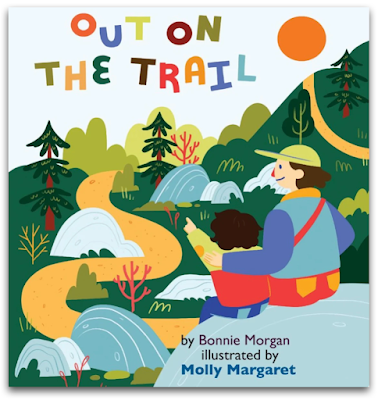
Out on the Trail

Written by Bonnie Morgan
Illustrated by Molly Margaret
Running the Goat, Books & Broadsides Inc.
32 pp.
Ages 0–4
June 2025 
 
 
Out on the trail
Just you and me.
I look to the left
And what do I see?
 
Newfoundlanders Bonnie Morgan and Molly Margaret takes young readers out on the trail to see an ocean, a brook, a cloud, a beach, a rock, and footprints. Those are the words that Bonnie Morgan emphasizes–they are the only bolded and coloured text–in her rhyming text. But Out on the Trail is not just about learning a few simple words from the natural world; it's also about seeing that natural world. 
From Out on the Trail, written by Bonnie Morgan, illustrated by Molly Margaret
As readers are instructed to look up and down and elsewhere, they are treated to amazingly bold and detailed digital artwork by Molly Margaret. We get to walk along a trail to see different forests and ecosystems; to witness the abundance of life and activity on land, in the sea, and in the air; and to think about what they are seeing and compare it to other scenes they've witnessed. While Molly Margaret doesn't always seem to use typical colours in her natural settings, she actually stays true to their essence. That purple ocean could be reflective of the wild waters and those blue stones just edging towards steel grey. But forget the colours and just focus on those vivid shapes that carry the reader along those trails and into those scenes of the spirited environment.
From Out on the Trail, written by Bonnie Morgan, illustrated by Molly Margaret
While Out on the Trail is not a concept book, it could be used effectively as one. Between those simple concepts from nature, there are also the positional words like left and right, up and down, and ahead and behind. Moreover, as that child is out on the trail for a walk with their parent, our very youngest can develop their early observational skills and, as such, their visual literacy skills. That's a lot of story from a picture book with minimal text and basic rhymes.
From Out on the Trail, written by Bonnie Morgan, illustrated by Molly Margaret
Bonnie Morgan and Molly Margaret may be taking readers along trails in Newfoundland and Labrador–the ocean and icebergs are giveaways to the setting–but Out on the Trail offers much more than a guide to local surroundings. It's an opportunity for a child to connect with a parent or guardian, enjoy the outdoor world, even vicariously, and to discover more beyond their own world.

June 03, 2025

Mr. Beagle and the Quidi Vidi Caper

Written and illustrated by Lori Doody
Running the Goat, Books & Broadsides, Inc.
978-1-998802234
44 pp.
Ages 4-8
June 2025 
 
If it's a picture book by Lori Doody, you know it's time for another visit to Newfoundland and Labrador. In fact, Lori Doody invites us to revisit her character Mr. Beagle, whose nose for mystery helped him solve the local cases in Mr. Beagle Goes to Rabbittown, Mr. Beagle and the Georgestown Mystery, and Mr. Beagle Climbs Signal Hill.  This time, Mr. Beagle heads to the charming neighbourhood of Quidi Vidi in St. John's, Newfoundland and discovers a new mystery to solve.
From Mr. Beagle and the Quidi Vidi Caper, written and illustrated by Lori Doody
While making a delivery from his store, Mr. Beagle's Convenience, he notices that folks in the neighbourhood are looking a little sad and seem to be having a hard day. He learns that their stuffed teddy bears have gone missing. "It was unbearable!"
From Mr. Beagle and the Quidi Vidi Caper, written and illustrated by Lori Doody
He walks through the neighbourhood, talking to people and visiting the fish and chips stand and the one selling pupsicles before heading to the wharf. As the locals and tourists, all donning colourful sweaters and hats, scarves and bottoms, meander the wharf, shopping, taking boat rides, fishing, watching artists and more, Mr. Beagle has his beagle eyes open and his sniffer on the scent. With observation and insight, he catches the culprit whose plight compelled him to theft.
From Mr. Beagle and the Quidi Vidi Caper, written and illustrated by Lori Doody
But identifying the thief is just part of Mr. Beagle's talent. As in his earlier stories, Mr. Beagle finds a way to help the offender and in turn enrich the community in a novel way. And for Quidi Vidi, there's going to be a new attraction.
 
With a plethora of pun and subtle charm, Lori Doody has Mr. Beagle solving a mystery and helping the neighbourhood of Quidi Vidi. The mystery he tasks himself to solve may not be a heist of incalculable wealth, but it is a grab at the most precious and comforting of possessions for many: a beloved teddy bear. So, he takes his task seriously and just apprehending the culprit is not enough. Mr. Beagle needs to know why the theft took place and what could be done to resolve this for both thief and victims. In doing so, he institutes a form of restorative justice whereby both victim and perpetrator can find healing.
 
That's a big message for a little story about a dog who solves the mystery of the disappearing teddy bears, but St. John's printmaker Lori Doody keeps the lightness and brightness of the story in her art. From the bold colours of the sea, sky and land to the myriad of characters that populate the community, Lori Doody takes us to a neighbourhood that is unique and rich in spirit. And with another mystery solved, Mr. Beagle has strengthened another Newfoundland community and revitalized its residents through humanity.
 
Mr. Beagle Climbs Signal Hill (2022)
Mr. Beagle and the Quidi Vidi Caper (2025)
 

January 22, 2025

Kuekuatsheu Creates the World / Kuekuatsheu ka ushitat assinu

Retold by Annie Picard
Illustrated by Elizabeth Jancewicz
Translated into Innu-aimun (Mushuau dialect) by Penash Rich
Running the Goat, Books & Broadsides, Inc.
Mamu Tishishkutamashutau Innu Education
978-1-998802210
48 pp.
Ages 4-8
October 2024
 
This Innu creation story is one that the author, Annie Picard, heard from her grandmother. Isn't this how these traditional stories were lovingly passed along through the generations? And isn't it wonderful that a new generation of children, Innu and others, will hear this story again, now with illustrations by Elizabeth Jancewicz.
From Kuekuatsheu Creates the World / Kuekuatsheu ka ushitat assinu, retold by Annie Picard, trans. by Penash Rich, illus. by Elizabeth Jancewicz

This story begins when the whole world was covered in water due to a great flood. Some animals survived the flood in a big canoe. Kuekuatsheu (Wolverine in Innu-aimun) suggests that he could create land for them if given some earth, so the different animals offer to dive deep into the water to grab some. First, Amishkᵘ (Beaver) attempts to fetch some from the bottom but it is too deep. Nitshikᵘ (Otter) and Muakᵘ (Loon) also try but are unsuccessful. Finally, the littlest animal, Utshashkᵘ (Muskrat), offers and, after diving deep into the water, is gone a long time. When they discover his body nearby, he still clutches a piece of earth.
From Kuekuatsheu Creates the World / Kuekuatsheu ka ushitat assinu, retold by Annie Picard, trans. by Penash Rich, illus. by Elizabeth Jancewicz
Kuekuatsheu blows on the earth, watching it grow, until it is so big that Missinakᵘ (Turtle) carries it away on its back. Kuekuatsheu creates a land so big that all life could live there.

This is a story of how we came to be but it is also a reminder that we must respect all animals, including the smallest, for it was Utshashkᵘ who was able to help create the land though he did not survive his ordeal. 
From Kuekuatsheu Creates the World / Kuekuatsheu ka ushitat assinu, retold by Annie Picard, trans. by Penash Rich, illus. by Elizabeth Jancewicz
This creation story has the elements that are often featured in Indigenous origin stories: animals working together, a turtle who carries the land on its back (hence Turtle Island), and a planet covered in water.  But Annie Picard makes the story more personal, relating how she heard these stories from her grandparents when she lived with them in Sheshatshiu Innu Nation in Labrador. The first image of a child at the knees of her grandmother shows the tender bond from which the story arose. And with each scene described by Annie Picard, as she heard it, there is the nuance of connection, compassion, and collaboration. The story is gently captured in the watercolour and ink artwork of Elizabeth Jancewicz who provides both realism and the fantastic. The animals are recognizable and realistic in their forms and sizes but Elizabeth Jancewicz also creates illustrations such as where Kuekuatsheu blows the clod of earth into a land mass that seem both natural and extraordinary. And that is just what it should be in a creation story that tells a traditional tale of what might have happened long ago but maybe not exactly that way. 

I'm so pleased to review Kuekuatsheu Creates the World / Kuekuatsheu ka ushitat assinu, an Innu origin story, particularly one that is available in English and Innu-aimun, both in Mushuau dialect, translated by Penash Rich for the review copy I read, and Sheshatshiu dialect, another edition but translated by Anne Nuna (Kuekuatsheu Creates the World / Kuekuatsheu ka tutak assinu). By providing multi-language editions, the author and publishers have opened up opportunities to a broader audience, both non-Indigenous who may not know the story and the Indigenous communities from which the stories originated, and that can only cultivate deeper inclusion. 

• • • • • •
 
This is the Sheshatshiu dialect edition:
 
Kuekuatsheu Creates the World / Kuekuatsheu ka tutak assinu
Retold by Annie Picard
Illustrated by Elizabeth Jancewicz
Translated into Innu-aimun (Sheshatshiu dialect) by Anna Nuna
Running the Goat, Books & Broadsides, Inc.
Mamu Tishishkutamashutau Innu Education
978-1-998802203
48 pp.
Ages 4-8
October 2024
 

May 20, 2024

My Bunny Lies Over the Ocean

Written by Bill Richardson
Illustrated by Bill Pechet
Running the Goat, Books & Broadsides
978-1-998802098
40 pp.
Ages 4-8
May 2024 
 
With a mondegreen play of words on the traditional Scottish folk song "My Bonnie Lies Over the Ocean," Bill Richardson and Bill Pechet have given us another bunny story of a legendary incident. Like their earlier book Hare B & B (2021), readers are treated to a silly but playful adventure, this time one in which a stuffed rabbit endeavours to make its way home with a lot of help from a menagerie of animals. And it's all to the accompaniment of some talented singing seagulls.
From My Bunny Lies Over the Ocean, written by Bill Richardson, illustrated by Bill Pechet
When a bow-tied and sunglass-wearing bunny is abandoned at the beach and a seagull falls in love, a global escapade ensues. With a seagull bemoaning the stuffie's plight of being dragged out to sea, My Bunny Lies Over the Ocean becomes a lament.
My Bunny was wet and bedraggled,
My Bunny was dashed by the waves,
My Bunny was found by a starfish,
And that's how my Bunny was saved.
The words may not all be as we may have learned them but they certainly sound like they were made for a story about an errant bunny.
From My Bunny Lies Over the Ocean, written by Bill Richardson, illustrated by Bill Pechet
And, boy, does this bunny travel, and with the help of everything from a starfish and a whale, a tallship and a kangaroo, and more. Still when Bunny finally gets back to the family–who should be chastised for abandoning Bunny in the first place–there will still be someone lamenting Bunny's absence.
From My Bunny Lies Over the Ocean, written by Bill Richardson, illustrated by Bill Pechet
I defy you to read this story and not sing it to the tune of "My Bonnie Lies Over the Ocean." It's so easy to do with words that rhyme and flow, especially with a repetitive chorus. The story may be different and homophones used, but Bill Richardson, who does clever very well, keeps the rhythm and the momentum of the original and gives it the humour and cheekiness that will delight readers of all ages. Kids may sympathize with a lost stuffie, but adults will chuckle at the lovestruck seagull and the astonishing path of the bunny to its home.
From My Bunny Lies Over the Ocean, written by Bill Richardson, illustrated by Bill Pechet
That cheekiness is seen in Bill Pechet's sketch art, from Bunny relaxing on a bed inside the whale's belly to seagulls singing atop the "Bunnilator" plane heading between signposts "Here" and "There." Sticking with his palette of pale turquoise, light lime green, and pale orange, Bill Pechet keeps us on that ocean, on the land, and in the air as Bunny finds its way home. And he makes us laugh.
 
Bunny may make it home via a prolonged path, but they will be prepared for another such eventuality. (Come on, it wasn't Bunny's fault that they were left behind.) And with a seagull singing its yearning for Bunny still, I suspect Bunny will never be alone again.

April 25, 2024

The Pig and the Dumpling

Written by Bonnie Johnstone
Illustrated by Veselina Tomova
Running the Goat, Books & Broadsides
978-1-998802081
40 pp.
Ages 4-8
March 2024 
 
In a tale from a Newfoundland outport, Bonnie Johnstone tells a story of a pig, a dumpling, and mayhem. It's a story that could only come from a small rural community in which everyone knows everyone else, and their actions are noted and intertwined for good and with misfortune.
From The Pig and the Dumpling, written by Bonnie Johnstone, illustrated by Veselina Tomova
After three fishermen tend to the garden belonging to the local convent, they are compensated with a hearty meal of stew with dumplings. As one of the men was not fond of dumplings, he tossed it towards the pig pen of Ignatius, Tulip, and their piglets. To his delight, Ignatius grabs that dumpling. To his horror, it scalds his throat and lodges there.
                                      The scalding hot lump
                                    of gluey dough
                                  plopped down
                                into his throat
                              like
                           a cork
                        in
                  a
            bottle.
In desperation, Ignatius makes a mad dash to the ocean, the ocean with icy cold water that would be sure to soothe his burning throat. But there is much activity in the outport, and it seems everyone is out and about and unknowingly in Ignatius's path. There's Tommy and Gussie who've gotten their kite stuck in Father McGettigan's rose bush. Then there's Father McGettigan and Reeni Puddicombe delivering pies for the church supper. Of course, Ignatius runs through and into Lizzie Carey's laundry hanging on the line, and, though he was able to miss the elderly Mrs. Maddigan and her cow Maude, the peddler Nellis was not as lucky. 
From The Pig and the Dumpling, written by Bonnie Johnstone, illustrated by Veselina Tomova
Ignatius's misfortune continues with more encounters with an accordion, drying fish, and a cart of kelp. And all for relief from a perilous dumpling.

Perhaps The Pig and the Dumpling is a cautionary tale about gluttony or perhaps about chewing one's food, but maybe it's just a story about a community in which everyone is an important part, from a pig at a convent's farm to the kelp farmers, children, the elderly, and everyone in between. It's a community of life and living, in which neighbours help each other, in which fish is dried and kelp is collected, and laundry is hung out to dry, and pies are made for a church supper. That little dumpling may have stoppered poor Ignatius's throat temporarily, but it gave him the opportunity to get out and interact with others in the community. His interactions may have been problematic for many, including poor Ignatius, but Bonnie Johnstone gives us a happy ending and a glimpse into a rural Newfoundland community as it may have been in the 1800s. (Bonnie Johnstone's "A Note About the Story" gives a little more background.)
From The Pig and the Dumpling, written by Bonnie Johnstone, illustrated by Veselina Tomova
Veselina Tomova's art is highly textured, not unlike the story, with acrylic brushstrokes on canvas giving movement to Ignatius's quest for cooling and chaos along that crusade. As she demonstrated in earlier books like Spirited Away: Fairy Tales of Old Newfoundland, PB's Comet and Daphne's Bees, Veselina Tomova knows how to get the atmosphere appropriate for the story, from light and airy, to dark and brooding, or silly and chaotic. With the colours, the shapes, the application of paint, Veselina Tomova gives The Pig and the Dumpling the realism with the nonsense and will have readers wondering whether there was an Ignatius to whom this really happened. With a quick visit to this outport of days gone by, they'll all know soon enough.

December 20, 2023

The Golden Apples

Written by Dan Yashinsky
Illustrated by Ekaterina Khlebnikova
Running the Goat, Books & Broadsides
978-1-998802050
40 pp.
Ages 6-9
September 2023
 
It all starts with golden apples. And it ends with golden apples. But the story in between is big, far greater than a few golden apples coveted by a king. The real story of The Golden Apples is Jack's story of quests, and it is this story that must be told aloud by a storyteller, such as Dan Yashinsky or the reader, and heard by all children, young and old.
From The Golden Apples, by Dan Yashinsky, illus. by Ekaterina Khlebnikova
Once upon a time–imagine a true storyteller like Dan Yashinsky saying this with an evocative, spirited voice– there was a king, a queen, and their three sons. When golden apples appear on a tree in their garden, and they disappear before the king can enjoy them, he sends his sons out, one at a time, to locate the golden-feathered bird which Jack, the youngest, had witnessed taking them. Both older boys succumb to temptations along the way, but Jack heeds the advice of a benevolent fox and discovers the bird. Unfortunately, Jack too is foolish in that he disregards some directives and lands himself in trouble. Still, he is offered opportunities to get himself out of trouble by undertaking yet another task.
From The Golden Apples, by Dan Yashinsky, illus. by Ekaterina Khlebnikova
Unfortunately, each task requires him to steal something. And each time, he ignores a piece of advice from the fox who tries to help him be successful. From the golden bird to a golden-maned horse, and a princess with beautiful eyes, Jack verges on getting things right until he doesn't. Still, this is Jack, the "hero" of many tales of folklore, so it all works out in the end, even if with a few twists along the way.
 
Dan Yashinsky, founder of the Toronto Storytelling Festival, knows how to tell a story. Whether it is in person or in written form, Dan Yashinsky keeps listeners and readers captivated, waiting for the next scene, the next conflict, the next laugh. He makes us want to find out what happens next, without padding his stories with filler to draw them out. Readers will quickly realize that Jack is the son often disregarded and the one who, with a little help and some cleverness, is able to surpass the minimal expectations others have of him. This may be familiar to some children who feel undervalued in families or in the classroom, but it offers them hope that they can achieve with perseverance. Still Dan Yashinsky makes Jack real with his ineptitude–come on, Jack, listen to the fox!–and unintentional fumbles but with a good heart. (In the end, he does something very difficult and heart-breaking that comes to a good end.)
From The Golden Apples, by Dan Yashinsky, illus. by Ekaterina Khlebnikova
I think Christmas is a great time for storytelling, as families gather around, perhaps in the aftermath of a big meal or as children are settling down before sleep. And The Golden Apples, told as Dan Yashinsky wrote it, with heart and verve, will bring everyone together. With the added dimension of Russian artist Ekaterina Khlebnikova's illustrations, a blend of different media that add depth and whimsy–like Nirvana and Metallica posters on the princess's walls, or Jack's headphones-wearing brother–The Golden Apples also has colour, humour, and texture. The Golden Apples may not be a Christmas story, but it would be a fine story to tell this holiday season or anytime a great tale is called for.

February 15, 2023

Daphne's Bees: Guest review

This review was written by Grade 9 student Bronte L.
 
Written by Catherine Dempsey
Illustrated by Veselina Tomova
Running the Goat, Books & Broadsides
978-1-927917503
48 pp.
Ages 7-11
2022
 
Daphne’s grandmother keeps honeybees, and she often lets Daphne inspect the hives. But on the morning of her 10th birthday, Daphne is treated with her very own hive, bee suit, and equipment. With the help of her dad and grandmother, Daphne builds her hive, and starts a new colony. She has drone bees, worker bees, and most importantly, a queen bee! Grandma teaches her all about their different jobs, how to maintain the hives, and their life cycles.
Daphne was so excited. Now she knew for sure that her queen had hatched, and was laying eggs. She also knew the bees were gathering pollen and nectar. The bits of pollen were the little bright colours and the nectar was the juice from the flowers that would become honey.
From Daphne's Bees by Catherine Dempsey, illus. by Veselina Tomova
Daphne soon discovers that keeping bees isn’t all flowers and honey. Bees are protective of their queen, and, if they think they’re under attack, they aren’t afraid to sting the intruder and die in the process. There are also wasps to worry about. Wasps are like pirates, flying around in search of new or vulnerable hives, looking to steal their honey. However, Daphne is protective of her hive, just like the worker bees, and makes sure that nothing is going to happen to it on her watch.
From Daphne's Bees by Catherine Dempsey, illus. by Veselina Tomova
Daphne’s Bees by Newfoundland author Catherine Dempsey and illustrator Veselina Tomova tells the story of Daphne, her hive, and everything she learns along the way to becoming a beekeeper. The book has loads of information, especially for a picture book, and could be enjoyed by kids from kindergarten to Grade 6. The book includes a glossary, background information, and plenty of puns. It’s a great book to build kids’ appreciation for honeybees.

Daphne’s Bees is an essential book for students learning about nature and the importance of pollinators. It’s informative and fun, and includes a lighthearted story with painted illustrations. The little bees and flowers look realistic, and you can tell that the illustrations are actual paintings, with their pencil outlines, canvas texture, and thick paint strokes.
From Daphne's Bees by Catherine Dempsey, illus. by Veselina Tomova
My grandfather used to keep bees, and I know that if I had read this book several years ago I would’ve immediately wanted to help him take care of his hives!

~ Bronte L., Grade 9

January 19, 2023

The Possible Lives of WH, Sailor

Written and illustrated by Bushra Junaid
Running the Goat, Books & Broadsides
978-1-927917855
60 pp.
Ages 9-12
2022

Who was the 19th c. sailor whose remains were discovered in Labrador in the 1980s? Where did he come from? How did he live? What was the story of his death?  Bushra Junaid examines these questions and tells us the sailor's possible stories in poetic rhyme of historical depth.

From The Possible Lives of WH, Sailor by Bushra Junaid
In verse, Bushra Junaid speaks of the bones found on the Strait of Belle Isle and exposed by erosion in 1987 near the village of L'Anse au Loup. The bones suggest a young man of short stature and missing a forearm, with kinky hair and strong teeth. Alongside the bones were some clothing, shoes, a knife and a pouch, several carved with the initials W-H. Though the story of WH is lost, Bushra Junaid insists on remembering this man, as a memorial for "all the Black fathers and brothers who plied these waters, For all the unnamed mothers and daughters bound to plantations" and for all they experienced before and after becoming seafarers.

She wonders at his origins and the memories he may have carried from his homeland whether perhaps West Africa, the Caribbean, the American south or even Nova Scotia. Was he taken by force or did he enlist to be a sailor? Did he fight battles, learn to read and write or acquire other skills? Was he treated fairly or discriminated against? And what of his family? With her questions, Bushra Junaid gives WH's life a legacy.
All these things we can't possibly know–
They have only made my curiosity grow
About all the possible lives you have lived.

I don't know from whence you came,
And I don't know your rightful name, but you
Remain.

Respect is due. It's time that you
Were laid to rest anew.
From The Possible Lives of WH, Sailor by Bushra Junaid
Born to Jamaican and Nigerian parents, Bushra Junaid accepts a responsibility to tell the story of WH, in essence claiming his bones as family. And with the telling of these possible stories, Bushra Junaid ensures that WH is honoured and will never be forgotten to history.
Some may say I've got no skin in the game,
Yet if it's really all the same,
This child of the diaspora would like to claim
You as kin.
Bushra Junaid is the respected illustrator of Adwoa Badoa's Nana's Cold Days (Groundwood, 2002) but The Possible Lives of WH, Sailor is her debut picture book as author and illustrator, and I think she successfully tells a story with great heart and lyricism. WH's true history may never be known but he will not be dismissed, and her words make us think about what that history may be and what the artifacts may tell us and what they don't. (Appended to the story are photographs of these artifacts housed at The Rooms in St. John's NFLD as well as extensive background and historical notes and references.)
 
Though WH's story may be a simple one of birth, life and death, that story's context is complex. As such, the simplicity of Bushra Junaid's art of lines and shapes created from pen and ink and watercolours complement her words. There is far too much that could be part of WH's story, so by focusing on simple vignettes of villages or ships at sea, Bushra Junaid grounds the man in the tangible.
From The Possible Lives of WH, Sailor by Bushra Junaid
I know that teachers will undoubtedly be using The Possible Lives of WH, Sailor for teaching purposes, especially for history–a list of discussion questions as part of an appended teachers' guide will be ever so useful–but this picture book should be seen as an exemplar for empathy and compassion for times and people gone and unknown. History, legacies and ancestry cannot always be corroborated but by giving them attention, even through speculation, we honour them.

October 03, 2022

Lana Llama

Written and illustrated by Lori Doody
Running the Goat, Books & Broadsides
978-1-927917-81-7
32 pp.
Ages 3-7
July 2022
 
Lana Llama looks similar to her flock. She is wooly like the sheep and she has four legs and two ears and a fuzzy tail. But she still notices that her legs and neck are longer and she can't bleat.
From Lana Llama by Lori Doody
As with any creature who wants to fit in, Lana tries to emulate the sheep of her flock. But it's awkward and she is unsuccessful.
From Lana Llama by Lori Doody
Still, when a barnyard bully, also with the same attributes of wooliness, four legs, two ears and a fuzzy tail, comes along, Lana Llama uses her differences to stand up to it and be accepted by her flock exactly as she is.

Now she's happy to stand up for others,
just by standing out.
 
From Lana Llama by Lori Doody
Every Lori Doody picture book that comes out is a treat for the heart and the eyes. Her folk art consists of simple lines and bold colours but it is more. It's both subtle and striking, and still cozy and true. She doesn't overwhelm with details in her characters or landscapes but the farm and its animals are definitive and real. Based in that reality is always a story that will resonate with young readers (and old ones too). Here it's about trying to fit in but finding the best fit comes from being oneself. Of course, Lana Llama wants to be like the sheep of her flock. They are her people, her community, and she believes that they give her her identity too. But Lori Doody reminds us that what makes us different makes us unique and valuable, with Lana Llama being the only one who can stand up to a barking bully by virtue of those very differences.

Whether you're a bleater, a hummer, a clucker or a barker, Lori Doody will find you the right community as she did for Lana Llama. After all, we all belong.