Showing posts with label perseverance. Show all posts

July 28, 2026

Love, Panda

A baby cuddles a panda stuffed animal who holds a note that reads, "Help." Additional letters and envelopes decorate the side.
Written by Elaine Su
Illustrated by Charlene Chua
Orchard Books (An imprint of Scholastic)
978-1-5461-7958-0
32 pp.
Ages 4–8
July 2026 
 
Who wouldn't love to cuddle a super-squishy stuffie of a panda? Apparently Baby Lou does, but Panda, who has always been Benny's, is having none of it.
 
After Panda gets left in the baby's room, Baby Lou is smitten. But Panda, distressed by the unfamiliar, from diapers aplenty and the baby sucking on its ear, begins a letter campaign to get his original boy, Benny, to retrieve him. 
A baby in a crib hugs a large panda bear stuffed animal.
Illustration by Charlene Chua from Love, Panda, written by Elaine Su
In letter after letter, delivered by Dump Truck, Panda describes what he has had to endure—the elephant mobile, a lift-the-flap book, annoying parents who are thrilled with the baby's simplest efforts—and begs Benny to come and get him. But, with each new letter, Panda begins to appreciate Baby Lou and even recognize things familiar to his time with Benny. 
By learning Baby Lou's routines and finding the familiar, Panda finds it's not so bad after all.
A baby turns pages in a lift-the-flap book as a stuffed panda looks on.
Illustration by Charlene Chua from Love, Panda, written by Elaine Su
Elaine Su's bio speaks of her own favourite stuffie which has since been passed down to her own children. There's always one toy, especially a stuffed one, that is fondly remembered as bringing comfort. (Mine was a pink and green stuffed snake named Horace.) But, what happens when a child outgrows it, and another child covets it? In Love, Panda, the stuffie has something to say about that. Without realizing it, Panda's perspective changes. He learns to recognize that different isn't bad and that perseverance can help one transition from the scary and unknown to something unexpected good.
A baby grabs a large panda bear stuffed animal while playing with a dump truck, blocks, and more toys.
Illustration by Charlene Chua from Love, Panda, written by Elaine Su
Without Charlene Chua's digital art, Panda would never be so adorable and heartwarming. She gives him the textures and expressions of the sweetest of stuffies. His shape and cushiony appearance will remind young readers of Squishmallows toys, but his facial expressions, from his eyes and brows to his mouth, give us the full range of feelings. He's distressed, he's surprised, he's resigned, and he's joyous.
 
I know Panda is a stuffie and his dilemma—being unceremoniously adopted by a new child—will not be a familiar one to most children, but Love, Panda is a lesson in persevering through that which might seem unimaginably challenging. Perhaps, for children, it will attending a new school, accepting a new baby, or welcoming a new teacher when one goes on maternity. For children, different can be overwhelming. But with time and with the clarity that can come with getting thoughts down on paper, they can triumph. Panda did, and he's not even mobile.

December 18, 2024

The Rez Doctor

Written by Gitz Crazyboy
Illustrated by Veronika Barinova
Coloured by Azby Whitecalf
Lettered by Toben Racicot
HighWater Press
978-1-55379-924-5
64 pp.
Ages 12+
September 2024

Though this is Ryan Fox's story, it is also the story of any Indigenous person who has been disregarded in their health care, undervalued in their education, and an heir to a history of social injustice. It's also the story of those who endure, persevere, challenge, and succeed.
From The Rez Doctor, written by Gitz Crazyboy, illustrated by Veronika Barinova, coloured by Azby Whitecalf, lettered by Toben Racicot
Ryan recalls what it was like going to the walk-in clinic as a child with his mom. From his experiences and those of the other patients seeking medical help, the non-Indigenous doctor finds it easier to condemn their lifestyles and push painkillers on them rather than really try to help. At school, his classmates dream of careers like lawyers and doctors but with teachers who criticize his work, either telling him he isn't working hard enough or not to become conceited because he'd done well, Ryan couldn't imagine himself achieving much.
From The Rez Doctor, written by Gitz Crazyboy, illustrated by Veronika Barinova, coloured by Azby Whitecalf, lettered by Toben Racicot
Thankfully, Ryan finds much comfort in his family and their traditions. Even with an uncle who struggles with alcoholism, Ryan values the support and encouragement he receives. Still, it's a school visit from Dr. Esther Tailfeathers, a former student, who recalled the words of her grandfather that "You always have to prove yourself to your community" that helps Ryan focus on medicine.

Through hard work, Ryan graduates from high school and is admitted to the University of Lethbridge. With new responsibilities come new challenges. He's living away from family, he wants to fit in with his peers, and he's responsible for motivating himself. And while there's good that happens to him, like meeting Charm, Ryan is convinced he's messing everything up. Only his uncle, now at a remand centre, reminds him to not let his chance at a good life slip away. Ryan heeds his sage advice.

The Rez Doctor is an inspiring story of self-empowerment. For Indigenous youth who are faced with prejudice at school and outside of their community, The Rez Doctor reminds them that regardless of their circumstances, like having family with addictions, studying far from home, struggling with finances, and clashing with those who diminish their capabilities–Ryan is encouraged to switch from medicine to geology so he can get a job in the oil fields–they can work hard and try their best to reach their goals. As with all of us, they may not get what they want but they may, as does Ryan, who is able to return to his community and work in a Tribal Clinic making things better for the health of his Indigenous community.
From The Rez Doctor, written by Gitz Crazyboy, illustrated by Veronika Barinova, coloured by Azby Whitecalf, lettered by Toben Racicot
Gitz Crazyboy is a Siksikaitsitapi (Blackfoot) and Dene writer who works as a youth facilitator in Calgary. The story he tells in The Rez Doctor is a literary exemplar to Indigenous youth about what can be. Though Ryan's family shows him wonderful support, encouraging his culture and traditions and his aspirations, he still is responsible for his choices. He has big ones to make, but Gitz Crazyboy has Ryan demonstrate that, even when distracted by good and bad, he steps up.
From The Rez Doctor, written by Gitz Crazyboy, illustrated by Veronika Barinova, coloured by Azby Whitecalf, lettered by Toben Racicot
The realism of Ryan's story is unmistakable, though I don't know if Gitz Crazyboy is telling someone's story. It reads like a creative biography, and the artwork by Veronika Barinova, now also of Calgary, reflects that. Her artwork, coloured by Azby Whitecalf and lettered by Toben Racicot, manifests that realism in the stark clinic examination room, the austere classroom, and the grimness of the remand centre. She also brings joy through Charm and Ryan's relationship, the connections Ryan experiences with family, and the heart that he demonstrates when he returns to serve his community.

It's not necessarily easy or possible to break away from a legacy of prejudice and discrimination. However, Ryan of The Rez Doctor was able to do so, and in doing so he did good for more than himself. He brought compassion and understanding and true service to his community that could only bring more goodness and success for all.

November 06, 2024

Two Tales of Twenty-Six: Liam and the Letters, Walter and the World

Written by Stephanie Simpson McLellan
Illustrated by Mike Deas
Red Deer Press
978-0-88995-746-6
64 pp.
Ages 6–8
November 2024
 
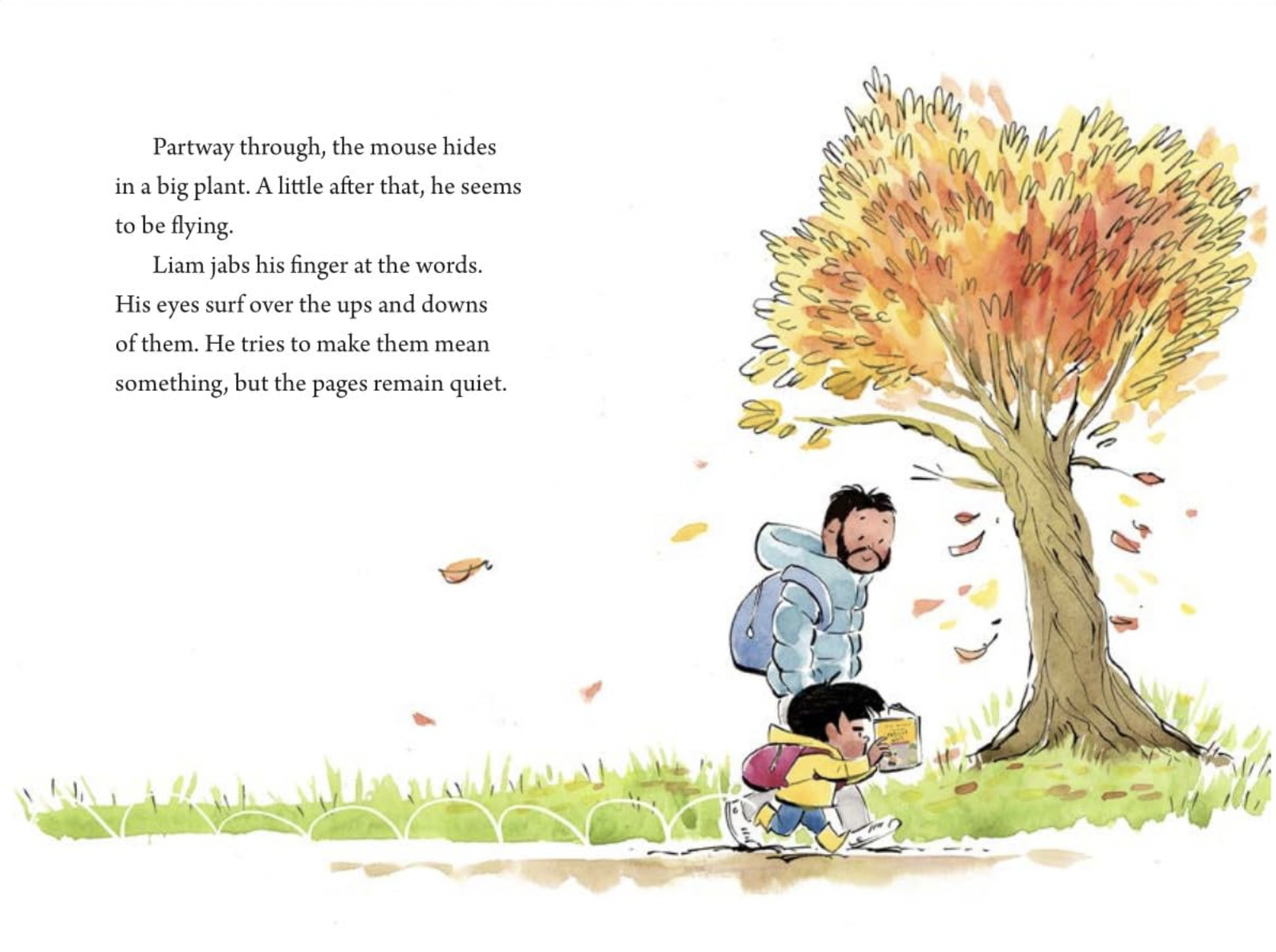
Like all skills, literacy develops at its own pace for the learner. For some children, the step between seeing shapes and deciphering into letters and then words comes earlier. For others, whether because of readiness or learning disability or even opportunity, the ability to read may come later. For Liam, it's not coming fast enough, especially when he has a charming book about a mouse and a bunch of cats–his family has cats!– and he wants to know what's happening.
From Two Tales of Twenty-Six: Liam and the Letters, written by Stephanie Simpson McLellan, illustrated by Mike Deas
In Liam and the Letters, a little boy is charmed by a book about a mouse and a lot of cats. He gets a lot of information from the illustrations, but he wants to know what's actually happening "but the random lines and loops of the letters stretch across the page like fences." (Liam and the Letters, p. 5) In fact, a sample of letters look a lot like those almost indecipherable text-based captchas and spell out "You Can't Come In" and could refer to the mouse and the outside world to which he is eager to visit or to Liam and his reading.
From Two Tales of Twenty-Six: Liam and the Letters, written by Stephanie Simpson McLellan, illustrated by Mike Deas
Liam is getting frustrated as fall turns to winter and he even throws his book away into the snow. But he retrieves it and makes a plan. After all, twenty-six letters is a lot. One letter at a time is manageable. 
One letter at a time could turn impossible into possible. (Liam and the Letters, p. 15)
From Two Tales of Twenty-Six: Liam and the Letters, written by Stephanie Simpson McLellan, illustrated by Mike Deas
So, he starts with the L and the A, letters from his name and ones that he recalls learning about at school. He's frustrated but with time he picks up on the W in the "Walk" sign on his way to school and the R on a cereal box. By spring, he's learned the letters and the weird-looking letters become readable.
 
Now, he can read the story that the reader can also read, simply by turning the book over. Walter and the World is the story of the mouse and the cats that Liam could not read. Walter the mouse has his own issues, with twenty-six cats whom he must evade if he's going to explore the outside world. Both Liam and Walter have twenty-six entities standing between them and what they crave, whether reading or an opportunity for exploration. Their stories may be different, but they are connected and ultimately even linked.
From Two Tales of Twenty-Six: Walter and the World, written by Stephanie Simpson McLellan, illustrated by Mike Deas
A tête-bêche book, which is also a flip book, has two stories in one book which you access by flipping it over. But Stephanie Simpson McLellan's book is not just two different stories. They are two linked stories with a child trying to read the other story. I don't think it matters which story is read first. If they read Liam's story first, they will get a perspective of what it means to look at a book and be frustrated at being unable to read it. But they will also get the satisfaction, as Liam gets, when he can put letters together into words and make sense of the story the reader can now read too. On the other hand, if they read Walter's story first, they'll be charmed by a cat-and-mouse story like no other and feel like they know a secret about the book that Liam cannot read when they read the second story. The order of the reading of the flip book does not matter here; it's the connection that matters.
 
Flip books can be problematic for libraries, particularly for cataloguing, but Two Tales of Twenty-Six will not be so. It will just be a fuller story, told from two different layers, that of a story character and that of a reader. For each, Stephanie Simpson McLellan who is a star of storytelling–my particular faves are The Christmas Wind and The Sorry Life of Timothy Shmoe–gives us a character who is faced with a challenge of twenty-six and tackles it with strategy and perseverance and ultimately success. It's two feel-good stories in one package.
 
To make it even more enticing for early readers–other than giving them a story with which they will be familiar–Two Tales of Twenty-Six is illustrated by Mike Deas, giving these young readers the graphic support to help them read and understand their reading. Mike Deas's art uses a blend of gouache, watercolour, ink, and digital tools to both support and enhance the stories, giving Liam the reader a starting point for his reading, and the reader of Two Tales of Twenty-Six the colour and the magic to make understanding possible and worthwhile.
 
I'm usually not enamoured with tête-bêche books but Two Tales of Twenty-Six is more than the sum of its parts and that's why it's extraordinary. It's a book that is geared to its audience perfectly, encouraging our youngest children in their reading, especially if they are frustrated, and allowing them to see themselves in a story while taking a step up in their reading from picture books.
• • • • • • •
 
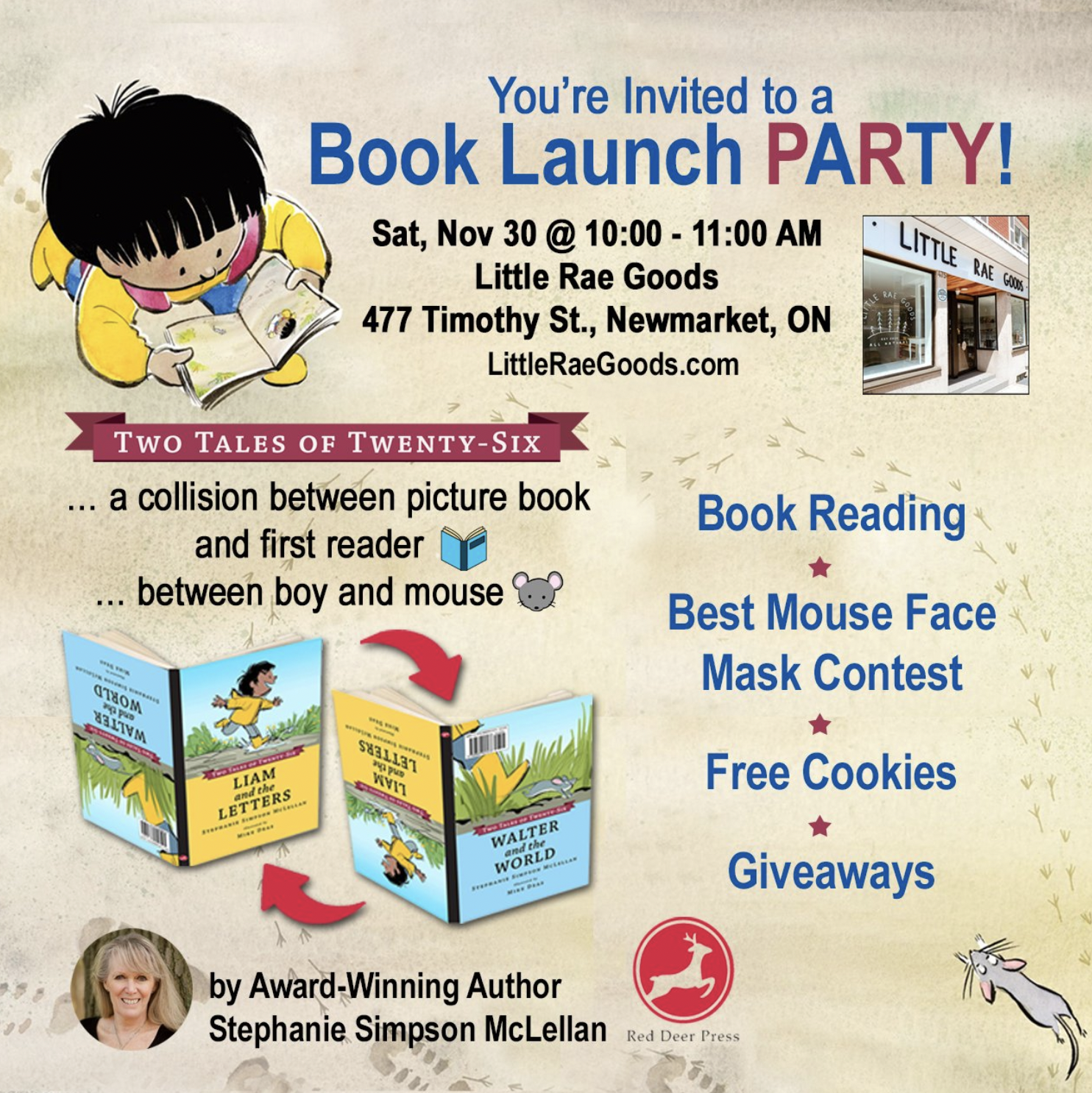
I'm very pleased to tell you about the book launch party for Two Tales of Twenty-Six
 
that will be held on

Saturday, November 30, 2024
 
from 10–11 a.m.
 
at

Little Rae Goode
477 Timothy St.
Newmarket, ON
 
 
This book launch will include:
 
• a book reading
 
• a contest for best mouse face mask

• free cookies

• giveaways

and

• book signing by the author Stephanie McLellan


June 27, 2024

Storytime with Franklin: A Collection of Six Favorites

Written by Paulette Bourgeois
Illustrated by Brenda Clark
Kids Can Press
978-1-5253-1293-9
184 pp.
Ages 3–8
May 2024
 
The Franklin books in my school library were well worn, much loved and a favourite of young readers and their families and teachers for the lessons he learned. Now those books don't need to get worn so fast or misplaced with others because six have been amalgamated into a lovely collection in hardcover. Storytime with Franklin will become its own favourite.
From Storytime with Franklin, written by Paulette Bourgeois, illustrated by Brenda Clark
The six stories covered in Storytime with Franklin are:
  • Franklin in the Dark
  • Franklin Goes to School
  • Franklin's New Friend
  • Franklin Rides a Bike
  • Franklin Goes to the Hospital
  • Franklin Says I Love You
In the first story, Franklin is afraid of crawling into his small dark shell so he drags it behind himself. He learns that other animals, like a lion, a bird, a duck, and a polar bear, have their own fears. With the help of a nightlight, he can face his fear head on. 
From Storytime with Franklin, written by Paulette Bourgeois, illustrated by Brenda Clark
When Franklin is ready to go to school, he is excited but also nervous, especially when he worries that he can't do some of the things his friends can. But, that nervous tummy ache disappears when his teacher shows Franklin that he can do some wonderful things already and would learn new things.

Franklin's New Friend is a very timely story about meeting a new friend who is very different from you. When a moose family moves into the neighbourhood, Franklin is scared because they are all so big. And when Moose comes to school and the teacher buddies Franklin up with Moose, Franklin is relieved when Moose doesn't speak or play with them. Franklin must learn that just because Moose is big doesn't mean he's mean or scary. In fact, he learns that they have common grounds that would eventually make his new friend into a special friend.
From Storytime with Franklin, written by Paulette Bourgeois, illustrated by Brenda Clark
Riding a bicycle without training wheels is a big challenge for little ones, so many will understand Franklin's reluctance to go for bike rides with his friends who can already ride bikes without help. But realizing that they all had things they had to learn and struggle with, whether swimming or rollerblading or baseball, it encourages Franklin to persevere too.

Franklin Goes to the Hospital is a story written by author Sharon Jennings who has written numerous stories based on Paulette Bourgeois's character Franklin. In this story, Franklin must have an operation when he injures his shell during a game of soccer. While everyone tells him how brave he is, Franklin doesn't feel very brave. Kindly Dr. Bear reassures him that "Being brave means doing what you have to do, no matter how scared you feel." (p. 143)
From Storytime with Franklin, written by Paulette Bourgeois, illustrated by Brenda Clark
The final story in the collection, Franklin Says I Love You, has Franklin anxious about how he might show his mother how much he loves her as a birthday gift. But how could he do so without a fancy gift? 

Franklin the Turtle is highly recognizable both from his demeanor, his actions, and his appearance, and that's all courtesy of Paulette Bourgeois and illustrator Brenda Clark. Both have created an iconic character who has been adapted into several animated TV series and whose learning has been used as examples for parents and teachers worldwide. Though it's been almost 40 years since he first appeared in 1986, his stories are as fresh and necessary now as ever. That's because Paulette Bourgeois understands young children's fears and apprehensions and has written stories to alleviate or, at the very least, mitigate them. The stories encourage children who are fearful of the unknown, the unexpected, the embarrassing, and the mundane to see their fears from different perspectives and give themselves opportunities to resolve those issues with independence.
 
Brenda Clark's illustrations, some prepared here with assistance from other artists including Shelley Southern, Muriel Hughes Wood, and Dimitrije Kostic, have always been bold in colour and familiar in setting. Franklin and his friends may be animals but they are also children who draw and play, have friends and family, worry and wonder and love. They are the children who are reading these books.
 
It's lovely to visit with Franklin again and be reminded of the valuable lessons he shares through just being young and learning. Storytime with Franklin becomes a play date with a familiar friend: companionable, reassuring, enlightening, and always joyous.

December 20, 2023

The Golden Apples

Written by Dan Yashinsky
Illustrated by Ekaterina Khlebnikova
Running the Goat, Books & Broadsides
978-1-998802050
40 pp.
Ages 6-9
September 2023
 
It all starts with golden apples. And it ends with golden apples. But the story in between is big, far greater than a few golden apples coveted by a king. The real story of The Golden Apples is Jack's story of quests, and it is this story that must be told aloud by a storyteller, such as Dan Yashinsky or the reader, and heard by all children, young and old.
From The Golden Apples, by Dan Yashinsky, illus. by Ekaterina Khlebnikova
Once upon a time–imagine a true storyteller like Dan Yashinsky saying this with an evocative, spirited voice– there was a king, a queen, and their three sons. When golden apples appear on a tree in their garden, and they disappear before the king can enjoy them, he sends his sons out, one at a time, to locate the golden-feathered bird which Jack, the youngest, had witnessed taking them. Both older boys succumb to temptations along the way, but Jack heeds the advice of a benevolent fox and discovers the bird. Unfortunately, Jack too is foolish in that he disregards some directives and lands himself in trouble. Still, he is offered opportunities to get himself out of trouble by undertaking yet another task.
From The Golden Apples, by Dan Yashinsky, illus. by Ekaterina Khlebnikova
Unfortunately, each task requires him to steal something. And each time, he ignores a piece of advice from the fox who tries to help him be successful. From the golden bird to a golden-maned horse, and a princess with beautiful eyes, Jack verges on getting things right until he doesn't. Still, this is Jack, the "hero" of many tales of folklore, so it all works out in the end, even if with a few twists along the way.
 
Dan Yashinsky, founder of the Toronto Storytelling Festival, knows how to tell a story. Whether it is in person or in written form, Dan Yashinsky keeps listeners and readers captivated, waiting for the next scene, the next conflict, the next laugh. He makes us want to find out what happens next, without padding his stories with filler to draw them out. Readers will quickly realize that Jack is the son often disregarded and the one who, with a little help and some cleverness, is able to surpass the minimal expectations others have of him. This may be familiar to some children who feel undervalued in families or in the classroom, but it offers them hope that they can achieve with perseverance. Still Dan Yashinsky makes Jack real with his ineptitude–come on, Jack, listen to the fox!–and unintentional fumbles but with a good heart. (In the end, he does something very difficult and heart-breaking that comes to a good end.)
From The Golden Apples, by Dan Yashinsky, illus. by Ekaterina Khlebnikova
I think Christmas is a great time for storytelling, as families gather around, perhaps in the aftermath of a big meal or as children are settling down before sleep. And The Golden Apples, told as Dan Yashinsky wrote it, with heart and verve, will bring everyone together. With the added dimension of Russian artist Ekaterina Khlebnikova's illustrations, a blend of different media that add depth and whimsy–like Nirvana and Metallica posters on the princess's walls, or Jack's headphones-wearing brother–The Golden Apples also has colour, humour, and texture. The Golden Apples may not be a Christmas story, but it would be a fine story to tell this holiday season or anytime a great tale is called for.

August 25, 2021

Burt the Beetle Doesn't Bite!


Written and illustrated by Ashley Spires
Kids Can Press
978-1-5253-0146-9
56 pp.
Ages 5-8
June 2021

While I may be cursing the mosquitoes and horseflies that are biting right now, award-winning author-illustrator Ashley Spires is showing her appreciation for the wealth of insect species inhabiting backyards and in particular a ten-lined June beetle called Burt.

From Burt the Beetle Doesn't Bite! by Ashley Spires

Showcasing Burt's attributes from his feathery antennae ("It's a style choice") to his all-natural furry belly, Ashley Spires introduces us to the insect often called a watermelon beetle. But when Burt notes the superpowers of ants, hawk moths, termites and stink bugs, he struggles to recognize what makes him so amazing. He tries to wink, tap dance, climb walls and fly but usually ends up on his back with legs flailing in the air. 

From Burt the Beetle Doesn't Bite! by Ashley Spires

But like any child looking to identify their own strengths rather than focusing on their weaknesses, Burt perseveres and finds his sticky legs and his huggable nature a gift to some insects trapped in a spider web.

From Burt the Beetle Doesn't Bite! by Ashley Spires
With colourful humour such as calling a spider web "fancy bum string" (pg. 43) and bold illustrations that are both charming and surprisingly accurate (except for their faces, of course), Ashley Spires teaches, entertains and grabs readers' attentions. There may be countless books about insects but Burt the Beetle Doesn't Bite! educates without droning on about insects' defining characteristics like habitat, eating, and reproduction. Instead kids will learn about the ten-lined June beetle but also about ants and dragonflies, the Australian tiger beetle, hawk moths, echolocation, spraying of toxins and more. And if that's not enough, the end papers display "cards" depicting insects according to their superpowers from "Super Stingy" and "Super Bright Bum" to "Super Annoying" (that's the mosquito!) and "Super Deadly Farts." Finding out what insect matches its superpower will be half the fun of Burt the Beetle Doesn't Bite!
From Burt the Beetle Doesn't Bite! by Ashley Spires
Ashley Spires has always known how to entertain us with her graphic novels and picture books, having won the hearts of young readers with Binky the Space Cat (see my review of Binky Takes Charge, 2012) and inspired them with The Most Magnificent Thing (2014) and The Thing Lou Couldn't Do (2016). Now with Burt the Beetle Doesn't Bite!, she teaches, informing kids about insects in a colourful and playful way that camouflages the learning. That, and her illustrations and her humour must be her superpowers and I'm so glad she uses them for good.

🐞 🐞 🐞 🐞 🐞

A downloadable activity package from Kids Can Press is available at https://www.kidscanpress.com/sites/default/files/products/assets/BurtTheBeetleDoesntBite_2685_activity.pdf

September 10, 2020

The King of Jam Sandwiches

Written by Eric Walters
Orca Book Publishers
978-1-4598-2556-7
312 pp.
Ages 8-12
September 2020

This was a difficult story for me to write because it's so personal. Many of the things I've written about are from my life. The question I'm already being asked is, How much of this is true? The answer is simple–too much and not enough. 
(From Author's Note

So begins The King of Jam Sandwiches, the story of thirteen-year-old Robbie whose familial circumstances have compelled him to take on adult responsibilities and worries far beyond his years, reminding all readers that even the most unbelievable of situations can be a child's reality.

Since his mother and grandparents have passed, Robbie only has his father, a man whose erratic behaviours shout of bipolar disorder, swinging between fears for his imminent death, hoarding food supplies and disappearing for days. Though he has an Uncle Jack and Aunt Cora, Robbie is always told that he'll be going into foster care if anything happens to his dad. So Robbie is the one steady element in his family. He cares for his dog, Candy; he does the laundry, if there's detergent; he peels potatoes when he gets home from school; and he works part-time at a butcher shop, though his father doesn't want him taking food, as charity, from the kindly Mr. and Mrs. Priamo. But Robbie does more than just endure and persevere. He makes plans and he has ambition.  Working hard to earn good grades and save his money, Robbie has a plan to get out from under his father and escape, ultimately going to university.
If you're broken and you know it, you have to get up every day and work harder and longer than everybody else if you want to get anywhere. (pg. 298)
Then Robbie meets Harmony, a new student. An enigma of brashness and hopelessness, Harmony is living with her newest foster family and counting on being reunited with her mother who has been in and out of rehab.  While Robbie feels that he has to prove himself, Harmony accepts his daily jam sandwiches as tasty, not humiliating; helps him buy some new, though heavily discounted, clothes that fit; and finds a way for him to do something fun like basketball. Robbie may not want to admit to anyone that they are poor and that his father is a negligent parent, feeling like this is the life he deserves, but Harmony, in her convoluted style, makes sure that he knows otherwise. 

I am loathe to call The King of Jam Sandwiches a coming-of-age story because, sadly, Robbie and Harmony have been adults for years.  They've carried burdens that children should not. They are the parents in their lives, looking after the adults who have failed to be parents. They live disquieted lives, never knowing when danger might arise or when the flimsy stability they've create for themselves might dissipate. And Eric Walters establishes that precariousness of reality from the onset and throughout The King of Jam Sandwiches. There is no respite from the poverty or the instability. There is only survival, physical and emotional, and the reader's hope that Robbie and Harmony get through it. (The author's "Post Note" reassures that they do.)

The King of Jam Sandwiches is a tough read because no one wants to think about children suffering. But The King of Jam Sandwiches is reality for many children, and while telling us about his own childhood wrapped in Robbie's story, Eric Walters has given voice to children who, like Robbie, don't think they deserve better or that they count. They do. They are the royalty of their own realities and, if they can get the support they need and want, they may even come to recognize that,
"You already are somebody." (pg. 115) 

September 08, 2020

Harvey Holds His Own

Written by Colleen Nelson
Illustrations by Tara Anderson
Pajama Press
978-1-77278-114-4
288 pp.
Ages 8-12
August 2020

It's funny how a little dog can help people without even trying. (pg.73)

After Harvey's first adventure (Harvey Comes Home, 2019) in which he becomes lost, Maggie's West Highland Terrier is happy to be home, though he does miss the boy who'd found him and the people at Brayside Retirement Villa where he'd spent much of his "leave." However, seventh grader Maggie doesn't necessarily feel very hospitable to Austin who, though he'd cared for Harvey well, had kept her dog without looking for his home. Still, as she chooses to do her volunteer hours at Brayside where Austin works alongside his grandfather, the head custodian of the facility, Maggie will learn more about connecting with others, even those with whom she seemingly has little in common, courtesy of a little dog.

Told from the different perspectives of Maggie, Austin and Harvey, Harvey Holds His Own follows multiple plot lines, all brought together via Maggie's volunteering at Brayside. There she meets new resident, Mrs. Josephine Fradette, a spirited senior, who shares her memories of being evacuated from Winnipeg to her grandparents' home during the Red River flood of 1950 and learning car mechanics from her Pépère. This connection is especially meaningful for Maggie who is feeling isolated from best friends Lexi and Brianne. Meanwhile Austin continues to help his grandfather at Brayside and is thrilled to reacquaint himself with Harvey during Maggie's visits–though he'd dearly love a dog of his own–but is distracted by fears that his Grandpa is in danger of losing his job.  And then there's adorable Harvey whose nose will lead him to both crisis and blessing, and bring Maggie, Austin, and others together in an ending that will leave readers smiling, heartened and satisfied.

From Harvey Holds His Own by Colleen Nelson, illus. by Tara Anderson
I am always apprehensive of animal stories as I anticipate hardships like vulnerabilities, injury and cruelty, especially at the hands of humans. Unfortunately, these things do happen in reality and they always leave me emotionally shattered. But Colleen Nelson, with her compassionate heart and love for Westies–there is a photo of her with her own family's–gives us a story of a girl, a boy and a dog (or two) that will make readers happy, both entertaining and reassuring them that things can work out well in the end. And while many will be drawn to this middle-grade novel because it is an animal story at its core, there are important messages about courage and perseverance, friendships new and old, and even love.
Loving something always comes with a risk; that's what makes it so special. (pg. 245)
I had to take a risk reading Harvey Holds His Own because of my own anxieties. What I got for that risk was a lovely story–with chapter headings delightfully illustrated by Tara Anderson–that reassures that there are good people who will always do right by others, whether they be their canine families, seniors in a long-term care facility, or friends. And isn't it nice to know, especially nowadays, that there is goodness out there?


July 27, 2020

Switchback: Guest review

This review was written by teacher Elizabeth Cook.

Written by Danika Stone 
Swoon Reads
978-1250221650
320 pp.
Ages 12-18
2019

Warning: Do not start this book right before bedtime as you will be compelled to read until the very end...which for me was three in the morning!

Danika Stone’s Switchback is a story of two best friends in Grade 10 who are required to go on an overnight camping trip in the Rocky Mountains to earn their gym class credit.  Vale (Valeria) and Ash (Ashton) couldn’t be more different.  Vale loves learning about new topics and going on hikes with her family.  She stands up for what is right against the school bullies, Mike and Brodie, which made her an easy target and a social outcast. On the other hand, Ash is loved by everyone for his self-deprecating humour and corny jokes (“Hey, Vale.  You know how trees get onto the internet?  They log on!”) but he would never choose to be outside, preferring to spend all day inside playing D&D or video games.

The group's two-day climb up the mountain begins with a small hike followed by a lunch break during which Vale sees Mike and Brodie littering the national park with their lunch wrappers.  Worried for the safety of the animals, she convinces Ash to help her pick up the garbage, which unfortunately results in them being left behind by their group.  Hoping to reach the designated camping spot at Twin Lakes, the pair continue on the path, until the cloud cover causes them to lose their way. As the dark night sky looms and the rains begin, Vale and Ash decide to set up a shelter to keep warm and hopefully avoid the forecast snow. 

The two teens face numerous challenges in the wilderness while trying to find a way back to civilization. Their biggest concerns are staying healthy and safe. First, they have limited food and water, as their meals disappeared with the rest of the school group. Other than a couple of sticks of gum, a handful of GORP (granola, oats, raisins, peanuts), the pair must fend for themselves. They also have to fight off hypothermia–their clothes get wet when the snow comes–and tend to their hiking injuries with only the small first aid kit that Vale had packed. Moreover, the two have to worry about the many animals they encounter along the way. When it is dark on the side of a mountain, every snap of a branch sends a new wave of panic through them as they pray for a harmless deer rather than a larger predator looking for a snack.

This YA novel is a definite page turner!  I started this novel hoping I would enjoy it for a couple of days, but I loved it too much to stop. I had to know what would happen next and read through the night until I was done.  Switchback is a real nail biter and it definitely kept my heart beating fast during many scenes. The story of these two friends trying to survive in the wilderness is a story of bravery, perseverance, and true friendship!

~ Reviewer Elizabeth Cook is a teacher in the Halton District School Board. She is an avid reader and fan of Canadian literature. 

March 14, 2019

The Dog Who Wanted to Fly

Written by Kathy Stinson
Illustrated by Brandon James Scott
Annick Press
978-1-77321-280-7
36 pp.
Ages 3-6
March 2019

A chattering squirrel just out of reach is the frustration of many a dog. Though a chase may be all that is wanted, but unlikely to happen when the squirrel remains out of reach, that mocking babble is taunting, and Zora is determined to find relief. If only she could fly!
From The Dog Who Wanted to Fly by Kathy Stinson, illus. by Brandon James Scott
Tully the cat may be the voice of reason, stating quite clearly that "Dogs can't fly" but Zora is resolute. She bounces as high as she can and she crashes. She flaps her ears and her tail and she crashes. She tries to springboard from a teeter-totter and she crashes. She considers using an umbrella but that idea is thwarted by a human. She fashions herself into a plane with ears, paws and tail extended but she cannot will herself "up." Still, when Tully begins to fall from a perch on a branch, Zora zings to the rescue.
From The Dog Who Wanted to Fly by Kathy Stinson, illus. by Brandon James Scott
Zora's story is that of author Kathy Stinson's own dog Georgia to whom she dedicates the story, but it really is the story of every dog who watches wistfully at chase fodder a.k.a. squirrels. But, like anyone with big dreams that may be preposterous–let's face it: dogs can't fly–there still may be a way to achieve versions of those goals and that's what Zora does when her friend is in danger.  Kathy Stinson, who can write everything from picture books to YA novels, tells Zora's story with words and logic that young readers will understand and enjoy, ending it with the subtle humour that children will appreciate, sure to laugh themselves silly.
And the squirrel was very quiet.
From The Dog Who Wanted to Fly by Kathy Stinson, illus. by Brandon James Scott
Brandon James Scott is an accomplished animator, creating the Emmy-nominated "Justin Time" TV series, but his artwork really shines when giving visual life to Kathy Stinson's story. He endows Zora with the cuteness to sweeten her story and the attributes of determination, imagination and compassion to carry it forward. Her expressive eyes and eyebrows, mouth and body language always speak to Zora's intentions, just as Tully and the squirrel voice their own views. (Check out the final illustration directly above.) Even Zora's backyard of fenced-in greenery is lush with light and life.

Here's to Zora who doesn't let logic keep her from her dreams and to the squirrel and Tully who will have to rethink what a dog can and cannot do.
Zora, The Dog Who Wanted to Fly by Kathy Stinson, illus. by Brandon James Scott

🐕🐕🐕🐕🐕🐕🐕

Annick Press, the publisher of The Dog Who Wanted to Fly, just posted this sweet book trailer for it on YouTube.
Uploaded by Annick Press to YouTube on March 12, 2019.

December 03, 2018

The Ice Chips and the Haunted Hurricane

Written by Roy MacGregor and Kerry MacGregor
Illustrated by Kim Smith
HarperCollins Canada
978-1-44345-231-1
167 pp.
Ages 7-10
September 2018

Many readers grew up reading Roy MacGregor's extraordinarily successful Screech Owls series of middle grade novels about the peewee hockey team. For adventure and mystery and, of course, hockey, these were the go-to books for kids. Now, for a slightly younger set–let's say early middle-grader–Roy MacGregor has teamed up with his daughter Kerry MacGregor to take their minor hockey team, the Ice Chips, on the road but through time and history too. And, in The Ice Chips and the Haunted Hurricane, the kids meet a hockey hero and a few ghosts as well.

Lucas Finnigan a.k.a. Top Shelf and his friends and teammates Swift, Edge and Crunch decide to recreate their initial magical experience of time slip that had them meeting Gordie Howe. They know that after Scratch, the magical Zamboni, resurfaces the rink with its magical flood and they skate across the centre line, they will be transported ... somewhere, sometime. But, as the Ice Chips are again matched up against their ice nemeses, the well-equipped and moneyed Stars, they know they are at a significant disadvantage, especially having lost valuable time waiting for the Riverton Community Arena to reopen. So Lucas, Swift and Edge, this time prepared with walkie-talkies, a camera, boots–they can't walk around in their skates everywhere–and other tools, and Crunch staying behind as tether with a walkie-talkie, jump back in time and into their newest adventure.

Strangely, the kids find themselves on a boat in the middle of a storm and it's two other Ice Chips, Bond and Mouth Guard, who unknowingly followed the trio of time-travellers to Nova Scotia, who meet a young hockey player and introduce him to the others when they're finally reunited. Though the kids don't connect the dots about this young star from Cole Harbour until near the end of the book, they're still impressed by his determination and drive, especially after taking them through some intense and very worthwhile hockey drills at the Citadel in Halifax. There's also a few encounters with ghosts including a sea captain from the Halifax Explosion, making The Ice Chips and the Haunted Hurricane a bona fide story of the Maritimes.

But, as in the first book in the series, The Ice Chips and the Magical Rink, Roy MacGregor and Kerry MacGregor's new book promotes lessons about getting the kids to work together, seeing beyond their weaknesses and looking towards empowerment with strategies to make their playing and their lives better while still immersing young readers in the hockey culture of today and then. Moreover, with the diversity of kids on the team–boys and girls of different ethnicities and physical and intellectual abilities including Swift who has a prosthetic leg–all children will see themselves in the Ice Chips. (I love that most of the teammates call each other by their nicknames and the gender of the player is rarely discussed.)

Hockey fans will definitely love the scrimmages on the ice, well told by Hockey Hall of Fame inductee Roy MacGregor and journalist Kerry MacGregor, but they'll be grabbed by the story of kids finding themselves in new circumstances, getting guidance from hockey greats and working together to find their way home. With Calgarian Kim Smith's illustrations to give the story some graphic spice, The Ice Chips and the Haunted Hurricane will be taking home a win. Though it will still be a few more months until The Ice Chips and the Invisible Puck comes out in April of 2019, I'm pretty sure that authors Roy MacGregor and Kerry MacGregor, who plan to make Swift's idol, one of Canada's most decorated Olympians, the focus of that story, will be able to keep up their stickhandling magic.
From The Ice Chips and the Haunted Hurricane by Roy MacGregor and Kerry MacGregor, illus. by Kim Smith

August 02, 2018

Raw Talent

Written by Jocelyn Shipley
Orca Book Publishers
978-1-4598-1834-7
138 pp.
Ages 11-14
August 2018

Everyone wants to help out Sunflower Farm, the family farm of Stonehill High students Vanessa and Heath. Since the death of their father, their mother has been struggling to keep the farm running and the school community is coming together for Farmshine, a performance and market fundraiser.  Raw Talent's narrator, Paisley who is Heath's Grade 9 classmate, intends to volunteer with her best friend Jasmeer but what Paisley really wants to do is perform. Her ambition is to be a singer-songwriter and she has no problem posting videos of herself performing but her stage fright is discouraging her from signing up to sing at Farmshine.  With a mother who is an accomplished flutist with the symphony and a university music teacher, Paisley is just not sure she can cut it on stage.

With celebrated singer-actor Maxine Gaston staying at Jasmeer's parents' B & B while her local home is being renovated and she is performing at the Stratford Festival, Jasmeer arranges for her to coach Paisley to help get over her performance anxiety.  Maxine Gaston is a great help but Paisley, who has much to overcome because of a disastrous audition at age 10 with the award-winning Sweetland Singers, is being harassed online, by phone and in person by Cadence, the self-important girlfriend of Heath and soloist with the Sweetland Singers.  Can Paisley get beyond her insecurities about her lower singing voice and Cadence's nastiness to stand up in front of an audience and do what she loves?

Raw Talent is a feel-good hi-lo novel for older middle graders and young teens. While written at an easier reading level, Raw Talent's story, part of the Orca Limelights series based in the performance arts, will resonant with young teens aspiring to new endeavours but unsure of their abilities. Jocelyn Shipley makes sure that the reader realizes that having a dream is futile if you don't set goals to achieve it.  It's up to Paisley to decide what she can and cannot do. Not her mother, not Cadence, not the director of the Sweetland Singers. Just her. She might have been devastated when she didn't get into the Sweetland Singers but she found a way to continue singing and performing albeit in the privacy of her room while still sharing it publicly. Then, with Maxine's coaching, she has the opportunity to take steps forward. Though not easy, especially with self-doubt and bullying that erodes her confidence, Paisley steps up. Jocelyn Shipley doesn't just hand Paisley the opportunity, though.  She makes sure the girl works for what she wants. Maxine Gaston is encouraging but she is not effusive and she makes it clear that, if Paisley isn't willing to put herself out there, she's not going to bother coaching her. That could be an "ouch" moment, but it's not because it's a challenge that Paisley accepts. Similarly, the bullying that Paisley experiences via Cadence is nasty but impactful and still she finds the means eventually to toss it off with a "Whatever". 

Whether Jocelyn Shipley intended, she's affirming Nietzsche's belief that "That which does not kill, makes us stronger".  Paisley's performance anxiety and Cadence's bullying can't stop her and, in fact, they give her the opportunity to be more than she could have imagined for herself.