Showing posts with label worries. Show all posts

July 20, 2026

Scaredy Squirrel Scared Silly (Scaredy's Nutty Adventures, Book 4)

Book cover of Scaredy Squirrel Scared Silly by Melanie Watt depicts a squirrel in a protective robot costume carrying a pumpkin labelled as a friendly jack-o'-lantern and wearing an emergency fanny pack.
Written and illustrated by Mélanie Watt
Tundra Books
978-1-77488-884-1 (pb)
84 pp.
Ages 4–8 
July 2026
 
I didn't get a chance to review this book of Scaredy's Nutty Adventures when it was released as a hardcover in 2024, so I'm pleased to review it now that a paperback edition was just released this month. When Scaredy Squirrel was first released in 2006, he became a beloved character. Mélanie Watt brought us a little squirrel who was overwhelmed, seeing threats everywhere. Now the star of his own animated series, as well as picture books and this early reader graphic novel series, Scaredy Squirrel is a much beloved character to helps young children see beyond their worries by laughing with him.
A cartoon squirrel lists off a few of things that terrify him, like haunted houes, mummies, witches, crows, Frankensteins, ghosts and vampire bats.
From Scaredy Squirrel Scared Silly, written and illustrated by Mélanie Watt
In Scaredy Squirrel Scared Silly, Mélanie Watt shares five short graphic stories about Scaredy and his relationship with Halloween. In the first chapter, titled "October 31st," our sciurine friend is actually looking forward to the un-scary aspects of the holiday. He likes the decorations and the lighting, but he's terrified of haunted houses, crows, vampire bats, and more. So, he's happy to stay in his cheerfully decorated tree, along with some unusual preventative measures.
A cartoon squirrel show his rabbit friend that he has bug spray for scary bugs, caution tape for mummies, a laser pointer to distract Frankensteins, while they stand outside his tree home decorated for Halloween.
From Scaredy Squirrel Scared Silly, written and illustrated by Mélanie Watt
The next stories have Scaredy planning a cute, but not scary pumpkin carving activity with his friends, working on his costume, considering going trick-or-treating—hard candy, gummy worms, and chocolate all have drawbacks—before heading out in search of candy apples.
A squirrel in a robot costume speaks to his costumed friends about how he'll spray a witch with water and do a card trick if needed
From Scaredy Squirrel Scared Silly, written and illustrated by Mélanie Watt
It may seem a little early to be thinking of Halloween, but I suspect there are many for whom the holiday is a big deal and who are already planning their costumes and parties. Whether you get Scaredy Squirrel now in anticipation of the holiday or keep it to read in October, Scaredy Squirrel Scared Silly will give young children a lot of laughs about his wacky but legitimate worries. Scaredy Squirrel may seem like an excessive bundle of anxiety, but he emulates the many children who have misgivings and fears about the familiar and the unknown. With a lighthearted approach and quirky and colourful illustrations, Mélanie Watt will let children see that many anxieties can be lessened and even alleviated with some friendly intervention and a new perspective.
A cartoon squireel screams, "Pumpking Zombies! Ahh!!!" at seeing two pumpkin-headed characters
From Scaredy Squirrel Scared Silly, written and illustrated by Mélanie Watt
Mélanie Watt's Scaredy Squirrel will always charm. She has created him as sweetly guileless—check out his toothy grin—and oddly expressive. And with detailed illustrations that give young readers much to enjoy, from costumes to decorated homes, readers will be looking forward to their own nutty Halloween adventure and all that it entails.
 
🎃 🎃 🎃 🎃 🎃 
 
This is Book 4 in Scaredy's Nutty Adventures series. Here are all published titles:
Book covers of "Scaredy Squirrel in a Nutshell," "Scaredy Squirrel Gets a Surprise," "Scaredy Squirrel Gets Festive," and "Scaredy Squirrel Scared Silly"
Scaredy Squirrel in a Nutshell (2021)
Scaredy Squirrel Gets a Surprise (2022)
Scaredy Squirrel Gets Festive (2023)
Scaredy Squirrel Scared Silly (2024) 

February 23, 2026

Ellis on Guard

Written by Sal Sawler
Illustrated by Nandita Ratan
Second Story Press
978-1-77260-444-3
24 pp.
Ages 6–8
February 2026 
 
Ellis had so many worries that if they wrote them all down, the list would wrap around their house three times. (pg. 2) 
That single line explains a lot about how Ellis conducts themself. It's not what defines them—they are far more than their worries—but they are a child who makes a lot of decisions based on those concerns. And Ellis is worried about a lot of things, from meeting new people to catching colds, and losing their puppy Peanut. To their benefit, Ellis notices a lot, because they are always aware or worried that danger is present.
From Ellis on Guard, written by Sal Sawler, illustrated by Nandita Ratan
When Ellis sees a poster about a missing dog named Walter, their worries are intensified. They become Big Worries. Now they have to worry about a dognapper, about Peanut being taken, and where Peanut might go. So, Ellis devises a plan to catch the dognapper with a trap. But now there are more worries because they needs supplies from the Creepy Closet and the Frightening Forest, and they have to talk to the Noisy Neighbor. With some support from Peanut and their mom, Ellis creates a trap. But what Ellis finds is that there is more to discover than a dognapper. There is more beyond worries. In fact, there is goodness.
From Ellis on Guard, written by Sal Sawler, illustrated by Nandita Ratan
Sal Sawler, the Nova Scotia writer of When the Ocean Came to Town (Nimbus, 2023), seems to understand a child's worries and how they can spiral out of control to the point at which they impact activities and thought. Worries are protective. They are there to help us avoid injury, dangerous circumstances, and bad people. Whether it's our own traumas or those of our ancestor, our bodies remember. But when they misremember, seeing peril everywhere, life is negatively impacted, and this is especially concerning for children. This child obviously knows some strategies for dealing with their anxieties like making a plan, putting on imaginary armour, or asking for help, but worries can be inescapable when they overwhelm. Still Sal Sawler sensitively takes Ellis in small steps from worrisome to attentive beyond the worries. Once Ellis realizes that they can do good, they put aside the worry and step up to be the protector they envision themself to be. I think kids would gain from discussions of how Ellis changes their outlook and sets aside a worry, perhaps helping to cope with their own concerns and see the positives where they exist.
From Ellis on Guard, written by Sal Sawler, illustrated by Nandita Ratan
Nandita Ratan is a Vancouver-based artist whose digital art keeps with the playful rather than the threatening nature of worries. Even when Ellis fears monsters or a dognapper or a  Spiky Shrub, Nandita Ratan does not make it scary. Instead, she makes the child's fears simple but embedded in the realism of a dark closet or a shaded forest. She keeps most of the illustrations light and colourful, never terrifying, and thus helps to convey the message that worries can be dispelled by not catastrophizing and with a change in perspective.
 
While Ellis on Guard is not a how-to story about dealing with worries, it is a picture book that might help a few children understand their own worries. Child have worries, as do the rest of us, and some of those worries don't disappear because we will them to do so. It might be enough for children to learn that there are positive thoughts that can help prevent over-the-top worries that anticipate the worst and turn things around enough to do good and see goodness beyond the worries.
 
 • • • • • • • 
 

August 14, 2025

Mabel Makes (^Up) a Friend (The Elephant in the Room)

Written and illustrated by Cyndi Marko
Penguin Workshop
979-8-217-04951-6
96 pp.
Ages 5–8
Releases August 26, 2025
 
Grade 2 is turning out to be a rough year for Mabel. Her friends Bea and Flora are in the other Grade 2 class and, because her family recently moved, Mabel travels on a different school bus than they do. And her teacher, Mrs. Crabgrass, sometimes keeps Mabel in at recess to do her homework that she forgets to do. But then Mr. Elephant comes into her life.
 
On her way home and then at her house, Mabel starts to see an elephant hiding, sometimes in a moving box, under a lampshade, or behind a shower curtain. She's confused so goes to ask her family about the elephant, but her dad is too busy with the twin babies, her mom is busy writing her book, and her Goth teen sister speaks only in spooky old poetry.
From Mabel Makes (^Up) a Friend, written and illustrated by Cyndi Marko
When he finally speaks to her, wondering who imagined him into existence, he chooses the name Mr. Elephant, and the two start sharing how they live their lives. After they determine he is not her fairy god-elephant, Mabel interviews him and in a playful way learns about elephants: where they live, what they eat, and what they do. When playing a video game becomes a little rambunctious, he seems to be the one creating mayhem. That mayhem continues when Mr. Elephant accompanies her to school the next day.
From Mabel Makes (^Up) a Friend, written and illustrated by Cyndi Marko
At school, Mabel gets into trouble for causing the art easels to fall, for not doing her homework—Mr. Elephant ate it because it had a smudge of peanut butter on it—and for her lack of focus. But when her friends Bea and Flora affectionately call her weird—"Oh, Mabel, I love how weird you are!"—Mabel is concerned until Mr. Elephant reminds her that they actually want to spend time with her, inviting her to a movie.
From Mabel Makes (^Up) a Friend, written and illustrated by Cyndi Marko
It's pretty obvious that Mabel is missing her friends and hasn't made any new ones. (In fact, the next The Elephant in the Room book has Mabel's parents signing her up for the scouting club called Lightning Bugs to help make new friends.) Not only is she lonely, she's also having a hard time focusing. She may create an imaginary friend who comes in handy to explain the messes she makes, the chaos she creates, and the school work that doesn't done. But Mr. Elephant doesn't take away her worries that she doesn't fit in or that maybe others don't like her. Cyndi Marko not only lets us see Mabel from the perspective of her teacher, her friends, and her parents, she also allows us to see what Mabel is seeing and feeling both from her own point of view and that of Mr. Elephant. He helps refocus her but also plays the scapegoat. His role is multifaceted and, though he may be a creation of her imagination, he is a real part of her. 
From Mabel Makes (^Up) a Friend, written and illustrated by Cyndi Marko
I've loved Cyndi Marko's storytelling since she published her Kung Pow Chicken series, another early graphic novel. These books and Mabel Makes (^Up) a Friend demonstrate that Cyndi Marko knows her early readers and gives them what they'll love: laughs, characters, and issues with which they can relate. Mabel seems to get into trouble at school while her family is too busy to see that she needs some support. But Mabel's troubles are multi-faceted in that she's feeling lonely, worrying, feeling ignored, and always seems to have the wiggles. She needs some help. Sadly, the only one who seems to provide it is the elephant she imagines for herself. But Cyndi Marko addresses what Mabel is going through while keeping it funny and clever and even providing facts about elephants. Her illustrations are very cute, especially her characters. Mabel and the other humans have stick arms and legs but their faces and bodies make them easily differentiated. And it's easy to see the emotions of sadness, confusion, silliness, and more in those faces and in their body language. Even with uncomplicated illustrations which are perfect for the audience of early readers, Cyndi Marko gives us more story and more feeling. 
 
Mabel Makes (^Up) a Friend, with its delightful artwork and important story, packs a lot into 96 pages. Not only will it entertain, it will teach science, reassure those fidgeting kids that accidents happen, assist kids in finding help, and maybe even encourage parents and teachers in becoming aware that, when little ones are challenged, sometimes they have to find their own supports, such as envisioning a bow tie-wearing pachyderm who is delighted to be picked for the job.

March 21, 2023

When Things Aren't Going Right, Go Left

Art by Peter H. Reynolds
Words by Marc Colagiovanni
Orchard Books
978-1-338-83118-4
32 pp.
Ages 4-8
March 2023
 
Of course, things don't always go right. That's life. But how we handle it when things don't go right makes for a good story when we get back on track.
From When Things Aren't Going Right, Go Left by Marc Colagiovanni, illus. by Peter H. Reynolds
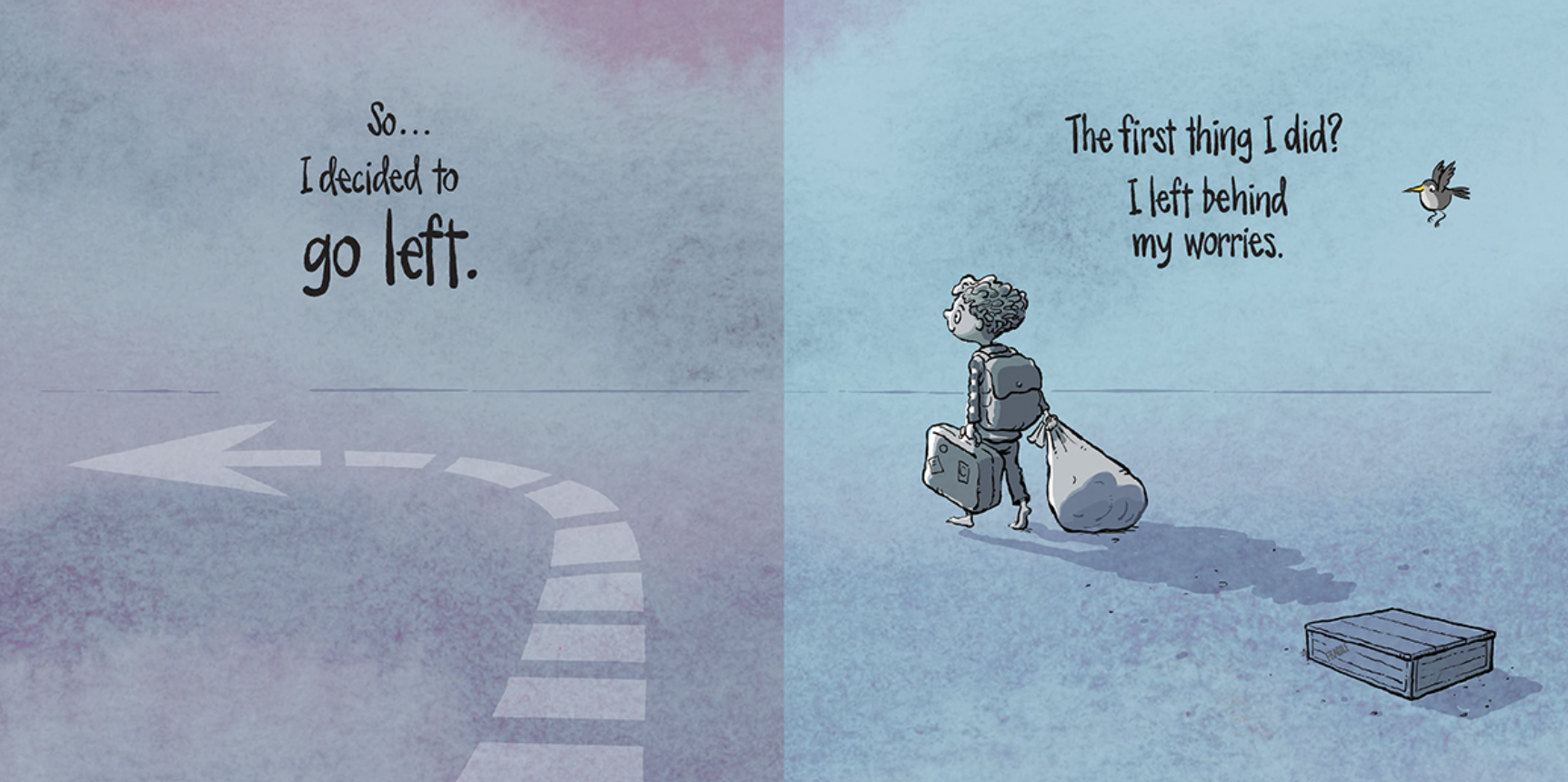
In Rhode Island's Marc Colagiovanni's debut picture book, a child is burdened by a box of worries, a sack of doubts, a suitcase of fears and a knapsack of frustrations. He wants to try something that has frustrated him, worried him, scared him, and made him doubt himself. It's a pool with a diving board.
From When Things Aren't Going Right, Go Left by Marc Colagiovanni, illus. by Peter H. Reynolds
He'd attempted a dive once and had been unsuccessful, and now considers another attempt. Ah, but there are those doubts and those fears and more. Worse yet, as he attempts to leave them behind, one encumbrance at a time, the annoying creatures shout back at him. Can he make them manageable or leave them behind to take control?
From When Things Aren't Going Right, Go Left by Marc Colagiovanni, illus. by Peter H. Reynolds
The message that it's okay to put down your burdens is an important one for all of us who sometimes feel we need to power through everything and anything. Marc Colagiovanni obviously knows this and, by using an example of a child attempting something that both scares and frustrates him, he reminds us that not everything is going to go right or be easy. It could be trying a formidable dive or making a new friend or overlooking those pesky demons that cause us stress and worry. We all have them, and we all need to find coping strategies to get beyond them. The message is meaningful, but the medium is everything.
From When Things Aren't Going Right, Go Left by Marc Colagiovanni, illus. by Peter H. Reynolds
The artwork from Peter H. Reynolds takes When Things Aren't Going Right, Go Left from social emotional advice to a visualization for coping. Though some may see a child attempting a dive as trivial, to that child those burdens of worry and fear are great. They are heavy loads of disquiet and cannot be diminished because others might seem them as negligible. Peter H. Reynolds makes us feel the weight of those burdens in the child's face and body language and, most clearly, in the palette of the art. From the grey blues and purples of the child's troubled steps, through the times of lighter oranges and pinks, until his world is bright and sunny yellow, this child feels everything, and so do we. 

Peter H. Reynolds's books are always a treat of messaging and graphics, and his collaboration with Marc Colagiovanni reminds us again that we have the capacity to make things better for ourselves while inspiring all of us to do our best.

 ⇨⇦ ⇨⇦ ⇨⇦

When Things Aren’t Going Right, Go Left by Marc Colagiovanni and Peter H. Reynolds | BOOK TRAILER

Uploaded by Scholastic to YouTube on February 222, 2023.

October 06, 2020

Teaching Mrs. Muddle

Written by Colleen Nelson
Illustrated by Alice Carter 
Pajama Press
978-1-77278-131-1
32 pp.
Ages 3-6
October 2020

As a teacher, I know we have a lot to learn from our students. If you're a really good teacher, and I believe Mrs. Muddle will be someday, you listen.
From Teaching Mrs. Muddle by Colleen Nelson, illus. by Alice Carter
 
First day of school can be an exciting day but also a trepidacious one, especially for new students such as kindergartners like Kayla who are already nervous about getting lost and missing their mothers.
Mom didn't look ready to say good-bye. I didn't know what she'd do without me all day.
But Mrs. Muddle is certainly muddled. First she mixes up all their nametags–Kayla is most definitely not Jeremy–and then she reads Kayla's favourite book upside down and tells it wrong. Fortunately, Kayla is very helpful and corrects her teacher without embarrassing her.
From Teaching Mrs. Muddle by Colleen Nelson, illus. by Alice Carter

When they head out for a tour of the school and Mrs. Muddle confuses the library for the gym, mistaking the bookshelves for an obstacle course, and a Gr. 5 classroom for the music room and then must repeatedly ask for directions to the bathroom, Kayla helps the teacher out, though Mrs. Muddle doesn't always recognize her slips.
"Mrs. Muddle, maybe you should let me handle this," I said.
"But it's your first day. You might get lost."
Even on my first day, I didn't think I'd get more lost than Mrs. Muddle!
It's the little ones who listen and follow Mr. Brown's gym rules–Mrs. Muddle can't seem to manage that–and Kayla who comes to the rescue when Jeremy hurts his knee on the playground. Finally, after a full day of guiding Mrs. Muddle, Kayla realizes it's time to go home and she has successfully gotten through the first day of kindergarten along with her classmates but also her teacher.

From Teaching Mrs. Muddle by Colleen Nelson, illus. by Alice Carter

Without making Kayla precocious or Mrs. Muddle outrageous, Colleen Nelson creates a very relatable school situation that is both engaging and charming. It's giving Kayla and every child the opportunity to see that they embody far greater capabilities than they imagine they possess. Though this is Colleen Nelson's first picture book, her impressive repertoire of both middle grade novels such as Harvey Comes Home and YA novels like The Fall, Finding Hope and Sadia have always cheered young people for their ability to face challenges, find solutions and make better lives for themselves than their circumstances might dictate. Even in a light but big-hearted story about finding your own way by helping others, Colleen Nelson drives home the conviction that young people can do so much.
From Teaching Mrs. Muddle by Colleen Nelson, illus. by Alice Carter
 
That brightness of Colleen Nelson's story and message about children's potential to lead is emphatically portrayed in Alice Carter's illustrations. Rich in the primary colours which will appeal to young children, Alice Carter makes what could have been a gloomy story about making mistakes or an incompetent teacher into an energized lesson in helping with heart and being confident.

Teaching Mrs. Muddle should become a must-read for parents sending little ones off to kindergarten but it will be also become a favourite for young children who will laugh at the muddled Mrs. Muddle and applaud Kayla for her cleverness and subtlety, recalling their own first times in new situations and satisfaction at handling them as well.

September 10, 2020

The King of Jam Sandwiches

Written by Eric Walters
Orca Book Publishers
978-1-4598-2556-7
312 pp.
Ages 8-12
September 2020

This was a difficult story for me to write because it's so personal. Many of the things I've written about are from my life. The question I'm already being asked is, How much of this is true? The answer is simple–too much and not enough. 
(From Author's Note

So begins The King of Jam Sandwiches, the story of thirteen-year-old Robbie whose familial circumstances have compelled him to take on adult responsibilities and worries far beyond his years, reminding all readers that even the most unbelievable of situations can be a child's reality.

Since his mother and grandparents have passed, Robbie only has his father, a man whose erratic behaviours shout of bipolar disorder, swinging between fears for his imminent death, hoarding food supplies and disappearing for days. Though he has an Uncle Jack and Aunt Cora, Robbie is always told that he'll be going into foster care if anything happens to his dad. So Robbie is the one steady element in his family. He cares for his dog, Candy; he does the laundry, if there's detergent; he peels potatoes when he gets home from school; and he works part-time at a butcher shop, though his father doesn't want him taking food, as charity, from the kindly Mr. and Mrs. Priamo. But Robbie does more than just endure and persevere. He makes plans and he has ambition.  Working hard to earn good grades and save his money, Robbie has a plan to get out from under his father and escape, ultimately going to university.
If you're broken and you know it, you have to get up every day and work harder and longer than everybody else if you want to get anywhere. (pg. 298)
Then Robbie meets Harmony, a new student. An enigma of brashness and hopelessness, Harmony is living with her newest foster family and counting on being reunited with her mother who has been in and out of rehab.  While Robbie feels that he has to prove himself, Harmony accepts his daily jam sandwiches as tasty, not humiliating; helps him buy some new, though heavily discounted, clothes that fit; and finds a way for him to do something fun like basketball. Robbie may not want to admit to anyone that they are poor and that his father is a negligent parent, feeling like this is the life he deserves, but Harmony, in her convoluted style, makes sure that he knows otherwise. 

I am loathe to call The King of Jam Sandwiches a coming-of-age story because, sadly, Robbie and Harmony have been adults for years.  They've carried burdens that children should not. They are the parents in their lives, looking after the adults who have failed to be parents. They live disquieted lives, never knowing when danger might arise or when the flimsy stability they've create for themselves might dissipate. And Eric Walters establishes that precariousness of reality from the onset and throughout The King of Jam Sandwiches. There is no respite from the poverty or the instability. There is only survival, physical and emotional, and the reader's hope that Robbie and Harmony get through it. (The author's "Post Note" reassures that they do.)

The King of Jam Sandwiches is a tough read because no one wants to think about children suffering. But The King of Jam Sandwiches is reality for many children, and while telling us about his own childhood wrapped in Robbie's story, Eric Walters has given voice to children who, like Robbie, don't think they deserve better or that they count. They do. They are the royalty of their own realities and, if they can get the support they need and want, they may even come to recognize that,
"You already are somebody." (pg. 115) 

June 03, 2019

The Little Book of Big What-Ifs

Written and illustrated by Renata Liwska
Houghton Mifflin Harcourt
978-1-32876-701-1
32 pp.
Ages 4-7
May 2019

I like to think of Renata Liwska's new picture book as a consequential book of big ideas and hopeful opportunities. It's an opening to look at the world from different perspectives. In a world rife with dissension, isolation and fear-mongering, The Little Book of Big What-Ifs provides an opportunity for little ones to see the possibilities for turning that world inside out in a positive way.

Renata Liwska sees common worries that might plague children like What if you slept through your birthday? or What if you make a mistake? and turns them around into What if you're surprised? and What if we all work together? It would seem that, for every uncertainty, there is a possibility for goodness and hope and community.
From The Little Book of Big What-Ifs by Renata Liwska
Sometimes Renata Liwska presents the different perspectives in a double spread as in the example below in which What if you can't think of anything? could also be What if your imagination runs wild? Other times she addresses the two disparate perspectives separately, starting the book with more of the worries but ending it with the positives of What if everyone shared? and What if it spreads? before deviating from the questions and asserting What a difference it would make!
From The Little Book of Big What-Ifs by Renata Liwska
These big ideas, though, come through subtly and intimately, never preachy nor scarily. Renata Liwska's words pack meaning and consideration but at the right level for her audience. Similarly, her illustrations are profound in their quiet resolution of feeling. Perhaps it's because her pencil drawings, coloured via Photoshop, seem touchably soft, like pages of stuffies that include bears, lynx, elephant and mouse. Perhaps it's the emotion with which she infuses her characters, through expression and action. The reassurance the lynx feels from another after spilling milk, or the pleasure of the elephant sharing a radish sandwich with a mouse. Every illustration gives depth of feeling and sensitivity to children's unease about their world and daily events.  Fortunately, Renata Liwska's The Little Book of Big What-Ifs reassures, soothes and uplifts while still acknowledging those qualms as familiar and honest.
From The Little Book of Big What-Ifs by Renata Liwska

February 06, 2019

The Creepy-Crawly Thought

Written by Alison Hughes
Illustrated by Jennifer Rabby
978-1-9993934-0-3
32 pp.
Ages 3-7
February 2019

We all get them, those creepy-crawly thoughts that interfere with sleep, daytime thinking and life in general. When they come, everything is tainted with worry and anticipation of something bad.
From The Creepy-Crawly Thought by Alison Hughes, illus. by Jennifer Rabby
So what can I do with creepy thoughts
that move right in to stay?
I'll plan a plan, I'll list a list
for shooing them away ...
A list of strategies is what Alison Hughes, author of picture books, middle-grade and YA novels, recommends for the young afflicted with the creepy-crawly thoughts. You can flush them down the toilet, blow them away, chuck them in the fireplace, or sing them away (apparently "bad thoughts hate harmony"). There are loads of suggestions for dealing with those fears and all are manageable for young children. No logic is needed to convince a child that those creepy-crawlies aren't real because reason doesn't always come into play with fears. But by placing control of those bad thoughts directly into the imagination of a child, something can be done.
I'll crowd out the creepy-crawlies
when all my happy thoughts appear,
and squeeze and squeeze and squeeze them out
until they disappear.
And even if those thoughts return, as they are want to do, a child has the means to send them into oblivion once again.
From The Creepy-Crawly Thought by Alison Hughes, illus. by Jennifer Rabby
As a teacher, I know how anxiety can affect children and telling them they have nothing to worry about just doesn't work. Invalidating their feelings while trying to reassure often creates new problems. But by placing the control in their small hands, children can visualize getting rid of these pesky thoughts with action and imagination. And with a variety of strategies for dealing with those creepy-crawlies, Alison Hughes ensures that there's at least one that will work for any child. Moreover her rhyming text, sure to annoy those monstrous thoughts, brings a lightness and manageability to the plight of a child dealing with anxiety.
From The Creepy-Crawly Thought by Alison Hughes, illus. by Jennifer Rabby
Jennifer Rabby's illustrations are relatively simple but effective in giving form to the creepy-crawlies. After all, how do you illustrate a negative thought that pervades without creating new fears for children? By making the creepy-crawly thoughts vague and nebulous blobs of different colours and facial (?) expressions, Jennifer Rabby suggests that there are a variety of detrimental thoughts that cause anxiety and worry and need to be eliminated. Moreover, their fuzzy shapes suggests the enigmatic nature of most fears and worries, allowing children to see their own within these amorphous forms.

Alison Hughes and Jennifer Rabby hope to donate copies of The Creepy-Crawly Thought to local, provincial and national child protection agencies and children's social services but you should purchase your own copy because you know that those creepy-crawlies can slither in at any time and rejection can be just a playful rhyme away.

July 13, 2018

Past Tense

Written by Star Spider
HarperCollins
978-1-443452113
304 pp.
Ages 13+
April 2018 

When you're fifteen years old (Julie) and you think you're in love with your best friend (Lorelei) and dreaming of that first kiss while your mother (Olive) is acting weird, telling you her heart is gone, and your best friend's ex (Henry) whom you never liked is hanging around and Dad (Max) is always working and your baby brother is only six months old, everything is a worry.  Your world is beyond tense, it's almost unendurable.

This is Julie's present. Her friendship with Lorelei has always been solid, though probably more so because Julie usually accommodates her popular and assertive friend, more so now that she is crushing on her.  But Lorelei is keeping secrets and making choices that Julie is questioning, at least to herself, so Julie doesn't confide in her best friend when her mother starts acting really, really weird.  Julie has discovered her mom, a former firefighter, is barely eating, thinks she no longer has a heart, and driving out to the cemetery at night with the baby. Stranger yet, when Julie insists on going with her on these excursions, her mom wants her to play out a game called Rest in Peace where Julie eulogizes her mother.  Does she tell her father? No. He's too busy and just contends that her mom is tired.

And into the mix comes Henry, Lorelei's ex. At first, Julie is convinced Henry just wants to reconnect with Lorelei, but it soon becomes obvious to all that Henry likes Julie. Julie doesn't know what to think. Maybe she just likes girls. Maybe she likes both boys and girls. Still, Henry who has his own worries is the one person she can talk to about everything. But can she reveal everything to her new ally when Mom is trying out caskets and Lorelei may be hiding a secret about their teacher Mr. Gomez?

Though a writer of some acclaim, Past Tense is Star Spider's first novel, and it's a doozy. Having a young teen questioning her sexuality is not unusual, though the path Star Spider takes her on to help understanding it–watching others, listening to her heart, and pondering what her head is telling her–is fresh. But when mixed in with her mother's mental illness, later diagnosed as Cotard's delusion, and a family on the edge, along with friend who is both secretive and affectionate, Julie's story is far more angsty. Fortunately, by looking back through the past–each chapter begins with a memory of Julie and her mother–the reader will realize the past shapes our relationships and our future but does not determine it.  Julie's friendship with Lorelei does not have to remain as it was when they were younger, just as her relationship with Henry can be something different than it was when he dated Lorelei.  And her strong and capable mother is no less because of her illness or status as a stay-at-home parent.  Living in the past is futile. Moving forward is a necessity.

June 02, 2017

Away

Written by Emil Sher
Illustrated by Qin Leng
Groundwood Books
978-1-55498-483-1
32 pp.
Ages 4-7
April 2017

There’s a looming red circle on the calendar and a family that knows that date is coming.  No one ever says but it’s evident from “discussions” a mother and child are having via sticky notes that it’s all about going away to camp for the first time. 
From Away 
by Emil Sher
illus. by Qin Leng
Though Mom is upbeat about having one last movie night, and buying bug spray and packing, her daughter is less so.  The child tells her mom she’s only borrowing the sleeping bag for one night; that Lester the cat would miss her; and that evidence from her grandmother suggests her mother's own childhood camp experience was traumatic.  Of course, her mother remembers it quite differently.
From Away 
by Emil Sher 
illus. by Qin Leng
Of course, as with many things, it’s the anticipation of the unknown that is worse than anything for the child.  Thankfully, a final series of notes on larger paper (this will undoubtedly be her letter home) about her camp experience indicate a charming reversal of attitude.
From Away 
by Emil Sher 
illus. by Qin Leng
Emil Sher's story about a young girl heading to camp for the first time is more about family and communication than it is about the camp experience.  The family's busy lifestyle requires them to communicate so much through their sticky notes but this does not affect their relationships but rather guide them in their activities, like a visit to the laundromat that includes math drill, and ensures connection even when apart.  Perhaps the child's reluctance is also associated with the fear that this connection could be lost with distance and time. Fortunately, Qin Leng's pencil and watercolour illustrations provide the softness of touch and brightness of affection needed to allay any family's trepidation about summer camp and reassure everyone–mother, child, cat, grandmother–that it's just like any other day (or week or two) but within a new location and some secondary characters.

Undoubtedly there will be many children who are already anticipating their own summer experience "away" and Emil Sher and Qin Leng have provided a wonderful literary grounding tool in Away that could help most overcome the worries about the unknown. The caring and affection are obvious in the notes and illustrations and will help push any child or adult from worry to acceptance and finally appreciation.  

February 16, 2017

My Beautiful Birds

Written and illustrated by Suzanne Del Rizzo
Pajama Press
978-1-77278-012-3
32 pp.
Ages 6-10
March 2017

In My Beautiful Birds, author-illustrator Suzanne Del Rizzo offers a poignant story of a Syrian child refugee traumatized by leaving his cherished pigeons behind.  It is a tale of sorrow and suffering and promise, and beautifully rendered in Suzanne Del Rizzo’s distinctive art.

From My Beautiful Birds 
by Suzanne Del Rizzo
Sami is a little boy who delights in caring for his pet pigeons.  When the family must escape their war-torn home and trek endless days to the Za'atari refugee camp, Sami worries for his birds’ safety, though he filled their bowls with food and saw them escape into the skies above. As life unfolds tenuously at the camp, first with shelter and then with the restoration of household routines and school, Sami worries and longs for his birds.
I wish it were like it used to be, just me and my pigeons up on our rooftop with the wind and the boundless sky.   Happy.  Free. (pg. 13)
Even a painting activity that starts out well enough, with Sami painting his “beautiful birds, knowing each wispy feather by heart” (pg. 15)
From My Beautiful Birds
by Suzanne Del Rizzo
becomes a disaster of blackened paint, not unlike the darkness in the sky and worries in the little boy’s heart.
Now, when the smoky nightmares boom, I watch the clouds. Sometimes, fluffy cloud-pigeons take shape.
Spiraling.
Soaring.
Sharing the sky.
(pg. 19)
From My Beautiful Birds
by Suzanne Del Rizzo
Everything changes when four birds–a canary, a dove, a rose finch and a pigeon–reach out to Sami, painting “the sky with promise, and the hope of peace.” (pg. 22) The boy in the blue hoodie and yellow boots reaches right back, and finds a way to look to a tomorrow where he can help others.

The sadness and trauma in this little boy’s life is so palpable, from the family’s departure to their adjustment to the refugee camp and to the despondency that permeates Sami’s new life.  Through use of colour and the texture of her art–here polymer clay with acrylics–Suzanne Del Rizzo balances the shadows of war and trauma with the bright colours of youthful exuberance and pastels of hope for a future.  There’s the tumultuous skies and the ordinary days, and the anger of loss with the chirpiness of birds and children at play.  I know the excellence of her art, complex in the depth of detail and its ability to evoke emotions.  But Suzanne Del Rizzo has demonstrated a new depth to her writing.  Perhaps it’s the tragic circumstances of the story but Suzanne Del Rizzo has put heart and hope into her words, giving breath to a staggering situation, suffusing it with some degree of optimism where there is so little.  My Beautiful Birds provides a promise that all the the darkness from that Syrian skyline of smoke is behind Sami and remains open to a bright sky of birds and lightness, the landscape of his future.
From My Beautiful Birds 
by Suzanne Del Rizzo

September 01, 2016

Root Beer Candy and Other Miracles

by Shari Green
Pajama Press
978-1-77278-007-9
240 pp.
Ages 8-12
September 2016

I’m trying to have faith
trying to believe everything
will be okay.
But what if things don’t work out?
What if Jasper leaves,
Daniel can’t breathe,
my parents aren’t in love?
What if my family falls apart,
and I have to choose a parent
and not
the other?
Then what good
 is faith?
(pg. 145)
It must feel like the weight of the world is upon Bailey’s small eleven-year-old shoulders.  Being sent with her 8-year-old brother to stay with their hitherto-unknown grandmother, Nana Marie, at Felicity Bay on Arbutus Island on the west coast seems trepidatious enough but this strangeness is compounded by her concerns for her parents who are attending Marriage Repair camp.
My parents should be here.
We should be together
the four of us–
diamonds, clubs, spades, hearts,
Crazy Eights on a Sunday afternoon,
four quarters making a whole
like we always used to be
but might never be
again.
(pg. 13)
Still Bailey has the joie de vivre to find adventures in everything from the pancakes in which she searches for the face of God–Aunt Debbie saw Tom Hanks’ face in her pancakes once– to a piece of driftwood that becomes a mermaid she christens “Our Lady of the Bay.”  And when the prophecy-delivering ice-cream man Jasper, a former preacher, foresees a stranger coming who will change everything, Bailey is hopeful that it’s Our Lady of the Bay who will bring about some good fortune.  With her parents’ marriage in need of repair, her friend and neighbour Daniel suffering with cystic fibrosis, a community divided and occasionally hostile, the compassionate Jasper being disgraced and driven out of town, and the church’s chalice missing, Bailey and Felicity Bay need a miracle or two.

But, even with these uncertainties and burdens, don’t ever think of Root Beer Candy and Other Miracles as anything but a story, told magnificently in verse form, of hope and courage and trust in the universe.  Good and bad may ebb and flow like the tides but that’s just the nature of  things.  In the end, it is what it is, and Bailey accepts it to be so.  Nonetheless it doesn’t stop her from making an all-out effort to help, whether it be her parents, Jasper, or a beached dolphin, and try to turn the tides of adversity.

Root Beer Candy and Other Miracles is Shari Green’s debut novel but it is an accomplished story in form and content worthy of a seasoned writer.  If you’ve enjoyed reviews on CanLit for LittleCanadians, you know that I am fond of novels in verse, but I fully comprehend the titanic challenge of writing one well.  Balancing structure with plot is complicated.  Yet Shari Green dives right in, creating characters and circumstances that effortlessly carry the reader from beginning to end on waves of sentiments, some fearful, most benevolent, all heartfelt.  Root Beer Candy and Other Miracles is in itself a miracle of a free verse of
…moments
of significance,
ordinary things
that turned out to be
extraordinary.
” (pg. 232)