Showing posts with label anxiety. Show all posts

July 20, 2026

Scaredy Squirrel Scared Silly (Scaredy's Nutty Adventures, Book 4)

Book cover of Scaredy Squirrel Scared Silly by Melanie Watt depicts a squirrel in a protective robot costume carrying a pumpkin labelled as a friendly jack-o'-lantern and wearing an emergency fanny pack.
Written and illustrated by Mélanie Watt
Tundra Books
978-1-77488-884-1 (pb)
84 pp.
Ages 4–8 
July 2026
 
I didn't get a chance to review this book of Scaredy's Nutty Adventures when it was released as a hardcover in 2024, so I'm pleased to review it now that a paperback edition was just released this month. When Scaredy Squirrel was first released in 2006, he became a beloved character. Mélanie Watt brought us a little squirrel who was overwhelmed, seeing threats everywhere. Now the star of his own animated series, as well as picture books and this early reader graphic novel series, Scaredy Squirrel is a much beloved character to helps young children see beyond their worries by laughing with him.
A cartoon squirrel lists off a few of things that terrify him, like haunted houes, mummies, witches, crows, Frankensteins, ghosts and vampire bats.
From Scaredy Squirrel Scared Silly, written and illustrated by Mélanie Watt
In Scaredy Squirrel Scared Silly, Mélanie Watt shares five short graphic stories about Scaredy and his relationship with Halloween. In the first chapter, titled "October 31st," our sciurine friend is actually looking forward to the un-scary aspects of the holiday. He likes the decorations and the lighting, but he's terrified of haunted houses, crows, vampire bats, and more. So, he's happy to stay in his cheerfully decorated tree, along with some unusual preventative measures.
A cartoon squirrel show his rabbit friend that he has bug spray for scary bugs, caution tape for mummies, a laser pointer to distract Frankensteins, while they stand outside his tree home decorated for Halloween.
From Scaredy Squirrel Scared Silly, written and illustrated by Mélanie Watt
The next stories have Scaredy planning a cute, but not scary pumpkin carving activity with his friends, working on his costume, considering going trick-or-treating—hard candy, gummy worms, and chocolate all have drawbacks—before heading out in search of candy apples.
A squirrel in a robot costume speaks to his costumed friends about how he'll spray a witch with water and do a card trick if needed
From Scaredy Squirrel Scared Silly, written and illustrated by Mélanie Watt
It may seem a little early to be thinking of Halloween, but I suspect there are many for whom the holiday is a big deal and who are already planning their costumes and parties. Whether you get Scaredy Squirrel now in anticipation of the holiday or keep it to read in October, Scaredy Squirrel Scared Silly will give young children a lot of laughs about his wacky but legitimate worries. Scaredy Squirrel may seem like an excessive bundle of anxiety, but he emulates the many children who have misgivings and fears about the familiar and the unknown. With a lighthearted approach and quirky and colourful illustrations, Mélanie Watt will let children see that many anxieties can be lessened and even alleviated with some friendly intervention and a new perspective.
A cartoon squireel screams, "Pumpking Zombies! Ahh!!!" at seeing two pumpkin-headed characters
From Scaredy Squirrel Scared Silly, written and illustrated by Mélanie Watt
Mélanie Watt's Scaredy Squirrel will always charm. She has created him as sweetly guileless—check out his toothy grin—and oddly expressive. And with detailed illustrations that give young readers much to enjoy, from costumes to decorated homes, readers will be looking forward to their own nutty Halloween adventure and all that it entails.
 
🎃 🎃 🎃 🎃 🎃 
 
This is Book 4 in Scaredy's Nutty Adventures series. Here are all published titles:
Book covers of "Scaredy Squirrel in a Nutshell," "Scaredy Squirrel Gets a Surprise," "Scaredy Squirrel Gets Festive," and "Scaredy Squirrel Scared Silly"
Scaredy Squirrel in a Nutshell (2021)
Scaredy Squirrel Gets a Surprise (2022)
Scaredy Squirrel Gets Festive (2023)
Scaredy Squirrel Scared Silly (2024) 

April 20, 2026

When You Dream Big!

Written and illustrated by Peter H. Reynolds
Orchard Books
978-1-339-00035-0
40 pp.
Ages 4–8
March 2026 
 
All of us will remember being asked what we'd like to be when we grow up. It's a rite of passage to be asked, to answer with something practical or unlikely, and then to change our minds. Knowing what you want to be when you grow older is a challenge. Ah, but dreaming big may be the start of a grand future. 
From When You Dream Big! written and illustrated by Peter H. Reynolds
When their teacher, Miss Rayna, plans a Dream Big Week, during which her students would share their dream jobs by writing them on colourful wings, Charley is stumped. Her classmates are enthusiastic about their ideas of going to mars, becoming an actor, or building a bridge across the ocean. They want to be engineers, astronauts, and artists. But Charley has no idea.  
From When You Dream Big! written and illustrated by Peter H. Reynolds
As she ponders and stresses about dreaming big, Charley becomes immobilized with anxiety. It's only when she focuses on her feet—"Ten toes — all pointing in the right direction" (pg. 20)—that she feels grounded enough to go on. The next morning, she awakens inspired by her dreams. She may not know what she wants to do when she grows up, but she know who she wants to be.
 
When You Dream Big! is less about doing than it is about being. Having dreams about your future job is normal, whether you're seven or twenty-seven. The dream can guide you in your education and your interests, and it can propel you to work hard. But dreaming about the future can be as much about who you will be as a person as what job you will have. Will you be adventurous? Will you be more assertive? Will you be responsible and caring? Peter H. Reynolds gives us a character who feels anxiety about the big dreams she's supposed to have and shows us that she's always had the right stuff to dream big, even if it is different than the dreams of her classmates. Even better, Peter H. Reynolds's Charley helps her classmates to dream big about who they can be, not just what they will do. 
From When You Dream Big! written and illustrated by Peter H. Reynolds
When I read Peter H. Reynolds's books, I always feel like someone has taken my hand. It's the hand of understanding, of compassion, and of guidance. He does this with his uplifting words and his heartfelt art. His text resonates with the voice of children who worry about their abilities or ideas, who compare themselves to others, and who feel joy when supported. Those same feelings come through in Peter H. Reynolds's pen and watercolour illustrations. Beyond the classroom posters of positive messages, he uses colour tellingly. His golds and purples are as reassuring as his words, and he spreads joy and reveals distraction and worry with colour and an effective use of line. His characters are fabulously diverse, and convincing in themselves. (Colby, a boy in a "Be You" shirt wants to make people smile more, while Josh wants to sleep a lot.) 
 
There is no one way to dream big, and Charley and her classmates and Miss Rayna all learn that this is true. With this epiphany comes relief, encouragement, and even creativity. So, when you dream big, good stuff can happen, even if it's not the dream coming true. (But maybe it will.)

February 23, 2026

Ellis on Guard

Written by Sal Sawler
Illustrated by Nandita Ratan
Second Story Press
978-1-77260-444-3
24 pp.
Ages 6–8
February 2026 
 
Ellis had so many worries that if they wrote them all down, the list would wrap around their house three times. (pg. 2) 
That single line explains a lot about how Ellis conducts themself. It's not what defines them—they are far more than their worries—but they are a child who makes a lot of decisions based on those concerns. And Ellis is worried about a lot of things, from meeting new people to catching colds, and losing their puppy Peanut. To their benefit, Ellis notices a lot, because they are always aware or worried that danger is present.
From Ellis on Guard, written by Sal Sawler, illustrated by Nandita Ratan
When Ellis sees a poster about a missing dog named Walter, their worries are intensified. They become Big Worries. Now they have to worry about a dognapper, about Peanut being taken, and where Peanut might go. So, Ellis devises a plan to catch the dognapper with a trap. But now there are more worries because they needs supplies from the Creepy Closet and the Frightening Forest, and they have to talk to the Noisy Neighbor. With some support from Peanut and their mom, Ellis creates a trap. But what Ellis finds is that there is more to discover than a dognapper. There is more beyond worries. In fact, there is goodness.
From Ellis on Guard, written by Sal Sawler, illustrated by Nandita Ratan
Sal Sawler, the Nova Scotia writer of When the Ocean Came to Town (Nimbus, 2023), seems to understand a child's worries and how they can spiral out of control to the point at which they impact activities and thought. Worries are protective. They are there to help us avoid injury, dangerous circumstances, and bad people. Whether it's our own traumas or those of our ancestor, our bodies remember. But when they misremember, seeing peril everywhere, life is negatively impacted, and this is especially concerning for children. This child obviously knows some strategies for dealing with their anxieties like making a plan, putting on imaginary armour, or asking for help, but worries can be inescapable when they overwhelm. Still Sal Sawler sensitively takes Ellis in small steps from worrisome to attentive beyond the worries. Once Ellis realizes that they can do good, they put aside the worry and step up to be the protector they envision themself to be. I think kids would gain from discussions of how Ellis changes their outlook and sets aside a worry, perhaps helping to cope with their own concerns and see the positives where they exist.
From Ellis on Guard, written by Sal Sawler, illustrated by Nandita Ratan
Nandita Ratan is a Vancouver-based artist whose digital art keeps with the playful rather than the threatening nature of worries. Even when Ellis fears monsters or a dognapper or a  Spiky Shrub, Nandita Ratan does not make it scary. Instead, she makes the child's fears simple but embedded in the realism of a dark closet or a shaded forest. She keeps most of the illustrations light and colourful, never terrifying, and thus helps to convey the message that worries can be dispelled by not catastrophizing and with a change in perspective.
 
While Ellis on Guard is not a how-to story about dealing with worries, it is a picture book that might help a few children understand their own worries. Child have worries, as do the rest of us, and some of those worries don't disappear because we will them to do so. It might be enough for children to learn that there are positive thoughts that can help prevent over-the-top worries that anticipate the worst and turn things around enough to do good and see goodness beyond the worries.
 
 • • • • • • • 
 

April 29, 2025

I Lost a Day

Written and illustrated by Briana Corr Scott
Nimbus Publishing
978-1-77471-363-1
32 pp.
Ages 4-8
April 2025 
 
For many of us, losing a day is a negative event. It means that we lost 24 hours in which we could have accomplished something or been more present for others or ourselves or enjoyed life. It could be losing it to strong feelings or procrastination, to futility, defeat or discombobulation. But Briana Corr Scott shows children that the loss of a day can bring positives of calm, greater clarity, effectiveness, and more.
From I Lost a Day, written and illustrated by Briana Corr Scott
In rhyming verse, Briana Corr Scott gets into the heads and hearts of children as they are overcome with anger or rage or sadness.
When my head holds a storm
That blocks out the light
 
When my hands are hard fists
That are ready to fight...
When those times come, each finds a way to cope, whether it be hiding under their sheets, listening to the rain, reading, sketching, playing music, running, or just being outdoors. Everyone is different but they choose strategies that work for them to help be distracted from the anger or the sadness or to help it dissipate. 
I smell the cool earth
As the wind moves the leaves
 
A piece of my sadness
Floats away on the breeze. 
From I Lost a Day, written and illustrated by Briana Corr Scott
The strategy that touched me the most was the untangling of a ball of yarn as it is a metaphor for the undoing of a lost day. After all, a lost day is but one day among many.
Yarn that is tangled
Can always be wound...
 
In the days that I lost
It was me that I found.
The title of I Lost a Day caught me off-guard with the discouraging tone I thought it set for the book. It is but a title. That title and the first illustrations of the book are just a preamble to explain what children can do to deal with big feelings of anger and depression, irritability and anxiety. It sets up the story to be one of enlightenment, in other words one of learning to see differently and to feel the lightness that comes of self-care. Briana Corr Scott, whose book While You Were Sleeping I reviewed in 2023, has a delicacy to her storytelling and her artwork. Her author's note details a personal connection to the story of I Lost a Day–in addition to suggestions for other activities to help cope with those lost days–and I believe that this connection is what has helped her be sensitive and comprehensive in the strategies she recommends to children to try.
From I Lost a Day, written and illustrated by Briana Corr Scott
That awareness of the enormity of those feelings and that potential ways in which they may be addressed and successfully waived come through in Briana Corr Scott's illustrations. She uses gouache and watercolour to create artwork that portrays those overwhelming feelings that can cause a loss of days, days of raging storms and devastating anguish. These images are powerful in their darkness and their influence to dominate. But then Briana Corr Scott shows children finding the stillness in rain and reading and the quiet in running and drawing, and recovering themselves. 
The sadness can't catch me
I'll pass it right by
 
My body feels lighter
When I sit and sigh.
This is not a how-to book to defeat depression or anger. It is however a story that appreciates how time may be lost to feelings that overwhelm and offers possibilities for coping with no judgment and no obligation to conform or control. Briana Corr Scott, instead, shows kindness and understanding with the hope that we might find ways to care for our mental health that work for us.

March 05, 2025

Happenstance

Written by Debra Loughead
BWL Publishing
978-0-228632696
284 pp.
Ages 12+
January 2025 
 
What would bring a teen from a wealthy family with both parents and a younger brother and, until recently, a nanny/housekeeper together with a girl who lives with her struggling mom who left her abusive husband, can't hold down a job and now dates incessantly looking for a new man? A ring, a moonstone ring. One loses it, one finds it. It's all happenstance.
 
Happenstance is told in the alternating voices of Sophie and Tara. Sophie has a dad who is a bank VP and is always travelling while her mom spends tons of money, often on new age stuff. Her mom has been hospitalized previously for depression and her brother Jonah deals with anxiety. Now that Dhanu, their nanny/housekeeper, has returned to Sri Lanka, their household seems unsettled. It feels even worse when the moonstone ring Dhanu had given Sophie's mom goes missing when Sophie borrows it.
 
That very ring is found by Tara, a Grade 10 student who loves acting and is in the school's production of "Our Town" though only as an understudy to the lead role. At home, her mom had tried repeatedly to leave Tara's disreputable dad but finally made it permanent in the past year. Still Mom can't keep a job and is always going on dates with guys she meets on dating apps, hopeful of meeting the right one. Though Tara's friend Priya tells her to look for the owner of the ring, Tara is reluctant to give up something so mesmerizing, especially after her mother wins $75,000 and Tara feels like the ring had something to do with their change of luck.
 
As Tara contemplates returning the ring or not, and Sophie wonders whether to look for it or not–both girls are grappling with family dynamics that leave them resentful and confused–their lives are taking odd turns, particularly with their best friends and with a new guy, Silas. He's the lead in Tara's school play and he's Sophie's new neighbour. But who will catch his eye?
 
Debra Loughead, who has previously published multiple books as Deb Loughead including The Secrets We Keep, Bright Shining Moment and The Snowball Effect, looks at two girls and how different they may be and yet how similar too. No one would ever see the similarities, but the moonstone ring allows their lives to become parallel and flipped to some degree. The superstitions tied to that ring may or may not be legit. The coincidences that occur may be just that: accidental and unrelated. But it offers an opportunity to see that lives are not all unfortunate or all lucky. It's a question of perspective. When Sophie and Tara ultimately meet, and connect with Silas, the teens see what they have in common even among the distinctions of their lives. Their new journeys with their families, their friends, and each other may have been prompted by a moonstone, a gem that signifies new beginnings, but how those new beginnings manifest is all up to those kids. Debra Loughead gives them the character to determine the nature of those new beginnings.
 
I don't know if that moonstone ring had any impact on these teens. After all, their lives are constantly in flux with friends, family, school, career choices, and more. But Debra Loughead makes us believe that things can happen sometimes by chance and sometimes by design and it's up to us to work with what we're given and make choices that are right for more than just ourselves.

July 08, 2024

Jacinta's Orderly World

Written by Margaret Sullivan
Illustrated by Scot Ritchie 
Plumleaf Press
978-1-73889827-5
32 pp.
Ages 3-7
May 2024
 
We  all like to have our things where can find them. For some, like Jacinta, having routines and things in order makes all the difference to having her day so smoothly. But then she meets someone who does things a little differently and still makes it work for them.
From Jacinta's Orderly World, written by Margaret Sullivan, illus. by Scot Ritchie
Jacinta likes order in her life, whether it's how her socks are organized in a drawer or using an egg carton to house her 12 most special rocks. (She's also very good at repurposing objects.) That control over what she does and how she does it brings her contentment. But outside of her control, things are always different and sometimes difficult.
From Jacinta's Orderly World, written by Margaret Sullivan, illus. by Scot Ritchie
Jacinta finds it stressful when her grandmother comes over to babysit and throws off Jacinta's order. Doesn't Grandma Nancy know that the cereal and cookie boxes are organized according to the colour spectrum ROY G BIV? And what is she supposed to do with the new stuff Grandma Nancy brings that don't fit in to her organization scheme?
From Jacinta's Orderly World, written by Margaret Sullivan, illus. by Scot Ritchie
But a trip to Kenny's garage to pick up their car gives Jacinta a new perspective. Without knowing it, she finds the beauty of her order in the chaos outside of her home. Whether it's the rainbow she discovers in spilled oil or a tiny mouse that resides in Kenny's garage, Jacinta finds that she can appreciate that which initially seems disorganized.
 
Margaret Sullivan, a poet and writer from Salt Spring Island, shares her experiences of seeking comfort in organizing her room via Jacinta whose own quest for order gives her satisfaction. Growing up in a military family who often moved locations, Margaret Sullivan found stability in the organization of her own space. Most young children feel a lack of control in their lives, having their activities from eating to sleeping, learning and play dictated by the adults in their lives so for Jacinta to be able to exercise some level of authority over her surroundings is important.  But, while Margaret Sullivan could have made Jacinta an anxious child, she made her one who appreciates order but could see beyond that which appears disorganized. She gives us a character that is multi-dimensional, who knows what she likes and how to get it but is open to others who may want something different.
From Jacinta's Orderly World, written by Margaret Sullivan, illus. by Scot Ritchie
Scot Ritchie's illustrations depict both the order and the chaos effectively and with kindness. His art shows the complexity of colour in our lives but also that it's up to us how we live with all that colour. He makes sure we don't see Jacinta's life as anything less than full. She doesn't live in a world of black and white, or even grays. Her life has everything she needs and likes and she still is able to look beyond herself. Her openness to new experiences and to the needs of others demonstrates that the richness of her life reaches beyond herself.

I like Jacinta. She's a cool kid. I like how she organizes and repurposes objects and how she opens her heart. She could have closed herself off to protect herself from that which might disturb her but, from her grandmother and mishaps and meeting Kenny, Jacinta takes it all in stride to find a way to cope. In fact, she does better than cope. She finds a way to appreciate them all. Life can be jumbled but Jacinta shows us that there is a way to see within and beyond and give it an order that works for us.

August 31, 2023

So Long, Stress!


Written by Helaine Becker
Illustrated by Joanna Sevilla
Scholastic Canada
978-1-4431-8770-1
152 pp.
Ages 9-13
August 2023
 
Self-help sections of bookstores are laden with books to help adults cope with everyday stress and debilitating anxiety. But, too often, we expect children to just manage with the same strategies that we might utilize. Just as there is no single solution for coping for us, applying adult strategies to children is problematic. By helping children understand stress and providing them with an array of strategies, they have an opportunity to say, "So Long, Stress!"
From So Long, Stress!, written by Helaine Becker, illus. by Joanna Sevilla
So Long, Stress! is so well-organized, and I wouldn't expect anything less from Helaine Becker who excels at non-fiction texts, making it easy for young readers to follow advice while giving them choices to help them help themselves. The book is divided into 5 parts with an additional section on resources as well as an extensive index. Part 1 deals with the physiology of stress, its purpose in aiding in survival, its symptoms, and how to identify one's own triggers.
From So Long, Stress!, written by Helaine Becker, illus. by Joanna Sevilla
Part 2, the largest section, focuses onto how to prevent and manage stress, from getting organized, developing a mindset to see challenges differently, relaxing through breathing, mindfulness, and exercise, and developing healthy habits for food and sleep.

Emotions are at the heart of Part 3 of So Long, Stress!, and since most of us associate stress with emotional distress, this section is key to helping young readers become familiar with their feelings. Becoming familiar includes acknowledging those emotions, expressing them, and reacting to them, as well as learning how to make meaningful connections with others, and finding creative outlets to help with self-care.
From So Long, Stress!, written by Helaine Becker, illus. by Joanna Sevilla
Inevitably, life will be filled with stresses and Part 4 considers how to deal with overwhelming challenges, including managing conflict.

Finally, Helaine Becker ends her comprehensive book with finding and asking for help, and provides resources that include websites, apps, and more.

So Long, Stress! includes everything, absolutely everything, a young person might use to help them find healthy habits to prevent stress, the means to face those inevitable challenges, and direction when those strategies might need extra support. Helaine Becker keeps her tone upbeat and hopeful that young people can manage, and she's given them a variety of angles from which to approach life's challenges. As an adult, I've had my share of stress and anxiety, and even I gleaned new tactics to help manage and endure. With her light but informative approach, coupled with Joanna Sevilla's colourful illustrations, Helaine Becker gets to the heart of stress and makes sure that young people have the means to deal with it successfully.

June 09, 2023

ThunderBoom

Written by Jack Briglio
Illustrated by Claudia Dávila 
Kids Can Press
978-1-5253-0496-5
128 pp.
Ages 9-12
May 2023
 
Going to the Santa Claus parade is a tradition that many families enjoy, even if they might worry about safety in the huge crowds. For Logan's family, those fears are far greater because Logan is nonverbal. So when Logan dashes away to see something and gets separated from his family, it is a scary situation for all. Thankfully ThunderBoom is around to help.
From ThunderBoom by Jack Briglio, illus. by Claudia Dávila
As the family prepares for their trip into the city for the parade, it becomes evident that Logan communicates with his parents and older sister Izzy in his own way. He uses hand and body actions, and occasionally speaks the first letter of the words he wants to say, and they get him. He loves playing with his tablet and he loves trains. And he's Mister Social speaking to everyone on the train. But he also is unaware of the dangers that might befall him when he's excited. Logan might understand that he's being told to listen more carefully but that doesn't stop him from bolting from his family when he wants a closer look at the parade.

He soon realizes he's in an uncomfortable situation, faced with a group of clowns. But when faced with a stressful situation, Logan's imagination kicks in to protect him. (Illustrator Claudia Dávila demonstrates this with a white haze that appears and displays Logan's thoughts in yellow boxes.) So Logan envisions himself as ThunderBoom, a superhero who can stomp his way into protection. Still, after getting away from the monstrous clowns, he finds a new dilemma to solve: the little girl he'd met on the train has lost her teddy bear and her parents. ThunderBoom springs into action once again.
From ThunderBoom by Jack Briglio, illus. by Claudia Dávila
After several more heroic adventures, Logan is finally reunited with his family, though he does have some moments of insight that his issues with discerning who is friend or foe, and hence his consequent reactions, may be him misunderstanding situations, just like others misunderstand him.

This may not be Jack Briglio's first book, but I suspect it's his most personal, as his "Author's Note" confirms. But that also means that his character Logan is more real, and Logan's alter ego of ThunderBoom evenmore genuine. Logan, modelled after Jack Briglio's son who has Angelman syndrome, has a great many fears and finds solace in his imagined superhero ThunderBoom for protection. He has found ways to communicate with his family but his ability to connect with others is limited, especially when he's anxious about those interactions. Thankfully his cheerful disposition seems to help him make friends, and also allies, who will help him become more independent and successful when he encounters challenges, whether it's a yappy dog or getting separated from his family.
From ThunderBoom by Jack Briglio, illus. by Claudia Dávila
The message from Jack Briglio is more about Logan's ability to successfully meet those challenges in his own way, whether it's using an imagined superhero or asking for help from others. Everyone is faced with challenges, but we all need to find strategies to confront and overcome those obstacles or hardships. Logan's strategy works for him –I do wonder what really happened to those clowns and baton twirlers he fights off–though he has undoubtedly learned other skills from his family to approach his difficulties with patience and confidence. He's just a kid who is learning, and Claudia Dávila's digital illustrations–appropriately using superhero colours of yellow and red, though subdued, like Logan himself–make him as real as Jack Briglio's characterization and story.

ThunderBoom tackles a lot of important issues, not the least of which is coping with challenges. Giving Logan a voice, both in ThunderBoom the superhero and ThunderBoom the book, Jack Briglio may help other children find their own voices. Moreover, with ThunderBoom  providing us with insight into individuals with Angelman syndrome and the families that love and support them, the story is an act of courage itself, much like that shown by the superhero depicted within.

June 13, 2022

Shadow Grave

Written by Marina Cohen
Roaring Brook Press
978-1-250-78300-4
288 pp.
Ages 8-12
May 2022
 
The trip to a New Hampshire bed-and-breakfast for twelve-year-old Arlo and his eight-year-old sister Lola with their mother for Thanksgiving is supposed to be a treat. With their father remarried with a new child and Mom dealing with health issues and Arlo managing anxiety, the family needs a break. And with money being an issue–they're driving Mom's old clunker of a car–everything is being done on a budget. But when something jumps into the road and they end up hitting a tree and totalling the car, their family trip takes an unexpected turn. 

The trio have no option but to seek help, especially as Mom's ankle may be broken and their one working cell phone cannot get a signal. Following the road that eventually becomes little more than a footpath, they reach the town of Livermore, an isolated community that almost feels deserted. In fact, when they finally get someone to open their door, the woman tells them, "You've come to the wrong place." (pg. 37) But Lovicia, with the urging of her young niece Hannah, lets them in and summons Doc Brown to tend to Arlo and Lola's mom. Everything's a little bit old-fashioned from the plaster cast Mom is given to the pot over a fire in the hearth but it's the lack of automobiles or phones that poses the greatest concern. And then Arlo hears some one say, "Leave now. While you still can." (pg. 46) With one last call to his Dad before their phone dies, the family is put up at the Samuels' B &B, a large mansion of Mr. Woodbridge Samuels, his young daughter Alice, and housekeeper Mrs. Hawthorn. They also meet all the community who join them for a Thanksgiving meal but, even though they are polite enough, Arlo feels the townspeople are somewhat reserved, perhaps even unwelcoming.
It was as though their warm smiles and formal manners hid their true feelings, like sweet perfume masks the stench of sweat. (pg. 87)
What their superficial politeness and old-fashioned natures hide is far more creepy than even Arlo and his family could anticipate, and whether or not they can get out of Livermore safely is part of the mystery of Shadow Grave.

Author Marina Cohen has always given us a little bit of creepy blended with the realism of family relationships, mental health, and more. With Shadow Grave, she again delivers us to a surreal world, this one the town of Livermore with its eerie inhabitants, time-frozen settings and dark unknowns, while integrating it with the familiar as Mom battles a life-threatening illness, Arlo struggles with his anxiety and the whole family is challenged with rebuilding after divorce. So while Marina Cohen has given us another solid middle-grade horror novel (check out my favourites The Inn Between, The Doll's Eye and Chasing the White Witch),  Shadow Grave has infused a story with ghost-like entities, monsters, and unknown dangers with the reality of a family's challenges, thereby also drawing in readers with the fears of every day life. She reminds us that some times the terrors we feel are both familiar and alien. 

Enter Livermore with caution. There are monsters of different kinds but, if you face them as Arlo does, with positive thoughts, trust and family, you may just get out alive.


March 30, 2022

Josie's Busy Calendar

Written by Jenn Wint
Illustrated by Allison Arndt
East 26th Publishing
978-1-955077323
42 pp.
Ages 3-7
October 2021
 
Like many children in Canada, Josie has had to endure the challenge of staying at home and away from school and friends and activities that have always added to her life. She has found many things to do, from creating art to running laps, watching TV to baking, but she misses her old life.
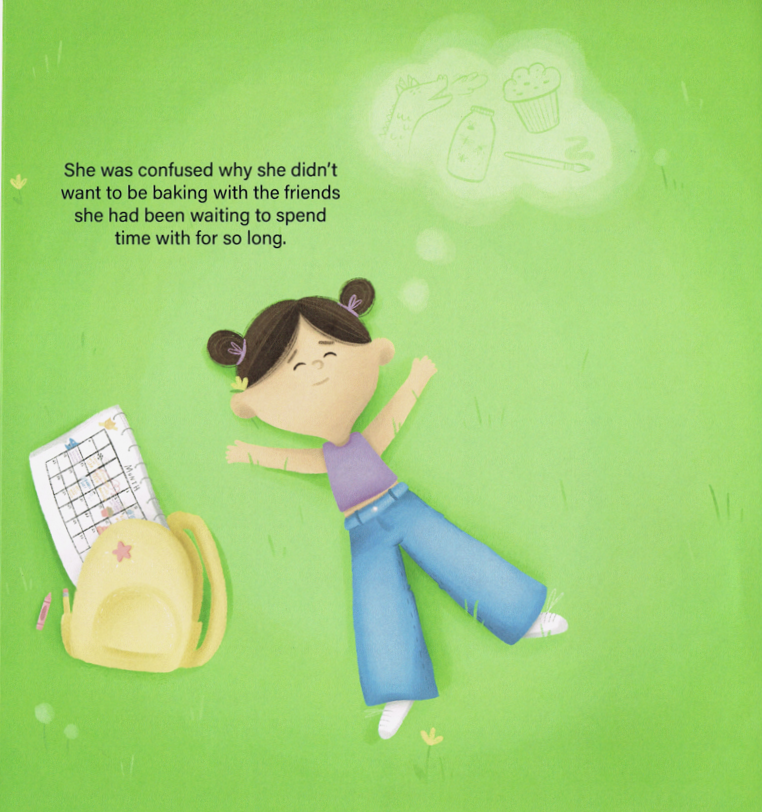
But, after weeks of playing on her own, Josie was officially lonely.
From Josie's Busy Calendar by Jenn Wint, illus. by Allison Arndt
But, then things open up again and Josie is able to return to school. The little girl is thrilled. Once she reconnects with her friends, she is filling her calendar with play dates for soccer and baking, riding bikes and swimming. But, like anything, too much of a good thing can be just as onerous, and Josie finds that "her tummy was in knots" though she doesn't understand why.
From Josie's Busy Calendar by Jenn Wint, illus. by Allison Arndt
Realizing that she misses her alone time, Josie schedules herself into that calendar and finds that a balance of commitments to others and herself is what makes her feel calm enough to do it all.
From Josie's Busy Calendar by Jenn Wint, illus. by Allison Arndt
Vancouver's Jenn Wint knows that, like adults such as herself, children experience anxiety but probably don't understand it, and coming out of this pandemic–fingers crossed–there will be many children who have and will experience anxiety to some degree. After years of restricted social activities–a source of anxiety for some–many children will go overboard and want to do everything: sports, music, play, etc. But, if Josie’s Busy Calendar teaches us anything it’s that there is always a limit. Too little opportunity for interaction and activity is just as bad as too much. Down time is also important. In fact, for many, it’s the only means by which they can recharge to do those activities in the first place. 
From Josie's Busy Calendar by Jenn Wint, illus. by Allison Arndt
With Allison Arndt's whimsical illustrations, Josie comes across as a typical child whose life is filled with people and activities but who has learned to appreciate quiet time, whether it's for reflection, for the clean fun of bubble baths or creating art. So, for your children and your students, consider that busy calendar as a potential source of both fatigue and fun and schedule in some time for quiet, whether to look inward with self-reflection or to daydream about what could be.

February 04, 2022

Valley of the Rats: Interview with author Mahtab Narsimhan

Valley of the Rats
Written by Mahtab Narsimhan
DCB
978-1-77086-628-7
232 pp.
Ages 9-12
September 2021 
Reviewed here
 
This week I had the privilege of interviewing 
author Mahtab Narsimhan about her 
most recent middle-grade novel, Valley of the Rats
for the Ontario Library Association's Superconference. 
Because that interview could only be attended 
by conference delegates, I am posting that essential Q & A here.  
Enjoy!

Author Mahtab Narsimhan
 

Helen Kubiw:   The setting of Valley of the Rats is both a little creepy and a whole lot of fascinating. Is the actual valley a myth, a reality or a figment of your imagination?

Mahtab Narsimhan:  The valley and village of Imdur is pure imagination but the roots of it lie in fact, as is often the case with storytellers. I saw a National Geographic documentary on YouTube about the Karni Mata temple in Rajasthan which houses 20,000 rats. They’re revered instead of reviled and that fascinated and horrified me.

I’ve lived in the city for most of my life and recently moved to a rural community. There’s a lot here that scares me. Grass snakes, geckos, frogs and mice…basically anything that creeps, crawls, or flies. The best stories are where you’ve channeled your fear into words and so was born…Valley of the Rats.


HK:  I think one of the strengths of your books is that you showcase cultures and places with which all young readers might not be familiar. You definitely do this in Valley of the Rats both with Krish’s family and the village of Imdur. What do you think the benefits are of exposing children to different cultures?

Mahtab Narsimhan:  Thank you, Helen, I try. It’s important for children to be exposed, at an early age, to literature which serves not only as a mirror but as a window or a sliding door. It creates empathy and acceptance of the Other. I can only hope that in the future this word (Other) is extinct and that no one notices differences between people and cultures, only similarities.   


HK:    Have you ever had to deal with rats, individually as a pet or on a larger scale, like an infestation. If so, when and where, and how did you cope?

Mahtab Narsimhan:  True Story: While I was editing Valley of the Rats, a tiny mouse found its way indoors. I discovered it, shivering with fright on the steps leading down to my office, at 5.30am which is when I write. I screamed for my husband to put it back outdoors. I wish I’d taken a picture to share with the students! My imagination is much larger (and braver!) than reality. I could never have lived through some of the stuff that I put my main character, Krish, through.

While growing up in Mumbai, I lived in an old neighbourhood which had rats the size of kittens. And during the monsoon season, they’d be out and about. If you recall, they even made an appearance in Mission Mumbai.


HK:   At its heart, Valley of the Rats is about survival: survival of a people abandoned by their government, and a young boy enduring challenging circumstances. What strategies of survival do you think kids could apply to their own lives to ease them through difficulties?

Mahtab Narsimhan:  Great question, Helen. I truly believe that each of us has the strength to deal with whatever comes our way. We need to believe in ourselves, dig deep for courage, and most important, ask for help when we need it. 

Krish is a germophobe but he’s trying to change and bond with his father, which is the reason he asked to go on this camping trip. Krish has always relied on his father to be the leader but when things go wrong, he knows it’s up to him to get them both out of this dangerous situation. By seeing the Other, more clearly, he learns to control his fear and take help from an unexpected source. (I’m being a bit vague here so as not to give spoilers for those who have yet to read the book).

What I hope readers will take away from this story is that no situation is hopeless. There is always a way out if you try hard enough and are willing to try something new. Don’t be afraid to ask for help. It’s not a sign of weakness but a sign of courage. You only fail if you stop trying.


HK:    Another theme of Valley of the Rats is conflict and all the kinds that kids learn about in school are present here: man vs. self, man vs. man, man vs. the environment, and even man vs. society. Which do you think drives the story most?

Mahtab Narsimhan:  Conflict is the engine that drives a story and one of the exercises I do when plotting is to list all the ways I can include conflict. I believe many types of conflict add depth and breadth to a story. They will work as long as they are well paced, and the reader has pockets of respite between the drama and the high-stakes action.


HK:   In addition to an action-filled plot, Valley of the Rats is very much a character study. First and foremost is Krish whose anxiety is almost crippling though he has found ways to cope, like using hand sanitizer constantly and chewing candies to calm. Why choose to have him deal with anxiety?

Mahtab Narsimhan:  These days, almost all of us have anxieties. Most of us have learned to cope with them and carry on. I’m a bit of a germophobe myself and always worry about bathroom doorknobs and grocery cart handles, among other things I have to touch in public spaces. When I’m anxious, I chew gum to calm down. So, there’s a little bit of me in Krish.
 
Most readers invest time in reading a story because they care about a character and by the end of the story a character must change, must grow and/or learn something new. If the character is the same at the beginning and at the end, it leaves the reader dissatisfied and feeling as if they’ve wasted their time.   
 
I wanted to show character change and how better to show it in a story than to have a character hate something in the beginning and then accept it in the end. Or a person deathly afraid of something and then accepting of it at the end.
 
This change is part of my plotting process using the seven-point story structure. My method is to plot backward and write forward. With Krish, I knew the change I wanted in him by the end of the story, and so, he had to be the exact opposite, in the beginning. Once I have the beginning and the end, I plot the incidents in the middle which lead to that change. 


HK:   Because of Krish’s anxiety and his relationship with his father, the boy’s self-confidence is sadly lacking. In fact, he is always comparing himself to his cousin Anjali–as does his father–whom he sees as brave, outgoing and optimistic. What would you say to kids who feel bad about themselves when they compare themselves to others?

Mahtab Narsimhan:  I would say don’t. It’s easier said than done because even as adults we suffer from “comparinitis.” Unfortunately, this also starts with adults who constantly compare their kids to others (family or neighbours or school friends), instead of focusing on what their kids are good at and nurturing those qualities. 
 
To kids who feel bad about this comparison, I would say:
  • Find the things you’re really good at and appreciate those qualities.
  • Write down a list of goals you’d like to achieve. This could be for a day, a week, a month or a year.
  • At the end of that period see how far along you’ve come. If you’ve achieved those goals, celebrate. If not, see what else you could have done to make them happen.
  • Above all, try. You only fail if you stop trying. (As you can tell, this is my own mantra).
It truly is a matter of mindset! I love this quote by Thomas Edison, one of the most successful innovators in American history. “I have not failed 10,000 times—I’ve successfully found 10,000 ways that will not work.”


HK:   Early in the book, Krish recalls a bit of wisdom from his dad: “Argue for your limitations and they’re yours.” How would you explain this to kids?

Mahtab Narsimhan:  If you constantly tell people why you cannot do something, or why you’re bad at it, you start believing it yourself and you will continue to be bad at that activity. It’s a self-fulfilling prophecy. You believe it and therefore you don’t try hard enough and hence you fail at it. 
 
Instead, if you tell yourself that you’ll get better at something with practice, that’s what you will do. You’re no longer making excuses for why you’re bad at something, you’re trying hard to get better at it. And practice always makes you better. 
 
Great example: I hate math and for the longest time I’ve told anyone who’ll listen that I get an allergy when I do math, I’m so bad at it, etc. Since I had a ready made excuse, I didn’t try to do well and I continued to do badly. 
 
Fast forward to the present when I have to run my own business and now I have to be good at numbers to make sure I’m doing it right. I stopped making excuses, learned what I had to, and asked for help when I needed it. I no longer say I’m bad at math or numbers. I just tell myself I’m getting better at it each day.


HK:    If there is one character whom I liked the least, it would have to be Krish’s dad. He’s willing to lie and be deceitful just to get what he needs and wants. Then he tells Krish he expects him to keep his word and doesn’t do so himself. Not only does he deceive his son, he is especially disrespectful of the people of Imdur who had rescued them. Worse yet, he acts like Krish is a disappointment to him. Though this is really his dad’s issue, Krish has to find a way to deal with a less than honourable dad whom he struggles to please. What advice do you have for kids on dealing with parents who are less than we expect of them? 

Mahtab Narsimhan:  In Indian culture we’re taught to always respect our elders. That they’re always right. In this particular instance, Krish’s Dad was a perfect character to showcase that sometimes adults make the wrong decisions too. That is the time to follow your own instincts and do what is right. If you believe it’s the right path, others will follow. When Krish finally took charge of the situation and told his Dad how the plan would go, his Dad not only followed but was proud of him. Krish managed to do all this without being disrespectful and standing his ground. This is what I hope readers can do too. Kids have very little agency in life, but they have their beliefs and a sense of right and wrong. If they hold on to it, others will have no choice but to follow. 


HK:    Though I don’t want to give too much away, there is a supernatural element to the story. Why did you add this? Also, do you believe in the supernatural?

Mahtab Narsimhan:  I love the fantasy genre. Adding a supernatural element was fun and it added another layer to the story.

I, personally, don’t believe in the supernatural though ghost stories, the occult, etc have always fascinated me and they’re great reads. In fact, I’ll be releasing a trilogy this spring which can best be described as Goosebumps meets Asian Mythology and the third novel in the series is called POSSESSED: The Ouija Board.


HK:    You’ve written picture books, early readers, middle-grade and young adult novels. I think your middle-grade novels, whether for younger readers (ages 8-12) or older ones (10-14), are especially well-received, as was The Third Eye which won the Silver Birch Award of the Forest of Reading. Do enjoy writing middle-grade fiction?

Mahtab Narsimhan:  It’s my absolute favourite age-group to write for. I'm currently working on another middle-grade trilogy set on Mars. Wish me luck because it’s one setting I will need to research online rather than visiting.

🐀🐀🐀

It was a wonderful interview 
and lovely to chat with Mahtab Narsimhan.
 
Many thanks to Mahtab Narsimhan 
for the pleasure of this interview 
 
and to Chantelle Cho, Sales & Marketing Assistant 
at Cormorant Books/DCB, for facilitating this event.

🐀🐀🐀

The video of this interview is now available at Mahtab Narsimhan's channel at https://youtu.be/Y_rIDTmiXDE.