Showing posts with label Mahtab Narsimhan. Show all posts

February 04, 2022

Valley of the Rats: Interview with author Mahtab Narsimhan

Valley of the Rats
Written by Mahtab Narsimhan
DCB
978-1-77086-628-7
232 pp.
Ages 9-12
September 2021 
Reviewed here
 
This week I had the privilege of interviewing 
author Mahtab Narsimhan about her 
most recent middle-grade novel, Valley of the Rats
for the Ontario Library Association's Superconference. 
Because that interview could only be attended 
by conference delegates, I am posting that essential Q & A here.  
Enjoy!

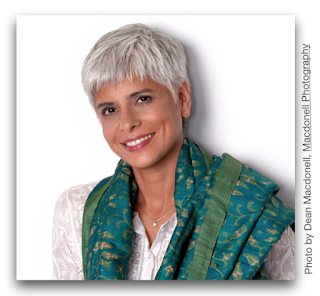
Author Mahtab Narsimhan
 

Helen Kubiw:   The setting of Valley of the Rats is both a little creepy and a whole lot of fascinating. Is the actual valley a myth, a reality or a figment of your imagination?

Mahtab Narsimhan:  The valley and village of Imdur is pure imagination but the roots of it lie in fact, as is often the case with storytellers. I saw a National Geographic documentary on YouTube about the Karni Mata temple in Rajasthan which houses 20,000 rats. They’re revered instead of reviled and that fascinated and horrified me.

I’ve lived in the city for most of my life and recently moved to a rural community. There’s a lot here that scares me. Grass snakes, geckos, frogs and mice…basically anything that creeps, crawls, or flies. The best stories are where you’ve channeled your fear into words and so was born…Valley of the Rats.


HK:  I think one of the strengths of your books is that you showcase cultures and places with which all young readers might not be familiar. You definitely do this in Valley of the Rats both with Krish’s family and the village of Imdur. What do you think the benefits are of exposing children to different cultures?

Mahtab Narsimhan:  Thank you, Helen, I try. It’s important for children to be exposed, at an early age, to literature which serves not only as a mirror but as a window or a sliding door. It creates empathy and acceptance of the Other. I can only hope that in the future this word (Other) is extinct and that no one notices differences between people and cultures, only similarities.   


HK:    Have you ever had to deal with rats, individually as a pet or on a larger scale, like an infestation. If so, when and where, and how did you cope?

Mahtab Narsimhan:  True Story: While I was editing Valley of the Rats, a tiny mouse found its way indoors. I discovered it, shivering with fright on the steps leading down to my office, at 5.30am which is when I write. I screamed for my husband to put it back outdoors. I wish I’d taken a picture to share with the students! My imagination is much larger (and braver!) than reality. I could never have lived through some of the stuff that I put my main character, Krish, through.

While growing up in Mumbai, I lived in an old neighbourhood which had rats the size of kittens. And during the monsoon season, they’d be out and about. If you recall, they even made an appearance in Mission Mumbai.


HK:   At its heart, Valley of the Rats is about survival: survival of a people abandoned by their government, and a young boy enduring challenging circumstances. What strategies of survival do you think kids could apply to their own lives to ease them through difficulties?

Mahtab Narsimhan:  Great question, Helen. I truly believe that each of us has the strength to deal with whatever comes our way. We need to believe in ourselves, dig deep for courage, and most important, ask for help when we need it. 

Krish is a germophobe but he’s trying to change and bond with his father, which is the reason he asked to go on this camping trip. Krish has always relied on his father to be the leader but when things go wrong, he knows it’s up to him to get them both out of this dangerous situation. By seeing the Other, more clearly, he learns to control his fear and take help from an unexpected source. (I’m being a bit vague here so as not to give spoilers for those who have yet to read the book).

What I hope readers will take away from this story is that no situation is hopeless. There is always a way out if you try hard enough and are willing to try something new. Don’t be afraid to ask for help. It’s not a sign of weakness but a sign of courage. You only fail if you stop trying.


HK:    Another theme of Valley of the Rats is conflict and all the kinds that kids learn about in school are present here: man vs. self, man vs. man, man vs. the environment, and even man vs. society. Which do you think drives the story most?

Mahtab Narsimhan:  Conflict is the engine that drives a story and one of the exercises I do when plotting is to list all the ways I can include conflict. I believe many types of conflict add depth and breadth to a story. They will work as long as they are well paced, and the reader has pockets of respite between the drama and the high-stakes action.


HK:   In addition to an action-filled plot, Valley of the Rats is very much a character study. First and foremost is Krish whose anxiety is almost crippling though he has found ways to cope, like using hand sanitizer constantly and chewing candies to calm. Why choose to have him deal with anxiety?

Mahtab Narsimhan:  These days, almost all of us have anxieties. Most of us have learned to cope with them and carry on. I’m a bit of a germophobe myself and always worry about bathroom doorknobs and grocery cart handles, among other things I have to touch in public spaces. When I’m anxious, I chew gum to calm down. So, there’s a little bit of me in Krish.
 
Most readers invest time in reading a story because they care about a character and by the end of the story a character must change, must grow and/or learn something new. If the character is the same at the beginning and at the end, it leaves the reader dissatisfied and feeling as if they’ve wasted their time.   
 
I wanted to show character change and how better to show it in a story than to have a character hate something in the beginning and then accept it in the end. Or a person deathly afraid of something and then accepting of it at the end.
 
This change is part of my plotting process using the seven-point story structure. My method is to plot backward and write forward. With Krish, I knew the change I wanted in him by the end of the story, and so, he had to be the exact opposite, in the beginning. Once I have the beginning and the end, I plot the incidents in the middle which lead to that change. 


HK:   Because of Krish’s anxiety and his relationship with his father, the boy’s self-confidence is sadly lacking. In fact, he is always comparing himself to his cousin Anjali–as does his father–whom he sees as brave, outgoing and optimistic. What would you say to kids who feel bad about themselves when they compare themselves to others?

Mahtab Narsimhan:  I would say don’t. It’s easier said than done because even as adults we suffer from “comparinitis.” Unfortunately, this also starts with adults who constantly compare their kids to others (family or neighbours or school friends), instead of focusing on what their kids are good at and nurturing those qualities. 
 
To kids who feel bad about this comparison, I would say:
  • Find the things you’re really good at and appreciate those qualities.
  • Write down a list of goals you’d like to achieve. This could be for a day, a week, a month or a year.
  • At the end of that period see how far along you’ve come. If you’ve achieved those goals, celebrate. If not, see what else you could have done to make them happen.
  • Above all, try. You only fail if you stop trying. (As you can tell, this is my own mantra).
It truly is a matter of mindset! I love this quote by Thomas Edison, one of the most successful innovators in American history. “I have not failed 10,000 times—I’ve successfully found 10,000 ways that will not work.”


HK:   Early in the book, Krish recalls a bit of wisdom from his dad: “Argue for your limitations and they’re yours.” How would you explain this to kids?

Mahtab Narsimhan:  If you constantly tell people why you cannot do something, or why you’re bad at it, you start believing it yourself and you will continue to be bad at that activity. It’s a self-fulfilling prophecy. You believe it and therefore you don’t try hard enough and hence you fail at it. 
 
Instead, if you tell yourself that you’ll get better at something with practice, that’s what you will do. You’re no longer making excuses for why you’re bad at something, you’re trying hard to get better at it. And practice always makes you better. 
 
Great example: I hate math and for the longest time I’ve told anyone who’ll listen that I get an allergy when I do math, I’m so bad at it, etc. Since I had a ready made excuse, I didn’t try to do well and I continued to do badly. 
 
Fast forward to the present when I have to run my own business and now I have to be good at numbers to make sure I’m doing it right. I stopped making excuses, learned what I had to, and asked for help when I needed it. I no longer say I’m bad at math or numbers. I just tell myself I’m getting better at it each day.


HK:    If there is one character whom I liked the least, it would have to be Krish’s dad. He’s willing to lie and be deceitful just to get what he needs and wants. Then he tells Krish he expects him to keep his word and doesn’t do so himself. Not only does he deceive his son, he is especially disrespectful of the people of Imdur who had rescued them. Worse yet, he acts like Krish is a disappointment to him. Though this is really his dad’s issue, Krish has to find a way to deal with a less than honourable dad whom he struggles to please. What advice do you have for kids on dealing with parents who are less than we expect of them? 

Mahtab Narsimhan:  In Indian culture we’re taught to always respect our elders. That they’re always right. In this particular instance, Krish’s Dad was a perfect character to showcase that sometimes adults make the wrong decisions too. That is the time to follow your own instincts and do what is right. If you believe it’s the right path, others will follow. When Krish finally took charge of the situation and told his Dad how the plan would go, his Dad not only followed but was proud of him. Krish managed to do all this without being disrespectful and standing his ground. This is what I hope readers can do too. Kids have very little agency in life, but they have their beliefs and a sense of right and wrong. If they hold on to it, others will have no choice but to follow. 


HK:    Though I don’t want to give too much away, there is a supernatural element to the story. Why did you add this? Also, do you believe in the supernatural?

Mahtab Narsimhan:  I love the fantasy genre. Adding a supernatural element was fun and it added another layer to the story.

I, personally, don’t believe in the supernatural though ghost stories, the occult, etc have always fascinated me and they’re great reads. In fact, I’ll be releasing a trilogy this spring which can best be described as Goosebumps meets Asian Mythology and the third novel in the series is called POSSESSED: The Ouija Board.


HK:    You’ve written picture books, early readers, middle-grade and young adult novels. I think your middle-grade novels, whether for younger readers (ages 8-12) or older ones (10-14), are especially well-received, as was The Third Eye which won the Silver Birch Award of the Forest of Reading. Do enjoy writing middle-grade fiction?

Mahtab Narsimhan:  It’s my absolute favourite age-group to write for. I'm currently working on another middle-grade trilogy set on Mars. Wish me luck because it’s one setting I will need to research online rather than visiting.

🐀🐀🐀

It was a wonderful interview 
and lovely to chat with Mahtab Narsimhan.
 
Many thanks to Mahtab Narsimhan 
for the pleasure of this interview 
 
and to Chantelle Cho, Sales & Marketing Assistant 
at Cormorant Books/DCB, for facilitating this event.

🐀🐀🐀

The video of this interview is now available at Mahtab Narsimhan's channel at https://youtu.be/Y_rIDTmiXDE.

September 17, 2021

Valley of the Rats

Written by Mahtab Narsimhan
DCB
978-1-77086-628-7
232 pp.
Ages 9-12
September 2021
Twelve-year-old Krish Roy has taken himself out of his comfort zone of the indoors, books and cleanliness when he suggests (or perhaps agrees) to an outdoor camping trip with his nature photographer father. Always cognizant of what a disappointment he is to his father who holds Krish's cousin Anjali as an example of how he wishes Krish would be i.e., optimistic, adventurous, outdoorsy, Krish is determined to bond with his dad, even if he has to arm himself with plenty of hand-sanitizer and candies to calm him.

But from the onset, everything seems to go wrong. In the bamboo forests of the Ladakh Range (India), their GPS gets busted and they get lost, they can't get a cell signal, Krish loses his pocket hand sanitizer, a thunderstorm hits and there are rats. Oh, there are rats, and plenty of them. Hopeful that the rats will lead them to people, Krish and his Dad follow them to a village of huts. There they are given shelter by the villagers of Imdur but warned not to leave their guest house or wander the village. In fact, they are adamant that Dad cannot take photos as they do not want people knowing of them.

However, Krish learns soon enough that this camping trip is actually an assignment Kabir Roy has undertaken, hopeful of a blockbuster photo story about a rumoured village of rat worshippers. But all Krish wants to do is fix their radio and get out of Imdur, a community rife with rats and unhygienic conditions. As Krish and his father both try to meet their own needs, the villagers of Imdur, lead by the shaman Imma and her daughter Tashi, try to maintain their secretive community. With a clash of cultures, between father and son, and the reclusive Imdur and those beyond its borders, there may be no happy ending here.

Each time Mahtab Narsimhan takes us into India as she did in several of her earlier middle-grade novels, including her Silver Birch award-winning The Third Eye (2007), The Tiffin (2011) and Mission Mumbai (2016), she drops us into cultures resplendent in myths, food, celebrations, and even superstitions. In Valley of the Rats, she again takes us into a world that is different and even surreal (there is an element of the fantastic in Imdur) and makes it credible. Because Mahtab Narsimhan's fictional village of Imdur was founded after the ecological event called Mautam, there is plausibility to communities like it finding unusual means of survival. Whether or not there really is an Imdur, perhaps by a different name, Mahtab Narsimhan has taken us there, to live with these people who wear rat-skin coats and feed what we consider vermin as if they are their pets or deities. As such, readers should know that they will truly be entering the valley of the rats, and there are no shortage of the creatures.

Still, Valley of the Rats is about survival. It's about the villages of Imdur seeking to survive in a world that gave them famine and rats and no government help. And it's about Krish enduring incredible anxiety to make his father accept him as he is–imagine a germaphobe in a community of rats–and the two of them surviving their encounter with a community that has secreted itself away from the world. Survival by its very nature is precarious; if it was easy, it wouldn't be so uncertain. Who survives and how in Mahtab Narsimhan's story is yet another secret–the plot is rife with them–that will only be revealed in the climatic last few pages but it's worth the wild adventure that is Valley of the Rats.

March 21, 2016

Mission Mumbai: A Novel of Sacred Cows, Snakes, and Stolen Toilets

by Mahtab Narsimhan
Scholastic Press
978-0-545-74651-9
272 pp.
Ages 9-12
March 2016
Reviewed from advance reading copy

Dylan Moore, 12, has gone a long way to get away from the worries of his parents’ impending breakup in New York City after finagling an invitation to go to India for three weeks with best friend, Rohit Lal.  For Dylan, it’s all about the adventure, the new experiences, especially the food, and taking photographs, determined to win a National Geographic contest and show his dad that his hobby is a worthwhile endeavour.  Problem is that Rohit isn’t that keen on going back to India, having accustomed himself to the amenities of life in New York City, and his displeasure is evident in every interaction he has, most notably with his mother and his Bua (father’s sister) whom Dylan dubs Boa for her venomous attitude.  Sadly Rohit’s rudeness has Boa deciding that, since she has financed the family’s stay in the U.S. including Rohit’s schooling, Rohit needs some discipline and will remain to go to school in Mumbai.

Even with the boys’ worries, everything is thrilling, flavourful and photogenic for Dylan.
My life in New York was so predictable, and this was so exciting! It was almost like starring in my own Bollywood adventure. (pg. 28)
But Dylan is trying to balance being a good guest and being a supportive friend, while navigating a culture with which he is totally unfamiliar.   Not surprising, Dylan gets himself into quite a few scraps, not including a scandalous shooing of a sacred cow, a swim in sewage-polluted water, a bladder-stressed train ride, and getting them banned from a restaurant.  And Rohit, desperate for his mother to take him back to NYC asap, resents Dylan’s wanting to stay on and takes advantage of Dylan’s ignorance time and time again.

It’s adventure after adventure for the two boys, as they bicker their way through their holiday in India, each resenting their own family dynamics and envious of the other’s, not realizing how much they both have.  Their friendship is so honest and complex and simple and real that every reader will understand the ups and downs of it, all against the unique backdrop that is India.  Mahtab Narsimhan has demonstrated her ability to capture the essence of other cultures in multi-layered plots in her previous books which include the 2009 Silver Birch Fiction award-winning The Third Eye (Dundurn, 2007) and The Tiffin (Dancing Cat Books, 2011), reviewed here, but Mission Mumbai takes her writing into more humourous realms.  Think of the lightness of Gordon Korman’s books with the flavours of Rohinton Mistry for middle-grade readers.  It’s a dazzling combination of characters, atmosphere, plot and humour.
Kerosene lamps smoked, a temple bell at a roadside shrine tinkled, and the air was thick with smells–some good, some gross.  Rohit swore softly under his breath as the cab inched forward.  After being in the air-conditioned flat, the heat was borderline torture.  It was like being in a malfunctioning steam room with the temperature stuck on “cook”.  My face was burning witht the heat and probably beet red. (pg. 48)
Whether a young reader is like Dylan, new to Indian culture, or Rohit, for whom the culture is familiar, Mission Mumbai will engage, enthrall and entertain.  And I haven’t even mentioned the monsoon, the wedding, the fire at the theatre, the wise old woman who gives them shelter, the heat, the scooties, and the glorious food!  So much to delve into and it’s all sweet and savoury and spicy and wholesome.

November 29, 2011

The Tiffin

by Mahtab Narsimhan
Dancing Cat Books
978-1-77086-039-1
190 pp.
Ages 9-12
2011

Twelve-year-old Kunal cannot remember a time when he didn’t live with Sethji and Mrs. Seth and work tirelessly as a waiter and delivery boy for their dhaba (roadside restaurant) in Mumbai. Reminded constantly by the abusive Sethji that Kunal is an orphan and should be thankful for the life they have given him, Kunal can find little support to help him deal with the menacing, new cook, Badri, abusive customers, frightening beggars or thieving gangs. When Kunal’s attempt at stealing money for his escape is thwarted and his sale to the Beggar King, Abdullah, is imminent, Mrs. Seth provides him with some money and information about his mother before he escapes with Vinayak, the kindly old dabbawalla (deliverer of the boxed lunches known as tiffins).

From the introductory chapter to the story, the reader learns that thirteen years earlier, a young woman named Anahita had sent a message hidden in a tiffin to her lover, Anurag. That tiffin had the auspicious distinction of being the one in six million tiffins that does not reach its destination. The reader will recognize soon enough that this is the cause of Kunal's fate. From what Mrs. Seth shares with Kunal just before his escape, it is a fate that Kunal is determined to correct by locating his mother. And his relationship with the dabbawallas is critical to his search.

Mahtab Narsimhan’s story reads as a junior version of any Rohinton Mistry book set in India: the colours and textures, as well as the smells, both fragrant and pongy, are fundamental to scaffolding the characters and their stories. Narsimhan chooses her palettes carefully: for Sethji’s fetid dhaba, for the cacophony at Andheri Station (from which trains are used to deliver the tiffins), and for the drenching monsoon rains. Narsimhan’s powerful writing bares the despair of Kunal and others, and is sure to have emotional impact; fortunately, the reader will intuit a kernel of hope in Kunal’s story which will at least ease the overriding bleakness.