Showing posts with label courage. Show all posts

January 04, 2026

How to Be Brave Like a Snail

Written by Naseem Hrab
Illustrated by Kelly Collier
Owlkids Books
978-1-77147-672-0
40 pp.
Ages 4–7
October 2025 
 
Naseem Hrab's Snail has taught young readers a lot, but mostly he has taught them to appreciate the ways of the vulnerable and how to fit in with his self-confident friends. And now the little gastropod is looking to face his fears and be courageous.
From How to Be Brave Like a Snail, written by Naseem Hrab, illustrated by Kelly Collier
Snail recognizes that there are some things that demonstrate his bravery. He's not afraid of all loud noises or of taking a tour of his backyard or of lullaby karaoke. What he does have a hard time with is asking for help, making mistakes, and believing in himself. When his friends begin planning to participate in a paper airplane contest, he can't bear the thought of losing. Knowing how deeply Snail feels, his friend Stump offers to help him with making the creases and with practising. 
From How to Be Brave Like a Snail, written by Naseem Hrab, illustrated by Kelly Collier
Both Snail and Stump participate in the contest, and, though it isn't clear who won, Snail is given a ribbon for the neatest creases. He's delighted. But Stump, who gets no recognition, is overwhelmed with prickly feelings. With Snail's help and a clever paper plane idea, Stump is able to accept his feelings and dealing with them in a constructive way.
 
I've always liked the ways of Snail and Stump. They are unassuming and thoughtful. They are neither loud nor self-absorbed, insolent nor self-important. They are true friends to each other and accepting of others, even if they don't want to be like them. They are good. But being true to yourself sometimes means acknowledging your vulnerabilities and finding your own ways to cope. Both Snail and Stump have feelings that threaten to stop them from doing or feeling. So they could overcome those emotions or accept them. Through their friendship and concern for each other, they are able to accept and overcome them.
From How to Be Brave Like a Snail, written by Naseem Hrab, illustrated by Kelly Collier
This is a sensitive issue for many children, especially those who are on the quiet side and more apt to feel vulnerable compared to their stronger and more boisterous peers. They tend to be overlooked and even discount themselves. I like that Naseem Hrab, author of a wonderful collection of picture books like Ira Crumb Feel the Feelings (2018), Weekend Dad (2020), and Otis & Peanut (2023), has more than acknowledged these children. She has given them a voice to share those vulnerabilities and even a novel coping strategy to help disperse them. (The "Classroom Discussion and Activity Guide" at Owlkids Books offers more help to do so with young readers.) 
 
As with the earlier two Snail and Stump books, the illustrations were created by Kelly Collier, the author-illustrator of books like A Horse Named Steve (2017) and The Imposter (2023). All Kelly Collier's characters, from Snail and Stump to Bear, Rabbit, and Rabbit, are easily recognizable though she adds playfulness to their looks. Whether it's Snail's eyebrows, that help him show emotions, or the way Stump covers his eyes with his twig arms when he cries, Kelly Collier has made them and their emotions recognizable and natural.
 
Feelings are very big things. Whether it's fear or anger, disappointment or sadness, they can overwhelm. Dealing with those big feelings when you're little can seem impossible. But, with a quick read of How to Be Brave Like a Snail (and maybe How to Party Like a Snail [2022] and How to Staycation Like a Snail [2024]), and undertaking a creative paper plane activity, those challenging feelings can be kept in check so they don't overwhelm or sabotage the good ones.


How to Party Like a Snail (2022)
How to Be Brave Like a Snail (2025)


October 17, 2024

Milo the Knight

Written by Grégoire Laforce
Illustrated by Charlotte Parent
Milky Way Picture Books
978-1-990252-35-8
48 pp.
Ages 4-8
October 2024
 
Milo is a brave knight who comes from a long line of knights. His armor means everything to him, and he is proud to wear it. And he always wears it just in case a dragon attacks their colony. Those silly jesters could waste their time on frivolous activities, but Milo is determined to keep everyone safe from the bad out there.
From Milo the Knight, written by Grégoire Laforce, illustrated by Charlotte Parent
One day while outside the castle walls, Milo is caught in a horrific rainstorm. It goes on and on, raining and raining, and Milo keeps going. It's only when the rain stops, and Milo is still struggling to keep going that he realizes that his beautiful armor has rusted until it seizes completely.
From Milo the Knight, written by Grégoire Laforce, illustrated by Charlotte Parent
A wandering jester offers Milo help, but he initially refuses. After all, he is a knight and not a silly jester. But the jester suggests that the only way to help Milo is for Milo to remove his armor. Even though he is both shocked to consider this and fearful of not being able to protect the colony–something which he already could not do–Milo opens his visor, looks into the jester's eyes and is moved to tears.
From Milo the Knight, written by Grégoire Laforce, illustrated by Charlotte Parent
But the armor does not survive, falling into useless pieces, while Milo emerges for the first time to feel the warmth of the sun and the stirring of the wind. By shedding his armor, Milo also sheds his fears and his mistrust.
 
Gatineau's Grégoire Laforce, former military, seems to have something to say about the roles we play in a community, from the protectors to the entertainers. No one is only one thing. And to restrict yourself by putting on a shield of armor that keeps you separate from others and from experiencing a life that is full and varied can be harmful. Milo only knew about being a knight, as did his ancestors. He didn't know otherwise. It was only the jester with his own perspective and suggestion that Milo remove his armor–an armor that was doing him harm at that point–that Milo becomes open to another life. Perhaps this was Grégoire Laforce's experience too, going from the military life of service and security to having kitchen parties with his family at home, as his bio reveals. It probably wasn't as easy as just removing a uniform but, as with Milo and the jester, a little outlook can bring big change.
From Milo the Knight, written by Grégoire Laforce, illustrated by Charlotte Parent
Montreal artist Charlotte Parent, who illustrated Mireille Messier's The Magic Cap, uses coloured pencils to give Milo the Knight both a bright contemporary feel as well as a medieval tone appropriate for a story about a knight. Her use of colour that range from pinks and purples to oranges and greens keeps the story light and bright as do the patterns she uses to decorate borders with floral motifs and scenes of activity. Milo the Knight could've been a darker tale of perceived fears and wariness of others and even injury, but Charlotte Parent makes it a story of revelation through her radiant colours and emotive lines and shapes.

Milo the Knight thought his life had been determined and he would serve as he had been born to do so but a change in circumstance and an openness to see beyond the obvious gives him the opportunity for more in his life. His service was admirable, but it was time to live for himself and enjoy that which he'd never experienced before. Whether he becomes Milo the Jester or Milo the Vagabond or something else entirely, he's taken off his armor and left himself free and receptive to more possibilities.
 

September 18, 2024

The Hawk Shadow

Written by Jan Bourdeau Waboose
Illustrated by Karlene Harvey
Kids Can Press
978-1-5253-1084
32 pp.
Ages 4-7
September 2024
 

When Serenity's older brother, Big Ed, decides to go fishing with his shiny new store-bought rod, she tags along with the hand-made one of spruce and moose sinew that her father has given her. But, though Big Ed is focused on the fishing he will do, Serenity's focus is elsewhere.
From The Hawk Shadow, written by Jan Bourdeau Waboose, illustrated by Karlene Harvey
As the two head out along Big Ed's fishing path to the river, Serenity revels in all the wonders of the natural world, from the sun and the singing robin, to a raven and some chokecherries. Big Ed may walk faster than Serenity but, even as she dawdles, he watches out for her. He also teaches her about their cultural beliefs from why the river is called Hawk River, the value of the cedar tree, and more.
From The Hawk Shadow, written by Jan Bourdeau Waboose, illustrated by Karlene Harvey
But when they start fishing and Serenity is distracted by a Red-Tailed Hawk that circles around her, and then leaves and returns, she realizes that he wants her to follow him. Fortunately, she does and finds that a little sister's help is needed.
From The Hawk Shadow, written by Jan Bourdeau Waboose, illustrated by Karlene Harvey
It's always a treat to read a Jan Bourdeau Waboose picture book. It's been far too long since her The Spirit Trackers (illustrated by François Thisdale) and it's lovely to revisit a sibling relationship that is embedded in an Indigenous community. The Hawk Shadow may be considered an Indigenous story–Jan Bourdeau Waboose is First Nation Anishinaabe of the Ojibway Bear Clan–but it also speaks to the interactions of an older brother and younger sister, an appreciation for the natural world, and a mindfulness to it and the messages within. Serenity is like her brother's shadow, following him, listening to his teachings, asking him questions, and ultimately freeing him from a dangerous situation. If she hadn't been mindful of him and of her surroundings, including listening to the Hawk, the siblings' outing may have had a far worse outcome. Jan Bourdeau Waboose shows us that even though  Serenity is watching and listening to everything around her, and is ostensibly distracted from her brother's words and quicker step, she is fully engaged. It's a lesson in being wholly present in place and with people.

Karlene Harvey, who has illustrated several other picture books including Melanie Florence's Kaiah's Garden, is a Tsilhqot'in and Syilx illustrator who respects the Indigenous basis for the story without highlighting any of the major styles such as the Woodland Style.  The realism of the Hawk's morphology is blended with the bold and the bright of the characters as they journey and fish but Karlene Harvey still adds light touches to remind readers of the community from which Big Ed and Serenity were born. In addition to the glorious end papers of beaded flowers, there's Big Ed's beaded bear paw medallion necklace and the bead work on Serenity's collar.
From The Hawk Shadow, written by Jan Bourdeau Waboose, illustrated by Karlene Harvey
Here's to listening, seeing, and being a part of something, whether it be a sibling relationship, the natural world, or a community. There is always much to learn and appreciate, even from the shadows.

June 27, 2024

Storytime with Franklin: A Collection of Six Favorites

Written by Paulette Bourgeois
Illustrated by Brenda Clark
Kids Can Press
978-1-5253-1293-9
184 pp.
Ages 3–8
May 2024
 
The Franklin books in my school library were well worn, much loved and a favourite of young readers and their families and teachers for the lessons he learned. Now those books don't need to get worn so fast or misplaced with others because six have been amalgamated into a lovely collection in hardcover. Storytime with Franklin will become its own favourite.
From Storytime with Franklin, written by Paulette Bourgeois, illustrated by Brenda Clark
The six stories covered in Storytime with Franklin are:
  • Franklin in the Dark
  • Franklin Goes to School
  • Franklin's New Friend
  • Franklin Rides a Bike
  • Franklin Goes to the Hospital
  • Franklin Says I Love You
In the first story, Franklin is afraid of crawling into his small dark shell so he drags it behind himself. He learns that other animals, like a lion, a bird, a duck, and a polar bear, have their own fears. With the help of a nightlight, he can face his fear head on. 
From Storytime with Franklin, written by Paulette Bourgeois, illustrated by Brenda Clark
When Franklin is ready to go to school, he is excited but also nervous, especially when he worries that he can't do some of the things his friends can. But, that nervous tummy ache disappears when his teacher shows Franklin that he can do some wonderful things already and would learn new things.

Franklin's New Friend is a very timely story about meeting a new friend who is very different from you. When a moose family moves into the neighbourhood, Franklin is scared because they are all so big. And when Moose comes to school and the teacher buddies Franklin up with Moose, Franklin is relieved when Moose doesn't speak or play with them. Franklin must learn that just because Moose is big doesn't mean he's mean or scary. In fact, he learns that they have common grounds that would eventually make his new friend into a special friend.
From Storytime with Franklin, written by Paulette Bourgeois, illustrated by Brenda Clark
Riding a bicycle without training wheels is a big challenge for little ones, so many will understand Franklin's reluctance to go for bike rides with his friends who can already ride bikes without help. But realizing that they all had things they had to learn and struggle with, whether swimming or rollerblading or baseball, it encourages Franklin to persevere too.

Franklin Goes to the Hospital is a story written by author Sharon Jennings who has written numerous stories based on Paulette Bourgeois's character Franklin. In this story, Franklin must have an operation when he injures his shell during a game of soccer. While everyone tells him how brave he is, Franklin doesn't feel very brave. Kindly Dr. Bear reassures him that "Being brave means doing what you have to do, no matter how scared you feel." (p. 143)
From Storytime with Franklin, written by Paulette Bourgeois, illustrated by Brenda Clark
The final story in the collection, Franklin Says I Love You, has Franklin anxious about how he might show his mother how much he loves her as a birthday gift. But how could he do so without a fancy gift? 

Franklin the Turtle is highly recognizable both from his demeanor, his actions, and his appearance, and that's all courtesy of Paulette Bourgeois and illustrator Brenda Clark. Both have created an iconic character who has been adapted into several animated TV series and whose learning has been used as examples for parents and teachers worldwide. Though it's been almost 40 years since he first appeared in 1986, his stories are as fresh and necessary now as ever. That's because Paulette Bourgeois understands young children's fears and apprehensions and has written stories to alleviate or, at the very least, mitigate them. The stories encourage children who are fearful of the unknown, the unexpected, the embarrassing, and the mundane to see their fears from different perspectives and give themselves opportunities to resolve those issues with independence.
 
Brenda Clark's illustrations, some prepared here with assistance from other artists including Shelley Southern, Muriel Hughes Wood, and Dimitrije Kostic, have always been bold in colour and familiar in setting. Franklin and his friends may be animals but they are also children who draw and play, have friends and family, worry and wonder and love. They are the children who are reading these books.
 
It's lovely to visit with Franklin again and be reminded of the valuable lessons he shares through just being young and learning. Storytime with Franklin becomes a play date with a familiar friend: companionable, reassuring, enlightening, and always joyous.

November 14, 2022

Fly

Written by Alison Hughes
Kids Can Press
978-1-5253-0583-2
200 pp.
Ages 10-14
October 2022
 
...my body is not all that I am. (pg. 40)

Fly is what 14-year-old Felix Landon Yarrow (a.k.a. Fly per his initials) dreams of doing. In his dreams, he is no longer trapped in a wheelchair by cerebral palsy. He is free to spread his arms and soar.
            My disability,
                         my difficulties,
                                               my pain–
often on public display–
are
in fact
all my own.
                                       Private. (pg. 59)
But, Felix is in a wheelchair. And though he feels very much like his pain is often on public display, whether he is working with his aide Levi or being driven in the "special" school bus, he knows that he is invisible to many, especially his peers. Still, that invisibility becomes his superpower, with Felix becoming a "Fly on the Wall" and ready to emulate his literary guide, Cervantes's Don Quixote, and follow truth and justice. His quest: to save his classmate and damsel in distress, Daria, from the arrogant and dangerous Carter.

As Felix watches and learns, he becomes Knightwatch and emails warnings to Daria about Carter and to Carter that his heinous and potentially criminal behaviour has been observed. But, like Don Quixote, along with battles with enemies come inner battles of understanding of self. 

Fly, a novel in free verse, may have a contemporary setting but its story is as classic as that of Don Quixote. It's about finding inner strength and fighting against injustices. But author Alison Hughes makes sure the reader realizes that much of this is also about perception. Told in Felix's voice, the reader will sympathize with his constrained physical nature and applaud his courage to pursue chivalrous goals of protecting first Daria and then others from oppressors. Going after Carter gives Felix purpose, though he doesn't realize until the end that his manner of attack may leave others vulnerable. His goal is outward, to help others, but the learning he takes from his endeavour is all about him and what he needs to do to be fair. The growth that Felix experiences, moving from annoyance at how others judge and treat him to appreciation for efforts others make, is a monumental one. And Alison Hughes takes the readers along on that epic journey through her elegant free verse. The writing flows and has shape that comes with self-discovery, engagement with others and context of circumstances. Felix's story takes a form not unlike his own body, both vulnerable and combative, and we're there for the moment of battle, within and externally, when Felix realizes that some of the limitations to the freedom to fly may be those he's imposed on himself.

January 08, 2022

A Sky-Blue Bench

Written by Bahram Rahman
Illustrated by Peggy Collins
Pajama Press
978-1-77278-222-6
32 pp.
Ages 5-8
 November 2021
 
Bahram Rahman, author of The Library Bus (Pajama Press, 2020), returns the reader to Afghanistan and offers another hopeful tale of resilience and courage, creativity and endeavour.
From A Sky-Blue Bench by Bahram Rahman, illus. by Peggy Collins

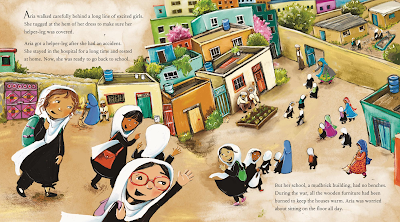
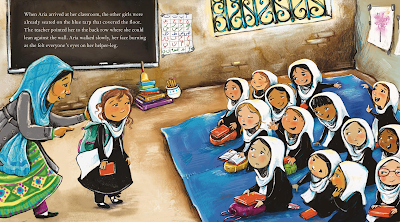
Aria is an Afghan girl with lovely new red shoes and a helper-leg that she got after an accident. (Bahram Rahman's appended notes talk of land mines and unexploded ordinance.) While she is eager to be returning to school after her lengthy hospitalization, Aria is apprehensive, especially as all the wooden school furniture has been destroyed for firewood and the children now sit with bent knees on a floor tarp, something she will be unable to do.

From A Sky-Blue Bench by Bahram Rahman, illus. by Peggy Collins
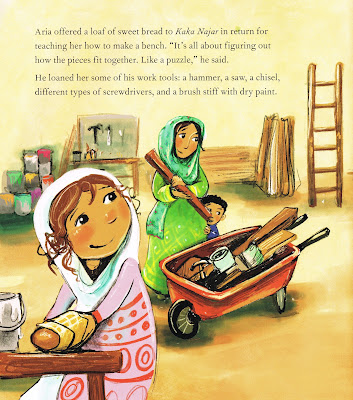
Aria contemplates not returning to school but rejects that idea and instead comes up with the "brave idea" to build herself a bench. Most of the girls laugh at her plan but Aria is determined and she and her lone friend scavenge the city for discarded wooden boards, broken pieces of furniture, and random nails and screws. Then, Aria and her mother visit a carpenter in the old city who, for the gift of a loaf of bread, loans her an assortment of tools and a can of sky-blue paint.
"Sky-blue is the color of courage, peace and," he tapped at his temple, "wisdom."
From A Sky-Blue Bench by Bahram Rahman, illus. by Peggy Collins
And so a bench is created, and with it an opportunity for Aria and the other girls to take control of their own schooling needs.

Though Bahram Rahman makes it clear from his notes about circumstances he and others experienced in his homeland of Afghanistan, he does not dwell on the horrors of land mines or the challenges of living with a civil war. Instead Bahram Rahman speaks to a girl's determination to get an education, be proactive and resourceful, and to challenge herself to meet her own needs. It's a brave commentary on focusing on what you can change, not on what you can't, and Aria demonstrates that the possibilities can be inspiring. 

While there is a brightness and a child-like quality to her art, Peggy Collins (Harley the Hero, 2021) stays firmly in realism, but without immersing her art in the adversity of the situation. Aria's prosthetic leg is barely visible under her black dress and the challenges of the civil war are obscured by the vibrancy of the community in its activity and colour. Peggy Collins takes us into the Afghanistan of Aria's life, not of news reports: her school, her helper-leg, her mother and little brother, and her community. Her sky-blue bench is as assured as she is.

A Sky-Blue Bench may be a story from Afghanistan but its lessons about self-reliance and resourcefulness will speak to all children, especially those facing their own challenges, and encourage them to find solutions. With a desire, some hard work and a little wisdom, Aria was able to build something worthwhile, with wood and with vision.

September 17, 2021

Valley of the Rats

Written by Mahtab Narsimhan
DCB
978-1-77086-628-7
232 pp.
Ages 9-12
September 2021

Twelve-year-old Krish Roy has taken himself out of his comfort zone of the indoors, books and cleanliness when he suggests (or perhaps agrees) to an outdoor camping trip with his nature photographer father. Always cognizant of what a disappointment he is to his father who holds Krish's cousin Anjali as an example of how he wishes Krish would be i.e., optimistic, adventurous, outdoorsy, Krish is determined to bond with his dad, even if he has to arm himself with plenty of hand-sanitizer and candies to calm him.

But from the onset, everything seems to go wrong. In the bamboo forests of the Ladakh Range (India), their GPS gets busted and they get lost, they can't get a cell signal, Krish loses his pocket hand sanitizer, a thunderstorm hits and there are rats. Oh, there are rats, and plenty of them. Hopeful that the rats will lead them to people, Krish and his Dad follow them to a village of huts. There they are given shelter by the villagers of Imdur but warned not to leave their guest house or wander the village. In fact, they are adamant that Dad cannot take photos as they do not want people knowing of them.

However, Krish learns soon enough that this camping trip is actually an assignment Kabir Roy has undertaken, hopeful of a blockbuster photo story about a rumoured village of rat worshippers. But all Krish wants to do is fix their radio and get out of Imdur, a community rife with rats and unhygienic conditions. As Krish and his father both try to meet their own needs, the villagers of Imdur, lead by the shaman Imma and her daughter Tashi, try to maintain their secretive community. With a clash of cultures, between father and son, and the reclusive Imdur and those beyond its borders, there may be no happy ending here.

Each time Mahtab Narsimhan takes us into India as she did in several of her earlier middle-grade novels, including her Silver Birch award-winning The Third Eye (2007), The Tiffin (2011) and Mission Mumbai (2016), she drops us into cultures resplendent in myths, food, celebrations, and even superstitions. In Valley of the Rats, she again takes us into a world that is different and even surreal (there is an element of the fantastic in Imdur) and makes it credible. Because Mahtab Narsimhan's fictional village of Imdur was founded after the ecological event called Mautam, there is plausibility to communities like it finding unusual means of survival. Whether or not there really is an Imdur, perhaps by a different name, Mahtab Narsimhan has taken us there, to live with these people who wear rat-skin coats and feed what we consider vermin as if they are their pets or deities. As such, readers should know that they will truly be entering the valley of the rats, and there are no shortage of the creatures.

Still, Valley of the Rats is about survival. It's about the villages of Imdur seeking to survive in a world that gave them famine and rats and no government help. And it's about Krish enduring incredible anxiety to make his father accept him as he is–imagine a germaphobe in a community of rats–and the two of them surviving their encounter with a community that has secreted itself away from the world. Survival by its very nature is precarious; if it was easy, it wouldn't be so uncertain. Who survives and how in Mahtab Narsimhan's story is yet another secret–the plot is rife with them–that will only be revealed in the climatic last few pages but it's worth the wild adventure that is Valley of the Rats.

June 21, 2021

Tough Like Mum

Written by Lana Button
Illustrated by Carmen Mok
Tundra Books
978-0-7352-6598-1
32 pp.
Ages 3-7
April 2021

Though her mum might not always feel very tough or that she is able to manage, Kim tries to emulate her, never admitting she needs help or acknowledging anything she might perceive as weakness. But can anyone really be tough all the time?
From Tough Like Mum by Lana Button, illus. by Carmen Mok

From Carmen Mok's gouache and coloured pencil illustrations, it is evident that Kim and her mother are financially strapped. They share a bed, their socks are unmatched, their clothes and furniture are patched, and the food in the house is minimal. It's no wonder that Kim awakens soothing herself with her thumb in her mouth. But Kim is a tough cookie, tough like her mum, and she gets herself ready for school, making her own breakfast and lunch, and even planning for dinner–"Tomato, you are my favorite soup. Sit right here and wait for me"–because her mom hasn't gotten out of bed this morning. But Kim has a form for school that is due that day, a form for a field trip that costs $6.00. How is she going to get Mum to sign it when she's still sleeping, attempting to shut out the world–"Don't start on me, Kim!"–and get the money she knows they don't have?

On that cold winter day, Kim gets herself off to school, though some parents question her about being without a hat. Kim just tells them she doesn't need it, and the parents call her tough like her mom Jen. Kim won't let anyone see that she's cold. Because she's learned not to ask for help. And at lunchtime when David makes fun of her sandwich, she stays tough, never letting them see how sad and mad she is on the inside. But there's still the problem of the school trip. 

She has tried to find a solution, submitting a few coins she'd found in her mom's pocket, hoping the teacher wouldn't notice. But Mrs. Jones does notice and suggests her mother check a certain box on the form. It may read "I can't pay" but Kim knows it really means "I need help" and that's a box her mum has never checked.

From Tough Like Mum by Lana Button, illus. by Carmen Mok
Accepting help is never easy, and it seems to be especially so for Jen and Kim.  But when Kim gets home from school, she finds a way to take care of her mother, sadly still in the clothes she slept in, with compassion, humour and courage. Asking and accepting help might not be easy but it can be worth it.
From Tough Like Mum by Lana Button, illus. by Carmen Mok

Though Lana Button's picture books, including Raj's Rule (For the Bathroom at School), What If Bunny's NOT a Bully, and Willow Finds a Way, are aimed at young children, they focus on some tough issues. There are worries that young children have that cloud their lives and can cause anxiety. Whether it's bullying or self-confidence, using the bathroom or an absent teacher, Lana Button understands that these are very big issues for children. But in Tough Like Mum, Lana Button demonstrates that the shame of poverty transcends age and manifests differently for young children and for their parents who try to provide their best. Kim wants to be tough about what money they don't have, or the food she eats, or the clothes she wears. She strives to be tough like her mum. But sometimes being tough means accepting that help is needed. Together Kim and her mum realize this.

Lana Button's honest story of a single mum and child living in poverty and struggling with the perceived disgrace of their circumstances is stark. There are moments of lightness, like when Kim is praised for her reading and then brings that joy to her mum with it, or when they snuggle together in bed. But it's a hard life for both and the illustrations by Carmen Mok reflect that sparseness of their lives. From a sparsely-furnished home, to the mismatched clothing and furniture, patched or damaged, theirs is an unadorned life, and the art depicts that. 
From Tough Like Mum by Lana Button, illus. by Carmen Mok

But Lana Button's message of having the courage to accept help is paramount. Asking for help is not weak, though many, including Kim, may feel that it is so, exposing their vulnerabilities. Perhaps Kim's mum has never checked that box before, managing to somehow scrape together needed funds or accepting that Kim would have to do without. But by acknowledging that they might need some help, they've taken a big step forward. That just proves how tough Kim and her mum truly are.
 
• • • • • • •

Check back tomorrow for my interview with author Lana Button about Tough Like Mum and her approach to writing this story.

May 25, 2021

Sugar Falls: A Residential School Story (10th Anniversary Edition)

Written by David A. Robertson
Illustrated by Scott B. Henderson
Colours by Donovan Yaciuk
HighWater Press
978-1-55379-975-7
48 pp.
Ages 14-18
May 2021 

In my family, silence has been the currency of injustice.
~ Senator Murray Sinclair, Foreword to Sugar Falls
 
Too many of the truths about injustices perpetrated against Indigenous peoples have been hidden, suppressed and ignored. With the original publication of Sugar Falls: A Residential School Story in 2011, some of those truths were told, based on the true story of Betty Ross, Elder at Cross Lake First Nation. Today with the release of this tenth anniversary edition of Sugar Falls, I hope even more readers are ready to hear those truths.
 
When a present-day class is given an assignment to look at the residential school system, with strict instructions to approach Elders with respect and an offering, Cree student April offers to introduce Daniel to her Kōkom, an Elder who survived it but whose story even April had not heard.
From Sugar Falls by David A. Robertson, illus. by Scott B. Henderson, colours by Donovan Yaciuk
April's Kōkom takes them into her round room "with all the sacred medicines and within the star blanket of the four directions" (pg. 4) where she would be safe. She prepares by wearing traditional attire, holding an eagle feather and doing a cleansing before she begins her story.

Abandoned at age five into the winter's cold by her own mother who had survived the residential school system, she is found and brought up as a daughter and sister in a loving family. A few years later, after he has a vision of darkness in her future, her father takes her to Sugar Falls where he teaches her to feel the beat of their hearts as drums in rhythm with that of the falls, and that "The beat of the drum represents the strengths of our relationships, between our ancestors, our traditions with Mother Earth, and with each other" (pg. 13) and that remembering this would keep her strong.
From Sugar Falls by David A. Robertson, illus. by Scott B. Henderson, colours by Donovan Yaciuk
Strength is what she will need when soon a grim priest comes and drags her away from that love and comfort to an ominously-large institution where Sister Marie scrubs at her skin and cuts her long hair. There Betsy meets Flora and begins an endless routine that includes prayer and chores and classes. Sadly there is also the abuse, a crack against the knuckles, a slap or a kick for speaking Cree, and the sexual abuse by the priest to whom the girls would close their minds and numb their bodies and pretend the visits were nightmares to be left in the night.

From Sugar Falls by David A. Robertson, illus. by Scott B. Henderson, colours by Donovan Yaciuk
Though Betsy can see across the water and envision home, she has made a promise to her father to be good and listen, so when Flora and a couple of other girls escape across the water, she remains behind. But Flora's death steels Betsy until one day "All I wanted to see was my family again, to wake up from the nightmare and have them by my side." (pg. 34) She walks into the water and remembers Sugar Falls. She is dragged back from the water but her resolve has returned and "no matter what they did to me, I held onto myself, my language and my spirit." (pg. 38)
 
From Sugar Falls by David A. Robertson, illus. by Scott B. Henderson, colours by Donovan Yaciuk
Betsy endured that place for several more years, and later attended high school in Winnipeg. She also changed her name to Betty to honour her friend Helen Betty Osborne who would be murdered.
I did it to keep her memory alive. My story, her story are stories that we should never forget, no matter who we are, they are important to all of us. (pg. 39)
Governor-General award-winning author David A. Robertson does so much in the telling of Sugar Falls. He honours Betty Ross by giving her story new life so that more will know of her courage and resilience and that of so many who endured and those who did not at the hands of a brutal system that never should have happened. Generations later, Indigenous people continue to live in the aftermath of that horrific injustice and with each story told, the silence is broken a little more, allowing an opportunity for justice to manifest.  By giving voice to Betty to speak of her past, from abandonment to loving family and residential school nightmare, and those of her granddaughter and non-Indigenous friend to hear her story from their own perspectives, David A. Robertson lets us see Betty as a survivor with heart, strength and compassion.

Because this is a graphic novel, less needs to be said in text and more can be carried by the artwork, and illustrator Scott B. Henderson and colourist Donovan Yaciuk take on their task with reverence and empathy. The despair of life at the residential school is clear in the starkness and gloom of the shapes, lines and colours of those scenes, with Scott B. Henderson and Donovan Yaciuk saving the brightness for outdoor scenes with family and the contemporary settings of school and Kōkom's home. It was clear where the lightness in Betty's life is, past and present.

Today, with the release of David A. Robertson's tenth anniversary edition of Sugar Falls, there is a new opportunity for the world to listen and see this story, to silence the silence and give survivors of the residential school system, both those who lived it and those whose legacy it is, a chance to tell their stories and have them remembered.

May 01, 2021

The Sun Will Come Out

Written by Joanne Levy
Orca Book Publishers
978-1-4598-2587-1
281 pp.
Ages 9-12
April 2021

If the title of Joanne Levy's newest middle grade novel has you singing the song "Tomorrow" from the musical Annie, then you know what 11-year-old Bea Gellman is wishing for when she has to attend her first summer sleepover camp without her best friend Frankie. All Bea's plans for a fabulous summer at Camp Shalom go out the window when Frankie is accepted to attend an expensive horse camp. Bea knows it won't be the same, even if her crush, Frankie's 14-year-old brother Jeremy, will be there as a counselor-in-training. But all Bea's dad can tell her is to look for the silver lining. 

Very quickly Bea makes a friend of Regan, a girl from Ireland, whose grandparents live locally and wish her to meet some Jewish friends. But also in Cabin 17 are mean girls Carly and Samantha who make Bea the butt of their jokes after she breaks out in hives. And with every new embarrassment, whether it's mistaking the mess tent for the arts and crafts area, seeing Jeremy, or being pushed into him for a kiss, Bea is reduced to hives that send her to the infirmary. There she meets Harry, the thirteen-year-old son of the camp directors, who helps out rather than participating in camp activities because of the meanness of some campers about his appearance. Because Harry has progeria, a rare genetic disorder that is characterized by a number of unusual physical traits including small stature, a large head and no hair, he is happiest helping out in the infirmary and staying behind the scenes.
 
Since Harry is delighted to have some company his own age and Bea appreciates being able to avoid her cabin, especially after learning that Regan and Jeremy were seen kissing after a rehearsal for the camp musical of Annie, the two young people become fast friends, bonding over video games and movies including that of the very musical set to be performed. But while they share a need to cocoon in the comfort of their new friendship, they realize that they're both running away from things that scare them. Harry recognizes that courage may require doing something that is frightening, but...
...even if something doesn't turn out the way you hope, that's not failing. Not trying at all because you're scared is failing. (pg. 235)
At Camp Shalom, there are days of rain and sun, friendships and bullies, and times of angst and glory, and Joanne Levy takes us there for every moment. Of course it has everything that kids experience through the school year, when they are faced with new challenges and people, learning to get by and get along and rise above. There's still much laughter and tears, camaraderie and struggles, but with Camp Shalom as the setting for Bea's newest chapter, Joanne Levy introduces a distinct world of Shabbat services, hamotsi, and ometz lev. But whether they can speak Hebrew or are looking forward to their bat mitzvahs or just figuring out friendships, Joanne Levy has created characters as real as those who may be currently struggling with virtual schools and missing their friends and looking for more.
 
The sun will come out tomorrow, or perhaps the day after, but Joanne Levy helps us see that, with a little humour, a dab of courage and the recognition of a silver lining to most things, almost anything can be endured and even transformative. Most of all, there will be notable moments in our lives when new people come into them, perhaps for only a short time, to offer the kind of friendships that teach us more about ourselves.

September 08, 2020

Harvey Holds His Own

Written by Colleen Nelson
Illustrations by Tara Anderson
Pajama Press
978-1-77278-114-4
288 pp.
Ages 8-12
August 2020

It's funny how a little dog can help people without even trying. (pg.73)

After Harvey's first adventure (Harvey Comes Home, 2019) in which he becomes lost, Maggie's West Highland Terrier is happy to be home, though he does miss the boy who'd found him and the people at Brayside Retirement Villa where he'd spent much of his "leave." However, seventh grader Maggie doesn't necessarily feel very hospitable to Austin who, though he'd cared for Harvey well, had kept her dog without looking for his home. Still, as she chooses to do her volunteer hours at Brayside where Austin works alongside his grandfather, the head custodian of the facility, Maggie will learn more about connecting with others, even those with whom she seemingly has little in common, courtesy of a little dog.

Told from the different perspectives of Maggie, Austin and Harvey, Harvey Holds His Own follows multiple plot lines, all brought together via Maggie's volunteering at Brayside. There she meets new resident, Mrs. Josephine Fradette, a spirited senior, who shares her memories of being evacuated from Winnipeg to her grandparents' home during the Red River flood of 1950 and learning car mechanics from her Pépère. This connection is especially meaningful for Maggie who is feeling isolated from best friends Lexi and Brianne. Meanwhile Austin continues to help his grandfather at Brayside and is thrilled to reacquaint himself with Harvey during Maggie's visits–though he'd dearly love a dog of his own–but is distracted by fears that his Grandpa is in danger of losing his job.  And then there's adorable Harvey whose nose will lead him to both crisis and blessing, and bring Maggie, Austin, and others together in an ending that will leave readers smiling, heartened and satisfied.

From Harvey Holds His Own by Colleen Nelson, illus. by Tara Anderson
I am always apprehensive of animal stories as I anticipate hardships like vulnerabilities, injury and cruelty, especially at the hands of humans. Unfortunately, these things do happen in reality and they always leave me emotionally shattered. But Colleen Nelson, with her compassionate heart and love for Westies–there is a photo of her with her own family's–gives us a story of a girl, a boy and a dog (or two) that will make readers happy, both entertaining and reassuring them that things can work out well in the end. And while many will be drawn to this middle-grade novel because it is an animal story at its core, there are important messages about courage and perseverance, friendships new and old, and even love.
Loving something always comes with a risk; that's what makes it so special. (pg. 245)
I had to take a risk reading Harvey Holds His Own because of my own anxieties. What I got for that risk was a lovely story–with chapter headings delightfully illustrated by Tara Anderson–that reassures that there are good people who will always do right by others, whether they be their canine families, seniors in a long-term care facility, or friends. And isn't it nice to know, especially nowadays, that there is goodness out there?


July 08, 2020

Until Niagara Falls

Written by Jennifer Maruno
Dundurn
978-1-4597-4593-3
168 pp.
Ages 8-12
February 2020

Living in Niagara Falls, nine-year-old Brenda and her classmates have been given an end-of-year project to research an extraordinary person who made the Falls famous. Brenda chooses the Great Blondin, an acrobat who walked a tightrope across the Niagara Gorge in the mid-1800s, seeing his feat as courageous as well as amazing. But courage is not limited to the exceptional. Sometimes it’s standing up in the everyday for what is right against those who would have you think otherwise.

It's 1960 and Brenda meets new student Maureen Sullivan when asked to accompany her home. Because Brenda sees her own life as rather lacklustre, an only child who works hard at school and lives with her father and Gran who is very steadfast in the right way to do just about everything, she is intrigued by Maureen whose life is both unconventional and unruly, even if she gives Brenda the chicken pox. Though she recognizes that Maureen’s family has less money than her own, living in a small shabby house filled with kids, Brenda is fascinated by the girl who peels gum off the pavement to eat, and dares Brenda to break rules and take on some risky challenges. Brenda decides “Maureen had to be the most amazing girl I had ever met” (pg. 15) and is delighted that she'll be part of her summer.

While Brenda is impressed with Maureen’s liveliness and her clever ideas, she does recognize that Maureen does a lot of scheming: finagling invitations for lunch; grabbing beer empties stored outside a restaurant to cash in for popsicles; pinching most of the ballots for a pickle slogan contest; blackmailing her eldest sister; and even getting new clothes from Gran for church.  But when it becomes evident that Maureen is a thief who finds a way to blame others for her misdeeds and that her friendship with Brenda is contingent about what Brenda can do for Maureen, Brenda has to show the courage of the Great Blondin and walk a shaky path between friendship and enmity.

Until Niagara Falls was recently included on the recommended summer reading list of the Forest Teen Committee, surprising as the book is clearly written for middle-graders. Still a good story is a good story and by capturing the essence of a different time but with circumstances familiar to many–making a new friend with someone very different than yourself–Jennifer Maruno has captured the attention of teen readers. There's humour–Maureen has a nickname for just about everyone–and hardships, compassion and meanness. There is a summer of swimming at the pool, going to the CNE and the library, hanging with friends, new and old, and pickles. (You'll have to read the book to understand that one.) Until Niagara Falls is a true coming of age story, with Brenda learning more about what her family means to her, that friends are those dearer than just temporary excitement, and that she can accommodate many in her big heart.