Showing posts with label vulnerabilities. Show all posts

January 04, 2026

How to Be Brave Like a Snail

Written by Naseem Hrab
Illustrated by Kelly Collier
Owlkids Books
978-1-77147-672-0
40 pp.
Ages 4–7
October 2025 
 
Naseem Hrab's Snail has taught young readers a lot, but mostly he has taught them to appreciate the ways of the vulnerable and how to fit in with his self-confident friends. And now the little gastropod is looking to face his fears and be courageous.
From How to Be Brave Like a Snail, written by Naseem Hrab, illustrated by Kelly Collier
Snail recognizes that there are some things that demonstrate his bravery. He's not afraid of all loud noises or of taking a tour of his backyard or of lullaby karaoke. What he does have a hard time with is asking for help, making mistakes, and believing in himself. When his friends begin planning to participate in a paper airplane contest, he can't bear the thought of losing. Knowing how deeply Snail feels, his friend Stump offers to help him with making the creases and with practising. 
From How to Be Brave Like a Snail, written by Naseem Hrab, illustrated by Kelly Collier
Both Snail and Stump participate in the contest, and, though it isn't clear who won, Snail is given a ribbon for the neatest creases. He's delighted. But Stump, who gets no recognition, is overwhelmed with prickly feelings. With Snail's help and a clever paper plane idea, Stump is able to accept his feelings and dealing with them in a constructive way.
 
I've always liked the ways of Snail and Stump. They are unassuming and thoughtful. They are neither loud nor self-absorbed, insolent nor self-important. They are true friends to each other and accepting of others, even if they don't want to be like them. They are good. But being true to yourself sometimes means acknowledging your vulnerabilities and finding your own ways to cope. Both Snail and Stump have feelings that threaten to stop them from doing or feeling. So they could overcome those emotions or accept them. Through their friendship and concern for each other, they are able to accept and overcome them.
From How to Be Brave Like a Snail, written by Naseem Hrab, illustrated by Kelly Collier
This is a sensitive issue for many children, especially those who are on the quiet side and more apt to feel vulnerable compared to their stronger and more boisterous peers. They tend to be overlooked and even discount themselves. I like that Naseem Hrab, author of a wonderful collection of picture books like Ira Crumb Feel the Feelings (2018), Weekend Dad (2020), and Otis & Peanut (2023), has more than acknowledged these children. She has given them a voice to share those vulnerabilities and even a novel coping strategy to help disperse them. (The "Classroom Discussion and Activity Guide" at Owlkids Books offers more help to do so with young readers.) 
 
As with the earlier two Snail and Stump books, the illustrations were created by Kelly Collier, the author-illustrator of books like A Horse Named Steve (2017) and The Imposter (2023). All Kelly Collier's characters, from Snail and Stump to Bear, Rabbit, and Rabbit, are easily recognizable though she adds playfulness to their looks. Whether it's Snail's eyebrows, that help him show emotions, or the way Stump covers his eyes with his twig arms when he cries, Kelly Collier has made them and their emotions recognizable and natural.
 
Feelings are very big things. Whether it's fear or anger, disappointment or sadness, they can overwhelm. Dealing with those big feelings when you're little can seem impossible. But, with a quick read of How to Be Brave Like a Snail (and maybe How to Party Like a Snail [2022] and How to Staycation Like a Snail [2024]), and undertaking a creative paper plane activity, those challenging feelings can be kept in check so they don't overwhelm or sabotage the good ones.


How to Party Like a Snail (2022)
How to Be Brave Like a Snail (2025)


April 12, 2023

Otis & Peanut

Written by Naseem Hrab
Illustrated by Kelly Collier
Owlkids Books
978-1-77147-496-2
80 pp.
Ages 6-8
April 2023

Otis is a long-haired guinea pig. Peanut is a naked mole rat. And they are as different in their personalities as they are physically. Yet, they are the best of friends, being for the other what they are not easily themselves. Together, they will touch your heart and remind you that diversity gives the world a soul.
From Otis & Peanut by Naseem Hrab, illus. by Kelly Collier
Told in three graphic stories, author Naseem Hrab, recent finalist for the Governor General's Literary Award for Weekend Dad, introduces us to her unlikely friends Otis and Peanut. In the first story, The Haircut, the two set off for the barbershop to get Otis a much-needed haircut. Unfortunately, their fears about the process and what they might look like causes them much anxiety. As Peanut tries to help Otis embrace change, Peanut realizes that they too would enjoy change. While that could be a new hat, a new coat, and new shoes, it might include a new friend. Fortunately, with a haircut, Otis becomes that new friend!
From Otis & Peanut by Naseem Hrab, illus. by Kelly Collier
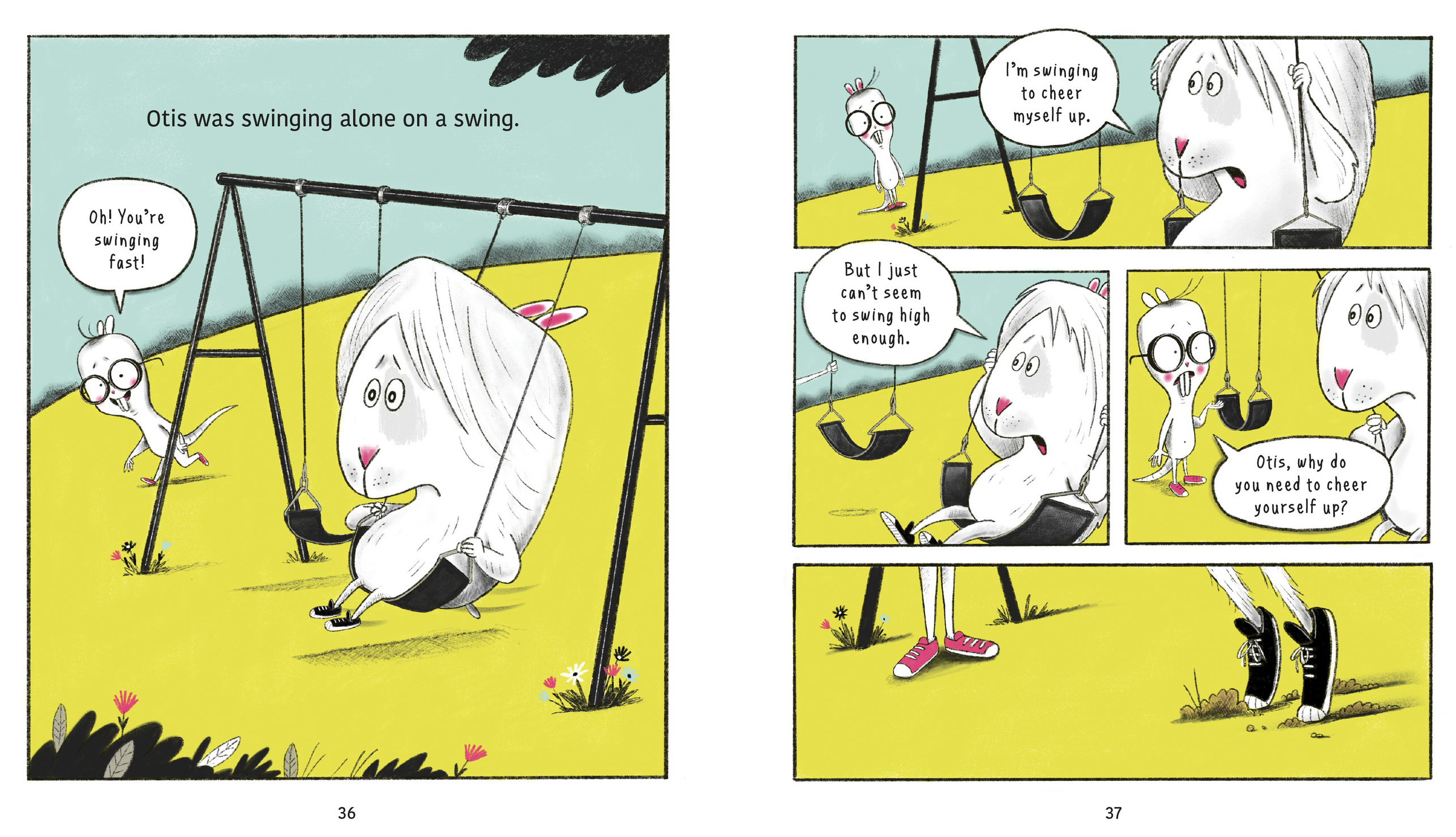
The Swing is the second story in the book and focuses on Otis missing their friend Pearl. As Otis tries to subdue the sadness that keeps him from enjoying a swing, Peanut recognizes that recalling the good memories of Pearl is important, as is accepting that grief and joy can coexist.
From Otis & Peanut by Naseem Hrab, illus. by Kelly Collier

In the final chapter titled The House, Otis is decorating their new house to make it a true home. 

"Well, I want to feel like my heart is here. So I'm painting it my favorite colors. And putting special things inside of it and outside of it."
From the front door to the lilac bush, Otis has reminders of friends that make the house truly his. But when there still feels like something is missing, Peanut becomes the solution.

There have been many comparisons of Otis and Peanut to the celebrated Frog and Toad as a duo of friends that learn from their interactions with each other and others. But I think Otis and Peanut are far more diverse both in their appearance and their demeanors. Naseem Hrab has made Peanut the confident and extroverted character, eager to take on change and challenges, while Otis is more sedate and thoughtful, more sensitive to their feelings and surroundings. But both are capable of expressing themselves beyond those personalities, with Peanut showing compassion and insight beyond what might be expected of an exuberant extrovert and Otis able to enjoy things beyond self and feeling. Through their self-expression and Nassem Hrab's storytelling, Otis and Peanut have loads to teach young readers about friendship, grief, change and self.

Those important lessons come by way of a lightness of text and art. Kelly Collier–whose Steve the Horse series was reviewed here–illustrated this early graphic novel digitally and yet it has the delicacy of ink and watercolour. Surprisingly, the economy of her palette brings a boldness to the illustrations. While Otis and Peanut are essentially black and white with only the barest hints of pink for ears and nose and such, Kelly Collier saves the chartreuse yellow, pale turquoise and bright pink for backgrounds and large swaths of coats and furniture and such. It is a limited palette but it's fabulous to highlight Otis and Peanut, the stars of the stories.

It's tough to write an early reader that doesn't talk down to kids while addressing big issues like grief and friendship and home. But Naseem Hrab has done so with her words and, with Kelly Collier's graphic novel illustrations, Otis & Peanut is sure to be a hit. And, since this is only Book #1, there will be more stories with which we can visit Otis and Peanut, and I look forward to all of them.

June 22, 2021

Tough Like Mum: Q & A with author Lana Button

Yesterday I reviewed Tough Like Mum, written by Lana Button and illustrated by Carmen Mok.
Written by Lana Button
Illustrated by Carmen Mok
Tundra Books
978-0-7352-6598-1
32 pp.
Ages 3-7
April 2021
 
 
Today I have the pleasure of presenting 
this question and answer interview 
with author Lana Button.
 
Author Lana Button

 
HK:  When I started reading Tough Like Mum, I wasn't sure if the issue tackled by the book was poverty or depression. Then I realized that what was most important was resilience which can be the antidote to both. As the author, what came first for you in writing the story: the issue or the response?
 
LB:  I am sensitive to these issues on a personal level, on a professional level as an early childhood educator, and on a creative level as an author for young audiences. I wanted to write a picture book story that would bring these issues to light; knowing and experiencing that there are children among the picture book audience who live with the challenges Kim and her mum face. It is important and powerful for children to read, in stories, that they are not alone in their experience. 

I also felt that a picture book tackling the issues of poverty and mental health could be used as a tool for building understanding and developing empathy, for those who have not had these life experiences. I was interested in telling a story that would provide a safe and age-appropriate place to start important conversations.

Finding the response–figuring out how to tell a hard-hitting story, while respecting the age and sensitivity of my young audience–was where I was tripped up, and where this story idea was stalled for a long time. I waited for the story to come to me. Then I heard two comments. One by a teacher. “Some of my students can’t complete their homework because their power gets shut off and it’s too dark.” Another was a response to the cost of an upcoming field trip. “It’s only $6.00. I mean, what’s $6.00?” All I could think from that was, “We can’t assume to know what $6.00 might mean to a family, what life is like in their home.” And BOOM! this very resilient little girl, waking up with her thumb in her mouth, popped into my head and her story became very clear to me.
 

HK:  Poverty is a tough topic to cover in a picture book, especially one for young children, though this is sadly the experience for many. How did you manage to stay realistic about the issue, for children to be able to see themselves, and still be compassionate without revealing vulnerabilities and sensitivities that some would prefer hidden? 
 
LB:  It is a tough topic, for sure. And I wanted to give a voice to Kim’s reality, while ensuring my young audience wasn’t overwhelmed. And so, I entrusted Kim as my storyteller. This resilient little girl is not easily shaken, and she conveys her experience in a matter-of-fact way, as children often do. She tells it simply, which allows a young audience to interpret the story at its baseline. I then relied heavily on the illustration to fill in the details of Kim and her mum’s reality. The nuances of the illustration allow an audience, when they are ready to take it in, to dig deeper into the story.


HK:  Tough Like Mum ensures that, first and foremost, we see the strengths of those dealing with poverty and hard times, not any weaknesses. Your title says it all. Is there a mum or a child for whom you wrote this book?
 
LB:  I wrote Tough Like Mum with the hope that there will be an audience who feels connected to this story on a personal level. I wrote it for anyone who is struggling or has struggled with financial burdens, and for those experiencing the weight of depression in their home.  In particular–the child who needs to feel seen, who needs to feel championed to try one more time, to reach out and ask for help–this book is for them.

 
HK:  I think that whatever hardships we all go through–physical, emotional, financial–asking for help is one of the hardest things to do and Tough Like Mum demonstrates that it happens for both adults and children. Why do you think it’s so hard to do so?
 
LB:  When we ask for help, we expose our vulnerability. That’s a scary place to be. Yes, it might be a path to help. But it might also be a path to rejection, to judgment and gossip, and to more pain. And if we’ve tried reaching out and then experienced hurt or rejection, it can be so much harder to take that chance again. 

And sometimes it might seem that the only thing we have control over is our reputation.
 
But it is my hope that a young reader might be inspired by Kim’s strength. That in times where they might need help, they will reach out to ‘the helpers’ in their community; the friends, the neighbours, the teachers.

In Tough Like Mum, Jen has done a great job teaching her daughter to be resilient. But ultimately it is Kim who leads her mum to realize that she is tough enough to accept help

 
HK:  The austerity of Carmen Mok's artwork reflects Kim and her mother's circumstances well. How much input did you have in ensuring the tone of the illustrations worked with your story?
 
LB:  I wrote the story with quite a few art notes. And I had a great conversation with Tara Walker at Tundra Books, who had the same visual interpretation of the story that I had. Samantha Swenson and I worked closely on the edits and she patiently indulged me as I gave her pages of back story for what seemed like every scene. I felt ‘heard’ and I felt like we were all on the same page when it came to the tone of the story. And so, when it was placed in the very talented hands of the incredible Carmen Mok it was time for me to step away and let Carmen and Sam do their magic. This distance is an essential part of the process, so that the illustrator can bring to life their interpretation, of what then becomes our story. And the result was a wonderful collaboration of words and art that told the story I was hoping to tell.

 
HK:  If there is one thing that you’d like young readers to see or learn from this story, what would it be?
 
LB:  I would love for a young reader to see hope at the end of a difficult day. I would love for each reader to see themselves as strong and resilient, and tough enough to ask for help (and keep asking for help) when they need it.


 • • • • • • •
 

Thanks to author Lana Button for talking to me about Tough Like Mum. This interview has given me loads to think about with respect to writing, and books that children need to read, of which Tough Like Mum is surely one.

Thanks also to Samantha Devotta, Associate Publicist at Penguin Random House Canada Young Readers, for reaching out and helping arrange this interview, and providing images to accompany both the review and this Q & A.

June 21, 2021

Tough Like Mum

Written by Lana Button
Illustrated by Carmen Mok
Tundra Books
978-0-7352-6598-1
32 pp.
Ages 3-7
April 2021

Though her mum might not always feel very tough or that she is able to manage, Kim tries to emulate her, never admitting she needs help or acknowledging anything she might perceive as weakness. But can anyone really be tough all the time?
From Tough Like Mum by Lana Button, illus. by Carmen Mok

From Carmen Mok's gouache and coloured pencil illustrations, it is evident that Kim and her mother are financially strapped. They share a bed, their socks are unmatched, their clothes and furniture are patched, and the food in the house is minimal. It's no wonder that Kim awakens soothing herself with her thumb in her mouth. But Kim is a tough cookie, tough like her mum, and she gets herself ready for school, making her own breakfast and lunch, and even planning for dinner–"Tomato, you are my favorite soup. Sit right here and wait for me"–because her mom hasn't gotten out of bed this morning. But Kim has a form for school that is due that day, a form for a field trip that costs $6.00. How is she going to get Mum to sign it when she's still sleeping, attempting to shut out the world–"Don't start on me, Kim!"–and get the money she knows they don't have?

On that cold winter day, Kim gets herself off to school, though some parents question her about being without a hat. Kim just tells them she doesn't need it, and the parents call her tough like her mom Jen. Kim won't let anyone see that she's cold. Because she's learned not to ask for help. And at lunchtime when David makes fun of her sandwich, she stays tough, never letting them see how sad and mad she is on the inside. But there's still the problem of the school trip. 

She has tried to find a solution, submitting a few coins she'd found in her mom's pocket, hoping the teacher wouldn't notice. But Mrs. Jones does notice and suggests her mother check a certain box on the form. It may read "I can't pay" but Kim knows it really means "I need help" and that's a box her mum has never checked.

From Tough Like Mum by Lana Button, illus. by Carmen Mok
Accepting help is never easy, and it seems to be especially so for Jen and Kim.  But when Kim gets home from school, she finds a way to take care of her mother, sadly still in the clothes she slept in, with compassion, humour and courage. Asking and accepting help might not be easy but it can be worth it.
From Tough Like Mum by Lana Button, illus. by Carmen Mok

Though Lana Button's picture books, including Raj's Rule (For the Bathroom at School), What If Bunny's NOT a Bully, and Willow Finds a Way, are aimed at young children, they focus on some tough issues. There are worries that young children have that cloud their lives and can cause anxiety. Whether it's bullying or self-confidence, using the bathroom or an absent teacher, Lana Button understands that these are very big issues for children. But in Tough Like Mum, Lana Button demonstrates that the shame of poverty transcends age and manifests differently for young children and for their parents who try to provide their best. Kim wants to be tough about what money they don't have, or the food she eats, or the clothes she wears. She strives to be tough like her mum. But sometimes being tough means accepting that help is needed. Together Kim and her mum realize this.

Lana Button's honest story of a single mum and child living in poverty and struggling with the perceived disgrace of their circumstances is stark. There are moments of lightness, like when Kim is praised for her reading and then brings that joy to her mum with it, or when they snuggle together in bed. But it's a hard life for both and the illustrations by Carmen Mok reflect that sparseness of their lives. From a sparsely-furnished home, to the mismatched clothing and furniture, patched or damaged, theirs is an unadorned life, and the art depicts that. 
From Tough Like Mum by Lana Button, illus. by Carmen Mok

But Lana Button's message of having the courage to accept help is paramount. Asking for help is not weak, though many, including Kim, may feel that it is so, exposing their vulnerabilities. Perhaps Kim's mum has never checked that box before, managing to somehow scrape together needed funds or accepting that Kim would have to do without. But by acknowledging that they might need some help, they've taken a big step forward. That just proves how tough Kim and her mum truly are.
 
• • • • • • •

Check back tomorrow for my interview with author Lana Button about Tough Like Mum and her approach to writing this story.

October 16, 2018

The Zombie Prince

Written by Matt Beam
Illustrated by Luc Melanson
Groundwood Books
978-1-55498-997-3
24 pp.
Ages 4-7
September 2018

With Halloween around the corner, a zombie prince sounds like a great costume. It oozes power and fear and may be just the thing to help Brandon destroy his enemies. But Brandon's is not a costume. It's an imaginary coat of armour to help the boy fight off, virtually, a schoolyard bully. 

Three boys, Brandon, Oscar and our narrator, hang out on the grass of the school yard, problem-solving how to deal with a bully, Sam, who has called Brandon a fairy. And though Ms. Gomez has declared that fairies are fearless creatures, Brandon is devastated by the bully's evident malice. So, each of the boys imagines himself as powerful enough to fight off Sam's hurtful words. Brandon sees himself as "a zombie who will destroy his enemies with the tears falling down his face." Oscar sees himself as a ghost who will block the mean words hurled at Brandon.  Our narrator declares himself a vampire who will suck bad things from the air, including "pollution and Mrs. Clark's perfume clouds and Sam's mean words."
From The Zombie Prince by Matt Beam, illus. by Luc Melanson
Finally our narrator suggests that "Sam was wrong, Brandon," and that Brandon would "make an awesome fairy, but you actually looked more like a prince." That delights Brandon and the three boys while away the rest of recess imagining planes, yetis and lasers in themselves and their surroundings.
From The Zombie Prince by Matt Beam, illus. by Luc Melanson
Anxiety about bullying often comes from ruminating over words said and abuses inflicted, and anticipating the worst as a consequence of overthinking. But, what the boys learn is that that same busy brain can be used to fuel an imagination that can allay that anxiety and produce calm and joy instead. Matt Beam's The Zombie Prince applauds the solace that comes from applying creativity to distracting and comforting rather than worrying, and with friends to help bolster that creativity with emotional support, Brandon glows with the relief of being a zombie prince.
From The Zombie Prince by Matt Beam, illus. by Luc Melanson
There's a similar glow to Luc Melanson's quirky illustrations that have a lovely green tinge, though not quite like that of a zombie's skin. The green is soft like grass and warm like sunshine, and uplifting like the support the three boys give each other. Moreover, by making the three children so different in their features, Luc Melanson supports Matt Beam's story assertion that all boys can be sensitive and supportive and never less for feeling vulnerable.

While littlest ones might be enamoured with the idea of a zombie prince–creepy and powerful–Matt Beam and Luc Melanson's illustrated story approaches the idea that power comes from something within, not from external appearances, and strength is built upon compassion and awareness, enhanced with a healthy dose of imagination.

December 08, 2015

Delicate


by C. K. Kelly Martin
Dancing Cat Books
978-1-77086-452-8
230 pp.
Ages 14+
November 2015


Who wants to be called “delicate”? Porcelain dolls, maybe.  But the teens in C. K. Kelly Martin’s Delicate would be loathe to be called delicate, regardless of the challenges, physical and emotional, they have to endure.

Delicate is told in the alternate voices of second cousins, Ivy and Lucan, who haven’t seen each other in seven years since Lucan’s mother Sheri told her cousin Lisette, Ivy’s mom, about seeing Ivy’s dad with another woman at a hotel.  The two teens will become reacquainted at a 75th brithday party for a relative, but first they are involved in their own dramas.  Life is drama after all, isn't it?  Ivy is devastated by her boyfriend Jeremy’s break-up with her after 18 months together and learning that he’s hooked up with her best friend Betina.  And Lucan is dealing with his divorced mother’s embarrassingly physical relationship with Julian, a man much younger than her, as well as trying to negotiate his best friend Des’s volatile relationship with girlfriend McKenna.  After the family get-together, Sheri helps Ivy get a summer job at her merchandising firm which is just around the corner from the Mill Street Café where Lucan gets a job,  and soon the two teens are comparing and sharing their lives with each other and declaring themselves absurdly delicate, though they both have tremendous strengths that they still have not recognized.

Fortunately, they enjoy each other’s company (how much is surprising) and the fresh perspectives on their respective issues.  Ivy vacillates between longing, anger and vengeance with regards to Betina and Jeremy, by whom she has been infected with an STI, even getting Lucan involved in a dog-napping scheme, while Lucan begins to see the abusive nature of Des and McKenna’s relationship, enlisting Ivy’s help to defuse its volatility.

The tenuous nature of relationships is made very clear from the plethora within Delicate: Des and McKenna, Ivy and Jeremy, Ivy and Betina, cousins Sheri and Lisette, Lucan and Des, and so many others.  The relationships between boyfriend and girlfriend, friends, husband and wife, parents and children and other relatives are all so delicate in that any incident or series of circumstances could destroy or alter them, shattering them to shards that may or may not be reconfigured.  I spent most of the book worried that Lucan’s peanut allergy–which I incorrectly assessed as his delicacy–would be his downfall but I was mistaken.  That would’ve been too obvious and C. K. Kelly Martin is never obvious.  Her other books (My Beating Teenage Heart, 2011; Yesterday, 2012; Tomorrow, 2013; The Sweetest Thing You Can Sing, 2014) have always fascinated me by her analysis of the complexity of the human condition and Delicate takes that one step further by examining both the obvious and the unseen and showing the immensity of both in affecting our lives and the way we see ourselves.  More importantly, C. K. Kelly Martin exposes the ways we hurt each other, sometimes deliberately, some accidentally, and some through negligence, and provides an upfront perspective on dealing.  Maybe that's all you can hope for.  Thankfully C. K. Kelly Martin does reassure the readers that being Delicate is not an indictment, just human.