Showing posts with label interview. Show all posts

November 03, 2025

Mighty Village Books: Interview with Danielle Daniel, new Canadian publisher

Anytime that I can promote Canadian books I do so. And with a new independent Canadian publisher starting up, it's another reason to make readers aware of their presence and the opportunity for new Canadian books for reading and for enjoying. Recently, I learned that author-illustrator Danielle Daniel, creator of the award-winning Sometimes I Feel Like a Fox (Groundwood, 2015), has been inspired to start her own publishing house named
 Mighty Village Books. Excited to learn more about Mighty Village Books, I interviewed Danielle Daniel about her new venture. 
 
 
Helen Kubiw: What motivated you to start your own publishing house?
 
Danielle Daniel: There have been many reasons behind this decision, but mostly, I wanted to build something new within the publishing industry—something filled with hope, creativity, and innovation. A model more aligned with my own spirit and vision for the future of publishing, one rooted in care, equity, and shared success.

 
HK: When did you first think about establishing a new publishing house, and how challenging was it to go from idea to reality?
 
Danielle Daniel: I began thinking seriously about this about three years ago, after my two novels were published and just as Sometimes I Feel Like a River was launching. Around that time, I noticed the joy I once felt on publication day had begun to fade. I wanted to reconnect with the heart of why I create, and to bring more meaning and joy into the process. Starting my own press felt like the natural next step, a way to nurture both my own work and the work of others within a model grounded in creativity, care and respect.
 
I’ve poured so much into building a press that reflects my values and vision. My experience as an author and illustrator of ten books, my background as an elementary teacher, and my MFA (Master of Fine Arts) in Creative Writing have all uniquely prepared me for this new chapter. I also genuinely enjoy growing and challenging myself—pushing into new territory feels like a natural extension of my creativity.

 
HK: As a publisher, what makes (will make) Mighty Village Books unique?
 
Danielle Daniel: Our motto is literally Little press. Big heart. At Mighty Village Books, we believe smaller is better. We publish with intention, choosing quality over quantity, because we care deeply about the books we create, the land on which we live and work, and the exceptional authors we’re honoured to support and champion. Our press was built to offer creators meaningful support and equitable profit-sharing—double the industry standard—because we believe storytelling should be sustainable, not extractive.
 
Beyond publishing books, we also create art and resources for classrooms, libraries, and beyond—beautiful, thoughtful tools that nurture imagination and connection. Through our shop and wholesale partnerships, we’re growing a creative community inspired by art and books. 


HK: This is a large and dauntless undertaking. Are there others who have partnered with you in this venture? Are there other creators whose work we’d recognize involved?
 
Danielle Daniel: This is indeed a large undertaking, and currently a sole proprietorship. While I have a small but mighty team who assist with graphic design and editing, Mighty Village Books remains a heart-led, independent operation built with great care and dedication. I’ve always been entrepreneurial by nature and look forward to the meaningful and rewarding work ahead.

 
HK: I like to keep a list of Canadian publishers of books for young people on my blog. Do you have the URL for your website yet? If so, can you please share it?
 
(HK: I have now added this site to my list of publishers. See the list to the left.)
 
 
HK: What genres are you hoping to focus on? Also, will you be accepting submissions from any creator, or might they be limited to those who are Canadian or Indigenous or another group?
 
Danielle Daniel: We welcome submissions from both debut and established Canadian and Indigenous authors. Our hope is to publish a wide range of voices, with a deep commitment to supporting storytellers from underrepresented communities.

Our vision is rooted in nurturing early literacy through picture books and middle-grade stories that honour the emotional landscape of childhood and reflect the richness of diverse Canadian experiences, with a particular focus on voices from Northern Ontario. We’re drawn to stories that hold tenderness and truth, that make room for big feelings, wild imagination, and the quiet brilliance of being a child.

 
HK: What are the titles of your first publications and when are they scheduled for release? 
 
Danielle Daniel: While our first titles will be released in spring 2028, our growing collection of art and products designed to uplift, inspire, and empower both children and grownups is available now.

 
HK: I know that I use BNC CataList for learning about upcoming releases of Canadian books. Will you have your catalogues listed there?
 
Danielle DanielYes, I’m familiar with BNC CataList and the important role it plays in connecting publishers, booksellers, and libraries across Canada. As Mighty Village Books grows and our first titles move closer to publication, I plan to have our catalogues listed there so readers like you can discover our upcoming books alongside other Canadian releases!

 
HK: Danielle, I am pleased to have reviewed several of your books, both those you’ve written (e.g., Sometimes I Feel Like a River [2023] and Sometimes I Feel Like an Oak [2024] and those which you have authored and illustrated (e.g., Sometimes I Feel Like a Fox  [2015] and Once In a Blue Moon [2018]). Will you continue to write and illustrate books? (I certainly hope so.) If so, will Mighty Village Books become your publisher?
 
Danielle Daniel: Thank you so much for your kind words, and for your support and thoughtful reviews of my previous books. I’m so grateful for your work in championing literacy. I’ll absolutely keep writing and illustrating—it’s the work I love most—and moving forward, my books will be proudly published through my press, Mighty Village Books.


It was wonderful to chat with Danielle Daniel 
and learn more about Mighty Village Books.
 
Many thanks to Danielle Daniel
for the pleasure of this interview 
 
and
 
 to Rachel Sentes, Publicist at Serif
for facilitating this discussion and post.


If you're interested in checking out the wonderful books that Danielle Daniel has written and/or illustrated previously, here is a sample of titles:
 
(written by Danielle Daniel, illustrated by Jackie Traverse; Groundwood, 2024)
(written by Danielle Daniel, illustrated by Josée Bisaillon; Groundwood, 2023)
You Hold Me Up
(written by Monique Gray Smith, illustrated by Danielle Daniel; Orca, 2017) 
I'm Afraid, Said the Leaf
(written by Danielle Daniel, illustrated by Matt James; Tundra, 2024)
(written and illustrated by Danielle Daniel; Groundwood, 2017) 
(written and illustrated by Danielle Daniel; Groundwood, 2015) 
Forever Birchwood
(written by Danielle Daniel; HarperCollins, 2022)
Reasons to Look at the Night Sky
(written by Danielle Daniel; Tundra, 2024) 

March 03, 2025

2024 Lane Anderson Award: Q & A with winners L. E. Carmichael and Byron Eggenschwiler

On January 29, 2025, the winners of the 2024 Lane Anderson Award were announced, and the winner in the Youth category was:
 
Polar: Wildlife at the Ends of the Earth
Written by L. E. Carmichael
Illustrated by Byron Eggenschwiler
Kids Can Press
48 pp.
Ages 7-11
2023
 
Today I have the great pleasure of interviewing the author and illustrator of Polar: Wildlife at the Ends of the Earth, Lindsey (L.E.) Carmichael and Byron Eggenschwiler. Here is my interview with these Lane Anderson Award winners.


Helen Kubiw: Congratulations to both of you on the Lane Anderson award. It’s a generous award and one that would surely be appreciated by any writer. As a writer of non-fiction, do you feel like non-fiction is often given less attention, from awards to lists of best-sellers, than fiction?
 
L. E. Carmichael: Thank you so much! To be honest, I’m still a little stunned.

When I tell people I write children’s nonfiction, they ALWAYS say “Oh, like textbooks?”. Nope, definitely not! But I think this response reflects a widespread notion that nonfiction is less artistic, or less interesting, or somehow less important than fiction. Which is absolutely not the case. In fact, research shows that many kids prefer nonfiction to fiction, and will even choose books above their reading level if they’re interest in the topic. When adults push kids towards fiction, kids get the message that the fact-based books they enjoy aren’t “real,” or don’t “count” as reading. And they may stop reading altogether.

That’s why awards like the Lane Anderson are so important. They not only encourage children’s book creators, they validate nonfiction in the eyes of adults, increasing the chance those adults will offer nonfiction to children.

Byron Eggenschwiler: Thanks! This really is a gracious award and a wonderful surprise to receive. 
 
I am not educated enough on the topic to really say one way or the other, fiction can be more flashy but both deserve a spotlight. Oddly I seem to have had a little more recognition within the non fiction space. 


 • • • • •  
HK: For many writers, writing is an opportunity to connect their personal experiences with the reader. What personal connections do you have with the topic of your book? How were you able to include those in your book?
 
L. E. Carmichael: When I was in sixth grade, my family moved to Yellowknife in the Northwest Territories. In summer, I got to experience the midnight sun, and in winter, I got to experience air so cold, your nostrils freeze shut to keep it out! I did NOT enjoy that last part, but I fell in love with the beauty of the landscape and the amazing animals that live there. When I grew up, I got a PhD in the genetics of northern wolves and arctic foxes.

Polar focuses on wildlife, so my human experiences don’t appear on the page. But my expertise came in handy during the research phase, and I hope that my passion for the topic shines through every sentence.

 
 • • • • •
HK: All this year’s finalists for the Lane Anderson focus on topics that have been tackled in other books. How do you decide on a topic knowing that other books on the same topic have already been published?
 
L. E. Carmichael: It takes two to five years to write and publish a nonfiction book, so the most important thing is to choose a topic I’m completely obsessed with. Without that enthusiasm, I’ll never make it over the finish line!

But I do read as many published children’s books on my topic as I can. That helps me figure out what’s been done a million times, and, more importantly, what hasn’t been done yet. I want my book to offer something new—a new format, a new perspective, or the newest scientific discoveries.
 

• • • • •
HK: Lindsey, you are the only finalist author who exclusively writes science books. Do you ever have a hankering for taking up the fiction writing pen? If so, how would you find a way to blend in your passion for science?
 
L. E. Carmichael: Funny you should mention… I co-wrote a middle grade fantasy novel with friend-and-fellow-science-writer, Helaine Becker, which is out on submission as we speak! And in January, I started an MFA in Writing for Children and Young Adults at Vermont College, with the goal of learning how to write a novel all by myself.

I’ll never stop writing nonfiction—I’m too curious to quit!—but I’m passionate about fiction that’s inspired by folklore. Fairy tales, urban legends, supernatural creatures, you name it, I love it. Science and folklore sound like a weird combo, I know, but they’re not: they’re two ways that humans make meaning and access wonder. After all, the more we know about the natural world, the more enchanted it appears.

And no matter what I’m writing, it’s going to be grounded in research. Information informs everything I do.


• • • • •
HK: Byron, you have illustrated for both fiction and nonfiction. Is the collaboration process with the author different for both?

Byron Eggenschwiler: In my experience, the process is pretty similar. I typically work directly with the editor and designer and don’t actually deal with the author at all. The publisher might pass along comments the author has at certain points but for the most part that’s all the interaction I have with the author. It seems almost strange, but I think that way they can bring our visions together and see what works and doesn’t from an outside point of view. Speaking for myself, artists can sometimes be fragile emotional creatures about our work so it’s nice to have that separation for the process. The main thing with non fiction as an illustration is I hope the author catches any inaccuracies with the animals behaviour or environment. 
 
 
 • • • • •
HK: When illustrating Polar: Wildlife at the Ends of the Earth, were there any challenges with ensuring realistic depictions to support the text?
 
Byron Eggenschwiler: Keeping things accurate is always a bit of a challenge because you have to do a lot of digging to find reference for certain details. Something like the snow prints of a paw or what kind of leaves in a nest. I want to make sure to do the animals and their environment justice and capture what makes them unique but also want them to fit properly on the page and perform how I want them too in an interesting way. I tend to look at images and then go off and draw a bit from my head and then go back and try to find the reference for the details. In some cases you need to take a few artistic licences to make things work out. A big challenge with this book, for me, was making sure to keep the image flowing around the text and headlines and finding that balance of supporting the text without overpowering the image. 
 

• • • • •
HK: Like all writing, non-fiction can become formulaic, by organizing text with features like information boxes, a glossary, an index, etc. How do you ensure that your book stays fresh and unique?
 
L. E. Carmichael: Interesting! I hadn’t thought about the glossary and index as being part of a formula, because to me they’re essential tools for navigating a nonfiction text.

As for the body of the book, I let the topic determine the structure. It’s a process of figuring out which pieces of information readers need, and when, and that’s different for every book.
 
Byron Eggenschwiler: I don’t have any specific methods but for me it’s really about how do I keep it interesting for myself. The aim is, if I can do that for myself, then hopefully others will enjoy it too. For this particular book I was drawn to Lindsey's concept of how these two ends of the Earth were tied together across the same spread. It was a fun challenge for me to find a way to connect those two worlds and have them almost make up one continuous image.
 
 
• • • • •
HK: When you write a book of non-fiction for young people, Lindsey, the audience is clear from the reading level and formatting. But, when you write, do you also need to focus on the teacher or parent who might want the book for educational purposes, and how would you do so?
 
L. E. Carmichael: My first priority is always engaging the young reader, but I do check curriculum guidelines in Canada and the USA, to get a sense for when kids are learning about my topic in school. That helps me focus in on the right age range for the book, which helps me figure out which concepts readers will be familiar with and which concepts will need more explanation. My editor, Katie Scott, is excellent at identifying content or word choices that are too advanced for my target audience!

I don’t write to curriculum (that’s textbook territory), but I do want my books to be resources for parents and educators—in the classroom or outside it. Children’s nonfiction is a powerful teaching tool, but there’s nothing more powerful than kids and their grown-ups connecting through a shared interest.


• • • • •
HK: I'd like to ask you both about your next project. Lindsey, is your next book slated to be another book of non-fiction and if so, what topics are you considering? And Byron, what project are you working on now? Also, as an illustrator, have you been tempted to become the author and illustrator of a story?
 
L. E. Carmichael: My next book is nonfiction, but it’s not science—it’s a women’s history project. I can’t share too many details yet, but I cannot wait for this one to hit bookstore shelves. Ask me more in 2026!

Byron Eggenschwiler: I have recently wrapped up two books that will be out this year, Unnaturally Blue by Dorson Plourde that is about a young girl who enjoys swimming but suddenly finds herself a little overwhelmed and goes on a journey to understand her strange new blue feelings. I also have a holiday themed book called The Little Ghost Quilt's Winter Surprise by Riel Nason coming out for the holidays.
Writing and illustrating a story is something I would love to do one day. I have a lot of half-baked ideas floating around and I hope to commit some time to developing them into something special. It would be nice to explore that side of the process. I also really enjoy being able to work with an author's story and having that jumping off point. 

• • • • •

What a fabulous interview! I learned a lot about the process of writing, particularly non-fiction, but also about how an author and an illustrator contribute to produce an extraordinary piece of literature for young people.
 
 
 Great thanks to Lindsey Carmichael and Byron Eggenschwiler
for agreeing to this interview and for their insightful answers to my questions.
 
 
Thanks also go to
Winston Stitwell, Coordinator at the Lane Anderson Award, 
for bringing this non-fiction award for young readers to my attention
and for facilitating this interview, 
as did Bianca Rodrigues, Marketing & Publicity Coordinator at Kids Can Press.

October 04, 2023

We Belong Here: Interview with author Frieda Wishinky and illustrator Ruth Ohi

We Belong Here
Written by Frieda Wishinsky
Illustrated by Ruth Ohi
North Winds Press (Scholastic Canada)
978-1-4431-9403-7
32 pp.
Ages 6-8
October 3, 2023
 
 
Yesterday, I had the pleasure of reviewing an important picture book, We Belong Here, about intolerance and kindness. Today, I have the good fortune of sharing with readers a bit more about the book and the creative process through this Q & A with its author Frieda Wishinsky and illustrator Ruth Ohi.


Helen Kubiw:  Whether it be the 1950s, the setting for We Belong Here, or now, there are always those who distrust others who are different, whether in their appearance, their cultures, their faith, language, or something else. Why do you think this still hasn’t changed?

Frieda Wishinsky:  That’s an important question. I think some people are afraid or uncomfortable with anyone who is different because they haven’t had the experience of getting to know them. I grew up in New York City where there were always people around from different cultures and backgrounds. I felt comfortable and curious about that difference. I loved the diversity of food, customs and experiences but I think that some people who live in places which lack diversity, feel afraid of what and who they don’t know.
 
Ruth Ohi:  We have a long way to go, but I feel it has changed: I believe there’s been progress. I’d like to see the interest in making things better continue to grow the way I think it already has.


HK:  I suspect those children who demonstrate intolerance, including those in the book, are often doing so from observing their own families expressing that same bigotry. While We Belong Here demonstrates the value in getting to know those who are different, how do think it’s possible for those children to rise above their learning when they’re seeing the worst at home?
 
Frieda Wishinsky:  I hope this story and friendship of Eve and Mark will help kids and their families appreciate that although we are different, we are also alike. No one likes being called mean names. Everyone wants to feel appreciated. And being in touch with people from different cultures makes life richer and better. Being open to change and new people makes us less fearful and happier. 


HK:  The note at the end of the book suggests that the book came about through discussions that you had about your family histories. Once you decide that this was going to become a book, how did the collaborative process work?
 
Frieda Wishinsky:  Over two years ago Ruth and I had coffee and shared our family histories. We talked about how Jewish and Japanese people faced discrimination after the war. I said, "If I can figure out how to write that theme of connection and help as a picture book, would you illustrate it?”  Ruth said yes. Now all I had to do was write the story. Not so easy! The story couldn’t be about adults. It had to focus on kids.
     It took me over a year and a half to figure out how to create a story about two kids from different places and cultures who help each other in difficult times.
     When I finally felt pretty good about my text, I passed it on to Anne Shone at Scholastic. Anne had worked on many books with both Ruth and me. Anne liked what I’d written but made some suggestions. After more revision, the text was approved by everyone at Scholastic. Ruth could now begin to illustrate.
     I didn’t see the story with its art till it was almost a finished book. Ruth and I did have a few discussions about historical accuracy, tomato sauce vs. beets, and adding in a carved wooden sculpture but we worked separately.
     Seeing the finished book was a delightful surprise. I loved how Ruth added evocative and touching art to the story and theme. I think her art highlighted and elevated my words. 

Ruth Ohi:  Once Frieda’s manuscript was accepted by Scholastic Canada, she and I communicated through our editor, Anne Shone. I read the text many times so that the characters could move about in my imagination for a bit. I then created page breaks and tiny thumbnails to see how action and pacing could work. I researched the 1950s to immerse myself in the time and sent research elements and resulting rough layouts to Anne. Sketches were drawn and redrawn many times with feedback, until approvals were given to begin final art.
Rough sketch by Ruth Ohi from We Belong Here

 
HK:  I appreciate the fact that both of you were able to contribute familial background history to the story of We Belong Here. I like that, by bringing the two together through Eve and Mark, you were able to produce a story of discrimination defeated by kindness. But, in your own family stories, did kindness always conquer the unfairness of intolerance?
 
Frieda Wishinsky:  During the early days of World War Two, my mom met the wives of two Polish Generals when they were all jailed by the Russians as political prisoners. (My mom’s offense was a German sounding last name) These women, Yadviga and Zhosha, treated my mom as a sister, although they came from different religions and backgrounds. The three of them helped each other survive the harshness of a Russian prison for two years. Yadviga and Zhosha also promised my mom that if they were released, they would make sure she was released too. When the Russians changed their political alignment, the Polish women were released, and they got my mom out of jail the next day. Yadviga and Zhosha then opened a children's home in Russia for kids whose parents had been sent to Siberia. My mom worked there till the end of the war.  My mom was a natural storyteller and told me what happened to her in those terrible years. I never forgot the kindness and humanity of these two women.
 
Ruth Ohi:  My Dad was one of the first Japanese Canadians to be allowed to teach in Toronto. He was also a guidance counsellor. Leafing through photos, he’d tell me stories about his wonderful students and the staff that he worked with then and throughout his career.


HK:  How much of the story includes actual events that took place, like the shop, the rock, and the taunts, and how much is fictionalized but based on stories told within the family?
 
Frieda Wishinsky:  The core of the story, that a Jewish family helps a Japanese family, is true. The rest is fiction. We did incorporate elements from our lives in the book though. For example, I was an imaginative kid who loved climbing up on some rocks in a NYC park. My dad carved a beautiful crane out of wood. My dad was a baker and made rugelach.


HK:  For each of you, what was the hardest part of creating this story?
 
Frieda Wishinsky:  The hardest part for me was taking a true story and a general theme and creating a picture book that was universal and kid focused.
 
Ruth Ohi:  One of the hardest parts for me was also one of the most interesting as I had the chance to research the 1950s: fashion, cars, buildings, packaging, life in general. Anything I illustrated needed to actually exist. Everyone helped: Frieda sent family photos, my art director Andrea sent some men’s hairstyles, and Anne found a cake plate that inspired a spot illustration.


HK:  While many of your picture books, like Fox and Squirrel have important messages about compassion, empathy, emotional support, your books generally have a light-hearted innocence to them that veils those important lessons. How did you approach illustrating We Belong Here knowing that a story of children coping with discrimination could not be couched in sweet and colourful animal characters?
 
Ruth OhiI think Frieda’s story has a sweet innocence as well. My author/illustrated picture books have a lot in common with We Belong Here as they tend to focus on the role of empathy. When finding friends who look different from you, it doesn’t always matter from a young child’s perspective whether it’s an animal or not. I love that there are so many different ways of viewing the world for a child to choose from. My book Scribble is a celebration of what makes us different. Three very different looking shapes (Circle, Square & Triangle), with the help of a non-shape friend, discover how much you can accomplish using your differences. Fox and Squirrel is a celebration of what makes us alike. The series is based on two very physically different animals who discover that they have a lot in common i.e., they both need to eat and sleep and like to play.
     Looking back, I think my author/illustrated stories reflect my childhood – someone who looked very different from everyone else in their class (I also wore a metal back brace for over four years for my scoliosis) and was figuring out their place in the world. I never set out to teach a lesson when I write a story, but do enjoy hearing that they help kids and spark conversations about empathy.


HK:  I know that We Belong Here is not your first picture book of a fictional account of a historical event. Your own Kenta and the Big Wave (2013) deals with the 2011 earthquake and tsunami in Japan, and Joy Kogawa’s Naomi’s Tree (2008) deals with the internment of Japanese-Canadians during WW2. How do you approach illustrating a book of historical relevance and are there certain challenges you need to address?
 
Ruth Ohi:  Like Frieda’s story, research was required for both. The interiors and houses in Kenta and the Big Wave came from photos taken during my visits to Japan with my Dad and then later with my husband and my own kids. Kenta’s dog is the Ohi’s Shiba Inu that my daughters got to walk. It was an honour to illustrate for Joy and great to finally meet her at the launch, do a library session together and hear her say that she loved my illustrations. She is so gracious and kind. I feel very lucky in the authors I’ve been able to illustrate for.


HK:  I had thought it was unusual for an author and an illustrator to query a book together (unless the author is the illustrator). How did you get the publisher to accept a submission with both text and illustrations?
 
Frieda Wishinsky:  We were lucky that we’d both published a bunch of books with Scholastic and we’d both worked with Anne Shone. Scholastic knew our work and we were happy this story resonated for them. Plus it’s great that I’m Jewish and Ruth’s background is Japanese so we could bring each of our cultures into the story authentically.


HK:  Do you see a follow-up book or perhaps a companion book that takes the perspective of an older Eve and Mark as teens or as parents themselves, or perhaps a story of a different kind of discrimination experienced by others?
 
Frieda Wishinsky:  I hadn’t thought of a follow-up book, but I’d love to do another book with Ruth. Now all I have to do is think of a story that she might like illustrating!
 
Ruth Ohi:  I’d love to illustrate another Frieda story. Anyone who gets to illustrate one of her manuscripts is very lucky indeed.

• • • • • • •

Many thanks to 
author Frieda Wishinsky and illustrator Ruth Ohi 
for the privilege of asking them questions 
about their new book We Belong Here
As a story, it has great depth in its history and its lessons, 
and both Frieda and Ruth have brought insight and heart to it.
I hope this interview shares all that with you, my readers.

• • • • • • •

January 24, 2023

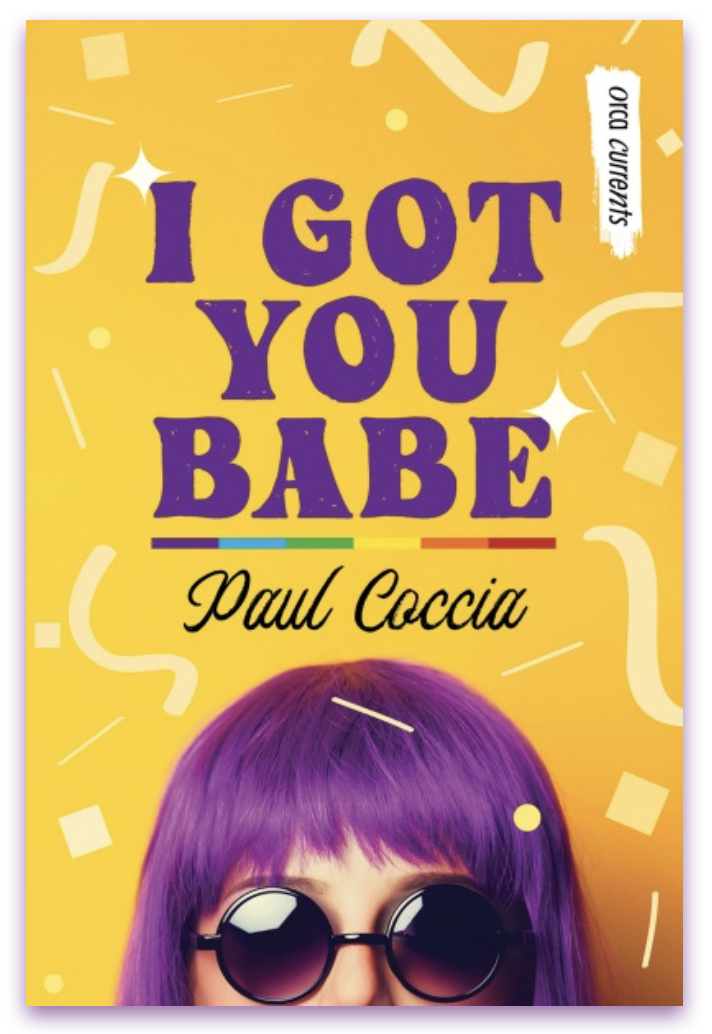
I Got You Babe: Guest interview with author Paul Coccia

I Got You Babe
Written by Paul Coccia
Orca Book Publishers
978-1-459834705
120 pp.
Ages 9-13
Release February 14, 2023


Yesterday CanLit for LittleCanadians reviewed Paul Coccia's upcoming novel, I Got You Babe. Today I present an interview conducted by student Hasini K. with author Paul Coccia. 13-year-old Hasini read I Got You Babe and prepared questions for author Paul Coccia to delve a little deeper into his new book. Paul Coccia, ever gracious, agreed to answer her questions and even visited with Hasini virtually to chat about the book. 

Here is their Q & A.
 
Author Paul Coccia

 • • • • • • •
Hasini:  In the novel, Mac and Amy propose to change the annual Fun Fair into a Pride Carnival theme. Their idea is welcomed and the committee supports the change.  What would you say to your LGBTQ+ readers if they find themselves in a less than supportive environment?


Paul Coccia:  My first concern would always be whether a reader is in harm’s way. I wouldn’t want to see someone in physical or emotional trouble due to advocating for something they believe in nor would I want them in an environment that is damaging to their well-being. That aside, I would advise trying to open a dialogue. Be forthcoming about how you see the issue and try to understand why someone may object. The opposition may be something practical like budget constraints as in I Got You Babe. If the environment or people can’t or won’t be supportive, then I would suggest finding spaces and people that can. Too often, we give too much time and space to negative people or situations and, if possible, actively choosing positive things and giving them time in your life is a healthy move.


Hasini:  I really appreciated Mac’s desire for scheduling and organizing all the tasks needed for the Pride Carnival Fun Fair.  Would you say that this represents you or how might you be different?

 
Paul Coccia:  I do enjoy planning and organization and am impressed by someone who can pull off a big event and make it seem effortless. Where I differ from Mac is, as a writer, sometimes it’s a lot more satisfying to plan something in my mind than it is to actually do the work to get it going in reality. When I’m writing (or reading for that matter), there are more possibilities. In my mind, I throw these really elaborate parties with the best food and all my friends get to come. I plan them, but I might need an Amy in my life to push me to get it done.


Hasini:  When brainstorming for the Fun Fair, Mac had a lot of great ideas for the Pride Carnival theme.  Naturally, he was disappointed when the committee told him too many were unrealistic and they didn’t have the budget for all of it.  What would you say to kids who have to deal with disappointment?

 
Paul Coccia:  Disappointment, unfortunately, is something we all deal with. Authors and illustrators will tell you, we get these fantastic ideas, and sometimes they don’t end up turning into books. At least not easily. A lot of times, it is due to factors entirely out of our control. I started trying to get published at 17. It took me a couple of decades to get one of my great ideas turned into my first book. Being patient and waiting for a moment to arrive is incredibly frustrating and disheartening. Sharon Jennings’ Unravel is a great example of a book that took her over a decade to get published and it became a Governor General’s Award Finalist. So, don’t give up. Your best ideas will find their time and place if they’re important to you.


Hasini:  Mac and Amy have a very strong friendship.  How might this friendship inspire the readers of your book?  Also, do you have a friendship that inspired these characters?

 
Paul Coccia:  The backstory! Mac and Amy were inspired by my younger brother and his friend. They met before kindergarten and have remained close since. In eighth grade, they put on a Sonny and Cher routine for the school talent show where she was Sonny and he was Cher.

I hope one takeaway is that in a friendship, there can be room for two divas with lots of mutual respect. That can mean taking time to listen to someone and hear what they want and need not just try to pull them into orbit around you no matter how fabulous you are.


Hasini:  I noticed that pronouns weren’t used for Mac for the first 50 pages of the book.  Was there a specific reason you delayed using the pronoun ‘he’?

 
Paul Coccia:  I wish I had been clever enough to notice! I would have removed the rest of the masculine pronouns and left the decision on pronouns up to the reader. Readers are already active participants in books so I’d be happy to let them decide. Alas, I was not that smart. From a craft perspective, the story is told from the first-person point of view and Mac usually refers to himself as ‘I’ or ‘me’ while others call him by name or ‘you.


Hasini:  I love that the name Chandra was used in your book.  I am not used to seeing my culture represented in books.  Was there a reason for the name choices of your characters?  

 
Paul Coccia:  I, and so many authors and illustrators I know, intentionally try to be inclusive when we create stories. Part of that means finding ways and places for all sorts of characters to exist in the worlds we write. First and last names are an understated tool for any writer as they have the benefit of characterizing quickly and efficiently by hinting at cultural heritage. Amy’s and Mrs. Khatri’s surnames did this too. That aside, Chandra is a beautiful name. There is a goldmine of names that are not used enough that authors can look up. When I am trying to include a character that has a specific heritage or background, I look up the most popular baby names or surnames in the country the character’s family would have originated from for the year I imagine the character was born.


Hasini:  Mac is insistent on representing a strong woman in the Pride Carnival Talent Show.  Why did you choose for him to want this?  How might you have participated in the show if you were one of the characters?

 
Paul Coccia:  Personally, I was so lucky to grow up in a house with many strong women so I tend to bring that into my writing whenever I can. I also really, really love Cher. She is the Goddess of Pop!

The LGBTQ+ community, in particular gay men, has looked toward strong and often transgressive people, notably women, as icons. Often, these women are such strong allies to the Queer Community. When I think of Mac, he really does have a strong sense of who he is and that, like many icons, he’s ahead of his time. He would naturally identify with a larger-than-life celebrity like Cher who has remained relevant for decades throughout her career. 
 
As for a talent show routine, I lean more toward visual art or culinary arts. If I could bake on stage, I’d have a decent shot at winning something. I can’t sing or dance though, not that that stopped Mac.


Hasini:  It is mentioned briefly in the story that Mac deals with bullies in the school. What would you say to kids reading the book who are dealing with bullying?

 
Paul Coccia:  If you’re being bullied, seek help. This could mean finding an adult or authority figure to intervene or seeking professional help. This may be hard to do as I’ve found an element of shame and self-doubt accompanies being bullied. Finding a way to stop the bullying and healing from it is important.

If you are a bully, I would strongly suggest you reflect and consider if this is the person you want to be. Perhaps you didn’t intend what happened. Then you should apologize and make amends. If you did intend to hurt someone, I wonder if this is a moment to be proud of. We all make mistakes and our actions have the effect of bringing us closer to a version of ourselves we’re proud for the world to see or farther away.


Hasini:  In the book, Mac’s mom makes some creative meals like kimchi hot dogs.  I see on Twitter that you are quite the baker.  Did you have creative meals at home growing up that influenced you and your character, Mac?
 
Paul Coccia:  We are an adventurous family for eating and cooking. I think having parents and grandmothers from different backgrounds in the house helped, as well as growing up in an area of Toronto different from our backgrounds. My family loves trying different foods from around the globe, whether we cook it or it is takeout. Our most inventive and peculiar dishes always come out of repurposing leftovers.  Thanksgiving dinner does really well with a Tex-Mex influence. Spaghetti makes a non-traditional but surprisingly satisfying pad Thai. It’s fun and a challenge to see how we can switch up a dish and turn it into something new. Similarly, in my first novel, Cub, the main character is particularly interested in fusion when he cooks. Food culture is one more place to literally feed my curiosity.

 • • • • • • •
 
Many thanks to both Hasini K. and author Paul Coccia for this interview. Hasini asked wonderfully in-depth questions about the writing and story of I Got You Babe and Paul Coccia gave us great insight into his process and motivation.  I'm so pleased to share their interview with CanLit for LittleCanadians readers.

Graphic from Orca Book Publishers

October 10, 2022

Celebrating Meredith Tutching, Director of the Forest of Reading: Guest post by CANSCAIP president Sharon Jennings

This Friday, the Ontario Library Association's Forest of Reading will announce the nominees for its readers choice book awards.  This announcement is the culmination of year-round work led by Meredith Tutching, Director of the Forest of Reading. We'd like to give her a little love and recognition ahead of this year's announcement.
 
The following article, written by author Sharon Jennings, was first published in the Fall 2022 edition of CANSCAIP News Vol 44 (4): 13-15. It is reprinted here with the author's permission.
 
📕📕📕📕📕 

Sharon Jennings
One of the nicest things about this cross-our-fingers-and-hope-it-dies period of Covid is meeting up with people whom we haven’t seen for over two years—not even on Zoom. So I was thrilled when Meredith Tutching agreed to let me take her out for lunch and interview her for this column. She did note, however, that there are far more interesting people to interview than her. Not for those of us toiling in the children’s book world!
 
Meredith is the Director of the Forest of Reading Program. As such,
whether you know it or not, she is one of the most important people in our lives. Why? Meredith gets our books (the ones that make it onto the Tree lists) out to the most important people: our young readers. If you are fortunate enough to find your book nominated for a Tree (as most creators have fondly dubbed the awards), you will see more sales than ever before and be asked to more schools and libraries than you thought possible. In other words, royalties and income. Most publishers have little to no money for marketing and promotion, and some publishers (we all secretly believe) don’t seem to have much interest in some of our books. But if you make it to a Tree list, your marketing dreams will come true. (Not Fifty Shades of Grey true, but still.)
Meredith Tutching
Newcomers, or those of us not paying attention, may be wondering: what exactly is a Tree award and why is it important? The program is made up of ten reading categories or divisions, from primary grades to high school young adult, English and French. The
tenth category is for adult titles. There are also ten juries of approximately fifteen volunteers each—educators, library professionals, booksellers. These juries choose ten books for their lists. They are mindful of the fact that these awards are about the enjoyment of reading. It is a recreational (not literary) program. In other words—FUN!
 
The truly brilliant aspect of this program is that once the titles have been selected and the books received by participating schools/libraries, it is the kids who vote (excluding the Evergreen, adult division). Over a few months, they read each (most) of the books and get into heated arguments with their classmates about why this book or that should win. Then they vote; the votes are counted; the winners are announced. Some of us think that our
book should have won. But how do you rant against a bunch of six-year-olds? Or sneer at teenagers rolling their eyes? There isn’t a cash prize for winning, but, even better, there is the bulk sales of our books and the adoration of our fans. On a side note, sometimes a reader will tell you, “I didn’t vote for your book.” Why, thank you for sharing, young man.
 
Back to Meredith. She didn’t set out to have this career. She graduated from Queen’s University with a degree in geography. She is also a professional synchronized skating coach and consultant, in addition to mentoring with Skate Ontario and Skate Canada. This last may seem irrelevant to us, but as she enthused over lunch about her ideas and goals for the Forest program, I could picture her out on the ice, demanding precision and sharp lines and keeping many athletes working smoothly together.

Meredith took a two-week job with OLA (Ontario Library Association) back in 2001. She’s now been there for over twenty years. In the early days, Meredith was the assistant to the Executive Director of the OLA, and the Forest job took up 30% of her time; in 2009 it became her full-time job. Meredith had so many ideas for going bigger and better, and she was so enthusiastic about kids and reading and promoting creators that the job couldn’t be contained in a few hours a week.
 
Now, the Forest is the largest recreational reading program and the largest children’s literary event in Canada. And Meredith has still more plans for further growth. She has always dreamed of expanding the program to fill the gaps in other provinces, and to do so, she finally managed to remove the program from the OLA website and obtain a standalone Forest website–forestofreading.com. This made it easier to reach out to schools across Canada with a program that could be seen as national, rather than piggybacking on an Ontario institution. Historically, there have been four schools outside of Ontario; this year there are almost fifty. Meredith wants to get to 200 by June 2023.
 
Just to be clear: books from published creators across Canada have always been eligible for the Forest Program. Meredith wanted to change the number of schools that would participate in the Program. So, if you live in Saskatchewan and your book is nominated for the Blue Spruce, you can now (or hopefully soon) get school visits in your home province and not have to travel to the participating schools in Ontario. (But then you might miss the ‘I feel like a rock star’ ceremony in Toronto as you are swarmed by autograph-seeking readers.)
 
The Program is always changing as it receives feedback. There are occasionally some complaints and grievances from creators and publishers (I’m shocked!) and, therefore, the team continues to take steps towards greater transparency. Once the books have been chosen, Meredith holds a meeting every September, in partnership with the Official Wholesaler, so that the publishers can learn about any new developments with the program and ask questions. The lists of nominated books are kept confidential until the official announcement in mid-October. And before that announcement, the wholesaler has pre-packaged listed books in order that they may go out immediately. Last year, the Official Wholesaler, Tinlids, sold over 105,000 books alone.
 
Occasionally, the Program has been accused of ‘hiding’ things (Hmmm. That sounds intriguing!) Meredith is careful to make sure the rules for submission and participation are clear and understood. Also, there is a ten-clause contract between the wholesaler and publisher which must be upheld. For example, there is a fee for each nominated book ($550.00 for a Silver Birch title), the book must be published and available by October 15, and there must be a guaranteed number of books ready to ship (approximately 3500 copies for each Silver Birch title).
 
Smaller publishers pay willingly and order in the books because this is marketing that they can’t afford and offers big dividends. Interestingly, it is some of the larger publishers who get huffy.
 
Sometimes, publishers get huffy as well when a book they expected to be on a list isn’t there. On the other hand, I mentioned to Meredith that some of my colleagues aren’t sure if their books got submitted. If we have such doubts, we are allowed to ask; however, she won’t divulge the reasons why the book was declined. Another way our books are getting into our readers hands: all one hundred titles are sent to a company (AERO—Alternate Education Resources for Ontario) that makes each title accessible in several formats for young people with print disabilities.
 
So much work done on our behalf, and that isn’t all of it! For years, library staff ran the program in their individual schools. Now the Forest and its volunteers do it all because of, as Meredith stated, “the erosion of school libraries.” And, by the way, Meredith liaisons with over 250 volunteers. Another by the way, only 7% of the Forest budget comes from government funding. And one more: Meredith divulged that she doesn’t read our books. What?! She feels that if she reads one, she will have to read them all. So why is she in this job? “I love the logistics of it.” Yup. Out there on the ice with her whistle!
 
Two hours flew by. We finished our lunch—chicken and avocado sandwiches and lemon-mint slushies. To be accurate, Meredith finished; I still had half a sandwich to get through as I scrambled to take notes, hoping that I would be able to decipher my own shorthand. She left, and I kept scribbling. Meredith’s final words were about what a close and supportive and helpful community we have. “There is room for everyone in this program.” She also
mentioned that, “Sometimes, creators are hard to herd.” Don’t we know it!

~ Sharon Jennings is the author of over 60 books for young people and current president of CANSCAIP.
 
📕📕📕📕📕

July 20, 2021

Sully, Messed Up: Q & A with author Stephanie Simpson McLellan

Yesterday I reviewed Stephanie Simpson McLellan's new middle grade/young adult novel Sully, Messed Up from Red Deer Press. This story about bullying was so compelling that I asked author Stephanie Simpson McLellan if I could do a Q & A with her to learn a little bit more about Sully and his story. She graciously agreed.

Sully, Messed Up
Written by Stephanie Simpson McLellan
Red Deer Press
978-0-88995-637-7
312 pp.
Ages 11-15
April 2021

Today I present that interview with author Stephanie Simpson McLellan about Sully, Messed Up.

Author Stephanie Simpson McLellan


HK:  When Sully wakes up on the first day of Grade 9, his face is messed up, with his nose, ears, mouth, nose and eyes relocating themselves around his head. Throughout the story, his facial landscape changes, but no one, except the Purse Lady, can see it. What was the purpose of giving Sully this transforming face?
 
SSM:  When I wrote the first draft of this story many years ago, my own three children were journeying through the often confusing and anxious space called adolescence. I remember well navigating this time myself. Every emotion feels so big and significant, and certainly anxiety – Sully’s prevailing emotion - can feel very physical. Most of us can relate to feeling sometimes that whatever emotion we’re feeling must be obvious – as plain as the nose on our face. So, at the most basic level, Sully’s messed up face is a metaphor for what he’s feeling inside.

Over the last year as I worked with Peter Carver on the book, I started to think also that it was an especially apt metaphor given that, with the popularity of social media, little is private. Both the good and bad things that happen to you— and everything in between—are very public. It’s like one giant bulletin board where everything about you is posted for everyone to see. No hiding! We even post emojis to tell people how we’re feeling, which is like giving people permission to look into your heart. In this vein, the metaphor of Sully’s messed-up face plays with how public everything is these days by taking it out of the digital space and putting it back into the physical world. Sully’s misery feels very public to him—so real and uncomfortable that surely everyone must be able to see his fears and insecurities.


HK:  I loved Mr. C’s fence of figurines whose scenes predict or illustrate Sully’s life and those of others in it. The characters you chose to represent each of the story’s characters, like Charlie Brown for Sully, Sleeping Beauty for Blossom and Madonna for the Purse Lady, were brilliant.  Please tell us about the inspiration for this fence, and how you chose the figurines to symbolize the characters.
 
SSM:  True Street, where the fence is located, is loosely based on a real street in my town that comes off Newmarket’s Fairy Lake Park. While I’ve taken some creative liberties with the actual geography and look of the house that sits on this short street, the real house actually did have a snake-rail fence about a decade ago, to which plastic figurines were affixed and often rearranged. While I never knew (or even saw) the owner, those figurines on the fence intrigued me, and I wondered what motivated someone to do this.

The character of each plastic figurine took some time to sort out. The final cast of characters is probably version six, changing each time I rewrote another draft. I wanted it to be at least somewhat plausible that each figurine could exist, and that readers would know who they were, but also wanted each figurine to reflect and reveal the character it represented. It’s a pretty eclectic mix, but then life (and high school as a subset of life) is a little like that – throwing people together from all sorts of backgrounds.


HK:  As an educator, I was saddened by the ineffectiveness and ignorance of Sully’s teachers and even his principal with regards to his bullying and the hazing carried out in the school. Why do you think they were all so oblivious of these goings-on? Or were they?
 
SSM:  My own kids had some great and not so great teachers. That’s probably true for all of us. I think, truthfully, that the bully/victim dynamic is tough on everyone, and as much as a school can say they don’t tolerate bullies, there are many things that make this difficult to regulate. For one, much of what happens to Sully occurs off school grounds. Secondly, Sully himself hides what’s happening from the teachers and other adults, fearing reprisal from the bullies. My goal wasn’t to paint the school administration as ineffectual but perhaps instead to reflect that there are some kids who fall through the cracks for one reason or another. In my son’s case, I knew there were teachers and administrators who cared, but it didn’t change the outcome. Mr. Green and Ms. Winters are parodies of real teachers I’ve known. The wonderful Ms. Wippet embodies many of the incredible educators I’ve encountered, but even Ms. Wippet can help only so far as Sully permits her to. 


HK:  Outside of bullies Tank, Ox and Dodger, so many characters could have altered the course of Sully’s story in Sully, Messed Up if they had spoken, listened or acted. Sully needed to speak up sooner, teachers and administrators needed to listen and open their eyes, and Sully’s classmates could’ve stepped up rather than act as silent bystanders or reinforcers who perpetuated the bullying with name-calling and laughter.  Which character or characters, outside of the trio of bullies, do you think was most important in that they could have changed everything for Sully by acting differently?
 
SSM:  Sully himself, as he came to realize, was the key to changing everything. Blossom and Morsixx tried very hard to help Sully but I believe that no matter how much we are loved and cared for by others, we are each ultimately responsible for ourselves. We make our own choices. It is up to us to advocate for ourselves. When I reflect back on some of my other books (such as Hoogie in the Middle and The Christmas Wind) I realize the thread of this is in much of what I write.

Eleanor Roosevelt said, “No one can make you feel inferior without your consent.” I’m not saying bullies can’t gain power over others (history gives us enough of those examples), but I believe that on a personal level, you can shrink a bully’s power by refusing to consent to the opinion they have of you. Decide that their opinion is not valid and then live that. Making a decision like this changes the way you think, feel and act. It changes the choices you make.

At one point in the book, I quote Barack Obama’s eloquent line: “Change will not come if we wait for some other person or some other time. We are the ones we’ve been waiting for. We are the change that we seek.” I think all the people in the world could have come to Sully’s aid, but it was only when he was ready that he became able to change is outcome.


HK:  Tennyson’s poem “The Lady of Shalott” figures prominently in Sully, Messed Up, both as part of an English assignment but also as reflective of Blossom’s story. Why use this classic ballad to mirror one character’s story?
 
SSM:  My undergrad major was English Lit (with a minor in Economics) and I loved nineteenth century literature. “The Lady of Shalott” poem and the beautiful rendering of it by John William Waterhouse, always stayed with me. When I first conceived the character of Blossom (at a Motocross park in Chatsworth, Ontario where my son was riding), it was with the image of “The Lady of Shalott” in my head: someone ethereal and mysterious; strong and individual, but also someone under the control of something bigger than her and, thus, ultimately fragile.


HK:   Though readers cannot help but feel bad for Sully as a victim of bullying, he is not always a likeable character. He’s so wrapped up in his own issues, monumental as they are, that he can’t see how rude he can be to others like Winston and Blossom and Morsixx. Why make Sully worthy of both our sympathy and occasionally our scorn?
 
SSM:  Not all of us are born leaders and heroes, and certainly Sully isn’t either of those for much of the book. But I think most of us have, or have had, a little bit of this in us. A preoccupation with our own story, unable to see outside our own heads. I wanted to make Sully real, someone deeply flawed who would really have to work at creating the best version of himself. Throughout much of the book, he giftwraps himself as the victim Tank is seeking. He does understand this on some level but hasn’t grown enough to alter it. I do love books where the protagonist is a hero waiting to happen, someone who already has the right ingredients for greatness, but I wanted to pay homage to someone who might never have completely realized his own potential without first being dragged kicking and screaming to this point. I think there are real Sully’s in every school. Kids who are under the radar, who don’t believe in themselves, who are fearful and anxious. I wanted to volley the idea that even these “through the cracks” kids have the potential to pull themselves in a different, and perhaps better, direction.


HK:  If there was one message you would like readers to take from Sully, Messed Up, what would it be?
 
SSM:  I would like readers to reflect on the idea that we are each captain of our own ship. That change starts with us and if we’re not happy with our current reality, it’s up to us to make different choices – including asking for, or accepting, help from others.

• • • • • • •

Sincere thanks to Stephanie Simpson McLellan for agreeing to be interviewed and providing such thoughtful and honest answers to my questions. 
 
Learning even more about Sully, I encourage all educators and school administrators and parents to read Sully, Messed Up to help the young people in their lives.
 
• • • • • • •

Though Sully, Messed Up is Stephanie Simpson McLellan's first novel for young people, she has an impressive collection of children's picture books. Do check out these titles too.

Leon's Song (2004)
The Chicken Cat (2000)