Showing posts with label Stephanie Simpson McLellan. Show all posts

November 06, 2024

Two Tales of Twenty-Six: Liam and the Letters, Walter and the World

Written by Stephanie Simpson McLellan
Illustrated by Mike Deas
Red Deer Press
978-0-88995-746-6
64 pp.
Ages 6–8
November 2024
 
Like all skills, literacy develops at its own pace for the learner. For some children, the step between seeing shapes and deciphering into letters and then words comes earlier. For others, whether because of readiness or learning disability or even opportunity, the ability to read may come later. For Liam, it's not coming fast enough, especially when he has a charming book about a mouse and a bunch of cats–his family has cats!– and he wants to know what's happening.
From Two Tales of Twenty-Six: Liam and the Letters, written by Stephanie Simpson McLellan, illustrated by Mike Deas
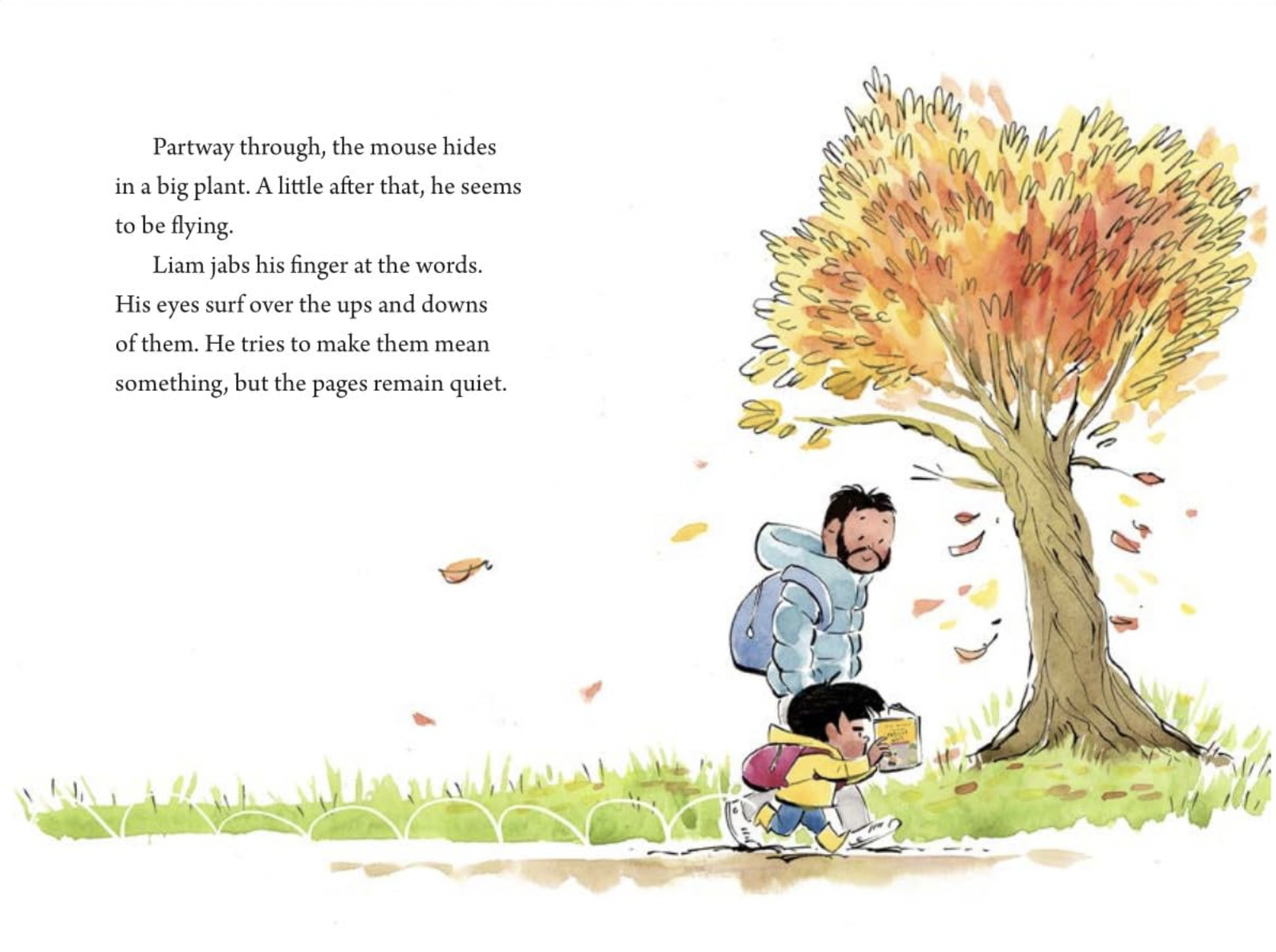
In Liam and the Letters, a little boy is charmed by a book about a mouse and a lot of cats. He gets a lot of information from the illustrations, but he wants to know what's actually happening "but the random lines and loops of the letters stretch across the page like fences." (Liam and the Letters, p. 5) In fact, a sample of letters look a lot like those almost indecipherable text-based captchas and spell out "You Can't Come In" and could refer to the mouse and the outside world to which he is eager to visit or to Liam and his reading.
From Two Tales of Twenty-Six: Liam and the Letters, written by Stephanie Simpson McLellan, illustrated by Mike Deas
Liam is getting frustrated as fall turns to winter and he even throws his book away into the snow. But he retrieves it and makes a plan. After all, twenty-six letters is a lot. One letter at a time is manageable. 
One letter at a time could turn impossible into possible. (Liam and the Letters, p. 15)
From Two Tales of Twenty-Six: Liam and the Letters, written by Stephanie Simpson McLellan, illustrated by Mike Deas
So, he starts with the L and the A, letters from his name and ones that he recalls learning about at school. He's frustrated but with time he picks up on the W in the "Walk" sign on his way to school and the R on a cereal box. By spring, he's learned the letters and the weird-looking letters become readable.
 
Now, he can read the story that the reader can also read, simply by turning the book over. Walter and the World is the story of the mouse and the cats that Liam could not read. Walter the mouse has his own issues, with twenty-six cats whom he must evade if he's going to explore the outside world. Both Liam and Walter have twenty-six entities standing between them and what they crave, whether reading or an opportunity for exploration. Their stories may be different, but they are connected and ultimately even linked.
From Two Tales of Twenty-Six: Walter and the World, written by Stephanie Simpson McLellan, illustrated by Mike Deas
A tête-bêche book, which is also a flip book, has two stories in one book which you access by flipping it over. But Stephanie Simpson McLellan's book is not just two different stories. They are two linked stories with a child trying to read the other story. I don't think it matters which story is read first. If they read Liam's story first, they will get a perspective of what it means to look at a book and be frustrated at being unable to read it. But they will also get the satisfaction, as Liam gets, when he can put letters together into words and make sense of the story the reader can now read too. On the other hand, if they read Walter's story first, they'll be charmed by a cat-and-mouse story like no other and feel like they know a secret about the book that Liam cannot read when they read the second story. The order of the reading of the flip book does not matter here; it's the connection that matters.
 
Flip books can be problematic for libraries, particularly for cataloguing, but Two Tales of Twenty-Six will not be so. It will just be a fuller story, told from two different layers, that of a story character and that of a reader. For each, Stephanie Simpson McLellan who is a star of storytelling–my particular faves are The Christmas Wind and The Sorry Life of Timothy Shmoe–gives us a character who is faced with a challenge of twenty-six and tackles it with strategy and perseverance and ultimately success. It's two feel-good stories in one package.
 
To make it even more enticing for early readers–other than giving them a story with which they will be familiar–Two Tales of Twenty-Six is illustrated by Mike Deas, giving these young readers the graphic support to help them read and understand their reading. Mike Deas's art uses a blend of gouache, watercolour, ink, and digital tools to both support and enhance the stories, giving Liam the reader a starting point for his reading, and the reader of Two Tales of Twenty-Six the colour and the magic to make understanding possible and worthwhile.
 
I'm usually not enamoured with tête-bêche books but Two Tales of Twenty-Six is more than the sum of its parts and that's why it's extraordinary. It's a book that is geared to its audience perfectly, encouraging our youngest children in their reading, especially if they are frustrated, and allowing them to see themselves in a story while taking a step up in their reading from picture books.
• • • • • • •
 
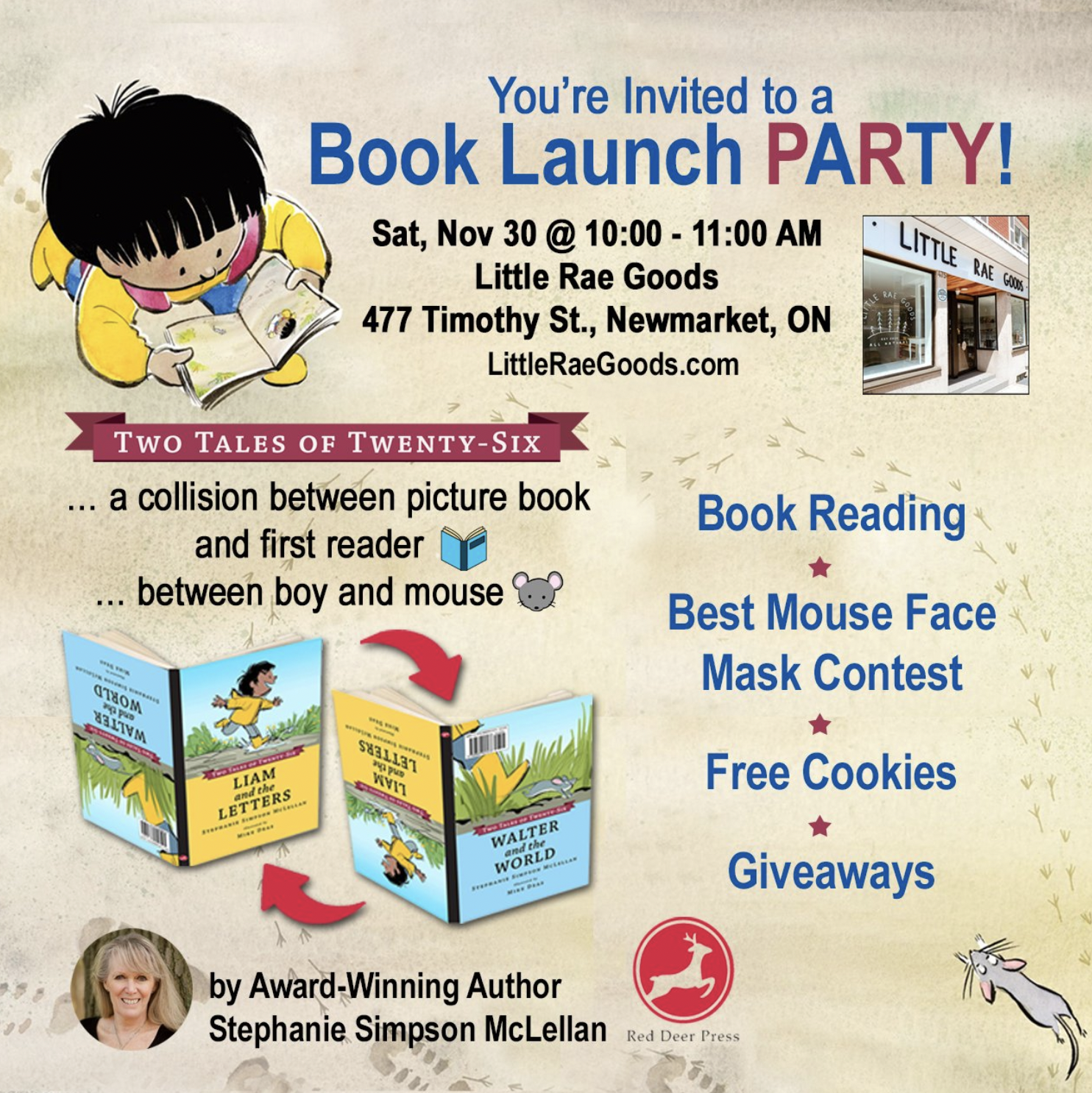
I'm very pleased to tell you about the book launch party for Two Tales of Twenty-Six
 
that will be held on

Saturday, November 30, 2024
 
from 10–11 a.m.
 
at

Little Rae Goode
477 Timothy St.
Newmarket, ON
 
 
This book launch will include:
 
• a book reading
 
• a contest for best mouse face mask

• free cookies

• giveaways

and

• book signing by the author Stephanie McLellan


July 20, 2021

Sully, Messed Up: Q & A with author Stephanie Simpson McLellan

Yesterday I reviewed Stephanie Simpson McLellan's new middle grade/young adult novel Sully, Messed Up from Red Deer Press. This story about bullying was so compelling that I asked author Stephanie Simpson McLellan if I could do a Q & A with her to learn a little bit more about Sully and his story. She graciously agreed.

Sully, Messed Up
Written by Stephanie Simpson McLellan
Red Deer Press
978-0-88995-637-7
312 pp.
Ages 11-15
April 2021

Today I present that interview with author Stephanie Simpson McLellan about Sully, Messed Up.

Author Stephanie Simpson McLellan


HK:  When Sully wakes up on the first day of Grade 9, his face is messed up, with his nose, ears, mouth, nose and eyes relocating themselves around his head. Throughout the story, his facial landscape changes, but no one, except the Purse Lady, can see it. What was the purpose of giving Sully this transforming face?
 
SSM:  When I wrote the first draft of this story many years ago, my own three children were journeying through the often confusing and anxious space called adolescence. I remember well navigating this time myself. Every emotion feels so big and significant, and certainly anxiety – Sully’s prevailing emotion - can feel very physical. Most of us can relate to feeling sometimes that whatever emotion we’re feeling must be obvious – as plain as the nose on our face. So, at the most basic level, Sully’s messed up face is a metaphor for what he’s feeling inside.

Over the last year as I worked with Peter Carver on the book, I started to think also that it was an especially apt metaphor given that, with the popularity of social media, little is private. Both the good and bad things that happen to you— and everything in between—are very public. It’s like one giant bulletin board where everything about you is posted for everyone to see. No hiding! We even post emojis to tell people how we’re feeling, which is like giving people permission to look into your heart. In this vein, the metaphor of Sully’s messed-up face plays with how public everything is these days by taking it out of the digital space and putting it back into the physical world. Sully’s misery feels very public to him—so real and uncomfortable that surely everyone must be able to see his fears and insecurities.


HK:  I loved Mr. C’s fence of figurines whose scenes predict or illustrate Sully’s life and those of others in it. The characters you chose to represent each of the story’s characters, like Charlie Brown for Sully, Sleeping Beauty for Blossom and Madonna for the Purse Lady, were brilliant.  Please tell us about the inspiration for this fence, and how you chose the figurines to symbolize the characters.
 
SSM:  True Street, where the fence is located, is loosely based on a real street in my town that comes off Newmarket’s Fairy Lake Park. While I’ve taken some creative liberties with the actual geography and look of the house that sits on this short street, the real house actually did have a snake-rail fence about a decade ago, to which plastic figurines were affixed and often rearranged. While I never knew (or even saw) the owner, those figurines on the fence intrigued me, and I wondered what motivated someone to do this.

The character of each plastic figurine took some time to sort out. The final cast of characters is probably version six, changing each time I rewrote another draft. I wanted it to be at least somewhat plausible that each figurine could exist, and that readers would know who they were, but also wanted each figurine to reflect and reveal the character it represented. It’s a pretty eclectic mix, but then life (and high school as a subset of life) is a little like that – throwing people together from all sorts of backgrounds.


HK:  As an educator, I was saddened by the ineffectiveness and ignorance of Sully’s teachers and even his principal with regards to his bullying and the hazing carried out in the school. Why do you think they were all so oblivious of these goings-on? Or were they?
 
SSM:  My own kids had some great and not so great teachers. That’s probably true for all of us. I think, truthfully, that the bully/victim dynamic is tough on everyone, and as much as a school can say they don’t tolerate bullies, there are many things that make this difficult to regulate. For one, much of what happens to Sully occurs off school grounds. Secondly, Sully himself hides what’s happening from the teachers and other adults, fearing reprisal from the bullies. My goal wasn’t to paint the school administration as ineffectual but perhaps instead to reflect that there are some kids who fall through the cracks for one reason or another. In my son’s case, I knew there were teachers and administrators who cared, but it didn’t change the outcome. Mr. Green and Ms. Winters are parodies of real teachers I’ve known. The wonderful Ms. Wippet embodies many of the incredible educators I’ve encountered, but even Ms. Wippet can help only so far as Sully permits her to. 


HK:  Outside of bullies Tank, Ox and Dodger, so many characters could have altered the course of Sully’s story in Sully, Messed Up if they had spoken, listened or acted. Sully needed to speak up sooner, teachers and administrators needed to listen and open their eyes, and Sully’s classmates could’ve stepped up rather than act as silent bystanders or reinforcers who perpetuated the bullying with name-calling and laughter.  Which character or characters, outside of the trio of bullies, do you think was most important in that they could have changed everything for Sully by acting differently?
 
SSM:  Sully himself, as he came to realize, was the key to changing everything. Blossom and Morsixx tried very hard to help Sully but I believe that no matter how much we are loved and cared for by others, we are each ultimately responsible for ourselves. We make our own choices. It is up to us to advocate for ourselves. When I reflect back on some of my other books (such as Hoogie in the Middle and The Christmas Wind) I realize the thread of this is in much of what I write.

Eleanor Roosevelt said, “No one can make you feel inferior without your consent.” I’m not saying bullies can’t gain power over others (history gives us enough of those examples), but I believe that on a personal level, you can shrink a bully’s power by refusing to consent to the opinion they have of you. Decide that their opinion is not valid and then live that. Making a decision like this changes the way you think, feel and act. It changes the choices you make.

At one point in the book, I quote Barack Obama’s eloquent line: “Change will not come if we wait for some other person or some other time. We are the ones we’ve been waiting for. We are the change that we seek.” I think all the people in the world could have come to Sully’s aid, but it was only when he was ready that he became able to change is outcome.


HK:  Tennyson’s poem “The Lady of Shalott” figures prominently in Sully, Messed Up, both as part of an English assignment but also as reflective of Blossom’s story. Why use this classic ballad to mirror one character’s story?
 
SSM:  My undergrad major was English Lit (with a minor in Economics) and I loved nineteenth century literature. “The Lady of Shalott” poem and the beautiful rendering of it by John William Waterhouse, always stayed with me. When I first conceived the character of Blossom (at a Motocross park in Chatsworth, Ontario where my son was riding), it was with the image of “The Lady of Shalott” in my head: someone ethereal and mysterious; strong and individual, but also someone under the control of something bigger than her and, thus, ultimately fragile.


HK:   Though readers cannot help but feel bad for Sully as a victim of bullying, he is not always a likeable character. He’s so wrapped up in his own issues, monumental as they are, that he can’t see how rude he can be to others like Winston and Blossom and Morsixx. Why make Sully worthy of both our sympathy and occasionally our scorn?
 
SSM:  Not all of us are born leaders and heroes, and certainly Sully isn’t either of those for much of the book. But I think most of us have, or have had, a little bit of this in us. A preoccupation with our own story, unable to see outside our own heads. I wanted to make Sully real, someone deeply flawed who would really have to work at creating the best version of himself. Throughout much of the book, he giftwraps himself as the victim Tank is seeking. He does understand this on some level but hasn’t grown enough to alter it. I do love books where the protagonist is a hero waiting to happen, someone who already has the right ingredients for greatness, but I wanted to pay homage to someone who might never have completely realized his own potential without first being dragged kicking and screaming to this point. I think there are real Sully’s in every school. Kids who are under the radar, who don’t believe in themselves, who are fearful and anxious. I wanted to volley the idea that even these “through the cracks” kids have the potential to pull themselves in a different, and perhaps better, direction.


HK:  If there was one message you would like readers to take from Sully, Messed Up, what would it be?
 
SSM:  I would like readers to reflect on the idea that we are each captain of our own ship. That change starts with us and if we’re not happy with our current reality, it’s up to us to make different choices – including asking for, or accepting, help from others.

• • • • • • •

Sincere thanks to Stephanie Simpson McLellan for agreeing to be interviewed and providing such thoughtful and honest answers to my questions. 
 
Learning even more about Sully, I encourage all educators and school administrators and parents to read Sully, Messed Up to help the young people in their lives.
 
• • • • • • •

Though Sully, Messed Up is Stephanie Simpson McLellan's first novel for young people, she has an impressive collection of children's picture books. Do check out these titles too.

Leon's Song (2004)
The Chicken Cat (2000)

July 19, 2021

Sully, Messed Up

Written by Stephanie Simpson McLellan
Red Deer Press
978-0-88995-637-7
312 pp.
Ages 11-15
April 2021

Who is Sullivan Brewster? He's Sullivan to his mom, Rooster to his little sister Eva, and Van to his stepdad Bill. He's Sully to his friend Morty, who has changed his own moniker to Morsixx since reinventing himself over the summer before their first year in high school. And to those who don't know him or want to target him, he becomes Bella, Sally and a host of horrible nicknames. Is it any wonder that thirteen-year-old Sully doesn't know who he is or what he should be doing or who his friends are? He truly is messed up, and that doesn't even count the messing up he's getting from a trio of bullies named Tank, Ox and Dodger.
 
Sully's story seems to start on that first day of Grade 9 when he wakes up with his facial elements relocated around his head.
His nose, pink and dripping, hunkered sideways on his left temple. One of his ears–it was hard to tell which one from the unfamiliar angle–bulged where his nose should have been. The other protruded, antenna-like, right above his lips, which quivered, post-scream, in the middle of his forehead. (pg. 9)
But no one seems to notice. Still, Sully uses his long hair to hide his potential disfigurement. This instead grabs the attention of Tank, the overlord at Wild Forest Secondary, and his sidekicks Dodger and Ox. Worried that he will now become the victim of the Gr. 9 hazing called the Naked Niner, whereby a selected student is unclothed and photographed and publicly humiliated, Sully tries to stay out of Tank's field of view. Unfortunately, everything he does seems to garner him more unwanted attention. 
 
First, he believes his friend and locker partner Morty/Morsixx is drawing too much attention with his new emo boy look and attitude so Sully starts avoiding him by carrying his backpack everywhere, hiding out in the parking lot at lunch and abstaining from taking the bus. Even though Morsixx and Blossom, a new girl who adorns her face and arms with ink of vines and flowers, try to support him, Sully continues to reject their efforts. Then he's given the topic of menstruation for his Sex Education class and Dodger pranks him with countless tampons, earning him the displeasure of the principal and a host of new nicknames.
 
When he begins to walk to and from school, past a purple house on True Street, with its fence adored with an unusual assortment of figurines in ever-changing scenes, Sully becomes acquainted with the Purse Lady who gets his attention when she asks him, "What happened to your face?" (pg. 80) But who is she and why does Mr. C, the strange man in the purple house, seem to know her and Sully and maybe even what is happening in his life, all represented in the figurines of Charlie Brown, the Knight, Sleeping Beauty, Darth Vader and more?
 
School can be a place of refuge for some but for others, especially those who become marked as victims, it can be brutal. And for Grade 9 students, it can be especially challenging. With an implicit hierarchy of power and confusion about the supports which they may or may not have, those preyed upon by bullies may become even more isolated. This is Sully who confuses his friends with contributing to his victimization and who doesn't want to worry his family. He is awkward in discussions with his teachers and his principal and then makes further choices that complicate things for himself. But, while Sully has been victimized, Stephanie Simpson McLellan tries not to play up the young teen as a victim. He is instead confused or rather messed up. He's got all the basics–friends, family, the will– to make things right but, like his face, things just haven't fallen into place correctly. Fortunately, when he can see beyond his personal disasters and into those of others, Sully learns to stand up for himself and help himself adapt. This is an important message for young people and, amidst all Sully's struggles, it's one that Stephanie Simpson McLellan emphasizes. With some insight and a little help from others, Sully is finally able to put to rights his situation and find himself.

• • • • • • • • •

Tomorrow I interview author Stephanie Simpson McLellan about Sully, Messed Up. For middle-graders and early young adults and their parents and their teachers, this Q & A will speak to all of you.

April 19, 2021

The Sorry Life of Timothy Shmoe

Written by Stephanie Simpson McLellan
Illustrated by Zoe Si
Owlkids Books
978-1-77147-393-4
32 pp.
Ages 4-8
April 2021 
 
Poor Timothy Shmoe.  He's a kid who never intends to do wrong or misbehave. In fact, according to the myriad of apologies he has to write, he always has a reason behind whatever incident has landed him in hot water again. Unfortunately, things just keep happening. (Funny, huh?)
From The Sorry Life of Timothy Shmoe by Stephanie Simpson McLellan, illus. by Zoe Si
Timothy Shmoe was not a bad kid...
But sometimes he did bad things.
From calling his father a bad name to expressing his dislike for a gift, playing hockey inside or touching other people's things, Timothy is a kid who just does things and doesn't think about the consequences. In other words, he's like many kids.

From The Sorry Life of Timothy Shmoe by Stephanie Simpson McLellan, illus. by Zoe Si
For each sorry event, Timothy is required to write a letter of apology. He often starts them with "I'm sorry that..." before going on to explain why what happened has happened. He was just trying to be honest or wanting to cool his mother down on a hot day or he woke up on the wrong side of the bed or Fluffy scratched him or...or...or. There's always something with Timothy that explains away his behaviour, or so he thinks.
From The Sorry Life of Timothy Shmoe by Stephanie Simpson McLellan, illus. by Zoe Si
But all those little episodes become a colossal comedy of errors when Timothy attends his sister's dance recital and he and his marbles end up creating an act of their own.
From The Sorry Life of Timothy Shmoe by Stephanie Simpson McLellan, illus. by Zoe Si

Parents and teachers know that impulse control in children may develop earlier (ages 3-4) but may take years to become entrenched, and Timothy is just learning to see that his actions have consequences. Like many parents, his are frazzled, trying to find the means to teach Timothy the behaviours that are less destructive or hurtful and the letter-writing may be a good start. Though he's obviously a reluctant apology writer, Timothy starts to accept that his actions are impacting others. In fact, his final letter suggests that his parents may wish he was never born because he wrecks everything. There is one more letter, this one from his dad, that expresses something very different.
I would only be sorry if you were not my son.
Stephanie Simpson McLellan, who has written a number of my favourites including The Christmas Wind (20017), takes both a light-hearted and serious tone in The Sorry Life of Timothy Shmoe. Yes, he does some silly things that older kids and adults usually recognize as potentially disastrous, but the frustrations that he and others feel are very real and even distressing. For a child to feel unwanted is sad. Thankfully Stephanie Simpson McLellan has given Timothy parents who are understanding and loving and, with their help, he's sure to grow into his self-control.

Vancouver cartoonist and illustrator Zoe Si uses ink and watercolour to play on that tenuous relationship of humour and consequence. She easily turns Timothy's initial delight in his play into frustration, embarrassment and even shame with his body language and facial expressions. We know how Timothy feels, as well as everyone in his orbit of activity. Except for the crazy dance recital where everything goes awry, Timothy is always the focus of Zoe Si's artwork, with significant white space being used to emphasize his limelight. 
 
There are laughs in The Sorry Life of Timothy Shmoe but also lessons about intention, consequences and forgiveness. Timothy Shmoe is anybody who makes mistakes and then has to face the consequences for those mistakes. That's all of us. Here's hoping none of our mistakes are ever too consequential for forgiveness.