Showing posts with label self-esteem. Show all posts

February 21, 2024

We Need Everyone

Written by Michael Redhead Champagne
Illustrated by Tiff Bartel
HighWater Press
978-1-77492-011-4
40 pp.
Ages 6-8
January 2024
 
Belonging is such an important emotional need for children and for all. But too often we compare ourselves with others and see their gifts and accomplishments as greater than our own, worrying that we don't belong or aren't good enough. Community advocate Michael Redhead Champagne will help children see that they all belong because we need everyone.
From We Need Everyone, written by Michael Redhead Champagne, illustrated by Tiff Bartel
We Need Everyone's book character Michael, easily recognizable by his bouncy asymmetrical hair, speaks to everyone about gifts. 
Gifts are skills and talents we share with others. Every gift is different, and every gift is special.
For many children, recognizing their own gifts may be a challenge, so Michael takes them through a series of steps to finding their gifts. These include making lists of what they like to do as well as what they are good at doing. If they have difficulties identifying those, they can always ask for help. Then it comes down to practising those gifts.
From We Need Everyone, written by Michael Redhead Champagne, illustrated by Tiff Bartel
But there is more to having a gift if we are to share them and build strong communities. Michael Redhead Champagne equates building community with activism and speaks of all those who help make our communities richer: artists, athletes, chefs, gamers, storytellers, and friends.
When you share your gift, you give strength to others. Even if you feel too small, too young, or too quiet, your gift is too special to keep to yourself.
Michael Redhill Champagne speaks from a place of knowing. He is Ininew (Cree), having been raised in Winnipeg's North End with his family from Shamattawa First Nation in northern Manitoba.  He knows what it means to belong to a community and to make a community. He shares his inspiration through public speaking and writing, hosting media events and telling of stories. We Need Everyone, his debut picture book, continues his message of empowerment and influence by helping kids see that they all have superpowers that are their gifts, and that these gifts, though not always easily identifiable, are what will help make our communities stronger. 
From We Need Everyone, written by Michael Redhead Champagne, illustrated by Tiff Bartel
Winnipeg artist Tiff Bartel ensures that the illustrations in We Need Everyone reflect Michael Redhill Champagne's message that everyone is needed. She includes children of all skin colours, sizes, and abilities. She shows a girl in a hijab cooking, children gardening, a child playing sledge hockey, another signing "I love you" and others painting. Some are active, some are quiet, some are sharing their cultures, and many are learning. And they are engaged joyously and vibrantly in ways to enrich their communities and acknowledge their own gifts.

We need everyone, and by sharing their gifts of storytelling and art, Michael Redhead Champagne and Tiff Bartel will give children strength and inspiration to see themselves as needed and belonging too.

 • • • • • • •
A free teacher's guide, titled Teacher Guide for We Need Everyone:
Empowering Students to be Active Community Members Through Indigenous Perspectives in Primary Classrooms and Beyond
  is available from HighWater Press (Portage & Main Press) here.

February 16, 2024

Leon Levels Up (Orca Currents)

Written by Paul Coccia
Orca Book Publishers
978-1-459837355
112 pp.
Ages 9-12
RL 2.3
February 2024
 
Twelve-year-old Leon Garcia considers himself a low-level kid gamer. He's not low-level because of his game playing but because of who he is. All he sees is that he's chubby, his mom cuts his hair, he wears his cousin's hand-me-downs, and he uses outdated tech. So, when his classmate Nico Saito, son of the founder of video-game developer Pix Grid, approaches him and invites him to game together on the weekend, Leon is surprised, pleased, and nervous. Leon figures this could be his chance to level up his life, or at least his coolness.
 
But a day of gaming is not just hanging out at Nico's house. Instead, Nico takes Leon to Pix Grid where they meet up with Gabs Lucas in the lab to play a next-level virtual-reality game which is so immersive the two boys suit up in full-body tracking outfits before being dropped into tanks filled with nanobots. Though Leon's thrilled with how strong and tall and skilled he is as an elf archer, Gabs tells him she's lost the connection with Nico who may have damaged his helmet when he plunged headfirst into the tank. And with the nanobots programmed to fill every available space, there's the danger of hurting Nico.  The only way to get them out safely is for Leon to complete the mission of saving the kidnapped Prince SpearMint from the dragon Lord Tachi. Oh, and before the timer runs out.

Leon Levels Up has all the excitement of a video game adventure in which Leon evades and fights a dragon, an old hag, and some ogres, while figuring out clues and strategy to rescue Prince SpearMint. As with many quests, the learning is in the doing, and Leon is plunged into this VR game with its life-or-death outcome with only his wits and character. He might have hoped that gaming with Nico would level up his game, but his cleverness and perseverance demonstrate he's already top drawer. 

Author Paul Coccia, whose other books include I Got You Babe, The Player, and On the Line with Eric Walters, often gives voice to young people who question who they are and whether they are good enough, and that's many tweens and teens. (It's also most adults.) Except for the narcissistic and the very confident, we compare ourselves to others and whether we pass muster. When faced with the good-looking and rich Nico Saito, Leon turns to look within and take stock. He ruminates about how he will be seen and judged, while judging himself. Only when he's in the "Dragon Hunt" game does he eventually set that aside, first appreciating his new persona and skills but ultimately recognizing that it was him, low-level Leon, who won the game. Paul Coccia takes us for a wild ride in Leon Levels Up, all at a lower reading level than typical for the middle grade reader, but never forgets to remind us that Leon never needed to advance to a higher level of self. For a twelve-year-old, he was already there.

March 03, 2023

Smile So Big

Written by Sunshine Quem Tenasco
Illustrated by Chief Lady Bird
North Winds Press (Scholastic Canada)
978-1-4431-8767-1
32 pp.
Ages 4-8
March 2023

Most of us, adult and child alike, will see something less than perfect in our appearance: too wide, too short, too white, too dark, nose or teeth too big, eyes too widely-spaced. There’s always seems to something that we see that others may or may not. How to see the truth?
From Smile So Big by Sunshine Quem Tenasco, illus. by Chief Lady Bird
Challa has a big, toothy smile and when she gets teased about it, her mom reassures her and shows Challa a beautiful mirror with a thunderbird design and fringe. Her mother tells her that this family heirloom would show the holder's true self, but the rule was that they "had to say what they saw in the reflection." Challa looks into the mirror and sees all her attributes and says, "I'm smiling so big. I sure do look cute." With that, the beads around the mirror light up. Challa is delighted.

From Smile So Big by Sunshine Quem Tenasco, illus. by Chief Lady Bird
When she shows her friend Neebin, who was always being teased about his long hair, Challa notices how he smiles and looks so cute when looking in the mirror. When he acknowledges aloud that he loves his long braid hair, not only do the beads light up, but the whole playground shakes and sparkles with magic! The same happens when her cousin Keggy recognizes how much she loves her dark skin and the house shakes and sparkles as it's enveloped in the magic of the thunderbird. When her friend Kiniw sees his own beauty and accepts his small size, the magic is revealed again.
From Smile So Big by Sunshine Quem Tenasco, illus. by Chief Lady Bird
Challa is perplexed why she only saw the beads light up, not the magic that came with it. She tries again to acknowledge her eyes, her nose, her hair, and her dimple but the magic doesn't appear until she feels and expresses real love for her smile.

Sunshine Quem Tenasco, Anishinaabe from Kitigan Zibi Anishinabeg, brings young readers to an Indigenous community and yet the story she tells will be understood by all of us who may be teased, or worse, about some aspect of our physical nature. With a little help from a magic mirror and the support of those who love us and came before us, we can all see, accept, and appreciate who we really are. Whether there's a magical mirror in your life or not, there are those who help you see the beauty within and those people, whether in our lives now or gone already, are our greatest champions. It's not because of validating who we are; it's because they reflect who we are through their love. Sunshine Quem Tenasco's dedication includes the following words: "To all the Indigenous kids on Turtle Island and to all the boys with braids, you are so loved. You are important. You are powerful." Her words lift those to whom she has dedicated her book but also to every child who has the good fortune to read this picture book.

Chief Lady Bird, a Chippewa and Potawatomi artist who collaborated with Sunshine Quem Tenasco on Nibi's Water Song (2019), gives us both the realism and the magic in her illustrations. The boldness of her colour and shapes impress with their power of message about beauty and self, encouragement, and heritage. Chief Lady Bird gives life and context to Sunshine Quem Tenasco's words, and together Smile So Big is as enchanting as it is grounded.

For every smile hidden because of unease, and for every cruel teasing endured, Smile So Big gives young readers the courage to see their beauty as reflected in their own mirrors, magical or not, as held by themselves and those who love them.

August 24, 2022

It's My Body!

Written and illustrated by Elise Gravel
North Winds Press (Scholastic Canada)
978-1-4431-9650-5
32 pp.
Ages 3-8
September 2022

Elise Gravel has always used her quirky illustrative way to entertain while teaching STEM, from her Disgusting Critters series to The Mushroom Fan Club and even her early graphic novel series Arlo & Pips. But in recent years, Elise Gravel's picture books have shown a proclivity for encouraging young readers to be respectful of self and others by demonstrating that we are more alike than our differences might suggest. In It's My Body!, Elise Gravel reminds us that our bodies are our own, to love and appreciate, even as they are different in shape, colour, ability and how we feel about them.
From It's My Body! by Elise Gravel
If we're going to talk about our bodies, we first have to recognize all the different kinds there are. Brilliantly, Elise Gravel gives us dozens of bodies, all unrecognizable as people but all representative of the myriad of human body types. Some have two legs, some do not. Some have ears, and some do not. Some are tiny, some thin, some pear-shaped, and others stocky. Some move by wheels and some with canes. And they can all do stuff.
From It's My Body! by Elise Gravel

What we choose to do with our bodies is up to us but Elise Gravel recommends that we honour them by keeping them healthy and happy with good food, activity, cleanliness, fresh air and rest. And she reminds us that "Nobody should touch your body in ways that you don't like" and we should respect that for others as well.
From It's My Body! by Elise Gravel

Without belabouring any one issue like inappropriate touch or hygiene, illness or diversity, disability or body positivity, Elise Gravel gives it all to us. She reminds us to be kind to ourselves and others and to appreciate our differences as well as our similarities. With her one-of-a-kind monsters, Elise Gravel makes us feel worthy and included, no matter what we can do, feel or look like. That will help children with the ideation of self-esteem, while also shepherding them to good mental and physical health. After all, as Elise Gravel's green-and-yellow-spotted character reminds us:
Thank you, BODY. Without you, I would be a NO-BODY!

May 12, 2022

Bharatanatyam in Ballet Shoes

Written by Mahak Jain
Illustrated by Anu Chouhan
Annick Press
978-1-77321-615-7
36 pp.
Ages 4-7
March 2022

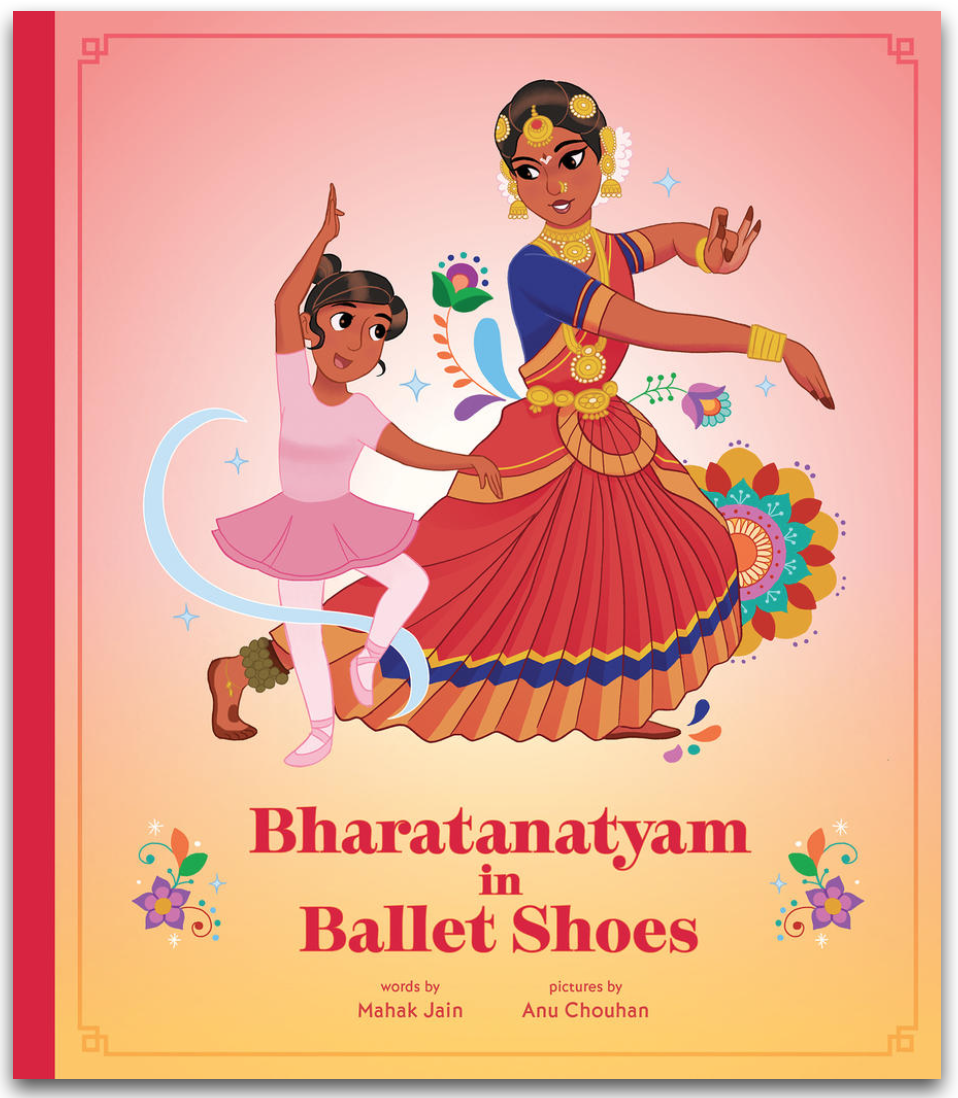
Palo loves doing Bharatanatyam, a classic Indian dance tradition, having learned from her mother whom she envisions as a queen of the dance. But when she heads to ballet class for the first time, she worries that she won't be able to dance and that her feet will fail her.
From Bharatanatyam in Ballet Shoes by Mahak Jain, illus. by Anu Chouhan
Though her toes seem eager to dance, Palo's apprehension grows as she meets young dancers Marco and Dana. They come from different backgrounds–Marco learned ballet as a baby and Dana learned to break dance from videos–and they are initially perplexed by Palo's unusual walk-dance. And when her Bharatanatyam moves get in the way of her ballet learning, Palo is not sure she'll be able to manage. Still Palo tells them about the Indian dance and about one of its most famous dancers, Rukmini Devi.

From Bharatanatyam in Ballet Shoes by Mahak Jain, illus. by Anu Chouhan

It's only when Palo can see, along with her new dance friends, that the glory is in the dance, whether Bharatanatyam or ballet or a blend of both, that she can accept that she really is a dancer.

While Bharatanatyam in Ballet Shoes will provide young readers with the inspiration to be themselves even if they worry that their differences will set them apart, I think that the picture book is more about the splendour of cultural diversity and inclusiveness of different art forms as both authentic and dynamic. How wonderful that a break dancer or a ballet dancer and a Bharatanatyam dancer can come together and learn, and even create something different. By doing so, Toronto's Mahak Jain, whose debut picture book Maya (Owlkids Books, 2016) gleaned her much positive attention, again brings her Indian culture to the forefront and introduces a classic dance tradition with its unique moves and costume (love the cross fan skirt). Moreover, she shows us that differences don't diminish who we are but rather enhance and that self-acceptance can mitigate any fears or worries about fitting in.

Anu Chouhan is a Punjabi-Canadian artist and game art director from BC whose artwork balances the boldness and brightness of Bharatanatyam with the soft and muted ballet. Whether it's the delicacy or the exotic, Anu Chouhan's artwork plays up that which defines them and unites them.
From Bharatanatyam in Ballet Shoes by Mahak Jain, illus. by Anu Chouhan
Palo may worry that Bharatanatyam and ballet are far too different to allow her to become a true dancer but Mahak Jain's afterword reveals a historical connection between two of the most famous dancers of each: Rukmini Devi and Anna Pavlova. If these two dancers could find a commonality that allowed them to blend elements of their dance with that of the other, then there's enough room for Bharatanatyam, and break dancing and ballroom and hip hop and more, to share any dance stage and studio around the world and bring dancing joy to those who move and those who watch.

January 10, 2022

Arnold the Super-ish Hero

Written by Heather Tekavec
Illustrated by Guillaume Perreault
Kids Can Press
978-1-5253-0309-8
32 pp.
Ages 4-7
2021

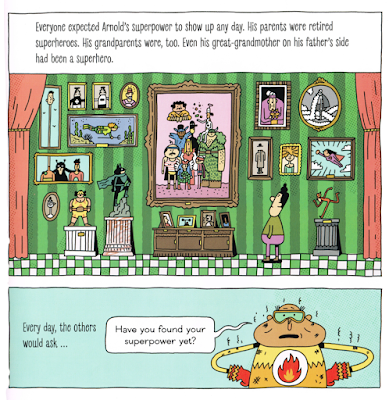
Arnold works in the family business, and that business is one of superheroes. They are superheroes like his super strong cousin and his super fast brother and his super bouncy uncle. But Arnold doesn't have a super power, yet, so, as they all wait for it to show up, Arnold is their phone guy.
From Arnold the Super-ish Hero by Heather Tekavec, illus. by Guillaume Perreault
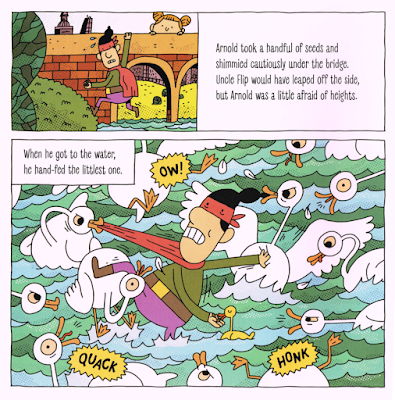
Then a call comes in for a superhero and no one responds when Arnold sounds the alarm. So, determined to follow the family motto of "Stop the bad guy from being a bad guy," Arnold dusts off his great-grandmother's mask and cape to find the crime. But just getting to the crime scene becomes problematic. As he speeds to the scene, as best he can after taking the bus, he comes across situations he misinterprets. A young man yelling at a woman in a wheelchair is actually a grandson trying to tell his grandmother who has lost her hearing aid to keep her hands off the tires so he can push her safely. Arnold's solution of giving the woman a stray kitten to hold works miracles for the grandson, grandmother and even the kitten. He sees a little girl throwing things in the water until she reveals she's trying to feed a baby duck before the more aggressive adults get the food. Arnold comes to the rescue again. 
From Arnold the Super-ish Hero by Heather Tekavec, illus. by Guillaume Perreault
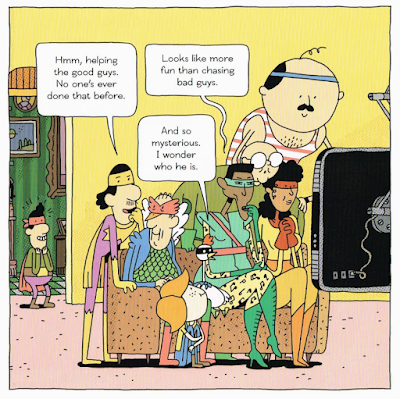
When Arnold finally gets to the called-in crime scene, he realizes that he can use his phone message-taking skills to good use to solve the problem and make two little girls very happy, with one declaring him a super-ish hero. After a few more good deeds, Arnold returns home to witness his efforts lauded on TV, with his family unaware that the Super Nice Guy superhero was their own family member. And that's a secret he's happy to keep to himself. (Oh, look, another superpower: keeping secrets!)

Kids love the idea of superheroes who can do beyond the norm, usually to fight crime and evil. But, if the past two years have shown us anything, it's that heroes come with all kinds of abilities, and goodness and kindness may be the greatest of all of these. As such, BC's Heather Tekavec has given us a humble character in Arnold, one who just wants to emulate his superhero family, but learns unintentionally that kindness is his strength. Even without trying for the spotlight, just stopping to offer assistance wherever help is needed, Arnold has become a hero. He's every guy and, with him, Heather Tekavec has shown us that anyone can be a hero.
From Arnold the Super-ish Hero by Heather Tekavec, illus. by Guillaume Perreault
Quebec illustrator Guillaume Perreault gives Arnold a banal look that works with the common person image. Except for a top-knot, there's not much to distinguish Arnold from anyone, including the reader. He doesn't stand out except when he does something kind. Guillaume Perreault may make Arnold's family members unique in their dress and skills but he makes Arnold stand out for his originality. In fact, Guillaume Perreault gives the whole book an understated feel with his choice of colours-no emphasis on bold primary colours–and blend of picture book illustrations with graphic novel boxes. Unlike most comic books about superheroes that bombard you with flash and action, Arnold the Super-ish Hero has the same restrained and easygoing appearance as does Arnold himself.

With a message that kindness is a superhero talent available to anyone, even Arnold, young readers will cheer for him and anyone who does good, knowing that the goodness comes in the doing, not from the recognition or the celebrity.

November 06, 2021

My Art, My World

Written by Rita Winkler with Helen Winkler and Mark Winkler
Art by Rita Winkler
Second Story Press
978-1-77260-214-2
32 pp.
Ages 6-9
October 2021
 
This is not a story. This is a life. It's a life well-lived by Rita Winkler, a young woman with Down Syndrome. She lives it with colour, with activity, and with heart. And she tells her life through her art, hence My Art, My World.
From My Art, My World by Rita Winkler
Rita introduces herself through a self-portrait and then discusses the making of her art: when, where, why. She reveals her activities like taking the bus, clearly the TTC, to her job at a coffee shop, and participating in dance class and yoga. She recounts anecdotes of seeing fish in a bag, dealing with pesky telemarketers and visiting her uncle in New York City. And she always represents it in her art.
From My Art, My World by Rita Winkler
But more than just capturing a moment in time, Rita Winkler expresses herself through her artwork. She recognizes how her art changes through the seasons, and how the season makes her feel. From summer flowers and Halloween, through Remembrance Day and New Year's Eve, Rita Winkler tells us how she feels through her art which is often, though not limited to, paint.
From My Art, My World by Rita Winkler
With a boldness of intent and line, Rita Winkler invites us to meet her and enter her world, one of artistic temperament, not of disability or limitations. It's a testament to what is and not what isn't and that message of acceptance is paramount to the verve in Rita Winkler's life and My Art, My World.

July 19, 2021

Sully, Messed Up

Written by Stephanie Simpson McLellan
Red Deer Press
978-0-88995-637-7
312 pp.
Ages 11-15
April 2021

Who is Sullivan Brewster? He's Sullivan to his mom, Rooster to his little sister Eva, and Van to his stepdad Bill. He's Sully to his friend Morty, who has changed his own moniker to Morsixx since reinventing himself over the summer before their first year in high school. And to those who don't know him or want to target him, he becomes Bella, Sally and a host of horrible nicknames. Is it any wonder that thirteen-year-old Sully doesn't know who he is or what he should be doing or who his friends are? He truly is messed up, and that doesn't even count the messing up he's getting from a trio of bullies named Tank, Ox and Dodger.
 
Sully's story seems to start on that first day of Grade 9 when he wakes up with his facial elements relocated around his head.
His nose, pink and dripping, hunkered sideways on his left temple. One of his ears–it was hard to tell which one from the unfamiliar angle–bulged where his nose should have been. The other protruded, antenna-like, right above his lips, which quivered, post-scream, in the middle of his forehead. (pg. 9)
But no one seems to notice. Still, Sully uses his long hair to hide his potential disfigurement. This instead grabs the attention of Tank, the overlord at Wild Forest Secondary, and his sidekicks Dodger and Ox. Worried that he will now become the victim of the Gr. 9 hazing called the Naked Niner, whereby a selected student is unclothed and photographed and publicly humiliated, Sully tries to stay out of Tank's field of view. Unfortunately, everything he does seems to garner him more unwanted attention. 
 
First, he believes his friend and locker partner Morty/Morsixx is drawing too much attention with his new emo boy look and attitude so Sully starts avoiding him by carrying his backpack everywhere, hiding out in the parking lot at lunch and abstaining from taking the bus. Even though Morsixx and Blossom, a new girl who adorns her face and arms with ink of vines and flowers, try to support him, Sully continues to reject their efforts. Then he's given the topic of menstruation for his Sex Education class and Dodger pranks him with countless tampons, earning him the displeasure of the principal and a host of new nicknames.
 
When he begins to walk to and from school, past a purple house on True Street, with its fence adored with an unusual assortment of figurines in ever-changing scenes, Sully becomes acquainted with the Purse Lady who gets his attention when she asks him, "What happened to your face?" (pg. 80) But who is she and why does Mr. C, the strange man in the purple house, seem to know her and Sully and maybe even what is happening in his life, all represented in the figurines of Charlie Brown, the Knight, Sleeping Beauty, Darth Vader and more?
 
School can be a place of refuge for some but for others, especially those who become marked as victims, it can be brutal. And for Grade 9 students, it can be especially challenging. With an implicit hierarchy of power and confusion about the supports which they may or may not have, those preyed upon by bullies may become even more isolated. This is Sully who confuses his friends with contributing to his victimization and who doesn't want to worry his family. He is awkward in discussions with his teachers and his principal and then makes further choices that complicate things for himself. But, while Sully has been victimized, Stephanie Simpson McLellan tries not to play up the young teen as a victim. He is instead confused or rather messed up. He's got all the basics–friends, family, the will– to make things right but, like his face, things just haven't fallen into place correctly. Fortunately, when he can see beyond his personal disasters and into those of others, Sully learns to stand up for himself and help himself adapt. This is an important message for young people and, amidst all Sully's struggles, it's one that Stephanie Simpson McLellan emphasizes. With some insight and a little help from others, Sully is finally able to put to rights his situation and find himself.

• • • • • • • • •

Tomorrow I interview author Stephanie Simpson McLellan about Sully, Messed Up. For middle-graders and early young adults and their parents and their teachers, this Q & A will speak to all of you.

March 24, 2021

The Bare Naked Book

Written by Kathy Stinson
Illustrated by Melissa Cho
Annick Press
978-1-77321-472-6
36 pp.
Ages 3-5
March 2021

We are all different and we are all the same, and this new edition of Kathy Stinson's classic body book reminds us of this. It celebrates how we are all similar in our body parts of hair, eyes, ears, noses, arms, teeth, tongues, bums, genitals, navels, toes and more and yet our differences in these similarities make us all naturally unique. The Bare Naked Book uncovers, i.e., lays bare (!), all the body facts to help little ones understand their bodies' bits and pieces and accept themselves as they are.
From The Bare Naked Book by Kathy Stinson, illus. by Melissa Cho
With a wonderful parade of bodies, Kathy Stinson starts her picture book with the declaration that...
Bodies, bodies!
Big and small,
short and tall,
young and old–
Every BODY is different!
Her sentiment is reflected in Melissa Cho's illustrations of people of all ages, colours, abilities and sizes who undoubtedly are as different on the inside as they are on the outside. (Aren't we all?)
From The Bare Naked Book by Kathy Stinson, illus. by Melissa Cho
Then Kathy Stinson looks at different body parts and how they may be different or what they can do, whether it be seeing or not seeing eyes that can cry or wink, or hands "Washing, holding, clapping, folding, dining, signing."
From The Bare Naked Book by Kathy Stinson, illus. by Melissa Cho
With each body part comes a question to help young children, primarily toddlers and preschoolers, locate their own for themselves. This reinforces their understanding and begins the discussion about how we are the same but different. There are additional lessons in Kathy Stinson's subtle statements like "Whatever you call whatever you have, your genitals belong to you" and a reminder after using your bum for a toilet break to "Remember please to wipe–and wash your hands!"
 
Kathy Stinson's original The Bare Naked Book (Annick Press, 1986), illustrated by Heather Collins, garnered much attention for its unabashed naming of human body parts but its honesty has won legions of fans. This new edition uses some of the original text but there is much that has been revised, providing a contemporary outlook of our world. Enhanced with illustrations by animator and designer Melissa Cho, The Bare Naked Book now reflects fully the diversity of our population. There are individuals of all shapes and colours and abilities, healthy and not so healthy, decorated and scarred, and all wonderfully uncommon and common. Melissa Cho makes our bodies a celebration of boldness, in colour and shape, and helps to ensure that every child will see themselves and those important to them in The Bare Naked Book. I was impressed by the diversity of physical traits and implied attributes of religion, culture, gender expression and relationships rarely seen in children's books but integral in our beautifully-varied world. These include a woman in a burka, several persons with amputated limbs including one with a blade prosthetic, someone with vitiligo, and another with mastectomy scars. It's as Kathy Stinson culminates her book...
Bodies, bodies
To love and to 
celebrate.
So many 
wonderful 
bodies!
From The Bare Naked Book by Kathy Stinson, illus. by Melissa Cho

June 15, 2020

Benjamin's Blue Feet

Written and illustrated by Sue Macartney
Pajama Press
978-1-77278-111-3
32 pp.
Ages 3-7
June 2020

Benjamin is a blue-footed booby who lives on an island in the Galapagos and loves searching for treasure. Unfortunately, with plenty of garbage clogging the oceans, it’s not surprising that much settles on Benjamin’s island. He finds a red “string-stretch-it” and an orange “hole-thing-um” and then he finds a “twink-um-doodle” a.k.a. a mirror. 
From Benjamin's Blue Feet by Sue Macartney
Unfortunately mirrors can be a curse for those of us who see in them what we don’t want to see. Benjamin sees that his beak is straight and very long, his wings are wide and bristly and his feet that are blue and floppy. And everything is different from those of his island mates.
From Benjamin's Blue Feet by Sue Macartney
Sadly Benjamin looks to his other found treasure to change his appearance, squeezing several onto his body to mask his “unsightly” body parts. 
From Benjamin's Blue Feet by Sue Macartney
Though a host of animals including sea lions, iguanas and finches laugh at his plastic enhancements, it is not until Benjamin recognizes the value in his big feet to his swimming, the beak to his fishing and his wings to his flying that this blue-footed booby appreciates all his attributes as they are.
From Benjamin's Blue Feet by Sue Macartney
Author-illustrator Sue Macartney tackles a lot of big issues in Benjamin's Blue Feet while maintaining a sweet story about a curious bird who finds novelty in junk. Like a child who finds gems among stones, Benjamin finds treasure in the garbage that washes up on shore. But it's that mirror that causes him to lose faith in himself when he finally sees what he looks like. By comparing himself to others, he deems himself less. And though he uses dangerous garbage to amend his appearance and can safely extricate himself from its inherent peril, this is what it takes for Benjamin to appreciate his morphological appearance as perfect for the functions of a blue-footed booby.

Sue Macartney’s art, created with pen and ink and digital media, always places the emphasis on Benjamin’s blue feet except when the garish garbage is around. His blue feet are vibrant and still harmonious with the earthiness of his environment, unlike the incongruous junk with its artificial and discordant colours.  Though Sue Macartney carries the reader to the unique environment of the Galapagos through the content of the landscape and its creatures (she also includes a double-spread of an assortment of "Creatures of the Galapagos"), I was especially mesmerized by her aquatic environment. She imbues her water with such hues of green and blues and textures of crinkly waves and whitecaps that the saltwater spray is almost palpable.
From Benjamin's Blue Feet by Sue Macartney
Benjamin may be surreal as a blue-footed booby who talks and can manipulate man-made junk, but the problem of ocean garbage and negative body image are not. They are dangerous challenges to our world and ourselves and teaching young children about them via an amiable bird reflects well on Sue Macartney and Benjamin both.

 • • • • • • • • • •

Tomorrow I interview author and illustrator of Benjamin's Blue Feet, Sue Macartney, about her new picture book.

August 06, 2019

Lili Macaroni

Written by Nicole Testa
Illustrated by Annie Boulanger
Pajama Press
978-1-77278-093-2
32 pp.
Ages 4-7
August 2019

It's too bad that school, a place of opportunity and learning, can be such a stressful experience for some young children. In fact, it can cause so much anxiety that they need to develop coping strategies to get through. That's a problem with the system, not the child, though it is difficult to see the troubles as anything but internal and very personal. Fortunately for Lili, she learns something about making things tolerable for herself and helps out others in the process.
From Lili Macaroni by Nicole Testa, illus. by Annie Boulanger
Lili can see her family in her hair, in her freckles, her eyes and her laughter. Her joie de vivre fills her days with love and imaginative play. When Lili is old enough to go to school, she looks forward to learning and meeting new friends. She does learn much, including about butterflies and moths. But when her new friends make fun of her last name, calling her Lili Macaroni-and-cheese, and her hair, eyes, freckles and laugh, Lili's joy begins to leak from her.
Why didn't Mom, Dad, Grandma, or Grandpa tell me that it wasn't good to be Lili Macaroni?
From Lili Macaroni by Nicole Testa, illus. by Annie Boulanger
Though she'd always said "I am the way I am," Lili is now envisioning herself as a dark-haired girl with no freckles. But Sophia is not her.
From Lili Macaroni by Nicole Testa, illus. by Annie Boulanger
Her dad suggests she draw one of her lovely polka-dotted butterflies to "help fly the heartache away." Clipping it to her shoulder, Lili feels the weight of the teasing leave her. It's a strategy she shares with her teacher who in turn shares Lili's butterfly solution with all her students.
From Lili Macaroni by Nicole Testa, illus. by Annie Boulanger
Teasing can be playful but it can also be bullying and very young children don't always know when one has become the other. In the mean while, there are little ones like Lili who must endure humiliating comments about their physical appearance and then wish they were anyone other than themselves. Fortunately, author Nicole Testa surrounds Lili with some very astute adults who recognize the little girl's need to feel good about being herself. Without hoovering up her bad feelings or demanding the school take action, they allow Lili to make her coping strategy work for her.  It's positive and it's empowering.

Quebec illustrator Annie Boulanger, who illustrated Nicole Testa's French-language Lili Macaroni: Je suis comme je suis! (Dominique et compagnie, 2017), gives Lili all the attributes the text imbues her with. She's a little wild, a lot of fun, and a whole lot of smart. She's colourful and inquisitive and enthusiastic. But when she' sad, the light is gone from her eyes and her clothing and the page.
From Lili Macaroni by Nicole Testa, illus. by Annie Boulanger
For young children going off to school for the first time, Lili Macaroni will help prepare them to recognize teasing that is insensitive and harmful and help them handle it for themselves as well as for others.

April 12, 2018

What Happens Next

Written by Susan Hughes
Illustrated by Carey Sookocheff
Owlkids Books
978-1-77147-165-7
40 pp.
Ages 4+
March 2018

Carey Sookocheff's understated illustrations may give the impression of a simple story but Susan Hughes' What Happens Next is nothing less than a compelling revelation about the secretive and debilitating nature of bullying and the sharing of an inspired strategy for resolution which begins with empathy.
From What Happens Next by Susan Hughes, illus. by Carey Sookocheff
The story of What Happens Next follows a child who is bullied by another child at school with name-calling ("Weirdo") and hurtful comments and physical acts like blocking their way and shoving at their books.  Sadly, there are children who are bystanders who either laugh or ignore the bullying.  Even though the child who is bullied has many positives at home like a playful and loving dog and a caring parent, this child carries the burden of the bullying which affects their sleep and behaviour. 
From What Happens Next by Susan Hughes, illus. by Carey Sookocheff
Finally the child, encouraged by their love of books and science, feels strong enough to share with Mom what has been going on with Bully B.
What I Say about Bully B. When Mom Comes to Kiss Me Good Night:
Everything.

What Mom Says:
That I'm brave for telling her.
That she's sorry I feel scared and hurt.
That she'll help.
But it's the mother's intensity of empathetic insight that should be included in every handbook on dealing with bullies.
What Mom Says Next:
That everyone has their own way of looking at things and people.  That each person's way of looking is made up of where they're standing and how they got there.  It's made up of what's in their mind, what's in their heart, and what's in their imagination.
From What Happens Next by Susan Hughes, illus. by Carey Sookocheff
And with that, Mom shows her child that, by sharing things they like with Bully B., they may be able to help change Bully B.'s way of looking. With courage and some trepidation, and ignoring Bully B.'s habitual meanness, the child tells Bully B. about genomes, water on the Earth's surface and Earth in the orbit around the Sun.
What's Different Now:
Not everything. But enough.
In fact, I'll let you read What Happens Next for yourself to see that enough is pretty darn good.

You'll notice that Susan Hughes' text takes on a form similar to a script with bolded directives and plain-text responses that gives an organic texture to the story.  In fact, when the child is being bullied or worried about the bullying, the text is very terse, like punches.  When involved with their books and the science within, as well as when Mom shares her insight into bullying, the text is softer, like blankets.  Illustrator Carey Sookocheff's artwork reflects this imbalance through her choice of colours and simple lines and shapes.  Everything is understated from her limited palette of pale grey and yellow with white, against grey-blue, green and red-orange to her simple scenes at home and playground.  But simple here is meaningful, as substantial as a careless case of  bullying.

What Happens Next is like nothing I've ever read for opening up discussions about bullying with our youngest readers to those in middle grades. To that end, Owlkids Books has created discussion guides for using the book with children. There is one for Grades 1-3 and one for Grades 4-6 and both are available at the Owlkids Books website. I encourage everyone, from educators and school administrators to parents and child and youth care workers to make What Happens Next a part of their programming to encourage meaningful lessons and dialogue about this perennial issue.

🌎🌎🌎🌎🌎🌎

Copies of the illustrations from within What Happens Next were retrieved from Carey Sookocheff's website, specifically at http://careysookocheff.com/what-happens-next/ on April 9, 2018, as they afford clarity of image that my own scans of the book could not.

March 28, 2017

A Horse Named Steve

Written and illustrated by Kelly Collier
Kids Can Press
978-1-77138-736
32 pp.
Ages 4-8
April 2017

Steve is a horse who wants to be exceptional.  When he finds a golden horn in the woods, he attaches it by string to his head, convinced it will make him very special. As Steve parades it in front of his miscellaneous animal friends, cooing about how fancy he is and how ordinary everyone else is, the horn begins to slip from his head until it’s hanging around his neck.  As the other animals begin attaching random embellishments like a branch, an acorn, a mushroom, or a leafy twig to their own heads, Bob the raccoon reveals to Steve that there is no beautiful gold horn on the horse’s head.  Steve starts to panic, searching everywhere and crying despairingly.  When he is convinced that his horn has fallen into the water, Steve demonstrates the lengths to which he’ll go to be considered distinct, revealing more about his desire for individuality than it does for his need for celebrity.
From A Horse Named Steve 
by Kelly Collier
There is definitely a Mélanie Watt Scaredy Squirrel tone to A Horse Named Steve, primarily because of Kelly Collier’s ridiculously self-absorbed horse, sidebar comments throughout the multi-fonted text, and the awkward relationships between Steve and his cohorts.  But A Horse Named Steve is as unique as Steve himself wants to be.  Few characters are a blend of Steve’s ludicrousness and wretchedness so evident in his pursuit, especially since he is convinced that a golden horn will fulfil that need.  But Steve is more childish than mean, craving attention and not knowing how to get it in a positive way.  Kelly Collier’s story reminds us how much the world is driven by individuals desiring fame and celebrity when their uniqueness would serve them better in highlighting their exceptionalities.

A Horse Named Steve is a quirky story about a horse who doesn’t realize how original he already is, and Kelly Collier’s illustrations are as eccentric as he is.  With simple lines and very few colours (black and white with beige), Kelly Collier both pokes fun at her characters, whose distinct facial expressions share hidden meaning, and society in general while amusing young readers with the absurdity of Steve’s passion for a distinction he already has.  They’ll laugh at his silliness but I hope they’ll appreciate his differences as hallmarks of extraordinariness.
From A Horse Named Steve 
by Kelly Collier