Showing posts with label gaming. Show all posts

March 25, 2024

Leon Levels Up: Q & A with author Paul Coccia


Leon Levels Up 
 (Orca Currents)
Written by Paul Coccia
Orca Book Publishers
978-1-459837355
112 pp.
Ages 9-12
RL 2.3
February 2024
 
On Feburary 16, 2024, I reviewed Paul Coccia's latest novel, a hi-lo middle grade story titled Leon Levels Up. With the official launch coming soon, Paul Coccia graciously agreed to a Q & A with me about the book. This is that interview.
 
 • • • • • • •
 
Author Paul Coccia


Helen KubiwLeon Levels Up is definitely a story embedded in gaming. Why choose this is as a vehicle for your plot?

Paul Coccia:  There were the inspirations of my nephew and friend to whom I dedicated the book. My friend got a rather expensive virtual reality gaming system during the pandemic (when the book idea was conceived) and I realized that during isolation, the online world and gaming allowed a lot of people to connect virtually when we couldn’t in-person. My nephew loves video games and it seemed like a story premise that would appeal to kids.
     This next reason will sound writerly in some ways, but I was thinking about the child main character and their agency. When I thought of my chubby, non-athletic Leon who (like me) is not very good at sports, I also thought about where he would feel empowered. The virtual world provided the opportunity for Leon to feel strong and do things he’d never be able to do in the real world. Thinking about why a person would gravitate to video games gave me insight into Leon’s character and how he could be an action hero.


HKYou acknowledge help from others with the topic of gaming, but do you do any gaming or did you try gaming to understand it better?

Paul Coccia:  I’m a very casual video game player and tend toward classic big-name franchises you’d likely find on the Nintendo systems. I’ve tried and found out that the first-person perspective a lot of games (and virtual reality) use is a sure way to have my character stuck in a corner. I can’t figure it out! Give me one of those dance competition video games though and I can get that choreography down quickly though.
     I do enjoy playing video games though, especially with one of my brothers or my nephew. I find it relaxing and entertaining, but I can go long periods without missing playing them. I enjoy the interactions with them more than I do the actual games.


HKThough Leon Levels Up is a piece of fiction, how real is the possibility of the tech that Leon and Nico play with at Pix Grid?

Paul Coccia:  All the technology presented in the novel is already in existence.  Nanobots, for example, have existed for years. I read they were being used for medical procedures and thought that was a cool use of modern technology.
      I wanted the game to be entirely possible in terms of technology and where it is today. However, someone making a game that involves tanks of nanobots in a gel is unlikely. Besides safety, there are hygiene concerns for cleaning the tank. The big deterrent would be the cost of making it combined with very few people being able to afford it. No video game company would take this on because it would cost a fortune. Is it possible though? Absolutely! 


HKDo you think Nico only used Leon so that he could get Gabs to let him play Dragon Hunt? Or do you think he saw something beyond what Leon could do for him?

Paul Coccia:  This question is very insightful. Nico is a character who thinks a lot of himself. When he invited Leon to play Dragon Hunt, Nico honestly felt the only person who had the skills worthy of playing with the great Nico was Leon. Nico wanted someone on his level of gaming. Leon was the only one who could possibly match or rival Nico’s skill in Nico’s eyes. This made Leon a worthy opponent/co-gamer. I don’t think readers would be surprised I think of Nico with this level of hubris.


HKToo many people see themselves only in terms of others, as does Leon. So, it’s not surprising that someone like Leon sees himself as “low level” when he compares himself to someone like Nico. What would you say to teens who only see themselves in terms of others? And would this be the same thing you would tell your teen self now?

Paul Coccia:  I think comparison is natural as is wanting and liking external validation, although it is not always fruitful. If all we look for is external validation, we will always be looking for an outside source for it. Internal validation, while it can be a difficult process, is a better investment for emotional energy. You can and should also consider if the person’s opinion you value is worth valuing and why.
     For my younger self, I would advise the sooner I stopped focusing on what people who don’t matter in my life thought I should do, I’d free up a lot of time and energy. With those, I can not only do things fulfilling to me, but appreciate, admire, and celebrate others without the negative effects of comparison. I can only be the best me; I can’t be the best someone else.


HK:   The hi-lo genre (high interest, low vocabulary) like that of the Orca Currents series is a popular one for older readers who may be challenged by reading. What are the challenges for you as an author to write a hi-lo novel?

Paul Coccia:  I find the length of hi-los the most challenging aspect. I find it easiest naturally to work in longer novel form. Things like word choice, sentence length, or complexity of the plot can be challenges, but they’re also incredibly rewarding when you know you’re hitting the mark. I find certain elements that make successful hi-lo books (e.g. dialogue tags like “he said”) are used more and can sound a bit clunky when writing or reading, but they are important for the hi-lo reader. Using a dependent clause as a sentence is another that technically is incorrect writing, but a hi-lo writer needs to break the rules for their readers’ success.


HKLeon Levels Up is a true coming-of-age story as Leon recognizes worth outside of materialism and popularity, becoming more grounded in realism as he immerses himself in the unreal. How hard is it to write a coming-of-age story in which a character must progress or develop in such a big way but in fewer pages than other novels?

Paul Coccia:  I’m a character-driven writer. It’s all about the character with me so length affecting character arc wasn’t as bad as the action was. Because Leon is running for his life quite literally a big chunk of the book, it became harder to build in situations where the character could stop and reflect. He’s too busy reacting physically to stop and have complex emotions beyond fear. In editing, I went back through to find where those moments could exist and build them out to help the reader get into Leon’s mind and understand his inferiority.
     One element of Leon that was very enjoyable to write was his age. Leon isn’t so young he is unaware of the world around him. He also isn’t too old to hide his vulnerabilities or emotions. Leon had a sweetness and sincerity to him I particularly liked writing.
 
 
HKI know you have a picture book coming out, and have written middle grade, young adult, and a short story as part of an anthology. Which genre was the most satisfying to write and which was the most difficult to write?

Paul Coccia:  One of the nice things about switching genres or audiences is getting to flex writing muscles I don’t always use like with articles or personal essays I’ve written for adults or the short story in Acorn Press’ The Annethology. Each project has helped me learn and deepen my respect for literature, particularly children’s literature.
     I’ve gotten a lot of satisfaction from each stab at a genre but know that my comfort zone is young adult novels.
     Picture books are a whole new challenge. They are hard! Writing them does not come easily to me. I have such admiration for picture book authors and illustrators who make it look easy. You need to be concise, choose few and just the right words, and still craft great stories and characters. They’re very rewarding, but less words do not equal less skill required. I think the opposite may be true.
 
• • • • • • •

Many thanks to Paul Coccia for being open to a Q & A, for taking the time to answer my questions, and for giving me a different perspective on a fabulous book which I had already enjoyed. Now I have more to think about, particularly, "I can only be the best me; I can’t be the best someone else." These are words to live by.

• • • • • • •
 
Great news: there's a book launch coming! 

Join Paul Coccia 
 
at

A Different Drummer Books
513 Locust Street
Burlington, Ontario

on
 
Saturday, April 6, 2024
1 PM (local time)

It's a great opportunity to pick up a signed copy of Leon Levels Up, meet Paul Coccia, and learn more about his book. 
Hope to see you there!

February 16, 2024

Leon Levels Up (Orca Currents)

Written by Paul Coccia
Orca Book Publishers
978-1-459837355
112 pp.
Ages 9-12
RL 2.3
February 2024
 
Twelve-year-old Leon Garcia considers himself a low-level kid gamer. He's not low-level because of his game playing but because of who he is. All he sees is that he's chubby, his mom cuts his hair, he wears his cousin's hand-me-downs, and he uses outdated tech. So, when his classmate Nico Saito, son of the founder of video-game developer Pix Grid, approaches him and invites him to game together on the weekend, Leon is surprised, pleased, and nervous. Leon figures this could be his chance to level up his life, or at least his coolness.
 
But a day of gaming is not just hanging out at Nico's house. Instead, Nico takes Leon to Pix Grid where they meet up with Gabs Lucas in the lab to play a next-level virtual-reality game which is so immersive the two boys suit up in full-body tracking outfits before being dropped into tanks filled with nanobots. Though Leon's thrilled with how strong and tall and skilled he is as an elf archer, Gabs tells him she's lost the connection with Nico who may have damaged his helmet when he plunged headfirst into the tank. And with the nanobots programmed to fill every available space, there's the danger of hurting Nico.  The only way to get them out safely is for Leon to complete the mission of saving the kidnapped Prince SpearMint from the dragon Lord Tachi. Oh, and before the timer runs out.

Leon Levels Up has all the excitement of a video game adventure in which Leon evades and fights a dragon, an old hag, and some ogres, while figuring out clues and strategy to rescue Prince SpearMint. As with many quests, the learning is in the doing, and Leon is plunged into this VR game with its life-or-death outcome with only his wits and character. He might have hoped that gaming with Nico would level up his game, but his cleverness and perseverance demonstrate he's already top drawer. 

Author Paul Coccia, whose other books include I Got You Babe, The Player, and On the Line with Eric Walters, often gives voice to young people who question who they are and whether they are good enough, and that's many tweens and teens. (It's also most adults.) Except for the narcissistic and the very confident, we compare ourselves to others and whether we pass muster. When faced with the good-looking and rich Nico Saito, Leon turns to look within and take stock. He ruminates about how he will be seen and judged, while judging himself. Only when he's in the "Dragon Hunt" game does he eventually set that aside, first appreciating his new persona and skills but ultimately recognizing that it was him, low-level Leon, who won the game. Paul Coccia takes us for a wild ride in Leon Levels Up, all at a lower reading level than typical for the middle grade reader, but never forgets to remind us that Leon never needed to advance to a higher level of self. For a twelve-year-old, he was already there.

July 25, 2019

Level 13

Written by Gordon Korman
Scholastic Press
978-1-338-28620-5
241 pp.
Ages 8-12
July 2019

Cameron Boxer is a middle-grade slacker. He acknowledges this and is happy with a life style that allows him to play video games, hang with his friends Chuck and Pavel, and eat junk food. Of course, most parents and schools aren't supportive of slackers and so Cam has had to find a way to appease them with a façade of effort (see Slacker by Gordon Korman; Scholastic 2016) and he's done this by establishing P.A.G. a.k.a. Positive Action Group. But things tend to get out of hand when Cam is involved and his community service club has ballooned to 874 kids who think Cam, president of P.A.G., is a stand-up kind of guy who wants to do good work. So while all the paggers are working on a fundraiser for the public library, Cam is trying to avoid getting involved in anything that would take him away from his gaming and potential money-making endeavour as a live streamer.

Being the slacker he is, Cam comes up with a plan that would give him all the time needed for gaming and still look good. He lies to all, except Pavel and Chuck, that he's failing in his schoolwork because of his commitment to P.A.G. and allows Chuck's new girlfriend Daphne to take over as an interim president. To cover up his gaming, Cam creates a new account as GameFox229 and wears a disguise of an old Zorro mask and stuffs gummy worms in his mouth. When Chuck brings Elvis, the beaver the kids helped out in Slacker, over to Cam's house–Daphne is worried how thin he is–the number of followers and subscribers watching Cam explodes. Seems the rodent is mesmerized watching Cam play, getting into the game with sounds and expressions that suggest he knows exactly what's going on. Moreover, when Cam discovers an old version of the Guardians of Geldorf game with a banned Level 13 and is determined to make history with it, Elvis is all in.

But the Awesome Threesome, Cam, Pavel and Chuck, are struggling to stay a cohesive group while Chuck tries to balance his commitment to Daphne and Pavel struggles to keep up his stellar grades while always helping to transport Elvis to join Cam for his streaming sessions.

You know things have to go wrong. Soon all the paggers, without letting anyone else know, are taking over Cam's schoolwork to ensure that his marks improve so he can once again lead them in P.A.G. Elvis is not getting any fatter and Daphne is starting to worry about his health and the frequency of his absences from his habitat. Chuck and Pavel, knowing the truth of Cam's successes, are dismayed to see him held up as a hero of good works and marks. Even Cam's sister Melody gets into things by blackmailing him. Cam and his schemes are a runaway train and he has to get things back on track before he loses everything: his reputation, his friends, and even his health.
When he got mixed up in things–even dumb things–they could balloon to Hindenburg size in the blink of an eye.
     Then again, remember what happened to the Hindenburg. (pg. 122)
Gordon Korman gives kids a story they'll laugh at while envying Cam. Think about how many children would admire Cam for his artful scheming, continued luck, and ability to avoid scandal. He may call himself a slacker but he puts so much effort into his plans and their realization that he becomes a slave to his hobby. Level 13 could be considered a cautionary tale about the dangers of addictive behaviour and taking advantage of others but it's more a laugh on how the best laid plans can go wrong, even for those like Cam who were born under a lucky star. Regardless of the glitch in Cam's plan to becoming a professional gamer, he keeps leveling up, learning more about himself and others and appreciating a life beyond that of a slacker. For the Win!

February 27, 2019

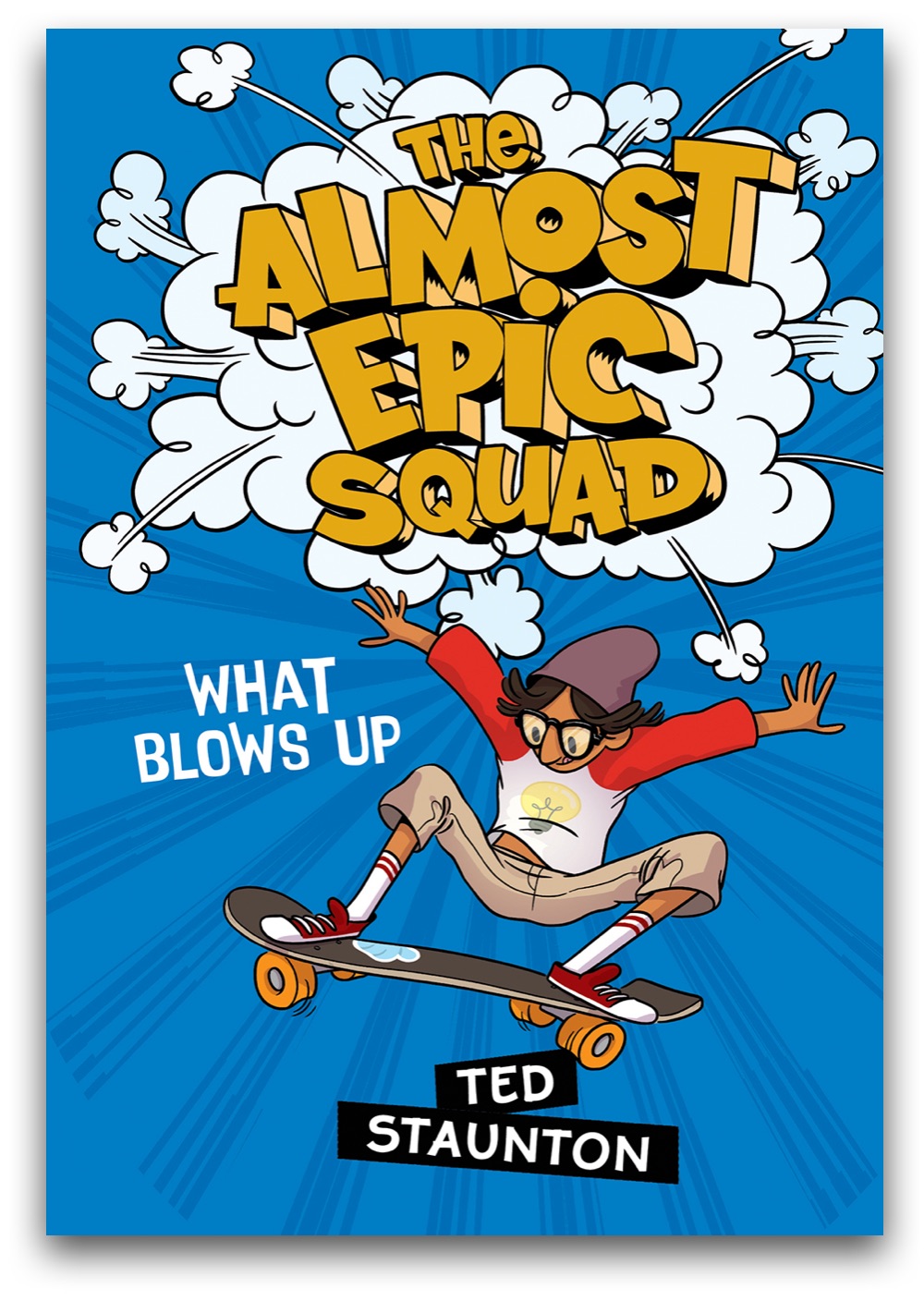
The Almost Epic Squad: What Blows Up

Written by Ted Staunton
Illustrated by Britt Wilson
Scholastic Canada
978-1-4431-5782-7
163 pp.
Ages 8013
January 2019

Thirteen years ago, four babies in the Dimly, Manitoba hospital were irradiated (or should that be irreidiated?) with reidium from the dust of its Dimly light bulbs when the electrical system overloaded during a storm. Since that time, the four children have been tracked by Dr. Fassbinder who is currently at the Institut de l'ennui/Boredom Institute. Now that the four are reaching puberty and their almost-epic superpowers are kicking in, everyone wants a piece of the action, whether to study them or abuse their powers.

Readers met Jessica Flem, the first of Dimly, Manitoba's almost superheroes in Kevin Sylvester's Mucus Mayhem (Scholastic Canada, 2018) and in What Blows Up, Ted Staunton introduces us to another, Gary Lundborg. Gary is a tall and clumsy kid–his nickname is Clumsborg–who is forgetful and has difficulties concentrating, though he does get "feelings" to which he pays attention. He seems pretty average, even if intuitive. But during testing, Dr. Fassbinder and his mouse research technicians realize that Gary is telekinetic, moving objects by simply imagining doing so. Strangely, his power cycle is between 3 and 6 a.m. only but it can be boosted by eating garlic.
From What Blows Up (The Almost Epic Squad) by Ted Staunton, illus. by Britt Wilson
When Gary gets the call from Bernard Cheeper of Department C, the boy is whisked away, first to training camp and then to the Balkan country of Pianvia, one of the few sources of reidium along with garlic, in order to help thwart the criminal plan of the elusive Boss. Seems the Boss, aided by teen evil genius Malevia Spleene and her Green Bay Packer bots, along with a work force of moles, has a plan of her own when it comes to the almost epic superheroes of Dimly.
But now, a quick perfume spritz and back to work. There was still Greep and Bafflegab to scream at and the Cat-A-Tonic gas dispenser to top up. So little time, so much evil: a villain’s work was never done. (pg. 107)
In a plot rife with minions, villains, superheroes (sort of), yaks, and double-crossing and humour, Ted Staunton continues The Almost Epic Squad as the very funny middle-grade series it is. (Kudos to Scholastic Canada for choosing such exceptionally humourous writers for the series.) Though What Blows Up, and you'll have to read the book to find out what that is, touches on Jess Flem's story and hints at the remaining squad members in the next two books, it is a solid stand-alone that will draw chuckles and sympathy for the awkward Gary and boos and jeers against the weirdly-costumed Boss and an assortment of freelance masterminds. The plot is complex with its multi-layers, and hilariously entertaining with its voice and unique story elements like a polo game on yaks, a mouse looking to cut a reality TV deal and an assortment of mishaps by poor Gary.
Machines beeped and hummed as he guided balloons (tricky), printed on a whiteboard (very tricky), and threw darts (don't ask) using mind power. Then came a couple of accidental don't-asks involving a tennis racquet and a Bunsen burner. (pg. 27)
Add some graphic novel-like illustrations from Britt Wilson and Ted Staunton's What Blows Up truly feels like a superhero story, albeit one in which the superhero doesn't always know what he's doing but he tries. With the last two kids of The Almost Epic Squad having their stories told in Lesley Livingston's Super Sketchy and in Richard Scrimger's Irresistible, these unlikely champions look like they're heading to make the world a safer place from villains while entertaining readers with their quirkiness and almost epic efforts.
There are loads of extras including videos, etc. at the Scholastic Canada website http://www.scholastic.ca/books/series/almost-epic/ so do check it out for more fun.

November 16, 2018

The Almost Epic Squad: Mucus Mayhem

Written by Kevin Sylvester
Illustrated by Britt Wilson
Scholastic Canada
978-1-4431-5779-7
187 pp.
Ages 8-13
September 2018 

In a hospital nursery in Dimly, Manitoba thirteen years earlier, a storm overloads the emergency lighting system and four babies are showered with the glowing dust from the reidium bulbs (the once famous Dimly Bulbs).  Four babies, four characters, four books.  This is Baby Flem's story. 

Baby Flem is actually Jessica Flem, an extraordinary gamer of Gang of Greats who is bizarrely afflicted with allergies. The thirteen-year-old, whose nose had been affected in the accident, must use copious tissues as well as her puffer, to relieve her congestion. Turning 13, Jessica is prepared for her annual checkup and bizarre questioning by Dr. Fassbinder, now of the Insitut de l'ennui, and another superfluous visit from her "babysitter" Garvia Greep who gifts her with a diary in which to chronicle her "changes."
Her voice sounded sickly sweet like a snake trying to do a Taylor Swift imitation. (pg. 25)
Dr. Fassbinder's questions about magic and flying and other weird stuff may seem outrageous but not as crazy as the small green gummy-like man who appears amidst her used tissues to sweep them up. Dr. Fassbinder doesn't seem too flummoxed by the green janitor who grows as Jess uses more tissues but disappears when finished, though her only friend, Cliff Snuffington, is fascinated by her "snot golem." (Of course, he's the guy who collects her used tissues, calling them "ori-gummy creations" and gathers them in plastic sandwich bags for his collection.)

Then the really weird stuff starts happening. You're probably wondering how things could get any weirder.  Well, Jess's notes begin disappearing from her diary; she discovers a dossier about her situation; her parents disappear; an old blimp manned by Garvia Greep starts pursuing them; a talking lab mouse named Algernon comes to their aid; and Jess tries to control her mucus-transforming power. And all the while she is participating in a Game of Greats tournament, aiming to reach Grand Master.

Transforming mucus into creatures to do your bidding, whether cleaning or fighting bad guys, may not exactly be a superpower all would aspire to have but it's completely appropriate for a young teen of the The Almost Epic Squad. (We'll have to wait for Books 2, 3, and 4 by Ted Staunton, Lesley Livingston and Richard Scrimger, to learn about the almost epic superpowers of the remaining thirteen-year-olds. See below for details.) Mucus Mayhem is an elevated Captain Underpants for the middle grade set. The humour is slightly gross but always clever, with a splash of the supernatural and filled with the action of chases, mad science and nefarious plots. The irreverence of Kevin Sylvester's premise will freak out and amuse readers to no end. And his punning and crackerjack writing will have everyone giggling with its tongue-in-cheek sauciness.
My head was swimming. But then my nose completely jammed and I began my tissue tango–nose, tissue, garbage basket. Or, more accurately, floor. Nose. Tissue. Floor. Repeat. Cha-cha-cha. (pg. 25)
Illustrator and cartoonist Britt Wilson's black-and-white cartoons pepper the story and will grab a few more readers who love artwork to help move the story, though Mucus Mayhem is already a zippy read of laughs and ickiness.
From The Almost Epic Squad: Mucus Mayhem by Kevin Sylvester, illus. by Britt Wilson
Fortunately, with additional titles in the series slotted for January (What Blows Up by Ted Staunton), May (Super Sketchy by Lesley Livingston) and September (Irresistible by Richard Scrimger) of 2019, it looks like The Almost Epic Squad will be tickling funny bones for a while.
Covers of The Almost Epic Squad books (covers not finalized for Super Sketchy and Irresistible)

August 29, 2016

Under the Dusty Moon

by Suzanne Sutherland
Dundurn 
978-1-459732025
268 pp.
Ages 12+
January 2016

When it’s just you and your mom, and your mom is the formerly-famous Micky Wayne, currently a solo singer but once lead of the band Dusty Moon, it’s not surprising that your lives are outrageously intertwined, even entangled, in a very public world.  Micky Wayne has a intense personality, both showering sixteen-year-old Victoria with love and embarrassment while putting it all into her music career.
That’s just who she is: transparent.  Her heart’s not so much on her sleeve as it is set out on a plate that she’s passing around the crowd for everyone to take a bite of. (pg. 10)
But Victoria, or the famous Vic of her mother’s songs, is coming to an age when she is torn between not wanting or needing her mother to always be there but still wanting her mother’s attention.  And with her mother learning at the onset of summer that she’d be going on tour to Japan, then returning to do the big annual end-of-summer concert on Toronto Island, before going to Europe for several months in the fall, Victoria feels shafted and disgruntled, and is almost cruel to her mother, telling her “Maybe if you were a real mother” (pg. 98) after Victoria is doored while cycling and ends up in a cast.

As Victoria navigates her evolving relationship with her mother, she is also extending herself into new and changing relationships with her peers.  Though her friendship with BFF Lucy is solid, the two girls are going beyond their gaming obsession of Lore of Ages, LoA, and delving into an gaming group for women called She Shoots that supports girls in creating games.  But their collaboration becomes precarious when Victoria decides to ask a boy, Shaun, from last year’s drama class to hang out.  Lucy thinks he’s an idiot, but Victoria asks him out anyway.  After a disastrous first date at a nude beach on the Island and a lengthy period of avoidance due to embarrassment, Victoria becomes more and more involved with the young man, though she lies to him about her mother when she learns he’s a big Dusty Moon fan and doesn’t know Micky Wayne is her mother.  Sadly, this new romance puts a strain on her relationship with Lucy, who too feels neglected.

Change is inevitable especially when you’re a young adult and yearning for independence ("I mean I love her, but I can't share her life forever"; pg. 259) and new experiences while still wanting to hold onto that which is familiar and seemingly safe.  Suzanne Sutherland, whose earlier book Something Wiki (Dundurn, 2015) is also a coming-of-age story with overtones of digital experiences, delves deeper in Under the Dusty Moon with older protagonists, extreme mother-daughter relationships, and a more intense boy-girl romance.  But at its heart it’s still a story of a girl growing up, though Victoria's evolution is not an easy one–Is growing up ever easy?–and happens in fits and starts.  Just like the game that she and Lucy are creating, growing up is like walking into a big house of unopened rooms that need to be explored.  Some doors are scary to open, others welcoming. Some open into expansive rooms, and others are just portals to other doors.  And, like their game, the choices one makes decide where you end up.  But, if you’re choosing to read Under the Dusty Moon, you’ve made a great choice and will enjoy the experience of accompanying Victoria on her newest game of life. Beta, anyone?