Showing posts with label school. Show all posts

September 11, 2024

The Outsmarters

Written by Deborah Ellis
Groundwood Books
978-1-77306-857-2
248 pp.
Ages 9–13
August 2024
 
We refuse to outmean them and we can never outspend them. We have to outsmart them. (p. 14) 
When you live in a small town and everyone knows your business, you have to be smart or even smarter to get through. Twelve-year-old Kate has to be very smart because her life is so convoluted, and she doesn't even know the half of it. She lives with her Gran after Kate's mom Alyssa abandoned her for her latest boyfriend and her addiction, but Gran is as curmudgeonly as they come. For a woman who runs The Junk Yard, a junk business that carries everything from toys to books, hardware and kitchen stuff, Gran is hardly a people person, and she passes on the hard lessons on life and business that she's learned to Kate. So, to make some money, Kate decides to set up a Philosophy Booth in an old shack on the property and charge "seekers" $2 to get answers to life's questions. Using a roulette wheel and cards with quotes from 32 philosophers from Buddha to Ovid, Kate starts making and saving her money so that she can help Mom leave her latest boyfriend, if she ever gets back in touch.
 
Through her six-week suspension from Grade 6 and into the summer, Kate reads a variety of people, from the crusty Ms. Prawn, their neighbour, who is always complaining about them and their cat Bargain, to junk yard customers Mrs. Doris Blight and Mrs. Jean Rutherford, and a teen Landon who needs advice about getting "them" off his back. Her advice always seems pertinent, and some seekers take it to heart. Without knowing it, Kate is opening up her world to new people and even friends, whom she's going to need when she learns some truths about her mother, Gran, and others.
That's the trouble with thinking. One you get started, it's damn hard to stop. (p. 73) 

Deborah Ellis has always tackled challenging issues in her writing, whether it be non-fiction or fiction and even short story collections. Her most recent books (e.g., Sit, Step, and My Story Starts Here: Voices of Young Offenders) look at everything from detention and abuse, to conflict and poverty. Similarly, some of her most popular books, including The Breadwinner series and Three Wishes: Palestinian and Israeli Children Speak, started important dialogues on children's lives in Afghanistan and the Middle East. While an Ontario location may seem more familiar to many North American readers, the story within is just as gripping as those in unusual settings because of the issues with which Kate a.k.a. Krate (you'll need to read the story to find out why) grapples. From abandonment by a mother with a drug addiction to bullying at school and a reluctance to connect with others as learned from those seemingly broken by life, Kate has been challenged. But, while Deborah Ellis never sugar coats life's challenges, she shows readers through Kate and Gran and Kate's seekers and new friends that there are opportunities to amend choices and open their once-closed worlds a little.

There are a lot of crusty characters in Deborah Ellis' The Outsmartersof which Kate and Gran are but two–but when you've spent much of your life hurt and scarred by others and their actions or you're worried that someone is trying to take advantage of you or intends harm, that crust becomes a shield. But a shield is a defense and outsmarting someone is an offensive move, getting them before they get you. It's sad to think that outsmarting someone or putting up a shield are the go-to moves for someone as young as Kate but, be sure assured, that her experiences take her to where she can walk with others, accepting help and being an ally as needed.

August 15, 2024

The Weedflower

Written by Elizabeth Davaze
Illustrated by Marianne Ferrer
Owlkids Books
978-1771475884
32 pp.
Ages 4-8
August 2024


In a busy schoolyard, with children jumping and climbing, sliding and clapping, one child sees a plant with a yellow flower growing in the crack between the cement and rubber turf. Only Sam sees it and watches it and sings to it and admires it.
From The Weedflower, written by Elizabeth Davaze, illustrated by Marianne Ferrer
But, as with most living things, the "alien bud" grows. It grows into a tall, bright yellow flower and then it catches the attention of the other children who join Sam to admire the flower. (Or is it a weed?) Not only do they admire it, but they also protect it and nurture it. They stop balls from hitting it and squirrels from nibbling at it. And the flower thrives. "Before long, the entire blossom had changed into one perfect, dreamy fluffball."

From The Weedflower, written by Elizabeth Davaze, illustrated by Marianne Ferrer
But when the adults at the school finally notice the "fluffball flower," they do not appreciate it the way that the children do.

    "They did not see the magic."

From The Weedflower, written by Elizabeth Davaze, illustrated by Marianne Ferrer
After much tugging by many adults, including the large principal, "the weedflower’s roots broke free, the stem came loose, and all the fluff floated away with all the students’ wishes in the breeze." It is only with time that Sam and the other children will see the weedflower has not gone because that fluff was actually filled with the promise of new life.
From The Weedflower, written by Elizabeth Davaze, illustrated by Marianne Ferrer
 
Adults may see a plant that is growing where they don't want it whether it be a dandelion in a lawn, or volunteer trees that grow to close to a house's foundation. But children don't see that. Ralph Waldo Emerson, who had much to say about nature, is quoted as saying, "A weed is simply a plant whose virtues we haven't yet discovered” and many children have no problem finding the virtues in the dandelion. They bring home bouquets for their mothers, and blow the dandelion fluff and watch it travel like fairies on wind currents. They delight in their spread on lawns to become fields of green dotted with yellow brightness. (We used to braid the stem and flowers into crowns.) To nurture any plant and have it destroyed for its inconvenience to another would be devastating. Kincardine author Elizabeth Davaze takes the perspective of children seeing the dandelion as a flower, a thing of beauty and wonder, and makes us realize the loss they feel when the weed, according to the adults, is eradicated. It's all about perspective, isn't it? Too bad the adults aren't enlightened enough to realize that the dandelion would not be stopped by pulling one out.
 
Montreal's Marianne Ferrer, whose illustrations I have long admired (e.g., Carmen and the House That Gaudí Built, Racines, and Le Jardin Invisible), knows where to put the emphasis on her illustrations. Green and gold, the dandelion's only colours, along with the brown of the dirt, are the basis of all Marianne Ferrer's artwork in The Weedflower, regardless of whether she's drawing the dandelion or the children. The attention is on the plant, just as the children want it to be. Moreover, her use of watercolour and gouache give The Weedflower its organic texture, prioritizing the natural world. 
 
I know some teachers will use The Weedflower as an introductory story to teach the life cycle of a plant–too many kids don't know that seeds come from flowers–but I think it's a wonderful exploration of perspective and seeing things through a child's eyes to appreciate all living things as extraordinary, even the seemingly lowly dandelion.

July 10, 2024

See You Later, Alligator!

Written by Lana Button
Illustrated by Noémie Gionet Landry
Scholastic Canada
978-1-4431-9885-1
32 pp.
Ages 3-8
July 2024
 
A lot of kids have anxiety about school. It's being away from home, it's being without the comfort of family, it's a day of unknowns, and it's a day of other's expectations that need to be met. Flora is not necessarily fearful of school but it sure is nice to be with her family and dog, and leaving that to enter a school of strangers isn't very easy.
From See You Later, Alligator!, written by Lana Button, illustrated by Noémie Gionet Landry      
When Flora's moms drop her off at school, getting Flora to get past the gate and into the school yard becomes a monumental feat. It would seem that, though Flora thinks going to school is easy-peasy, she continues to be drawn back to them and her dog for one last hug, or one more kiss, or another goodbye wave. With each rhyming phrase for goodbye–who knew there were so many?–Flora continues to be distracted from joining her classmates in the school yard.
From See You Later, Alligator!, written by Lana Button, illustrated by Noémie Gionet Landry
Some may think that Flora is anxious about school but I suspect it has more to do with wanting to be close to her family than not being at school. She's not crying or complaining about an upset stomach or misbehaving; she just obviously loves her family. It may be a "See you later, Alligator!" and a "Take care, Polar Bear!" and even a "See you soon, Raccoon!" plus extra hugs and kisses and elbow bumps and more before she enters the school, but she does, and is happy to be among her classmates.
 
If you have a little one starting school for the first time, or a young child returning to school after summer holidays, there may be some hesitancy but a reading of Lana Button's See You Later, Alligator! will reassure them that many children feel some unease at leaving the comfort of home for the classroom. In addition to writing a wonderful collection of picture books (e.g., What If Bunny's Not a Bully?, My Teacher's Not Here! and Raj's Rule (For the Bathroom at School)), Lana Button is an early child educator and knows young children and their fears, worries, expectations, and more. As such, she has always aimed her books for their needs, and See You Later, Alligator! is just another stellar example of understanding and addressing how children perceive and react with regards to school and how to best address their needs.
From See You Later, Alligator!, written by Lana Button, illustrated by Noémie Gionet Landry
Noémie Gionet Landry, an illustrator (and doctor!) from New Brunswick, is a new name for me but she is no newcomer to children's book illustration. Her digital artwork has an ease and brightness to it, seeing young children with their animal backpacks, colourful clothing, and diversity in everything about them. Noémie Gionet Landry makes sure that every child will recognize themselves somewhere in See You Later, Alligator! and will find the familiar in its setting and story. She brings the visual to Lana Button's story, ensuring children will appreciate it at a personal level.

Summer vacations may have just started for many children but September (or August or whenever) is around the corner and See You later, Alligator! will be just as important as pencil crayons and a new backpack to starting the year off right. Help your young children see that going to school can be easy-peasy once they get in the door.

June 27, 2024

Storytime with Franklin: A Collection of Six Favorites

Written by Paulette Bourgeois
Illustrated by Brenda Clark
Kids Can Press
978-1-5253-1293-9
184 pp.
Ages 3–8
May 2024
 
The Franklin books in my school library were well worn, much loved and a favourite of young readers and their families and teachers for the lessons he learned. Now those books don't need to get worn so fast or misplaced with others because six have been amalgamated into a lovely collection in hardcover. Storytime with Franklin will become its own favourite.
From Storytime with Franklin, written by Paulette Bourgeois, illustrated by Brenda Clark
The six stories covered in Storytime with Franklin are:
  • Franklin in the Dark
  • Franklin Goes to School
  • Franklin's New Friend
  • Franklin Rides a Bike
  • Franklin Goes to the Hospital
  • Franklin Says I Love You
In the first story, Franklin is afraid of crawling into his small dark shell so he drags it behind himself. He learns that other animals, like a lion, a bird, a duck, and a polar bear, have their own fears. With the help of a nightlight, he can face his fear head on. 
From Storytime with Franklin, written by Paulette Bourgeois, illustrated by Brenda Clark
When Franklin is ready to go to school, he is excited but also nervous, especially when he worries that he can't do some of the things his friends can. But, that nervous tummy ache disappears when his teacher shows Franklin that he can do some wonderful things already and would learn new things.

Franklin's New Friend is a very timely story about meeting a new friend who is very different from you. When a moose family moves into the neighbourhood, Franklin is scared because they are all so big. And when Moose comes to school and the teacher buddies Franklin up with Moose, Franklin is relieved when Moose doesn't speak or play with them. Franklin must learn that just because Moose is big doesn't mean he's mean or scary. In fact, he learns that they have common grounds that would eventually make his new friend into a special friend.
From Storytime with Franklin, written by Paulette Bourgeois, illustrated by Brenda Clark
Riding a bicycle without training wheels is a big challenge for little ones, so many will understand Franklin's reluctance to go for bike rides with his friends who can already ride bikes without help. But realizing that they all had things they had to learn and struggle with, whether swimming or rollerblading or baseball, it encourages Franklin to persevere too.

Franklin Goes to the Hospital is a story written by author Sharon Jennings who has written numerous stories based on Paulette Bourgeois's character Franklin. In this story, Franklin must have an operation when he injures his shell during a game of soccer. While everyone tells him how brave he is, Franklin doesn't feel very brave. Kindly Dr. Bear reassures him that "Being brave means doing what you have to do, no matter how scared you feel." (p. 143)
From Storytime with Franklin, written by Paulette Bourgeois, illustrated by Brenda Clark
The final story in the collection, Franklin Says I Love You, has Franklin anxious about how he might show his mother how much he loves her as a birthday gift. But how could he do so without a fancy gift? 

Franklin the Turtle is highly recognizable both from his demeanor, his actions, and his appearance, and that's all courtesy of Paulette Bourgeois and illustrator Brenda Clark. Both have created an iconic character who has been adapted into several animated TV series and whose learning has been used as examples for parents and teachers worldwide. Though it's been almost 40 years since he first appeared in 1986, his stories are as fresh and necessary now as ever. That's because Paulette Bourgeois understands young children's fears and apprehensions and has written stories to alleviate or, at the very least, mitigate them. The stories encourage children who are fearful of the unknown, the unexpected, the embarrassing, and the mundane to see their fears from different perspectives and give themselves opportunities to resolve those issues with independence.
 
Brenda Clark's illustrations, some prepared here with assistance from other artists including Shelley Southern, Muriel Hughes Wood, and Dimitrije Kostic, have always been bold in colour and familiar in setting. Franklin and his friends may be animals but they are also children who draw and play, have friends and family, worry and wonder and love. They are the children who are reading these books.
 
It's lovely to visit with Franklin again and be reminded of the valuable lessons he shares through just being young and learning. Storytime with Franklin becomes a play date with a familiar friend: companionable, reassuring, enlightening, and always joyous.

August 07, 2023

Dear Elsa

Written by Marco Fraticelli
Red Deer Press
978-0-889956865
240 pp.
Ages 8-12
May/July 2023
 

looking out the window
in his new school
the sad student (pg. 32)
 
As part of a school assignment, 10-year-olds Elsa of Boston and Leo newly of Toronto must write emails to each other as pen pals. Neither is initially keen, and Leo is especially so when he learns his pen pal is a girl. But, through revealing messages from September through the following August, the two go from strangers to something deeper.

At the outset, the differences between the two middle-graders are pronounced. Leo, who has newly moved from Montreal to Toronto for his parents' jobs as teachers, complains about everything, from not having any friends, his teacher, following rules, sending emails to Elsa of at least 250 words, and schoolwork writing poetry. Elsa, on the other hand, loves rules, has divorced parents, and, though Leo suggests she must be one of the popular kids based on the advice she gives him, calls herself an in-between kid who has a few good friends and is relatively quiet. But as she allows him to vent while still offering him a different perspective, Leo discovers some things about himself, like that he really likes writing poetry, especially haiku, which he often shares with her. Elsa is slower to reveal herself, probably because Leo is so busy complaining, but she too begins to divulge what her life is like, rather than just giving Leo the opportunity to share. Readers, and Leo, learn of her parents' relationship, her trip to Cancun, her aspirations, her prowess as an archer, and eventually her wheelchair. While Leo broadcasts about everything, Elsa holds back much about her own situation, and is delighted to be treated like she isn't someone with a disability.

Dear Elsa may be author Marco Fraticelli's first children's book but his decades of experience as a Grade 5 teacher as well as an award-winning poet have given him a strong foundation for an irresistible story of two children exploring their differences and finding common ground to be the friend the other needs at that time. Their writing relationship may continue past their Grade 5 year–that is not revealed at the book's conclusion–but it's almost irrelevant as the two derived safety, perspective, opportunity, and solicitude from their relationship.

In 2015, I prepared a post titled, Dearest readers...: A Letters in youngCanLit book list, which provided a list of books that featured characters writing letters or emails or texts as the vehicle for the plot. I will definitely be adding Dear Elsa to that list now to ensure that middle-grade readers (and perhaps their teachers) have an opportunity to visit with Leo and Elsa and witness how a friendship can develop from afar and with seemingly different individuals. All it takes is opening oneself up the opportunity, as Leo learns both in emails and at school, and perhaps some heartfelt poetry.

August 03, 2023

Percy's Perfect Friend

Written by Lana Button
Illustrated by Peggy Collins
Pajama Press
978-1-77278-281-3
32 pp.
Ages 3-6
April 2023
 
Many very young children will be trying to fit into new school situations next month as they start schools and daycares for the first time or perhaps attend a new school because of a move or recent immigration. Finding a way to fit in and make friends can be very difficult, especially if the other kids have already established friendships. This is the situation for Percy when he joins a new class, and finds an unusual but perfect friend to help him fit in.

From Percy's Perfect Friend, written by Lana Button, illus. by Peggy Collins
The kids in Percy's new class are definitely having fun at their dress-up and imaginative play but he feels very alone and apart from the group. When he spots a fluffy pink cat, he introduces himself and, as part of his own play, names her Miss Petticomb.
From Percy's Perfect Friend, written by Lana Button, illus. by Peggy Collins
Cuddling his new pink friend, he "hears" her whisper that she wants a friend to play with and accommodates her. All morning she rests in his arms, being the friend he needs. But, when he places Miss Petticomb down to do some art, she disappears. He discovers the other kids have taken Miss Petticomb to be a guest at their tea party. It's only when he attempts to rescue her that Percy realizes that the pink cat can be the friend that brings them all together if they use their imagination and show a little flexibility.
From Percy's Perfect Friend, written by Lana Button, illus. by Peggy Collins
As an early child educator, Lana Button has seen how children play and more importantly how they enter play and make connections with other children. Many adults assume that children will just organically know how to make friends and fit in. As a teacher, I too have seen parents who encourage their young children to "Just go and play with those kids" without realizing how big a step that is for many children, just as it is for the rest of us. In Percy's Perfect Friend, Lana Button models for children how to engage with new friends by scaffolding that interaction with a perfect pink friend, although any toy might work as nicely. She sees the kids as they are, some exuberant and extroverted and others reserved and perhaps even anxious. A toy, whether pink or blue, soft or hard, can be that catalyst for meaningful and playful interaction.
Peggy Collins, the author-illustrator of the Blue Spruce award-winning picture book Harley the Hero, brings her cheerful digital artwork into the play-based classroom or preschool of young children. Her young characters represent all children of different abilities and ethnicities, energies and interests, and places them in a room of colourful tables and chairs, costumes and toys, teapots and books. It's an invitation to look and play and see, perfect for any child trying to find what interests them.

If you have a little one heading to preschool or a new school this fall and who may be anxious about making friends, Lana Button and Peggy Collins will show them how Percy did it and how he probably made more than one perfect friend in doing so.

June 27, 2023

Tegan and Sara: Junior High

Written by Tegan Quin and Sara Quin
Illustrated by Tillie Walden
Farrar, Straus and Giroux
978-0-374-31301-2
304 pp.
Ages 10-14
May 2023

The names Tegan and Sara are well known to many as the Canadian Indie-pop duo but also producers of the TV series High School, based on their own secondary school experiences. Their Wikipedia page is loaded with accomplishments, collaborations, awards, and activism. But, for Tegan Quin and Sara Quin to become who they are today, they had to navigate the ups-and-downs of the middle grade years and puberty, all while trying to maintain their most important relationship, that of identical twins. This is the story of those Junior High highs and lows.
From Tegan and Sara: Junior High, written by Tegan Quin and Sara Quin, illus. by Tillie Walden
It's the beginning of their Grade 7 year and everything is new for the twins. First, their mom Sonia and stepdad Bruce have moved houses to be closer to the girls' dad, Steve. That means leaving their old friend Faiza and making new friends. But the girls will now be in separate classes so there is an added element of anxiety that their lives are more separate than they're used to. And Tegan and Sara are very close. Still, though they may be identical in their appearance, they do differ in their personalities. (Illustrator Tillie Walden tries to keep the two different in the artwork, when she can, by drawing Sara in red and Tegan in blue, though most of the illustrations are in violet.) So, when they meet Noa, Chloe, Vincent, and Avery, it's Tegan who becomes fast friends with Noa, much to the annoyance of obnoxious Avery who claims Noa as her own best friend and to the disappointment of Sara who is less concerned with becoming popular and more with remaining friends with Faiza.
From Tegan and Sara: Junior High, written by Tegan Quin and Sara Quin, illus. by Tillie Walden
But then Sara meets Kaito from her science class and his friend Roshini and things take another turn. While the twins navigate puberty–and all the surprising changes that come with it–and friends and family, two significant developments arise. First, the girls discover a guitar and start delving into song writing and performing. Second, they both develop crushes, Tegan on Kaito and Sara, much to her surprise, on Roshini. While doing things differently is normal, the twins rely on each other for support, and when things start to go awry, whether it's one getting her period and not telling the other or one exposing secrets that should not have been shared, Tegan and Sara find themselves in conflict. Can they be there for each other to get through the bad times and celebrate the good or will people and other things come between them?
From Tegan and Sara: Junior High, written by Tegan Quin and Sara Quin, illus. by Tillie Walden
Junior high and middle school is always tough. There are so many changes happening for young people, both inside and outside of their bodies, and figuring them out is even tougher when they don't always know whom to trust for support. Tegan Quin and Sara Quin certainly represent what middle graders might be going through as they confront new circumstances at home, at school, with friends and with their own bodies. But what Tegan and Sara understand best is how it feels to be and live with an identical twin. It's that relationship that is key to them becoming the successful musical duo they have and getting through those middle grade years undefeated. Yet their story highlights the fact that Tegan and Sara are their own people with their unique likes, dislikes, insecurities, worries, skills, and more, and, in the context of middle grade angst, they show grit.
Tegan and Sara: Junior High will be a welcome graphic novel for middle grade readers who may or may not know the twins as the singer-songwriters they are, but they will know the uncertainty of figuring out themselves with the coming of age. Tegan Quin and Sara Quin may be telling their story, but it's a story that goes beyond the autobiography and becomes more about encouragement and illustration for getting through.

June 16, 2023

Mr. S: A First Day of School Book

Written and illustrated by Monica Arnaldo
Katherine Tegen Books (An Imprint of HarperCollins)
978-0-06-300395-8
40 pp.
Ages 4-8
June 2023
 
When is a sandwich more than sandwich? How about when it's a teacher and called Mr. S. Or is it?
From Mr. S by Monica Arnaldo
When the children arrive for their first day of class in room 2B they are met by...no one! Of course, they know they should have a teacher but the only indications that a teacher is around is a steaming mug of coffee, a sandwich, and "Mr. S" written on the board. The perplexed children are divided what to do until a loud slap of a ruler hitting the ground, from beside the sandwich, grabs their attention and they start to wonder. With that and the connection to Mr. S–it must be Mr. Sandwich, right?–the students feel compelled to do an alphabet lesson on sandwich types, an art class, a music class, and storytelling, even giving an errant boy lines to write.
From Mr. S by Monica Arnaldo
Unbeknownst to them, there is a story going on outside their window in the gloom of a thunderstorm. The man who'd been in their classroom before they arrived–this was on the title page– is dealing with mayhem upon mayhem with his car in the parking lot. There's a whole farce happening out there, including everything from lightning and pizzas, a sympathetic raccoon or two, and a fire. For the man, it goes from bad to worse. And when he finally does show up, it's still not clear whether the sandwich has been in charge all along.
From Mr. S by Monica Arnaldo
Okay, let's forget that a class would never be left unattended, especially a kindergarten class and not on the first day of school when kids are normally greeted by their teachers outside before being led into the school. Let's forget that because this is fiction and suspending reality is necessary to make this story so charming. But that's me as an adult and a teacher who knows how things are supposed to be. But these are little kids on their first day. What do they know? And look at that sandwich with its olive eyes, bologna tongue and lettuce ears or hair. It looks like a face. And the name on the board did say "Mr. S." Those children were actually quite clever putting the clues together. They were even more clever for directing their own instruction, albeit very sandwich-based. 
 
Montreal's Monica Arnaldo has written a quirky story of a class being taught by a sandwich but it's surprisingly plausible, especially since children can come up with some pretty fantastic ideas when presented with unusual clues. These kids are a hoot, policing themselves under the watchful eyes of a sandwich, learning the alphabet–could you find a sandwich for each letter of the alphabet?–and creating artwork that emulates great artists like Warhol, Banksy and perhaps Rothko. These kids have character, from differences in their mobility–one child is in a wheelchair and another uses purple forearm crutches–to their shapes, sizes and colours, and their attitudes which range from silly and playful to studious and bossy. Monica Arnaldo has given us real children, and, for them, Mr. Sandwich is just as real, even giving them fodder for debate about different kinds of teachers.
From Mr. S by Monica Arnaldo
The art is as playful as the story and there's so much to find in Monica Arnaldo's digital illustrations created with watercolour, coloured pencils and ink. Whether it's the details in the classroom, like the children reading from Monica Arnaldo's picture book Are You a Cheeseburger?, or the endpapers of children's lunch bags and teacher photos, and definitely the drama happening outside in the parking lot, there is humour and reality that will put a smile on every reader's face and a chuckle in their belly. (And I haven't even given away the ending which will surprise and make children wonder.)

Here's to Mr. S, the sandwich and the book, to all the teachers who guide and inspire and delight, and to the children who find learning opportunities in the most unconventional circumstances.

April 29, 2022

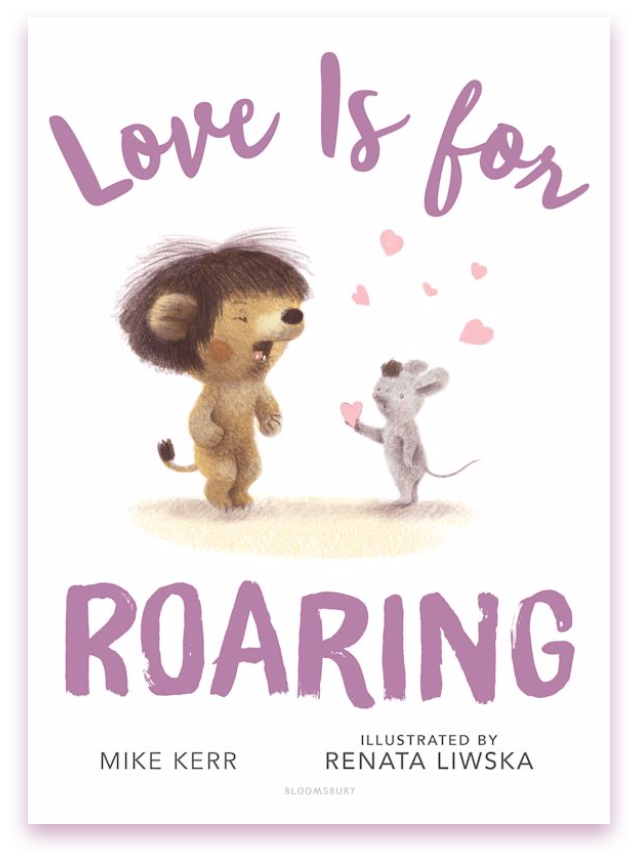
Love is for Roaring

Written by Mike Kerr
Illustrated by Renata Liwska
Bloomsbury
978-1-68119-124-9
32 pp.
Ages 4-8
January 2022

While I probably should have reviewed this lovely picture book in January when it came out so that it would be ready for Valentine's Day, I think that books about love in all its forms are important all year round, don't you think?

From Love is for Roaring by Mike Kerr, illus. by Renata Liwska
At school, the animals are given the assignment of showing their love as a crafty card. But this work distresses Lion who is perplexed by what is required.  Mouse can see the stress this causes Lion and tries to draw out of Lion what he understands love to be and what he might love. But that doesn't go well. Everything Mouse suggests, from hugs and kisses and sweet treats, are negated by Lion whose experiences with or perceptions of those are aggravating.
From Love is for Roaring by Mike Kerr, illus. by Renata Liwska
Finally when Mouse suggests activities like running and playing, roaring and chasing, Lion realizes that there are many things he loves doing, including being and having a friend.
From Love is for Roaring by Mike Kerr, illus. by Renata Liwska
As teachers, we know that understanding any assignment relies on both the teacher's ability to explain it and the student's ability to make connections with it. It's no wonder that Lion, a fearless creature, finds the homework assignment to "Show your Love" to be "impossible, the undoable, the unimaginable" and it causes him much anxiety. Thankfully Mike Kerr gives Lion a friend in Mouse, an animal with infinite wisdom and the patience to help Lion see that love is possible and even familiar. Mike Kerr may be an instructor of illustration at the Alberta University of the Arts but the text of Love is for Roaring suggests that he has the right words to tell a story beyond the artwork. Lion's distress is palpable as is Mouse's concern. And Renata Liwska's illustrations elevate the story with something special. It's a mixture of soft colours, cushioned textures and recognizable body language. From frustration to solemn introspection and playful exertions, Lion and Mouse and their classmates are the children who will read this book and see themselves within the digital artwork. They will know about frustration and wanting to help a friend. They will know distress and confusion and the relief of resolution. Love is for Roaring may be every child's story of uncertainty about school work and finding a connection where one might not have been evident initially.

March 26, 2022

A Soft Place to Fall

Written by Tanya Christenson
Red Deer Press
978-0-889956384
409 pp.
Ages 12+
January 2022
 

Out of suffering have emerged the strongest souls;
the most massive characters are seared with scars.
 
~ Kahlil Gibran 


Kahlil Gibran's words may end Tanya Christenson's debut novel, A Soft Place to Fall, but they work well as a preface to a story of struggles, challenges and loss from which triumphs emerge from the ordinary.

The story is told from the perspective of Creighton Fischer, a boy whose singing mom, Gracie Rae, left when he was just five, and whose father's work with the carnival has kept them moving for many years. When, after Creighton's Grade 7 year, Dad decides it's time for them to settle down, they move to Breton, Mom's old home town. Because of gaps in his learning and attendance, it is recommended that Creighton join an alternate school. There, under the compassionate and diverse teaching methods of Ms. Hayworth, Creighton becomes part of a unique cohort. The dozen or so students soon reveal themselves to be impacted by various traumas and disabilities but Ms. Hayworth's approach is to meet their needs and not slot them into the rigid curriculum. And by showing flexibility and empathy, she brings out the best in most of them. That is, except for Carlos a.k.a. Carcass. And for Creighton, he finds his first real friends in Carin, Ratchet and Schooner and the support system he and all of them need to brave the loss of loved ones, economic hardships, bullying, past traumas, criminal charges, and even love.

The twelve kids in Ms. Hayworth's class may attend L.O.S.E.R. (Lane Oslo School of Educational Reform) but they aren't losers. They may be flawed through trauma, mental health, disability or circumstances beyond their control but they are not losers. They are human. Their resilience may at times be shaky but it is undeniable and it thankfully allows them to persist.
 
BC's Tanya Christenson, a teacher and school counsellor, knows kids and she's written these kids as human as you and I. And she doesn't wrap up their struggles with happy endings, ribbons or balloons. Tanya Christenson makes their outcomes as real as the kids. They've suffered abandonment, abuse and upheaval, and they have endured. Sometimes they've triumphed over those struggles and  sometimes not, and like all of us, they have needed support and a soft place to fall. Because, after all, we will all fall some time, some way. I just hope that there will always be a soft place to fall, perhaps even land, for anyone challenged by life. And that's everyone.

July 19, 2021

Sully, Messed Up

Written by Stephanie Simpson McLellan
Red Deer Press
978-0-88995-637-7
312 pp.
Ages 11-15
April 2021

Who is Sullivan Brewster? He's Sullivan to his mom, Rooster to his little sister Eva, and Van to his stepdad Bill. He's Sully to his friend Morty, who has changed his own moniker to Morsixx since reinventing himself over the summer before their first year in high school. And to those who don't know him or want to target him, he becomes Bella, Sally and a host of horrible nicknames. Is it any wonder that thirteen-year-old Sully doesn't know who he is or what he should be doing or who his friends are? He truly is messed up, and that doesn't even count the messing up he's getting from a trio of bullies named Tank, Ox and Dodger.
 
Sully's story seems to start on that first day of Grade 9 when he wakes up with his facial elements relocated around his head.
His nose, pink and dripping, hunkered sideways on his left temple. One of his ears–it was hard to tell which one from the unfamiliar angle–bulged where his nose should have been. The other protruded, antenna-like, right above his lips, which quivered, post-scream, in the middle of his forehead. (pg. 9)
But no one seems to notice. Still, Sully uses his long hair to hide his potential disfigurement. This instead grabs the attention of Tank, the overlord at Wild Forest Secondary, and his sidekicks Dodger and Ox. Worried that he will now become the victim of the Gr. 9 hazing called the Naked Niner, whereby a selected student is unclothed and photographed and publicly humiliated, Sully tries to stay out of Tank's field of view. Unfortunately, everything he does seems to garner him more unwanted attention. 
 
First, he believes his friend and locker partner Morty/Morsixx is drawing too much attention with his new emo boy look and attitude so Sully starts avoiding him by carrying his backpack everywhere, hiding out in the parking lot at lunch and abstaining from taking the bus. Even though Morsixx and Blossom, a new girl who adorns her face and arms with ink of vines and flowers, try to support him, Sully continues to reject their efforts. Then he's given the topic of menstruation for his Sex Education class and Dodger pranks him with countless tampons, earning him the displeasure of the principal and a host of new nicknames.
 
When he begins to walk to and from school, past a purple house on True Street, with its fence adored with an unusual assortment of figurines in ever-changing scenes, Sully becomes acquainted with the Purse Lady who gets his attention when she asks him, "What happened to your face?" (pg. 80) But who is she and why does Mr. C, the strange man in the purple house, seem to know her and Sully and maybe even what is happening in his life, all represented in the figurines of Charlie Brown, the Knight, Sleeping Beauty, Darth Vader and more?
 
School can be a place of refuge for some but for others, especially those who become marked as victims, it can be brutal. And for Grade 9 students, it can be especially challenging. With an implicit hierarchy of power and confusion about the supports which they may or may not have, those preyed upon by bullies may become even more isolated. This is Sully who confuses his friends with contributing to his victimization and who doesn't want to worry his family. He is awkward in discussions with his teachers and his principal and then makes further choices that complicate things for himself. But, while Sully has been victimized, Stephanie Simpson McLellan tries not to play up the young teen as a victim. He is instead confused or rather messed up. He's got all the basics–friends, family, the will– to make things right but, like his face, things just haven't fallen into place correctly. Fortunately, when he can see beyond his personal disasters and into those of others, Sully learns to stand up for himself and help himself adapt. This is an important message for young people and, amidst all Sully's struggles, it's one that Stephanie Simpson McLellan emphasizes. With some insight and a little help from others, Sully is finally able to put to rights his situation and find himself.

• • • • • • • • •

Tomorrow I interview author Stephanie Simpson McLellan about Sully, Messed Up. For middle-graders and early young adults and their parents and their teachers, this Q & A will speak to all of you.

January 27, 2021

Oh My Gods!


Written by Stephanie Cooke and Insha Fitzpatrick
Illustrated by Juliana Moon
Houghton Mifflin Harcourt
978-0-358-299523
208 pp.
Ages 8-12
January 2021
 
When her mother has to relocate to curate a gallery show, thirteen-year-old Karen is sent to stay with her father, Zed, a man she barely knows, in Mt. Olympus.
From Oh My Gods! by Stephanie Cooke and Insha Fitzpatrick, illus. by Juliana Moon
She's surprised by his extravagance, from the carriage drawn by horses in winged costumes at the airport, to her multiple rooms at his mansion, at ordering every type of pizza imaginable since he doesn't know what she likes, and even the wrist corsage he gets her for her first day at Mt. Olympus Junior High. Not only is her dad the mayor of Mt. Olympus, he's the dean of her school. The man is ubiquitous, as well as charming and wealthy.
From Oh My Gods! by Stephanie Cooke and Insha Fitzpatrick, illus. by Juliana Moon
Karen is shown around the school by a really fast guy, Hermes, who introduces her to the different groups, from the Titans football team, to the Fates, random Jeff and the kids of the Mythbusters group who take Karen under their wing. There's the bright Tina who offers to catch her up; the kindly Dita; the guitar-playing Pol; and his sister Art who is wicked with a bow and arrow. 
From Oh My Gods! by Stephanie Cooke and Insha Fitzpatrick, illus. by Juliana Moon
When a boy is turned to stone in the library where Karen and Tina are studying, the group meet at a local diner and peruse a book on Monsters and Mythological Creatures, suggesting that a Gorgon might be at work. Karen is flummoxed by their earnestness, convinced they must be part of a LARPing group, that is, until they reveal themselves to be the gods and goddesses Apollo (Pol), Athena (Tina), Aphrodite (Dita), and Artemis. Learning that her father is a god as well, and that Karen may be a demigoddess whose powers could come in at puberty, all the weirdness of her new situation makes some sense.
From Oh My Gods! by Stephanie Cooke and Insha Fitzpatrick, illus. by Juliana Moon
But, there's still the mystery of the boy turned to stone which escalates when Pol is similarly transformed and there is a worry that Karen's arrival may be related to these bizarre crimes.

While fitting in to a new school, making new friends, and establishing a relationship with a previously-absentee father may be familiar circumstances for some young people, Karen's new life is anything but. By telling Karen's coming-of-age story in a world based on the immortals of Greek mythology, Toronto author Stephanie Cooke and American author Insha Fitzpatrick have added a playful dimension to this graphic novel.  Everything is a little more fantastic, from the characters and their abilities–details are provided in "Karen's Mythology Notes!!!" at the book's conclusion–to Karen's naive accounting for the weirdness she perceives–like centaurs as drama students really committed to their craft–and the inclusion of so many elements of Greek mythology. Every new reveal, like the diner called Ambrosia and the Fates literally bumping into Karen and her friends and saying "We didn't see this coming" (pg. 123), is cheeky and entertaining. While the illustrations by Brazilian digital artist Juliana Moon have given Karen and her friends the normalcy of young teens with their backpacks, clothes and hair, she also embeds it in the mythological Mt. Olympus and makes it realistic.  

I've just learned that this is a series–yay!–and Oh My Gods! is just OMGs #1. The next book, titled The Forgotten Maze, is due out in January 2022, and this is particularly welcome as Stephanie Cooke and Insha Fitzpatrick have left us with an impending adventure starring Jeff and a maze, as well as with wanting to know if and how Karen discovers her powers as a demigoddess.

January 07, 2021

Raj's Rule (For the Bathroom at School)

Written by Lana Button
Illustrated by Hatem Aly
Owlkids Books
978-1-77147-340-8
32 pp.
Ages 3-7
August 2020

Rules are often put in place to keep us safe. Some are imposed by others and adopted by everyone, and some are very personal and created to meet our own needs and preferences. The latter is the case for Raj whose reluctance to use the bathrooms at school compels him to adhere to some very strict and strange rules. But, some rules are doomed to be broken.
From Raj's Rule (For the Bathroom at School) by Lana Button, illus. by Hatem Aly
Not unlike a lot of people, Raj is reluctant to use any bathroom other than the one at home. In order to abide by this rule, Raj offers some charming and very practical tips to prevent the need for school bathroom breaks. He avoids drinking at school, not from the water fountain or from juice boxes. He may wash his hands at the sink but quickly and he avoids the water table. 
From Raj's Rule (For the Bathroom at School) by Lana Button, illus. by Hatem Aly
He definitely stays away from the very funny Kyle and avoids distractions and movements that might keep him from sitting still, often squeezing his knees together. But, when a sneeze necessitates a visit to the school bathroom, all his rules are for naught and Raj learns that the outcome is better than he thought.

From Raj's Rule (For the Bathroom at School) by Lana Button, illus. by Hatem Aly
You have to wonder how many people deny themselves the opportunities for happiness because of the fear of the "what ifs." Raj is obviously afraid of something associated with using a public washroom–and nowadays with COVID19, who isn't?–but the distress on his poor little body as he attempts to keep it from its natural functions is apparent. (Doctors would probably advise against this as well.) But Lana Button's gentle text doesn't poke fun at Raj and his predilection. She offers a compassionate, even rational, perspective and allows Raj the opportunity to problem solve his own solutions, both how not to use the bathroom and how to manage when he must use it.  As she has unequivocally accomplished in her earlier books like Willow Finds a Way (2013), My Teacher's Not Here! (2018) and What If Bunny's Not a Bully? (2020), Lana Button is respectful of how young children think, emphasizing their very legitimate struggles with bullies, friends, routines, and change but still giving them the vehicle to find their own solutions. And, as all teachers and parents should know, by allowing children the opportunity to problem solve their own answers, they are encouraging them to accept them.
 
New Brunswick illustrator Hatem Aly, who also created the art for The Proudest Blue: A Story of Hijab and Family (2019), is no stranger to blending lightness with the important messages of authors. He never makes Raj look silly or insignificant, instead making Raj just one of the kids whose issue just happens to be not wanting to use the bathroom at school. It could have been never eating the crusts on bread, or wearing his favourite red socks every day, or carrying a stuffie everywhere. But Hatem Aly has made the adorable Raj, the boy with a bounty of dark wavy hair, big eyes and wish to avoid a public bathroom, just another kid in diverse class of kids of different sizes, colours and abilities. They're boisterous and quiet, impetuous and cautious, and Raj is just one of them.
From Raj's Rule (For the Bathroom at School) by Lana Button, illus. by Hatem Aly
At a time when being vigilant in public is the norm, little Raj is wise to consider how to avoid potential problems by strategizing ways to bypass his school bathrooms. But, more importantly, Raj can still find a way to ease his worries while becoming happier at school, both physically and emotionally, by simply tweaking his rules so they work with his new reality.