Showing posts with label similarities. Show all posts

August 12, 2023

A Tale of Two Kitties

Written and illustrated by Judith Graves
Acorn Press
978-1-773661179
32 pp.
Ages 2-4
August 2023

It may have been National Cat Day on August 8th but for some of us every day is National Cat Day.
From A Tale of Two Kitties by Judith Graves
Mittens and Boots are two cats who look amazingly similar except for the distinct white markings that define them. Though they are treated the same in terms of their food and their sleeping preferences–their own chairs on opposite sides of a fireplace–they differ in their interests–singing vs. painting–and like to be kept separated. Then the chairs are gone, and a loveseat takes their stead. 
 
Mittens and Boots are not happy, convinced this is payback for all the things cats do, like hacking up in unusual places, enthusiastic use of their litter boxes, and late-night yowling. But, when sleep times comes, the two are forced to share the loveseat, albeit with some annoyance. Still, it seems the loveseat has a mind of its own and determined to bring the two felines together, maybe even with a new friend.
From A Tale of Two Kitties by Judith Graves
Anyone who has ever had multiple cats in a home knows that they can be best buddies or warily tolerant. Sometimes their humans are successful in bringing them together and sometimes less so. Obviously author-illustrator Judith Graves–whose YA novel Exposed is the only book I've reviewed here–knows about cats and living with them. Their personalities are so distinct and yet they share commonalities that make us wonder why they aren't better friends or at least companionable. But, cats will be cats and forcing them together, even as a loveseat did, doesn't always work. But, when options are limited, they can be compelled to accept and even endure the other, overriding their innate territorial instincts.
From A Tale of Two Kitties by Judith Graves
A Tale of Two Kitties
is Judith Graves's debut picture book as the author and the illustrator, and as an artist (see her website at https://judithgraves.com/ or her etsy shop at https://www.etsy.com/ca/shop/SassyLassieDesignsCA) with designs in acrylic as well as watercolour, I hoping we'll be seeing more of her work in children's book illustration. The story of Boots and Mittens is sweet and familiar, and we might be able to anticipate the next story with the arrival of Snowball (!). But it's Judith Graves's art of expressive cats, colourful wallpapers, and homey furnishings that brings life to her story. I love the colours, primarily teal and orange, and the warmth of that palette because, let's face it, with cats in the home, there's always a softness of spirit. 

Embedded in Judith Graves's art and story is an endearing cheekiness. "Purrhaps" it's her use of feline-inspired puns or the playfulness of her art, but regardless A Tale of Two Kitties is a whole package of sweet fun, lively art and feline reality.

August 07, 2023

Dear Elsa

Written by Marco Fraticelli
Red Deer Press
978-0-889956865
240 pp.
Ages 8-12
May/July 2023
 

looking out the window
in his new school
the sad student (pg. 32)
 
As part of a school assignment, 10-year-olds Elsa of Boston and Leo newly of Toronto must write emails to each other as pen pals. Neither is initially keen, and Leo is especially so when he learns his pen pal is a girl. But, through revealing messages from September through the following August, the two go from strangers to something deeper.

At the outset, the differences between the two middle-graders are pronounced. Leo, who has newly moved from Montreal to Toronto for his parents' jobs as teachers, complains about everything, from not having any friends, his teacher, following rules, sending emails to Elsa of at least 250 words, and schoolwork writing poetry. Elsa, on the other hand, loves rules, has divorced parents, and, though Leo suggests she must be one of the popular kids based on the advice she gives him, calls herself an in-between kid who has a few good friends and is relatively quiet. But as she allows him to vent while still offering him a different perspective, Leo discovers some things about himself, like that he really likes writing poetry, especially haiku, which he often shares with her. Elsa is slower to reveal herself, probably because Leo is so busy complaining, but she too begins to divulge what her life is like, rather than just giving Leo the opportunity to share. Readers, and Leo, learn of her parents' relationship, her trip to Cancun, her aspirations, her prowess as an archer, and eventually her wheelchair. While Leo broadcasts about everything, Elsa holds back much about her own situation, and is delighted to be treated like she isn't someone with a disability.

Dear Elsa may be author Marco Fraticelli's first children's book but his decades of experience as a Grade 5 teacher as well as an award-winning poet have given him a strong foundation for an irresistible story of two children exploring their differences and finding common ground to be the friend the other needs at that time. Their writing relationship may continue past their Grade 5 year–that is not revealed at the book's conclusion–but it's almost irrelevant as the two derived safety, perspective, opportunity, and solicitude from their relationship.

In 2015, I prepared a post titled, Dearest readers...: A Letters in youngCanLit book list, which provided a list of books that featured characters writing letters or emails or texts as the vehicle for the plot. I will definitely be adding Dear Elsa to that list now to ensure that middle-grade readers (and perhaps their teachers) have an opportunity to visit with Leo and Elsa and witness how a friendship can develop from afar and with seemingly different individuals. All it takes is opening oneself up the opportunity, as Leo learns both in emails and at school, and perhaps some heartfelt poetry.

January 17, 2023

Crescent Moon Friends

Written by Wadia Samadi and Mo Duffy Cobb
Illustrated by Lisa Lypowy
Acorn Press
978 -1-773660967
32 pp.
Ages 4-8
2022
 
Two girls. Two cultures. Two families. Two sets of traditions. One moon under which their differences are more similar than at first seen.
From Crescent Moon Friends by Wadia Samadi and Mo Duffy Cobb, illustrated by Lisa Lypowy
Aisha joins Amelia's class in Canada after leaving war-torn Afghanistan. When they become reading partners, they also become friends, sharing traditions of their cultures from games and food to celebrations and beliefs.

As they share, they also learn. Amelia's family follows Islamic traditions of peace and prayer while Amelia's teaches compassion and kindness. The two girls also have different dispositions, Aisha leaning to the maths and sciences and Amelia to the arts. One has the heart and mind of a scientist while the other one of a dreamer and a poet. And though they both love the moon, they see it differently.
From Crescent Moon Friends by Wadia Samadi and Mo Duffy Cobb, illustrated by Lisa Lypowy
It's relevant that the crescent moon, an important symbol of Islam, draws the attention of both girls. Still even in their different relationships with the celestial body, they appreciate how it is seen by the other. 

Afghanistan-born Wadia Samadi and P.E.I.'s Mo Duffy Cobb wanted to tell a story of two different girls who find commonalities in their differences. And young readers will learn how being different is okay but also will recognize that the differences aren't as contrary as some might expect. Amelia and Aisha are just to girls who have been brought up in different traditions and, with the sharing of those traditions, their friendship is strengthened.
From Crescent Moon Friends by Wadia Samadi and Mo Duffy Cobb, illustrated by Lisa Lypowy
Whether she's depicting Canada or Afghanistan in her illustrations, Edmonton's Lisa Lypowy uses watercolours to keep them bright and atmospheric. Even with her colours and shapes, Lisa Lypowy shows how similar the girls and their lives are while different in temperaments, landscapes and weather, clothing and customs. 

Wadia Samadi and Mo Duffy Cobb end their book with blurbs about Prince Edward Island and Kabul, Afghanistan. In one last manifestation, they compare and contrast the two locations and help young readers see, yet again, that separating ourselves along lines of differences hurts us but finding our connections makes us better.

October 03, 2022

Lana Llama

Written and illustrated by Lori Doody
Running the Goat, Books & Broadsides
978-1-927917-81-7
32 pp.
Ages 3-7
July 2022
 
Lana Llama looks similar to her flock. She is wooly like the sheep and she has four legs and two ears and a fuzzy tail. But she still notices that her legs and neck are longer and she can't bleat.
From Lana Llama by Lori Doody
As with any creature who wants to fit in, Lana tries to emulate the sheep of her flock. But it's awkward and she is unsuccessful.
From Lana Llama by Lori Doody
Still, when a barnyard bully, also with the same attributes of wooliness, four legs, two ears and a fuzzy tail, comes along, Lana Llama uses her differences to stand up to it and be accepted by her flock exactly as she is.

Now she's happy to stand up for others,
just by standing out.
 
From Lana Llama by Lori Doody
Every Lori Doody picture book that comes out is a treat for the heart and the eyes. Her folk art consists of simple lines and bold colours but it is more. It's both subtle and striking, and still cozy and true. She doesn't overwhelm with details in her characters or landscapes but the farm and its animals are definitive and real. Based in that reality is always a story that will resonate with young readers (and old ones too). Here it's about trying to fit in but finding the best fit comes from being oneself. Of course, Lana Llama wants to be like the sheep of her flock. They are her people, her community, and she believes that they give her her identity too. But Lori Doody reminds us that what makes us different makes us unique and valuable, with Lana Llama being the only one who can stand up to a barking bully by virtue of those very differences.

Whether you're a bleater, a hummer, a clucker or a barker, Lori Doody will find you the right community as she did for Lana Llama. After all, we all belong.

September 28, 2022

The Line in the Sand

Written and illustrated by Thao Lam
Owlkids Books
978-1-77147-570-9
48 pp.
Ages 5-8
September 2022
 
When a monster drags a stick behind them and creates a line in the sand, they are unaware of the conflict that results. But how that conflict is resolved is up to those who perceive it.
From The Line in the Sand by Thao Lam
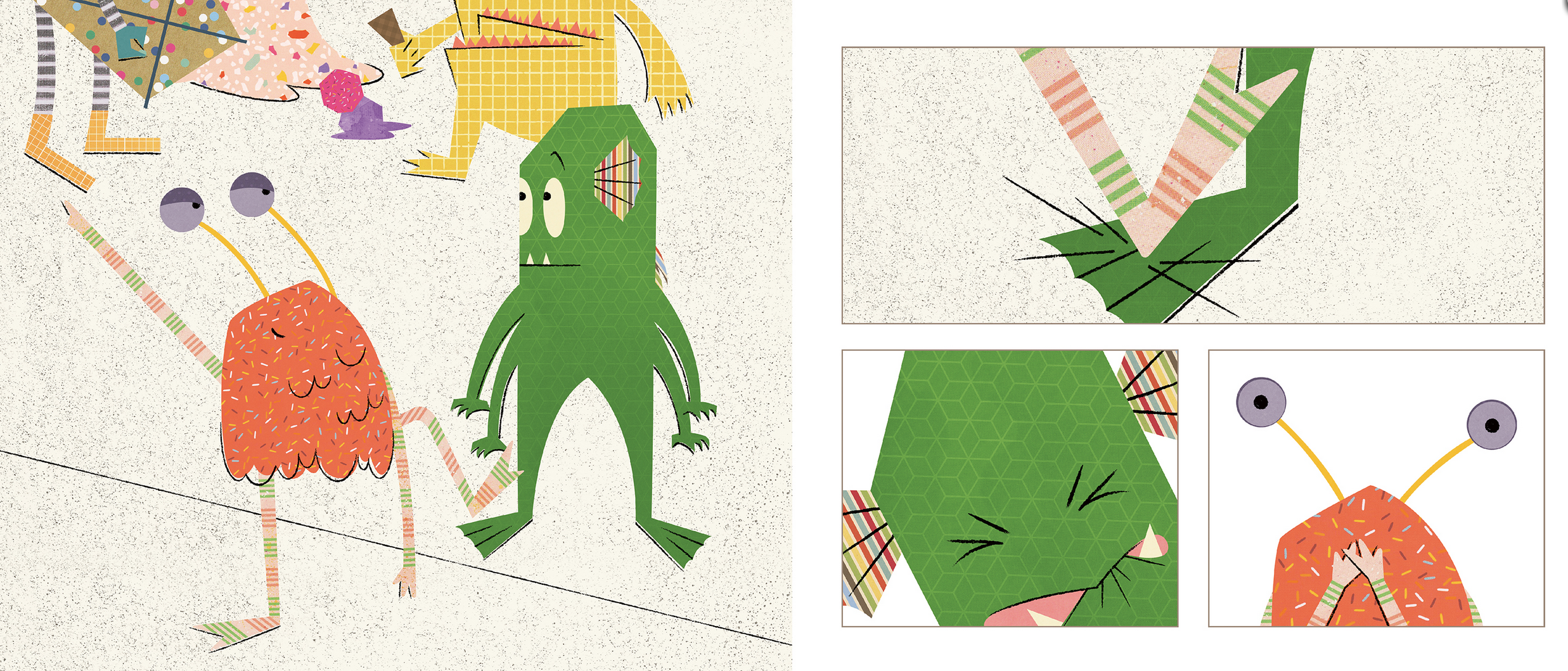
A varied assortment of monsters are playing at the beach: collecting shells, playing games, flying kites and building sand structures. One seven-eyed and four-limbed creature amuses itself by dragging a stick behind itself. (Haven't we all dragged sticks through sand and dirt to create shapes?) But several of the other monsters notice this line. It divides them. And when one tries to step over the line, another gets distressed and directs it back.
From The Line in the Sand by Thao Lam
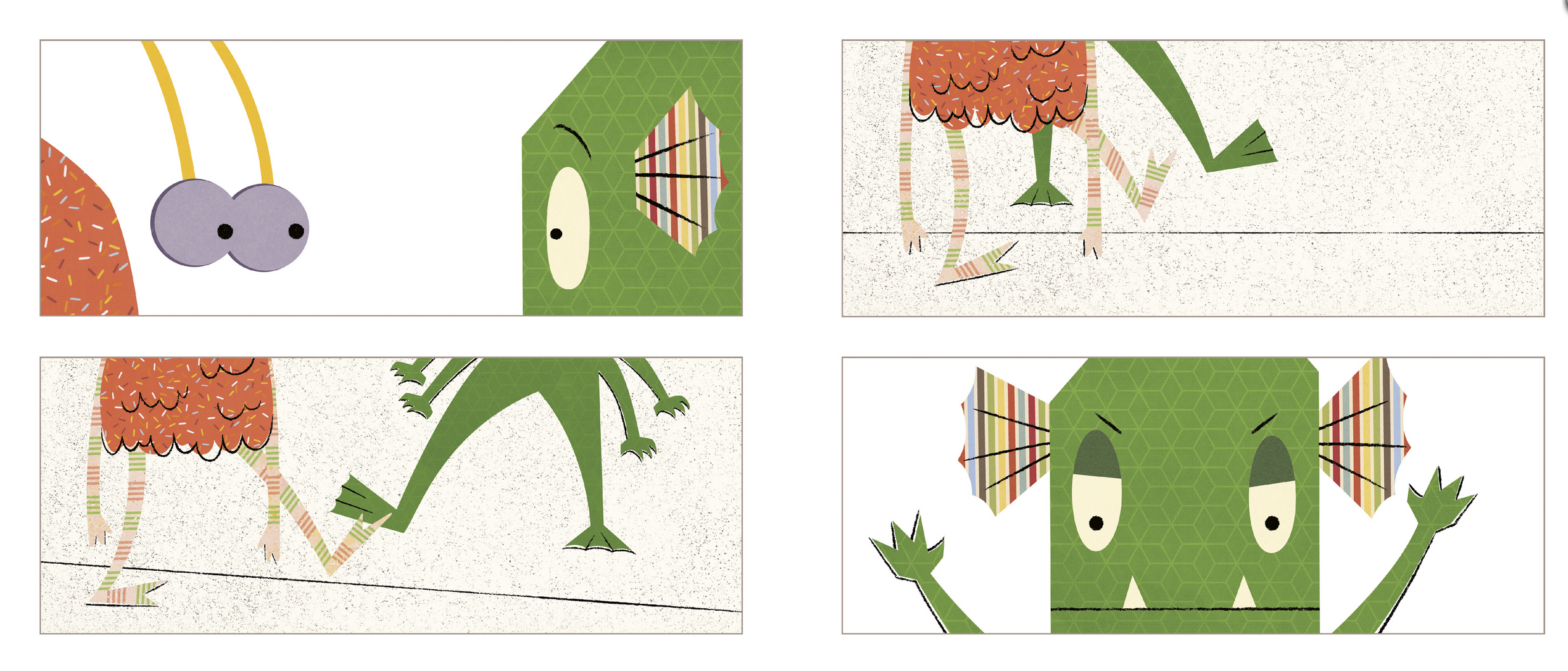
This does not please the purple-eyes-on-antennae creature who promptly lifts its foot across the line and stomps on the green webbed foot of the other. Though it is deliberate, the purple-eyed monster does not realize the impact it would have, causing the green one to stumble and fall across the line and into its assailant, blurring the line in the sand.
From The Line in the Sand by Thao Lam
Then a bee flies into the mix.  Both monsters are thrown into a tizzy trying to evade the insect and in the process kick up the sand, obliterating the line. Looking up to see the roughened sand, the two creatures realize that beyond their interaction are numerous more lines, all drawn by the same stick-dragging monster. But, no one is reacting to those lines at all. They walk across them, they ignore them, or they are oblivious. The lines are present but of no concern.  Soon enough, our two rivals recognize the emptiness of their conflict, especially as they'd already joined forces to try to defeat a bee.

Conflict is often borne of words so it's meaningful that Thao Lam wrote a picture book about conflict as a wordless story. That just tells you how much words can get in the way. (They can also work wonders when used well.) In The Line in the Sand, no words are needed to convey distress, discord, territoriality, shock or even rage. These creatures, though their morphologies suggest otherwise, are as human as Thao Lam's readers.  (Don't we all differ to some degree in our shapes, colour, limbs and more?) Like all of us, they can be protective and defensive if they perceive a slight, intentional or not. And intention is key here because the creature with the stick intended nothing except play. Sadly, that line in the sand was the basis for some inadvertent conflict. Only when the two come together in a common goal–ridding themselves of a bee–do they see their squabble as insignificant.
From The Line in the Sand by Thao Lam
From her very quirky characters, that vary in colour from green to orange, yellow, pink and blue, with or without stripes or dots or other patterns, and with various limbs, eyes and more, Thao Lam includes everyone and spotlights no one. In their peculiarities, they are us. And we are them, drawing lines accidentally, taking offence indiscriminately, and coming together only when we see our similarities, not our differences. 

The Line in the Sand reminds us that conflict can be borne of misunderstanding or disregard but with communication, even without words, and awareness, resolution is possible.

August 09, 2019

The Mostly True Story of Pudding Tat, Adventuring Cat

Written by Caroline Adderson
Illustrated by Stacy Innerst
Groundwood Books
978-1-55498-964-5
128 pp.
Ages 8-11
April 2019

Pudding Tat, so named for the special dessert Farmer Willoughby brought to his Wellington County barn cats on Christmas Day, was always a concern for his mother. White as snow and eyes as pink as his tongue, Pudding could not catch mice or avoid dangers as well as Mother Tat had taught her kittens. But, when his siblings are pushed to leave the barn, Pudding literally gets a flea in his ear that encourages him to do the same. That flea, tired of the loud partying of the others, steers Pudding to water, hopeful of drowning his fellow parasites, while keeping the cat safe as a host. 
From The Mostly True Story of Pudding Tat, Adventuring Cat by Caroline Adderson, illus. by Stacy Innerst
With each new chapter, Pudding and his flea evolve, developing their relationship from one based in parasitism to one of mutualism. Their first major adventure starts in 1901 when they join Annie Edson Taylor for her barrel ride over Niagara Falls. Next, Pudding and his flea travel to Buffalo, New York, and the site of the Pan-American Exposition. En route, they see the discrimination levelled against the African American railway porters and the indentured child street musicians. They are present when President McKinley is shot and when Vincent Bryan and Gus Edwards compose “In My Merry Oldsmobile” – a tribute to Gus’s new car. In 1910, they’re on-board as Walter Wellman and his crew attempt their first cross-Atlantic airship flight. They even survive the sinking of the Titanic in 1912 and a crossing into No Man’s Land at the beginning of the famous Christmas Truce during World War I. While they experience long periods of confinement and hunger, there are moments of opulence, filled with comfort and food. And there is always music to which Pudding Tat is drawn. Relying so much on his hearing, he is lured by songs sung and instruments played, taking him into new circumstances, sometimes comfortable, sometimes perilous. In the end, cat and flea make their way home, having defied all expectations had for and by the visually-impaired feline.

Caroline Adderson, author of award-winning books for adults and children – including Middle of Nowhere (Groundwood, 2012) – blends the right mix of history and fictional narrative to create a story of cooperation, resiliency and risk-taking. She gives Pudding Tat the voice of a modest but heartfelt hero, albeit an accidental one, who experiences big adventures but is surprised by his exploits. He really is a feline Forrest Gump. His poor eyesight and lack of camouflage may make him vulnerable but it doesn’t stop him from living beyond them. With Stacy Innerst’s multi-panelled graphics detailing the breadth of Pudding Tat’s adventures in each chapter, it’s clear that, like the period of innovation in which he lived, the white feline reached beyond his potential and achieved more than expected.

🐈🐈🐈🐈🐈🐈🐈🐈

(A version of this review was originally written and paid for by Quill & Quire, as noted in the citation below.)

Kubiw, H. (2019, May 7). Review of the book The Mostly True Story of Pudding Tat, Adventuring Cat. Quill & Quire. https://quillandquire.com/review/the-mostly-true-story-of-pudding-tat-adventuring-cat/

June 07, 2017

Different? Same?

Written by Heather Tekavec
Illustrated by Pippa Curnick
Kids Can Press
978-1-77138-565-7
32 pp.
Ages 2-6
May 2017

Maybe it's not really a book genre but I would call Different? Same? an interactive non-fiction book.  It's the kind of book that encourages young children to voice their observations in answer to the simple questions "How are these animals different?" and "How are these animals the same?"  And it's a lovely way of emphasizing the commonalities of animals while still appreciating the diversity of species that populate our world.
From Different? Same! 
by Heather Tekavec
 illus. by Pippa Curnick
For each double-spread, a series of animals are differentiated by their motility, habitat, textures, colours, sounds and other physical and behavioural attributes.  But a final statement at the bottom right corner instructs the reader to "But look closer now..." before sharing the similarity of note for that set of animals.

A final double spread illustration invites readers to seek other similarities, such as spots and webbed feet amongst the forty animals–insects, birds, amphibians, reptiles and mammals–depicted in the artwork.  It becomes a find and seek adventure for children, whether they read the book themselves or not. And, if they want to learn a little more, a note at the conclusion called "Why Animals Have the Characteristics They Do" clarifies the functionality of the characteristics noted, turning Different? Same? into a more serious science book for older readers.
From Different? Same! 
by Heather Tekavec 
illus. by Pippa Curnick
Heather Tekavec has published ten previous children's volumes including the popular Stop, Thief! (Kids Can Press, 2014) but this is her first non-fiction book. Still she retains her lively writing by turning Different? Same? away from pure information text and into a book of discovery.  UK illustrator Pippa Curnick furthers that intent with her amusing animals from all levels of the classification hierarchy.  All and all, Different? Same? shows us how distinct the animals in the world are while celebrating common ground, a lesson we should all accept and appreciate in our own world.

October 05, 2016

Friend or Foe?

by John Sobol
Illustrated by Dasha Tolstikova
Groundwood Books
978-1-55498-407-7
32 pp.
Ages 4-7
October 2016

The beginning of Ottawa author John Sobol’s debut picture book Friend or Foe? is only missing the “Once upon a time…” because the sentiment is definitely that of a traditional tale, here based on a lonely, dark mouse who lives in a small house beside a great palace in which a white cat lives.

The two creatures have their evening routine, with the mouse creeping out onto the roof of the house, and the cat peering down from the palace’s tower window, each staring at the other. When the mouse notices a tiny hole in the palace’s exterior wall, he decides to slip into the palace, hopeful that he might find a friend in that cat with whom he feels a connection.  As he makes his way through the palace, he continues to wonder whether the cat really is a friend or perhaps a foe.
As the mouse climbed the stairs to the palace tower, he began to grow afraid.
What if he was wrong? If he was, the cat would tear him to pieces.  Still he kept climbing.
Was the cat friend or foe?
He had to know.
(pg. 11)
But as he approaches the feline from behind, asking her aloud whether she is a friend or foe, the feline is startled and tumbles off the palace tower.  John Sobol ends Friend or Foe? with a twist, both in the animals’ reversal of fortunes and in the answer to the titular question that is probably reflective of many relationships though nebulous in its honesty.

From Friend or Foe? 
by John Sobol, illus. by Dasha Tolstikova

John Sobol's story is aptly illustrated by American Dasha Tolstikova’s austere artwork which emphasizes the disparity in the characters’ sizes and situations, powerfully using hues and tints of greys with only dashes of brightness in a red brick wall or orange light bulb.  Though there is little colour in Friend or Foe?, supporting the idea that there really is a subtle differentiation between the two situations of the title, Dasha Tolstikova uses colour cleverly both to reflect that contrast and suggest their similarity. Friend or Foe? is a very artful examination of connection in which only differences and likenesses are normally perceived.
From Friend or Foe? 
by John Sobol, illus. by Dasha Tolstikova

^^^^^^^^^^^^^^^^^^^^^^^^^^^^^^^^^^^^^^^


A very special launch event is in the works for John Sobol’s Friend or Foe? 


Be part of Small Print Toronto’s Cat & Mouse City 
with author John Sobol 

for young readers 
(ages 2-8, who must be accompanied by an adult) 

on Saturday, October 22, 2016 

from 11 a.m. – 1 p.m. 

at 

Lillian H. Smith Library 
(Toronto Public Library) 
239 College Street 
Toronto, ON 

The event is free but participants must sign up early as space is limited so register at https://www.eventbrite.ca/e/cat-mouse-city-with-john-sobol-tickets-27655152305

Small Print Toronto’s invitation describes the event as follows: 
Our popular model city-building workshop, Mouse City, is about to face its its biggest urban planning challenge yet: the arrival of cats! Urban planners aged 2-8 can decide how Mouse City will accommodate its new, feline citizens. 
Ottawa author John Sobol will unveil his new book, Friend Or Foe?, and help young planners find the best place for their cardboard buildings on a large city grid.

February 06, 2013

Sharing Our Lives: Social Justice Book List #2

In this second book list of youngCanLit that can be used to embed social justice issues, the theme of Sharing Our Lives involves examining how our lives are similar and different from those of others.


Picture Books
Dear Baobab
by Cheryl Foggo
Illustrated by Qin Leng
Second Story Press
24 pp.
Ages 6-8
2011
Everybody's Different on Everybody Street
by Sheree Fitch
Illustrated by Laura Jolicoeur
Nova Scotia Hospital Foundation
2001
Goodnight, Canada
by Andrea Beck
North Winds Press/Scholastic Canada
32 pp.
Ages 3-7
2012
Jeremiah Learns to Read
by Jo Ellen Bogart
Illustrated by Laura Fernandes and Rick Jacobson
North Winds Press
32 pp.
Ages 6-8
1997
The Legend of Ninja, Cowboy, Bear
by David Bruins
Illustrated by Hilary Leung
Kids Can Press
32 pp.
Ages 3-7
2009
Migrant
by Maxine Trottier
Illustrated by Isabelle Arsenault
Groundwood
40 pp.
Ages 7-13
2011
No Two Snowflakes
by Sheree Fitch
Illustrated by Janet Wilson
Orca Book Publishers
32 pp.
Ages 4-8
2001


Small Saul
by Ashley Spires
Kids Can Press
32 pp.
Ages 3-7
2011
Tadeo’s Search for Circles
by Marion Brooker
Illustrated by Kyrsten Brooker
Fitzhenry & Whiteside
32 pp.
Ages 4-7
2011


Fiction
The Boy from Left Field
by Tom Henighan
Dundurn
209 pp.
Ages 9-14
2012


The Breadwinner Trilogy
by Deborah Ellis
Groundwood Books
Ages 9-12 
The Breadwinner 
170 pp.
2000


 Mud City
164 pp.
2002

 Parvana's Journey
199 pp.
2003
A Group of One
by Rachna Gilmore
Henry Holt
184 pp.
Ages 13+
2001
Half Brother
by Kenneth Oppel
HarperCollins Canada
377 pp.
Ages 12+
2010
The Moon Children
by Beverley Brenna
Red Deer Press
140 pp.
Ages 9-12
2007
The Paper House
by Lois Peterson
Orca Book Publishers
108 pp.
Ages 8-11
2012


Non-Fiction
If the World were a Village: A Book about the World’s Children
by David J. Smith
Kids Can Press
32 pp.
Ages 8-13
2011


Kids of Kabul: Living Bravely Through a Never-ending War 
by Deborah Ellis
Groundwood Books
143 pp.
Ages 12+
2012


Last Airlift: A Vietnamese Orphan’s Rescue from War
by Marsha Skrypuch
Pajama Press
99 pp.
Ages 10-15
2011


No Borders
by Darla Evyagotailak and Mindy Willet
Photos by Tessa Macintosh
Fifth House
40 pp.
Ages 10+
2012
Off to Class: Incredible and Unusual Schools Around the World
by Susan Hughes
Owlkids Books
64 pp.
Ages 8-13
2011
Piece by Piece: Stories About Fitting Into Canada
Edited by Teresa Toten
Puffin Canada
183 pp.
Ages 12-17
2010


This Child, Every Child: A Book About the World's Children
by David J. Smith
Kids Can Press
36 pp.
Ages 9-12
2011
We Want You to Know: Kids Talk About Bullying
by Deborah Ellis
Coteau Books
120 pp.
Ages 9-14
2010