Showing posts with label Thao Lam. Show all posts

April 09, 2025

Everybelly

Written and illustrated by Thao Lam
Groundwood Books
978-1-77306-764-3
40 pp.
Ages 3-6
April 2025 
 
When did we learn to judge people based on how they look? When do we learn that bellies are not seen as beautiful or that because someone is different that they don't belong? Young children are often accepting of everyone, until or unless they are taught otherwise. For this child, the people whom she sees at their local pool are a rich mosaic of professions, preferences, and looks, and she appreciates all of them.
From Everybelly, written and illustrated by Thao Lam
Maddie and her mama go down to the community pool to swim. Everybody is there, from Stan and Dan who bake cookies, Vibhuti who is in a band, and Mr. Mendoza who talks to his daughter in Argentina on Sundays. There are artists and shopkeepers, students and the elderly. There are those with a walker or a prosthetic leg, or using a pool lift to move them from their wheelchair into the water. Everyone is there and enjoying the pool in their own way. Some float on inflatables, while others swim, and some just relax poolside. They are different and they are beautiful.
From Everybelly, written and illustrated by Thao Lam
It's obvious that Maddie notes everything and everyone. Whether it be how bellies can be used as tables for phones or drinks, or that bellies can stretch bigger and bigger until they pop like her friend's mom's who's giving her another brother. (Uma wanted a dog.) Maddie knows that there are some who work hard to keep their bellies flat though she likes when her belly is full because her mother works hard to keep them fed. (Maddie thinks about all the foods she would fill her belly with, from jelly beans and gimbap, to gỏi cuốn, and fried chicken.) Every belly is different, supported by bodies that vary in their abilities, their challenges, their attributes, and their clothing and adornments that include scars and tattoos. With all these people, Maddie's world is richer and more colourful.
From Everybelly, written and illustrated by Thao Lam
Everybelly is a tribute to the diversity of people that make our lives fuller. By seeing all the people whom she knows and even those she doesn't, Maddie is learning empathy and an appreciation for a wide variety of cultures, bodies, preferences, and more. She may notice what they look like, such as the size of their bellies, and what they are doing, like breastfeeding, but she accepts them as part of her community. Thao Lam, who both wrote the text and illustrated Everybelly, gives us the words to help see the innocence and openness of Maddie's perspective–like her claim that Mr. Popov was keeping time with his broom on the ceiling as she tap-danced (!)–and her acceptance of her world as full and vibrant. For her, this is the norm, and she relishes it.
From Everybelly, written and illustrated by Thao Lam
But beyond Maddie's words and thoughts, Thao Lam has given the child and her community exuberance via the artwork. Thao Lam's cut-paper collage as seen in earlier books like One Giant Leap and The Paper Boat is even bolder and splashier, giving greater depth and texture to a setting that is basically a pool and poolside. But that setting is all the richer for the people that inhabit the space, even if only temporarily. There are so many different bathing suits, hats, towels, and sandals. They are colourful and patterned. Some like burkinis hide more than others and some leave it all out to be seen. I could spend hours poring through the book, finding details that intrigue, like the heart surgery scar on one gentleman, the pigeons eating spilled popcorn, or the imprint of sunglasses left on a sunburned belly. Thao Lam lets us see this community in all its glorious bodies and lives to appreciate a mother-daughter relationship and a communal appreciation for diversity.

March 15, 2024

One Giant Leap


Written and illustrated by Thao Lam
Owlkids Books
978-1-77147-599-0
48 pp.
Ages 3-7
March 2024
 
Getting a child dressed, especially in winter, is akin to the prep required to outfit an astronaut. Each step must follow another to ensure coverage, safety, and fit. But when you're venturing out into that wide world of possibilities, it's best to be prepared.
From One Giant Leap, written and illustrated by Thao Lam
Zippers pulled up on a suit, boots tugged onto feet, gloves wrenched on, and a hat stretched down low on a forehead are just the first steps of venturing outside. But as the child is transported in an elevator to the 1st floor, an imaginative transformation occurs. What was a child in a snowsuit is now an astronaut in a spacesuit. So, when they finally venture outside, it isn't into the snow, it's onto the moon.
From One Giant Leap, written and illustrated by Thao Lam
Everything now is an exploration of a new land of shapes and structures. There's climbing and falling, searching and anticipating, and following footsteps. Are those aliens or something else? Is there peril? Can they communicate? Should they? What should they say?
From One Giant Leap, written and illustrated by Thao Lam
Can the astronaut reach their destination and fulfill their mission? Only by following their trek across barren landscapes of inhospitable structures and unusually-garbed creatures can readers even know whether they make it to...the coatroom at school.

As a wordless picture book, One Giant Leap has a story that is driven by the cut-paper collage of Thao Lam's artwork. The story which is immense comes from the reader seeing and interpreting the visuals. Is that a rocket launch pad or an apartment elevator? Are those aliens or children in colourful snowsuits? Are those buildings or mountains, man-made structures or lunar landforms? Vietnamese-Canadian author-illustrator Thao Lam, known for her complex and meaningful books including The Paper Boat: A Refugee Story and The Line in the Sand, still knows how to do playful. Dressing in a snowsuit and venturing out into the greater universe, this child embarks on an other-worldly adventure, fueled only by imagination. What they experience is all up to them, and Thao Lam lets us see what they see. It's a textured landscape of dull grays and blacks, with only a dash of colour from an orange spacesuit or when other bizarre creatures appear. But in that lunar landscape, it is all about starkness, with the energy provided only through the child's imagination.
From One Giant Leap, written and illustrated by Thao Lam
Whether stepping onto an unknown space body or onto a frozen city street, it's a giant leap of daring that must come from within. It's knowing what to expect and never knowing what could be found. For this little one, it's One Giant Leap into inventiveness and creative thought, and it looks like they had a great flight.

September 28, 2022

The Line in the Sand

Written and illustrated by Thao Lam
Owlkids Books
978-1-77147-570-9
48 pp.
Ages 5-8
September 2022
 
When a monster drags a stick behind them and creates a line in the sand, they are unaware of the conflict that results. But how that conflict is resolved is up to those who perceive it.
From The Line in the Sand by Thao Lam
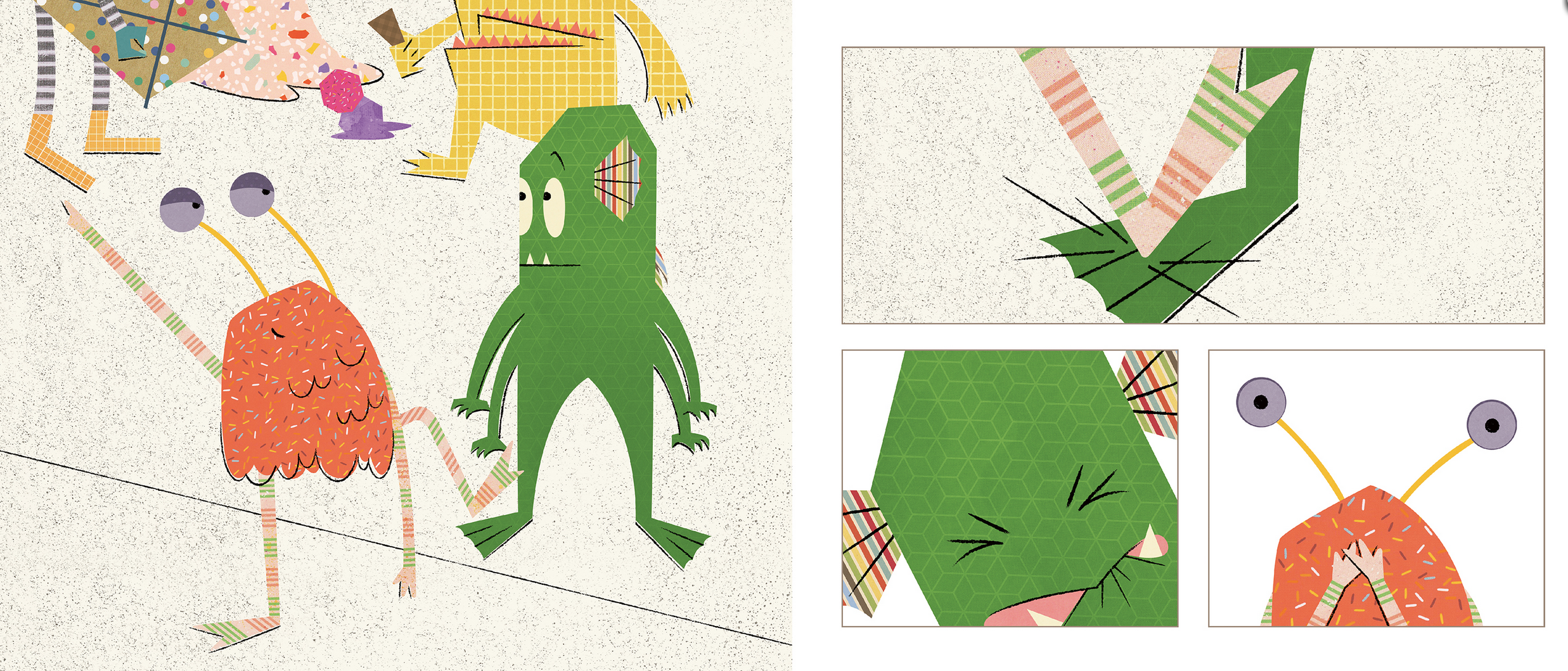
A varied assortment of monsters are playing at the beach: collecting shells, playing games, flying kites and building sand structures. One seven-eyed and four-limbed creature amuses itself by dragging a stick behind itself. (Haven't we all dragged sticks through sand and dirt to create shapes?) But several of the other monsters notice this line. It divides them. And when one tries to step over the line, another gets distressed and directs it back.
From The Line in the Sand by Thao Lam
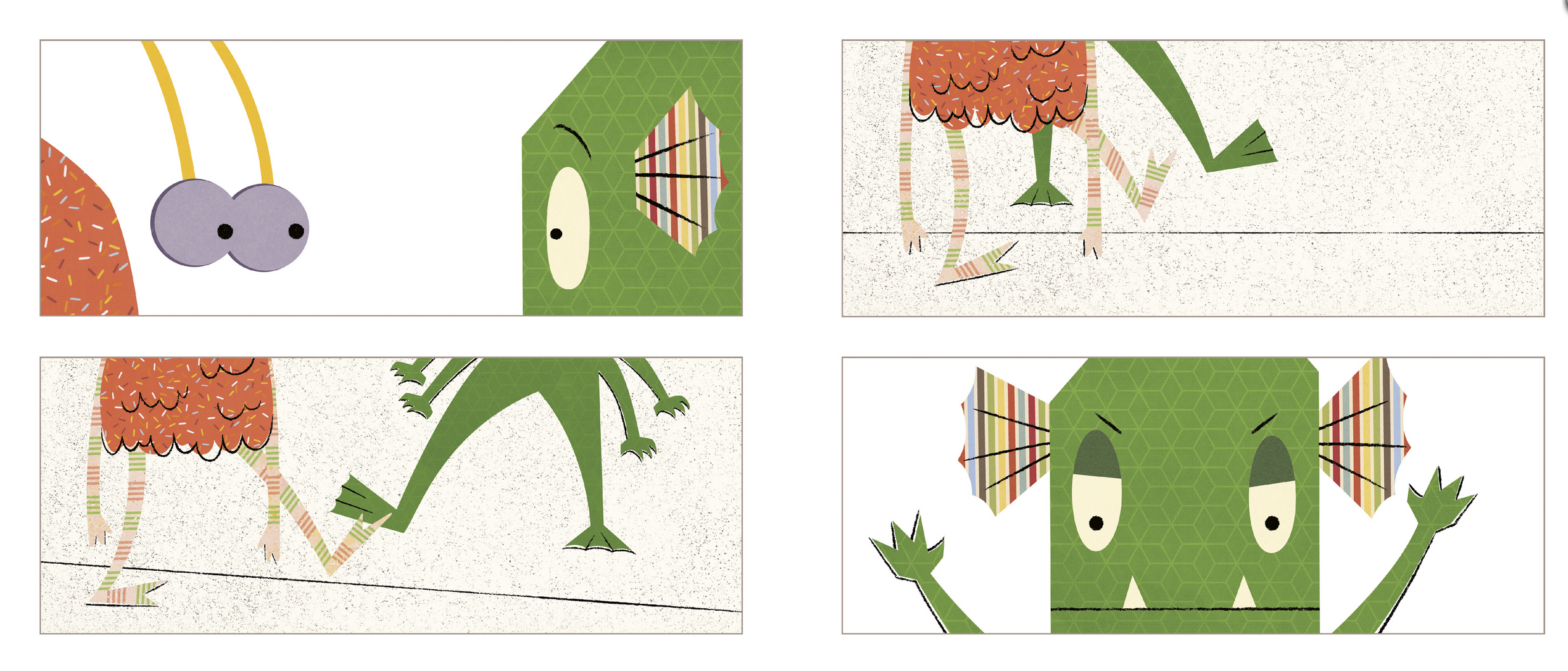
This does not please the purple-eyes-on-antennae creature who promptly lifts its foot across the line and stomps on the green webbed foot of the other. Though it is deliberate, the purple-eyed monster does not realize the impact it would have, causing the green one to stumble and fall across the line and into its assailant, blurring the line in the sand.
From The Line in the Sand by Thao Lam
Then a bee flies into the mix.  Both monsters are thrown into a tizzy trying to evade the insect and in the process kick up the sand, obliterating the line. Looking up to see the roughened sand, the two creatures realize that beyond their interaction are numerous more lines, all drawn by the same stick-dragging monster. But, no one is reacting to those lines at all. They walk across them, they ignore them, or they are oblivious. The lines are present but of no concern.  Soon enough, our two rivals recognize the emptiness of their conflict, especially as they'd already joined forces to try to defeat a bee.

Conflict is often borne of words so it's meaningful that Thao Lam wrote a picture book about conflict as a wordless story. That just tells you how much words can get in the way. (They can also work wonders when used well.) In The Line in the Sand, no words are needed to convey distress, discord, territoriality, shock or even rage. These creatures, though their morphologies suggest otherwise, are as human as Thao Lam's readers.  (Don't we all differ to some degree in our shapes, colour, limbs and more?) Like all of us, they can be protective and defensive if they perceive a slight, intentional or not. And intention is key here because the creature with the stick intended nothing except play. Sadly, that line in the sand was the basis for some inadvertent conflict. Only when the two come together in a common goal–ridding themselves of a bee–do they see their squabble as insignificant.
From The Line in the Sand by Thao Lam
From her very quirky characters, that vary in colour from green to orange, yellow, pink and blue, with or without stripes or dots or other patterns, and with various limbs, eyes and more, Thao Lam includes everyone and spotlights no one. In their peculiarities, they are us. And we are them, drawing lines accidentally, taking offence indiscriminately, and coming together only when we see our similarities, not our differences. 

The Line in the Sand reminds us that conflict can be borne of misunderstanding or disregard but with communication, even without words, and awareness, resolution is possible.

September 25, 2020

The Paper Boat: A Refugee Story

Written and illustrated by Thao Lam
Owlkids Books
978-1-77147-363-7
40 pp.
Ages 6-10
September 2020
 
Told exclusively in the glorious collage art of Thao Lam, The Paper Boat follows the flight of a little girl and her mother away from Vietnam, a journey paralleled by an army of ants who strive for their own survival.

From The Paper Boat by Thao Lam

As the front endpapers illustrate, The Paper Boat begins amidst a history of the war in Vietnam. The conflict between South Vietnam and the North Vietnamese escalates until April 30, 1975 when Saigon falls and the South Vietnamese surrender. While a family tries to curtail an invasion of ants with sugar water, and a little girl uses her chopsticks to rescue them and send them on their way, the Vietcong tanks roll past their window. Soon the family is packing up and saying their goodbyes, with mother tearing her daughter away from her father and grandparents who have their own journeys.
From The Paper Boat by Thao Lam

As mother and daughter escape through long grass, hiding from soldiers, they follow a parade of ants in the moonlight to the water's edge. But while they wait for Vietcong patrols to leave, the mother distracts the child by fashioning a paper boat from the wrapping around their food. When their escape boat arrives, the paper boat is left behind but discovered by ants who will begin their own escape by boat.

From The Paper Boat by Thao Lam


The ants endure a multitude of hardships–undoubtedly mirroring what the child and her family bear on their own boat–from limited food and water, to calamitous weather and the capsizing of the boat before making landfall. Even as they help each other, some are lost, before they come together at a new table in a new place.

From the clues in Thao Lam's story, as well as her "Author's Note," it becomes evident that The Paper Boat is based on the author-illustrator's own family history of escape from Vietnam. This tale of migration is laced with trauma and danger and, by telling it through the parallel story about the ants, Thao Lam tells us so much without the reader witnessing the horrors of their fleeing. They, like the ants, come to make a new home, with the child together with both parents and even a new little one–though a photograph with incense on a side table suggests a grandmother who did not survive–in a city teeming with families undoubtedly with some of their own stories of migration.

By creating her story without text, Thao Lam invites the reader to delve into the story and make connections between the two families, one ant and one human, finding the similarities and differences in their plights and the relationships between and within. By using her collage art with images on cut paper layered to create depth and texture, Thao Lam brings us to a table, onto a boat, and into a city. Moreover, by using a limited palette, mostly sombre colours like dark blues and black with splashes of pink and golden for hopeful elements like the sun, the boats and food, Thao Lam makes us see where hope lies. Reassuringly, their new home is filled with the colour of promise.

From The Paper Boat by Thao Lam

May 23, 2016

Two picture books to launch from Owlkids: SKUNK ON A STRING and MAYA (Toronto)

It's twice the fun
because there are two books being launched!


 - - - - - - - - - - - - - - - - - - - - - - - - - 

Join author-illustrator Thao Lam for the launch of

Skunk on a String
Owlkids Books
978-1-77147-131-2
40 pp.
Ages 4-7
March 2016

A wordless picture book about a skunk who sees the world from a new perspective
Reviewed here


and


debut author Mahak Jain

and award-winning illustrator Elly McKay

for the launch of their picture book

Maya
Owlkids Books
978-1-77147-100-8
32 pp.
Ages 4-7
April 2016

The story of a young girl who uses her imagination and the legend of a banyan tree to assuage her fears and grief

on

Saturday, June 4, 2016

2-3:30 p.m.

at

Toronto Public Library
Lillian H. Smith branch

There will be:
  • swag bags for the first 30 kids (and treats for adults too)
  • storytime
  • crafts and activities
  • refreshments
  • book signing
  • books on sale courtesy of Another Story Bookshop


 - - - - - - - - - - - - - - - - - - - - - - - - -  


March 15, 2016

Skunk on a String

by Thao Lam
Owlkids Books
978-1-77147-131-2
40 pp.
Ages 4-7
March 2016

Wordless picture books have a nuance that takes them beyond texted children’s books.  It’s the distinction of stories told without the clues of text, stories told in whatever way the visual reader chooses to see the tale.  The possibilities are endless.  In this review, I will endeavour to share my own take on Skunk on a String.  It may not be what others see but it’s mine.

Amongst a colourful parade of costumed walkers clinging to massive balloons floats a skunk with a relatively plain red polka-dot balloon string wrapped around its back leg. How he got into this predicament is unknown.  What he sees and the reactions he generates are the basis for Thao Lam’s illustrations, both full page and panelled pages with multiple scenes.

From Skunk on a String by Thao Lam
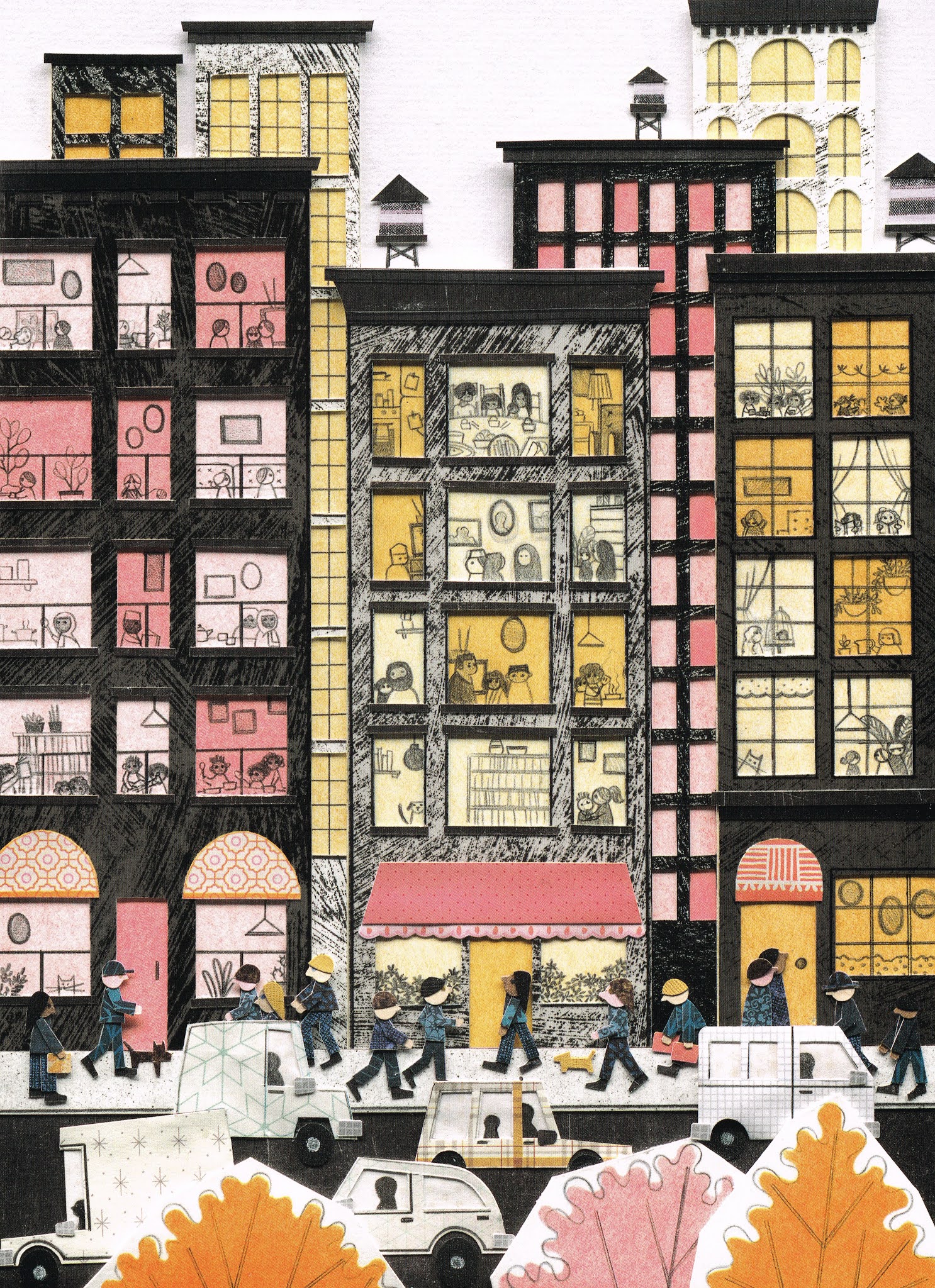
From the city blocks of apartments with their multitude of residents–cooking, watching TV, doing laundry, reading–to the construction workers on top of unfinished buildings and the animals at the zoo, the skunk sees much, all the while trying to catch something to help bring him down.  Hope seems imminent with a foray on a garbage truck but our little guy is again set aloft and cruising over, and in, an ocean, a desert and finally an amusement park, where a ferris wheel gives him the opportunity to become unstrung.  But, with this new freedom, the little skunk gets a new perspective on his adventure and finds a way to get back the truly free experience of seeing the world.

Thao Lam uses collages of brightly coloured and textured papers to create the amazing worlds that our little skunk visits.  Both minimalist in some scenes (e.g., the zoo) and incredibly detailed in others (e.g., the apartment building), she fashions clever illustrations that depict a full range of landscapes, each with their own touches of life: fish, cacti, elephants, trees, plants, humans.  There’s both a depth and a lightness to her illustrations, not unlike the world that Skunk on a String gets to visit, ultimately cherishing the opportunity for adventure he’s been given.