Showing posts with label communication. Show all posts

January 14, 2025

Izzy Wong's Nose for News

Written by Marty Chan
Orca Book Publishers
978-1-4598-3937-3
208 pp.
Ages 8-12
September 2024
 
Twelve-year-old Izzy Wong may have a nose for news, but she has to make sure she's not putting her nose where it doesn't belong or sniffing out a story that isn't there. She may aspire to be the next Sarah Koenig and make her journalist/news-anchor mom proud of her, but Izzy Wong still has a lot of learning to do. After all, she is only in Grade 6.
 
Izzy may not be popular, but she loves reporting news from the school and interviewing her classmates about tests and other school happenings for her podcast. They might not like being questioned but Izzy doesn't let that deter her. But when she learns that the third-floor girls' bathroom flooded over the weekend and has caused much damage to classrooms and the library, Izzy thinks she's got a fabulous podcast story in solving the mystery of how it happened. 

But Izzy is still a novice at interviewing and pursuing a story. She gets useful advice from her mom how to keep herself from starting rumours and making herself part of the story, but she doesn't always follow the advice or heed the warnings of her teachers or principal. Instead, she begins speculating that Doyle McTaggert, a sixth-grade prankster, may have been behind stuffing paper towels in the toilets. With that leading her, Izzy begins seeing things that make Doyle look guilty and, without intending to do so, she starts gossip about her classmates. How is she going to get to the bottom of this mystery without making everyone hate her or clouding her investigation with rumours?

While a flooding in a school bathroom may not be the mystery of the century, it is a big deal in an elementary school where bathrooms are places of chatter and refuge. And when classrooms and staff are impacted–from the massive clean-up and ruined school equipment and furniture–it is a very big deal and mystery that the authorities want solved, although perhaps not how Izzy goes about it. But author Marty Chan makes Izzy a believable character who is determined to do something, although her passion is not always embedded in common sense or the sound judgement of her elders. She's eager but impetuous and she takes missteps that she sometimes should walk back but doesn't. In other words, she's a kid who is learning from her mistakes and by doing her best, even if it isn't always right. Fortunately, Marty Chan lets Izzy grow into her journalistic skills and herself, learning some sensitivity from her missteps and some wisdom from her peers and elders about the consequences of her actions. At least she learns. And she solves a mystery that wouldn't have been uncovered without her diligence in pursuing a story. Izzy may have been distracted by the whiff of stories of romance and revenge but, in the end, she got to the heart of the matter and matured as an investigative reporter.

June 19, 2024

Greetings, Floof!

Written by C. J. Hong
Illustrated by A. J. Smith
Kids Can Press
978-1-5253-0723-2
32 pp.
Ages 3-7
June 2024

A tiny pink fluff ball of an alien called Floof has arrived on our planet and scientific investigator Dr. Greta Goodnote is ready to meet and greet the explorer from Ploof. But it's going to take a little help from readers to really get to know the alien named Floof. 
From Greetings, Floof!, written by C. J. Hong, illustrated by A. J. Smith
First, though, Floof must come out of his spaceship. So, Dr. Greta encourages readers to give him a Ploofian hello by raising their arms and jiggling them. (Lucky we have a scientist to help guide us.) When Floof finally emerges, it's to cuddle a couple of bunnies the reader has pointed out to him. When the rain comes, readers are again enlisted, first to blow about the clouds and then to help a very fluffy Floof to return to his pre-ultra-poofing self. (This requires everything from blowing, and then closing and opening the book, and even shaking it gently.) And when he enjoys his first kiss, Floof is encouraged to pay it forward in his own Ploofian way.
From Greetings, Floof!, written by C. J. Hong, illustrated by A. J. Smith
By making readers part of the story, needing to help greet Floof, to locate animals to cuddle, to blow away rain clouds, to de-poof Floof, and more, C. J. Hong makes Greetings, Floof! an interactive story. While this is generally more difficult with picture books that are read aloud to children, rather than chapter books in which they might make choices of how the story continues, C. J. Hong keeps young readers enthralled, waiting for their next task in helping little Floof out. Not only are they learning empathy and cooperation, but they also see that science is something as basic as building knowledge through observation, experimentation, and application. 
 
American artist A. J. Smith has created an incredibly cute alien in his digital artwork but Floof is still very different. So Ottawa's C. J. Hong's story of the little guy inspires inquiry, coupled with open-mindedness for those who look and speak differently. Because of that, C. J. Hong ticks off all the boxes for a story of science, communication, compassion, and acceptance while demonstrating that kindness can bridge worlds, even planets.
From Greetings, Floof!, written by C. J. Hong, illustrated by A. J. Smith

February 03, 2024

Still My Tessa

Written by Sylv Chiang
Illustrated by Mathias Ball
North Winds Press (Scholastic Canada)
978-1-4431-9623-9
32 pp,
Ages 4-8
January 2024
 
Evelyn is both perplexed and worried. The older child she has always known as her sister is now telling her that they aren't her sister, or her brother. Tessa is her sibling. What does that mean? Is Evelyn even Tessa's sister?
From Still My Tessa, written by Sylv Chiang, illustrated by Mathias Ball
Evelyn sees that Tessa is not herself. Evelyn wants to play with Tessa and take them out of their dark room and make them smile again but she doesn't know how. When she writes a note to the "Best Sister Ever!" Tessa explains to Evelyn that they are not her sister, or her brother, but prefers to be called Evelyn's sibling. They do some stuff together but it's obvious that Tessa is growing up and their interests have changed. They are also burdened with educating Evelyn about their pronouns (they/them/their) and dealing with those who assume they know what Tessa's pronouns must be.
From Still My Tessa, written by Sylv Chiang, illustrated by Mathias Ball
Evelyn wants to learn and she does. After a week, she's using Tessa's preferred pronouns and almost gets a smile from her sibling. But when the family goes for a bike ride, Tessa is again challenged by those who assume their gender is female. Evelyn has no problem informing people they meet that Tessa is her sibling, recognizing that if she can adapt to Tessa's pronouns in a week, others can learn as well. And when their parents introduce Evelyn as a girl and Tessa as non-binary, Tessa's smile finally returns.
From Still My Tessa, written by Sylv Chiang, illustrated by Mathias Ball
The premise behind Still My Tessa goes beyond just recognizing that we should all feel comfortable with the pronouns by which we are addressed. It also recognizes that young children might have to learn about pronouns and being non-binary but that this can be learned with the right teaching. Teacher Sylv Chiang (she/her) finds a sibling relationship the perfect vehicle for addressing the use of pronouns. As a little sister who obviously adores Tessa, Evelyn just wants them to be the sibling with whom she can play and make happy. And by modelling what's she's learned, Evelyn can help teach others what is appropriate for Tessa and all of them. 
 
Illustrator Mathias Ball (he/they) may have had to struggle with enlightening others about their preferred pronouns, and, as such, their depictions of Tessa are truly authentic, reflecting what a child struggling to understand and accept and advocate for themselves with their non-binary status and pronoun preferences would feel. Evelyn is a happy child whose biggest worry is who will play with her, while Tessa is filled with angst. Whether it is becoming a teenager, already a struggle for many, or understanding their non-binary nature, Tessa projects that burden, rarely cracking a smile or venturing from their room and from beneath their headphones. Still, Mathias Ball doesn't make them sullen or angry, but they do make them introspective and solemn. That doesn't mean the illustrations are anything but bright and cheerful and inclusive, ensuring that Tessa and Evelyn both see the joys of their world.

Accepting how we would like to be addressed is an important part of our identities. But it isn't always easy for others to accept the appropriate pronouns or gender designations (even nonconforming ones). Still Evelyn demonstrated that learning can happen and doesn't have to change her relationship with Tessa, except by also becoming their ally now. With a little instruction–Sylv Chiang offers some help understanding of what it means to be non-binary, how to use pronouns, and how to become an ally. With compassion and clarification, every young child can learn to use the correct pronouns as Evelyn did for her sibling and help others to do the same. (And Still My Tessa may even help a few parents learn how to becomes allies for their children.)

November 24, 2023

Next Door

Written by Deborah Kerbel
Illustrated by Isaac Liang
Kids Can Press
978-1-5253-0658-7
32 pp.
Ages 3-7
October 2023
 
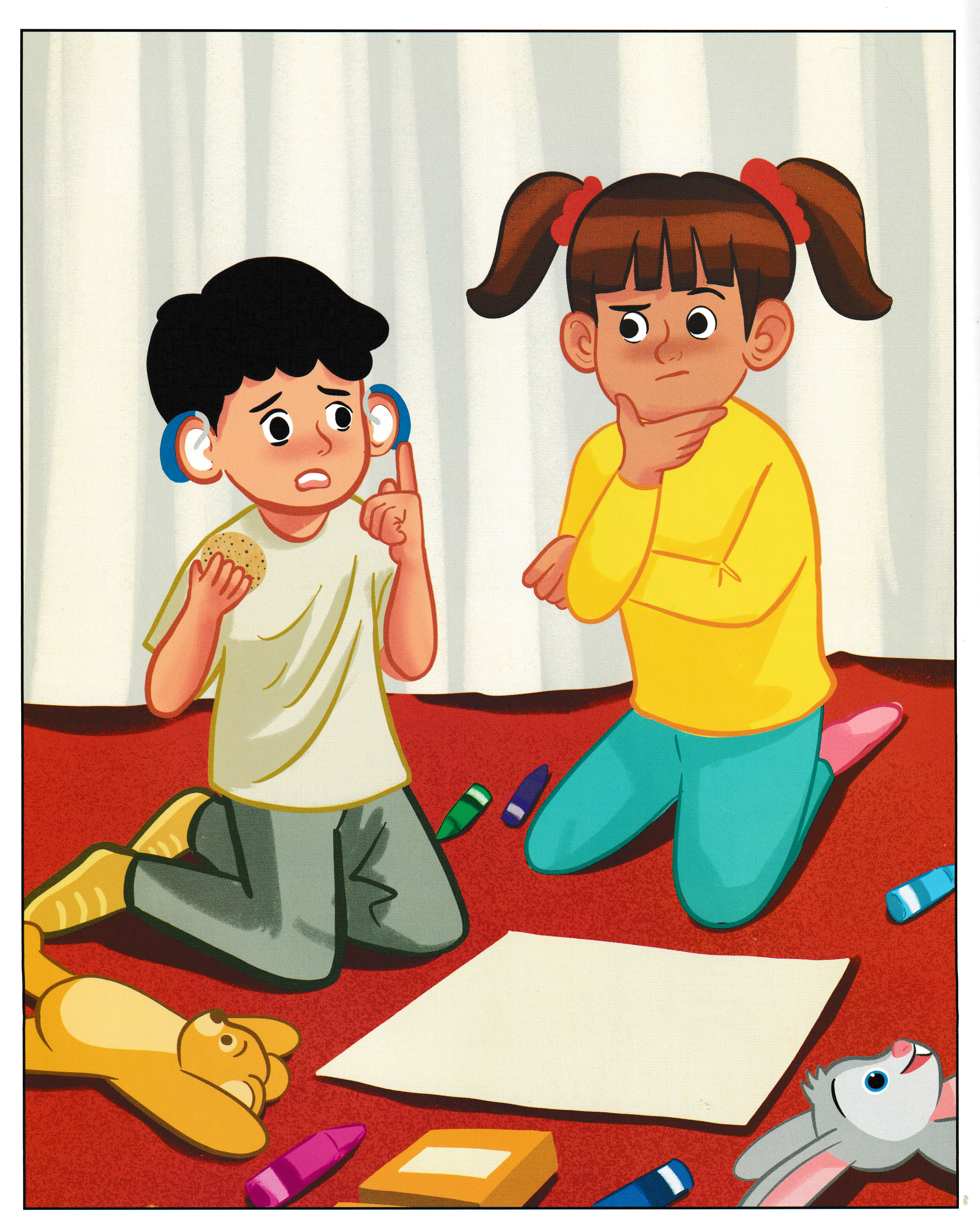
Wordless picture books have a general hush about them. In wordless books, i.e., ones in which the stories are told through illustrations alone, no one is speaking and there is no text to distract. It's all rather subdued. In fact, it's a perfect reflection of what the main character, a young boy with hearing aids, must experience much of the time. But don't be fooled into thinking that there is no story to be told or personal connection to be made.
From Next Door, written by Deborah Kerbel, illustrated by Isaac Liang
A boy and his mother head out from their home just as a moving van arrives and begins unloading boxes. It's evident these are not their goods as the boy is familiar with the places and people he encounters on their walk. Though he may have limited hearing, as evidenced by his hearing aids, he notices everything, from the musician busking, the construction workers at work, and even baby birds in a high nest. It's unfortunate when a cyclist races past the boy, startling him into dropping his teddy bear. But, after confirming he is okay, communicating via American Sign Language, his mother settles the boy.
From Next Door, written by Deborah Kerbel, illustrated by Isaac Liang
Returning to their building, they visit their new neighbours in the apartment next door. Using her own way of communicating, with hand movements and an Arabic/English dictionary, the woman welcomes them. But the boy spies a little girl hiding from them. When he approaches her, it is evident that neither can understand the other. But through the sharing of food and art, the two children find their own way to communicate.
 
This story is deeply personal for Toronto author Deborah Kerbel whose own sister had been born profoundly deaf. Deborah Kerbel's Author's Note speaks of her sister's abilities to connect, and Next Door's story reflects that ability for children who find different ways to communicate because of hearing and language differences. Undoubtedly a child who has a hearing impairment and one whose language is different than those around them may both feel at a disadvantage when trying to communicate. But, as the boy demonstrates, his disability is not a hindrance to living a good life, one in which he communicates with others, just in his own way. He successfully uses American Sign Language and his hearing aids to enable connection with others. But, when he meets the new little girl next door, he's on an equal playing field as she struggles to get him to understand her. But, with some effort and the common ground of art, along with a tasty cookie, a connection is made.
From Next Door, written by Deborah Kerbel, illustrated by Isaac Liang
Deborah Kerbel opens up about her sister's story to help convey the possibility that communication does not cease with hearing or a different language. We find new ways to communicate when the customary route is not available. By juxtaposing the boy's circumstances with that of his new young neighbour, Deborah Kerbel has found a way for any child for whom communication is challenging, because of, for example, cultural differences, emotional barriers, or physical barriers, to accept that different can still be effective. 
 
Isaac Liang is a deaf illustrator from Singapore who imbues the art of Next Door with knowledge and sensitivity. Because of his personal experiences with hearing impairment, Isaac Liang has found a way to bring the quiet and the connection for the children through his digital art. Because comprehension through the sense of hearing is compromised, his emboldens the story with colour and shape. Perhaps words are unnecessary but meaning still comes through with every building, person, and detail. 

Next Door is a great picture book for helping children develop their visual literacy skills and their empathy and acceptance for those who communicate differently. Hopefully it will help them to recognize that we do not all hear or see or understand the same way–the cyclist who almost collides with the child assumed the boy could hear him coming–and to find new ways of communicating that might work better for others. And, when it all comes down to it, kindness always works.

September 11, 2023

Friends Find a Way!

Written by Heather M. O'Connor
Illustrated by Claudia Dávila
Scholastic Canada
978-1-4431-9386-3
32 pp.
Ages 3-7
September 2023
 
When Suze first joined Tyson's class in Heather M. O'Connor's Fast Friends (2020), there was some nervousness about a non-verbal child in a wheelchair becoming friends with a boy who couldn't slow down. But, the two children did become friends, and fast friends at that, with Suze enjoying the speed in her wheelchair as much as Tyson loved helping her race about. Now the class is heading to the zoo for a field trip and both Tyson and Suze are excited to see the cheetah, an animal known for speed.
From Friends Find a Way!, written by Heather M. O'Connor, illus. by Claudia Dávila
At the zoo, the class are buddied up–Tyson with Suze–and told to stay together. As they focus on visiting different animals, the kids help direct the class, using the map. Of course, when it's time to see the cheetah, Tyson and Suze know just where to go. But as Tyson remains enthralled with the cheetahs, the class moves on, and suddenly Tyson and Suze are on their own. Tyson hadn't been paying attention, but Suze had, and though she can't express herself verbally, she knows how to tell Tyson where the class has gone.
From Friends Find a Way!, written by Heather M. O'Connor, illus. by Claudia Dávila
While some readers may see Suze's disability as the focus of Friends Find a Way!, author Heather M. O'Connor spends less time on Suze's limitations and more on the connection that Suze and Tyson have. That friendship may have been based initially on their appreciation for speed, but it has evolved into one of camaraderie, similar interests, and cooperation. There is no judgment about who can do or can't do something but instead shows them working together to get what they both need and want. It's that working together to navigate the rambling paths of the zoo to the missing class and to get there as quickly as possible that is how this friendship works. And a story about friends finding a way, whether to rejoining their class or to making their lives fuller and better, is the way to go.
From Friends Find a Way!, written by Heather M. O'Connor, illus. by Claudia Dávila
Claudia Dávila, who illustrated Fast Friends as well as Friends Find a Way!, keeps her digital art colourful, upbeat and dynamic, just like Suze and Tyson. And her illustrations are as inclusive as Heather M. O'Connor's story. Claudia Dávila shows us people of all ages, abilities, cultures and more and makes them all part of the community. And with a delightful assortment of animals, from the sloth and red panda, Komodo dragon and kangaroos, she also takes us on a visit to the zoo alongside Suze and Tyson's class.

Friends do find a way to make things work and Tyson and Suze have found a friendship that works for them, whether at school or at the zoo. They are truly fast friends, both in the speed of their mobility and in the security of the connection, with new experiences strengthening that bond even more.

• • • • • • • 
 
Friends Find a Way (2023)

June 09, 2023

ThunderBoom

Written by Jack Briglio
Illustrated by Claudia Dávila 
Kids Can Press
978-1-5253-0496-5
128 pp.
Ages 9-12
May 2023
 
Going to the Santa Claus parade is a tradition that many families enjoy, even if they might worry about safety in the huge crowds. For Logan's family, those fears are far greater because Logan is nonverbal. So when Logan dashes away to see something and gets separated from his family, it is a scary situation for all. Thankfully ThunderBoom is around to help.
From ThunderBoom by Jack Briglio, illus. by Claudia Dávila
As the family prepares for their trip into the city for the parade, it becomes evident that Logan communicates with his parents and older sister Izzy in his own way. He uses hand and body actions, and occasionally speaks the first letter of the words he wants to say, and they get him. He loves playing with his tablet and he loves trains. And he's Mister Social speaking to everyone on the train. But he also is unaware of the dangers that might befall him when he's excited. Logan might understand that he's being told to listen more carefully but that doesn't stop him from bolting from his family when he wants a closer look at the parade.

He soon realizes he's in an uncomfortable situation, faced with a group of clowns. But when faced with a stressful situation, Logan's imagination kicks in to protect him. (Illustrator Claudia Dávila demonstrates this with a white haze that appears and displays Logan's thoughts in yellow boxes.) So Logan envisions himself as ThunderBoom, a superhero who can stomp his way into protection. Still, after getting away from the monstrous clowns, he finds a new dilemma to solve: the little girl he'd met on the train has lost her teddy bear and her parents. ThunderBoom springs into action once again.
From ThunderBoom by Jack Briglio, illus. by Claudia Dávila
After several more heroic adventures, Logan is finally reunited with his family, though he does have some moments of insight that his issues with discerning who is friend or foe, and hence his consequent reactions, may be him misunderstanding situations, just like others misunderstand him.

This may not be Jack Briglio's first book, but I suspect it's his most personal, as his "Author's Note" confirms. But that also means that his character Logan is more real, and Logan's alter ego of ThunderBoom evenmore genuine. Logan, modelled after Jack Briglio's son who has Angelman syndrome, has a great many fears and finds solace in his imagined superhero ThunderBoom for protection. He has found ways to communicate with his family but his ability to connect with others is limited, especially when he's anxious about those interactions. Thankfully his cheerful disposition seems to help him make friends, and also allies, who will help him become more independent and successful when he encounters challenges, whether it's a yappy dog or getting separated from his family.
From ThunderBoom by Jack Briglio, illus. by Claudia Dávila
The message from Jack Briglio is more about Logan's ability to successfully meet those challenges in his own way, whether it's using an imagined superhero or asking for help from others. Everyone is faced with challenges, but we all need to find strategies to confront and overcome those obstacles or hardships. Logan's strategy works for him –I do wonder what really happened to those clowns and baton twirlers he fights off–though he has undoubtedly learned other skills from his family to approach his difficulties with patience and confidence. He's just a kid who is learning, and Claudia Dávila's digital illustrations–appropriately using superhero colours of yellow and red, though subdued, like Logan himself–make him as real as Jack Briglio's characterization and story.

ThunderBoom tackles a lot of important issues, not the least of which is coping with challenges. Giving Logan a voice, both in ThunderBoom the superhero and ThunderBoom the book, Jack Briglio may help other children find their own voices. Moreover, with ThunderBoom  providing us with insight into individuals with Angelman syndrome and the families that love and support them, the story is an act of courage itself, much like that shown by the superhero depicted within.

September 28, 2022

The Line in the Sand

Written and illustrated by Thao Lam
Owlkids Books
978-1-77147-570-9
48 pp.
Ages 5-8
September 2022
 
When a monster drags a stick behind them and creates a line in the sand, they are unaware of the conflict that results. But how that conflict is resolved is up to those who perceive it.
From The Line in the Sand by Thao Lam
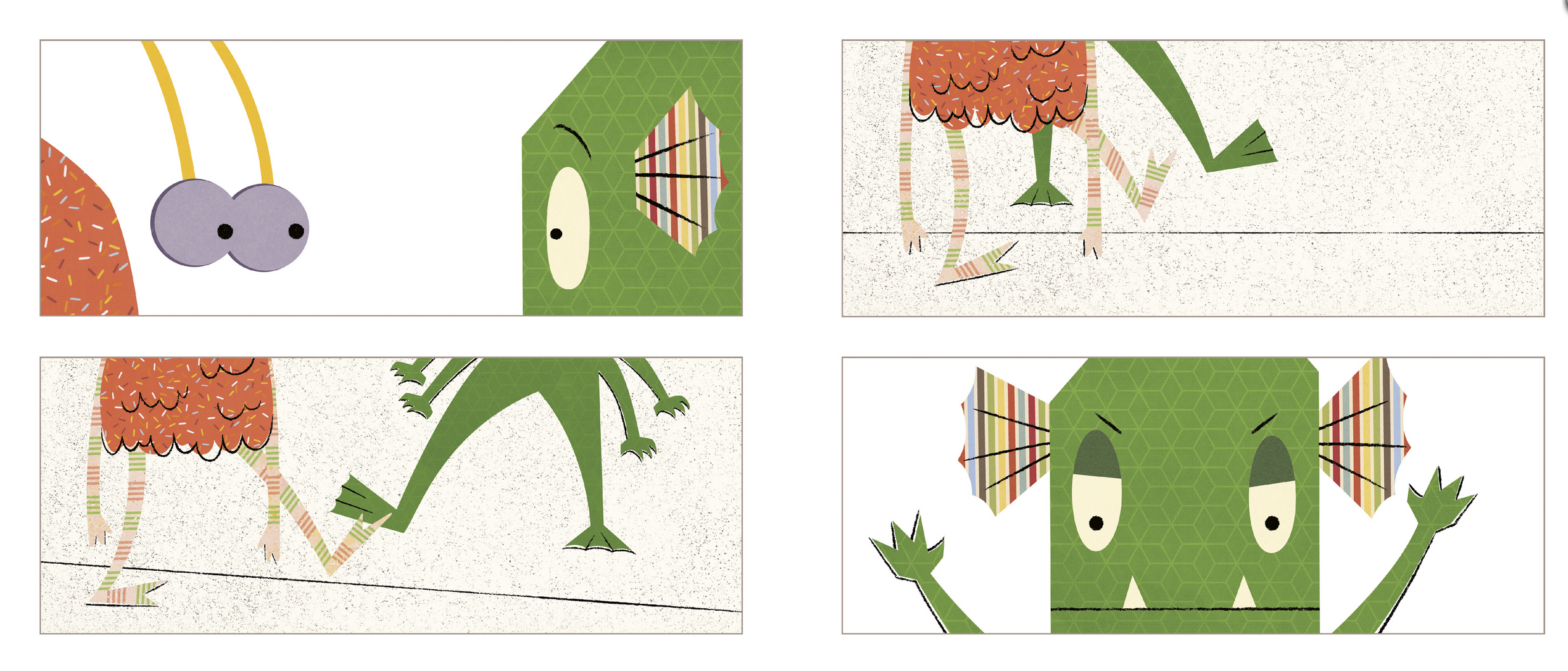
A varied assortment of monsters are playing at the beach: collecting shells, playing games, flying kites and building sand structures. One seven-eyed and four-limbed creature amuses itself by dragging a stick behind itself. (Haven't we all dragged sticks through sand and dirt to create shapes?) But several of the other monsters notice this line. It divides them. And when one tries to step over the line, another gets distressed and directs it back.
From The Line in the Sand by Thao Lam
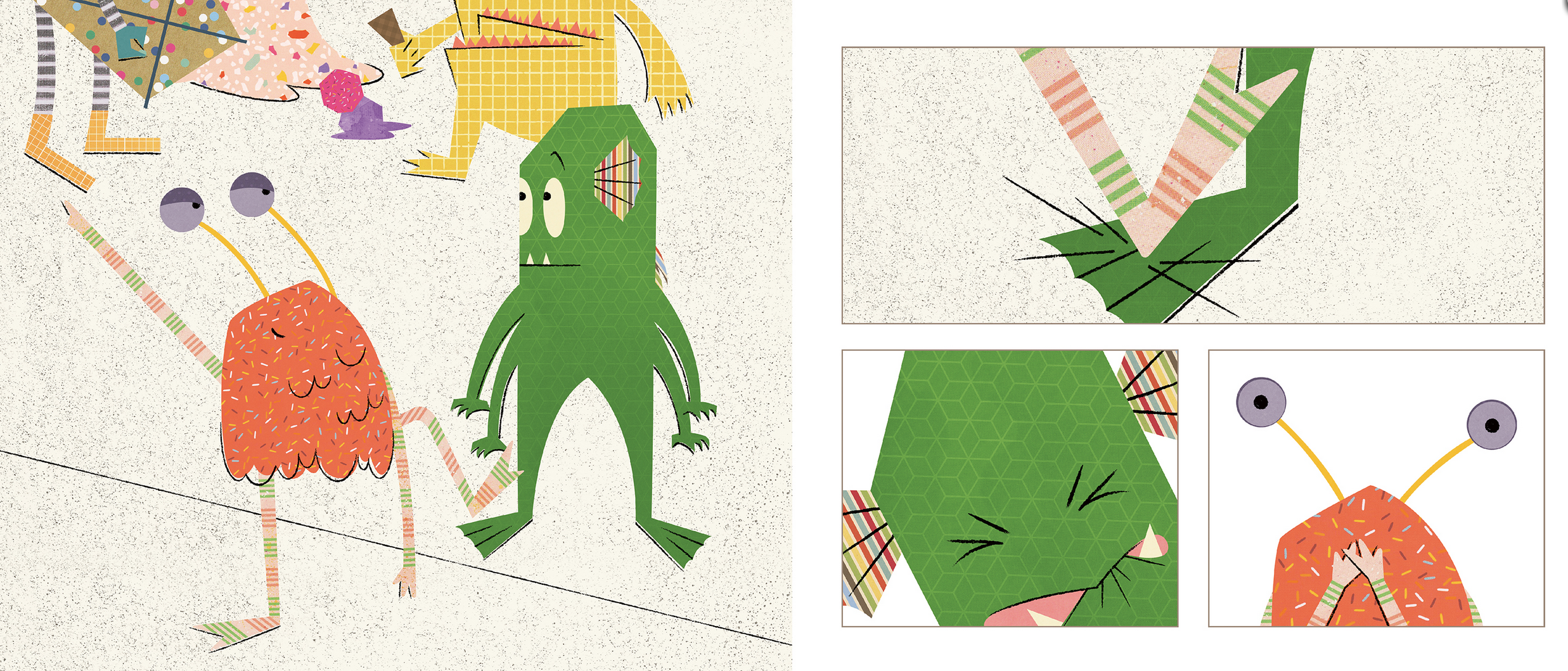
This does not please the purple-eyes-on-antennae creature who promptly lifts its foot across the line and stomps on the green webbed foot of the other. Though it is deliberate, the purple-eyed monster does not realize the impact it would have, causing the green one to stumble and fall across the line and into its assailant, blurring the line in the sand.
From The Line in the Sand by Thao Lam
Then a bee flies into the mix.  Both monsters are thrown into a tizzy trying to evade the insect and in the process kick up the sand, obliterating the line. Looking up to see the roughened sand, the two creatures realize that beyond their interaction are numerous more lines, all drawn by the same stick-dragging monster. But, no one is reacting to those lines at all. They walk across them, they ignore them, or they are oblivious. The lines are present but of no concern.  Soon enough, our two rivals recognize the emptiness of their conflict, especially as they'd already joined forces to try to defeat a bee.

Conflict is often borne of words so it's meaningful that Thao Lam wrote a picture book about conflict as a wordless story. That just tells you how much words can get in the way. (They can also work wonders when used well.) In The Line in the Sand, no words are needed to convey distress, discord, territoriality, shock or even rage. These creatures, though their morphologies suggest otherwise, are as human as Thao Lam's readers.  (Don't we all differ to some degree in our shapes, colour, limbs and more?) Like all of us, they can be protective and defensive if they perceive a slight, intentional or not. And intention is key here because the creature with the stick intended nothing except play. Sadly, that line in the sand was the basis for some inadvertent conflict. Only when the two come together in a common goal–ridding themselves of a bee–do they see their squabble as insignificant.
From The Line in the Sand by Thao Lam
From her very quirky characters, that vary in colour from green to orange, yellow, pink and blue, with or without stripes or dots or other patterns, and with various limbs, eyes and more, Thao Lam includes everyone and spotlights no one. In their peculiarities, they are us. And we are them, drawing lines accidentally, taking offence indiscriminately, and coming together only when we see our similarities, not our differences. 

The Line in the Sand reminds us that conflict can be borne of misunderstanding or disregard but with communication, even without words, and awareness, resolution is possible.

December 08, 2021

My Words Flew Away Like Birds

Written by Debora Pearson
Illustrated by Shrija Jain
Kids Can Press
978-1-5253-0318-0
40 pp.
Ages 4-8
October 2021

There are all kinds of fitting in. But when you're new to a country with a new language, it is especially hard. Not only are you missing your old home with its familiar people and places, you're in a new place where communication is near impossible. For the child in My Words Flew Away Like Birds, she is completely unprepared for the vacuum of language with which she and her parents must endure.
That was my world 
back then.
This little girl remembers the trees, the noisy market, her grandfather's bakery, and her friends. In preparation for their move, her mother teaches her some rudimentary phrases that should help break the ice, like "Hello, how are you?," and "It was nice to meet you.
From My Words Flew Away Like Birds by Debora Pearson, illus. by Shrija Jain
The words felt strange 
and lumpy 
in my mouth.
But, though she is amazed by the things she sees, like snow and a dog in a coat and booties, everyone speaks so fast in her new country and she cannot grasp the words or their meaning. She tries desperately to watch and listen but she feels so lost. 
From My Words Flew Away Like Birds by Debora Pearson, illus. by Shrija Jain
It's not until the next spring when she helps a little girl who falls off a playground swing that she can use one of her learned phrases, experiment with echoing the other child's words, and finally make the connection that makes her feel she belongs.

Many of us know what it's like to travel to new places where different languages are spoken. If we're considerate, we try our best to communicate in their language but appreciate it when the locals help us out by speaking in ours. But for immigrants, immersion in a new culture with a new language is undoubtedly daunting. Not only do they have to navigate bureaucratic and new cultural norms, they often must do so in a new language. For children who are desperate to make connections at school or in their neighbourhoods, how do they do this without words? Fortunately, what the child in My Words Flew Away Like Birds realizes eventually is that kindness and play have no language barriers and learning only happens when mistakes are made. These are both simple and complex messages and Debora Pearson shares them with a convincing text rich in auditory embellishments and striking dialogue, emphasizing what is most important to the young child. She'll remember the sounds she hears and the muffled vocalizations, hand-lettered for emphasis, until they can become words to her, words that don't fly away but instead are ones she can grab hold of.
From My Words Flew Away Like Birds by Debora Pearson, illus. by Shrija Jain
Artist Shrija Jain's pen and ink illustrations, which were coloured digitally, underscore the importance of the words and the connectivity between child and place. Using only pastel shades of blue, rose, purple and orange to offset the vivid black details of hand-lettered words, the immigrant family and those with whom they interact, and sparse landscape elements, Shrija Jain demonstrates what is truly important: connection through communication in all its forms and efforts.

This child may feel like the words of her first language flew away but she does find some new words and is delighted to move forward and recognize that "these words are here to stay." As with much learning, it happens with time and practice, and that includes mistakes, and the making of connections to make that learning worthwhile.

August 22, 2019

Ping

Written and illustrated by Ani Castillo
Little, Brown Books for Young Readers
978-0-316-42464-6
48 pp.
Ages 4-8
September, 2019 

Ping is both subtly complex and powerfully simple in its message about communication and connecting with others. It says loads about how to do it, when to do it, and the need to accept how others return that communication. Like the game of ping-pong–the premise upon which the story is based–there is a give and take between communicants that must be respected to ensure successful connections are made.
My friend,
in this life...

...we can only PING.

The PONG belongs to the other.
From Ping by Ani Castillo
Ani Castillo highlights the multitude of ways you can Ping (note that the verb "Ping" is always capitalized). It can include using your voice or painting or using a computer. It can be with small or large gestures, and you can Ping to one or many. But it's the approaches to Pinging that are most impressive. With many adverbs, Ani Castillo recommends Pinging freely, generously, wisely, kindly, persistently, hopefully, and mindfully. However, even with those intentions, you must still wait for the Pong and accept it as given. It may come as expected or not but it will be the basis for new connections regardless.
From Ping by Ani Castillo
Best known for her cartooning, Ani Castillo's illustrations of amorphous characters in Ping will be relatable to all children. They're cute but unrecognizable and could be any person reading this book. But, with Ping, her debut picture book, Ani Castillo has found a voice that communicates with heart as well as art. She helps us see the importance of self-expression but always with thoughtful intent and consideration for the recipients of that expression. In a world of social media and the constant airing of opinions, we need to follow the sage advice that Pinging requires wisdom and responsibility. Regardless of the reciprocating Pong, we must Ping with humanity.  Shouldn't this always be the way with communication?
From Ping by Ani Castillo
Ping is about thoughtful discussion and that is exactly what it will inspire: conversations about how we communicate and how we should. It is learning and teaching in one, all with tenderness and understanding for our need to connect with others and how to do it effectively and with compassion.

August 14, 2019

The Playgrounds of Babel

Written by JonArno Lawson
Illustrated by Piet Grobler
Groundwood Books
978-1-77306-036-1
32 pp.
Ages 5-10
August 2019

From JonArno Lawson, the author of the award-winning Sidewalk Flowers (illustrated by Sydney Smith, Groundwood, 2015), comes another important story about differences and communication that demonstrates we are far less disparate than appearances may suggest.
From The Playgrounds of Babel by JonArno Lawson, illus. by Piet Grobler
The story begins with a kerchief-clad woman telling a story to a group of children. Her language, in the hand-drawn speech bubbles, is a series of lines, dots, and shapes. One boy translates for his friend, who clearly does not understand the woman, and so begins an updated version of the Tower of Babel biblical story. The dark-haired translator shares how at one time everyone spoke the same language until they attempted to build a tower to reach God. In response, God sent a dragon to destroy the tower and confounded their speech into many different languages. The boy's fair-haired friend interjects about not believing in God and knowing there's no dragon in the story but his friend persists. He focuses his story, or rather the woman's story, on two girls who suddenly cannot speak to one another.
From The Playgrounds of Babel by JonArno Lawson, illus. by Piet Grobler
Amidst their crying at this turn of events, the girls hug and realize that the songs they'd sung before could be the commonality they need. Though the words are different, they now "had a way to translate, because they knew they were singing exactly the same thing in two different languages."
From The Playgrounds of Babel by JonArno Lawson, illus. by Piet Grobler
Author JonArno Lawson explains the origins of his story in his Author's Note and, while it has a personal foundation from his own childhood and from the inquisitiveness of his own daughter, The Playgrounds of Babel extends far beyond these sparks. It speaks to the opportunities our differences provide to make our world richer not weaker. Throughout the story, a variety of languages are "spoken" from the birds who speak in terms of berries or caterpillars and snakes who speak in Ss as well as backward Ss. Everyone has a language that may be different from another but still allows them to communicate. Even in the world from which the boys and storyteller speak, there is more than just the words. There is imagination and the need to suspend disbelief and to see that God could whistle for a dragon to return to the heavens.

South African artist Piet Grobler provides the illustrations that blend harshness with wonder in a story within a story. I like that the contemporary setting from which the boys and the storyteller speak is dark and stark, until the end, and the world of the two girls is colourful and diverse. It reminds us that the storyteller brings the richness of colour to a story, even if it's one based in conflict or difficulty. Using watercolour and ink (including the dip pen to produce lines of varying thickness), Piet Grobler contrasts the two worlds and changes the reader's perspective repeatedly.

The Playgrounds of Babel has a powerful message about communication and differences but it's also about telling stories and realizing that anything can be real if we believe.

April 22, 2019

Mya's Strategy to Save the World

Written by Tanya Lloyd Kyi
Puffin Canada
978-0-73526-525-7
200 pp.
Ages 9-12
April 2019
Reviewed from Advance Reader's Copy

She may be dealing with her mother's prolonged absence tending to her ill grandmother, a comic but persistent misunderstanding about her sister's shin pads, a communication project with an annoying boy, and a mission to convince her parents to get her a cell phone, but Mya is still out to save the world because it seems to need it.

Twelve-year-old Mya, eight-year-old sister Nanda and their father seem to be a little lost when Mom heads to Myanmar to tend to her ailing mother. Mya, who aspires to work for the United Nations, uses all her skills in conflict resolution, patience, forgiveness and more to handle the ever-imploding household that can't balance meal preparation, laundry, cleaning and child care. But Mya is also a globally conscious and compassionate girl who, having organized their Kids for Social Justice group with best friend Cleo, worries about many issues, including the Rohingya crisis in Myanmar. However, while she would love to have the support of Cleo, her friend has just been gifted her first cell phone and is way too involved with texting and her crush Drew.

Meanwhile, Mya has been partnered with Ian to work on a communications project for English. As they pursue their project, sometimes in sync and sometimes not, Mya begins to learn a little bit more about effectively interacting with others to get her points across although not without a few misunderstandings and occasional strife. Oh, and did I mention the issues surrounding the mining of cobalt–war, child labour, safety, etc.–which is a key component in electronics like cell phones? Can Mya use all her diplomacy to find a friendly resolution to all the issues–environmental, social justice, family and relationship–with which she is concerned?

Wow, this girl has a lot on her plate: family, friends, school, boys, the world. (Did I mention she gets her period while her mother is away?) Yet, she never curls up and hides her head under the blankets. She's other there doing her bit and trying her best. Even when it seems like no one appreciates her efforts or takes them seriously, she manages. Taking advice from her father,
...if people take small steps in the right direction, the world will slowly shift. (pg. 158)
Mya continues to crusade for herself, others and our world. But Tanya Lloyd Kyi never makes Mya a saint or a tedious rah-rah cheerleader.  Rather, Mya is a stalwart advocate for doing one's best. Moreover, there is a freshness to Mya's social activism and her coming of age story. Tanya Lloyd Kyi could have weighed down the story with social issues that are heart-breaking and alarming or she could have steeped Mya's navigation into puberty with angst and confusion. Instead, she chose to offer hope that those small steps would lead somewhere positive, making those baby steps the first steps to social change and, on  a personal basis, to being a teenager.

••••••••••••
 
Tanya Lloyd Kyi launches Mya's Strategy to Save the World this week in Vancouver. See details here.

March 05, 2019

What We Buried

Written by Kate A. Boorman
Henry Holt and Company
978-1-250-19167-0
320 pp.
Ages 14-18
February 2019

You created your reality; live with it. (pg. 260)

But the realities that have been created for eighteen-year-old Jory Brewer and his sixteen-year-old sister Lavinia (Liv) are only minimally their own doing. Jory, born with Moebius syndrome, has several paralyzed craniofacial nerves which affect his appearance, his speech and his eating. He may choose to say very little and be more socially withdrawn but how others respond to him is not on him. He'd had one corrective surgery as a child and doctors had recommended further intervention but his parents didn't think it was a good investment. On the other hand, what they thought was a good investment was putting Liv on the child beauty pageant circuit, including a stint on Darling Divas, the reality TV show about pageants and their contestants. Unfortunately, in the aftermath of that career, Liv is now suing her parents for "irreparable and lasting harm." (pg. 11)

On the day of the trial, their parents disappear from the courthouse. Liv returns to the house, for the first time in months, ostensibly to help Jory but more to learn what has happened to their parents whom she believes Jory is helping. When she thinks she knows where they've gone, the two siblings head out to an old cabin their mother had inherited and which their father had always wanted to sell. But in a chilling road trip during which the two are haunted by fleeting visions, possible déjà vu, recurrent memories and danger, Liv and Jory transform from squabbling sibs to something unexpected.
And there it was–an uncanny sense of temporality. Like my reaction to what was happening–the focus of my attention–was a better measure of time than the minutes clicking over on the digital clock.  Everything was beginning to feel malleable and unfixed, like if I looked hard enough at the road illuminated by our headlights, I'd see beyond it, or behind it, or something. (pg. 103)
Kate A. Boorman has written a thriller that is equal parts plot and character in which both are significant and extraordinary. As the reader struggles to sort out the plot including what happened to the teens' parents, how the repeating news story on the radio is important, and what is real and either supernatural or illusion, Jory and Liv are exploring who they were, who they are and who they want to be.
Book jacket of What We Buried by Kate A. Boorman
The front cover of What We Buried may look like the story is about Liv and her perceptions but the back cover reveals that Jory's perspective is just as important. It's the way the two siblings see things about themselves, each other, their parents and the outside world and how it sees them that makes What We Buried intense and emotional.
You know the saying "Seeing is believing"? It's a problem, when you think about it. I mean, it's reasonable for people to want proof before they accept something they've been told. I do. I'm a fan of logic and demonstrable facts. But the idea inherent: that you can believe what you see? That's majorly flawed, because people usually have no idea what they're looking at. It's why people think my sister is a lovely, tragic victim. It's why they so often assume I can't tie my own shoes. (pg. 6)
The contrast of reality and illusion is a complex one in What We Buried and that's because Kate A. Boorman draws us in but doesn't join us for the journey. It's up to the reader to determine what might be real and what might be memory or what might be something else entirely. See if you can see beyond the masks of Liv's beauty and Jory's disorder and look deeper into their stories to find what may be buried, both literally and figuratively.

November 01, 2018

Out of the Blue

Written and illustrated by Wallace Edwards
Scholastic Canada
978-1-443-148726
32 pp.
Ages 3-7
August 2018

The message of Wallace Edwards's newest picture book, a story deceptively simple but unusually rich in context and imagery, is all about differences and finding commonalities to evoke compassion. Out of the Blue may be aimed at ages 3 to 7 but it's a directive that should be picked up by all of society.

Ernest is a rhino (Wallace Edwards does illustrate great rhinos, as well as elephants, zebras, lions, cats, mice, etc.) who gets his kite stuck in a tree.  While he contemplates a solution to his problem, he gets a fleeting glimpse of an aerial object (really it's a UFO) and hears a loud noise in the sky. Worrying that someone might need his help, Ernest embarks on a trek, with the help of a large egret, across the plain and then alone up a treacherous mountain. When he discovers the space ship and bumps into a green amorphous alien, both he and the creature are terrified of the monster each sees in the other.
From Out of the Blue by Wallace Edwards
When they both venture out to eye the other, they attempt to communicate. But, as with all whose languages are different, Ernest and the creature endeavour to find commonalities, whether in the shape or colour or emotion of their communiques.
From Out of the Blue by Wallace Edwards
Displaying their dialogue bubbles as puzzle pieces that struggle to find the means to fit, Ernest and the creature finally discover that they may each be familiar with different things but they both love. And what the alien needs help with is his transport which has lodged in the ground. Ernest is happy to help his new friend who, in turn, offers his support, courtesy of some extraordinarily malleable appendages, before waving goodbye.
And there were no more monsters, only friends.
Because Out of the Blue is about communication and perception, Wallace Edwards was astute to have little text in the story.  The reader is given the opportunity to interpret the story and the dialogue between the two creatures, familiar and not, while still recognizing their fears, troubles, and helpfulness. Moreover, extra activities from Scholastic include What Would You Say? and Take Turns Telling the Story offering children the opportunity to create their own discussions between Ernest and the alien.
Scholastic Canada's extra activities for Out of the Blue by Wallace Edwards
Wallace Edwards's stories always have a surreal quality to them, particularly in the art that brings the familiar, like rhinos and trees and mountains, into the realm of the fantastic. Yet Ernest, who is very earnest in his endeavours to help and communicate with the other-worldly creature, is very real and down-to-earth in his efforts and his feelings. Fortunately, he sees beyond the monster he assumes the unfamiliar being is and instead finds a friend. 

Out of the Blue shares a positive message that fits into our troubled times of suspiciousness and antagonism. Too many see the differences as strife when it would seem that we're more alike than we often know. Thank you Wallace Edwards for reminding us of this.

June 02, 2017

Away

Written by Emil Sher
Illustrated by Qin Leng
Groundwood Books
978-1-55498-483-1
32 pp.
Ages 4-7
April 2017

There’s a looming red circle on the calendar and a family that knows that date is coming.  No one ever says but it’s evident from “discussions” a mother and child are having via sticky notes that it’s all about going away to camp for the first time. 
From Away 
by Emil Sher
illus. by Qin Leng
Though Mom is upbeat about having one last movie night, and buying bug spray and packing, her daughter is less so.  The child tells her mom she’s only borrowing the sleeping bag for one night; that Lester the cat would miss her; and that evidence from her grandmother suggests her mother's own childhood camp experience was traumatic.  Of course, her mother remembers it quite differently.
From Away 
by Emil Sher 
illus. by Qin Leng
Of course, as with many things, it’s the anticipation of the unknown that is worse than anything for the child.  Thankfully, a final series of notes on larger paper (this will undoubtedly be her letter home) about her camp experience indicate a charming reversal of attitude.
From Away 
by Emil Sher 
illus. by Qin Leng
Emil Sher's story about a young girl heading to camp for the first time is more about family and communication than it is about the camp experience.  The family's busy lifestyle requires them to communicate so much through their sticky notes but this does not affect their relationships but rather guide them in their activities, like a visit to the laundromat that includes math drill, and ensures connection even when apart.  Perhaps the child's reluctance is also associated with the fear that this connection could be lost with distance and time. Fortunately, Qin Leng's pencil and watercolour illustrations provide the softness of touch and brightness of affection needed to allay any family's trepidation about summer camp and reassure everyone–mother, child, cat, grandmother–that it's just like any other day (or week or two) but within a new location and some secondary characters.

Undoubtedly there will be many children who are already anticipating their own summer experience "away" and Emil Sher and Qin Leng have provided a wonderful literary grounding tool in Away that could help most overcome the worries about the unknown. The caring and affection are obvious in the notes and illustrations and will help push any child or adult from worry to acceptance and finally appreciation.