Showing posts with label moving. Show all posts

July 21, 2025

The Friendship Blanket

Written by Leonarda Carranza
Illustrated by Erika Rodriguez Medina
North Winds Press
978-1-0397-0346-9
32 pp.
Ages 4–8
July 2025
 
There's a reason blankets show up so often in children's literature. They offer warmth, comfort, and security. They are more than a covering. They are a sanctuary. And for this child, it's also a connection to her former life and that of her future.
From The Friendship Blanket, written by Leonarda Carranza, illustrated by Erika Rodriguez Medina
When the little girl and her Mami move far away from her Abuelita and the home she has known, her grandmother gifts her with a blanket so that she can always have a piece of home with her. Though Mami tries to reassure the child by offering to paint her new room orange and pink like the sunsets at home and by telling her she'll make new friends, the little girl still experiences some trepidation and much longing for her old home.

...I miss Abuelita so much my chest burns.
 
From The Friendship Blanket, written by Leonarda Carranza, illustrated by Erika Rodriguez Medina
When she attends her new school for the first time, she does not feel welcome. Some children laugh and point, and, even when she tries to connect, they don't seem to understand her.  Her mother tries to reassure her as does her family in her dreams. But it's not until the girl notices that "Lonely is everywhere," that she sees a way to connect with a classmate in a meaningful way and use her Abuelita's blanket to bolster that connection.
 
Brampton's Leonarda Carranza was born in El Salvador and has used her experiences to fuel her writing. (Her first book was Abuelita and Me, a Blue Spruce-award nominee.) While The Friendship Blanket has a distinct Latino flavour to it, it is a story of any child who is uprooted from family or from the home they'd always enjoyed. Her Abuelita and her mother do the right stuff to ease the move and transition to a new place but it's a process that is dependent on so many factors, from the school and the kids there, to the opportunity to stay connected with those left behind, and even the understanding of the adults in her life. Leonarda Carranza makes the mother sympathetic and loving but she can only do so much. The little girl has to step up, which she does, by finding a way to facilitate those new connections. Thankfully, she has that blanket from her Abuelita. It's bright and beautiful and it's a wonderful device for sharing with and relating to others.
 
Erika Rodriguez Medina, also of Latina heritage (Mexico), ensures that this is a story of a child from a Spanish-speaking community. From the way the child's hair is braided to the depth of her skin tone, and the bold colours and patterns of her blanket, Erika Rodriguez Medina makes sure that we see this as a child who has moved to a very different community. Most of her classmates, perhaps even her teacher, cannot appreciate her heritage and the richness of her experiences; instead, they make her feel invisible. Erika Rodriguez Medina helps us feel her hurt through her expressive face and body language, but we can also appreciate the power of her family connections. 
From The Friendship Blanket, written by Leonarda Carranza, illustrated by Erika Rodriguez Medina
Most parents and caregivers know the value of a special blanket for a child or a senior, and for everyone in between. It can help provide the comforts of place and people in a way that very few things can. And if you're lucky enough to have blanket that does double-duty as a friendship spark, all the better,

October 01, 2024

Puffin and Penguin

Written by Helaine Becker
Illustrated by Kevin Sylvester
Kids Can Press
978-1-5253-0654-9
80 pp.
Ages 6-9
October 2024
 
Who knew that Puffin's life would change so much when his mom got a new job at the United Avian Nations in New Stork City?! But a move from Iceland to their new home in Brookloon must also include the making of new friends, so there is that. 
From Puffin and Penguin, written by Helaine Becker, illustrated by Kevin Sylvester
At his new school, Puffin is introduced to a diverse group of students, from Eaglet the nervous Nellie; King Penguin, the cool kid; Screech Owl,the coding whiz; and Canada Goose, the fashionista. When his teacher, Ms. Grey, buddies Puffin up with Penguin, it's not a perfect match. Penguin already has so many responsibilities and activities that taking on one more, especially the enthusiastic Puffin for whom he has little time, is just too much.
From Puffin and Penguin, written by Helaine Becker, illustrated by Kevin Sylvester
 Initially Puffin is annoyed about being abandoned and with everyone calling him a "funny-looking lil' penguin" (p. 27) but his father advises him that there's no need "to get so hot under the feathers" (p. 29) and to give his new classmates a bit of "puffin pedagogy." (p. 31)
 
So Puffin hatches a plan–lots of fun word play in Puffin and Penguin–to inform his classmates about himself and puffins and to make some new friends by joining the Drama Club. But his efforts come across as bragging and he realizes he often comes on too strong and appears to be trying too hard. Still when there's a glitch with the lighting during the performance of "King Midas and the Golden Pinkie," it's Puffin's fluorescent beak that saves the day. 
From Puffin and Penguin, written by Helaine Becker, illustrated by Kevin Sylvester
Puffin and Penguin has this amazing blend of science–who knew puffins' beaks fluoresced?–and word play and humour and plain old fun. Helaine Becker's story of two birds who are unlikely buddies shows young readers ways to make friends and to accept differences. And by telling her story with a plethora of puns, Helaine Becker actually makes you laugh while demonstrating ways to be a friend and make a friend while being true to yourself. (Puffin makes it clear, for example, how much he dislikes being called Puffy.)
 
And then there's Kevin Sylvester's artwork that adds even more humour. From making Penguin truly look overextended and weary to Puffin ranting about Penguin's neglect and Puffin's "Too Cool for School" backpack–highly relevant for a bird coming from Iceland–Kevin Sylvester's cartoon illustrations tell more about the story, intensifying the fun and revealing more about the characters than words alone could. 
From Puffin and Penguin, written by Helaine Becker, illustrated by Kevin Sylvester
Because it's an early reader graphic novel, Puffin and Penguin has to work for younger readers in the 6 to 9-years-old audience, giving them more than a picture book but less than a middle grade novel. But Helaine Becker and Kevin Sylvester have found a perfect combo of message and medium, giving readers a relatable story of moving to a new place and making friends with the chuckles and brightness of an illustrated book. Puffin and Penguin is a perfect bundle of everything to entertain and even inform. They don't need more Penguin and Puffin to complete their story but I think young readers would be delighted if Helaine Becker and Kevin Sylvester would take us on a few more adventures with our new avian friends. Do I see a cultural exchange in their future perhaps?

November 24, 2023

Next Door

Written by Deborah Kerbel
Illustrated by Isaac Liang
Kids Can Press
978-1-5253-0658-7
32 pp.
Ages 3-7
October 2023
 
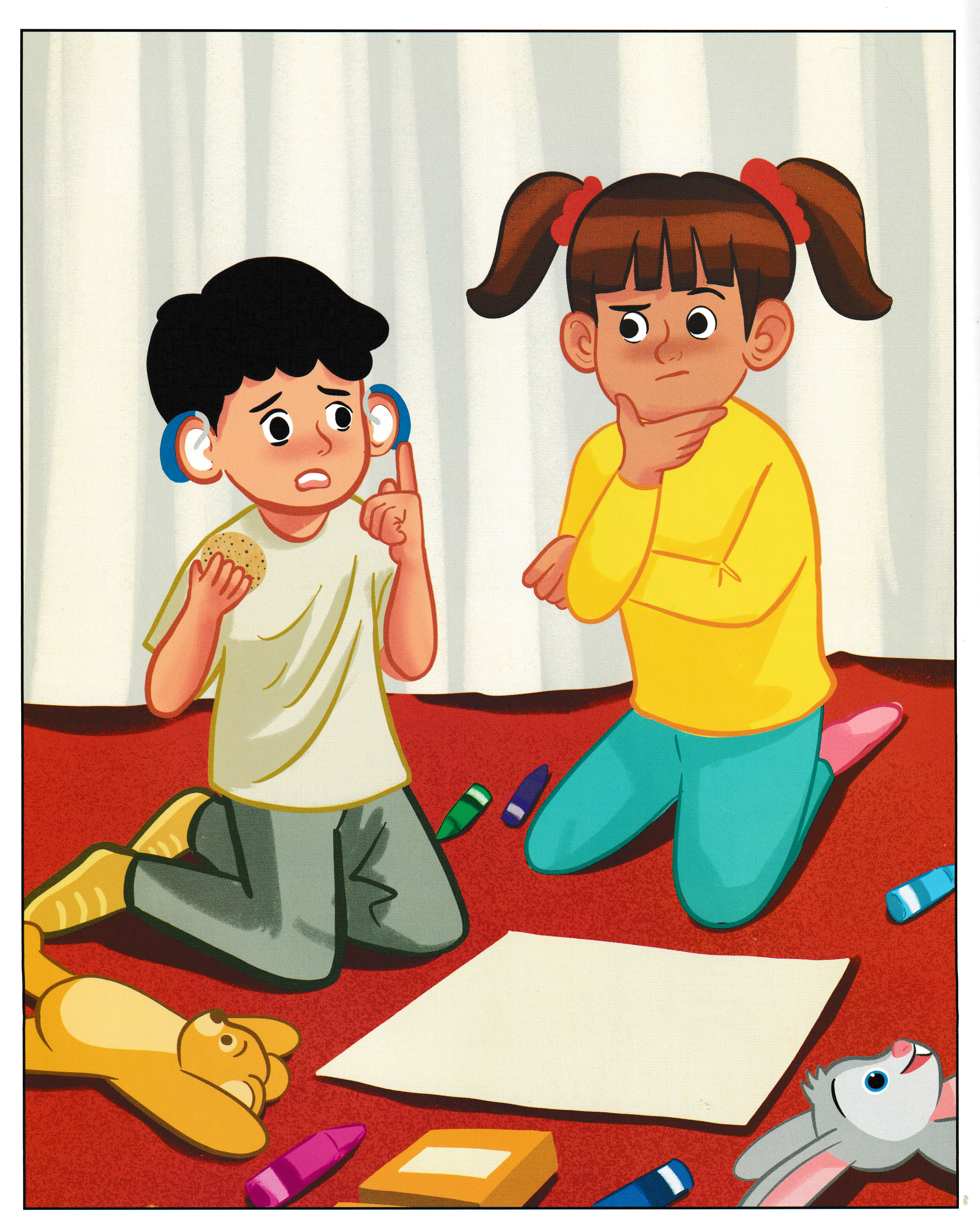
Wordless picture books have a general hush about them. In wordless books, i.e., ones in which the stories are told through illustrations alone, no one is speaking and there is no text to distract. It's all rather subdued. In fact, it's a perfect reflection of what the main character, a young boy with hearing aids, must experience much of the time. But don't be fooled into thinking that there is no story to be told or personal connection to be made.
From Next Door, written by Deborah Kerbel, illustrated by Isaac Liang
A boy and his mother head out from their home just as a moving van arrives and begins unloading boxes. It's evident these are not their goods as the boy is familiar with the places and people he encounters on their walk. Though he may have limited hearing, as evidenced by his hearing aids, he notices everything, from the musician busking, the construction workers at work, and even baby birds in a high nest. It's unfortunate when a cyclist races past the boy, startling him into dropping his teddy bear. But, after confirming he is okay, communicating via American Sign Language, his mother settles the boy.
From Next Door, written by Deborah Kerbel, illustrated by Isaac Liang
Returning to their building, they visit their new neighbours in the apartment next door. Using her own way of communicating, with hand movements and an Arabic/English dictionary, the woman welcomes them. But the boy spies a little girl hiding from them. When he approaches her, it is evident that neither can understand the other. But through the sharing of food and art, the two children find their own way to communicate.
 
This story is deeply personal for Toronto author Deborah Kerbel whose own sister had been born profoundly deaf. Deborah Kerbel's Author's Note speaks of her sister's abilities to connect, and Next Door's story reflects that ability for children who find different ways to communicate because of hearing and language differences. Undoubtedly a child who has a hearing impairment and one whose language is different than those around them may both feel at a disadvantage when trying to communicate. But, as the boy demonstrates, his disability is not a hindrance to living a good life, one in which he communicates with others, just in his own way. He successfully uses American Sign Language and his hearing aids to enable connection with others. But, when he meets the new little girl next door, he's on an equal playing field as she struggles to get him to understand her. But, with some effort and the common ground of art, along with a tasty cookie, a connection is made.
From Next Door, written by Deborah Kerbel, illustrated by Isaac Liang
Deborah Kerbel opens up about her sister's story to help convey the possibility that communication does not cease with hearing or a different language. We find new ways to communicate when the customary route is not available. By juxtaposing the boy's circumstances with that of his new young neighbour, Deborah Kerbel has found a way for any child for whom communication is challenging, because of, for example, cultural differences, emotional barriers, or physical barriers, to accept that different can still be effective. 
 
Isaac Liang is a deaf illustrator from Singapore who imbues the art of Next Door with knowledge and sensitivity. Because of his personal experiences with hearing impairment, Isaac Liang has found a way to bring the quiet and the connection for the children through his digital art. Because comprehension through the sense of hearing is compromised, his emboldens the story with colour and shape. Perhaps words are unnecessary but meaning still comes through with every building, person, and detail. 

Next Door is a great picture book for helping children develop their visual literacy skills and their empathy and acceptance for those who communicate differently. Hopefully it will help them to recognize that we do not all hear or see or understand the same way–the cyclist who almost collides with the child assumed the boy could hear him coming–and to find new ways of communicating that might work better for others. And, when it all comes down to it, kindness always works.

November 17, 2023

If You See a Bluebird

Written by Bahram Rahman
Illustrated by Gabrielle Grimard
Pajama Press
978-1-77278-284-4
32 pp.
Ages 5-8
October 2023
 
When families are displaced, whether from war, natural disasters, persecution, or something else, making a new home is not always easy, especially for children. And the good memories of that original home may make one long for what once was. But home is not just a place. It is the family too, as an Afghan boy learns from his grandmother and a visiting bluebird.
From If You See a Bluebird, written by Bahram Rahman, illustrated by Gabrielle Grimard
Ali and his parents and Nana had to flee Kabul, Afghanistan after war broke out. They travelled by foot, bus, and eventually escaped via plane, taking very little from their home. Now, in Canada, they live near an ocean, and Ali and Nana ride bikes to collect blackberries. But Ali misses Kabul, noting that the blackberries are not as deliciously sweet as the mulberries back home. Nana points out to him that though they are different they are not bad.
From If You See a Bluebird, written by Bahram Rahman, illustrated by Gabrielle Grimard
When they take a break from their berry-picking, they see a bluebird, and Nana reminds him that if you see a bluebird and make a wish before it flies away, your wish will come true. Her wish, for their family to be together and safe, had already come true. But his wish is for the fighting to stop in Kabul so that they might return home. It is then that Nana reminds him that home "is the love we have for each other."
 
It would be tough for a child to give up the familiar and the sweetness of his life in Kabul, with his mother playing her ghichak, his toys on a swing, gathering mulberries, and sitting on the tree's branch to look out over his neighbourhood. But,when he is reminded by his Nana of what home really is, he sees his new situation in a different light. There are now blackberries, his mother has a new instrument, spruce trees line the driveway, and they are safe. He finally appreciates this, shouting out to his parents when they arrive back that, "I am home!"

Bahram Rahman, himself a refugee from Afghanistan, gives us a different perspective of war and escape from war and adjustment to a new living situation in If You See a Bluebird. He has already shared stories in The Library Bus (2020) and A Sky-Blue Bench (2021) but in his latest picture book story, Bahram Rahman demonstrates that escape from a dangerous conflict does not always translate into a rejection of that insecurity. Because there has been loss, of place, people, objects and connection, the substitution of a new home in safety is not necessarily embraced immediately or wholeheartedly. So, Bahram Rahman shows us that a little boy can miss the wonderful things he remembers of his Afghan home but learn to lean towards something different and new that is nonetheless home.
From If You See a Bluebird, written by Bahram Rahman, illustrated by Gabrielle Grimard
Gabrielle Grimard, who also illustrated The Library Bus, has such a sensitive touch for making us feel Ali's hesitation at embracing the new place as home, holding such strong positive memories of Kabul. She gives us the bleakness of the danger when the soldiers come and the family flees but Gabrielle Grimard brings in the birghtness and colour when Ali and his family are safe and happy, whether in a Kabul without war or in Canada.

If You See a Bluebird offers the hope one needs when going through change and especially when challenged with hardships. It's a reminder that with love and family, all can be endured. And making a wish when a bluebird lingers might just help as well.

July 21, 2023

The Care and Keeping of Grandmas

Written by Jennifer Mook-Sang
Illustrated by Yong Ling Kang
Tundra Books
978-0-‎7352-7134-0
32 pp.
Ages 3-7
April  2023
 
Many children will be spending time with grandparents this summer when their parents are busy working. It'll be a special time for many of them, being nurtured and loved and experiencing new learning. But when a grandparent moves in with a family that nurturing can go both ways, as both child and grandparent spend time together. Jennifer Mook-Sang's story is all about that special and tender relationship that comes when a grandmother comes to live with her granddaughter's family.

From The Care and Keeping of Grandmas, written by Jennifer Mook-Sang, illus. by Yong Ling Kang
Like the plants her grandma brings with her, a little girl tries to make her grandmother comfortable. After all, adapting to new surroundings can be a little tough at first. And this child is all about making her feel at home. She makes sure she knows where everything is and helps her make her room her own. It takes time to adjust to new routines and new surroundings and the child makes sure her grandmother has what she needs. 
From The Care and Keeping of Grandmas, written by Jennifer Mook-Sang, illus. by Yong Ling Kang
As her grandmother tends to her plants, ensuring they have light and food and water, the child  ensures her grandmother gets what she needs too. It might be noise-cancelling headphones or a playful water fight, but the child watches out for her. Sometimes both grandma and plant struggle, whether wilting from the stresses of the environment or their new circumstances. But love and attention can make it all better. Then the new place becomes home where they belong and fit in and even thrive.
From The Care and Keeping of Grandmas, written by Jennifer Mook-Sang, illus. by Yong Ling Kang
Not all young children are fortunate enough to have an elder move in with them but, though it may be a difficult transition for all concerned, just as it is with transplanting a plant to a new pot or flower bed, it can be incredibly rewarding. I don't know if Jennifer Mook-Sang has ever had a grandmother move in with her family but the openness of her story to the fullness of that intergenerational relationship and the richness of the new circumstances is certainly revealing. Told with much affection and patience, The Care and Keeping of Grandmas is all about making it right for the grandmother, not expecting her to just fit into their situation. The child's understanding of the difficulties and challenges of adapting to a new situation is filled with compassion, and I suspect it is the reason that her grandma eventually finds her place with them. 

Even though there are challenges, illustrator Yong Ling Kang keeps the lightness of Jennifer Mook-Sang's story with her watercolour and pencil artwork. Whether it's the freshness of the plants growing inside or out, or the colourful clothes which they wear, or the scenes of markets and kitchens and bedrooms, Yong Ling Kang keeps everything lively, even if subdued, and bright without being too bold. Her artwork is so reflective of an elder whose life is slowing down a bit and a child who is keeping pace with her to help her fit in.

Transitioning to a new living situation is difficult at the best of times but imagine how difficult it might be when giving up your own home to share one with your younger family. The adjustment would be great and not always successful, as one plant discovers, but with love and time much can be resolved. Ultimately, Jennifer Mook-Sang and Yong Ling Kang show us that this grandma, like many of her plants, will be just fine, perhaps even flourishing.

December 19, 2022

Who's Hockey?: A 'Hockey is for Everyone' Book about Acceptance

Story by Jeff McLean
Drawings by Nicola Pringle
Words by Terri Roberts
Game Seven Media
978-1-7773056-0-4
40 pp.
Ages 4-9
November 2022

The question may be Who's Hockey? but the answer is "Everybody!"

Cam and her family have just moved, again, and, though each move is a new adventure, it's also a challenge, especially with leaving behind her hockey team and finding new friends with whom to play. The first morning at the new house, Cam and her dog Gordie are outside promptly, dragging her net and sticks and gear out onto the basketball court in the park. But it's just the two of them and she's ready to head home after shouting out "Doesn't anyone play hockey around here?" and hearing crickets.
From Who's Hockey? by Jeff McLean and Terri Roberts, illus. by Nicola Pringle
But, from her back yard, Lidia hears Cam and when Cam mentions she's looking for hockey, Lidia asks, "Who's Hockey?" Cam proceeds to tell Lidia, and also her little brother Cooper, about the greatest game on earth and they help Cam recruit a few more players in the park.
From Who's Hockey? by Jeff McLean and Terri Roberts, illus. by Nicola Pringle
Soon they almost have two full teams, but no one knows about hockey or how to hold a stick or play. Cam is happy to teach them everything about her favourite game and Gordie is happy to be part of the action.
From Who's Hockey? by Jeff McLean and Terri Roberts, illus. by Nicola Pringle
It's a full day of learning and fun and making new friends. If Who's Hockey? shows readers anything, it's that hockey can be for anyone and everyone and sometimes fitting in means sharing what you like as much as conforming to what others are all about. 

The story of Who's Hockey? comes from former pro hockey player Jeff McLean–co-creator with Dean Petruk of PRIDE hockey tape– with Newfoundland's Terri Roberts putting it to words. The basis for it are the principles of the NHL of which acceptance of all who love the game is but one. Cam offers anyone the opportunity to learn to play the game regardless of age, size, backgrounds, and abilities. It's about having fun and playing together. Alberta illustrator Nicola Pringle makes sure that everyone is included and accepted. Whether right-handed or left-handed, a person of colour or not, wearing glasses, a hijab, or a ball cap, all are welcomed and encouraged to be part of a team and have fun. There is joy in the playing and there's joy in the story of Who's Hockey?, ensuring that young readers will get the positive message about opening themselves up to new things and new people for the opportunity for good things to happen.

November 08, 2022

Berani: Guest review

 This book was reviewed by Grade 9 student Bronte.

Written by Michelle Kadarusman
Pajama Press
978-1-77278-260-8
224 pp.
Ages 8-13
August 2022

Malia is a courageous girl who stands up for what she believes in, but activism can be a risky business. When she gets into some trouble with her school for circulating a petition against palm-oil, a product that many families in her town rely on for their income, she has to make a difficult decision that could result in lots of trouble for many people. Meanwhile she is trying to convince her Canadian-born mother not to move the family from Indonesia where Malia has lived all her life, and where her late father is buried.

Ari spends his days attending school, playing chess, and doing chores around his uncle’s restaurant in exchange for a chance to live with him, and get an education at the local public school. But the guilt of leaving behind his dear cousin, Suni, and the rest of his family has been gnawing on him. Furthermore, Ginger Juice, his uncle’s pet orangutan, has been suffering from her poor living conditions, and he’s worried her days are numbered. 
 
Berani alternates between the points of view of Ari and Malia as they help others and try to solve problems around their communities, as well as that of Ginger Juice, who longs for home. It is an inspiring story ideal for grades 4-6, written by Michelle Kadarusman, award-winning author of books such as Music for Tigers and The Theory of Hummingbirds. As someone who cares for the environment, I think Berani is a fantastic way to introduce some of our world’s problems to kids. This book touches on so many important issues: animal rights, climate change, preserving the environment, the loss of family members, and the struggles of moving. The main characters Ari, Malia, and of course Ginger Juice are brave, kind, and thoughtful. The book’s colourful descriptions and Indonesian words sprinkled throughout (a glossary is provided) really set the scene, and the way the chapters flip between the kids' and orangutan's perspectives is a nice touch as well. It’s a great way to start conversations about our world, and our responsibilities as inhabitants of it. (Michelle Kadarusman includes a section with information on orangutans and how we can help them.) Berani, which I would rate 9 out of 10 stars, is definitely worth a read!

~ Written by Bronte, Gr. 9

April 21, 2022

Martin and the River

Written by Jon-Erik Lappano
Illustrated by Josée Bisaillon
Groundwood Books
978-1-77306-444-4
36 pp.
Ages 3-6
March 2022
 
As Earth Day nears, we need to consider that the experiences of young people with the natural world will be quite different depending on where they live. But, if Martin and the River shows us anything, it's that it doesn't have to be that way.
From Martin and the River by Jon-Erik Lappano, illus. by Josée Bisaillon
Martin lives in a rural community where the river and its environs are more than just the landscape of his life: they are his companions. He watches the frogs, great blue herons and crayfish. He knows the behaviour of the otters and osprey. Countless hours are spent at the river that runs through the fields behind his house. Then a new job moves the family to the city.
From Martin and the River by Jon-Erik Lappano, illus. by Josée Bisaillon
As Martin prepares to leave the river and its life force, he seeks a plan to help. But it's not until his parents take him for a visit to the city, with its subway, museum, and its own natural area that Martin finds a way to bring the river to the city with him.
From Martin and the River by Jon-Erik Lappano, illus. by Josée Bisaillon
Story from Jon-Erik Lappano? Art by Josée Bisaillon? I was already sold on Martin and the River. I knew it would be impactful and it is because it touches on big ideas of adapting to change and of our relationships with nature. Every child will experience some change in their lives, especially the leaving behind of the familiar and going to the unknown, whether it be home, family or school. How they deal with that change is important in determining how disquieting the transition will or will not be. Martin may be a resilient child but change is still change and leaving behind his beloved river was going to be hard. Thankfully he and his parents knew enough to help make that transition smoother by finding another river for him to embrace.

Beyond the concept of change, Martin and the River is a big story because of the child's relationship with the river and its elements, hence my choice to review this book for our upcoming Earth Day. For Martin, Earth Day is everyday. It's appreciating the natural world and its plants and animals and water. It's acknowledging how nature sustains us, especially spiritually. He was fortunate to be able to spend time communing with the river and experiencing the life within. But these experiences helped him to bridge a difficult transition because he was able to appreciate that another natural environment had much to offer as well, just different. 

And don't Josée Bisaillon's illustrations, blends of coloured pencil, pastels, gouache and digital art, just burst with the life of that river and the scenes of the city? From the lush greenery, golden fields and busy indoor and outdoor city scapes, Josée Bisaillon has taken us into Martin's busy brain, imagining, appreciating and feeling. Everything is big and bold and wild.

Not every child is fortunate to have a river as a friend, but I hope that every child finds their own natural element, as Martin did with his rivers, to underscore their lives and guide them with reflection, resilience and imagination.

July 12, 2021

Percy's Museum

Written by Sara O'Leary
Illustrated by Carmen Mok
Groundwood Books
978-1-77306-252-5
32 pp.
Ages 4-8
April 2021

Percy loved living in his busy urban neighbourhood in which friends and activity were plentiful. But a move to the country, where houses are separated and playmates undiscovered, Percy isn't sure what to make of his new home.
From Percy's Museum by Sara O'Leary, illus. by Carmen Mok
But discovery reveals the unexpected. There's a special "Percy-sized house" at the edge of the yard and a plethora of natural wonders. There are "bees kissing flowers, ants on parade, and birds putting on air shows." There are wild strawberries to taste, and trees to sit upon, and everywhere there is change.

From Percy's Museum by Sara O'Leary, illus. by Carmen Mok

Taking in all these wonders, he collects and documents them, putting them on display in his small pink house. Even though he realizes that he isn't lonely because there is always something to see and do in his new place, it might be nice to share. So, with some balloons and drinks and a sign pointing out "Percy's Museum," Percy is delighted to discover that sometimes friends find you.

From Percy's Museum by Sara O'Leary, illus. by Carmen Mok

Change is hard for many of us and more so for some than others. It's evident from Carmen Mok's first illustration of a forlorn Percy sitting alone on a bench in an expansive yard that his new situation is uncomfortable. But this child opens his eyes and heart and begins to explore his new surroundings. He sees things he'd never imagined, from fish in a creek and baby birds in a tree to a patch of edible wild strawberries. He immerses himself in the nature of his new home and uncovers new wonders, or at least new to him and, through Sara O'Leary's words, we go with him.  She takes us into Percy's heart and lets us see with his eyes. She's very good at doing this, giving readers the perspective of young children, for example imagining their parents as children (When I Was Young, 2011) and seeing their familiar neighbourhood in the unfamiliarity of night (Night Walk, 2020). There's a innocence and sweetness to Percy's perception of his new world and his openness to new experiences. He's never critical or complaining. He doesn't whine that his new home isn't as good as his old. He simply knows it's different, and different doesn't mean bad or wrong. And don't Carmen Mok's gouache and coloured pencil illustrations mirror that freshness of outlook? 

Percy's Museum is a reflection of this little boy's heart: it's cheerful, bright and full of wonders, and an invitation is sure to enrich, in more ways than one.

May 15, 2017

Macy McMillan and the Rainbow Goddess

Written by Shari Green
Pajama Press
978-1-77278-033-8
240 pp.
Ages 8-12
May 2017

Why do we think
we can know anything about a person
by how they look
what they can do
what life is like for them now?
Because it turns out
we really can’t.
The only way to know that stuff
is if someone
tells you the story.
(pg. 152)
Truer words were never spoken. And these from an 11-year-old Macy McMillan, a child who lost her hearing at age 4 and rarely enunciates words verbally but feels deeply, speaking volumes through signing and in her narration in Shari Green’s latest middle grade novel in verse.

Reluctantly, Macy is preparing for a new chapter in her life, leaving her garden and reading window seat at the pretty house she shares with Mom on Pemberton Street to the home of Mom’s fiancé Alan and six-year-old twin daughters Bethany and Kaitlin. Macy's elderly neighbour Ms. Iris Gillian is also moving, her to a seniors’ facility called Rosewood Manor, and Macy’s mom volunteers Macy for the task of packing Iris’ books and other bits and bobs. Though Macy is initially uninterested in helping, she needs someone with whom she can communicate, even if only by notes, since there are few persons available who can sign, after a falling out with her best friend Olivia and her mother far too busy with her wedding. With a school project based on students’ family trees, Macy is feeling even more untethered, never having known her father and uninterested in her future family.
…and I’m feeling more and more
like a dried-up
all-alone-on-my-branch
leaf.
(pg. 26)
But Iris, named for the Goddess of the Rainbow, becomes the grounding that Macy needs to help her find her story. Though Iris, lover of books and baking cookies, is struggling with her memory and health, she is able to share with Macy, often through writing and with some signing, the story of her life, rife with adventures and tragedies, new chapters aplenty, some with endings more sad than happy, but always the right ending.

As Macy struggles with the upcoming wedding, even trying to stop it, and with completing her school project, she is beginning to see her world in terms of the connections she has and is making, all learned courtesy of the Rainbow Goddess next door.
Ever since Steven–the man in the bookshop–
I make a point of connecting with people
who come into my life
because even if only for a moment
their story connects with mine.
That should mean something…
even if there’s not chapter in a café next door.
 (pg.  67) 
Shari Green, author of Root Beer Candy and Other Miracles (Pajama Press, 2016), has found her story as a writer of extraordinary middle grade novels in verse. Though I suspect she can write just about anything–middle grade, young adult, speculative fiction, non-free verse–her talent is definitely in writing insightfully poignant tales in the impassioned and crisp free verse style. As in her earlier book, Shari Green uses few words, but the right ones, to grow a story of such sensitivity for and awareness of her characters and readers that all will leave the story fulfilled. Her characters’ stories connect with us in ways we cannot put into words. I was astounded that a little girl could gain so much wisdom, courtesy of Iris and Shari Green of course, about life’s stories that she has a middle-aged woman such as myself in tears and heeding her advice.
Hearts are waiting, worrying, hurting
–in need of a message
you can send.
(pg. 226)
Macy McMillan and the Rainbow Goddess is a message from the writing goddesses that everyone’s life is just a story or series of stories that need to be told to be fully appreciated but no worries here because one of their scribes, Shari Green, has taken on that task capably and, like Iris, with wholehearted extravagance.

May 08, 2017

Greetings, Leroy

Written by Itah Sadu
Illustrated by Alix Delinois
Groundwood Books
978-1-55498-760-3
32 pp.
Ages 4-7
May 2017

Greetings, Leroy is one long email from a new Canadian boy named Roy to his friend Leroy in Jamaica, telling about his new life and first day at school.  But as the young boy tries to connect with his friend, missing so much of his Jamaican home, it becomes evident that his new life in Canada is already rich with Jamaican connections.
From Greetings, Leroy 
by Itah Sadu
illus. by Alix Delinois
Roy looks a little saddened sitting at his computer, trying to get a response from his friend Leroy, one of the many Roys on his soccer team.  There’s Iroy, Delroy, Uroy, Stedroy, Buckroy, Royson and, of course, Leroy.  With all the Roys back home in Jamaica, it’s no wonder Roy feels left out.  And it’s no wonder he’s nervous about the first day of school in Canada when his peer support system isn’t with him.  

But the day brings warm surprises of reminders of his Jamaican home, from his father playing Bob Marley and the Wailers, and their neighbour Ms. Muir giving him a Bob Marley button.  
I puffed out my chest big, big and grinned from ear to ear, because Bob Marley was Jamaican and I am Jamaican, too. (pg. 8)
At school, the principal has a picture of Bob Marley playing soccer and his new class greets him with “Welcome, Roy, one love” (pg. 13) channelling Marley’s song, “One Love.”  But when Roy realizes that he’s lost his Bob Marley button after showing it to the principal, it becomes a frantic search that ends happily, just as Roy’s email to Leroy does.
From Greetings, Leroy 
by Itah Sadu 
illus. by Alix Delinois
Storyteller Itah Sadu, much loved for her book Christopher, Please Clean Up Your Room (re-released in 2006 by Scholastic Canada) and known for her bookstore A Different Booklist in Toronto, creates effortlessly the voice of a young boy bridging two worlds: his former life in Jamaica and a new one in Canada. (Born in Canada but raised in Barbados and then returning to Canada, Itah Sadu would have first-hand knowledge.)  Greetings, Leroy is a story about moving and moving on, respectful of the two worlds from and into which Roy will grow.  Itah Sadu makes it clear that the two worlds are not separate entities but rather interconnected parts of Roy’s world, bringing him joy and memories and opportunities.  

Haitian-born artist Alix Delinois has already made a name for himself as the illustrator behind Muhammad Ali:  The People’s Champion (Walter Dean Myers, 2016), Eight Days: A Story of Haiti (Edwidge Danticat, 2010) and Mumbet’s Declaration of Independence (Gretchen Woelfle, 2014), all stories that celebrate Black culture and history. With Greetings, Leroy, Alix Delinois is able to apply his bold artwork to a similarly relevant story, though here focusing on a Jamaican boy’s new life in Canada, and honouring Itah Sadu’s story with pride and festivity for an old life lived and a new life’s promise.

As a story of immigration, of new experiences and first days at school, Greetings, Leroy may take many back to those uneasy days of newness but reminds us that, as Bob Marley sang, everything’s gonna be alright.  
From Greetings, Leroy 
by Itah Sadu 
illus. by Alix Delinois

April 21, 2017

Stop Feedin' da Boids!

Written by James Sage
Illustrated by Pierre Pratt
Kids Can Press
978-1-77138-613-5
32 pp.
Ages 3-7
April 2017

I wish I could review more books illustrated by Pierre Pratt. Unfortunately for me, his illustrations often accompany French-language texts and I am reluctant to reveal my lack of skill reviewing French books.  So, although author James Sage is British, I am delighted to be able to review an English-language text that is fortunate to be illustrated by Montreal's Pierre Pratt, a man whose bio includes copious nominations and awards, including the Governor General Literary Award for Children's Book Illustration, Le Prix TD, Bratislava's Golden Apple Award, and the UNICEF-Bologna Book Fair Illustrator of the Year Award.
From Stop Feedin' da Boids!
by James Sage
illus. by Pierre Pratt
In Stop Feedin' da Boids!, Swanda and her dog Waldo and her family move from the country to Brooklyn.  Though she misses the wildlife, she soon finds herself enamoured with the birds that flock outside their apartment onto the iron fire-escape.
From Stop Feedin' da Boids!
by James Sage
illus. by Pierre Pratt
Providing the birds with a bird feeder, more and more pigeons come to visit, much to the dismay of her neighbours who are displeased with the mess.  Swanda seeks help from so-called experts–a pest control officer, a zookeeper and an exotic bird fancier– but it's not until Lexi from the deli tells Angelo who tells another neighbour who shares with another neighbour and so on and so on the titular advice that Swanda rids the building and neighbourhood of her countless feathered friends. But Swanda's story doesn't end there. A chance sighting and a lot of heart finds Swanda discovering some new wildlife to welcome into her home.
From Stop Feedin' da Boids!
by James Sage
illus. by Pierre Pratt
James Sage weaves a light-hearted story about a little girl who likes animals perhaps a little too much but whose intentions are always charitable.  But it's Pierre Pratt's artwork that provides the context for Swanda's love of animals and the neighbourhood that envelops her.  She is part of her community, whether it be the countryside or a diverse neighbourhood of people, animals and urban life. They are both detailed landscapes of colours and textures, solitude and activity.  Look for the dogs or cats looking out windows, or Mr. Kaminski's two-toned shoes, or the mega-armed bodybuilder.  There's a 1920s feel to the Brooklyn of Stop Feedin' da Boids!, and Pierre Pratt uses strong strokes and bold colours to create a cityscape of tall angled buildings and community of diverse people, all different in size, colour, shape, expression and dress.  It's wild and it's homey.  It's the same style that charmed readers in Gustave (by Rémy Simard, Groundwood, 2014) and No-Matter-What Friend (by Kari-Lynn Winters, Tradewind Books, 2014) by bringing an intensity to the storytelling and readers into the story's setting.

Go ahead and read this one aloud–get that Brooklyn accent right!–but be sure to share the illustrations to get the whole story behind why Swanda should "Stop Feedin' da Boids!"

October 05, 2015

Ben Says Goodbye

by Sarah Ellis
Illustrated by Kim La Fave
Pajama Press
978-1-927485-79-8
32 pp.
Ages 3-6
October 1, 2015

Last time (A+ for Big Ben) darling preschooler Ben had to deal with being the only one in the family not getting a report card and feeling like a little kid.  This time he has another challenge to overcome: the moving away of his best friend Peter.  Desolate, Ben moves away too, under the table to become a caveboy, with only his teddy bear for companionship.  There he eats with his fingers and plays with rocks, and responds to offered food with the occasional "guh." And, most importantly, he is able to to recreate his time with Peter in amazing petroglyphs that provide him with closure and appreciation for their friendship.
Sarah Ellis' latest Ben story focuses on a common upset for children: the moving away of a friend.  Her text shows how a child doesn't recognize all the efforts of others to distract from the potential trauma but instead allows him to immerse himself in his memories, giving them texture in the drawings he produces within his cave.  Kim La Fave, who gets little Ben's shy or determined face spot on, illustrates Ben Says Goodbye so expressively that Ben's angst and ultimate release and acceptance are remarkably visible.  Using the simplest of lines, Kim La Fave gets the angles of the faces, hands and bodies with their tiny feet so right that their intentions are always plain, allowing even the youngest readers to see more into the artwork than might be expected.  And the cave drawings are so evocative of boys having fun and making adventures from their limitless activities. It's not surprising that Ben will miss his compadre when they've already lived so many lives in a few short years.

Best of all is the culminating picture and text that, without saying much, say everything, providing a hopeful future of friendship, albeit with someone of the opposite gender.  A happy ending to a story that demonstrates that even the very young can work their way through difficult situations on their own and come out smiling.  Ben has so much to teach all of us, even if he is just a preschooler!

March 14, 2014

From There to Here

by Laurel Croza
Illustrated by Matt James
Groundwood Books
978-1-55498-365-0
32 pp.
Ages 4-7
For release May 2014

The little girl in I Know Here (Groundwood, 2010), Laurel Croza and Matt James' first book together and the 2011 winner of the Marilyn Baillie Picture Book Award, recollects all the wonderful attributes of her home in northeastern Saskatchewan.  After father's work on a dam there is complete, the family would be moving to Toronto, and the young girl was anticipating that move and what she would miss of her home.  Now the little girl and her family have arrived in Toronto and, in poetic observations, she compares their life "there" to their new life "here", in From There to Here.

Of course, it is so easy for the young girl to still see all the positives of her former home and how different everything is in Toronto.  From her father's job, to the type of roads, the buildings, time with family, the vegetation, the sky–everything is different.  

"It's different here, not the same as there."  

Laurel Croza's clean text emphasizes the simple thought processes of the girl as she navigates her mindset from the country to her new urban setting.  It's succinct but progressive.  And illustrator Matt James, who won the 2013 Governor General's Award for Children's Illustration, emphasizes with elegance the differences between the "there" and the "here", never making one look better than the other, just different but similar.  Matt James juxtaposes the colours and lines of trees with bed-frames and windows blinds, or the northern lights and the street lamps, with such refinement. As in any great picture book, the text should be complemented by the illustrations, as Laurel Croza and Matt James have done so easily in From There to Here.   They found the means to endow memories and new experiences with the quality of perspective, effortlessly taking the reader on a smooth journey From There to Here.