Showing posts with label hockey. Show all posts

December 02, 2024

The First Ones on the Ice

Written by Lana Button
Illustrated by Alex MacAskill
Nimbus Publishing
978-1-77471-305-1
32 pp.
Ages 3-7
November 2024
 
With many parts of Canada having had their first snowfall, there will be many looking forward to frozen lakes and rivers as well as outdoor rinks, whether in a yard or a park, to get their skating and hockey seasons started. And they'll think about being the first ones on the ice.
From The First Ones on the Ice, written by Lana Button, illustrated by Alex MacAskill
This story starts with a brother and sister, bundled in their hats and scarves, boots and coats and mittens, heading out in the predawn, forging a path through fresh snow. There is only a snowplow on the road and wildlife and a lot of snow. They carry their skates and hockey sticks but also shovels. They know what must be done.
From The First Ones on the Ice, written by Lana Button, illustrated by Alex MacAskill
With shovels to the snow, they clear the ice before the sun is even up, anticipating that others would soon arrive. When done, they skate. Then the others come, kids their age and even older ones that play pro hockey. The sibs skate and play, and cheer and dig pucks out the snow. And when they've headed inside for some hot soup and everyone else follows suit, there's one last special opportunity for enjoying that ice.
From The First Ones on the Ice, written by Lana Button, illustrated by Alex MacAskill
For many children who grew up in Canada or northern environments, first snows and outdoor skating are a hallmark of the onset of the season. Lana Button's story may or may not be based on her own experiences but it's definitely reminiscent of all of ours and those of children in many rural areas where every day would be spent on the ice.  There's no grumbling about the cold or getting up the morning or sharing the ice with others. For these kids, being on the ice was a time of camaraderie and pure joy, and they squeeze out over moment from predawn to after nightfall. It might not be the way it is now, with fears for stranger danger and ice that doesn't stay frozen but Lana Button's story, in addition to taking some of us back to simpler times when we could spend whole days on the ice, reminds us that we are part of communities in which we do for others and we share. But because Lana Button tells the story that has a nostalgic winter theme, the messaging is sweet and never preachy.
From The First Ones on the Ice, written by Lana Button, illustrated by Alex MacAskill
And if Lana Button's story doesn't take you onto the ice and feeling that cold air and the satisfaction of all-day play, then the art of Halifax's Alex MacAskill will definitely do so. From the skies and the snow, this winter landscape is tangible. He gives temperature and texture and life to his illustrations, whether it be a dog slipping on the ice, a child getting stuck in deep snow, or the siblings enjoying hot soup indoors. I could hear the crunch of the snow and slap of a stick on the ice and even the quiet of a landscape newly covered in snow.

My family may not have the amount of snow these kids are living with in The First Ones on the Ice, but we've already had discussions about whether the river here is frozen. (The coyotes suggest it is.) So winter is here, and lakes and rivers and even local outdoor rinks are freezing and readying for young skaters and hockey players to take to the ice. As Lana Button and Alex MacAskill show us, being the first ones, and the last ones, on the ice is something very special.

September 05, 2023

The Hockey Skates

Written by Karl Subban
Illustrated by Maggie Zeng
HarperCollins
978-1-443467230
32 pp.
Ages 4-7
September 2023

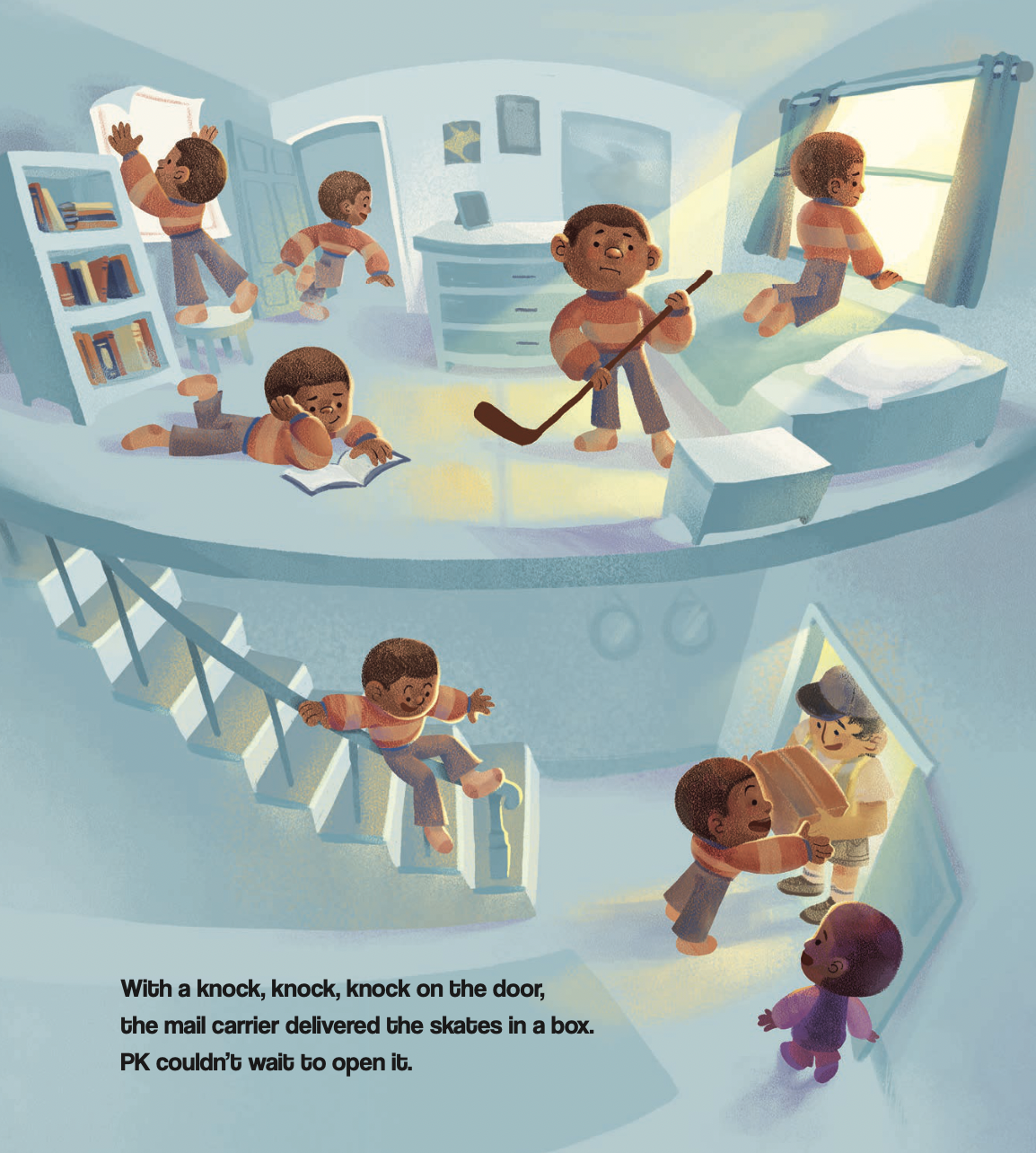
PK had been promised a new pair of skates by his parents. Though it was summer, they were hopeful that he'd have them in time for winter. So his mother ordered a pair of black skates, size 7, with one blade. PK waited patiently for his new skates to arrive, but getting his perfect new skates was not as easy as they'd thought.
From The Hockey Skates, written by Karl Subban, illus. by Maggie Zeng
Ah, the anticipation of that delivery! PK watched and waited and watched some more, until finally the mail carrier delivered a box just for him. But, horror of horrors, the box held a pair of white figure skates! So, PK's mother sends them back, reiterating in her order what she'd told them in the first place: black skates.
From The Hockey Skates, written by Karl Subban, illus. by Maggie Zeng
But, like Goldilocks, the skates were never quite right. Colour, size and type were wrong, wrong, wrong, and with each delivery and the approach of winter, PK and his family became more and more anxious. Would PK ever get his hockey skates in time to hit the ice with the rest of his friends?
From The Hockey Skates, written by Karl Subban, illus. by Maggie Zeng

Karl Subban may be the author of The Hockey Skates, but he is probably best known as the dad to NHL hockey players P. K. Subban, Malcolm Subban and Jordan Subban. As a hockey dad, he undoubtedly has some wild stories about his three sons, and this one, of getting a delivery of hockey skates for PK, will read like a Canadian version of Goldilocks with a touch of Roch Carrier's classic The Hockey Sweater. I don't know if this really happened to P. K. Subban, the professional hockey player, but for PK the child and every child who has ever waited for something special, whether a visitor, a gift, or something on order, the story of The Hockey Skates is very real. It's that mix of anticipation and disappointment that makes it so familiar and plausible, and by bringing humour into the story, Karl Subban makes the repeated letdowns worthy of a chuckle or two. 

The illustrations were created by Montreal's Maggie Zeng who does sweet very well (e.g., Room for More, This is the Boat That Ben Built) and she does it again in The Hockey Skates. But she also gets in on Karl Subban's humour, from making the skates ridiculously small with PK tottering in them and giving her characters amusing, but  honest, expression as they deal with shock, dissatisfaction, confusion, hope and finally success. 

I may be reviewing this picture book on one of the hottest days of our summer (with Humidex, it currently feels like 39°C at my location) but you can bet there are kids already thinking about hockey, whether playing or watching it. And, if they're hoping to play, they'll want to make sure their equipment fits. Hopefully, they won't have to wait months to ensure they're prepared to hit the ice when those lovely cool temperatures and frozen ponds call to them. With a little patience, a whole lot of kismet and opportunity, and by starting now, they should be ready in time.

December 19, 2022

Who's Hockey?: A 'Hockey is for Everyone' Book about Acceptance

Story by Jeff McLean
Drawings by Nicola Pringle
Words by Terri Roberts
Game Seven Media
978-1-7773056-0-4
40 pp.
Ages 4-9
November 2022

The question may be Who's Hockey? but the answer is "Everybody!"

Cam and her family have just moved, again, and, though each move is a new adventure, it's also a challenge, especially with leaving behind her hockey team and finding new friends with whom to play. The first morning at the new house, Cam and her dog Gordie are outside promptly, dragging her net and sticks and gear out onto the basketball court in the park. But it's just the two of them and she's ready to head home after shouting out "Doesn't anyone play hockey around here?" and hearing crickets.
From Who's Hockey? by Jeff McLean and Terri Roberts, illus. by Nicola Pringle
But, from her back yard, Lidia hears Cam and when Cam mentions she's looking for hockey, Lidia asks, "Who's Hockey?" Cam proceeds to tell Lidia, and also her little brother Cooper, about the greatest game on earth and they help Cam recruit a few more players in the park.
From Who's Hockey? by Jeff McLean and Terri Roberts, illus. by Nicola Pringle
Soon they almost have two full teams, but no one knows about hockey or how to hold a stick or play. Cam is happy to teach them everything about her favourite game and Gordie is happy to be part of the action.
From Who's Hockey? by Jeff McLean and Terri Roberts, illus. by Nicola Pringle
It's a full day of learning and fun and making new friends. If Who's Hockey? shows readers anything, it's that hockey can be for anyone and everyone and sometimes fitting in means sharing what you like as much as conforming to what others are all about. 

The story of Who's Hockey? comes from former pro hockey player Jeff McLean–co-creator with Dean Petruk of PRIDE hockey tape– with Newfoundland's Terri Roberts putting it to words. The basis for it are the principles of the NHL of which acceptance of all who love the game is but one. Cam offers anyone the opportunity to learn to play the game regardless of age, size, backgrounds, and abilities. It's about having fun and playing together. Alberta illustrator Nicola Pringle makes sure that everyone is included and accepted. Whether right-handed or left-handed, a person of colour or not, wearing glasses, a hijab, or a ball cap, all are welcomed and encouraged to be part of a team and have fun. There is joy in the playing and there's joy in the story of Who's Hockey?, ensuring that young readers will get the positive message about opening themselves up to new things and new people for the opportunity for good things to happen.

June 10, 2021

The Player

Written by Paul Coccia
Lorimer
978-1-4594-1576-8
181 pp.
Ages 14+ (RL 2.0)
March 2021

Cooper knows he's gay. He was out to his old hockey team and even had a boyfriend on the team but, since it folded and his boyfriend moved away, Cooper is now back to keeping  this sexual orientation a secret to his new team, the Great Blues. So when his teammate Pesh makes a move on Cooper in their hotel room at an away game, he's pleased. But Pesh is an enigma to Cooper. The teen, the son of British Sri Lankan parents who aren't behind his hockey dreams of becoming the team's centre and captain on his path to going pro, is also going out with Bobbi, a girl who wants to go into sports PR and handles Pesh's social media and brand. 
 
Pesh likes flirting with Cooper and making out with him on away games but also starts wanting to fool around before games, convinced it improves their game. But, regardless of this "secret pre-game action" (pg. 110), Pesh is always one of the guys, leading the locker room chatter about girls, while driving his team with practices and high-handedness to ensure he'll look good to the scouts. Meanwhile Cooper can't resolve Pesh's egotism and expectations with the excitement of being in a relationship, albeit a secret one.

While Bobbi takes on helping Cooper with his image, having figured out that he is gay and determined to help him come out in a sport with little practice in being inclusive, Cooper works to keep his relationship with Pesh a secret from her, not wanting to hurt his new friend or jeopardize his position on the team or with Pesh.  But secrets are a dangerous currency and Cooper has to balance what he wants, what he feels and what he knows is right if he's to survive the evolving hockey drama.
 
Because The Player is part of Lorimer's SideStreets hi-lo series, addressing mature teen issues and written with text to engage the reluctant or less experienced reader, Paul Coccia helps all teens hear the voices of young men who are gay, or bicurious, or something else. As he did in his earlier book Cub (2019) and now in The Player, Paul Coccia makes sure that we see relationships like between Cooper and Pesh for what they are: young love, intoxicating and fulfilling, born of attraction and common interests. But as in any relationship, things can go wrong when the individuals have different expectations about exclusivity, openness and needs. The fact that Cooper is gay and Pesh bicurious or perhaps bi is irrelevant. What is important is what Cooper thinks and feels, because The Player is told in his voice. It's through him that we experience Pesh's actions and his own discomfort with Pesh's less-than-straightforward approach to their relationship and that with Bobbi. But, as in any relationship, it's being yourself first and foremost that gives you the strength to be able to give to another. By standing up for himself and what he needs, not only trying to be something for someone else, Cooper opens himself up to greater things in hockey and love.

December 09, 2020

Hockey in the Wild

Written and illustrated by Nicholas Oldland
Kids Can Press
978-1-5253-0241-1
32 pp.
Ages 3-7
September 2020 

There's something wild going on in the woods as the beaver, bear and moose anticipate the start of hockey season. But, as sometimes happens when looking forward to something wonderful, being too eager can be problematic and the waiting exasperating.
From Hockey in the Wild by Nicholas Oldland
Heading out for his daily dip in the lake, the beaver is surprised to find the water had turned to ice but thrilled to share the news with his friends (by cell phone, no less). But when the trio hit the ice, they are chagrined to realize that the ice isn't thick enough yet. Still the friends are determined and return, better prepared with life vests or water wings, none of which sadly help.
From Hockey in the Wild by Nicholas Oldland
To distract themselves from their waiting, they "practiced competitive napping" and sing karaoke. They eat comfort food and veg out watching television. Unfortunately when it would seem that winter has finally arrived in all its frozen glory, the group is out of shape and unprepared to head out on the ice.
From Hockey in the Wild by Nicholas Oldland
So, the beaver, the bear and the moose get to work. This time, with a little preparedness with respect to their personal training and foresight about the conditions of the ice, the friends launch their hockey-on-the-lake season with gusto and success.
From Hockey in the Wild by Nicholas Oldland

Nicholas Oldland always charms with his Life in the Wild books. (See the graphic below for the list of titles available currently.) He puts forth important messages about everything from teamwork and environmental awareness to patience and perseverance, all important lessons for young readers. But, by suiting these messages up in his adorable forest creatures –like a beaver in a baby-blue swim suit, or a moose with a polka-dot cellphone case or a cardinal as goalie–Nicholas Oldland's story gets meaning without preaching. Still it's always his illustrations that will draw young readers. I've written before (see my review of One Wild Christmas) about the subtlety of the lines and shapes of his digitally-rendered artwork and the narrow palette that speak to young children. It's rustic but not silly.

At this time of year, there will be a lot of anticipation and impatience shown by young children. Whether they're hockey fans or not, Hockey in the Wild will encourage children to wait. That could be waiting until the right time to open gifts or until the ice is strong enough, or until they're ready to pursue new challenges, but it always means waiting with the right attitude to help ensure success.

🏒 🏒 🏒 🏒 🏒 🏒 🏒 🏒 🏒

December 07, 2020

The Puck Drops Here (Hockey Super Six #1)

Written and illustrated by Kevin Sylvester
Scholastic Canada
978-1-4431-6348-4
176 pp.
Ages 8-12
September 2020

I don't know if I can safely write this review. I had to take a solemn pledge to never repeat anything I saw to ANYONE under penalty of...I don't know since it's apparently TOO TOP SECRET. But, I'm going to take a chance and brave it because you really need to hear about this book. It's too good to miss. (Though I did read that "There was once a kid in grade four in Canmore who took just a glimpse of, a mere peek at, page one of this book and repeated a single word that appeared on that page. Notice we said, "Was."" Yikes.)

From The Puck Drops Here (Hockey Super Six #1) by Kevin Sylvester
Twins Jenny and Benny, and friends Mo, Starlight, DJ and Karl are all eager to try out for the GOOBERS (Greater Ottawa-Outaouais Brainy Educational Regional School) hockey but Coach Clapper feels they all need to work on something, whether it is teamwork (Benny and Jenny), speed (DJ), physique (Mo), attention (Starlight) or being Karl (yes, he's just too Karl). So, stealing the key to an underground, top-secret hockey rink from his prime minister mom, PM Pauline Patinage, Karl sneaks his friends in for some special practice time. However, unbeknownst to them, government scientist Clarence Crosscheck, who'd been pretending to work on an artificial rink that could be used year-round, has been plotting to take over the world with a freeze ray using special comet crystals called Frozeum 7.
From The Puck Drops Here (Hockey Super Six #1) by Kevin Sylvester
When the kids arrive, Clarence accidentally blasts them, imbuing them with energy that translates into new powers (well, all except Karl, apparently) that would make Coach Clapper thrilled. But Clarence Crosscheck, realizing his machine has failed and learning PM PP is approaching, takes off, but not before releasing his experimentally-developed and hungry Super-Giant Ice Squids from their cage.
From The Puck Drops Here (Hockey Super Six #1) by Kevin Sylvester
In an epic hockey challenge, the Hockey Super Six take on the Ice Squids and the only things they have in common are a passion for hockey and a hunger to win. (Actually the squids just want to win the challenge so they can eat the kids because they really are hungry.)

I need to thank Kevin Sylvester for The Puck Starts Here and for starting this new series. We so need to find laughter in our lives, and The Puck Drops Here had me snickering, giggling, and smiling the whole way through. From his distinctive sketches (very familiar to readers of his award-winning series Neil Flambé) and humour (like the tongue-in-cheek comments between the kids, and story elements like Clarence's one-eyed human-sized hockey puck robot named Ron), all embedded in a hockey story line, Kevin Sylvester ticks all the boxes for a belly-laughs middle grade read about a much-loved sport. It's a little crazy (like the goalies who "are universally understood to be weird"; pg. 24) and a whole lot of funny ("This isn't hockey! This is monkey in the middle!"; pg. 117) and allows hockey viewing via appropriate social distancing.

Young readers will undoubtedly love The Puck Drops Here and this series. (The second book in the Hockey Super Six series, On Thin Ice, dropped last month.) For Christmas, for hockey lovers, for middle graders looking for a laugh, this will be a barnburner for Kevin Sylvester. He definitely scores!

November 11, 2020

Planet Hockey: First Star of the Game

Written by J. Torres
Illustrated by Tim Levins
Scholastic Canada
978-1-4431-2889-6
132 pp.
Ages 8-12
October 2020

After catching an edge, falling into the goalie and breaking his arm, Isaac is desolate about costing his team the hockey game. As he recovers, he gets into playing a multiplayer online game called SHOT a.k.a. Super Hockey Online Tournament at which he excels. However, months later, after he has recovered, Isaac refuses to return to hockey, gratified to reach the top of the online game's ranking as GOAT789. But the universe seems to have a different plan for Isaac.
From Planet Hockey: First Star of the Game by J. Torres, illus. by Tim Levins
As popular as hockey may be in Canada and elsewhere on our planet, it's also a favourite on Galaxia where its Supreme Leader, Emperor Mad Maroon, claims to be the self-proclaimed #1 hockey fan in the universe. But playing in the Galaxian Hockey League is intensive. Teams like the Streek, the Blast, the Muck, the Crag and the Stalks overwhelm the last place team, the Zeazide Pods, with their extraordinary speed, hitting and powers like electricity and the stink of gas. On a planet where the more hockey games you lose, the more taxes you pay, and the last place team cleans everyone else's gear, the Pods are determined to improve their chances. Unfortunately, paying so much in hockey tax, all they can do is purchase an outmoded robotic scout, SKOU7, that mistakenly captures Isaac and his new neighbour Lily to help out the team.
From Planet Hockey: First Star of the Game by J. Torres, illus. by Tim Levins
Lily, an extraordinary goalie, is happy to help out the Pods, sympathetic to their plight, though Isaac is reluctant, worried they'll learn he's not any good at playing the actual game anymore. But with Lily's enthusiasm and determination to help the Pods, and Isaac's finesse at online hockey which allows him to coach and play strategy, the teal-coloured and tentacled creatures with heart finally become stars of the game.
From Planet Hockey: First Star of the Game by J. Torres, illus. by Tim Levins
For kids who love a good hockey story and graphic novels, Planet Hockey: First Star of the Game is sure to score big. And for those who aren't big sports fans, it still has something that is in short supply nowadays and makes for an entertaining middle-grade read: humour. From an alien emperor who considers himself the Boss of Everyone (really) to the best hockey player who is actually a goat, not just the GOAT (Greatest Of All Time), and hockey players called Crowsby, Grootzky and Stickenheiser, J. Torres will score giggles and snorts while sharing lessons in reaching beyond your fears and helping others, even aliens.
From Planet Hockey: First Star of the Game by J. Torres, illus. by Tim Levins
The fun is even livelier because of Tim Levins's illustrations, having created J. Torres's characters as "normal" humans and outrageous aliens of all shapes and colours. It's entertaining checking out every new element, like a flying ref with a red goal light, a colour commentator with the head of a microphone and arena snacks like Mackerel Jacks and rockcorn.

If you’re missing playing hockey or watching hockey, take in a game or two at Planet Hockey and find out who the First Star of the Game really is. (Hint: it’s not the goat.)

February 18, 2020

Meet Willie O'Ree (Scholastic Canada Biography)

Written by Elizabeth MacLeod
Illustrated by Mike Deas
Scholastic Canada
978-1-4431-7561-6
32 pp.
Ages 5-9
January 2020

Though there is still time to read this illustrated biography for Black History Month, Meet Willie O'Ree will become one of those books that will be a go-to story about civil rights, athleticism and perseverance that will resonate throughout the year.
From Meet Willie O'Ree by Elizabeth MacLeod, illus. by Mike Deas
Willie O'Ree was born on October 15, 1935 in Fredericton. By the time he was 5, he was already skating and playing hockey, though he liked all sports, including baseball, tennis, volleyball, rugby and swimming, and enjoyed school. Though the kids in his neighbourhood all played together regardless of skin colour, Willie and other black people had to deal with discrimination. But Willie knew that things had to change, and when, at thirteen, he defied the racist requirement that blacks get their hair cut outside the barbershop, he took an important step in saying "No" to discrimination.
From Meet Willie O'Ree by Elizabeth MacLeod, illus. by Mike Deas
Though a great hockey player, Willie also played baseball, even trying out for Milwaukee's minor league team. But, travelling in the Deep South, Willie was disgusted by the racism he endured at hotels, on buses and most everywhere, so he was pleased when he was let go and able to return to Canada and play hockey. He started playing in 1952 and made his way through different and progressively better leagues. However, when playing for a major junior league team, Willie took a puck in the eye and was blinded. Still, he never told his team, fearing it would prevent his rise to the NHL.
From Meet Willie O'Ree by Elizabeth MacLeod, illus. by Mike Deas 
Willie became the first black player in the NHL, playing for the Boston Bruins. He still endured racist comments from opposing players but he fought back. He was traded several times and ended up in pro leagues other than the NHL but he didn't retire until he was forty-three, and then went on to work for the NHL's Diversity Task Force, helping to encourage children of colour to play hockey.
From Meet Willie O'Ree by Elizabeth MacLeod, illus. by Mike Deas
The accolades and honours Willie O'Ree received were numerous but probably none as great as his induction into the Hockey Hall of Fame in 2018.
Willie reached his goal of playing in the NHL by believing in himself. He worked hard, even when he faced racism and serious injuries. And he never gave up on his dream. (pg. 29)
Author Elizabeth MacLeod and illustrator Mike Deas probably had a tough job telling Willie O'Ree's incredible story. From his childhood and experiences with racism to his athletic career with its ups and downs and more racism, Willie O'Ree endured much, accomplished more and persevered always. His story is one of effort and determination, and Elizabeth MacLeod makes sure to tell as much of his story as possible, including a timeline with photographs at the end of the story.

Mike Deas's illustrations, which are a blend of digital art with gouache, watercolour and ink, are animated, showing a kid with a love of sports and a young man determined to play a sport he loved. Though the art is cheerful, it finds a way to demonstrate Willie O'Ree's experiences with racial discrimination and hardship related to his injury without ever trivializing either.
 
It was a pleasure to meet Willie O'Ree, a pioneer of black achievement in hockey and a hero of sports dreams. 
•••••••••

With Meet Willie O'Ree, the Scholastic Canada Biography series now includes five volumes.

November 25, 2019

Brady Brady: Teammate Turnaround

Written by Mary Shaw
Illustrated by Chuck Temple
Scholastic Canada
978-1-4431-6373-6
32 pp.
Ages 4-8
September 2019

Brady is called Brady, Brady because he needs to be called multiple times to get his attention. That is, except for hockey. The anticipation of his team, the Icehogs, starting their season has the boy and his buddy Chester excited and practising enthusiastically. But after tryouts for the season, Chester is placed on another team and is ready to give up on hockey. Can Brady help his friend see that playing the game is the fun part and that they'll always be best buddies?
From Brady Brady: Teammate Turnaround by Mary Shaw, illus. by Chuck Temple
After Chester learns that he has been placed on another team, he dumps all his goalie equipment at the front of the arena with a note, "Free equipment. No longer needed." While the two wait in Chester's dad's car, Brady reminds him that "We're gonna win the Stanley Cup together one day" and "We can still play hockey together. On my backyard rink, in my basement, on my driveway." But when the boys rush back into the arena to retrieve Chester's equipment, it's already gone. 
From Brady Brady: Teammate Turnaround by Mary Shaw, illus. by Chuck Temple
So begins a search for the missing goalie pads, stick and bag. They enlist the help of a group of kids hanging out in the lobby to search the change rooms, the washroom, the concession stand and finally the lost and found room. High up on a shelf, the equipment sits. But reaching it becomes a problem for the children. Together, working as team, they construct a human pyramid to retrieve Chester's equipment, before he realizes that these kids are the Rink Rattlers, the team to which he has been assigned.
From Brady Brady: Teammate Turnaround by Mary Shaw, illus. by Chuck Temple
Chuck Temple's diverse kids with the quirky smiles and palpable enthusiasm for hockey are the right composite of cartoon and lifelikeness, quirky and real to keep the story fun, funny and truthful. So many kids love playing sports but dread playing with kids they don't know. We all love the familiar to some degree, especially in new situations. By making Chester's story about finding friends to help him out, before even heading onto the ice, Mary Shaw upholds the quote (attribution vague) that "There are no strangers, just friends you haven't yet met." It's no surprise that Chester feels comfortable playing with the Rink Rattlers now that he knows who they are and that his friendship with Brady is not at stake. 

Ultimately, Chester "knew it didn't matter what uniform he was wearing as long as he was playing the sport he loved." With their overwhelming enthusiasm for hockey, these kids would make any team, whether Icehogs or Rattlers or something else, remarkable because they knew how to work together to accomplish something great.

••••••••••••••••

A number of Brady Brady stories have been published, including 3 collections and several French-language versions. Check them out at Scholastic Canada or at the Brady Brady website.

December 03, 2018

The Ice Chips and the Haunted Hurricane

Written by Roy MacGregor and Kerry MacGregor
Illustrated by Kim Smith
HarperCollins Canada
978-1-44345-231-1
167 pp.
Ages 7-10
September 2018

Many readers grew up reading Roy MacGregor's extraordinarily successful Screech Owls series of middle grade novels about the peewee hockey team. For adventure and mystery and, of course, hockey, these were the go-to books for kids. Now, for a slightly younger set–let's say early middle-grader–Roy MacGregor has teamed up with his daughter Kerry MacGregor to take their minor hockey team, the Ice Chips, on the road but through time and history too. And, in The Ice Chips and the Haunted Hurricane, the kids meet a hockey hero and a few ghosts as well.

Lucas Finnigan a.k.a. Top Shelf and his friends and teammates Swift, Edge and Crunch decide to recreate their initial magical experience of time slip that had them meeting Gordie Howe. They know that after Scratch, the magical Zamboni, resurfaces the rink with its magical flood and they skate across the centre line, they will be transported ... somewhere, sometime. But, as the Ice Chips are again matched up against their ice nemeses, the well-equipped and moneyed Stars, they know they are at a significant disadvantage, especially having lost valuable time waiting for the Riverton Community Arena to reopen. So Lucas, Swift and Edge, this time prepared with walkie-talkies, a camera, boots–they can't walk around in their skates everywhere–and other tools, and Crunch staying behind as tether with a walkie-talkie, jump back in time and into their newest adventure.

Strangely, the kids find themselves on a boat in the middle of a storm and it's two other Ice Chips, Bond and Mouth Guard, who unknowingly followed the trio of time-travellers to Nova Scotia, who meet a young hockey player and introduce him to the others when they're finally reunited. Though the kids don't connect the dots about this young star from Cole Harbour until near the end of the book, they're still impressed by his determination and drive, especially after taking them through some intense and very worthwhile hockey drills at the Citadel in Halifax. There's also a few encounters with ghosts including a sea captain from the Halifax Explosion, making The Ice Chips and the Haunted Hurricane a bona fide story of the Maritimes.

But, as in the first book in the series, The Ice Chips and the Magical Rink, Roy MacGregor and Kerry MacGregor's new book promotes lessons about getting the kids to work together, seeing beyond their weaknesses and looking towards empowerment with strategies to make their playing and their lives better while still immersing young readers in the hockey culture of today and then. Moreover, with the diversity of kids on the team–boys and girls of different ethnicities and physical and intellectual abilities including Swift who has a prosthetic leg–all children will see themselves in the Ice Chips. (I love that most of the teammates call each other by their nicknames and the gender of the player is rarely discussed.)

Hockey fans will definitely love the scrimmages on the ice, well told by Hockey Hall of Fame inductee Roy MacGregor and journalist Kerry MacGregor, but they'll be grabbed by the story of kids finding themselves in new circumstances, getting guidance from hockey greats and working together to find their way home. With Calgarian Kim Smith's illustrations to give the story some graphic spice, The Ice Chips and the Haunted Hurricane will be taking home a win. Though it will still be a few more months until The Ice Chips and the Invisible Puck comes out in April of 2019, I'm pretty sure that authors Roy MacGregor and Kerry MacGregor, who plan to make Swift's idol, one of Canada's most decorated Olympians, the focus of that story, will be able to keep up their stickhandling magic.
From The Ice Chips and the Haunted Hurricane by Roy MacGregor and Kerry MacGregor, illus. by Kim Smith

July 19, 2018

The Whirlpool

Written by Laurel Croza
Illustrated by Kelsey Garrity-Riley
Groundwood Books
978-1-77306-032-3
96 pp.
Ages 10-14
May 2018

Don't be deceived by the simple cover illustration and the less-than-100 page count. The Whirlpool, a collection of seven short stories from award-winning picture book author Laurel Croza, is not an early reader.  Its stories are sophisticated and aimed at upper middle grades, covering a wide variety of issues from emotional abuse and grief to destiny and bullying.

In It's a Step, the narrator Charity lives with her mother and abusive father.  As her dad rails against her mom taking a job at Tim's, both mother and daughter find the means to take a small step to a better life.  In Book of Dreams, Mike finds the support he doesn't get at home from his mom and her latest boyfriend at a restaurant where he gets respect, appreciation and a turkey dinner. While a very different story in terms of characters, OH! is also about finding home. The Oh! So Perfect Hair Dolly goes from factory to store shelf and dreams of being named by a child. The desolation of being passed over during Christmas shopping and then being relegated to the reduced price bin is reflective of any child who has felt unloved.  

The Whirlpool is the story of fifteen-year-old Jasmine who is the brunt of swirling rumours at the whirlpool that is school about her having a baby. As she deals with the gossip and nastiness, Jasmine resolves to "look the whirlpool in the eye" (pg. 30) and reveal her story. A Beautiful Smile also looks at nastiness at school, this time with a young teen from the north standing up to a mean girl at her new Toronto school. Most satisfying is the public and clever way in which Nicola finds support and salvation.

Although all the stories have something important to impart, my two favourite stories are The Sunflower and Destiny. Though told from the perspective of a squirrel, The Sunflower is neither trite nor silly. It is an emotional story about loss and grief and making connections, and I defy anyone not to sob at its telling.  Destiny is a revealing story about following one's dreams, regardless of others' desires and opinions.  Johnny helped inspire his younger sister Dani to play hockey even when her father thought figure skating would be more appropriate. Dani persevered and changed her father's mind about her playing hockey. Now, with Johnny drafted to the OHL, she wants to help her brother accept his true destiny too.

Each story in Laurel Croza's collection is packed with emotional growth, from taking first steps to fulfilling one's destiny, or saving yourself, or accepting strengths and weaknesses as part of the whole package. The stories may be brief (each less than 20 pages) but they wallop you with the power of their storytelling, dialogue and message. My favourite, The Sunflower, does that all in five pages.

I shouldn't be surprised that Laurel Croza can weave such powerful tales. Her highly-acclaimed picture books, I Know Here and From There to Here, which were beautifully illustrated by Matt James, conveyed amazing stories in few words. But these stories are not picture book tales transformed into text. They are not for our youngest readers, though, because of the length of the books, parents and teachers might expect them to be so.  The stories in The Whirlpool collection deal with issues of abuse, gossip, abandonment, and death. While these are issues with which younger readers may be familiar, the older protagonists in Laurel Croza's stories suggest that older middle grade readers might understand the messages better.

I've always loved short story collections for the breadth of stories that can be told and the piecemeal manner in which the text can be read. They are potent teaching tools and convenient for reading in shorter time periods. With The Whirlpool, Laurel Croza has provided a worthwhile addition to the youngCanLit collection of short story anthologies as it enlightens, reassures and inspires.

November 21, 2017

When the Moon Comes

Written by Paul Harbridge
Illustrated by Matt James
Tundra Books
978-1-101-91777-0
40 pp.
Ages 4-8
September 2017
In a land so inescapably and inhospitably cold, hockey is the chance of life, and an affirmation that despite the deathly chill of winter we are alive. – Stephen Leacock
With Stephen Leacock's words prefacing the book, readers can anticipate a book of cold and ice which only hockey can warm to life.  This is our Canada.
Separate illustrations from When the Moon Comes 
by Paul Harbridge
 illus. by Matt James
The children in When the Moon Comes anticipate the coming winter, but it's all about the hockey.  November may still find ducks on the beaver flood in the woods but December finally brings the cold snap that causes it to freeze.  They're already envisioning being on the ice but Arthur suggests they must wait for the moon. When the snow finally comes, dumping it on town and country alike, and the lunar cycle progresses until the full moon, the children make their way after school to the place of dreams and action.
From When the Moon Comes 
by Paul Harbridge
 illus. by Matt James
Their long trek is rewarded with a fire that warms their skates and their anticipation as they take turns clearing the "magic ice."
It is dark, dark now, and the face of the sky is freckled with stars.  But on the far side of the flood, the sky is brighter behind the trees. The moon is rising.
     When the moon comes, we glide out onto the ice we have claimed.  It is marvelous ice, as good as any we have known.
From When the Moon Comes 
by Paul Harbridge
 illus. by Matt James
In several wordless pages of Matt James' extraordinary art, the children skate and play and are stars in their own arena.  It is only when the puck disappears into the snow that Arthur, the voice of reason, suggests it is time to end the game.  The game may be set aside but the magic at the fire, drinking tea and toasty sandwiches, is just a new play before heading home.
Our wet pants freeze solid in the cold, and we walk clanking like knights in armor, lances over our shoulders, hoods like helmets around our faces. 
The story ends with the children warm and slumbering at home while the moon with its promise of more hockey accompanies their sleep.

Paul Harbridge's story of late night hockey on a frozen beaver flood is as magical as the ice.  His words of anticipation and emotion are subtle but reverent, packed with feeling.  Like the world hidden beneath the snow and ice, there is a story of expectation from the past and of the future that underlies what is at its core a tale of shinny.  Artist Matt James, whose work I've admired in Northwest Passage (Groundwood, 2013), The Stone Thrower (Groundwood, 2016) and From There to Here (Groundwood, 2014), enriches Paul Harbridge's text with acrylic and India ink illustrations that convey the awe and appreciation of the children for their landscape and their activity.  There may be darkness and frigid temperatures but there is warmth and camaderie and action.  With many strokes of pen and paint, Paul Harbridge and Matt James take all readers to a place of inhospitable iciness and hospitable hockey that can only be witnessed and fully appreciated When the Moon Comes.

November 14, 2017

Goodnight, Hockey Fans

Written by Andrew Larsen
Illustrated by Jacqui Lee
Kids Can Press
978-1-77138-105-5
32 pp.
Ages 3-7
October 2017

Older readers will recognize the title as the sign-off of radio and TV broadcaster Foster Hewitt after calling a hockey game for Hockey Night in Canada.  They may even recognize the setting, time and place, from their mid-1950s to early-1960s home, with its antennaed television and transistor radio.  But every child, then and now, who dreams of hockey glory will feel this story.

Though the family–mom, dad, son, dog and cat–are enjoying watching television, it's time for the child to go to bed.  He's a little apprehensive, not knowing if he'll be able to fall asleep, especially amidst the silence that seems to roar.
From Goodnight, Hockey Fans 
by Andrew Larsen 
illus. by Jacqui Lee
He shines his flashlight on his hockey poster, pennant and puck trophy and finally settles on calming himself with his dad's old transistor radio.  When he hears the familiar "Welcome back, hockey fans from coast to coast" he knows he has found his ticket to dreamland.
From Goodnight, Hockey Fans 
by Andrew Larsen 
illus. by Jacqui Lee
And dream he does. First it's just the hockey game that might be being watched on TV, but soon the announcement of a boy skating onto the ice and going after the puck is trumpeted.  There is that culminating goal and cheers that fade into the nighttime quiet, but it's not really over until mom and dad head to bed and hear the iconic sign-off from their son's concealed radio:  "Goodnight, hockey fans from coast to coast."
From Goodnight, Hockey Fans 
by Andrew Larsen 
illus. by Jacqui Lee
What a delightful way to celebrate hockey in Canada and to honour Foster Hewitt, the voice of Canadian hockey! By melding the broadcast of a hockey game, complete with the broadcaster's trademark sayings, with a boy's imaginative dreams, everyone is transported to a dreamland of historic play on the ice.  Andrew Larsen who can't possibly be old enough to remember when Foster Hewitt's broadcasts took place on radio and TV captures the wonder of the game and the dream of children nation-wide to play with their hockey heroes and score a winning goal.   The playfulness that Andrew Larsen embeds in his books (see Dingus, Kids Can Press, 2017; Charlie's Dirt Day, Fitzhenry & Whiteside, 2015; and See You Next Year, Owlkids Books, 2015) comes through loud and clear, even in the quiet of a dreaming child's bedroom.

That same playfulness is evoked in Jacqui Lee's retro-style illustrations. From the colours she selects, very reminiscent of a 1950s paint palette, to the uniforms of the hockey players, Jacqui Lee's artwork blends well with Andrew Larsen's story's setting.  The art, like the text, is of a time when Foster Hewitt was everything to hockey in Canada, including the soothing voice of dreams and comfortable slumber.