Showing posts with label skating. Show all posts

December 02, 2024

The First Ones on the Ice

Written by Lana Button
Illustrated by Alex MacAskill
Nimbus Publishing
978-1-77471-305-1
32 pp.
Ages 3-7
November 2024
 
With many parts of Canada having had their first snowfall, there will be many looking forward to frozen lakes and rivers as well as outdoor rinks, whether in a yard or a park, to get their skating and hockey seasons started. And they'll think about being the first ones on the ice.
From The First Ones on the Ice, written by Lana Button, illustrated by Alex MacAskill
This story starts with a brother and sister, bundled in their hats and scarves, boots and coats and mittens, heading out in the predawn, forging a path through fresh snow. There is only a snowplow on the road and wildlife and a lot of snow. They carry their skates and hockey sticks but also shovels. They know what must be done.
From The First Ones on the Ice, written by Lana Button, illustrated by Alex MacAskill
With shovels to the snow, they clear the ice before the sun is even up, anticipating that others would soon arrive. When done, they skate. Then the others come, kids their age and even older ones that play pro hockey. The sibs skate and play, and cheer and dig pucks out the snow. And when they've headed inside for some hot soup and everyone else follows suit, there's one last special opportunity for enjoying that ice.
From The First Ones on the Ice, written by Lana Button, illustrated by Alex MacAskill
For many children who grew up in Canada or northern environments, first snows and outdoor skating are a hallmark of the onset of the season. Lana Button's story may or may not be based on her own experiences but it's definitely reminiscent of all of ours and those of children in many rural areas where every day would be spent on the ice.  There's no grumbling about the cold or getting up the morning or sharing the ice with others. For these kids, being on the ice was a time of camaraderie and pure joy, and they squeeze out over moment from predawn to after nightfall. It might not be the way it is now, with fears for stranger danger and ice that doesn't stay frozen but Lana Button's story, in addition to taking some of us back to simpler times when we could spend whole days on the ice, reminds us that we are part of communities in which we do for others and we share. But because Lana Button tells the story that has a nostalgic winter theme, the messaging is sweet and never preachy.
From The First Ones on the Ice, written by Lana Button, illustrated by Alex MacAskill
And if Lana Button's story doesn't take you onto the ice and feeling that cold air and the satisfaction of all-day play, then the art of Halifax's Alex MacAskill will definitely do so. From the skies and the snow, this winter landscape is tangible. He gives temperature and texture and life to his illustrations, whether it be a dog slipping on the ice, a child getting stuck in deep snow, or the siblings enjoying hot soup indoors. I could hear the crunch of the snow and slap of a stick on the ice and even the quiet of a landscape newly covered in snow.

My family may not have the amount of snow these kids are living with in The First Ones on the Ice, but we've already had discussions about whether the river here is frozen. (The coyotes suggest it is.) So winter is here, and lakes and rivers and even local outdoor rinks are freezing and readying for young skaters and hockey players to take to the ice. As Lana Button and Alex MacAskill show us, being the first ones, and the last ones, on the ice is something very special.

September 05, 2023

The Hockey Skates

Written by Karl Subban
Illustrated by Maggie Zeng
HarperCollins
978-1-443467230
32 pp.
Ages 4-7
September 2023

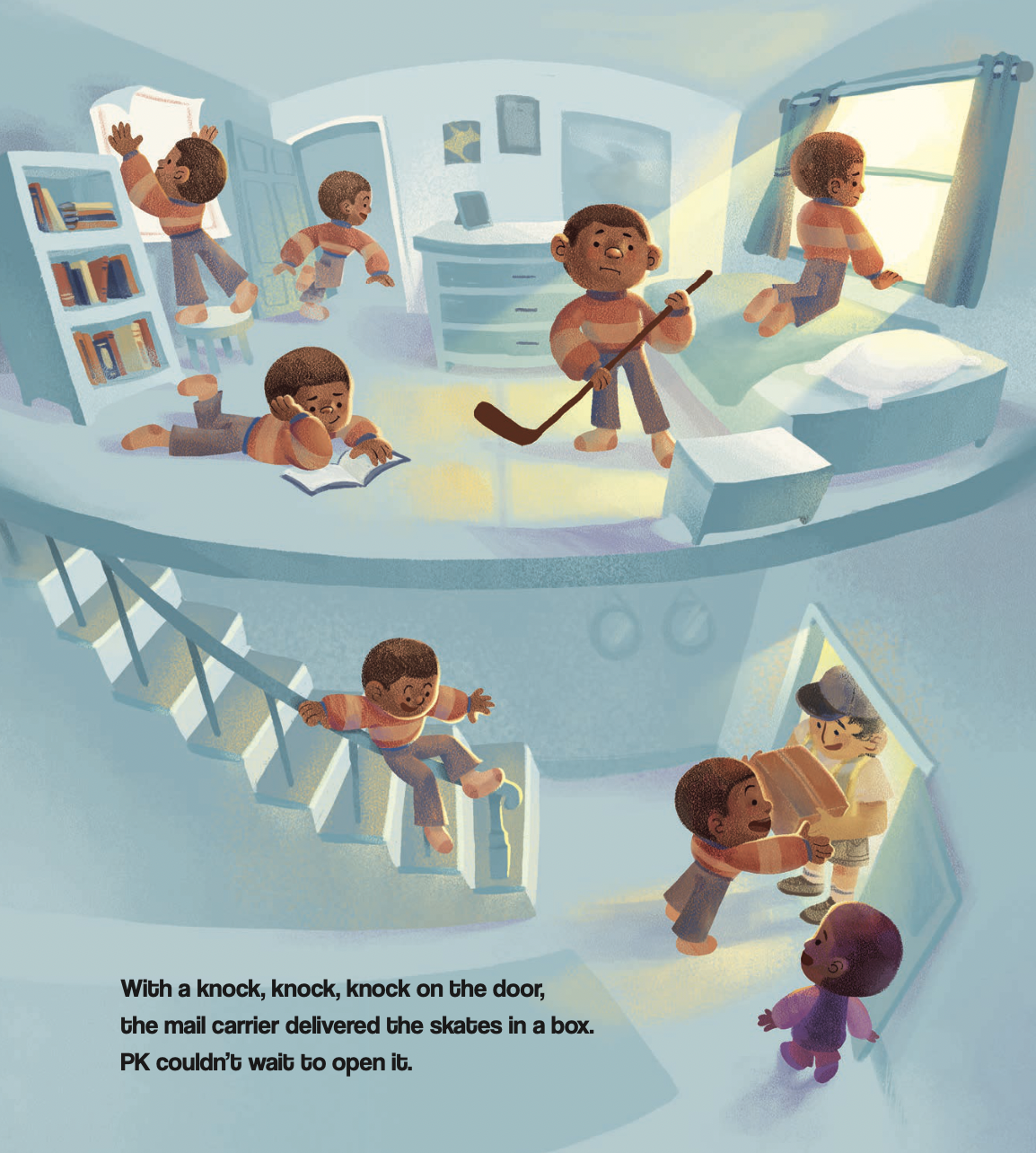
PK had been promised a new pair of skates by his parents. Though it was summer, they were hopeful that he'd have them in time for winter. So his mother ordered a pair of black skates, size 7, with one blade. PK waited patiently for his new skates to arrive, but getting his perfect new skates was not as easy as they'd thought.
From The Hockey Skates, written by Karl Subban, illus. by Maggie Zeng
Ah, the anticipation of that delivery! PK watched and waited and watched some more, until finally the mail carrier delivered a box just for him. But, horror of horrors, the box held a pair of white figure skates! So, PK's mother sends them back, reiterating in her order what she'd told them in the first place: black skates.
From The Hockey Skates, written by Karl Subban, illus. by Maggie Zeng
But, like Goldilocks, the skates were never quite right. Colour, size and type were wrong, wrong, wrong, and with each delivery and the approach of winter, PK and his family became more and more anxious. Would PK ever get his hockey skates in time to hit the ice with the rest of his friends?
From The Hockey Skates, written by Karl Subban, illus. by Maggie Zeng

Karl Subban may be the author of The Hockey Skates, but he is probably best known as the dad to NHL hockey players P. K. Subban, Malcolm Subban and Jordan Subban. As a hockey dad, he undoubtedly has some wild stories about his three sons, and this one, of getting a delivery of hockey skates for PK, will read like a Canadian version of Goldilocks with a touch of Roch Carrier's classic The Hockey Sweater. I don't know if this really happened to P. K. Subban, the professional hockey player, but for PK the child and every child who has ever waited for something special, whether a visitor, a gift, or something on order, the story of The Hockey Skates is very real. It's that mix of anticipation and disappointment that makes it so familiar and plausible, and by bringing humour into the story, Karl Subban makes the repeated letdowns worthy of a chuckle or two. 

The illustrations were created by Montreal's Maggie Zeng who does sweet very well (e.g., Room for More, This is the Boat That Ben Built) and she does it again in The Hockey Skates. But she also gets in on Karl Subban's humour, from making the skates ridiculously small with PK tottering in them and giving her characters amusing, but  honest, expression as they deal with shock, dissatisfaction, confusion, hope and finally success. 

I may be reviewing this picture book on one of the hottest days of our summer (with Humidex, it currently feels like 39°C at my location) but you can bet there are kids already thinking about hockey, whether playing or watching it. And, if they're hoping to play, they'll want to make sure their equipment fits. Hopefully, they won't have to wait months to ensure they're prepared to hit the ice when those lovely cool temperatures and frozen ponds call to them. With a little patience, a whole lot of kismet and opportunity, and by starting now, they should be ready in time.

January 28, 2016

Clean Sweep! Frank Zamboni’s Ice Machine (Great Ideas Series)

Written by Monica Kulling
Illustrated by Renné Benoit
Tundra Books
978-1-77049-795-5
32 pp.
Ages 5-8
January 2016

It’s always a great day when another of Monica Kulling’s Great Ideas Series books comes out.  These illustrated biographies, enhanced with artwork by an assortment of talented Canadian illustrators, highlight key individuals whose innovations we have come to rely upon but about whose stories we often know so little.  There’s been George Eastman’s photography, Elijah McCoy’s invention for oiling train engines, Elisha Otis’ elevator, Margaret Knight’s paper bags, Lillian Gilbreth’s efficient kitchen, Marconi’s wireless and now an invention dearly loved by hockey fans the world over, the Zamboni invented by Frank Zamboni.

Opening with a poem called Bone Blades that emphasizes “a way to fly around, when ice is on the ground”, Monica Kulling takes young readers to the early 1940s when Frank Zamboni and his brother and cousin opened their Iceland Skating Rink.  Resurfacing the ice, while skaters waited, was a time-consuming endeavour of a tractor levelling out the pits and grooves, a crew shovelling away the shavings, washing the surface and then spraying with fresh water, and all before a gleaming finish was added by hot water.

Having learned to tinker with trucks and tractors on their Idaho farm and working at his brother’s auto repair shop in California, as well as studying at an electrical school in Chicago, Frank was a busy man, working with his brother Lawrence doing electrical work, drilling wells, installing pumps and then making ice for home ice-boxes.  It wasn’t a big jump to making ice rinks with the smoothest surfaces ever.

But it wasn’t until after the war that Frank was able to buy military parts that became the foundation for his ice-resurfacing machine and a version of his famous Zamboni machine was created.

Oh, how I wish that the Zamboni had been a Canadian invention.  It seems so quintessentially Canadian.  But Monica Kulling still makes the reader applaud for the innovation and brilliance of Frank Zamboni to find a ground-breaking solution to a common problem.  By sweeping in details about his early years and training, as well as family and engineering development, in addition to some Zippity Zamboni! fun facts appended to the story, Monica Kulling again demonstrates how extraordinary developments can arise from very ordinary circumstances.

Having Renné Benoit, whose artwork has graced award-winning picture books such as Lily and the Paper Man (2007), Proud as a Peacock, Brave as a Lion (2009), and The Secret of the Village Fool (2012) as well as the recent A Year of Borrowed Men (2015), do the illustrations for Clean Sweep! seems intuitive, as she creates memorable work that feels like old photographs from a bygone era.  Her colours and lines are soft and sepia-like, both light and substantial, depicting people and places of a different time so naturally.

Clean Sweep! Frank Zamboni’s Ice Machine is a fresh take on a historic innovation told simply but with sparkle by Monica Kulling and perfected by Renné Benoit’s art.

********************************************
I encourage teachers to consider using this wonderful series for teaching biographies to young children.  Clean Sweep! and others in the series demonstrate an innovative way to share someone’s life story without the boring parts that are so often embedded in the teaching of biographical literature.

Here is a complete list of Great Ideas Series books, including upcoming releases:


  1. It’s a Snap! George Eastman’s First Photograph (Tundra, 2009)
  2. All Aboard! Elijah McCoy’s Steam Engine (Tundra, 2010)
  3. In the Bag! Margaret Knight Wraps It Up (Tundra, 2011)
  4. Going Up! Elisha Otis’s Trip to the Top (Tundra, 2012)
  5. Making Contact! Marconi Goes Wireless (Tundra, 2013)
  6. Spic-and-Span! Lillian Gilbreth’s Wonder Kitchen (Tundra, 2014)
  7. Clean Sweep! Frank Zamboni’s Ice Machine (Tundra, Jan/2016)
  8. To the Rescue! Garrett Morgan’s Underground (Tundra, Jan/2016)
  9. Zap! Nikola Tesla Takes Charge (Tundra, Aug/2016)

October 06, 2014

The Wolf and Me: The Seven Sequels

by Richard Scrimger
Orca Book Publishers
9781459805316
256 pp.
Ages 10-16
For release October 1, 2014

Poor Bunny.  He's such a great guy but, often through no fault of his own, he gets himself immersed in the most unusual, even dangerous, situations.  In Ink Me (Scrimger, 2012), the prequel to The Wolf and Me, Bunny (Bernard, as only his grandfather called him) ended up with a tattoo indicating he was part of the 15 Street gang and that he had killed someone, all untrue.  Sadly he did get mixed up in some dangerous situations and is currently at Creekside, a young offender facility just outside of Toronto.  While Bunny is finding his time at Creekside useful, especially with the lessons he has with Mr. Wing to help him with his literacy (especially his spelling), he's not a troublemaker, and he's happy to have the holidays until New Year's with his family. Too bad he gets kidnapped while out skating with his brother Spencer at Toronto's City Hall.  See what I mean?  This kid has no luck.

While his hostage-takers demand to know about his grandfather, David McLean (though Bunny initially believes they're asking about "Mr. Clean"), the woman named Vi attempts to gain his confidence, offering to help him get a note to the police.  But Bunny learns of her deceit and manages to escape, setting off on an amazing skating adventure on the icy landscape, in search of Creekside, home, or just help.

Bunny may call himself "dumb" and "stupid" but he's very smart about putting all the little pieces of the puzzle together to make a comprehensive big picture.  He just doesn't have a lot of luck.  Sure that he's found Creekside, Bunny breaks into a juvenile detention centre for females!  As unfortunate as that may seem, that mistake puts him in a position to help others, even if it does complicate things.
"Here I am in my little life trying to deal with my troubles.  Some people are worrying about me and some are heping me and some are making it hard for me and all the time theres this–this–this gigantic ALL all around me.  It make me feel small but also grate full." (pg. 122)
Like the detention centre, there are many obstacles that impede Bunny's journey.  But he always finds a way to turn them into something positive, including an encounter with a wolf that allows him to connect with his grandfather.  And if anyone deserves a break in life, it's Bunny.

I'm delighted that Richard Scrimger was able to parlay Bunny's Ink Me fiasco into a second adventure that shows the teen's growth after incarceration at Creekside while providing both him and the reader the evidence that he's one of the good guys.  Bunny makes the best of that which life tosses at him, whether they're rocks or candies. Who else could manage to enjoy a hockey game with his captors and take advantage of his only footwear–a pair of hockey skates–to escape?  Bunny.  And I'm so glad Richard Scrimger gave him life.  He makes life better for all who meet him, fictional characters and readers alike.
"Life isnt about making sense.  Its a gift and you do your best with it." (pg. 190)