Showing posts with label patience. Show all posts

March 02, 2026

Butterfly Sea

Written by Cynthia Mackey
Illustrated by Marie-Laure Couët
Tielmour Press
978-1-998426-22-5
42 pp.
Ages 4–8
January 2026
 
When a child takes her camera and heads out to photograph butterflies, she sees more than might be expected.
From Butterfly Sea, written by Cynthia Mackey, illustrated by Marie-Laure Couët
It's early morning. With a sea and grass and flowers nearby, there is lots to engage this little girl and her baby sister. While she patiently and quietly situates herself to watch for butterflies, the toddler becomes a side show of activity. But the toddler's play becomes visual poetry with every new permutation. She's a mermaid asking for ice cream when her teal blanket gets knotted into a tail, and then a pirate, and a shark. And while her older sister is tasked with watching her, ensuring she is safe and fed, the photographer does not lose focus.
From Butterfly Sea, written by Cynthia Mackey, illustrated by Marie-Laure Couët
Always mindful of her purpose, the young photographer watches and sees. But she sees with more than her eyes. She sees with her heart and her imagination. When the toddler appears swinging a branch, the photographer sees a pirate searching for treasure. She will "hand her maps and whisper golden secrets, promising riches and jewels on faraway beaches." (pg. 13)
From Butterfly Sea, written by Cynthia Mackey, illustrated by Marie-Laure Couët
With time and patience and dedication to both caregiving and observation, the child photographer gets what she'd waited for and enjoys a visual display for all the senses.
From Butterfly Sea, written by Cynthia Mackey, illustrated by Marie-Laure Couët
At first glance, the story of Butterfly Sea is a simple one of two children who've gone out to play, one hopeful of photographing butterflies. But the story is so much richer because Cynthia Mackey tells it with imagery and imagination that takes a simple story to one of pirates and sharks, kaleidoscopes and flowers. And it's told with lyricism that makes a simple outing into something magical.
 
The credits tell us that Marie-Laure Couët's art was created digitally, and I'm astonished as the textures of paper and paint suggests watercolour. How Marie-Laure Couët was able to achieve the subtle nuance of watercolour on textured paper, perfect for an adventure into nature, is beyond me. But the texture of that digital art mirrors the organic nature of the seaside and the meadows and everything else in between, and there is a sweetness there that reflects the relationship both between children and between children and nature.
 
This is the second book written by Cynthia Mackey that I have reviewed—If a Bumblebee Lands on Your Toe (2025) was the first—and I'm beginning to sense a theme. It might be the bewitching quality of insects, all around us but never really observed, or the power of the natural world to invigorate our lives, or the connection between species, or . . . maybe it's all of the above and none of the above. Maybe it's just the luxury of children at play, each in their own way, but told through the lens of fascination with observation.

January 25, 2025

Life in the Wild: The Collected Adventures of the Bear, the Moose and the Beaver


Written and illustrated by Nicholas Oldland
Kids Can Press
978-1-5253-1292-2
200 pp.
Ages 4-8
September 2024

Nicholas Oldland's Bear, Moose and Beaver have returned and they're in an amazing collection of six previously published books so young readers won't just be introduced to these characters but really get to know them.

The six stories included in this collection are Big Bear Hug, Making the Moose Out of Life, The Busy Beaver, Up the Creek, Walk on the Wild Side, and Hockey in the Wild. Playing up some fun puns, Nicholas Oldland truly takes us into the wild lives of his trio of friends.
From Life in the Wild, written and illustrated by Nicholas Oldland
Big Bear Hug is a story of how a bear loves to give hugs to everyone and everything but most especially trees. But when a man with an axe arrives to chop down one of the most beautiful trees, the bear has other ideas.
From Life in the Wild, written and illustrated by Nicholas Oldland
Making the Moose Out of Life has a moose who starts to wonder if he's missing out on life and decides "to take life by the antlers." (p. 49) Instead, a sailing misadventure leads to new experiences, a new friend, and the catalyst for courage to try new things.
 
A very busy but careless beaver learns the error of his ways when hospitalized after a tree-felling mishap in The Busy Beaver. However, his rehabilitation for his injuries gives him the opportunity to make right his mistakes.
From Life in the Wild, written and illustrated by Nicholas Oldland
Up the Creek's tale focuses on the three friends learning to cooperate on a canoeing trip filled with disasters and bickering. It is only through teamwork that the bear, moose and beaver can survive.
 
The theme of cooperation is revisited in Walk on the Wild Side when a mountain hike becomes a competition that becomes dangerous.
From Life in the Wild, written and illustrated by Nicholas Oldland
Finally, in Hockey in the Wild (reviewed here in 2020), the trio anticipate the start to their hockey season on the ice but patience is necessary to keep themselves safe to enjoy their winter pastime.
 
In all these stories, Nicolas Oldland infuses his characters with honest friendships while they learn lessons in patience, cooperation, teamwork, compassion and more. And he does so by example, not by preaching. Nicholas Oldland ensures that each animal is unique, quirky in their own ways, and yet willing to change when needed to help others and help themselves grow as individuals.
From Life in the Wild, written and illustrated by Nicholas Oldland
Teachers and parents may love the stories for the important lessons Nicholas Oldland imparts but kids will adore them for the silliness of these very realistic stories–who hasn't had a competition with a peer or sibling that ended in disaster?–and Nicholas Oldland's digital art. The simplicity of the shape and lines of his characters and settings make everything easily recognizable but it's the details in the expressiveness of his characters' faces and gestures that will be more relatable and still very cute. Whether chagrined at a capsized canoe or standing in a bathing suit on an ice-covered lake, the bear, moose and beaver emote according to all life's circumstances and tell children that they know how they feel.
 
Nicholas Oldland offers readers a great opportunity to take a comprehensive walk on the wild side with the bear, the moose and the beaver in Life in the Wild because whether it's winter or summer, spring or fall, there's always something happening, including ways to live in the not-so-wild.

September 05, 2023

The Hockey Skates

Written by Karl Subban
Illustrated by Maggie Zeng
HarperCollins
978-1-443467230
32 pp.
Ages 4-7
September 2023

PK had been promised a new pair of skates by his parents. Though it was summer, they were hopeful that he'd have them in time for winter. So his mother ordered a pair of black skates, size 7, with one blade. PK waited patiently for his new skates to arrive, but getting his perfect new skates was not as easy as they'd thought.
From The Hockey Skates, written by Karl Subban, illus. by Maggie Zeng
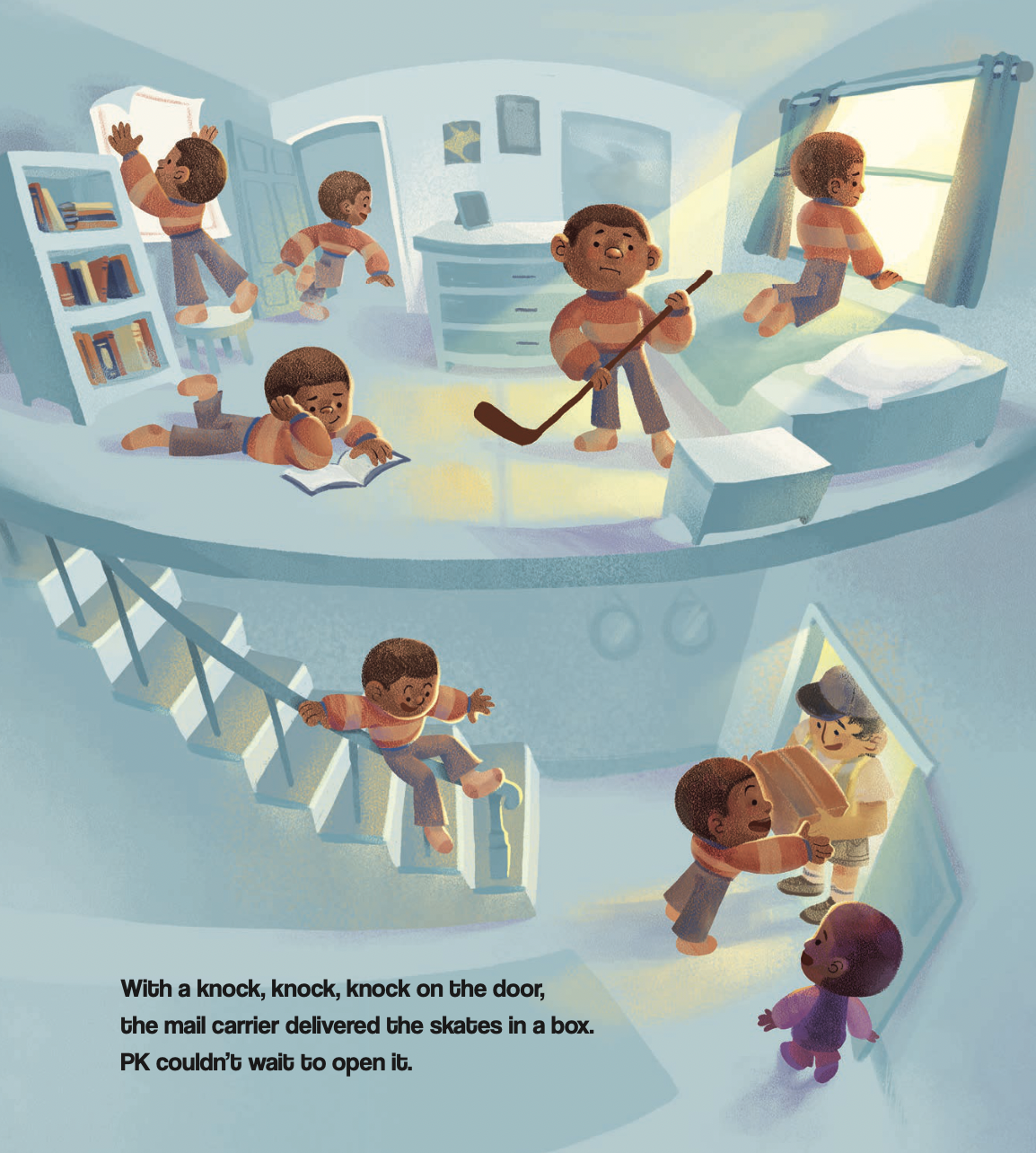
Ah, the anticipation of that delivery! PK watched and waited and watched some more, until finally the mail carrier delivered a box just for him. But, horror of horrors, the box held a pair of white figure skates! So, PK's mother sends them back, reiterating in her order what she'd told them in the first place: black skates.
From The Hockey Skates, written by Karl Subban, illus. by Maggie Zeng
But, like Goldilocks, the skates were never quite right. Colour, size and type were wrong, wrong, wrong, and with each delivery and the approach of winter, PK and his family became more and more anxious. Would PK ever get his hockey skates in time to hit the ice with the rest of his friends?
From The Hockey Skates, written by Karl Subban, illus. by Maggie Zeng

Karl Subban may be the author of The Hockey Skates, but he is probably best known as the dad to NHL hockey players P. K. Subban, Malcolm Subban and Jordan Subban. As a hockey dad, he undoubtedly has some wild stories about his three sons, and this one, of getting a delivery of hockey skates for PK, will read like a Canadian version of Goldilocks with a touch of Roch Carrier's classic The Hockey Sweater. I don't know if this really happened to P. K. Subban, the professional hockey player, but for PK the child and every child who has ever waited for something special, whether a visitor, a gift, or something on order, the story of The Hockey Skates is very real. It's that mix of anticipation and disappointment that makes it so familiar and plausible, and by bringing humour into the story, Karl Subban makes the repeated letdowns worthy of a chuckle or two. 

The illustrations were created by Montreal's Maggie Zeng who does sweet very well (e.g., Room for More, This is the Boat That Ben Built) and she does it again in The Hockey Skates. But she also gets in on Karl Subban's humour, from making the skates ridiculously small with PK tottering in them and giving her characters amusing, but  honest, expression as they deal with shock, dissatisfaction, confusion, hope and finally success. 

I may be reviewing this picture book on one of the hottest days of our summer (with Humidex, it currently feels like 39°C at my location) but you can bet there are kids already thinking about hockey, whether playing or watching it. And, if they're hoping to play, they'll want to make sure their equipment fits. Hopefully, they won't have to wait months to ensure they're prepared to hit the ice when those lovely cool temperatures and frozen ponds call to them. With a little patience, a whole lot of kismet and opportunity, and by starting now, they should be ready in time.

December 09, 2020

Hockey in the Wild

Written and illustrated by Nicholas Oldland
Kids Can Press
978-1-5253-0241-1
32 pp.
Ages 3-7
September 2020 

There's something wild going on in the woods as the beaver, bear and moose anticipate the start of hockey season. But, as sometimes happens when looking forward to something wonderful, being too eager can be problematic and the waiting exasperating.
From Hockey in the Wild by Nicholas Oldland
Heading out for his daily dip in the lake, the beaver is surprised to find the water had turned to ice but thrilled to share the news with his friends (by cell phone, no less). But when the trio hit the ice, they are chagrined to realize that the ice isn't thick enough yet. Still the friends are determined and return, better prepared with life vests or water wings, none of which sadly help.
From Hockey in the Wild by Nicholas Oldland
To distract themselves from their waiting, they "practiced competitive napping" and sing karaoke. They eat comfort food and veg out watching television. Unfortunately when it would seem that winter has finally arrived in all its frozen glory, the group is out of shape and unprepared to head out on the ice.
From Hockey in the Wild by Nicholas Oldland
So, the beaver, the bear and the moose get to work. This time, with a little preparedness with respect to their personal training and foresight about the conditions of the ice, the friends launch their hockey-on-the-lake season with gusto and success.
From Hockey in the Wild by Nicholas Oldland

Nicholas Oldland always charms with his Life in the Wild books. (See the graphic below for the list of titles available currently.) He puts forth important messages about everything from teamwork and environmental awareness to patience and perseverance, all important lessons for young readers. But, by suiting these messages up in his adorable forest creatures –like a beaver in a baby-blue swim suit, or a moose with a polka-dot cellphone case or a cardinal as goalie–Nicholas Oldland's story gets meaning without preaching. Still it's always his illustrations that will draw young readers. I've written before (see my review of One Wild Christmas) about the subtlety of the lines and shapes of his digitally-rendered artwork and the narrow palette that speak to young children. It's rustic but not silly.

At this time of year, there will be a lot of anticipation and impatience shown by young children. Whether they're hockey fans or not, Hockey in the Wild will encourage children to wait. That could be waiting until the right time to open gifts or until the ice is strong enough, or until they're ready to pursue new challenges, but it always means waiting with the right attitude to help ensure success.

🏒 🏒 🏒 🏒 🏒 🏒 🏒 🏒 🏒

April 23, 2020

What Grew in Larry's Garden

Written by Laura Alary
Illustrated by Kass Reich
Kids Can Press
978-1-5253-0108-7
32 pp.
Ages 4-7
April 2020

What Grew in Larry's Garden is far more than meets the eye, or the tongue, in this picture book about fruits and vegetables that help build community.

Larry, a teacher, has a small but impressive garden next door to young Grace who likes to help him.
From What Grew in Larry's Garden by Laura Alary, illus. by Kass Reich
There were buttery yellow carrots and purple potatoes. Rainbow chard and scarlet runner beans. Rosy tomatoes the color of ripe peaches. And black ones with red insides.
Together they garden, nurturing the plants and enjoying harvests. When problems arise, like bugs and squirrels, Larry always says, "We can figure this out." His positivity and efforts lead him to encourage his students to grow their own tomato plants from seed and to gift them to others, explaining in letters why they'd been chosen. From gifts of thanks or apologies or to helping them face their fears, Larry was actually allowing his students to connect with others.

From What Grew in Larry's Garden by Laura Alary, illus. by Kass Reich
But when a neighbour adds a big panel to the top of his fence, blocking the sun out of Larry's garden, it's Grace who figures out a way to make things right, echoing back to Larry that he will just need to "Wait and see" what her idea is.

From What Grew in Larry's Garden by Laura Alary, illus. by Kass Reich
Laura Alary based What Grew in Larry's Garden on Toronto teacher Larry Zacharko's project to use tomato plants to help his students connect with their community. Although this endeavour is but a portion of the story of What Grew in Larry's Garden, the whole story is supportive of the need to build community, whether it is by gifting a tomato plant, helping others, making compromises or reaching out to those who seem immovable. Laura Alary makes sure to communicate through her text that community comes with time and effort and is worth both.

Versatile artist Kass Reich–she has written and illustrated a series of Hamster concept books as well as provided art for the Megabat series and other picture books–uses gouache and coloured pencils to bring Larry's garden and his community to life. She uses colour and shape to embrace the reader in a neighbourhood of picturesque houses and arboreal splendour and a garden so textured with life that it's hard to believe there's room for Larry and Grace and a ginger cat to work and play. Fortunately, their efforts at creation and connection produce far more than a garden of fruits and vegetables. They also create a closeness of people and place.

What Grew in Larry's Garden is rosy reciprocity, budding bonds and sprouts of support. Ah, for every garden to be this lush. 

From What Grew in Larry's Garden by Laura Alary, illus. by Kass Reich

January 29, 2020

What's Up, Maloo?

Written and illustrated by Geneviève Godbout
Tundra Books
978-0-7352-6664-3
40 pp.
Ages 3-7
January 2020

Tackling issues of mental health in picture books requires a special touch. You can be neither silly about it nor aggressive while still getting the message out that there is help. Geneviève Godbout's text and art, always thoughtful and serene in soft pastels and coloured pencils, meets the challenge with style and compassion.
From What's Up, Maloo? by Geneviève Godhout
When kangaroo Maloo is happy and hopping, she is on top of the world. Life is a bed of roses, pink ones in fact. But when she's not, the hop goes out of her and a grey cloud envelopes her thinking. She walks to her friends who all ask, "What's up, Maloo?" and all she knows is that she's not hopping. There's the baking wombat, the swimming crocodile, and the koala, all who want to help. They attempt to lull her into play with balls in the water, and levitate her with the air from fans but the black cloud around Maloo does not dissipate and she isn't hopping.
From What's Up, Maloo? by Geneviève Godhout
The friends continue on their walking journey until they find a sail-like sheeting which they spread out and upon which Maloo bounces, hoping for her hop to come back. A bit of fun, a lot of friendship and a little time and Maloo is hopping again, now with her friends in tow!
From What's Up, Maloo? by Geneviève Godhout
Geneviève Godbout's illustrations are so serene and thoughtful, emphasizing a tenderness to Maloo's plight and the compassion of her friends. But still Geneviève Godbout's story stays inspirited, playing with graphic idioms such as Maloo's lack of a spring, or hop, in her step, the black cloud around her as an analogy for depression, and the bed of roses that make up her landscape when she is happy. Geneviève Godbout's What's Up, Maloo? makes me hopeful that, with a little help from friends who are supportive without being controlling or taking charge of her feelings, Maloo can get her hop back whenever the dark cloud descends again.

🌸🌸🌸🌸🌸🌸

It seems highly appropriate that I review What's Up, Maloo? on January 29th which is Bell's Let's Talk Day.  This is the day when media corporation Bell Canada contributes 5¢ to mental health initiatives in Canada for every applicable text, call, tweet, or social media video view in support of Bell Let's Talk.  So let's talk about What's Up, Maloo? to get our own conversation going about using Canadian picture books to support mental health. You'll find me on social media doing just this and I hope you'll do the same.

June 14, 2017

Ukaliq and Kalla Go Fishing

Written by Nadia Mike
Illustrated by Amanda Sandland
Inhabit Media
978-1-77227-135-5
32 pp.
Ages 4-8
April 2017 

Ukaliq is an Arctic hare and Kalla is a lemming and they are friends, though they are very different.  Ukaliq is energetic and loud and acts before thinking.  On the other hand, Kalla is careful, thinking before he acts and preparing for all circumstances.   When the impetuous Ukaliq disrupts Kalla’s quiet to insist they go fishing, their trip becomes a study in contrasts.
From Ukaliq and Kalla Go Fishing
by Nadia Mike 
illus. by Amanda Sandland
While Ukaliq is already heading out on his snowmobile, noisily disturbing the char beneath the ice surface, Kalla is thoughtfully preparing snacks and ensuring he has sufficient fuel.  Ukaliq has already been fishing, impatiently yanking on his line by the time Kalla arrives but it is Kalla who quickly catches the first of many fish.  Kalla tries to advise Ukaliq about patience, but the Arctic hare pays him no heed.  Eventually Ukaliq realizes the wisdom of Kalla’s approach, benefiting from the lemming's preparedness and attention to detail in more than a few ways.
From Ukaliq and Kalla Go Fishing 
by Nadia Mike 
illus. by Amanda Sandland
The lesson in Nadia Mike’s Ukaliq and Kalla Go Fishing is easily recognizable, making it essentially an Arctic fable about self-control and foresight.  The silly Arctic hare may appear to be the go-getter, but he’s loud, too quick off the mark and exasperating.  It’s the lemming who is shrewd and considerate.  With Amanda Sandland’s cartoon illustrations, the humour in Ukaliq’s brash and inconsiderate behaviour is unmistakable.  I suspect it’s better to laugh at his silliness rather than focus on how futile or dangerous his efforts are.  Kalla, on the other hand, is Yoda-esque, small in stature but big in heart and insight.
From Ukaliq and Kalla Go Fishing 
by Nadia Mike 
illus. by Amanda Sandland
With Ukaliq and Kalla Go Fishing, Nadia Mike and Amanda Sandland have created a children’s book that contrasts different personalities and teaches an obvious lesson about being self-possessed and cautious in the unique setting of the Arctic.  Moreover, this lesson is sure to be extended beyond just this book as it is also available in an Inuktitut edition and like another Inhabit Media picture book, The Owl and the Lemming, Ukaliq and Kalla Go Fishing has become a short (5 min.) film by Taqqut Productions.  
Ukaliq and Kalla Go Fishing Inuktitut edition

August 30, 2016

Rhino Rumpus

Written by Victoria Allenby
Illustrated by Tara Anderson
Pajama Press
978-1-927-485-96-5
24 pp.
Ages 2-4
August 2016

Victoria Allenby and Tara Anderson, the author-illustrator duo who brought us Nat the Cat Can Sleep Like That (Pajama Press, 2013), have returned with another picture book for our littlest ones, this time focusing on the sibling antics of three rhinos as their mother attempts to bring them to some degree of harmony.
From Rhino Rumpus 
by Victoria Allenby, illus. by Tara Anderson
From page one, the three little rhinos are forever being unruly: rude, in a mood, tussling.  And Mama rhino has to interject and bring them in line.  Dinner time is not much different, and Mama sends them to get ready for bed.   Even bathtime (whose illustration is the “magic page” i.e., the cover art) involves a lot of pushing and boisterous escapades that Mama rhino rumbles to a stop with an emphatic “Quiet!”  Teeth brushing, a story and song, and a plea to “And when you wake, please get along!” signals the ultimate family hug and the blissful stillness that is sleep.

The text is perfect for toddlers who will delight in its simplicity and sounds, while those children who are just learning to read will be pleased to test themselves on the easy-to-read rhyming lines and repetition of numbers (e.g., One little rhino…, Two little rhinos…, Three little rhinos…).  I suspect that Victoria Allenby who dedicates the book to her nieces “who ALWAYS get along” has witnessed similar naughtiness but, by experiencing it with love and affection, she has given it a boisterous comic feel to it, something that will lighten the mood for any parent (or aunt!) who has to brave it and strive for calm.  Similarly, Tara Anderson, who dedicates the book to her own little one, animates the text with her coloured pencil illustrations that convey exuberance, joy, mischief and affection with each stroke.  Never is there anger or hostility between the siblings or directed at the little rhinos, and the message of patience in parenting is conveyed with fun and warmth and caring.
From Rhino Rumpus 
by Victoria Allenby, illus. by Tara Anderson
Rhino Rumpus will undoubtedly become the go-to book for families with young ones who get into squabbles, both for parents who need to recognize that children learn through play, even boisterous play, and for children who need to see that parental love is a gift that should not be overlooked, even if it does need a rest occasionally.
From Rhino Rumpus 
by Victoria Allenby, illus. by Tara Anderson