Showing posts with label sadness. Show all posts

September 28, 2024

Dad, I Miss You

Written by Nadia Sammurtok
Illustrated by Simji Park
Inhabit Media
978-1-77227-482-0
40 pp.
Ages 9-12
August 2024
 
Dad, I Miss You is a conversation that only takes place in the minds of a father and son as the boy is returned, again, to a residential school, leaving his father, mother, and two-year-old sister behind. It is a heartbreaking exchange that never takes place in person but tells us so much about the family and what they went through.
From Dad, I Miss You, written by Nadia Sammurtok, illustrated by Simji Park
As a young boy recalls catching a fish, having learned from his father, his father watches his son out the window, also thinking about how proud he is for feeding the family and sure the boy will be a good provider for his own family when he is a man.
From Dad, I Miss You, written by Nadia Sammurtok, illustrated by Simji Park
When the child hears the plane that will transport him far from his home, in his mind he tells his dad that he doesn't want to go back there. Hearing the same plane, his father is hopeful that it will be over soon if the boy just does what they say. After all, "They said it will be better this way." (p. 9)
 
And as the boy packs his things, he wishes that his dad would stop them from taking him and not to let them take his baby sister too. His dad has the same worries about his daughter.
From Dad, I Miss You, written by Nadia Sammurtok, illustrated by Simji Park
As the boy is taken away and endures the horrors of residential school, from the cold and lack of food to punishment and loss of language, his father keeps hope that his child is learning and will be home soon. But things are different when he returns home. Thankfully there is still love and acceptance and the wisdom to understand what he may be going through.
I know you've forgotten some parts of yourself, but after some time, you'll find yourself again. (p. 37)
Every story that speaks to the residential school experiences of Indigenous families is heartbreaking. But Nadia Sammurtok approach of getting into the unspoken thoughts of both son and father remind us of the emotional toll on both parents and children. While the son knows what he must live with at the school, from hunger and abuse, loss of culture and homesickness, his father does not know. The boy's family has been told a sanitized and misleading version of what his child will learn and do, but without first-hand accounts they cannot know what happens there. Still, as both father and son show stoicism, revealing their feelings and thoughts only to themselves, Nadia Sammurtok shows us the depth of their connection. They think about similar things but from different perspectives and readers can only hope that this connection will sustain their relationship through the hardships of a child taken away to residential school. (As the story is based on Nadia Sammurtok's own family history of residential school separation, we hope that they found strength in that connection.)
From Dad, I Miss You, written by Nadia Sammurtok, illustrated by Simji Park
Simji Park, an artist based in England and the Netherlands, uses pencil and watercolours to create scenes of great heart and feeling. Just as the dialogue between father and son is repressed, Simji Park's illustrations are subdued, using soft tones and quiet lines to depict simple scenes of home and school. She still conveys the muted comfort of home and the angst of the residential experience, but she does so with hushed ambience, reflecting the unspoken dialogue between father and son.

Every book that speaks about the tragedy of families separated when Indigenous children were forced into residential schools is unique and revealing. By focusing on the unspoken thoughts of a parent and a child, Nadia Sammurtok makes us see something a little different. The bond between a parent and a child is stretched and almost severed and yet there is hope that there is enough resilience to reunite and strengthen. Dad, I Miss You is a story of tragedy but also one of the capacity of family to reconnect and prevail.
 
• • • • • • •
Teaching about the residential school experiences is a challenging one for teachers and parents. A QR code appended to the book links to downloads of educational support materials. 
• • • • • • •

August 16, 2022

Blanket

Written and illustrated by Ruth Ohi
Groundwood Books
978-1-77306-614-1
32 pp.
Ages 3-6
August 2022 
 
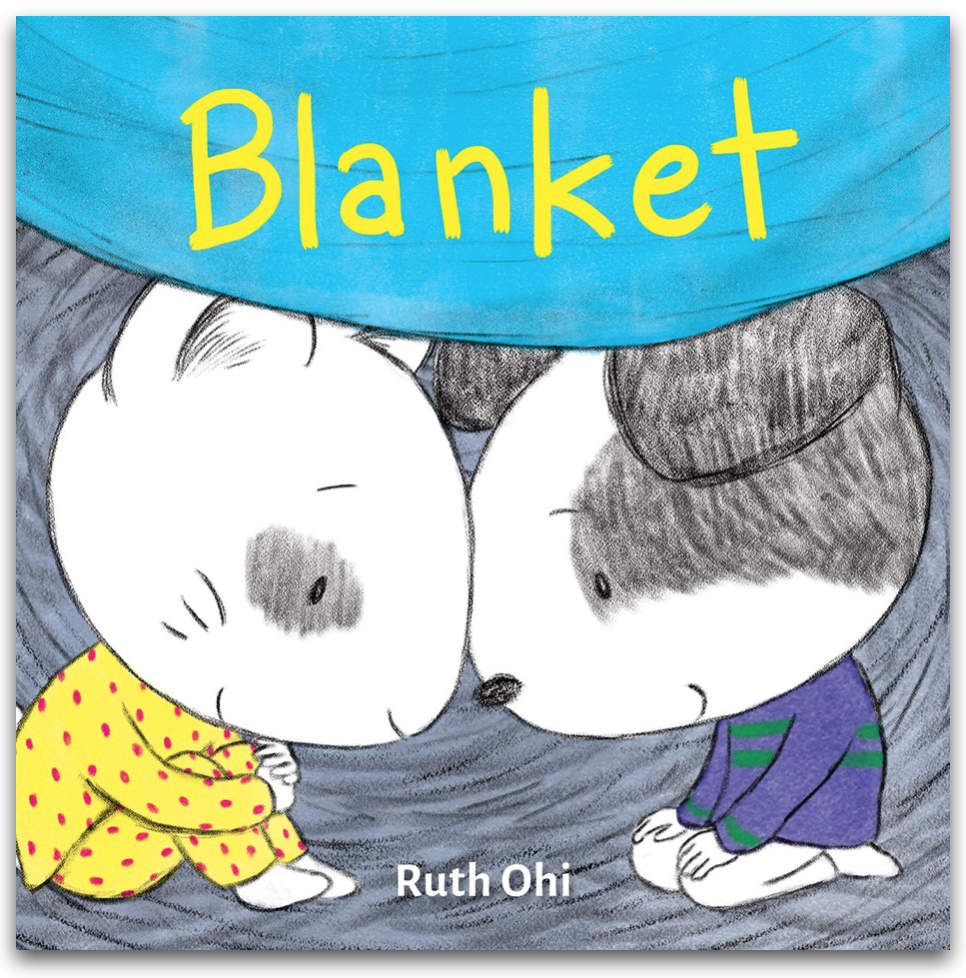
Readers and writers know the power of words. Words can evoke and reassure, anger and subdue, and enlighten and confuse. They can do it all, or it would seem. But sometimes words aren't needed for an impact to be made. Author and illustrator Ruth Ohi makes this subtle and powerful point with her first wordless picture book, Blanket.
From Blanket by Ruth Ohi
Sometimes it doesn't matter if it's sunny outside and the birds are chirping and the flowers are blooming. Inside, really deep inside, is where it can still be grey and that sunshine cannot reach. Yet.
From Blanket by Ruth Ohi
When Cat awakens to the grey inside, they take their turquoise blanket and burrow under it. When Dog shows up, they see the lump that is Cat beneath the blanket, but Dog does not demand anything of Cat. Dog sits down nearby and quietly reads. With time and still beneath the blanket, Cat snuggles over to Dog. Eventually, Cat lifts the blanket and allows Dog to enter and share their protected space.

It's obvious that, while the darkness beneath the blanket offers Cat security, it is also a place where fears can grow and take over. But Dog has a flashlight and the two play with the light before Dog suggests using the blanket to create a shelter over two chairs. It gives Cat the security they need but offers more light and something else. It's a first step to feeling safe enough to venture outside and transform the blanket from shield to shared comforter.
From Blanket by Ruth Ohi

While Ruth Ohi's charming animals are easily recognizable for their sweetness and emotional depth, Blanket is so different from her earlier picture books because of its wordless nature. I've always been delighted with Ruth Ohi's books (e.g., No Help Wanted; Fox and Squirrel, The Best Christmas Ever; Kenta and the Big Wave); still, Blanket is so impressive in its story and messaging that it will sit with me for a very long time. (Though I love sharing books with others, I'll be holding on to Blanket for myself.) Blanket reminds us that, if someone is dealing with sadness or depression, it is not up to others to decide how to help them. When an individual is dealing with an internal greyness, everyone wants to help but seldom–only in dire circumstances–should another decide what is needed. Dog knows this. With time and patience, a flashlight and some playfulness, Dog is able to offer Cat opportunities to come out from the shadows of the blanket. It's still up to Cat when they are ready to move from beneath the blanket into the light. And with few colours and strategic lines of smiles and eyes that are dim and then bright, Ruth Ohi tells us all this in her moving illustrations. Even in the darkness of Cat's sadness, Ruth Ohi has given us light through her art.

A blanket can be so much more than a coverlet for a bed. It can be shelter and armour, defense and offense, and love and fear. It can hide and reveal. This is Cat's blanket. It offers them the opportunity to hide from the world but also reveals Cat as they are to Dog. There is power in that blanket for good and I'm so glad that Cat used it as they needed and that Dog was there to take their cues from Cat.

June 23, 2022

Annie's Cat is Sad


Written by Heather Smith
Illustrated by Karen Obuhanych
Feiwel and Friends
978-1-250-80684-0
32 pp.
Ages 4-8
June 2022
 
When Annie comes home from school and her cat Delilah does not rush to see her or even want to hang out with her, Annie is convinced that Delilah is sad. But what to do when your cat is sad?
From Annie's Cat is Sad by Heather Smith, illus. by Karen Obuhanych
Though Annie is delighted to see Delilah, having missed her while at school, she needs to seek out her cat. But Delilah seems to want to be alone, hiding beneath the sofa. Annie understands and tries to do whatever she can to draw Delilah out and make her happy.
From Annie's Cat is Sad by Heather Smith, illus. by Karen Obuhanych
She warms some milk, tops it with whipping cream, makes a joke–it's a cattuccino–and offers a hug. Then Annie turns on the TV and invites Delilah to join her in some yoga, making up her own colourful poses.
From Annie's Cat is Sad by Heather Smith, illus. by Karen Obuhanych
But as she tries to engage Delilah, it's obvious that it's Annie who has had a bad day, and it may be Delilah who will help the orange-haired child deal with her sadness when the other strategies don't work.

No one likes to see someone they care for in distress, whether from fear or sadness or trauma. While a young reader will undoubtedly understand a beloved pet who is not acting like itself and be concerned, they will also empathize with coming home from a bad day at school and looking to their furry friend for solace. As a parent and a kind person, Heather Smith understands this and makes sure that children will accept that bad days happen and there are different ways to cope. Sometimes those strategies work and sometimes they don't. But the best thing to do is try to find what works for you. It may just be a cuddle with a cat who understands better than you that sadness has taken hold. 

It's a very light touch that Heather Smith has taken with Annie's Cat is Sad. She can do angsty and heavy (The Agony of Bun O'Keefe and Chicken Girl are but two young adult examples) but Heather Smith excels at the subtle, allowing young people to take from the text the meaning that they need to read. (Her award-winning The Phone Booth in Mr. Hirota's Garden is another prime example.) That's especially poignant when her readers need to read between the lines and with cues from Hawaii's Karen Obuhanych's illustrations. Take the understated line, "I just want you to know. It's okay to cry." with an illustration of a tear dropping from Annie's eye as a large-eyed Delilah watches. We as readers may be watching Delilah for most of the story, wondering what it would take to make her less sad, and charmed by Karen Obuhanych's grey tabby with the pink nose and green eyes. But, Annie with her voluminous ginger hair is really the star and young readers will want to go back over the story is find the clues that it was really Annie who was dealing with the bad day.

Whether feline or human, child or adult, we have bad days. And, as Annie ostensibly strives to help Delilah through hers, she provides examples for all to distract themselves from their temporary troubles, and assure them that support can be found, especially when you share your burdens.

April 27, 2022

Last Week

Written by Bill Richardson
Illustrated by Emilie Leduc
Afterword by Dr. Stephanie Green
Groundwood Books
978-1-77306-566-3
64 pp.
Ages 9-12
April 2022

Last Week is a sombre little book. It is based on the last week of a child's grandmother, affectionately called Flippa, as she with her family prepare for her death via Medical Assistance in Dying (MAiD). It is sombre because of a child's recognition of time passing swiftly before that death in a week of six hundred four thousand and eight hundred seconds or in the seven chapter days.
From Last Week by Bill Richardson, illus. by Emilie Leduc

This last week begins with Monday and with a child and their father flying across the country to be with the parent's mother during her last week. The child recalls how Flippa used to swim every day in the sea, walking in her wet suit, goggles and flippers the three blocks to the ocean. But no more. Because Flippa always felt it was important to make every second count, the child does that with the seconds they have left with her, chatting while she rests in bed, trying to make her laugh, and more.

From Last Week by Bill Richardson, illus. by Emilie Leduc

Visitors come and bring food and stay to chat and cry and reminisce. When Flippa feels well enough to come out of her room, she recalls being there for the child's birth. Now they will be there for her, "For when I'm set free," she declares. A visit from the green grocer, Mr. Bark, has the two ribbing each other about the tomato plants she'd bought from him having not produced any tomatoes. It's all very low-key with everyone knowing that Flippa's end is near but rarely really discussing it directly. With Flippa's doctor scheduled to come Sunday at 11 a.m. and administer the trio of medicines, the conclusion of that last week is imminent, and the child finds a way to be with Flippa, connect with her and even share a good-bye gift.

From Last Week by Bill Richardson, illus. by Emlie Leduc
Bill Richardson has written a story of such elegance in Last Week. The death of a grandparent can be one of the first significant deaths a child can experience, except for that of a pet, but a scheduled death is a whole different issue. With that last week, the child understands the momentousness of that juncture while preparing for a loss, appreciating every moment and witnessing others' responses. Bill Richardson keeps the story from the child's perspective and what they see, feel, hear, and know. By doing this, it becomes the child's story, not about the death. In fact, Flippa's death is never revealed though readers will know it was impending and unavoidable. That inevitability permeates the story and the child's narration of it but this child does not manifest the same grief as their father or the other visitors. After all, grief for the dying or the dead is different for all. For this child, it's making those seconds count with support and love, easing Flippa through that last week in their own way.
From Last Week by Bill Richardson, illus. by Emilie Leduc
While it is an illustrated chapter book, Last Week is not awash in the colour or boldness of art. Emilie Leduc's illustrations are stark and hushed. The black, grey and white palette keeps the tone of the story soft and quiet. Even though Flippa's last week is busy with visitors and family, those moments are important but fleeting, not unlike the art. Both Bill Richardson and Emilie Leduc can do bright and cheerful, humorous and busy. (Check out Bill Richardson's The Alphabet Thief or Hare B & B and Emilie Leduc's All Year Round.) But they set the tone of the book with their words and art, making Last Week important in its dignity of story message –which includes an Afterword by Dr. Stephanie Green about assisted dying–while taking the opportunity to introduce young people to an important end-of-life discussion.

January 29, 2020

What's Up, Maloo?

Written and illustrated by Geneviève Godbout
Tundra Books
978-0-7352-6664-3
40 pp.
Ages 3-7
January 2020

Tackling issues of mental health in picture books requires a special touch. You can be neither silly about it nor aggressive while still getting the message out that there is help. Geneviève Godbout's text and art, always thoughtful and serene in soft pastels and coloured pencils, meets the challenge with style and compassion.
From What's Up, Maloo? by Geneviève Godhout
When kangaroo Maloo is happy and hopping, she is on top of the world. Life is a bed of roses, pink ones in fact. But when she's not, the hop goes out of her and a grey cloud envelopes her thinking. She walks to her friends who all ask, "What's up, Maloo?" and all she knows is that she's not hopping. There's the baking wombat, the swimming crocodile, and the koala, all who want to help. They attempt to lull her into play with balls in the water, and levitate her with the air from fans but the black cloud around Maloo does not dissipate and she isn't hopping.
From What's Up, Maloo? by Geneviève Godhout
The friends continue on their walking journey until they find a sail-like sheeting which they spread out and upon which Maloo bounces, hoping for her hop to come back. A bit of fun, a lot of friendship and a little time and Maloo is hopping again, now with her friends in tow!
From What's Up, Maloo? by Geneviève Godhout
Geneviève Godbout's illustrations are so serene and thoughtful, emphasizing a tenderness to Maloo's plight and the compassion of her friends. But still Geneviève Godbout's story stays inspirited, playing with graphic idioms such as Maloo's lack of a spring, or hop, in her step, the black cloud around her as an analogy for depression, and the bed of roses that make up her landscape when she is happy. Geneviève Godbout's What's Up, Maloo? makes me hopeful that, with a little help from friends who are supportive without being controlling or taking charge of her feelings, Maloo can get her hop back whenever the dark cloud descends again.

🌸🌸🌸🌸🌸🌸

It seems highly appropriate that I review What's Up, Maloo? on January 29th which is Bell's Let's Talk Day.  This is the day when media corporation Bell Canada contributes 5¢ to mental health initiatives in Canada for every applicable text, call, tweet, or social media video view in support of Bell Let's Talk.  So let's talk about What's Up, Maloo? to get our own conversation going about using Canadian picture books to support mental health. You'll find me on social media doing just this and I hope you'll do the same.

January 09, 2019

Will Giraffe Laugh?

Written and illustrated by Hilary Leung
Cartwheel Books (Scholastic)
978-1-338-21561-8
38 pp.
Ages 2-5
January 2019

For a sweet concept lesson in how friends and a chuckle can make life better, it's Hilary Leung's newest board book Will Giraffe Laugh?
From Will Giraffe Laugh? by Hilary Leung
When Giraffe wakes up grumpy, his friends are there to help. Bear brings on his juggling skills, with no less than a ball, cherries, a plunger, a toothbrush and strawberry, but that doesn't seem to do the trick. Talented Crocodile performs a puppet show for Giraffe who ends up with a puppet stuck to his nose. Sheep makes an awesome balloon dog which unfortunately deflates and torpedoes into Giraffe's eye. Even Frog's versatile tongue gets out of hand and ties up Giraffe while seeking a fly. Finally Ladybug (remember her from Will Ladybug Hug?) tries for a smile with some flowers that only cause Giraffe to sneeze.
From Will Giraffe Laugh? by Hilary Leung
And then it starts to rain. Now everyone is sad, and Giraffe uses all their tricks to attempt to cheer up his friends. The tricks may not work but some humourous tumbles into a muddy swamp has everyone laughing.
From Will Giraffe Laugh? by Hilary Leung
Concept book–books that teach concepts like numbers to very young children–can be dull and lifeless but Hilary Leung's board books, all based on animal questions, are not. Of course, they use bright colours and bold shapes with simple text but the depth of the messages and the emotions evoked in the eyes and body language of Hilary Leung's characters make them neither boring nor facile. In Will Giraffe Laugh?, there is a message about emotions, particularly grumpiness or sadness. While it may be unreasonable to wipe away a friend's depression–though we tend to try to do so–it may be possible to draw someone out of a bad mood, and Will Giraffe Laugh? teaches that, with a little effort and some wonderful friends, relief is within reach. It may be a little messy and not as planned but, in the end, it's a worthwhile endeavour to help improve another's life, even if only temporarily.

June 12, 2018

I'm Sad

Written by Michael Ian Black
Illustrated by Debbie Ridpath Ohi
Simon & Schuster Books for Young Readers
978-1-4814-7627-0
40 pp.
Ages 4-8
June 2018

At any time, there will be media coverage about a celebrity's unexpected death from suicide. There will be yet another outcry for resources to support mental health initiatives.  And there will be those who still won't get it, thinking that having everything–fame, money, friends, home–is enough assurance that overwhelming, debilitating sadness cannot overtake and even engulf.  But if there's a great place to start to acquire an understanding of sadness, which can manifest as depression, it's the newest collaboration from the dynamic duo of Michael Ian Black and Debbie Ridpath Ohi who amused and enlightened us with I'm Bored (Simon & Schuster Books for Young Readers, 2012).
From I'm Sad by Michael Ian Black, illus. by Debbie Ridpath Ohi
The first double spread has a single image of the pink flamingo simply stating, "I'm sad." The message is a simple statement but Debbie Ridpath Ohi's illustration says so much more. From the drooping feathers to the bowed neck and downcast eyes, this bird is barely holding itself up or together.  The imaginative little girl and bored potato from I'm Bored listen and attempt to understand. They try to help by acknowledging that they don't think the flamingo will always feel sad and that everybody feels sad sometimes. Even as they try to help, as all friends would want to do, they grapple with understanding what the flamingo needs, initially only thinking of what would work for them. Michael Ian Black astutely recognizes that we all can only understand from our own frame of reference, with the little girl thinking ice cream, sports and activity while the potato knows that dirt would certainly cheer it up.  Even after the little girl recognizes that sometimes allowing oneself to be sad can be therapeutic and relieving flamingo that its sadness will not change their friendship, it's a good laugh courtesy of the potato's dry wit that relieves some of the tension.  It may not alleviate the sadness but it can help.
I'm Sad by Michael Ian Black, illus. by Debbie Ridpath Ohi
Many children's books that attempt to provide bibliotherapy fall short of the mark because they tend to get too preachy, convinced they have the answer. I'm Sad is not one of them. It surpasses in its message that sadness can be a significant emotion and reassurance can be the most effective strategy for helping a friend feeling debilitated by it.  By having the little girl and the potato attempt to understand, question, reassure, and suggest, Michael Ian Black has them standing with flamingo in its struggle with sadness. They don't try to vacuum it up or ignore it. They simply accept it as the flamingo explains it.  If flamingo begins to feels better, so be it.  If it doesn't, they are still there for it.

In the boldness of her colour and line, Debbie Ridpath Ohi makes sure that the depth of Michael Ian Black's message is evident. Amidst the potato's cynicism and the little girl's joie de vivre, the flamingo's sadness is unmistakable. Debbie Ridpath Ohi's ability to evoke so much story with the simplest of lines continues to astound and impress me. (See my reviews of Sam & Eva and I'm Bored.) Even her final image packs a punch of friendship and support with only a silhouette without benefit of colour.
From I'm Sad by Michael Ian Black, illus. by Debbie Ridpath Ohi
All school libraries and guidance counselling offices should have a copy of I'm Sad to help children understand the sadness they or their friends or family may be experiencing and to reassure, just as the little girl and potato do, that support is there, even if the sadness can't be wiped out.
From I'm Sad by Michael Ian Black, illus. by Debbie Ridpath Ohi
• • • • • • • • • •
n.b. There is a classroom guide by Marcie Colleen available for download here

October 13, 2014

Gustave

by Rémy Simard
Illustrated by Pierre Pratt
Translated by Shelley Tanaka
Groundwood Books
978-1-55498-451-0
56 pp.
Ages 4-7
For release October, 2014

From the title page alone, Gustave evokes a rough darkness with its heavily-inked, coarse lettering and shades of colours with overlays of black.  There's black, black and more black. Sombre and fearful is how Gustave begins, with a little mouse overwhelmed by the loss of his dear friend Gustave when they venture too far from home and encounter a cat.  Gustave will not be returning home with the little mouse whose sorrow is well conveyed by the spare words of Rémy Simard's blunt text:
Gustave won't play with me anymore.
He won't tell me goodnight.
He won't look at me anymore.
(pg. 6)
But Pierre Pratt's illustrations, in ink and gouache, are the force by which the story of Gustave is told.  The double-page spreads of artwork, sometimes with few words, if any, overwhelm the story, just as the consequences of the little mouse's actions smother him with sorrow.  It is only in the last half-dozen pages of the story that the colours are able to seep through, ending with a single page of bright artwork opposite a white page of text. It is a bright, hopeful ending in both text and illustration.

Though I may describe Gustave as having a dirge-like quality, it is nothing but brilliant in its masterful picture book story-telling of a mouse grieving the loss of a friend.  I suspect that, even without the unexpected twist at the end, this story could not have been told any better than it has been by Rémy Simard and Pierre Pratt, thankfully translated by Shelley Tanaka so that so many more of us can appreciate it.

Gustave is currently nominated for a 2014 Governor General's Literary Award for Illustration in a French Children's Book. Bonne chance, Pierre Pratt!