Showing posts with label loss. Show all posts

July 17, 2024

The Space Between Here and Now

Written by Sarah Suk
Quill Tree Books
978-0063255135
320 pp.
Ages 13-17
October 2023

I know I'm a little late to review Sarah Suk's second young adult book (she wrote Made in Korea in 2021) but I just recently heard of this novel from the Red Maple panel of the Forest Kid Committee who recommended it for their summer reading list. (Each year that I help out with this committee, I learn of new Canadian titles for young readers. These young people are amazing readers!) After checking out their recommendation, I was intrigued by the blurb about The Space Between Here and Now and was not disappointed.
 
Aimee Roh is a typical 17-year-old Korean Canadian living in Vancouver, BC with Appa, her father. She's thinking about university, she hangs with her friends, she has a passion for photography, and she and her father have a close but respectful relationship. She's typical in every way except that she has a rare condition called Sensory Time Warp Syndrome a.k.a. STWS. Those with STWS have different triggers for memories that can transport them back to the time of the memory. When triggered by smells, Aimee disappears, travels back to a memory usually for just few minutes. Some people grow out of the condition, but Aimee is finding that she's experiencing more frequent episodes and wonders if it is because of the stresses of being a senior and anticipating the next phase of her life. What doesn't help is that it is impossible to talk to her father about it or get the supports she needs to help her cope.
 
After a particularly lengthy disappearance in which she is taken to a long-forgotten memory of a family outing to Kitsilano Beach, before her mother abandoned the family when Aimee was 6, Aimee is confused. Her memory doesn't match what she remembers and she begins to wonder whether her mother perhaps had STWS. Taking matters in hand, and with the encouragement and help of best friend Nikita, Aimee embarks on a spring break trip to Korea, hopeful of finding out some answers about her mother and family that her father doesn't seem to want to share with her.
 
With Nikita researching online for clues, and Aimee reconnecting with her Aunt Gomo and childhood friend Junho, the search for Aimee's mom begins. With some new insights into her STWS and into her relationship with her father, Aimee finds herself gaining clarity and even confidence where there was once only confusion.

Teen angst is not unusual but the angst that comes from a chronic condition that unexpectedly disappears you from your life, even if temporarily, is beyond typical. It has left Aimee in a precarious position, in a space between then and now, unclear as to her memories of her past and her understanding of her present. Sarah Suk, a Vancouver author, gives Aimee a story that might appear tenuous, never knowing when she might disappear or where she will end up or even if there is a possibility of ending up in a time loop. But Aimee's story is not anxiety-driven; it is driven by a need to know. Young adults will appreciate that push to become self-actualized, to understand oneself. Aimee's life is many layered, between her issues of abandonment by her mother, being disaffected with her father, and struggling not to stand out because of her STWS. While today's teens may not have a memory-driven time-travel condition, they have their own issues that challenge them in their drive for understanding and satisfaction. They can learn from Aimee who faces peer pressures and family pressures and uncertainty and is still able to resolve things well enough for herself. She may not get the answers she was specifically looking for, but she gets what she needs and learns things that will help her, as well as others. 

Though the fantastical nature of Aimee's STWS elevates The Space Between Here and Now from the drama of teen angst to the realm of science fiction,  Sarah Suk gives a story that is both enlightening about one Korean-Canadian family as well as familiar. For that reason, I urge young people to read The Space Between Here and Now for some insight into their own lives and relationships with others, particularly parents, to see how reconciliation may be reached with patience, effort and, most definitely, compassion.

April 30, 2024

Otis & Peanut: Forever and Ever

Words by Naseem Hrab
Drawings by Kelly Collier
Owlkids Books
978-1-77147-497-9
80 pp.
Ages 6-8
April 2024 
 
Like the classic early readers about Frog and Toad, Otis and Peanut have many stories to tell. The unlikely friendship of the long-haired guinea pig (Otis) and the naked mole rat (Peanut) is fodder for three more stories in Otis & Peanut: Forever and Ever that cover everything from cake to memories, gardening and absent sisters.
From Otis & Peanut: Forever and Ever, written by Naseem Hrab, illustrated by Kelly Collier
In the story titled "The Cake," Peanut surprises Otis with a luscious three-layer strawberry cake based on his sister Pearl's recipe. Though Peanut wants to dig in, Otis wonders what they are celebrating. Apparently, Peanut's answer of "celebrating cake with cake" doesn't cut it and is determined to save it for a special occasion. But would there ever be a good enough reason to eat cake?
From Otis & Peanut: Forever and Ever, written by Naseem Hrab, illustrated by Kelly Collier
The second story, "The Dream," has Peanut at home enjoying a breakfast of toast and jam when he discovers his last jar of strawberry jam made by Pearl. After eating, he is inspired to plant some strawberry seeds his sister had given him. After watching some kids play in the sprinkler and dreaming of when he and Pearl did the same, Peanut retrieves his own sprinkler to water his garden but to also reminisce and enjoy.

"The Collection" is Naseem Hrab's final story for Otis & Peanut: Forever and Ever, and says more about memories than the earlier chapters. While Peanut grieves the loss of his sister Pearl and finds himself remembering her in everything from baking to eating and playing, it is Otis who helps him to see the value in keeping memories as tangible objects. Otis himself keeps scrapbooks of memories and demonstrates to Peanut that, no matter how important the memories are, sometimes you can forget them. So, Peanut finds a way to keep his own memories, both happy and sad, safe and make new memories with his friend.
From Otis & Peanut: Forever and Ever, written by Naseem Hrab, illustrated by Kelly Collier
There is a gentleness to Naseem Hrab's stories of Otis and Peanut that invites young readers to see their own lives within the stories of the guinea pig and the mole rat. Children will be familiar with celebrating with cakes, planting a garden, playing in a sprinkler, and keeping bits and bobs of photos, ticket stubs, etc. as memories. They'll also know what it is to be a friend and have a friend. So, by nature of these stories, not only will they practise their reading and make connections between text and illustrations, they'll be making meaningful connections between the story and their own lives, learning about empathy, acceptance, cooperation and more.

Kelly Collier, who illustrated the first Otis & Peanut book, uses the same colour palette of turquoise and chartreuse with splashes of pink as she did in the first. It works to keep the overall effect uncomplicated but focused. Whether it's the cake or the jam and the garden or the keeping of memories, one emphasis is evident and not the background of detailed characters and settings or the jibber jabber of extraneous text. Together Kelly Collier and Naseem Hrab remember who their audience is and ensure that their reading and storytelling needs are met.

Because children have so much happening in their lives, whether it's a daily occurrence like picking clothes or reading books, or special events like a birthday party or performing at a recital, there are loads of stories that Naseem Hrab and Kelly Collier can share through Otis and Peanut. Whether it's to teach them about being a good friend, or to reflect the young lives of these readers, Otis and Peanut are there, as are we, to watch and learn. 

Otis & Peanut: Forever and Ever (2024)

October 13, 2023

Do You Remember?

Written and illustrated by Sydney Smith
Groundwood Books
978-1-77306-986-9
40 pp.
Ages 3-6
October 2023
 
Remembering someone who is gone, whether through death, divorce, or moving, is a mix of grief and comfort. It's remembering the good times but never forgetting that loss. Do You Remember? is the sensory experience of a young boy and his mother remembering times when his father was still with them.
From Do You Remember?, written and illus. by Sydney Smith
Lying in bed in the dark, a mother asks her son whether he remembers a picnic in a field. She recalls the bugs and snakes the child looked for, but he remembers the sweet berries. They continue to trade remembrances, always asking, "Do you remember..." He recalls when his parents gave him his bicycle and he lost control, falling into a haypile. Then she recalls "the rainstorm" of the hard rain and leaking roof, thunder and lightning, and then the loss of power which led to the burning of Grandpa's old oil lamp.
From Do You Remember?, written and illus. by Sydney Smith
With each memory, there is that beginning idea, and then a multitude of vignettes involved in that memory. Perhaps most significant for them is when they left their home behind, and travelled further than they ever had, and got lost. That's the memory but the vignettes shows us the boy's dad handing him a teddy bear through the truck's open window, then waving to them, and the child holding the bear as they enter traffic and get lost. The memory is not just one of leaving: it is one of carrying boxes, a dad's face, a dad's wave, the many cars, watching from the back seat, holding his bear, and then seeing the source of all those memories stacked against the wall in their new place. The bear, the oil lamp, the bicycle, the picnic blanket–they're all there.

But do their memories have to remain in the past? Or are there new memories to be made?

A memory may be but a moment in time but it's a complex amalgamation of spoken words, foods tasted, textures touched, emotions felt, and images processed. It's seeing and feeling everything and incorporating them into a memory. It could be a sad memory or a joyous one, but it's all wrapped up and available to return the one remembering to another time and place. But, as Sydney Smith demonstrates, these memories are just part of the whole, of the past and future, of good times gone and future experiences still to be had. And loss and pain can play with those memories. In the case of this child and his mother, there has been a separation of his parents, and the consequent moving to a new home. Whatever rift has contributed to his parents' separation, his mother encourages him to remember times with his dad. She has not put her animosity, if she has any, ahead of the needs of her child. Instead, she encourages him to remember and to share in his remembrances too. There is tenderness in their exchange, understanding that there may be hurt below the surface and caution to not create more discomfort. They are tentative but honest, and that sincerity obviously comes from love.

Sydney Smith's illustrations, primarily watercolour and gouache, show a sensitivity for what the family is going through while demonstrating the strength of connection between mother and child even under these circumstances. They neither ignore nor rail at their heartache for their losses of father, husband, home, and established family. They look back but still forward. There is darkness–they are speaking at night in bed in their new apartment–but there are moments of lightness both in the past and in their future–as the child opens the window to the light–and Sydney Smith gives them that in his soft and thoughtful art.
From Do You Remember?, written and illus. by Sydney Smith
Sydney Smith dedicates this book to his mom, and his words and art honour parents who must move forward with a different family configuration. This mother, and undoubtedly many others, had to find ways to help their children accept new circumstances while not giving up on everything from the past. They remember and are loving enough to ensure their children do too.

June 12, 2023

Malaika, Carnival Queen

Written by Nadia L. Hohn
Illustrated by Irene Luxbacher
Groundwood Books
978-1-77306-850-3
32 pp.
Ages 4-8
May 2023
 
Malaika, whom Nadia L. Hohn introduced us to in Malaika's Costume (and revisited with Malaika's Winter Carnival and Malaika's Surprise), is always joyous with colour and exuberance. But it's family that brings her the most happiness. In Malaika, Carnival Queen, family is no less important but there is an element of grief that is wrapped in that familial warmth.
From Malaika, Carnival Queen by Nadia L. Hohn, illus. by Irene Luxbacher
Malaika lives with her Mummy, her new father Papa Fred, her Grandma, her new sister Adèle and new baby brother. But she's dreaming of a man carrying a basket of fruit, handing her a mango. Malaika believes it a dream about her father and her mother confirms it. Grandma gives Malaika a photo of her daddy working on a fruit farm with a message "To Malaika, my likkle one." He'd come to Canada before them to work on a farm, but he'd become ill and passed away without them.
From Malaika, Carnival Queen by Nadia L. Hohn, illus. by Irene Luxbacher
They decide it's important for Malaika to learn more about her father, so they take a trip to the farm where he'd worked, meeting some men who'd worked with him. They speak of his love for his daughter and his dream to make a carnival like back home. Malaika is invited to be the Carnival Queen for their upcoming harvest festival to which she agrees.

Malaika is ready with her carnival peacock dress, but she has a plan to make the parade extra special and ensure that "home" is at the heart of the event.
 
Malaika, Carnival Queen is an involved story but at its heart it's about family and home. Malaika has a family, but she has lost her birth father and needed to know more about him. With him showing up in her dreams, it was time to learn more. Nadia L. Hohn gives us the Malaika whom we've grown to love through her earlier books but in Malaika, Carnival Queen we are introduced to another side of her, that which has experienced loss. With Malaika's father as a migrant worker, Nadia L. Hohn opens the discussion with children about families who are separated through immigration, particularly because of farm work. Though the story of migrant farm workers is one of hardships, that's not the story that Malaika, as the daughter of one, needed to hear. She needed to connect with her father through his coworkers and through a carnival, and Nadia L. Hohn does that for the little girl. 
From Malaika, Carnival Queen by Nadia L. Hohn, illus. by Irene Luxbacher
That connection of family and place comes through Malaika's creation of a carnival flag of home. It's a banner of colour and heart and memory, and all those are depicted in Irene Luxbacher's illustrations. The artwork, created in gouache, soft pastels and found papers, gives the story both a softness of purpose and a quilting of connection. Those media are perfect for a story of loss and finding connection but also making connection. Irene Luxbacher, who has illustrated all four of the Malaika books, gives the colour and the boldness of a child with high spirits, but she also gives us tenderness for the loss felt by Malaika and others as well as a collage-feel that comes from kinship.

As Malaika grows older, Nadia L. Hohn shows us more sides to the little girl and her family, but she always keeps her as one with sensitivity. She may be a carnival queen but she's also a daughter, a granddaughter, a sister, and a friend, all which make her truly impressive and inclusive.
• • • • • • •

Malaika's Winter Carnival (2017)

June 01, 2023

The Remembering Stone

Written and illustrated by Carey Sookocheff
Groundwood Books
978-1-77306-589-2
40 pp.
Ages 3-6
March 2023

Sometimes a stone is more than a stone. Sometimes it's a memory, sometimes it's a connection, and sometimes it's an opportunity.

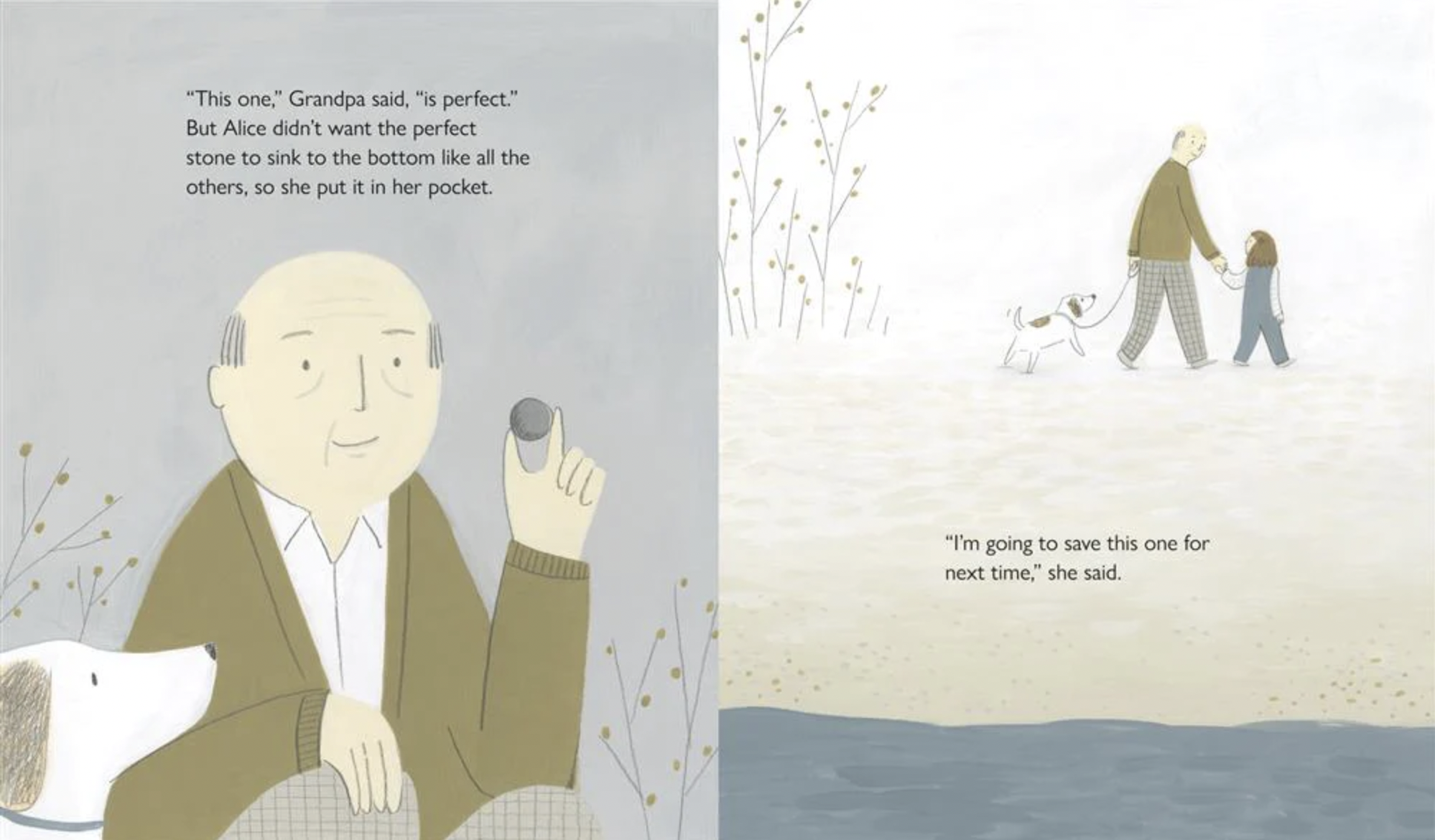
Alice has brought a stone for show-and-tell. Of course, her classmates see it as a stone. A rock. A piece of earth. Though she has lots of stories about using it to trick her dad or as a shape for tracing, it's the memory of skipping stones with her grandpa that is most important. Her grandpa knew how to skip stones and pick out the perfect ones. When he'd found this perfect stone, Alice had kept it in her pocket, probably for their next outing but perhaps because she didn't want to give it up to the water.
From The Remembering Stone by Carey Sookocheff
But when her grandpa got sick and passed away, the stone became something more.
From The Remembering Stone by Carey Sookocheff
The response to her show-and-tell stone may not have been what Alice expected but, when she realizes she's lost her stone on the playground, her classmates understand how important it is to her and they all start looking. They find a lot of stones, though not her special stone. Still, her new stones become something more too.
From The Remembering Stone by Carey Sookocheff
Carey Sookocheff's story is as deceptively simple as her illustrations. It may appear only to be about a girl and a stone which connects her to her grandfather. But Carey Sookocheff uses that stone as a bridge beyond that intergenerational relationship and allows Alice to see that it is both something special and something ordinary. The stone's value is what she places on it. It can remind her of her grandpa or help make new connections with her classmates or it can be just a skipping stone. Regardless of what the stone or stones have been or become, they have meaning, even when they're gone. 

The Remembering Stone truly becomes Carey Sookocheff's story because she illustrates it. Using acrylic gouache and graphite, she embeds the story in reality. Her art is clean and smooth and gives a calmness to being with others. It's the reality of going to school, participating in show-and-tell, spending time with a grandparent, and losing a grandparent. It's all about what a child might experience so it will speak to many children. But, while the story connects with young readers, it will also give them an opportunity to see that there are opportunities beyond the obvious. A skipping stone becomes a memory first but then it transforms both in its presence and in its absence. It's a remembering stone even when it's not.

March 11, 2023

The Bee Without Wings

Written and illustrated by Amberlea Williams
Princeton Architectural Press
978-1-797222509
40 pp.
Ages 4-8
March 2023

Though some parts of Canada will still be hit by significant snowfalls today, we'll all be anticipating spring and all that that season brings with it: bees, flowers, warmer temperatures, rain and so much more. But things aren't always as expected as Sasha learns.
From The Bee Without Wings by Amberlea Williams
While out with her cat Molly, Sasha finds a bee that is acting differently. She soon realizes it has no wings. She tries to help it, first by bringing it to a flower and then, when that is unsuccessful, by offering it sugar water. After a few sips, the bee is energized. But Sasha knows that, without wings, the bee's life will be very difficult. And so, Sasha takes responsibility for Bea, giving it shelter, food, and safety. Still Sasha knows that Bea longs to fly, and so she devises a contraption that would give Bea the pleasure of flight.
From The Bee Without Wings by Amberlea Williams
But bees do not live forever, and Sasha can see Bea slowing down and eating less. The loss is hard for Sasha and Molly, but they find a way to honour her, and, with much planning and research, Sasha does just that the next spring.

There are so many lessons that parents and teachers can take from The Bee Without Wings whether it be about a bee's life cycle or dealing with loss, but Ottawa's Amberlea Williams doesn't overwork those messages. Instead, she gives us a story of a compassionate child who loves being out in the natural world and recognizes a need to care for living things. In a world of "Me! Me! Me!" it's refreshing to see a child whose heart is full of wonder and empathy. From the child's words and actions to Amberlea Williams's gouache and coloured pencil illustrations, there is brightness and kindness. Even with the tragedy of a wingless bee and her inevitable passing, Amberlea Williams gives us lightness and joy, from eyes bright with curiosity and feeling, to landscapes magnificent in both flowers and snow.
From The Bee Without Wings by Amberlea Williams
Amberlea Williams appends her story with pages about caring for early spring bees and creating your own bee-friendly garden, thus giving young readers an opportunity to do good in the natural world themselves. But, even without those conservation efforts, young readers are encouraged to open their eyes and observe nature as it is. Sasha may have benefited serendipitously by her actions, making a friend in Bea, but her efforts were wholly altruistic, giving Bea sanctuary where her physical limitations may have hampered her. It's a feel-good story that confirms the insight of Laozi that "Great acts are made up of small deeds.”

• • • • • • •
 
An activity sheet from the book is available from the publisher for download here.
 

October 22, 2022

The Brass Charm


Written by Monique Polak
Illustrated by Marie Lafrance
North Winds Press (Scholastic Canada)
978-1-4431-5758-2
32 pp.
Ages 5-9
September 2022
 
Everyone has troubles in their lives sometime. Some are horrific and life-changing, some are temporal but seem overwhelming.  Most of us cannot see past our own issues when we're immersed in them. It's that bubble of now. It is probably especially the case for young children many of whom, thankfully, have not had to endure great hardships. So, when the roof of their home is destroyed in a storm, Tali is devastated.
From The Brass Charm by Monique Polak, illus. by Marie Lafrance
As the family heads to stay with Oma while repairs may be undertaken, Tali's mother reminds her that "People survive worse" and to "Think of Oma." Tali knows her grandmother survived World War II but she never talks about it. Still Tali is "too sad to think of anyone" but herself, even when she meets a little neighbour girl who obviously craves some company. That is, until her Oma shows her a tiny brass charm of a monkey man and shares a memory of her own hardship.

From The Brass Charm by Monique Polak, illus. by Marie Lafrance
Telling her story in the third person, Oma tells of a girl forced to leave home and sent to a prison called Terezin. The people kept there were worked tirelessly and fed very little and on the day of her birthday, the child was overcome with how her life had changed for the worse. A woman, hearing her cry, bestows upon her a small brass charm of a monkey man that a stranger gave her when her own life had seemed stormy. Now Oma remembers that lady whose own life had been difficult and could still find "it in her heart to be kind to a stranger."
 
In a message of paying it forward, Monique Polak has Tali sharing the story of the brass charm with Elodie, the little neighbour girl, bolstering them both through their challenges.
From The Brass Charm by Monique Polak, illus. by Marie Lafrance
In a story within a story, Montreal author Monique Polak is actually telling her mother's own history of surviving Terezin as a child and receiving the charm. Because of Terezin's history and its common role as a transit camp for those moved onto other concentration camps, as Monique Polak's Afterword details, the woman who shared that charm was never seen again. Yet the kindness she extended in such trying circumstances, just as Tali's Oma did for her grandchild, speak to a strength of character beyond the typical. It speaks to empathy and compassion and feeling beyond self. And for Tali to listen and learn and then apply that lesson to another makes that small brass charm a greater gift than any gold or diamond trinket could replace.
From The Brass Charm by Monique Polak, illus. by Marie Lafrance
There is a lesson from history here with Tali's Oma remembering Terezin and an experience from World War II. But it is in the context of connecting with others and a grandmother-granddaughter relationship. Not surprising that, even with a story that includes both historical and contemporary scenes, Marie Lafrance whose artwork was rendered with graphite on paper before digitally coloured and texturized via collage, is able to meld the two time periods by focusing on the child in each. It's Tali's experience and then her oma's when she was a child. It is from their perspective: what they see, what they feel, how they respond. So when the two come together in the present, as elderly woman and young child, they are feeling and understanding as the same. And Marie Lafrance gives the two similarities in their physical appearances, with the golden curls of their hair and delicate chins and ears, and makes it clear they are related. But she also gives a softness to a hard story, a story of destruction and hatred, loss and generosity. By keeping the dark grey tones for the camp and the storm and using soft colours of blues and rose and such for everything else, Marie Lafrance emphasizes the tenderness of being there for others, not the damage of the negative.

I can't think of a gentler way to introduce children to the Holocaust and Nazi concentration camps than a reading and discussion of The Brass Charm, though its story is far greater than those historic concepts. Read for a memorial day such as the International Holocaust Remembrance Day (January 27) but also for lessons about empathy and the goodness of paying it forward. The best acts of kindness do not require recompense or recognition. They come from making someone's life a little easier, whether during storms, times of trouble or now.

• • • • • •

Author Monique Polak will be launching her new book on November 20, 2022 at 2 PM at the Gelber Conference Centre, Musée de l'Holocauste Montréal / Montreal Holocaust Museum. Reserve your free tickets at Eventbrite here

October 25, 2019

Bon Voyage, Mister Rodriguez

Written by Christiane Duchesne
Illustrated by François Thisdale
Pajama Press
978-1-77278-089-5
32 pp.
Ages 5-9
September 2019

Who is Mister Rodriguez? Where has he gone? These are two questions that the children of a charming coastal town are asking about the exceptional elderly man in the navy swing coat and red scarf. In the end, though, all that matters is that he is happy wherever he has ended up.
From Bon Voyage, Mister Rodriguez by Christiane Duchesne, illus. by François Thisdale
Each day, a group of children, the narrators of this tale, watch for Mister Rodriguez. But on one Monday, they watch him pause and look at his feet and realize the day is going to be different.
From Bon Voyage, Mister Rodriguez by Christiane Duchesne, illus. by François Thisdale
When a dove lands upon his foot and he attaches a very fine thread to her foot, the children notice. The next day the man seems to float just above the street while carrying a goldfish in its bowl upon his head. The following day, an old sheepdog approaches him and he transports the dog down the street in a wicker sled, again levitating above the ground. On Thursday, Mister Rodriguez ties wings to the back of a limping cat. On Friday, he rests upon a piano that appears on the street. And on Saturday, Mister Rodriguez does not appear and the children look for him. Finally the elderly man reappears floating far above them, accompanied by the fish, the cat, the dove, the dog and the piano. Knowing he would never return, they leave him a message in the sand.
From Bon Voyage, Mister Rodriguez by Christiane Duchesne, illus. by François Thisdale
Though the children did not weep for their loss of Mister Rodriguez, knowing that he was happy, I wept. I wept for an extraordinary man whose time had come to pass to the other side but who eased the passage of others with him. Though there is much for young readers to interpret about Mister Rodriguez and his existence on this plane and the next, they will appreciate the richness he brought to the lives of children who took pleasure in "seeing" him walk through or above the street, his cap low on his forehead, his bright red scarf a beacon of his brightness and his overcoat light billowing "as if he had clouds under" it. Christiane Duchesne's text leaves open what the children actually see and what actually happened to Mister Rodriguez but still laces it with the heartfelt emotion of a dear friend's passing.
From Bon Voyage, Mister Rodriguez by Christiane Duchesne, illus. by François Thisdale
Because of the surreal, perhaps supernatural, texture of Bon Voyage, Mister Rodriguez, François Thisdale's illustrations, created with acrylic and digital media, have the perfect blend of the ethereal and the realistic. The foggy coastal town is ghostly with its overhanging mist and crashing waves and a man who may be intangible. Still François Thisdale allows us to see how the children see Mister Rodriguez: walking, helping, guiding, living and not. He is a sympathetic and intriguing character, both down-to-earth and elevated.

Picture books about death and dying are plentiful and all aim to help children understand loss and grief. But Bon Voyage, Mister Rodriguez presents the concept of death in a wholly unique fashion, leaving open what happens after we leave the physical world. Mister Rodriguez, along with a lovely assortment of companions, may transition from one world to the next under the watchful of a group of children but it's evident that his life is far greater than just a physical presence in this world.

February 11, 2019

The House of One Thousand Eyes

Written by Michelle Barker
Annick Press
978-1-77321-071-1
354 pp.
Ages 14+
2018

The House of One Thousand Eyes is a dark book but 1980s East Berlin was a dark time and place. It was a time of the Berlin Wall and the Stasi (the State Security Service) and repression of thought, opportunity and interaction. It was a time of oppression and control and secret-keeping. It was dark and even more so for seventeen-year-old Lena Altmann.

When she lost her parents in a factory explosion, Lena was sent to an asylum. After three years of treatment, she was released into the care of her aunt, a Party member, who treats Lena as a simpleton in need of direction to prevent her readmission to the hospital.
... but Auntie was a good citizen, and goodness was rewarded.
     Badness, however, got you a one-way ticket to smartening up ... (pg. 57)
Unfortunately, her Uncle Erich, whom she adores and visits weekly, is a writer and a man of opinions and insight. 
Paper could get a person in trouble. When you wrote something down, you gave it life and made it yours. (pg. 22)
When she witnesses the removal of his things from his flat and finds a new tenant in place who tells her he has lived there for five years, Lena wonders whether she is delusional. She is told by all that she has no uncle. She cannot locate any of his books at the bookstores or library (her own have disappeared as have her photos of him) and is told there is no birth record of such person.

Working as a night cleaner at Stasi headquarters, also know as the House of One Thousand Eyes, Lena tries to determine what happened to her uncle and cut through the deceit and illusion that all is right in the "Better Berlin." But will the wall she has built up in her own mind continue to protect her from harmful thoughts and brutality such as that she suffers nightly at the hands of one Stasi officer? Or is it like the real Berlin Wall, still in place in 1983, doing more harm than good or in danger of crumbling?

The House of One Thousand Eyes is a brilliant novel of historical fiction. The setting may only have been thirty-six years ago, still in my lifetime, but it's of a time and place so inaccessible, concealed in the propaganda disseminated by those in power and perpetuated by those choosing to survive at all costs, that it will seem far more distant.  It is a hard and dark time for East Berliners who had to choose whether to deceive themselves about the inequities perpetrated by a corrupt regime or to suffer the consequences, as does Lena's uncle, for free thought and disapproval. Just as Uncle Erich knows about veiling one story in another, Michelle Barker's subtext about mental health, social inequalities and the freedom of expression is never lost in the story of Lena as she searches for her uncle and tries to make sense of a world that often made no sense at all. But Michelle Barker builds up Lena's worlds, real and "schrullig," into a monument that honours lives lived with courage and conviction, never blocking the light of truth, and she does so with strength of words and greatness of style.

May 04, 2018

Missing Mike: Book launch (Toronto, ON)

Author 
Shari Green

is launching her newest middle grade novel

Missing Mike
 
Written by Shari Green
Pajama Press
978-1-77278-045-1
244 pp.
Ages 8-12
May 2018

on

 Wednesday, May 16, 2018

4:00 - 5:30 pm

at

Queen Books
914 Queen St. E.
Toronto, ON 

From Pajama Press's website at http://pajamapress.ca/book/missing_mike/:

From the acclaimed author of Macy McMillan and the Rainbow Goddess, a timely middle-grade story about the devastation of wildfires and the resilience of the human spirit.

He’s a rescue, a mutt. Maybe there’s a little golden retriever in him, although he’s not exactly pretty. He’s had a run-in with coyotes and he’s missing an eye. But Mike is eleven-year-old Caera Donovan’s dog, and they love each other absolutely. Usually her pet follows Caera everywhere, but on the day the family first smells smoke in the air, Mike becomes anxious. Pine Grove is in the path of a wildfire, and the family is ordered to evacuate. In the ensuing chaos, Mike runs off. And then the unthinkable happens; there is no time to search for Mike. They are forced to leave him behind.

Shocked and devastated, Caera watches helplessly as the family drives through a nightmare, with burning debris falling from the sky and wild animals fleeing for their lives. Once in the city far from the burn zone, the Donovans are housed with a volunteer host family. Jewel, the hosts’ daughter, is nice, but Caera can only think about what she may have lost. What will happen if nothing is left? But as she reflects on what “home” means to her, Caera knows only one thing. She is not going to lose Mike. She will do what it takes to find him, even if it means going back to Pine Grove on her own.

With her signature style combining simplicity and lyricism, Shari Green, the author of Root Beer Candy and Other Miracles and Macy McMillan and the Rainbow Goddess tells an uplifting story of love and loss. And she shows how one girl’s stressful journey eventually leads her to an unexpected place, and a new definition of home.
Retrieved on May 2, 2018 from http://pajamapress.ca/book/missing_mike/


January 12, 2018

Elisapee and Her Baby Seagull

Written by Nancy Mike
Illustrated by Charlene Chua
Inhabit Media
978-1-77227-166-9
40 pp.
Ages 4-7
November 2017

When her father Livee brings home a baby seagull, seven-year-old Elisapee adopts it, calling it Naujaaraq or Nau for short.  She adores the little bird, caring for it as a mother would: making a soft bed for it and gathering sculpins and other food to feed it.  As Nau grows and begins to accompany Elisapee outdoors, they realizes they must encourage Nau to learn to fly.  After a few attempts, Nau takes to the air and even joins other seagulls, returning nightly.  Giving Nau a pink ribbon for her foot, Elisapee is delighted to be able to pick out Nau amongst the other gulls. And then a few days pass and Nau never returns.  Learning about loss is a hard lesson for Elisapee but one she accepts, rich in memories and understanding for the wildlife of the Arctic.
From Elisapee and Her Baby Seagull 
by Nancy Mike 
illus. by Charlene Chua
Only in the Arctic, a world of sculpins and krill, tundra and brilliant northern lights, could the story of Elisapee and Her Baby Seagull be as real as it is.  Most children will have brought home a found animal or injured bird to tend at home until time to let it go but Elisapee with the help of her little brother Jimi extends her care for Nau beyond the norm.  She gathers food along the shore, she draws pictures of the seagull, and she doesn't squirrel it away in her house to ensure it never leaves her, as some children may be want to do.  Elisapee is a mother in spirit and action, knowing the time would come for her little one to leave the nest, and, though it saddens her, she accepts it as a part of life.

This is Nancy Mike's first picture book and it is based on a childhood experience in Nunavut.  Her devotion to Nau and delight in her is palpable, raising the story from one about removing an animal from its habitat, as might be the case here in southern Ontario, to one of fostering a little one until it is ready to leave the nest and be with its own kind.  Charlene Chua, who illustrated previously-reviewed Akilak's Adventure (2016) and Fishing with Grandma (2016), brings that wide-eyed wonder and adoration to life in her artwork.  She also embeds the story in an Arctic environment and Inuit culture, making it all the more authentic.  

The beautiful spirit that Elisapee remembers as Nau is there in the story too.  It is the spirit of childhood and home, all the more memorable for being shared with the feathered and non-feathered.
From Elisapee and Her Baby Seagull 
by Nancy Mike 
illus. by Charlene Chua

September 07, 2017

The Winnowing

Written by Vikki VanSickle
Scholastic Canada
978-1-4431-4886-3
312 pp.
Ages 12+
September 2017

If powerful people believed in a theory, it became real.  It didn’t matter if it was crazy.” (pg. 292)

In Marivic Stone’s world, there are many beliefs that are accepted as real.  There’s the Infertility Crisis that was only resolved by SuperGen, a hormonal shot developed by the Barton Five scientists. There are the stigmatizing changes at puberty that include the Adolescent Physical Impairments a.k.a. imps which produce bizarre traits of superhuman eyesight or hearing or speed or strength, and the ACEs, Adolescent Chronosomniatic Episodes, which are vivid night terrors.  No wonder young people who begin to experience the imps and ACEs are eager to be winnowed at their local center for adolescent health to stop the progression of these horrors.

When the ACEs and imps arrive for Marivic, she is fully prepared to be checked into the Barton Center for Adolescent Health, the facility to which best friend Saren Silver had only gone the day before.  Though she doesn’t know what to expect, as those winnowed have memory impairment, and though she knows complications can lead to death, as they did for Saren’s older brother Lex, Marivic sees the winnowing as a rite of passage in which she is eager to engage.  But things seem less clear when a group of new intakes, including Marivic and Saren and classmates Kamal, Quin, and Tavi, are invited to a covert “Dis-orientation.”  There a young teen, Abbot, tells them that everything they’ve been told about the winnowing and Barton is untrue and that the organization called Winfree, the People for a Winnowing Free World, wants to help them escape before they come to harm. Most of the teens scoff at the idea of the authorities conspiring to hide the truth about the winnowing, ACEs, imps and more but, after learning the next day that Saren died during her winnowing, Marivic goes rogue–“Mrs. Silver could be sad for both of us.  I was going to be angry.” (pg. 121)–and joins Kamal in escaping the facility.

But getting out is just the beginning.  In addition to Abbot, who harbours a secret about his own origins, Marivic and Kamal are introduced to Dr. Lowry, one of the original Barton Five, who reveals the source of the SuperGen and her research on the ACEs; Ren, a young man with whom Marivic is able to communicate telepathically; and Daisy, the proprietor of the Starlight Diner and adopted mum of Abbot.  There are a lot of theories to sort through regarding the truth and lies about the winnowing and SuperGen but some answers will only come when Marivic breaks back into Barton.  She may be on a rescue mission, but she has no idea that she is the key to blowing open the whole conspiracy.

Reaching adolescence is never easy but not as problematic as in Vikki VanSickle’s first novel of speculative fiction for teens.  Just as the term winnowing suggests–cleaning of the chaff from the grain–the adolescents are sanitized from the effects of puberty.  But it’s the wholesale acceptance of the need for this process that is so alarming.  It’s easy to understand how a crisis, like infertility, can establish fear but it’s this fear that allows government and experts to make recommendations that are accepted as necessary.  There’s a type of internal terrorism to promote compliance.  Only when anomalies such as death at winnowing and the existence of those conceived without benefit of SuperGen–Abbot is one of these Naturals–contradict the accepted belief system that the faith and submission are shattered.  But it takes courage and conviction to see beyond the established way of doing things and Vikki VanSickle makes sure that readers see Marivic as someone who is enlightened enough to question these incongruities as important.

In fact, it’s Marivic who is astute enough recognize that it’s the fears of those who are different that are the source of the problems, leading to paranoia and violence.  Whether it’s seeing the Naturals like Abbot as a threat–“…if superhuman is the new normal, then where does that leave me?” (pg. 238)–or seeing danger from those only seeking refuge, fear distorts thinking and creates the very problems they hope to avoid.

Vikki VanSickle has lots to say about fear, distrust, manipulation, and blind submission but also about defiance, courage and winnowing the irrational to reveal the truth.  What The Winnowing teaches us is that there is a need for caution in construing meaning within the realm of fear, as well as for openness and respect for all.


Look for my Q & A with author Vikki VanSickle tomorrow as part of the blog tour celebrating the release of The Winnowing.  Vikki VanSickle reveals much about her path to writing speculative fiction and her enthusiasm for sci-fi and The X Files.

November 14, 2016

The Griffin of Darkwood

by Becky Citra
Coteau Books
9781550506914
173 pp.
Ages 8-13
July 2016

It’s not unusual for there to be hints of secrets untold in Becky Citra’s novels for young people.  Two past Forest of Reading nominated books, Never To Be Told (Orca, 2006) and Missing (Orca, 2011) are two perfect examples in which there are personal mysteries that need to be solved.  While The Griffin of Darkwood splendidly plays on this same theme, as well as that of loss, Becky Citra takes on a whole new dimension in her writing: fantasy.  And she draws you in that story effortlessly with the expertise of a seasoned writer.

Twelve-year-old Will Poppy and his mother Adrienna are writers.  They even have their own Muses: a knight and a woman from Ancient Greece respectively.  But just after Adrienna finishes her book, The Magical Night, and Will deposits it with her publisher, Mr. Barnaby, Adrienna dies and Will is spirited away unceremoniously by nasty Aunt Mauve to a castle called Sparrowhawk Hall with its two equally-scary servants, Mr. and Mrs. Cherry.  Except for his mother’s pencil box, which always seemed magical to him, and a package containing a photo of his mother’s parents and a piece of  cloth with the words "The Griffin of Darkwood" woven into it, Will brings little with him to Sparrowhawk, though, with his desire to write having disappeared, he needs little.

Sparrowhawk is a quaint, old-fashioned English village of cobbled streets and alleys, and Will soon discovers the bookstore of Favian Longstaff, Ex Libris, and meets the energetic Emma Storm and her dog Peaches and Emma’s friend, chef-in-training Thom Fairweather.  Through his new friends, Will learns of the centuries-old griffin’s curse–there are stories of a young girl dying and a murder–which explains the rather unwelcoming welcome Will and his aunt get from many of Sparrowhawk’s villagers.

But, the mystery only begins there.  Even though Will refuses to write, he is still a writer and he keeps his eyes open and has a lot of questions. Why does his aunt seem to be keeping important mail from Will?  How could she afford the castle when they were all as poor as church mice?  Why is Mr. Cherry sneaking around looking for a secret passageway? Should Will heed the predictions of poet Vespera Moonstone and Granny Storm?  And what of the magic he seems to witness: book characters come to life at the bookstore, the eye colour-changing Macavity the cat, falling into a crystal ball, and the light emanating from his mother’s pencil box?  With a host of new friends and a lot of magic, with a little writing mixed in, Will finds that he is the solution to this mystery in ways he could never have imagined.

Though a contemporary story, there’s an Old English feel to The Griffin of Darkwood that readers and lovers of medieval history will appreciate. From the castle with its tower, great hall and keep, as well as the story-telling tapestries and the village of Sparrowhawk, Becky Citra sets an atmospheric tale of mystery, deceit and redemption.  From a poor orphan who has lost his will to write and under the “protection” of a selfish aunt, to evil servants with malevolent intentions, and a mysterious creature, sight unseen,  that dominates the landscape, The Griffin of Darkwood is itself a tapestry.  The tale is rich in characters and setting and plot, all the essential components of a great story.  The Griffin of Darkwood will fill a reading void for early and middle-grade readers who are in want of a Harry Potteresque fantasy without the truly scary bits and a huge page count, and who appreciate the far-too-rare triumph over evil in our own world.