Showing posts with label Sydney Smith. Show all posts

April 12, 2024

Sydney Smith wins 2024 Hans Christian Andersen Award


On April 8, 2024 at the Bologna International Children's Book Fair, IBBY (International Board on Books for Young People) announced the winners of the very prestigious Hans Christian Andersen Award. This award, given biennially, to an international author and an illustrator of books for young people has never been awarded to a Canadian, until now. This year, alongside Austrian author Heinz Janisch, the award was given to Nova Scotia illustrator (and also author) Sydney Smith.
 
At CanLit for LittleCanadians, I have had the pleasure to review a great number of Sydney Smith's books, both those that he illustrated and those that he wrote and illustrated. They include:
 
Written by JonArno Lawson
Illustrated by Sydney Smith
Groundwood Books
32 pp.
Ages 4-7
2015
 
Written by Monica Kulling
Illustrated by Sydney Smith
Groundwood Books
32 pp.
Ages 4-8
2015
 
Written by JoEllen Bogart
Illustrated by Sydney Smith
Groundwood Books
32 pp.
Ages 4-8
2016 

 
Written by Esta Spalding
Illustrated by Sydney Smith
Tundra
224 pp.
Ages 8-12
2016
 
Written by Joanne Schwartz
Illustrated by Sydney Smith
Groundwood Books
52 pp.
Ages 5-9
2017 
 
Written by Kenneth Oppel
Illustrated by Sydney Smith
HarperCollins
256 pp.
Ages 8-12
2018
 
Written and illustrated by Sydney Smith
Groundwood Books
40 pp.
Ages 4-7
2019


Written by Jordan Scott
Illustrated by Sydney Smith
Neal Porter Books (Holiday House)
32 pp.
Ages 4-8
2023

Written and illustrated by Sydney Smith
Groundwood Books
40 pp.
Ages 3-6
2023


These are only a selection of Sydney Smith's books. For a more complete listing, check out his web page at https://www.sydneydraws.ca/.
 
Also, if you'd like to read the press release from IBBY, with lovely comments about Sydney Smith's art, it is posted  here.
 
⭐ ⭐ ⭐ ⭐ ⭐ 

Congratulations to 
Sydney Smith 
on this extraordinary recognition!

October 13, 2023

Do You Remember?

Written and illustrated by Sydney Smith
Groundwood Books
978-1-77306-986-9
40 pp.
Ages 3-6
October 2023
 
Remembering someone who is gone, whether through death, divorce, or moving, is a mix of grief and comfort. It's remembering the good times but never forgetting that loss. Do You Remember? is the sensory experience of a young boy and his mother remembering times when his father was still with them.
From Do You Remember?, written and illus. by Sydney Smith
Lying in bed in the dark, a mother asks her son whether he remembers a picnic in a field. She recalls the bugs and snakes the child looked for, but he remembers the sweet berries. They continue to trade remembrances, always asking, "Do you remember..." He recalls when his parents gave him his bicycle and he lost control, falling into a haypile. Then she recalls "the rainstorm" of the hard rain and leaking roof, thunder and lightning, and then the loss of power which led to the burning of Grandpa's old oil lamp.
From Do You Remember?, written and illus. by Sydney Smith
With each memory, there is that beginning idea, and then a multitude of vignettes involved in that memory. Perhaps most significant for them is when they left their home behind, and travelled further than they ever had, and got lost. That's the memory but the vignettes shows us the boy's dad handing him a teddy bear through the truck's open window, then waving to them, and the child holding the bear as they enter traffic and get lost. The memory is not just one of leaving: it is one of carrying boxes, a dad's face, a dad's wave, the many cars, watching from the back seat, holding his bear, and then seeing the source of all those memories stacked against the wall in their new place. The bear, the oil lamp, the bicycle, the picnic blanket–they're all there.

But do their memories have to remain in the past? Or are there new memories to be made?

A memory may be but a moment in time but it's a complex amalgamation of spoken words, foods tasted, textures touched, emotions felt, and images processed. It's seeing and feeling everything and incorporating them into a memory. It could be a sad memory or a joyous one, but it's all wrapped up and available to return the one remembering to another time and place. But, as Sydney Smith demonstrates, these memories are just part of the whole, of the past and future, of good times gone and future experiences still to be had. And loss and pain can play with those memories. In the case of this child and his mother, there has been a separation of his parents, and the consequent moving to a new home. Whatever rift has contributed to his parents' separation, his mother encourages him to remember times with his dad. She has not put her animosity, if she has any, ahead of the needs of her child. Instead, she encourages him to remember and to share in his remembrances too. There is tenderness in their exchange, understanding that there may be hurt below the surface and caution to not create more discomfort. They are tentative but honest, and that sincerity obviously comes from love.

Sydney Smith's illustrations, primarily watercolour and gouache, show a sensitivity for what the family is going through while demonstrating the strength of connection between mother and child even under these circumstances. They neither ignore nor rail at their heartache for their losses of father, husband, home, and established family. They look back but still forward. There is darkness–they are speaking at night in bed in their new apartment–but there are moments of lightness both in the past and in their future–as the child opens the window to the light–and Sydney Smith gives them that in his soft and thoughtful art.
From Do You Remember?, written and illus. by Sydney Smith
Sydney Smith dedicates this book to his mom, and his words and art honour parents who must move forward with a different family configuration. This mother, and undoubtedly many others, had to find ways to help their children accept new circumstances while not giving up on everything from the past. They remember and are loving enough to ensure their children do too.

September 25, 2023

My Baba's Garden

Written by Jordan Scott
Illustrated by Sydney Smith
Neal Porter Books (Holiday House)
978-0-8234-5083-1
32 pp.
Ages 4-8
March 2023
 
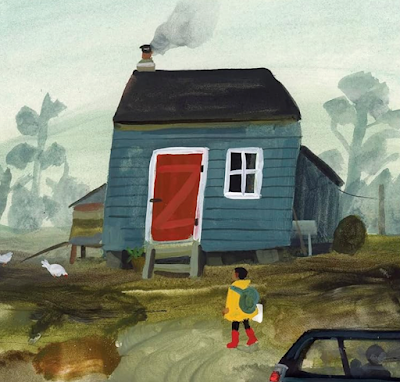
When writer Jordan Scott and artist Sydney Smith collaborated on their first picture book, I Talk Like a River (2020), a powerful storytelling partnership was created. In a subtle and nuanced story of a child who stuttered, Jordan Scott and Sydney Smith gave us a beautiful and unusual perspective. Much the same way, they take a grandmother (Baba)-grandson relationship with elements that some may see as peculiar and make them heartfelt and moving and fully synergistic.
From My Baba's Garden, written by Jordan Scott, illus. by Sydney Smith
Based on his own experiences with his Baba, his grandmother who emigrated from Poland after World War II, Jordan Scott speaks of a boy who was driven daily in the early morning to her renovated chicken coop home. There she feeds him, takes him to school, and then picks him up to babysit him. But it's more than babysitting. She is his Baba, a woman who speaks little English, suffered greatly during the war, and who shows him love with her food, her caring, and her teachings.
From My Baba's Garden, written by Jordan Scott, illus. by Sydney Smith
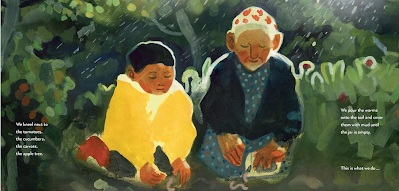
Her home is filled with food: preserves, dried, stored from the harvest, and cooking. Her wartime experiences compel her to ensure there is plenty for those she loves and to not waste anything. Even a drop of food that slips from his spoon is picked up, kissed, and returned to the bowl. And, when they walk in the West Coast rain, she gathers worms and places them in a jar of soil she keeps in her pocket. After school, she and her grandson deliver those worms to her garden.
From My Baba's Garden, written by Jordan Scott, illus. by Sydney Smith
Then his Baba must leave her home and move in with the child and his family. Things change, but the child has learned well.

I must admit that I cried with the telling of My Baba's Garden. I met my own Ukrainian Baba only once when she came for a visit, but I know the importance of food from my father who immigrated to Canada after the war. Food was significant to him, and he was determined to ensure that there was always enough and that those he loved, family and friends, never went hungry. His garden was extensive, and he grew tomatoes, garlic, onions, potatoes, carrots, beets, cucumbers (for pickling), and we visited friends' orchards and farms to ensure a wealth of preserves for the year. With her food, her garden, and her actions, this child's Baba showed love too. And she does so with little spoken language but great communication, teaching her grandson an appreciation for food that is grown, food that is offered, and a garden that provides. (Jordan Scott's note "My Baba" mentions that he and his children still pick up worms.) Their relationship is based on caring and compassion, and, whether at her chicken coop house or at his family's home, that relationship was solid. Jordan Scott's words are so emotive, as a child speaks of his grandmother, recognizing that she gives him everything and with few words.
There's so much to see, so much to smell, too much to eat.
That little boy and Jordan Scott honour their Babas.

Sydney Smith, award-winning illustrator of Sidewalk Flowers, Small in the City and Town by the Sea, consistently tells the story from a child's perspective. This boy sees his grandmother and appreciates what she does in a greater context, including one of love for him. He does not ridicule her for her life, her intentions, or her actions, understanding far more than many would. Sydney Smith shows us a child in a bright yellow rain slicker who brings her a picture he has drawn of them. He shows a Baba taking pleasure in that artwork, in that child: she strokes his cheek, she kisses his food, and she holds his hand as they walk. Sydney Smith makes sure that we see them. His watercolour and gouache illustrations take us into that garden and house, to sit with that child as he eats breakfast, to return worms to the soil, and to trudge through the rain to school. The art is filled with love and quiet understanding.

His Baba's garden and her home were places of love and learning. Under her watchful eye, this child learned to see and to feel beyond the obvious, and to appreciate love given through food and actions. Like his Baba's, Jordan Scott's words say much, even if limited, and with great heart, and Sydney Smith brings the colour, the context, and even more feeling to them. It was a pleasure to visit My Baba's Garden and partake in this repast of intergenerational tenderness.

October 04, 2019

Small in the City

Written and illustrated by Sydney Smith
Groundwood Books
978-1-77306-198-6
40 pp.
Ages 4-7
September 2019

On October 2, the Canada Council for the Arts announced its finalists for the 2019 Governor General's Literary Awards, and Small in the City was one of the nominated titles for the English-language children's book illustration. This is Sydney Smith's fourth nomination–he and JonArno Lawson won in 2015 for Sidewalk Flowers (Groundwood, 2015)–and this one is all the more distinct as Small in the City is his first picture book as author and illustrator.
From Small in the City by Sydney Smith
Though the cover makes a young child who looks out of a streetcar window larger than life, minimizing the buildings reflected in the glass, Sydney Smith's illustrations show a child peripheral to the city. They look out over the streets of people doing and buildings standing. When they leave the streetcar, they are dwarfed by everything in the busy city. People march past looking at their feet or their phones. Sounds of taxis and car horns and construction and sirens are loud and scary. It's almost too much.
From Small in the City by Sydney Smith
But as the child ventures through the cold streets and snowflakes begin to fall, they know how to be a part of that city. They know which alleys to avoid and wonderful places to hide or climb or enjoy the steam from a dryer vent. As they walk from the busyness into a neighbourhood of trees and yards, local stores and houses, and a park, this child gives advice about where safety can be found. Soon enough the reader will observe that the child has posted salmon-pink notices to posts and fences and doors. The child may be small in the city but a lost cat is even smaller. Still, with the flurries becoming snow squalls with near whiteout conditions, the child reaches home, convinced that "You will be all right."
From Small in the City by Sydney Smith
Sydney Smith's artwork, created with ink, watercolour and gouache, journeys with the child from a dark-toned city centre through neighbourhoods infused with colour to a home blanketed in the lightness of peace and contentment. It's a Toronto of commerce and community, movement and stability, and this child lives in it and of it. They may be small but they are not insignificant and as they walk closer and closer to home, their presence becomes more meaningful.

Being small in the city is a perspective most adults have forgotten. It's seeing the heart of the city as it is, free of interpretation and expectation but infused with perception. As such, Small in the City is a story of a child for children and most certainly for those who have ever lost a pet. This could have been a sad story of loss and fear but Sydney Smith makes it one of resilience and hope, expectation and common sense. It's seeing shelter and warmth, food and comfort where adults might only see trees and shrubs, a dryer vent, the fishmonger and a church ledge. It's perspective as perception that makes Small in the City effusive in community and family and takes the reader from the obscurity to the light of home with its happy ending.

September 24, 2018

Inkling

Written by Kenneth Oppel
Illustrated by Sydney Smith
HarperCollins
978-1-44345-028-1
256 pp.
Ages 8-12
September 2018

When  a splotch of ink pulls itself out of the sketchbook of graphic artist Mr. Rylance, only the cat Rickman sees it roaming and exploring until it hides itself within the drawing efforts of sixth grader Ethan. In fact, while the talented Mr. Rylance, known for his Kren graphic novels, struggles with writer's and artist's block undoubtedly stemming from the death of his spouse, his son is just struggling to contribute the artwork to a class project. (His peers are convinced he should be able to draw like his dad.) But after Ethan discovers the ink splotch which he calls Inkling is able to absorb the ink from books, newsprint and even photographs and complete incredible illustrations, he begins to use the inky entity to build on his own clumsy stick figure drawings and submit the artwork as his own.
From Inkling by Kenneth Oppel, illus. by Sydney Smith
While Inkling feeds on a variety of print which affects its voice and behaviour–violent comic books are the worst!–and draws Ethan's homework, the boy struggles to keep his secret advantage safe and undercover. But, like all good secrets, it is revealed, first to one friend and then to his father, before being discovered by Ethan's archenemy, the daughter of Dad's publisher.  Too soon, Ethan is scrambling to keep Inkling safe and stop those who wish to enslave it. 
From Inkling by Kenneth Oppel, illus. by Sydney Smith
What starts out as an imaginative creation story of a splotch of ink soon becomes a cautionary tale against finding an easy way out of work and taking advantage of those who might help you. And you'll be astonished when you feel like cheering for a blob of ink who expresses itself wildly in terms of whatever text it has most recently consumed, including L.M. Montgomery's Anne of Green Gables, Roald Dahl's The BFG and Hemingway's The Old Man and the Sea, and then feel angst for it when Inkling writes, in inky bold writing, that "I AM ALONESOME" (pg. 82). Kenneth Oppel has made us care for bats, a fostered chimp and now a blob of ink. Too soon the reader will see Inkling as a living thing, even before given a name, and I defy any science teacher to do a lesson on the characteristics of living things and not struggle with Inkling's classification. It's all in Kenneth Oppel's ability to give life through his words, invigorating Inkling with needs and wants and free will.

Though Inkling is not a picture book or a graphic novel, it is illustrated, here by Governor General award-winning artist Sydney Smith who takes Kenneth Oppel's story and sugars it with artwork that adds but doesn't explain. From chapter heading panels to ink splats small and large on every double-spread and the occasional expression of Inkling's work, Sydney Smith guides us to understanding the evolution of Inkling from static ink on a page to living being, absorbing, learning and feeling. Remember: Inkling is composed solely of ink.

I suspect teachers will be jumping on Inkling (please don't hurt him!) to use in class for everything from writing voice and setting to writing "What If?" stories as the basis for plot. But don't disregard Inkling's magic as a blob of ink restores life to a family disintegrating in grief and offers hope through the art of its dynamic efforts.

March 22, 2017

Town Is by the Sea

Written by Joanne Schwartz
Illustrated by Sydney Smith
Groundwood Books
978-1-55498-871-6
52 pp.
Ages 5-9
April 2017

A little longer than most picture books, Town Is by the Sea needs all those pages to envelop the daily life of a father and son, one above ground in the sunshine of a summer day and the other in the dark deeps of a coal mine.  It's a picture book about legacy, family, work and child's play.  Amazing that Joanne Schwartz and Sydney Smith managed all that in 52 pages.

Long before a little boy awakens to stand in his underwear at the window and gaze upon the sea, his father has breakfasted, grabbed his lunchbox and joined the multitudes of men making their way to work in the coal mines. The father's routine in the darkest dark is juxtaposed against the brightness and lightness of the young boy's day.  Working underground versus playing and running in the sun. Both close to the sea but different.  Though the boy's day is filled with different activities like swinging in the playground, enjoying his lunch, going to the store, visiting his grandfather's grave, and sitting by the sea, his father's day is the same throughout, sombrely depicted with one line, repeated with similar oppressive illustrations:
"And deep down under that sea, my father is digging for coal.
From Town Is by the Sea 
by Joanne Schwartz 
illus. by Sydney Smith
While it might appear that the end of the day has come when his father returns home safe and the family is drawn together for supper and a sit on the porch overlooking the sea, the young boy's day ends with thoughts of the two different types of days and his own inevitable future in the mines.

"In my town, that's the way it goes."

Town Is by the Sea is a powerful story in words and text of lives lived in a town based in coal mining. Both author Joanne Schwartz and illustrator Sydney Smith are Nova Scotia-born and the depth of their knowledge is evident in the weight of their contributions to the book.  Though Town Is by the Sea could be an oppressive story of a dangerous vocation and the formidable eventuality for the boy and his cohorts, Joanne Schwartz and Sydney Smith play up the lightness of childhood, giving a shine to the boy's movements, even in the visit to his grandfather's grave.  

  My grandfather used to say,
Bury me facing the sea b'y,
I worked long and hard
underground.

From Town Is by the Sea 
by Joanne Schwartz
 illus. by Sydney Smith
The antithesis of the two lives is reflected in the very sea that pervades their landscapes and their livelihoods.  It is both brilliant and overbearing, life giving and life sapping.  It can sparkle and shimmer or be frothy and tumultuous.  In her words, Joanne Schwartz gets it right.  In his artwork, Sydney Smith is definitive. His watercolour and ink illustrations, the very style that garnered Sidewalk Flowers (JonArno Lawson, Groundwood, 2015) numerous awards and had me effusive over The White Cat and the Monk (JoEllen Bogart, Groundwood, 2016), produces that contrast of light and dark, and easy and difficult, so apparently effortlessly that it's as if Sydney Smith was born to illustrate this very book.  

I'm so pleased that neither Joanne Schwartz, a Toronto librarian, and Sydney Smith, illustrator extraordinaire, were destined to lives beneath the sea digging coal.  Without them,  there would be no Town Is by the Sea and this story book is far too important to never have been shared with those who live by that sea and those who do not.
From Town Is by the Sea 
by Joanne Schwartz 
illus. by Sydney Smith

Town Is by the Sea: Book launch (Halifax, NS)

Halifax Public Libraries

and 

Groundwood Books

are partnering for the book launch 

of the first collaboration

between 


author Joanne Schwartz 


and 

illustrator Sydney Smith


Town Is by the Sea

on

Saturday, March 25, 2017

10 a.m. -12 p.m.

at

Halifax Public Library
Central Branch
Lindsay Children's Room
5440 Spring Garden Road 
Halifax, Nova Scotia Canada


From the website of the Halifax Public Libraries:

Families are invited to help launch the new picture book Town Is by the Sea with the author Joanne Schwartz and illustrator Sydney Smith. In this beautifully understated and haunting story, a piece of Canadian history is brought to life. A young boy wakes up to the sound of the sea, visits his grandfather's grave after lunch, and comes home to a simple family dinner with his family, but all the while his mind strays to his father digging for coal deep down under the sea. Stunning illustrations by Sydney Smith, the award-winning illustrator of Sidewalk Flowers, show the striking contrast between a sparkling seaside day and the darkness underground where the miners dig.

June 13, 2016

Look Out for the Fitzgerald-Trouts

by Esta Spalding
Illustrated by Sydney Smith
Tundra Books (Penguin Random House)
978-1-770498761
224 pp.
Ages 8-12
May 2016

Look Out for the Fitzgerald-Trouts because they’re here now and I’m sure they’re going to be around for a while (I’m already anticipating a follow-up book), even if they don’t have anyone really looking out for them.   The four Fitzgerald-Trout children-Kim, 11; Kimo, 11; Pippa, 8; and Toby, 5–are an odd assortment of children conceived through different combinations of fathers and mothers which include the wealthy and greedy Maya (mother to Kim and Pippa), the vain singer Tina (Kimo and Toby’s mother), the missing-at-sea Johnny Trout (father of Kimo) and mammalian research scientist Dr. Fitzgerald (father of Kim, Pippa and Toby).
They had different mothers and different fathers.  But they knew that didn’t matter.  They were a family because if you aren’t a family, you don’t live together in the same little car.  They knew they were brothers and sisters, even if when they made a new friend at school they had to take out a stick and draw in the dirt to explain just how they were related. (pg. 31)
And they all live in a small green car, which has gotten too small for them all to sleep in comfortably at night.  Kim, who wishes she lived in a house like the Perfects in her favourite book (a two-books-in-one The Perfects and The Awfuls),  keeps their little family on track with her to-do lists (which often includes "Find a House"), ensuring they go to school, do their laundry at Mr. Knuckles’ laundromat, and purchase food essentials and ice for their cooler from the loose coins Maya would give them or the money Tina dropped off for them.

When Maya is arrested for defrauding her investment clients, Kim almost finds them a home in Maya’s empty mansion, until it is seized to help repay investors.  Also thwarted is Kim's plan for them to hide away in the staged bedrooms of the massive furniture store MARRA.  It’s not until Kim decides that the Perfects whose lives are just too ideal are not the best of role models and that the Awfuls, who have endured and survived a variety of challenges, might be able to help guide them, that the Fitzgerald-Trouts find a home, far off the beaten path.

Look Out for the Fitzgerald-Trouts may read like a handbook of how NOT to parent your children but it’s a celebration of family, unconventional as it may be, and the drive to find a home and meet challenges with creativity and perseverance.  Esta Spalding has produced a set of widely-different characters who don’t always get along but at heart are everything to each other.  They are strong and weak, and childish and mature, and selfless and inconsiderate, and they are children who have adventures and suffer all manner of adversity and stick together. Middle-grade readers and proficient early readers will enjoy the journey on which Esta Spalding’s story takes them, all the more beguiling for its tropical island setting, its diverse and over-the-top characters and the ruts and potholes along the way.  And, though the illlustrations are rarely a subtantial component of any novel, Sydney Smith’s black-and-white line drawings help give substance to the Fitzgerald-Trouts and their story.  Look out for Look Out for the Fitzgerald-Trouts on reading lists everywhere very soon.

Kim from Look Out for the Fitzgerald-Trouts 
by Esta Spalding, illus. by Sydney Smith

January 21, 2016

The White Cat and the Monk: A Retelling of the Poem “Pangur Bán”

by JoEllen Bogart
Illustrated by Sydney Smith
Groundwood Books
978-1-55498-780-1
32 pp.
Ages 4-8
March, 2016


At its foundation, The White Cat and the Monk has all the elements of a contemplative read: quiet, books, companionship, and a cat.  But, bigger picture, The White Cat and the Monk is an essay in study and reflection in one’s work and the importance of mindfulness.  JoEllen Bogart has taken the essence of Pangur Bán, a ninth century Old Irish poem, to its humble message and, with Sydney Smith’s austere but inspired illustrations, produced a masterpiece.

The story of Pangur Bán is a simple one.  A white cat treds a familiar path at night to the room of a monk who studies his manuscript, replendent in colour, while Pangur, the cat, waits and watches for a mouse.  Their tasks are intense and focused yet strangely companionably intimate and respectful.  Each appreciates the other’s need for quiet and concentration while providing an anchor for that isolation.

JoEllen Bogart has provided a lovely interpretation of the importance of work and the efficacy of mindfulness, and Sydney Smith has demonstrated again why he has won mutiple awards for his illustrations in Sidewalk Flowers.  In The White Cat and the Monk, Sydney Smith has emphasized the simplicity in the lives of the cat and the monk with the coarse lines and neutral palette of greys, taupes, beiges, golds and blacks, with colour only appearing in the nose of Pangur, the cheeks of the monk, the pages of the manuscript he reads and the few plants and flowers.  Yet the tones of the illustrations, like the text, are not sombre, just modest, as are the tasks upon which the two characters are concentrating.  The White Cat and the Monk is a brilliant reinforcement in words and art of the magnitude of focusing on just that moment and just that one task for life to be complete.  
From The White Cat and the Monk
 by JoEllen Bogart and Sydney Smith

November 10, 2015

Groundwood Books' Book Party: November 21, 2015 (Toronto)

Groundwood Books 
is having a party!

Join authors and illustrators

Maureen Fergus and Carey Sookocheff


Monica Kulling and Sydney Smith


Deborah Hodge

and


Danielle Daniel


for an afternoon of activities and presentations for children ages 4-9

on Saturday, November 21, 2015

from 1 to 4 p.m.

at

the Koffler Center of the Arts
180 Shaw Street
Toronto, ON

In addition to the fun activities, 
Another Story Bookshop will have the books available for purchase.