Showing posts with label cities. Show all posts

March 27, 2023

I Love My City

Written by France Desmarais and Richard Adam
Illustrated by Yves Dumont
Translated by Nicholas Aumais
Pajama Press
978-1-77278-283-7
56 pp.
Ages 8-12
March 2023

From issues of transportation and land use, to balancing human needs with environmental stewardship and sustainability, urban studies are an important part of the school curricula from Grades 3 upwards. But focusing on cities in all their nuances, from their histories to their economies, politics, services, and cultures, is a tall order. Still, France Desmarais gives us that big picture because of Richard Adam's background in urban studies, architecture, and public administration. And so, the story of cities is told.
From I Love My City by France Desmarais and Richard Adam, illus. by Yves Dumont
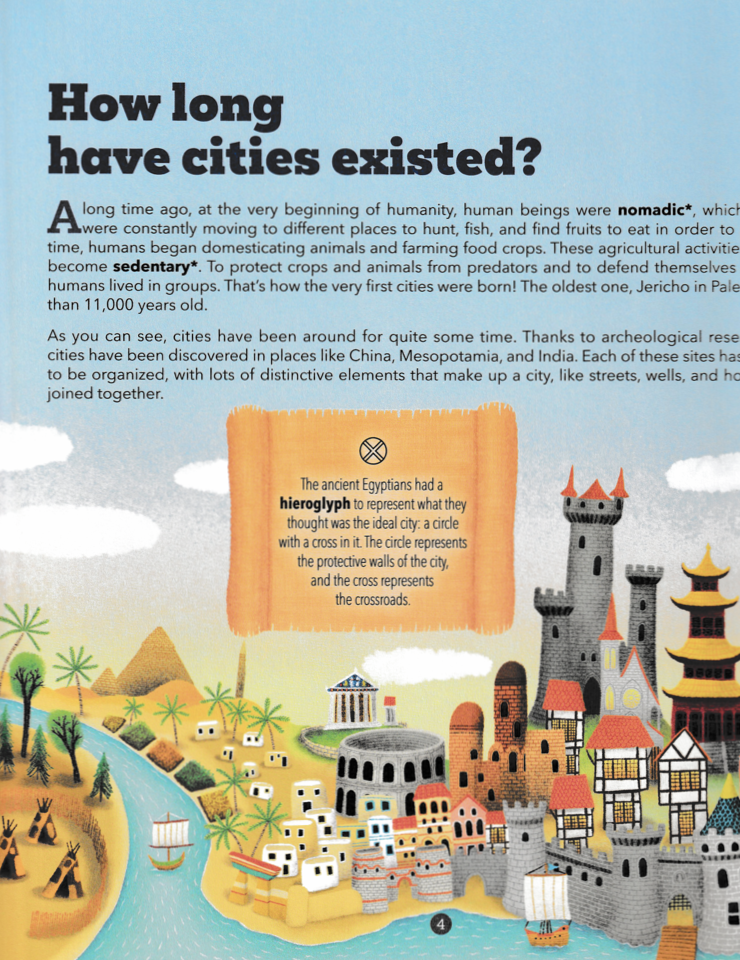
In a well-organized and comprehensive story, France Desmarais and Richard Adam explain how and where cities were first established. They cover the different types of cities across the globe, from favelas to megacities. They also look within those cities for those who manage cities, from City Halls to urban planners and all the services needed to ensure functioning hubs. Water filtration, wastewater systems, renewable and non-renewable sources of energy, and transportation are all covered in some depth but never so expansive that the reader will bore or get lost. Beyond the information, which usefully includes bolded words for emphasis, including demonym, funicular and hydroelectricity, there are anecdotes from around the world to add interest and demonstrate relevance. From the Zabbaleen of Cairo and the invention of the traffic lights and the underground reservoirs of Montreal, young readers will visit cities of the world and look deep into their infrastructures and their efforts to balance populations with environment.
From I Love My City by France Desmarais and Richard Adam, illus. by Yves Dumont
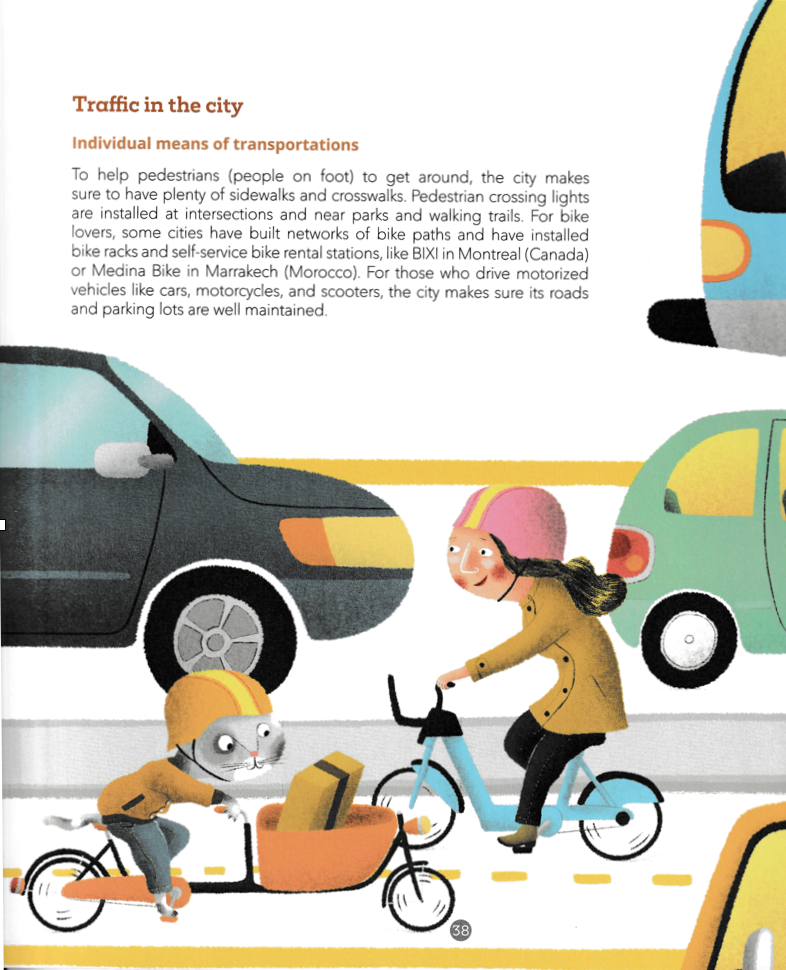
Beyond the content, though, are Yves Dumont's illustrations that show the breadth of cities through time and space. Whether it's the plans of cities to integrate all housing, transport and services, or stylized depictions of power plants, or busy couriers on bikes and commuters on public transport, Montreal's Yves Dumont brings cities to life. He gives them colour and motion, purpose and serenity. He makes them everything to everyone, just as are the cities which have evolved in our world.
From I Love My City by France Desmarais and Richard Adam, illus. by Yves Dumont
Teachers don't need to wait until World Cities Day (October 31) to use I Love My City in their classrooms. With discussions from history and civics, architecture and energy, I Love My City will be a useful teaching tool and readable book of non-fiction for young readers every day of the year.

September 29, 2021

My City Speaks

Written by Darren Lebeuf
Illustrated by Ashley Barron
Kids Can Press
978-1-5253-0414-9
32 pp.
Ages 3-7
September 2021

When a young girl and her father head to her outdoor violin recital, the city becomes their companion, sensory-rich and amazingly diverse in its scope. This visually-impaired child, as evidenced by her white cane, listens as her city speaks and she hears, as well as smells and tastes and feels. Her city is alive.
From My City Speaks by Darren Lebeuf, illus. by Ashley Barron

As she and her father walk to the park, she "sees" everything but her seeing is with all her senses except her eyes. The reader will see the neighbour pruning his shrubs and the lady walking her terrier and her father locking the door but the child will know them in her own way. We see them reach the tactile paving at the busy intersection while she hears the city moving.
It rushes and stops and waits and goes.
From dropping a letter off in the post box to watering plants in the raised garden beds near a construction site, the child hears the city growing in different ways. But the city is really a spectacle of contrasts: busy and relaxed, playful and working. And she hears it all.
From My City Speaks by Darren Lebeuf, illus. by Ashley Barron

After stops at a playground, ice-cream shop and grocer's, filled with their own sensory experiences, the weather changes.
It pitters and patters and drips and drains.
From My City Speaks by Darren Lebeuf, illus. by Ashley Barron
Finally after a subway ride, alive with "whispers and giggles and sometimes meows," the girl and her father reach the outdoor venue where she and other children are to perform. Then, her city not only speaks, it listens.

Vancouver's Darren Lebeuf may take us to his neighbourhood–though maybe not–to experience it through the senses of a child whose eyesight is impaired but this could be any city. There are roads and parks, stores and playgrounds. There are quiet areas and busy ones, and the girl notices everything around her. By choosing to make his character less dependent on her eyesight, the sense that most of us rely on as we navigate our neighbourhoods, Darren Lebeuf helps us hear and occasionally smell and taste, reminding us of everything we undoubtedly miss when we use only our eyes. Moreover by giving a rhythm to his words, like the "hasty honks, impatient beeps, distant chimes, reliable rumbles, speedy sirens and urgent clangs," Darren Lebeuf has found the city's heartbeats, those that come from its people, its infrastructure, and more.

But while Darren Lebeuf's character cannot rely on her eyesight, readers will get the full visual experience from Ashley Barron's cut-paper collages of the most vibrant colours and the most intricate details. There's a hot pink Vespa, a raccoon peeking out from a trash container, and the family's cats playing with a toy mouse. On the subway, the child may not see the hijab-wearing woman sharing earbuds with a wheelchair-bound young man or the pink-haired person beside another with pencil-skewered hair, but we do. And so the child's amazing sense of what is going on around her is all the more impressive. 
 
Darren Lebeuf and Ashley Barron's My City Speaks certainly speaks to an awareness for one's environment but it also celebrates the richness of an urban landscape in stimulating all our senses and the importance of being ever present in its distinct quality.

September 29, 2020

Night Walk

Written by Sara O'Leary
Illustrated by Ellie Arscott 
Groundwood Books
978-1-55498-796-2
32 pp.
Ages 3-7
September 2020


I think a lot of us have sleepless nights, nights during which we are "owl-eyed" and our heads churn. When this little girl can't sleep, her dad offers her a solution in a Night Walk.
 
From Night Walk by Sara O'Leary, illus. by Ellie Arscott
So pulling on boots, hat and coat over her pajamas, the child joins her father in a walk "just to be out." As might be expected, everything looks different at night, as they walk "from one island of light to the next like explorers," peeking into the lit windows of people's late-night lives. There's the variety store's sad-looking woman joyously welcoming a baby in her apartment above. There are people at restaurants or eating at home. Others are walking dogs or cycling or traveling by bus. One man plays his violin to his pets on his deck decorated with fairy lights.  Everywhere there is life and colour, sound and quiet.
 
From Night Walk by Sara O'Leary, illus. by Ellie Arscott

A final stop on their Night Walk takes the child and her father to the playground where she recognizes that this community of people and places, which she usually only experiences in the daylight hours, is her home and where she wants to be.

From Night Walk by Sara O'Leary, illus. by Ellie Arscott 

Sara O'Leary loves to give us a child's perspective on the ordinary which becomes extraordinary through their eyes and she has done the same with Night Walk. By seeing her community, one she passes through regularly during the day, at a different time and lit from outside by the moon and streetlights and from within by lamps, the child sees differently and is amazed. It's this wonder that Sara O'Leary, whose previous works include A Family is a Family is a Family and When I Was Small, captures in the depth and simplicity of the child's words and thoughts. They are told from her perspective and with her voice, and the fascination with this new world is unmistakable.
From Night Walk by Sara O'Leary, illus. by Ellie Arscott

This is Toronto artist Ellie Arscott's first picture book but she matches the marvel of the child's experience with illustrations that reflect the sweeping landscape of the neighbourhood. In her watercolour and ink artwork, Ellie Arscott takes the homes and businesses and people in the community from the backdrop into the all-around i.e., foreground, middle ground and background. The reader will still always be able to pick out the child in her bright red vest but Ellie Arscott makes us feel like we are seeing the world from the young girl's point of view and it is this world that is the star of Night Walk.

I hope that there will always be someone to guide a young child on a Night Walk of discovery, safe in their community and open to all the lights that shine.

October 04, 2019

Small in the City

Written and illustrated by Sydney Smith
Groundwood Books
978-1-77306-198-6
40 pp.
Ages 4-7
September 2019

On October 2, the Canada Council for the Arts announced its finalists for the 2019 Governor General's Literary Awards, and Small in the City was one of the nominated titles for the English-language children's book illustration. This is Sydney Smith's fourth nomination–he and JonArno Lawson won in 2015 for Sidewalk Flowers (Groundwood, 2015)–and this one is all the more distinct as Small in the City is his first picture book as author and illustrator.
From Small in the City by Sydney Smith
Though the cover makes a young child who looks out of a streetcar window larger than life, minimizing the buildings reflected in the glass, Sydney Smith's illustrations show a child peripheral to the city. They look out over the streets of people doing and buildings standing. When they leave the streetcar, they are dwarfed by everything in the busy city. People march past looking at their feet or their phones. Sounds of taxis and car horns and construction and sirens are loud and scary. It's almost too much.
From Small in the City by Sydney Smith
But as the child ventures through the cold streets and snowflakes begin to fall, they know how to be a part of that city. They know which alleys to avoid and wonderful places to hide or climb or enjoy the steam from a dryer vent. As they walk from the busyness into a neighbourhood of trees and yards, local stores and houses, and a park, this child gives advice about where safety can be found. Soon enough the reader will observe that the child has posted salmon-pink notices to posts and fences and doors. The child may be small in the city but a lost cat is even smaller. Still, with the flurries becoming snow squalls with near whiteout conditions, the child reaches home, convinced that "You will be all right."
From Small in the City by Sydney Smith
Sydney Smith's artwork, created with ink, watercolour and gouache, journeys with the child from a dark-toned city centre through neighbourhoods infused with colour to a home blanketed in the lightness of peace and contentment. It's a Toronto of commerce and community, movement and stability, and this child lives in it and of it. They may be small but they are not insignificant and as they walk closer and closer to home, their presence becomes more meaningful.

Being small in the city is a perspective most adults have forgotten. It's seeing the heart of the city as it is, free of interpretation and expectation but infused with perception. As such, Small in the City is a story of a child for children and most certainly for those who have ever lost a pet. This could have been a sad story of loss and fear but Sydney Smith makes it one of resilience and hope, expectation and common sense. It's seeing shelter and warmth, food and comfort where adults might only see trees and shrubs, a dryer vent, the fishmonger and a church ledge. It's perspective as perception that makes Small in the City effusive in community and family and takes the reader from the obscurity to the light of home with its happy ending.

July 17, 2019

Me, Toma and the Concrete Garden

Written by Andrew Larsen
Illustrated by Anne Villeneuve
Kids Can Press
978-1-77138-917-4
32 pp.
Ages 3-7
May 2019

There will be many kids whose summer vacation will include hanging out with relatives, away from home. But if that away-from-home holiday is also based in the wide-openness of unstructured time without benefit of anchors such as immediate family and friends, it may seem insurmountable or boring. Still, sometimes it's necessary to take a chance on beginning something new for growth to happen.
From Me, Toma and the Concrete Garden by Andrew Larsen, illus. by Anne Villeneuve
Vincent has been sent to stay with his Aunt Mimi for the summer while his mother recuperates from an operation. A box of dirt balls from a secret admirer–"Are you sure this secret person even likes you?" I say. "They gave you a box of dirt!"–adds to the grayness of Vincent's new surroundings until he makes the acquaintance of Toma. As an icebreaker, Vincent brings down some of the dirt balls and suggests they throw them over the tall brick wall into the empty lot. An elderly man whom Toma calls Mr. Grumpypants  is watchful of their distraction.
From Me, Toma and the Concrete Garden by Andrew Larsen, illus. by Anne Villeneuve
What begins as a tiresome holiday becomes a summer with a new friend, playing ball, reading comics, visiting the ice cream truck and more when Mr. Grumpypants points out to the boys, balcony to balcony, that the empty lot is starting to green. In fact, Mr. Grumpypants whose name is Marco is a kindly gardener who helps the boys water the garden through the fence and teaches them about the flowers that had been sheltered in the dirt balls.

But when Vincent's mother feels well enough to have him home, he's saddened to leave everyone and the garden behind. Thankfully there's much to occupy a child before their next summer holiday and it will be a wonderful surprise when Vincent and Toma are reunited again and extend their gardening into something even more special.
From Me, Toma and the Concrete Garden by Andrew Larsen, illus. by Anne Villeneuve
Like his earlier picture book, See You Next Year (Owlkids, 2015), Andrew Larsen gets into the head of children on summer holidays. In Me, Toma and the Concrete Garden, Andrew Larsen emphasizes the turnaround from the gloomy unknown of new place to a brightness that comes from belonging. That goes for both Vincent and the apparently worthless dirt balls. It is the unknown that makes for the dullness. But, with time and a little nurturing, the new friendship and the piles of dirt blossom into something invaluable.

Though I know that Anne Villeneuve, author-illustrator of Loula is Leaving for Africa (Kids Can Press, 2013) and other books, typically uses ink and watercolour, it seems highly appropriate to use those two media in a picture book in which colourful blooms sprout from soil balls. By emphasizing the black ink in her opening illustrations with only celadon and rose to relieve the gloom, Anne Villeneuve hints at the coming of verdant green and colourful florals. Moreover, with her wonderful assortment of people and animals, from a toddler with his mother to other children, middle-aged persons and the elderly Marco, Anne Villeneuve brings life to a community in which children and flowers can grow.

Many may dismiss unstructured summers in urban settings as flat and uninspired for children but Me, Toma and the Concrete Garden makes it clear that sometimes the incredible can sprout from very little.

July 24, 2018

Walking in the City with Jane: A Story of Jane Jacobs

Written by Susan Hughes
Illustrated by Valérie Boivin
Kids Can Press
978-1-77138-653-1
36 pp.
Ages 6-9
April 2018


Jane Jacobs is an icon of urban activism both in her birth country of the United States and her adopted home of Canada. In both places, her support of cities as communities for the people pitted her against traditional urban planners and developers but won her the support of her neighbours near and far.

Susan Hughes, author of numerous fiction (e.g., What Happens Next, The Four Seasons of Patrick, Virginia) and non-fiction (e.g., Off to Class, Case Closed?, Coming to Canada) books for young readers, takes Jane's story from humble but passionate beginnings–an anecdote about Jane being sent home from school when she wouldn't promise to brush her teeth everyday and trying to incite her classmates to follow is especially telling–to a move to New York City where she saw her city through "eyes on the street" and recognizing life in the city as a "ballet of the sidewalk."
From Walking in the City with Jane by Susan Hughes, illus. by Valérie Boivin
She knew that animals, plants, river, sunshine and rain all worked together as part of a healthy ecosystem. "But a city is also an ecosystem," she realized. "It is made of different parts – sidewalks, parks, stores, neighborhoods, City Hall ... and people, of course. When they all work together, the city is healthy. (pg. 14)
After her marriage to architect Bob Jacobs, Jane continued to work as a journalist. She used her writing to criticize city planning that supported businesses and transportation and thought seldom of the people upon which communities were built. She initiated protests that stopped the razing of her own neighbourhood for construction of a highway. It took years of protests and activism, including an arrest for interrupting a city meeting, before Jane and her fellow activists were able to stop the development of the expressway and even save a local park from traffic.  Her family's move to Toronto did not suppress her love of cities or the need to advocate for neighbourhoods.
She inspired communities to take a stand for their neighborhoods. She also encouraged everyone living in cities to look around them while they walked and to listen, linger and think about what they saw. (pg. 34)
From Walking in the City with Jane by Susan Hughes, illus. by Valérie Boivin
By highlighting key events in Jane Jacobs's life–school, the move to New York City, marriage and family, the protests against Robert Moses's plans for development, the move to Canada and continued advocacy for cities for people–Susan Hughes distills Jane's story to one of action. Of course, there is much more to her long-life story (she was 89 when she passed) but these milestones shaped the trajectory of her influence about the way we think about cities.
Illustration by Valérie Boivin used in Walking in the City with Jane by Susan Hughes retrieved from https://valerieboivin.carbonmade.com/projects/6410126
Quebec artist Valérie Boivin, already well-known for illustrating French-language books including 752 lapins, Le livre où la poule meurt à la fin, as well as her own Un après-midi chez Jules, brings structure and dynamics to Jane Jacobs's story. Just like the cities Jane Jacobs supported with her action, Valérie Boivin blends work and play and landmarks with conventional buildings to create landscapes that are familiar and still noteworthy.

Walking in the City with Jane honours Jane Jacobs's urban activism and reminds us to be functional players on the stages of our cities, not merely bit players with walk-on roles, and the best way to do that is to open our eyes and engage.

January 29, 2018

The Way Downtown: Adventures in Public Transit

Written by Inna Gertsberg
Illustrated by Mike Lowery
Kids Can Press
978-1-77138-552-7
44 pp.
Ages 4-8
2017

I've waited too long to review this gem of a non-fiction book that can be used to teach transportation, mapping, communities and so much more.  With the stories and art blending together into a fascinating depiction of travel on water and land within the city of Zoom, The Way Downtown includes everyone and their need to get around safely and efficiently.
From The Way Downtown: Adventures in Public Transit
by Inna Gertsberg 
illus. by Mike Lowery
(image from mikelowery.com)
Dr. Brodie is our first traveller, making her way from her island home by ferry and then cycling to the museum where she works.  In addition to learning about ferries and water transport, the reader learns about cycling and bike sharing.  Young Robbie is visiting his Aunt Raisa and he travels with her by bus and subway, all the while taking photographs of the urban wildlife.  Agent Theodore Rybka is on a mission to deliver an important package.  He takes multiple train and subway rides to remain incognito and confuse would-be followers of the spy. The busking Zanies family are heading to Great Park, like all our travellers, to perform.  Though public transit aficionados, using monthly transit passes, they lose Zach along the way and learn the efficiency of relocating separated parties. Finally, Boris, the guide dog, takes his visually impaired partner Guy via sidewalk and light rail train to meet their friend Leslie.
From The Way Downtown: Adventures in Public Transit 
by Inna Gertsberg
illus. by Mike Lowery

These are but 5 stories out of a billion taking place because of public transit in the city of Zoom but they give a snapshot of how different people live their lives and get around, whether visiting, working, or playing.  Readers will learn about all manner of public transit: how to use it, what to expect, paying for it, etiquette, and more.  From Lost & Founds, to repairs that take place, as well as guide dogs, The Way Downtown is an informative and entertaining read about getting around in the city. It's a fun look at the everyday concept of travel by public transit (none of the stories have travellers in cars) to see the benefits and intricacies of urban movement from place to place. Though I might see Toronto, my hometown and the residence of author Inna Gertsberg, in the city of Zoom, I suspect that Zoom could be any and every city with multiple public transit provisions, a great park and other urban features likes hospitals, a zoo, museum and observatory.
From The Way Downtown: Adventures in Public Transit
by Inna Gertsberg 
illus. by Mike Lowery 
(image from mikelowery.com)
Mike Lowery, who illustrated Maureen Fergus's award-winning The Day My Mom Came to Kindergarten (Kids Can Press, 2013) and Andrew Larsen's A Squiggly Story (Kids Can Press, 2016), gets in the busyness and complexity of an urban centre like Zoom which keeps all its people moving via many modes of public transit.  There's lots to notice and details to pick out and Mike Lowery makes The Way Downtown an urban Where's Waldo? of movement and stories being lived.  The organization of the book which resembles a graphic novel with information embedded in maps, graphic organizers and more is both inviting and comprehensive, as well as engaging.
From The Way Downtown: Adventures in Public Transit
by Inna Gertsberg 
illus. by Mike Lowery
Take a worthwhile foray into public transit, whether in a classroom with young students learning about transportation and communities (the glossary provided is worthwhile) or with your own children before a trip or to see themselves in and about their own neighbourhoods, by getting on board The Way Downtown: Adventures in Public Transit.

March 14, 2016

Tokyo Digs a Garden

by Jon-Erik Lappano
Illustrated by Kellen Hatanaka
Groundwood Books
978-1-55498-798-6
32 pp.
Ages 3-7
March 2016

Imagine a small house that was once part of a countryside lush with forests and meadows and wildlife now dwarfed by skyscrapers and hidden among the overdeveloped city buildings and billboards.  This is the house of Tokyo and his parents and his grandfather, the original owner of the country home, and Kevin the cat.

When an elderly woman on a bicycle hands Tokyo three seeds, telling him “…they will grow into whatever you wish”, the boy removes a brick from their yard and plants them in the soil beneath. The next day, there are three small wildflowers. After breakfast, there is moss covering the bricks.  By dinner, there are trees and shrubs and more wildflowers. And by the next day, “the garden had grown up and over the buldings, across the streets, dwon the road, over the cars and into the expressway.” With time, the city is made over into a wild entity of rivers and forests and wildlife and the people adapt to these changes because “Gardens have to grow somewhere, after all.

From Tokyo Digs a Garden
by Jon-Erik Lappano, illus. by Kellen Hatanaka
The message is clear.  Mother Nature will not be stopped and, no matter how much humans develop the land into unrecognizable entities, it will grow and become what it should.  Tokyo and his grandfather’s honest acceptance of this phenomenon is both educational and calming.  Jon-Erik Lappano gets the tone just right, never preachy, always intuitive, and even playful. (Kevin’s love of ice cream is quite clear.)  And Kellen Hatanaka, whose artwork first decorated Work: An Occupational ABC (Groundwood, 2014), dignifies that tone with his astute and beautiful illustrations.  Think of a Henri Rousseau jungle but with an art deco flair and you’ll get an idea of the lushness of Kellen Hatanaka’s garden in Tokyo Digs a Garden.  More brilliant in colour and stronger in line, the artwork carries the story from message to revelation.

Tokyo Digs a Garden plants the seeds for discussion of nature and land development and sows the dramatic beauty of transformation.

From Tokyo Digs a Garden by
Jon-Erik Lappano, illus. by Kellen Hatanaka