Showing posts with label creative non-fiction. Show all posts

June 11, 2026

Gander: The Town That Welcomed the World

Book cover of Gander: The Town That Welcomed the World shows a child looking out over the water at colourful boathouses and docks
Written by Nikki Bergstresser 
Illustrated by Reilly Fitzgerald 
Plumleaf Press 
978-1-997872047
36 pp.
Ages 9–9
Releases June 30, 2026 
 
Explaining to children the terrorism of 9/11 is a big ask. But by focusing on the kindness of a community instead of wicked intentions, the message is one of positivity and not hatred. Gander did welcome the world and Gander: The Town That Welcomed the World tells that story. 
People disembark from a plane in Gander, Newfoundland
From Gander: The Town That Welcomed the World, written by Nikki Bergstresser, illustrated by Reilly Fitzgerald
What Nikki Bergstresser does is take the story of those stranded in Gander on September 11, 2001 down to the level of the people. Readers won't read about the events that prompted these extraordinary landings but rather see what they see and what they feel, only getting a vague picture of something big happening elsewhere.
The skies grew silent. Air travel around the world
came to a sudden stop. (pg. 5)
Who did know about what was happening were those in Gander who, seeing the news, jumped into action. They gathered supplies like bedding and towels, and toys for the children, and brought the passengers, who'd waited on their planes for upwards of 24 hours, to churches, schools, community halls, and home. They fed them, helped them make phone calls, comforted them, and showed them the heart of Gander.
Map shown to visitors of where Gander, Newfoundland is located
From Gander: The Town That Welcomed the World, written by Nikki Bergstresser, illustrated by Reilly Fitzgerald
Though those who found safety in Gander are not named—more than 6,000 people on 38 planes arrived—there is one little girl with long dark braids who is often seen: listless on a plane, resting on a cot, or exploring the land and waters of Gander with her hosts. Nikki Bergstresser and Reilly Fitzgerald help personalize these experiences without making anyone a main character. After all, it's Gander that's the star.
Illustration shows shows 9/11 guests welcomed into homes ad helped with making phone calls
From Gander: The Town That Welcomed the World, written by Nikki Bergstresser, illustrated by Reilly Fitzgerald
When Gander's guests finally get to continue their journeys six days after the first plane landed there, there's a rainbow casting the glow of good will. 
 
Many young children, particularly in Canada, may not be aware of the events of 9/11. Unless they were directly impacted by a relative who was there or by perhaps a parent who was pilot or a resident of Gander, most adults will not discuss the events of the day with them. But there is a way to speak to them about it with sensitivity, and Nikki Bergstresser's Gander: The Town That Welcomed the World would be a tasteful and enlightening way to do so. BC's Nikki Bergstresser packs a lot of depth in her words, conveying easily the exceptionality of this day with the natural response of these Ganderites and Newfoundlanders in general. Her words take us through those days by balancing the fears and confusion with action and kindness.  
Illustration by Reilly Fitzgerald shows plane leaving Gander with rainbow behind it
From Gander: The Town That Welcomed the World, written by Nikki Bergstresser, illustrated by Reilly Fitzgerald
Reilly Fitzgerald's artwork relies on the authentic, much like the response of the community of Gander. Reminiscent of the artwork of Ted Harrison, Newfoundland's Reilly Fitzgerald uses acrylics to create bold illustrations, with elements heavily outlined in white or black. The impact is extraordinary in its confidence. He gives us scenes of people arriving, confused and frightened, and of people joyous in their heartwarming drive to help. And he gives us a Newfoundland that is expansive and welcoming.
 
Nikki Bergstresser and Reilly Fitzgerald have brought young readers a non-musical and more colourful version of "Come From Away." The complexity of emotions, from fear and confusion to compassion and determination, are all there, and tell the story of Gander stepping up to help those waylaid by the events of September 11. Whether used as a jumping off point for teaching a historical event or for character education, Gander: The Town That Welcomed the World will be a notable story for its retelling of a remarkable act of humanity.

August 21, 2023

Burt the Beetle Lives Here!

Written and illustrated by Ashley Spires
Kids Can Press
978-1-5256-1011-9
64 pp.
Ages 5-8
June 2023

Author-illustrator Ashley Spires introduced her readers to Burt the ten-lined June beetle (also known as a watermelon beetle) in Burt the Beetle Doesn't Bite! (Kids Can Press, 2021) and charmed us with his story as well as educating us on the natural habits of a variety of other insects. This time, Ashley Spires takes us into insect real estate to look at the nests and habitats of Burt and his insect friends as they seek shelter for short stints and longer periods.
From Burt the Beetle Lives Here! by Ashley Spires
Burt likes to spend short periods of time "snug as a bug" under a leaf. But when he realizes that it would be nice to have a place to call home, he looks at the homes of other insects. He considers the chrysalis of the monarch butterfly, the foam of the spittlebugs, and the silk web nests of tent caterpillars, but each doesn't work for him. So, he considers what materials he might use to build his own, taking his cues from wasps, bees, and weaver ants. Again, none work for him. 

Though he's ready to give up on finding a home within sight of his beloved porch light, Burt realizes soon enough that he needs shelter from weather and predators, and finds that protection, and even camaraderie, in a most familiar location. 
From Burt the Beetle Lives Here! by Ashley Spires
Kids love learning about science and living things, but it must be taught in a way that entertains through the inquiry process. As in all her Burt books, Ashley Spires has given young students, and their teachers, an easy source of relevant scientific information, here about insects and their habitats using Burt as an insightful guide. Through his very small eyes, readers are shown a bug's-eye view of a variety of different insect nests, with explanations for how the animals live in them or create them. And with her trademark humour, Ashley Spires will make kids chuckle at Burt's antics, as the adults in their lives will laugh at the analogies to human home-buying with places with stunning views, lots of potential, open floor plans and advertised as architectural masterpieces and those that are perfect for entertaining or impeccably renovated.
From Burt the Beetle Lives Here! by Ashley Spires
Ashley Spires, creator of Binky the Space Cat, consistently uses a clean illustrative style that is digitally rendered, never cluttering her illustrations with superfluous details that, while accurate, may detract from the key information about where the insects live and why. Because of the organic nature of the story, Ashley Spires's palette is primarily one of greens and browns, but she gives us enough shades and tints and tones to make it appear rich and varied, much like nature itself.

Whether you're a teacher of younger students who need to understand local habitats or how communities create nests, or you're a school librarian who loves providing quality creative non-fiction for the many children who prefer non-fiction or fiction, or a reader to appreciates fabulously illustrated books with a side helping of humour, Burt the Beetle Lives Here! has got you covered, perhaps even better than Burt's leaf!
 
🐛 🐞 🐜 🐝 🐛 🐞 🐜 🐝 🐛
 
Burt the Beetle Lives Here! (2023)

June 07, 2023

The Halifax Explosion: 6 December 1917, at 9:05 in the Morning

Written by Afua Cooper
Design and illustration by Rebecca Bender 
Plumleaf Press
978-1-7782428-0-9
36 pp.
All ages
For release August 2023
 
On December 6, 1917, two ships collided in Halifax Harbour. The Mont-Blanc was carrying munitions, and the Imo was carrying war supplies. When the two collided, the devastation was extraordinary. Almost 2000 individuals lost their lives, with approximately 9000 injured, and whole communities disappeared. Buildings collapsed, fires erupted, and a tsunami was created. Certain stories from the explosion are memorialized, like Vince Coleman's telegraph message that saved 300 train passengers from certain death. But there are so many stories, and the ones of African Nova Scotians who lived or died in the explosion need to be recognized. So, Dr. Afua Cooper has done just this in her free verse poem.
From The Halifax Explosion: 6 December 1917, at 9:05 in the Morning by Afua Cooper, design and illustration by Rebecca Bender
Her poem begins with naming the two ships and their purposes for being in Halifax Harbour. The text is differentiated with different coloured fonts, bolding of certain words and enlarged text for emphasis. Dr. Afua Cooper's words don't just tell, they emote. The explosion as a result of the collision in monumental.
The sound of
          terror
   The sound of death
Armageddon
The angel blowing the trumpet of destruction (pg. 10-11)
Its destruction is palpable in her words. 
And the City of Halifax gave one long
                           piercing scream
into the bowels of the Earth
           And the Earth moved furiously
                        Belched and vomited
                                         flames (pg. 12)
But then she speaks of the people, and specifically the Black people of Halifax. Some got to work like Clement Ligoure, a Black doctor from Trinidad, though his efforts were not dignified with the support he required. Some were lost and never returned, like Edward Hickey, a dock worker, and little Aldora Andrews. Some survived but with devastating injuries. And many others lived but had everything they'd worked their lives for taken away. Yet, they had greater fights ahead because "Old Jim Crow raised his nasty head". (pg. 19)
From The Halifax Explosion: 6 December 1917, at 9:05 in the Morning by Afua Cooper, design and illustration by Rebecca Bender
The Halifax Explosion was a tragedy. And it was all the more crushing for the racism African Nova Scotians were still subjected to in its aftermath. With The Halifax Explosion: 6 December 1917, at 9:05 in the Morning, Halifax's seventh poet laureate, Dr. Afua Cooper, goes beyond the event and instead goes with the people. She does give the basic facts, including in the "Historical Note" at the end, but her poem does more than just recount the tragedy. With powerful and weighty words, she makes us see and feel for the disaster and how African Nova Scotians were impacted. Her words come from a place beyond the archives. Unlike most picture books in which the illustrations carry much of a story's weight, The Halifax Explosion rests squarely on Dr. Afua Cooper's words. (The poem in its entirety is posted at the conclusion of the book.) Perhaps that's why there is much austerity in the cover and the artwork. The impact of the devastation is well-documented, and key photographs were used to support the details. However, by blending historical photographs with only occasional illustrations by Rebecca Bender, the book goes beyond the reality and extends to the humanity, even if that benevolence was sadly lacking towards African Nova Scotians at the time.
 
There is power in Dr. Afua Cooper's poem of African Nova Scotians whose stories are little known and perhaps less remembered. However, remembered they should be. There are those whose legacies are solid in Canadian history beyond the Halifax explosion, such as Viola Desmond and Dr. Clement Ligoure, but then there are those whose deaths are perhaps not even recorded, or their injuries and losses disavowed. Dr. Afua Cooper tells us their names and about their families. She acknowledges them. The last words of her poem are "Does Halifax remember?" With her poem, they are less lost and truly commemorated.
From The Halifax Explosion: 6 December 1917, at 9:05 in the Morning by Afua Cooper, design and illustration by Rebecca Bender

June 23, 2020

An Owl at Sea: Guest review

Today's review was written by teacher Elizabeth Cook.

Written by Susan Vande Griek
Illustrated by Ian Wallace
Groundwood Books
978-1-77306-111-5
32 pp.
Ages 6-10
May 2019

This beautiful picture book was written by Susan Vande Griek after she read a news article about a Short-eared Owl that somehow flew to an oil rig many kilometres out in the ocean off Scotland.  An Owl At Sea starts with an owl resting on a fence post in a field looking to see if it can find a mouse to eat.
From An Owl at Sea by Susan Vande Griek, illus. by Ian Wallace
It doesn’t explain why or how the owl got so far from this field when we see it navigating the sky above the ocean next.  However, the story of its journey to that oil rig, and then home, is captivating to read.

I am always drawn into books written in verse.  For me, it makes the story all the more magical.  An Owl At Sea by Susan Vande Griek is written in verse and I was instantly struck by the power of a simple description of the owl written in verse. 
Chunky legs,
tired wings
drop,
fold,
talons searching
for something to hold.
These words helped me feel the exhaustion of the owl, desperate for a place to rest after finding itself so far from its field back home. Susan Vande Griek weaves words so beautifully that the scene unfolds before your own eyes.

From An Owl at Sea by Susan Vande Griek, illus. by Ian Wallace
The words alone create wonderful images for the reader; however, that shouldn’t take away from the stunning artwork by Ian Wallace. His watercolour artwork brings the scene alive. I especially loved his images of the owl on its harrowing journey above the crashing waves and in the misty weather. It is almost as if you can feel the salty spray on your face as you cross your fingers tight, hoping for a safe landing for the owl.

From An Owl at Sea by Susan Vande Griek, illus. by Ian Wallace
An Owl At Sea is a great story to read about the determination of animals.  In the classroom, it would be an interesting book to read in combination with a non-fiction book on owls to compare how extraordinary a feat this journey was for the Short-eared Owl.  It could inspire more research on astounding animal accomplishments and their stories.  This book also illustrated the kindness of the humans that all helped this feathered creature return to its grassy field.  Perhaps, it will inspire children to find ways to help out animals in their own community.

~ Elizabeth Cook is a teacher in the Halton District School Board. She is an avid reader and fan of Canadian literature.

May 28, 2020

Pirate Queen: A Story of Zheng Yi Sao

Written by Helaine Becker
Illustrated by Liz Wong
Groundwood Books
978-1-77306-124-5
36 pp.
Ages 6-10
March 2020

The Pirate Queen was a woman whose impact was strong but whose details are vague, if not non-existent, and so Helaine Becker has created her story. Whether the Pirate Queen started in poverty and was captured by pirates to become a captain's wife or not, the story that Helaine Becker envisions for this extraordinary woman, born in Imperial China in the late 1700s, is one of making something from nothing, rewriting her story to one of possibilities and taking control. 
In Canton, girls like us were like ink: used and used until we were all used up.
But Fortune had shaken my bones and spun the wheel of my fate.
I had been given something rare: an opportunity.
I was ink, but I could also be the brush. 
From Pirate Queen: A Story of Zheng Yi Sao by Helaine Becker, illus. by Liz Wong
According to Helaine Becker's illustrated creative biography of the Pirate Queen, the girl refused to marry the pirate captain Zheng Yi unless he gave her an equal share in his enterprise. So, when he died six years later, she took command over more than 1800 ships and 70,000 men, never allowing any of the pirates to challenge her. Working with other squadron leaders as a council, she came to dominate the South China's seas and its economy.

From Pirate Queen: A Story of Zheng Yi Sao by Helaine Becker, illus. by Liz Wong
But the Pirate Queen did not restrict herself to the water. She also conquered poorer coastal towns until the emperor deemed it necessary to go after her. Attacks and attempts to starve her and her Red Flag Fleet were unsuccessful, as were attacks by British, Dutch and Portuguese ships.  When she finally decided to retire from the sea, she finds a way to leave free and rich while still thinking of those beneath her.
In the end, I had written my own scroll, using brine and blood as my ink.
I had never dreamed of the sea, but the sea, it seemed, had dreamed of me.
From Pirate Queen: A Story of Zheng Yi Sao by Helaine Becker, illus. by Liz Wong
Though Helaine Becker is a versatile writer of picture books, early readers, middle grade fiction, and non-fiction, I think she has outdone herself in this story of the Pirate Queen. Her author's note makes it clear that little is known about the Pirate Queen, whose name Zheng Yi Sao refers to her simply as "Wife of Zheng Yi" but Helaine Becker writes her a life story of smarts and cunning, seeing chances where others might see despair. But Helaine Becker doesn't just make up a story about Zheng Yi Sao; she gives it life with words and voice–the story is narrated by the Pirate Queen– that make the Pirate Queen real and even eloquent. I can just imagine this young woman with her meagre existence deciding to make something of her atrocious circumstances, believing she had nothing to lose. In the end, she gained much and made a life for herself and others.

If you've been reading CanLit for LittleCanadians, you'll know what a big fan I am of illustrated biographies and Pirate Queen: A Story of Zheng Yi Sao will become an auspicious addition to that genre especially with American illustrator Liz Wong's pencil on bristol board (digitally coloured) art giving the richness of colour and form to the story. It's the telling of a little known historical figure whose impact was extraordinary but seldom discussed. That's about to change. Because of Helaine Becker, the Pirate Queen has had her story told and her fierceness acknowledged for the ages.

November 08, 2019

The Munchy Munchy Cookbook for Kids: Essential Skills and Recipes Every Young Chef Should Know

Written by Pierre A. Lamielle
Familius
978-1-64170-156-3
170 pp.
Ages 8-13
September 2019

As a teacher-librarian, I loved purchasing cookbooks for the school library. Kids love looking at photos of great food, dreaming about sweet desserts and baked goods, and emboldening them to try their hand at some kitchen magic. With Chef Pierre A. Lamielle's newest cookbook, this one for children specifically, they'll get a good start on developing their culinary skills and creating some tasty treats.

More than a recipe book, The Munchy Munchy Cookbook for Kids covers important lessons, all told via quirky illustrations and a group of distinct characters called the Munchy Munchy Bunch which includes Sal, Pepper, Ragu, Ziti, Sage, Rose, and Bean. The first lessons focus on avoiding dangers that involve sharp objects, fire and hot items or sources of germs. From learning how to slice, hinge and saw with a knife, to dealing with burns and fires and avoiding Salmonella, Cyclospora and E. coli, Pierre A. Lamielle's "Safety Pages" are an excellent beginning to this cookbook.
From The Munchy Munchy Cookbook for Kids by Pierre A. Lamielle
While introducing the Munchy Munchy Bunch, Pierre A. Lamielle also presents the basic tastes of salty, bitter, sour, sweet and umami, and makes a case for ketchup–with recipe included–being a balance of all five tastes. (Who knew?)

From The Munchy Munchy Cookbook for Kids by Pierre A. Lamielle
The remaining sections–Breakfast, Lunch, Dinner and Sweets–focus on basic recipes but always offer up more. From cooking eggs six ways to making jam for breakfast, or preparing soup, salad, or sandwiches for lunch, and serving up schnitzel, butter chicken or pizza with homemade dough, each meal becomes an exploration of ingredients, techniques, history, and culture. The photographs, most of which are double-spreads that extend across the hardy hidden wire o binding (making scanning of the images near impossible for me), are appealing and never unsophisticated. The recipes are for restaurant quality food from the pumpkin pie soup to the soy delicious lettuce wraps, veggie chili with mini cornbread muffins and browneapolitan dessert. For vegetarian to meat-eaters, and those who prefer savoury to sweet or vice versa, everyone's tastes are covered within the recipes of The Munchy Munchy Cookbook for Kids,
From The Munchy Munchy Cookbook for Kids by Pierre A. Lamielle
Calgary's Chef Pierre A. Lamielle, who has appeared on Top Chef Canada and Chopped Canada, has his spoon in a lot of creative bowls from cooking and writing, to illustrating and teaching, all related to art and food. By mixing both here in The Munchy Munchy Cookbook for Kids, Pierre A. Lamielle has found a way to teach and entertain young readers with the promise of developing their culinary skills, of feeding themselves and others, and of making tasty food a source of sustenance and joy.

December 14, 2018

The Birdman

Written by Troon Harrison
Illustrated by François Thisdale
Red Deer Press
978-0-88995-506-6
48 pp.
Ages 8+
October 2018

While The Birdman is an illustrated biography, more picture book than non-fiction text, similar to several I've reviewed in the last few weeks, the illustrations of François Thisdale, an artist of inimitable skill, blends the realistic with the ethereal and elevates Troon Harrison's story of abolitionist and birder Alexander Milton Ross (1832-1897) from storybook to art book.

From his birth in the town of Belleville, Upper Canada and through his childhood, Alexander Milton Ross was brought up to appreciate and love the outdoors. He probably would have been a naturalist if not for an incident in which his parents gave food and shelter to a group of escaping slaves and the young boy was shocked to learn of the tragedies of their lives while admiring their courage and determination to seek freedom.
Alexander never forgot the suffering he saw in the eyes of those former slaves. He though about how a bird could fly free but a person could be bought and sold, beaten and whipped.
From The Birdman by Troon Harrison, illus. by François Thisdale
Following his mother's belief that "The most worthy ambition is to alleviate people's suffering", Alexander studied to become a doctor, while meeting abolitionists and reading Uncle Tom's Cabin which turned him onto helping slaves reach freedom.  When he finished his medical studies, he travelled to Virginia and Tennessee where he met with slaves secretly to help them on their journeys, including providing them with items needed and teaching them a bird call as a signal to find help. When he became a wanted man for his work, he escaped to Canada, still helping a woman whose slave owner intended to marry her off, and learning firsthand the true terror of escape.
From The Birdman by Troon Harrison, illus. by François Thisdale
But Alexander Milton Ross would not diverted from his mission to help slaves escape to Canada. Now undercover as an ornithologist interested in the collection and classification of birds, Alexander got permission from wealthy plantation owners in states like Alabama, Mississippi and Kentucky to roam their lands, giving him the opportunity to secretly talk to the field slaves about the Underground Railroad and provide them with the information needed to flee to safety. He soon became known to all as the Birdman.

Troon Harrison tells multiple anecdotes of Alexander's helping slaves escape as well as the tale of his own imprisonment–he was released when an escaping slave returned claiming that he hadn't escaped but was only late in returning because of a sprained ankle–all supporting Alexander Milton Ross's mother belief that it was important "to leave the world some better than you found it."

Alexander Milton Ross's story is a tense read because of the circumstances of those he intended to help and the danger in which he placed himself. I suspect there are more and more stories from which Troon Harrison could have drawn but, by focusing on the man's beginnings and his love of the natural world to help him achieve much in aid of escaping slaves, his story is well told. And for those who want to learn more about the man, Troon Harrison provides an extensive historical note, timeline and bibliography to help. (I also recommend Caroline Pignat's Governor General award-winning novel in verse The Gospel Truth (Red Deer Press, 2015) in which Alexander Milton Ross plays an integral role.)

Troon Harrison weaves these events about Alexander Milton Ross's life into a compelling narrative of a compassionate man of action while François Thisdale's artwork gives the story depth. Look for the birds on almost every double-spread illustration of an outdoor scene. There's the oriole and the brown thrasher, the bluebird and the killdeer, and many more. They are all flying free or untethered, offering hope of a heaven in a new land where freedom might be found. In a fusion of drawing and painting and digital imagery, François Thisdale melds the natural world with historical realism and enhances the text of Troon Harrison by acknowledging the efforts of abolitionist Alexander Milton Ross while reminding young readers that sometimes courage is needed for worthwhile change to happen.
From The Birdman by Troon Harrison, illus. by François Thisdale

July 24, 2018

Walking in the City with Jane: A Story of Jane Jacobs

Written by Susan Hughes
Illustrated by Valérie Boivin
Kids Can Press
978-1-77138-653-1
36 pp.
Ages 6-9
April 2018


Jane Jacobs is an icon of urban activism both in her birth country of the United States and her adopted home of Canada. In both places, her support of cities as communities for the people pitted her against traditional urban planners and developers but won her the support of her neighbours near and far.

Susan Hughes, author of numerous fiction (e.g., What Happens Next, The Four Seasons of Patrick, Virginia) and non-fiction (e.g., Off to Class, Case Closed?, Coming to Canada) books for young readers, takes Jane's story from humble but passionate beginnings–an anecdote about Jane being sent home from school when she wouldn't promise to brush her teeth everyday and trying to incite her classmates to follow is especially telling–to a move to New York City where she saw her city through "eyes on the street" and recognizing life in the city as a "ballet of the sidewalk."
From Walking in the City with Jane by Susan Hughes, illus. by Valérie Boivin
She knew that animals, plants, river, sunshine and rain all worked together as part of a healthy ecosystem. "But a city is also an ecosystem," she realized. "It is made of different parts – sidewalks, parks, stores, neighborhoods, City Hall ... and people, of course. When they all work together, the city is healthy. (pg. 14)
After her marriage to architect Bob Jacobs, Jane continued to work as a journalist. She used her writing to criticize city planning that supported businesses and transportation and thought seldom of the people upon which communities were built. She initiated protests that stopped the razing of her own neighbourhood for construction of a highway. It took years of protests and activism, including an arrest for interrupting a city meeting, before Jane and her fellow activists were able to stop the development of the expressway and even save a local park from traffic.  Her family's move to Toronto did not suppress her love of cities or the need to advocate for neighbourhoods.
She inspired communities to take a stand for their neighborhoods. She also encouraged everyone living in cities to look around them while they walked and to listen, linger and think about what they saw. (pg. 34)
From Walking in the City with Jane by Susan Hughes, illus. by Valérie Boivin
By highlighting key events in Jane Jacobs's life–school, the move to New York City, marriage and family, the protests against Robert Moses's plans for development, the move to Canada and continued advocacy for cities for people–Susan Hughes distills Jane's story to one of action. Of course, there is much more to her long-life story (she was 89 when she passed) but these milestones shaped the trajectory of her influence about the way we think about cities.
Illustration by Valérie Boivin used in Walking in the City with Jane by Susan Hughes retrieved from https://valerieboivin.carbonmade.com/projects/6410126
Quebec artist Valérie Boivin, already well-known for illustrating French-language books including 752 lapins, Le livre où la poule meurt à la fin, as well as her own Un après-midi chez Jules, brings structure and dynamics to Jane Jacobs's story. Just like the cities Jane Jacobs supported with her action, Valérie Boivin blends work and play and landmarks with conventional buildings to create landscapes that are familiar and still noteworthy.

Walking in the City with Jane honours Jane Jacobs's urban activism and reminds us to be functional players on the stages of our cities, not merely bit players with walk-on roles, and the best way to do that is to open our eyes and engage.

October 18, 2017

Mr. Crum's Potato Predicament

Written by Anne Renaud
Illustrated by Felicita Sala
Kids Can Press
978-1-77138-619-7
40 pp.
Ages 4-8
September 2017

Those delicious potato chips we purchase for their crispiness and salty goodness?  Seems they originated when a picky, picky patron of Mr. Crum's restaurant in the mid 1860s just could not be appeased.  Fortunately, the chef, Mr. George Crum, found a clever and tasty way to resolve a potato predicament.
From Mr. Crum's Potato Predicament 
by Anne Renaud 
illus. by Felicita Sala
Author Anne Renaud weaves a fictionalized account of the very real Mr. Crum, a Native American and African American, who loved to cook and opened a restaurant to which people flocked.  When a oddly dressed man named Filbert Punctilious Horsefeathers orders a "heaping helping of potatoes", Mr. Crum delivers up his traditional wedged potatoes that had been boiled, fried in lard and sprinkled with salt.  But Mr. Horsefeathers sends the food back, declaring the potatoes too thick.  A second helping is also deemed too thick and "bland as burlap."  This continues with Mr. Crum cutting his wedges thinner and thinner, and salting them more and more, until playfully exasperated he cuts the "thinnest, slimmest and trimmest of slices" and fries them so crispy that they crackle and drenches them in salt.  The picky Mr. Horsefeathers finally declares them to be perfection.
From Mr. Crum's Potato Predicament 
by Anne Renaud 
illus. by Felicita Sala

Quebecker Anne Renaud has written both children's non-fiction (e.g., Pier 21: Stories from Near and Far, Lobster Press, 2008 and The Extraordinary Life of Anna Swan, Cape Breton University Press, 2013) and picture books (e.g., Missuk's Snow Geese, Simply Read, 2008).  By blending the informational aspects of the story with a fictionalized context, Anne Renaud has created a revealing text that both entertains and informs.  Similarly, Australian illustrator Felicita Sala, who also illustrated Monica Kulling's On Our Way to Oyster Bay (Kids Can Press, 2016), capably imagines the people and places of the time with the details to entrance rather than just accurately depict.

Enriched with an author's note, photographs, and references, including newspaper articles, Mr. Crum's Potato Predicament pays tribute to the history of chef Mr. George Crum as developer of the potato chip, though the author acknowledges that others have laid claim to this invention.  Still, at a time when communications across a country were not instantaneous and communities were essentially isolated from hearing of new inventions, it's not surprising that the potato chip may have been developed at several locales at the same time.  As we know, potatoes are a staple in most households and trying to do something different with a common ingredient is not unusual.  What is unusual is that, in Anne Renaud's story, that need for innovation was at the behest of an unhappy customer who just thought potatoes should not be so thick or so bland.  The brilliant Mr. Crum found a way to appease that problematic customer and to retaliate for his seemingly ridiculous requests by inventing a food that has flourished for over 160 years.  That's a tasty example of serendipity.
From Mr. Crum's Potato Predicament 
by Anne Renaud
 illus. by Felicita Sala

September 19, 2017

The Water Walker

Written and illustrated by Joanne Robertson
Second Story Press
978-1-77260-038-4
36 pp.
Ages 6-9
September 2017

At first glance from title and illustration, The Water Walker may look like an Aboriginal myth or a picture book story.  It is neither.  It is an illustrated piece of creative non-fiction that recounts the efforts of Ojibwe Grandmother (Nokomis) Josephine Mandamin originally of Manitoulin Island and her extraordinary efforts to raise awareness about the need to protect our water (Nibi).  Her story is true, as attested by three knee surgeries and countless pairs of sneakers.

As a child, Nokomis loved Nibi in all its attributes: cold, warm, calm, wild.  Every day she would thank Nibi for its gift of life. "Gichi miigwech, Nibi, for the life you give to every living thing on earth.  I love you.  I respect you." (pg. 9)  But after hearing an elder (ogimaa) speak of water's fate and Nokomis realized that water was being disrespected and wasted, she banded with her sister and women friends (kwewok niichiis) to formulate a plan to protect Nibi.  Four days later, a copper pail full of Nibi in one hand and a Migizi (bald eagle) Staff in her other, Nokomis lead the Mother Earth Water Walkers in their walk around the Great Lakes and the St. Lawrence River.  For the next seven springs, they walked, prayed and sang, offering sacred tobacco (seema) at every Nibi encountered.

From The Water Walker by Joanne Robertson
Though the media picked up on their walking for Nibi, Nokomis knew there was more to do.  The Water Walkers went to the waters surrounding Turtle Island (North America) and sang Nibi's praises and demonstrated their respect.  They went to the Pacific Ocean, an oil spill in the Gulf of Mexico, the Atlantic Ocean and the Arctic Ocean.  Still Nokomis prays and sings to Nibi and hopes everyone will help protect Nibi.
From The Water Walker by Joanne Robertson
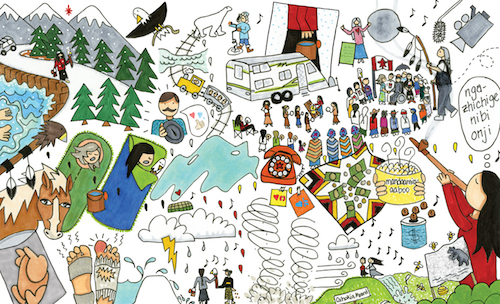
The Water Walker in the story of a grassroots crusade to demonstrate respect and inform people about the importance and potential destiny for Nibi if we continue as we have.  With water rights being given away for pennies and contamination through industry and pollution, Nibi is at risk.  It is no longer the limitless commodity generations before us believed it to be.  Nokomis Josephine Mandamin did not wait around for disaster to compel her to act.  She let her heart drive her into action.  Now Joanne Robertson, a member of Atikameksheng Anishnawbek and founder of the Empty Glass for Water campaign, is sharing that story through her invigorating illustrations, bold in line and colour.  Though most of her characters are seemingly lacking in detail, with their similarly rounded heads, expressionless faces and stiff walking postures, Joanne Robertson fashions them to be unique and distinct in dress and hair.  The illustration of the parade of Mother Earth Water Walkers with the sun blazing behind them is simple but powerful, as is the collage of memories of places and people visited on their walks.
From The Water Walker by Joanne Robertson
The Water Walker may be an illustrated biography of Nokomis Josephine Mandamin's walking for Nibi but it is also a tale of action, both accomplished and endless, to do for Nibi as it has always done for us.

~~~~~~~~~~~~~~~~~~~~~~~~~~~~~~~~

The book launch for the book will take place on Tuesday, September 26, 2017 at A Different Booklist in Toronto.  Both Grandmother Josephine Mandamin and author/illustrator Joanne Robertson will be in attendance to speak from 12:30 -2:30 p.m. with a book signing and reception fro 5-7 p.m. The events are posted here

May 17, 2017

Mary Anning's Curiosity

Written by Monica Kulling
Illustrated by Melissa Castrillón
Groundwood Books
978-1-55498-898-3
116 pp.
Ages 7-12
May 2017

I could wait until May 21st, the 218th anniversary of Mary Anning’s birth, but that’s on the weekend and I don’t want to wait.  This extraordinary woman who began life as a miracle girl, surviving a bolt of lightning that killed three women including the woman who held her, has waited long enough, being the woman whom American scientist and writer Stephen Jay Gould declared to be “probably the most important unsung (or inadequately sung) collecting force in the history of paleontology.” (1)

From a very young age, Mary Anning had traipsed the beaches and cliffs of her home in Lyme Regis with her father Richard and older brother Joe.  They would scour the Black Ven cliffs of limestone, shale and clay for treasures called curiosities that they could clean and sell, supplementing her father’s carpentry income. Mary loved going hunting for ammos (ammonites), thunderbolts (belemnites), “devil’s toenails” (Gryphaea) and all shells but she always hoped to find the giant crocodile (a misnomer) of local lore.  After a cliff fall in 1807 prevents her father from ever fossil hunting again, the family’s debts begin to accumulate. Mary who’d always been sneaking out to go hunting decides to leave school in 1810, at age twelve, and continue excavating and selling curiosities, as well as doing odd jobs whenever possible.

And then Joseph, after his work as an upholsterer’s apprentice, discovers the massive eye socket fossil of the giant croc.  But it’s Mary who must excavate it and the rest of the skull while keeping their fossil-seller competitor Captain Cury at bay.  With tireless devotion to her task, and the support of the wealthy and educated fossil collector Miss Elizabeth Philpot, Mary locates the long snout with jagged teeth and rest of the skull which are removed with the stone to the privacy and indoor warmth of her house for cleaning and preparation.  By putting the skull on display, Mary is able to help earn additional funds for the family while pursuing the remainder of the great animal’s fossilized body.

Though Mary Anning (1799-1847) is a part of history, the story that Monica Kulling tells is a creative retelling of her early life and first major discovery, one which helped define her as one the world’s greatest fossilists.   As was the case for those living to pay rent and food and the uncertainty of health (her mother loses many of her babies), Mary Anning’s beginnings were shaky.  But the lightning strike that she survived miraculously heralded a new beginning, apparently taking her from dull child to one with brilliant curiosity and fever for learning.  Like the curiosities she hunted on the beaches and cliffs of Dorset, Mary Anning was a marvel, she of determination and  inquisitiveness, both which served her and her family well.

As with her earlier picture book biographies, Monica Kulling has highlighted a significant figure of original thought and action whom we should know but probably don’t.  With Mary Anning’s Curiosity, Monica Kulling has demonstrated that she too can be innovative, now extending her biographic storytelling into chapter books, helping young readers delve deeper into lives of significant individuals whose stories need to be told to understand our worlds today.  And Monica Kulling is the storyteller to do so, giving life to lives lived in different times and places so that they might be truly appreciated.


(1) From  Purcell, Rosamond Wolff and Gould, Stephen Jay. Finders, Keepers: Eight Collectors (1992). W. W. Norton & Company. 155 pp.

September 17, 2014

Becoming Fierce: Teen Stories IRL: Authors share

Stories by Chris Benjamin, Ben Boudreau, Gerard Collins, Alison DeLory, Jamie Fitzpatrick, Patti Larsen, Cale Liom, Chad Pelley, Lee D. Thompson and Jo Treggiari 
Forward by Susin Nielsen
Edited by Allister Thompson
Fierce Ink Press
978-1-927746-61-5
205 pp.
Ages 13+
For release September 23, 2014

Yesterday's review of Becoming Fierce is a great introduction to the ten Canadian writers who gave life to their stories about becoming and being fierce.  Like greatness, some people have fierceness (is that ferocity?) thrust upon, while others grow into that fierceness with age and experience.  I wonder if some of us never become fierce.

These ten authors have agreed to answer this very simple request:  If you could tell your pre-fierce self something in three little words, what would it be?

I expected something similar to "It gets better".  Now we know why they are the writers and I simply give them space for their words.  Sometimes the answer can't be restricted to a mere three words, the idea of becoming fierce being such an overwhelming concept.  But here are the gracious and personal responses of the authors: 


Jamie Fitzpatrick 
(Newfoundland)
These Memories Can’t Wait 


You are lucky


......................................................................................................


Ben Boudreau
(Nova Scotia)
Say It’s Okay


Keep aiming higher


......................................................................................................


Jo Treggiari 
(Nova Scotia)
Love You Like Suicide


Create and Live


......................................................................................................


Chris Benjamin 
(Nova Scotia)
Cuisvé 


Hunger for Justice


......................................................................................................


Gerard Collins
(Newfoundland)
The Long Last Year 


Don't be afraid


......................................................................................................


Alison DeLory 
(Nova Scotia)
Some of My Parts


Embrace your uniqueness


......................................................................................................


Chad Pelley 
(Newfoundland)
Before I Was Me


For better or for worse, the real world could not be more different than the bizarre and temporary world of high school.


......................................................................................................


Lee D. Thompson 
(New Brunswick)
Diary of a Fluky Kid


Always be yourself


......................................................................................................


Patti Larsen 
(Prince Edward Island)
Prince Nameless


Trust the Universe
Just keep writing
You got this

......................................................................................................


Cale Liom
(Prince Edward Island)
I Used to Think I’d Make a Good Boy


Learn martial arts

......................................................................................................


Each author's words will resonate with the reader after you've read each of their stories and perhaps even before you do.  And for anyone who is in need of becoming fierce, the stories will tell you in so many different ways that it does get better.  Learn from those who have been through it.  Read Becoming Fierce: Teen Stories IRL.