Showing posts with label owls. Show all posts

December 17, 2025

Owl

Written by Kara Griffin
Illustrated by K. Shawn Larson
Acorn Press
978-1-773661971
32 pp.
Ages 5-8
November 2025 
 
When a grandfather tells his grandson about a beautiful barred owl who lives in the forest nearby, the child is determined to see the bird. The grandfather explains how she hunts for food and where she lives and the sounds she makes. The two even practise calling the barred owl. But no matter how often the child looks and listens for the bird, he is disappointed. 
From Owl, written by Kara Griffin, illustrated by K. Shawn Larson
Learning that the owl is out at night when the boy is sleeping, he finally catches a glimpse of it but only a flash before it disappears. Surprisingly, the bird has seen the boy and even watched him as he sleeps. They are both intrigued with the other. 
 
When the two finally meet, it is because the barred owl has come to the child's window and the two connect in an unexpected and sweet way that the child will never forget.
From Owl, written by Kara Griffin, illustrated by K. Shawn Larson
Seeing any owl–barred, barn, great horned, screech, snowy or another–is always an amazing experience. There is a mystery to them, wrapped up in their magnificence of morphology and their behaviour. For this child, seeing a barred owl that had a connection to his grandfather would be especially prized. Kara Griffin, an author from Prince Edward Island, reminds us of the importance of our connections to the natural world. Her earlier picture books, Flitt's Call (2023)—also illustrated by K. Shawn Larson—about a bank swallow, and The Sea That Sings To Me (2023), both emphasize that powerful connection. In Owl, Kara Griffin tells the story beyond a kid wanting to see a majestic bird. It's a story that speaks to an interrelationship.
 
K. Shawn Larson, also from P.E.I., uses watercolours with an earnestness that addresses the authenticity of this story. It seems very real. I know it's astonishing to imagine an owl purposefully covering a child with a blanket but the way K. Shawn Larson paints it, and Kara Griffin tells is, it all seems very plausible. But K. Shawn Larson doesn't give up any of the whimsy of the story, including some unusual residents in her scenes along with a plethora of local flora and fauna. It's a place you want to visit and to appreciate the beauty of its scenery and the diversity of its wildlife.
From Owl, written by Kara Griffin, illustrated by K. Shawn Larson
I know that there are numerous STEM lessons that could be derived from Owl, but, if you have a little one who is enamoured with these impressive creatures, Owl will teach as well as delight and is sure to have them looking for one in a forest or in their dreams soon enough.

December 01, 2023

When the Owl Calls Your Name

Written and illustrated by Alan Syliboy
Nimbus Publishing
978-1-77471-246-7
32 pp.
All ages
November 2023
 
While many children will be familiar with the depiction of owls as wise, old creatures, there are many cultures that associate the beautiful, majestic owl with death. In many Indigenous cultures, the owl may be seen as a harbinger of an impending death, a messenger of the Creator calling someone home. This is the premise of Mi'kmaw artist Alan Syliboy's story of When the Owl Calls Your Name which is based on "The Owl Song" performed by Alan Syliboy and the Thundermakers. (A video of this spoken word performance with music and dance is appended to this review.)
From When the Owl Calls Your Name, written and illustrated by Alan Syliboy
When the Owl Calls Your Name is not a typical picture book for children. It does not have a plotted story, moving from initiating conflict to resolution. It is a lyrical exploration of what it means when the owl calls your name. In text that is so beautiful that it is almost sorrowful, Alan Syliboy tells us that when the owl is heard to call our name, he will lead our spirit to the place of the ancient ones. But the owl is very quiet, flying on silent wings, so you never know when it is coming for you. With that recognition, Alan Syliboy reminds us we can't always be prepared for death so we must live our lives as if it could happen at any moment.
From When the Owl Calls Your Name, written and illustrated by Alan Syliboy
There is a unique essence to When the Owl Calls Your Name that speaks to both the Mi'kmaw culture, in content and art, and the spiritual beliefs of life beyond the corporeal. The messaging is straight-forward, both informative of beliefs and inspirational with regards to life paths, even beyond death. But the artwork will draw readers in, especially with the uniqueness of Alan Syliboy's shapes and line that are very reminiscent of ancient petroglyphs, though far more elaborate. The stylized people have upside-down trapezoid heads without facial features and ferns projecting from their heads, while the spirits are softer, in line and shape, with swirls of a different life within. And the owl is gorgeous, ornate in its face, feathers, and body. Alan Syliboy is very strategic with his use of colour, using greys and white, with only hints of purple, for much of the story when the owl visits and the spirit is leaving the body. But when living in the now or joining ancient ones who would embrace the new arrival, there is warmth and colour within.
From When the Owl Calls Your Name, written and illustrated by Alan Syliboy
When the Owl Calls Your Name is both a book that shares cultural beliefs and an inspirational poem that tells readers what the appearance of the owl means. The owl both portends death but reassures that death heralds the beginning of a new journey, according to the signpost that brought us to this life. It reminds that there is a place for us after death with the ancient ones but also that we never know when the Creator will be calling us home.
 So you must live your life in such a way
That you will be ready for the owl
when he calls your name.
 
• • • • • • • 

The video of the spoken word performance of "The Owl Song" by Alan Syliboy and the Thundermakers, along with members of Symphony Nova Scotia and an interpretive dancer, can be viewed at https://youtu.be/_3THnJGNqPk?si=3PH_q_CQZ0VKy1sc.
 
The Owl Song – Alan Syliboy and the Thundermakers with Symphony Nova Scotia (The Fusion Sessions)
 Posted on April 29, 2021 by Symphony Nova Scotia on YouTube.

June 23, 2020

An Owl at Sea: Guest review

Today's review was written by teacher Elizabeth Cook.

Written by Susan Vande Griek
Illustrated by Ian Wallace
Groundwood Books
978-1-77306-111-5
32 pp.
Ages 6-10
May 2019

This beautiful picture book was written by Susan Vande Griek after she read a news article about a Short-eared Owl that somehow flew to an oil rig many kilometres out in the ocean off Scotland.  An Owl At Sea starts with an owl resting on a fence post in a field looking to see if it can find a mouse to eat.
From An Owl at Sea by Susan Vande Griek, illus. by Ian Wallace
It doesn’t explain why or how the owl got so far from this field when we see it navigating the sky above the ocean next.  However, the story of its journey to that oil rig, and then home, is captivating to read.

I am always drawn into books written in verse.  For me, it makes the story all the more magical.  An Owl At Sea by Susan Vande Griek is written in verse and I was instantly struck by the power of a simple description of the owl written in verse. 
Chunky legs,
tired wings
drop,
fold,
talons searching
for something to hold.
These words helped me feel the exhaustion of the owl, desperate for a place to rest after finding itself so far from its field back home. Susan Vande Griek weaves words so beautifully that the scene unfolds before your own eyes.

From An Owl at Sea by Susan Vande Griek, illus. by Ian Wallace
The words alone create wonderful images for the reader; however, that shouldn’t take away from the stunning artwork by Ian Wallace. His watercolour artwork brings the scene alive. I especially loved his images of the owl on its harrowing journey above the crashing waves and in the misty weather. It is almost as if you can feel the salty spray on your face as you cross your fingers tight, hoping for a safe landing for the owl.

From An Owl at Sea by Susan Vande Griek, illus. by Ian Wallace
An Owl At Sea is a great story to read about the determination of animals.  In the classroom, it would be an interesting book to read in combination with a non-fiction book on owls to compare how extraordinary a feat this journey was for the Short-eared Owl.  It could inspire more research on astounding animal accomplishments and their stories.  This book also illustrated the kindness of the humans that all helped this feathered creature return to its grassy field.  Perhaps, it will inspire children to find ways to help out animals in their own community.

~ Elizabeth Cook is a teacher in the Halton District School Board. She is an avid reader and fan of Canadian literature.

February 12, 2020

Tanna's Owl

Written by Rachel and Sean Qitsualik-Tinsley
Illustrated by Yong Ling Kang
Inhabit Media
978-1-77227-250-5
32 pp.
Ages 5-8
January 2020

In "A Greeting from Rachel" as the preface to the book, Rachel Qitsualik-Tinsley recounts how all animals were important and considered family. When her father brings home an orphaned baby snowy owl, she learns an important lesson about caring and ownership.
I don't think you can really own an animal. Or a piece of Land. Or anything, actually. You can only bring things together. Learn to help. To care.
The little grey and brown owl with the big eyes that Tanna thought to be ugly at first needs lots of care. They house the little bird whom they called Ukpik (Inuktut for owl) in her father's workshop. It needs to eat several times a day and that means Tanna and her siblings must go out to catch lemmings. When Ukpik does not get her food right away, she stomps and sways and chomps in her demanding way.
From Tanna's Owl by Rachel and Sean Qitsualik-Tinsley, illus. by Yong Ling Kang
As Ukpik grows, becoming both bigger, less cute and more dangerous with her sharp beak, Tanna continues to feed her, now giving her any kind of meat or fish. When Tanna takes her outside, Ukpik looks interested in flying, flapping her wings, but she is too young to fly yet. After Tanna goes away to school and returns the following summer, she learns that Ukpik is gone.
"It was grown," Father told her. "The owl didn't belong to us. It had to fly free."
From Tanna's Owl by Rachel and Sean Qitsualik-Tinsley, illus. by Yong Ling Kang
Though the child had felt burdened taking care of the little owl, she missed Ukpik. So when she spots a fully grown snowy owl, Tanna hopes that maybe it was the owl she'd cared for.

From Tanna's Owl by Rachel and Sean Qitsualik-Tinsley, illus. by Yong Ling Kang
Though many a child will bring home an animal for which to care, Tanna's Owl is a unique tale of the far north and embedded in a culture and heritage that respects its animals as part of the Land or Water or Sky. Tanna's father is very matter-of-fact about her need to care for the orphaned bird but also for its need to leave when ready. Staying as a family pet was not respectable nor natural. Tanna knows this in her heart but she obviously comes to care for the animal who may not have seen the little girl as more than a food source. Fortunately, her father's wisdom is subtly shared with the child about what she needs to do, positive or sad.

Nunavut's Rachel and Sean Qitsualik-Tinsley's stories always bring readers to an Inuit world of place, people and experience. I've reviewed a variety of their tales from origin stories in How Things Came To Be: Inuit Stories of Creation (Inhabit Media, 2016) to history in Tuniit: Mysterious Folk of the Arctic (Inhabit Media, 2015) or picture books like Lesson for the Wolf (Inhabit Media, 2015). They provide a real glimpse into life in the Arctic for the Inuit people and a reminder that they reside in a natural world that is vast and complex. With their stories, we learn more each time. Accompanied by the simple and informative illustrations by Toronto's Yong Ling Kang, children will see what a baby owl and a full-grown snowy look like as well as how an Inuit family may live. The art depicts a modesty of life with a practicality of wisdom and pleasures while still representing familial and natural connections.

Inviting us in to learn the story of Tanna's Owl, Rachel and Sean Qitsualik-Tinsley with Yong Ling Kang have taught us more bout compassion, responsibility and respect, as well as cultural experience, than any school lesson might.
From Tanna's Owl by Rachel and Sean Qitsualik-Tinsley, illus. by Yong Ling Kang

November 15, 2016

The Owl and the Lemming

by Roselynn Akulukjuk
Illustrated by Amanda Sandland
Inhabit Media
978-1-77227-120-1
32 pp.
Ages 5-7
November 2016

Like Aesop’s Fables, The Owl and the Lemming is a tale with a moral but it is more than just a morality story. Through the words of Nunavut-born filmmaker Roselynn Akulukjuk and illustrator Amanda Sandland, this fable is an Inuit legend with a lesson based on a local predator-prey relationship amidst that Arctic ambience of mossy and rocky tundra.  The Owl and the Lemming is as elegant in its story-telling and art as it is wise in its teaching.

A young lemming makes her way out of the den in the spring to partake in some much-needed feeding on tasty moss.  So engrossed in her eating, she fails to notice a snowy owl land directly in front of the entrance to the lemming’s den.   The young lemming tries to trick the snowy owl with some juvenile ploys based on distraction but, though young, the owl is wise to her intentions. Finally the lemming invites the owl to play a jumping game with the lemming’s fate as a meal the prize.  The owl is only too happy to show his prowess at jumping, sadly for him allowing the lemming to scurry back into her den.  Though his father cautions him, “Next time, don’t play with your food” (pg. 25), the little owl knows it was his pride that cost him his meal.

That old adage of pride going before a fall is ever so true in this Inuit tale, told with humour by Roselynn Akulukjuk who directed a puppet-based film of the story for Taqqut Productions, just winning Best Animation at the 41st annual American Indian Film Institute Festival.  It’s an auspicious recognition of the talent of Roselynn Akulukjuk to tell such a legend with both clarity and richness, staying true to her Nunavut roots while extending herself into her new pathways for story-telling.  Similarly, Amanda Sandland uses her artwork to combine the whimsical with the realistic, creating composite images of drawings with photographic backgrounds.  With only a few touches of comic design, like the den’s doorway and fencing, added to the true tundra landscape, Amanda Sandland puts all her efforts in creating a lemming and an owl worthy of the legend’s title.

From The Owl and the Lemming 
by Roselynn Akulukjuk, 
illus. by Amanda Sandland
Readers should look for the release of Taqqut Productions’s film of this story, but indulge in this literary version from Inhabit Media for teaching and learning an important moral about pride and survival from a very northern perspective.


October 31, 2016

Bera the One-Headed Troll

by Eric Orchard
First Second / Roaring Brook Press
978-1-626721067
128 pp.
Ages 7-14 
August 2016


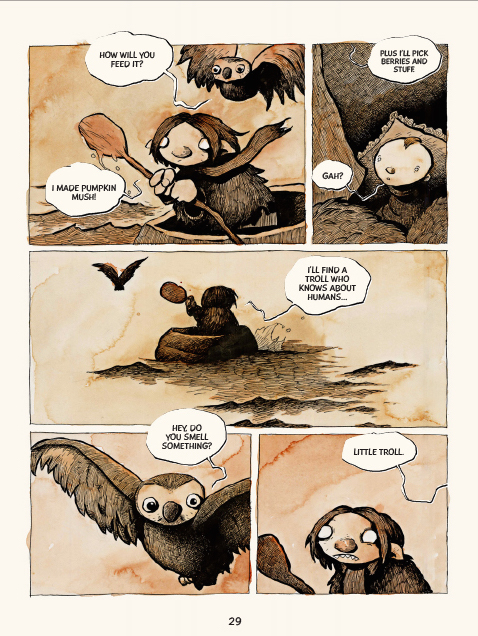
With today being Halloween and Bera the One-Headed Troll being filled with pumpkins and trolls and witches, it seems only fitting to review this graphic novel today.  Written and illustrated by Eric Orchard, the illustrator of the recently reviewed If I Were a Zombie (Kate Inglis, Nimbus, 2016) –am I sensing a monstrous theme here?–Bera the One-Headed Troll is atmospherically perfect for a fun but teensy bit scary read.

Bera, who lives on an isolated island with her owl companion Winslowe, is the official pumpkin gardener of the Troll King. (There’s the pumpkin connection for Halloween,  and, except for the cover and an occasional candle burning yellow, it’s the colour scheme of all the book’s graphics.)  When Bera rescues a human baby from three evil mermaids (they are not of the lean and lovely variety), she takes upon herself the task of returning the baby to its humans.  But that is contrary to the wishes of the malevolent Cloote, former  head witch of the Troll King, who wishes to use the baby to return to the good graces of the Troll King.
From Bera the One-Headed Troll 
by Eric Orchard
Bera who feels unprepared for dealing with the baby decides to seek a hero from her books, specifically choosing Wulf the Dragon Masher.  On their journey, Bera and the baby, with Winslowe scouting from above, encounter the mermaids again, as well as the Guardian, a sea monster as big as an island, and a bunch of hedgehog wizards.  Thankfully this last group whose mandate it is to protect the creatures of the wood already know firsthand of Cloote’s destruction and offer to steer Bera to Wulf’s tower.  Wulf, a troll of epic proportions and light-spirit (“Hey, is that a baby?”, “Well, look at that” and “Imagine that!”; pg. 52), has not been on an adventure in a very long time and, though willing of spirit, he succumbs to his epic sleepiness.

So Bera goes in search of another hero, finding both Duke Otig, the two-headed troll hero of the troll-giant war, and then the three-headed Nanna the Great.  But the reader will soon realize that heroes are not just those who undertake adventures and engage in battles.  Heroes are also those who make extraordinary sacrifices to do ordinary things, making their own quests in the spirit of goodwill, not glory.
From Bera the One-Headed Troll 
by Eric Orchard
Bera the One-Headed Troll is a offbeat graphic novel filled with trolls (one-, two- and three-headed varieties), goblins, witches, and rats (Vince is particularly helpful) and positive messages about offering assistance to those in need.  With only her want to do the right thing, Bera takes herself out of her comfortable pumpkin patch island and discovers new strengths and instincts, while making some new friends and good karma in the process.  I thought Bera the One-Headed Troll was going to be a dark, dark tale for a Halloween night, and its graphics would’ve supported that notion.  Eric Orchard’s trolls and witches and other creatures could be seen as darkly unnerving, as are the settings of straggly trees and murky swamps and stone edifices.  But Bera the One-Headed Troll is neither dark nor frightening.  It is a positive message wrapped in a dark cloak festooned with pumpkins.  Read it for Halloween but take its guidance beyond the day.