Showing posts with label Inuit. Show all posts

April 14, 2025

The Warmest Blanket in the World

Written by Tamara Levine
Illustrated by Ellie Arscott
Second Story Press
978-1-77260-410-8
24 pp.
Ages 6-8
February 2025 
 
While most of us are already thinking about the warmth of spring and summer, there will be many, particularly the elderly, for whom the change of seasons will not necessarily bring that which would warm their fingers and toes. For those with poorer circulation and other health issues, particularly those associated with aging, cold feet and hands can be problematic. And young Frida wishes she could do something to help her amazing great-grandmother Ama who says she feels like she lives in a refrigerator.
From The Warmest Blanket in the World, written by Tamara Levine, illustrated by Ellie Arscott
Frida enjoys visiting her great-grandmother as much as the older woman relishes seeing the child, telling her each time, "Do you know you've made my day? You're one special kid!" Ama tells Frida stories about her life and the importance of women fighting for their rights. (Frida even attended a protest with Ama once.) They sing songs together and they snuggle under her blanket. But even that blanket doesn't keep Ama warm enough. So, Frida gets some advice from her mom, her grandmother and her aunt.
From The Warmest Blanket in the World, written by Tamara Levine, illustrated by Ellie Arscott
Frida recalls what she'd learned of muskoxen which reminds her aunt, a knitter, of a mill in Nisku, Alberta where Tanis, an Inuk woman from NWT, prepares qiviut, the wool that comes from muskoxen. This wool is said to be the warmest in the world. 
From The Warmest Blanket in the World, written by Tamara Levine, illustrated by Ellie Arscott
Frida writes Tanis and explains how much she loves her great-grandmother and how much Ama has done to make things better for girls and women. Now Frida wants to help her. The response she gets is far greater than some skeins of wool.
From The Warmest Blanket in the World, written by Tamara Levine, illustrated by Ellie Arscott
There are a lot of layers to Tamara Levine's story of The Warmest Blanket in the World. There is a sweet intergenerational relationship between Ama and Frida. There is a story of activism and doing good and supporting the rights of others, particularly women and girls. There is also a story of compassion and sharing. And there's the story of the muskoxen and how the Inuit have spun the wool of these Arctic animals into yarn and clothing. That's a lot of stories, and Ottawa's Tamara Levine weaves them all together in a story of family. This is more than a story of a blanket. It's about who needs what, who can help, and why we should help. 

Ellie Arscott, who illustrated the award-winning Night Walk, keeps the lightness of family and the warmth of a blanket and affection in her artwork, done in watercolour and ink. There is realism, when she depicts the muskoxen on the tundra and in the sepia images of suffragettes fighting for the right to vote. But there is a quaintness in the patterns of blankets and bed linens, in the calico cat and in the coziness of their homes. Ellie Arscott keeps it all bright and homey.
 
The Warmest Blanket in the World is a tender story of family and kindness. It's wrapped in qiviut and embedded with affection and humanity. It doesn't get any more warm-hearted than that.

November 08, 2024

Lemming's First Christmas

Written by Jamesie Fournier
Illustrated by Tim Mack
Inhabit Media
978-1-77227-543-8
28 pp.
Ages 0-5
October 2024
 
Avinngaq (lemming in Inuktitut) lives under a house and hears children singing, "Santa Claus is coming to town." When she asks Qimmiq (a sled dog), he tells her that Santa Claus puts presents under the tree. That just leads to more questions because Avinngaq doesn't know what a tree is. And so begins Avinngaq's quest to ensure Santa Claus visits her.
From Lemming's First Christmas, written by Jamesie Fournier, illustrated by Tim Mack
Qimmiq has a simple explanation about a tree–"It grows out of the ground, and you decorate it"–and he goes with Avinngaq to find one. The other Arctic animals bring forth what they suggest might be a tree. From Natsiq (a ringed seal) who brings some seaweed, and Tuktu (a caribou) who brings a purple saxifrage, Qimmiq can only tell what is not a tree. Other animals include Tiriganiaq (an Arctic fox) and Ukaliq (an Arctic hare) but it's not until Avinngaq rests on a piece of driftwood that Qimmiq confirms she's found a tree.
From Lemming's First Christmas, written by Jamesie Fournier, illustrated by Tim Mack
So, the friends decorate the driftwood with the seaweed, the purple saxifrage, arctic willow, and berries, sing, "Santa Claus is coming to town" and are delighted to find presents under the tree the next morning.
From Lemming's First Christmas, written by Jamesie Fournier, illustrated by Tim Mack
For our very youngest children, Lemming's First Christmas would be a bright beginning to the holiday season. Of course, they'll start singing the song too and it could get tiresome for the next seven weeks but maybe you could break that up with a reading or two of Lemming's First Christmas and some discussions about Arctic animals and plants, about cultural traditions, and even the magic of the holiday season. Jamesie Fournier, a writer in Iqaluit, keeps the story positive and simple, which is perfect for an early picture book–it has thicker pages and a reinforced cover–while introducing them to the Arctic and its plant and animal species, and teaching them a few words of Inuktitut. (A double-spread at the back posts the Inuktitut names and their pronunciations along with illustrations of the animals depicted.) It's very sweet and all the more so for Tim Mack's illustrations. I've reviewed several books which Tim Mack has illustrated (It's Time For Bed and What's My Superpower?) and his cartoon style of digital art will resonate with very young readers. His characters are cute and recognizable, and even if unfamiliar with an Arctic environment, children will recognize the play of shadows at night, the magic of snow and stars, and the quest for answers from those we know.
From Lemming's First Christmas, written by Jamesie Fournier, illustrated by Tim Mack
Get into the holiday season in a gentle way with Lemming's First Christmas. It's an easy introduction for those who may become overwhelmed with the customs of the holiday and let them see it from the perspective of a group of animals who interpret a tradition in their own way and make it a very sweet first Arctic Christmas.


August 25, 2023

We Love You As Much As the Fox Loves Its Tail

 Written by Masiana Kelly
Illustrated by Tamara Campeau
Inhabit Media
978-1-772274769
28 pp.
Ages 3-5
July 2023
 
This is a picture book about love. It's about how much love there is for a child, before its birth and after and even in the future, and it's the love that is seen in a northern environment of foxes, narwhals and muskoxen.  As such, We Love You As Much As the Fox Loves Its Tail is a lullaby to a newborn.

From We Love You As Much As the Fox Loves Its Tail, written by Masiana Kelly, illus. by Tamara Campeau
Speaking to their new baby, a family recalls how much they longed for the baby and how they celebrated its arrival. How do you express anticipation and adoration? They look to the familiar in their lives for demonstrations of love. There's the polar bear who loves to sleep and the caribou who love to run. In a northern environment, both green and flowered in the summer and crystal blue in the winter, and often vividly dynamic with the aurora borealis, there is much available to which the family can compare their love, both as it is and as it will be given.
From We Love You As Much As the Fox Loves Its Tail, written by Masiana Kelly, illus. by Tamara Campeau
Masiana Kelly's text suggests a familiarity with those northern environs and, as an Inuk and Dene writer from Nunavut and the Northwest Territories and as a mother, she obviously draws on her background. Her words speak of love and appreciation for her home of people and place. And that joy comes through with brilliance in Tamara Campeau's artwork. Oh, the colours and the life of those waters and skies, animals and land! These digital illustrations are filled with life, but then Tamara Campeau has always excelled at bringing the spirit of the north into her artwork and to the stories of others, like Grandfather Bowhead, Tell Me a Story and In the Sky at Nighttime.

From We Love You As Much As the Fox Loves Its Tail, written by Masiana Kelly, illus. by Tamara Campeau
If you know anyone having a baby or just having had a baby, We Love You As Much As the Fox Loves Its Tail would be a lovely gift to the family. It evokes the abundance of love and the closeness of family, and, no matter if the family lives in an urban landscape, in a prairie rural community, or a far northern region, We Love You As Much As the Fox Loves Its Tail will evince the joy of a new babe from its pages.

April 28, 2023

The Woman and Her Bear Cub

Adapted and retold by Jaypeetee Arnakak
Illustrated by Dayna B. Griffiths
Inhabit Media
978-1-772274660
36 pp.
Ages 3-6
April 2023
 
Many children take it upon themselves to adopt animals they believe have been abandoned. They do it with the best of intentions, though sometimes without regard for the bigger picture. The Woman and Her Bear Cub is a traditional Inuit story of such a fostering but with the wisdom that comes with living in conjunction with the natural environment and not overriding it.
From The Woman and Her Bear Cub by Jaypeetee Arnakak, illus. by Dayna B. Griffiths
A child and her mother are out on the ice hunting when they discover a polar bear cub stranded behind some broken ice. The mother wisely looks for tracks and evidence that the mother bear is nearby but can find none, so they help the cub from its location and take it home.
From The Woman and Her Bear Cub by Jaypeetee Arnakak, illus. by Dayna B. Griffiths
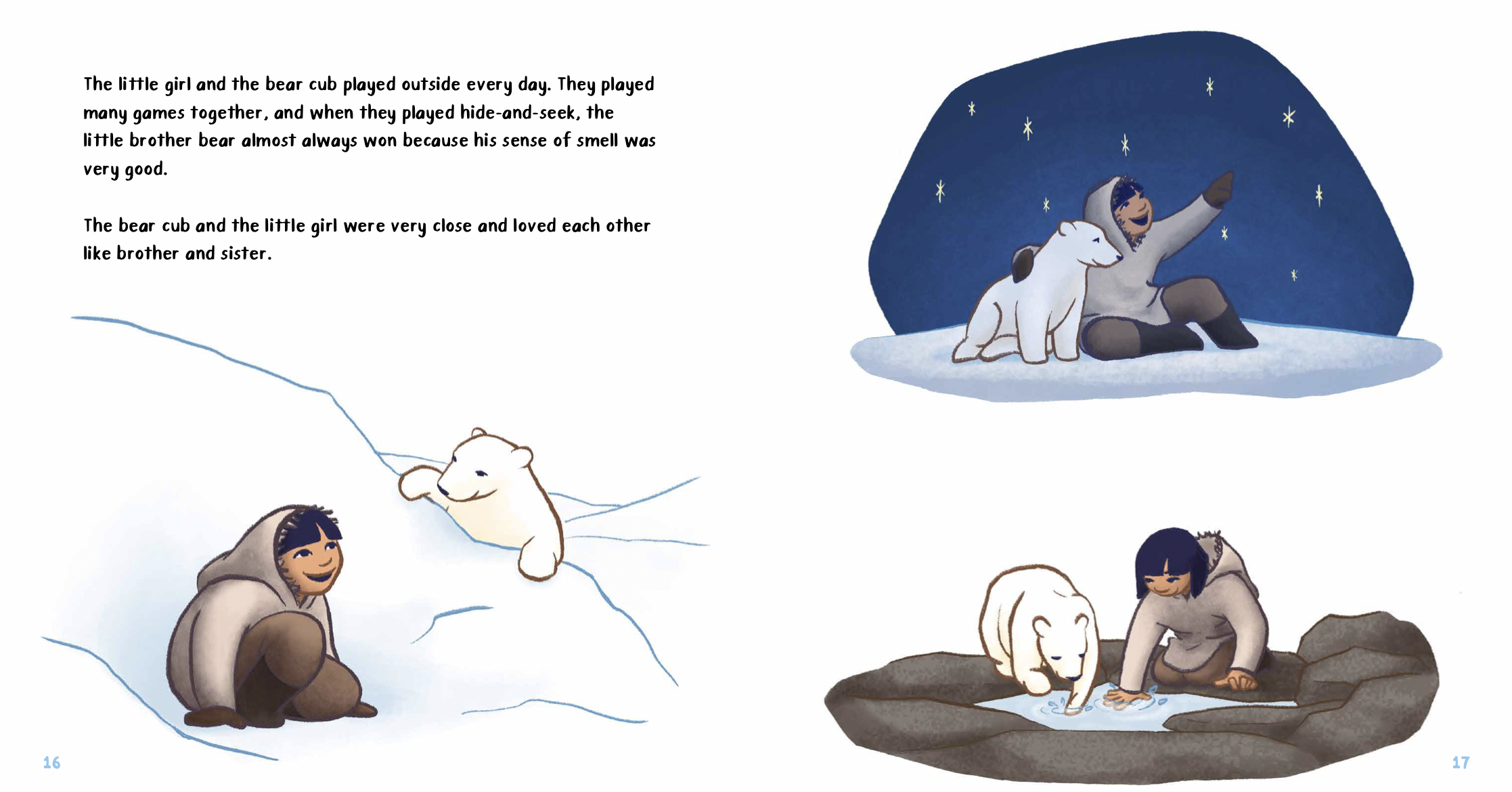
The child calls the cub her baby brother and their bond is as strong as siblings. They spend time together, playing and such, with the bear becoming an integral part of their family, even bringing back seals and fish that he has caught for them.
From The Woman and Her Bear Cub by Jaypeetee Arnakak, illus. by Dayna B. Griffiths
But when the cub is no longer a baby bear, and he becomes so big that the others in the village are concerned, the mother prepares her child for the time he would have to leave them. Still, it isn't until her brother bear returns from hunting one day with his own mother that the mother and child are able to say goodbye.
From The Woman and Her Bear Cub by Jaypeetee Arnakak, illus. by Dayna B. Griffiths
Jaypeetee Arnakak is a multi-talented Inuit linguist, translator, educator, and writer who grew up in Clyde River on Baffin Island. He has edited a collection of traditional stories from oral recordings of Inuit Elders and adapted several into picture books. The Woman and Her Bear Cub is one such traditional story and one that tells of compassion for living things and letting go when the time is right. There is no willful removal of a wild animal to provide companionship or entertainment. Neither is there a selfishness to take and keep what does not belong to them. The mother and her child give sanctuary to a lost bear cub only until he is reunited with his mother. It's not about their needs but about his needs. 

That quietness of purpose and landscape is portrayed in the illustrations of The Woman and Her Bear Cub by artist and designer Dayna B. Griffiths of Toronto. By creating art that appears stark, with a restrained palette of blue, white, and grey-brown, Dayna B. Griffiths makes the Arctic landscape of blue sky and white snow dotted with an occasional qarmaq (dwelling) very powerful. As such, the interjection of a white bear and grey-brown-clad people, with the occasional dog of both grey and white, in that landscape makes them both an important and insignificant focus.

As with most traditional stories, even those that may take on fantastical proportions, there is a germ of truth, and I suspect this one is based in reality. Adopting a lost animal and caring for it until care is no longer necessary is a story for all times. Here, a polar bear and an Arctic landscape may make this story unique, but its premise is grounded in the authenticity of compassion for those in need and dictated only by the one most affected. It is a lesson in selflessness and benevolence and a true reflection of the graciousness of Inuit values.

June 06, 2022

Una Huna?: Ukpik Learns to Sew

Written by Susan Aglukark
Illustrated by Amiel Sandland and Rebecca Brook
Inhabit Media
978-1-77227-433-2
36 pp.
Ages 5-7
June 2022
 
After Ukpik's father (ataata), uncle and cousin return from a hunting trip with five caribou, the child's mother enlists her help in preparing the furs for a special project. Though she doesn't know what the special project will be, Ukpik is delighted to be part of something that will include some beads (sunguajait) that her anaana had been saving.
From Una Huna?: Ukpik Learns to Sew by Susan Aglukark, illus. by Amiel Sandland and Rebecca Brook
First, Ukpik is told get the ulu her grandfather (ataatatsiaq) had made for her as she would help with the cleaning of the skins. She is instructed on how to remove incidental fat and how to be careful with the sharp tool. Later the skins are stretched out and pinned to the ground to dry.
From Una Huna?: Ukpik Learns to Sew by Susan Aglukark, illus. by Amiel Sandland and Rebecca Brook 
As they wait for the skins to dry, Anaana allows Ukpik to work with the beads forming a pattern. After the skins are dry, Anaana teaches Ukpik how to soften the skins by tromping on them and also using a sakuut

For practise, Anaana cuts pieces according to a pattern for Ukpik and her friend Qopak to learn to sew mittens. When it becomes evident that the girls are becoming fatigued, Ukpik's anaana reminds her that:
You must begin your lessons now so you know how to do the right stitches for each pattern. The size and shape of the stitches matter, Ukpik, and to get these right, you must practise. (pg. 25)
From Una Huna?: Ukpik Learns to Sew by Susan Aglukark, illus. by Amiel Sandland and Rebecca Brook
It takes days of patience and meticulous work to prepare the skins so that they might be fashioned into clothing, and it's a skill that connects Ukpik and Anaana and others with their ancestors. Anaana and Ataata recognize that the world for Ukpik and her peers is changing (the earlier book Una Huna?: What is This? relates the introduction of new tools to the community from the south) but that skills like sewing and skin preparation are lines of kinship that will link them with their heritage forever.  
 
Author Susan Aglukark is perhaps best known as an award-winning Inuk singer-songwriter but her Una Huna? picture books take us to a northern Indigenous community in a different way, perhaps to see what growing up there might have been like for her. Una Huna?: Ukpik Learns to Sew reminds us that learning is happening constantly for children and especially for this Inuk child who wants to know and to discover all that she can. Una Huna? translates to "What is this?" and reflects Ukpik's inquisitive nature and desire to understand the nature of her people's ways of living while still being a kid who likes to play with her friends and puppy on the tundra. And, for most readers, Una Huna?: Ukpik Learns to Sew will be an introduction to traditional skills of the Inuit in addition to their language (a glossary with Inuktitut pronunciation guide is provided), making this picture book another culturally relevant book from Inhabit Media.
 
The illustrations by Amiel Sandland and Rebecca Brook are both playful and informative, striking the right balance for young readers who will learn but be entertained by the artwork. Amiel Sandland has always been astute at keeping the art simple enough for children to get the essentials of the details without overloading them with insignificant fluff. As such, the illustrations give us the starkness of the tundra and the straightforwardness of living as Inuit on the land while emphasizing an ancestry of significance.
 
Una Huna?: Ukpik Learns to Sew is an endearing recollection of the learning of traditional skills from a parent who is both patient, wise and loving.  It's about being at the crossroads of past and future, connecting to one's heritage but seeing what that might mean for later. It's a big story told skilfully with the essence of the Inuit at its core.

February 28, 2022

I Can See You

Written by Rosemarie Avrana Meyok
Illustrated by Michelle Simpson
Inhabit Media
978-1-77227-420-2
28 pp.
Ages 0-4
February 2022
 
Concepts books, i.e., those that teach concepts such as the alphabet, colours and numbers, are always valuable resources for parents and teachers. These books introduce young children to early learning but, if handled well, will entertain while that learning is happening. With bright illustrations, a simple rhythm of repetition and a unique cultural foundation for that learning, I Can See You will teach, delight and enlighten.

From I Can See You by Rosemarie Avrana Meyok, illus. by Michelle Simpson
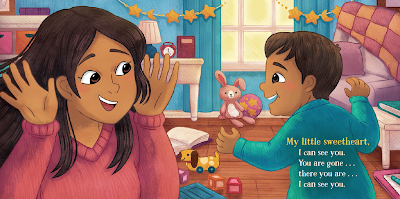
In I Can See You, mothers and grandmothers endearingly play with babies, based on the senses of seeing, hearing, smelling, feeling and even tasting. Embraced with obvious adoration, a baby, always called "my little sweetheart" is experienced fully by the parent or caregiver.
 
From I Can See You by Rosemarie Avrana Meyok, illus. by Michelle Simpson
From playing peek-a-boo to giggles, hugs and kisses and cuddles, each baby is well-loved and the basis for readers, and undoubtedly young listeners, to understand how the five senses can be the vectors for that love.

From I Can See You by Rosemarie Avrana Meyok, illus. by Michelle Simpson  
Born in NWT and residing in Nunavut, author Rosemarie Avrana Meyok speaks from experience both of people and place. As a great-grandmother, she has undoubtedly done her fair share of baby cuddling and nurturing. Her words are simple, as appropriate for a concept book, but never shallow. Rosemarie Avrana Meyok gives depth of feeling to those words but also experience with their message. From the baby in an amautik (parka with a hood for a baby) receiving kunik (nose kisses) from her mother to an Arctic landscape of cottongrass and saxifrage or northern lights–depending on the season– I Can See You takes young readers to the far north. In her joyful artwork, Niagara Falls illustrator Michelle Simpson brings that landscape to life, in its people and its place. The vegetation is distinctly that of the tundra, the stilted houses are raised above the permafrost, the stuffies include walrus, narwhal and snowy owls, and there are earrings that are beaded or resemble the ulu. Everything speaks to an Arctic community and an Inuit culture at its heart. And more at its heart is the love of mother or grandmother, perhaps aunt or sister, for babies who are seen, heard, touched, tasted and smelled with tenderness, knowing all the love that every child deserves.

May 08, 2021

The Shaman's Apprentice


Written by Zacharias Kunuk
Illustrated by Megan Kyak-Monteith
Inhabit Media
978-1-77227-268-0
32 pp.
Ages 9-12
May 2021

In this picture book based on his animated short film Angakuksajaujuq: The Shaman's Apprentice, Inuk director Zacharias Kunuk delivers a powerful story about a young girl facing her fears as she learns from her grandmother, a shaman, in finding healing help from the underworld.
From The Shaman's Apprentice by Zacharias Kunuk, illus. by Megan Kyak-Monteith
Qunguliq and her granddaughter Supijaq are summoned by a young man to provide healing for an ill man at his camp. Packing up their qamutiik (sled), they head to the nearby camp, unaware that the qurvik (bed pan) has fallen off in their travels.

Though Qunguliq questions the ill man about why he is sick and what he may have done wrong, he refuses to answer her. Qunguliq requests Supijaq retrieve the qurvik which the girl cannot locate but, sent out again to the qamutiik, the pot has reappeared. Using the pot for its intended purpose, Qunguliq smears the urine on the ill man's face but without any of the expected healing.

Qunguliq decides they must travel underground and, with a magic song, opens a deep hole leading there. Cautioning her granddaughter that she must not be fearful if their journey underground is to be successful, Qunguliq leads them down a slope deep into the earth. But as they travel down, Supijaq realizes that their bodies have changed, becoming limp and soft as if their bones had left their bodies.
From The Shaman's Apprentice by Zacharias Kunuk, illus. by Megan Kyak-Monteith
At the bottom, they face a giant husky protecting a doorway. Again, Supijaq is warned not to show fear, and the two proceed into a darkened room of tormented human spirits and Kannaaluk, also known as The One Below.

Kannaaluk reveals something to them which triggers a vision for the shamans of what the man had done, exposing a selfishness as the cause of his own illness. Returning to the sick man's qarmaq (sod house), Qunguliq confronts the man about breaking a taboo before he is healed.
From The Shaman's Apprentice by Zacharias Kunuk, illus. by Megan Kyak-Monteith
This traditional Inuit story is rich with culture, language and an inter-generational relationship blended with subtle lessons about facing fears and karma. From the qarmaq with its qulliq (seal oil lamp) to healing practices and the presence of Kannaaluk (the legendary spirit, also known as Takannaaluk and Nuliajuk, who controls the sea mammals), Zacharias Kunuk embeds us in a traditional setting of the Inuit and honours this story with its messages of customs and beliefs. Born in a qarmaq on Baffin Island, Zacharias Kunuk tells this story with authenticity and insight and with the eye of a filmmaker. Qunguliq, whose voice is the only one given words, brings the wisdom and affection while her granddaughter listens and learns through her silence and actions. But with the artwork of Megan Kyak-Monteith, also born in Nunavut, The Shaman's Apprentice is radiant, whether in the qarmaq lit by the qulliq, or across the tundra of glowing blue snow, or even in the depths of the underworld. Though her palette is limited, Megan Kyak-Monteith evokes warmth and cold, comfort and tension with the profoundness of her technique. 

As with all traditional storytelling that is destined to teach and carry forward culture, The Shaman's Apprentice does so admirably in words and art, informing those outside of the culture and preserving it for those within.

February 26, 2021

Second Story Press Indigenous Writing Contest

Publisher Second Story Press is holding its third annual contest for unpublished works for young people by Indigenous (First Nations, Métis and Inuit) writers who are citizens or permanent residents of Canada.
 
Previous winners include:
 
Jodie Callaghan for The Train
 and

Michael Hutchinson for The Mighty Muskrats Mystery series
 
Here are most of the details you'll need to submit a manuscript:

 
What?  
• A previously unpublished, original manuscript of fiction or non-fiction which cannot be under consideration for publication by another publisher.        
• Submission must be written for young readers ages 5 to 18.          
• The jury will be particularly looking for stories with an urban setting. (Not looking for stories that rhyme or stories with anthropomorphized animals.)
• Send the complete manuscript but, if submitting a picture book manuscript, illustrations need not be provided.
• Submissions must be in English, or provide an English translation.
 
 
Who?
• Writers must be Canadian Citizens or Permanent Residents, 18 years of age or older and living in Canada. (Unfortunately, due to contest regulations, residents of Quebec are excluded.)
 
 
When?
• Submitted digitally (email or Google form) or postmarked by May 14, 2021.
(Deadline was previously April 16 before it was extended.)
• Winner will be announced on  June 24, 2021.


How to submit?
• Copy of manuscript by post with entry form (link here) to 
Second Story Press
20 Maud Street, Suite 401
Toronto, ON, M5V 2M5
Attn: Indigenous Writing Contest
or
• By email to contest@secondstorypress.ca with entry form (link here)
or
• By Google form (link here)


Prize?
• A publishing contract from Second Story Press
 
 
Selection?
By jury of Jodie Callaghan, Nancy Cooper and Margie Wolfe


Details about this year's contest are posted at www.secondstorypress.ca/indigenous-contest
 
Good luck!

November 13, 2020

Kits, Cubs, and Calves: An Arctic Summer

Written by Suzie Napayok-Short
Illustrated by Tamara Campeau
Inhabit Media
978-1-77227-274-1
32 pp.
Ages 7-11
September 2020

I know summer is over and it has definitely passed in the far north but learning about other cultures and ecosystems, life cycles and food chains, is never out of season, and certainly not in schools so Kits, Cubs, and Calves: An Arctic Summer is undoubtedly a great read at any time of year.
From Kits, Cubs, and Calves: An Arctic Summer by Suzie Napayok-Short, illus. by Tamara Campeau
Akuluk, who lives south of the Arctic and had been spending time in Nunavut with her grandparents, has just arrived in Saattut to visit with her aunt and uncle. Even though it is summer, she is dressed warmly in her atigi, a duffle parka, when the northern float plane delivers her and her stuffed polar bear, Piulua. Even driving from the dock, Akuluk can see new life on the tundra in the form of fox kits playing and at the house, there are seven month-old puppies born to their sled dog Blackie. 

The next day, Akuluk's Aunt Sulie and Uncle James, along with Uncle Tommy, take her out on the boat to check out their summer camp grounds, now inhabited by polar bears. With a wealth of food, that includes dried Arctic char, palaugaaq bannock and aqpiit (a glossary of Inuktitut words explains these and more at the conclusion of the story), they begin their foray on the Arctic Ocean.
From Kits, Cubs, and Calves: An Arctic Summer by Suzie Napayok-Short, illus. by Tamara Campeau
Their sighting of a pod of creamy white beluga whales, including a grey calf, mesmerizes Akuluk, and even more so when they use a recording device to hear the mother's cooing, clicking, chattering and whistling sounds. Based on the Inuktitut word for small, mikilaaq, Akuluk names the baby Miki. But when another lone calf appears, they watch as the mother and the other whales check it out, perhaps to adopt the orphan.

From Kits, Cubs, and Calves: An Arctic Summer by Suzie Napayok-Short, illus. by Tamara Campeau
Finally they arrive near their old camp and see the polar bear and her cubs who'd previously found their fishing nets filled with char and now return annually. The family willingly gave up "their traditional land to help these large animals survive." (pg. 21) They place themselves between the bears on land and the whales and watch the bears eat their catch of seal meat, as seagulls, hopeful of remnants, look on.  Akuluk learns that normally the Arctic foxes would be following the bears, eating any meat left behind, but in the summer they have their kits and stay away from the nanuit (sing. nanuq) who would prey on the very young.
"Everywhere we go, Inuit and animals, we all have a need to stay close, so we can help one another," she says, putting an arm around Akuluk. "The wildlife do what they can to help one another, in their own way, and we do what we can in ours. We have to share our earth with all the wildlife that live here. We need to look after our land, and the plants in it, too." (pg. 29)
Suzie Napayok-Short who was born in Frobisher Bay and has lived on Baffin Island and Nunavut takes delight in Akuluk's visiting and learning, perhaps because these were her own experiences. Not only does Akuluk get to spend time with family and witness animal wonders in the Arctic, she learns of the traditional ways, piusituqait, and their importance in maintaining ecosystems. Author Suzie Napayok-Short embeds her storytelling, perhaps recounting, with a respectful gravitas, recognizing Akuluk's visit as pivotal for the young girl. 
From Kits, Cubs, and Calves: An Arctic Summer by Suzie Napayok-Short, illus. by Tamara Campeau
Illustrator Tamara Campeau who also illustrated The Muskox and the Caribou and In the Sky at Nighttime stays true to her artistic style of realism with a hint of the personal. She doesn't make her illustrations frivolous or silly; instead, the art depicts the true nature of the familial relationships and the wonder of the natural world. By blending the authentic with the deferential, Tamara Campeau dignifies Suzie Napayok-Short's story while giving it colour and shape.

Kits, Cubs, and Calves: An Arctic Summer goes beyond summer and gives a picture of life in Nunavut for its people, its animals and the land, and it's a great place to visit through Suzie Napayok-Short and Tamara Campeau's work.

October 15, 2020

When Pumpkins Fly

Written by Margaret Lawrence
Illustrated by Amanda Sandland and Margaret Lawrence
Inhabit Media
978-1-77227-249-9
32 pp.
Ages 4-8
September 2020
 
Though Halloween will be a very different holiday for many children this year, author Margaret Lawrence demonstrates for young readers how different it must always be in her territory of Nunavut when getting a pumpkin into the community is a very big thing.

From When Pumpkins Fly by Margaret Lawrence, illus. by Amanda Sandland and Margaret Lawrence

As always in remote communities like Margaret Lawrence's home of Sanikiluaq on Flaherty Island in Hudson's Bay, cargo flights play an important role in delivering much needed provisions. Getting a pumpkin is not as easy as heading to a field of thousands and picking out one.  When the pumpkins arrive and one becomes part of each class's celebrations, which includes carving and eating, a draw is held to select the lucky student from each who gets to take the carved pumpkin home.

As with all children who go out trick or treating, the children of the community dress up in the costumes but also in heavy coats and mittens and carry flashlights to ward off the darkness. But it's after the trick-or-treating and the community hall dance is over that young minds go to the dark places of the night.

From When Pumpkins Fly by Margaret Lawrence, illus. by Amanda Sandland and Margaret Lawrence
As I drift off, I think about the tunnaat who live out on the land. Halloween is a night to think about these ancient and wise beings that like to visit our community.
As the wind blows and temperatures drop, the child wonders about the pumpkin on the steps outside which may be appropriated by a fox or ravens but also perhaps tunnaat.
From When Pumpkins Fly by Margaret Lawrence, illus. by Amanda Sandland and Margaret Lawrence

The cargo planes may bring the pumpkins to Margaret Lawrence's home but When Pumpkins Fly brings all young readers to this Inuit community to experience a Halloween that is a little bit different. Though illustrator Amanda Sandland may live in the Toronto area, her artwork, with contributions from Margaret Lawrence, takes us to that cold climate for this annual holiday, ensuring authenticity of location with her landscapes and people. 

At its heart, Halloween is still an event of pumpkins and trick-or-treating for the children of Sanikiluaq and When Pumpkins Fly depicts it as such. But it is also a one-of-a-kind occasion for a community that enjoys the popular aspects of the holiday along with their own traditions. By allowing Inuit children the opportunity to see themselves and for non-Inuit children to learn about cultures other than their own, When Pumpkins Fly takes us all out on Halloween.

🎃🎃🎃🎃🎃

When Pumpkins Fly is also available in Inuktitut from publisher Inhabit Media.

May 05, 2020

The Walrus and the Caribou

Written by Maika Harper
Illustrated by Marcus Cutler
Inhabit Media
978-1-77227-256-7
32 pp.
Ages 5-7
2019

This traditional Inuit origin story from actress Maika Harper and illustrator Marcus Cutler reminds us of the richness of the storytelling tradition, the source of Maika Harper's tale, and the breadth of its narration on revealing culture, history and people.

From The Walrus and the Caribou by Maika Harper, illus. by Marcus Cutler
When Guk was breathing life into the world, she pondered how the different parts of the animals should be organized. The walrus was generated when Guk blew air into her sealskin parka and added some flippers and wrinkles and antlers. (Yes, antlers.) The caribou was created from breathing life into her sealskin pants. With the addition of some big hooves and hair, a snout and tusks, her caribou was complete.
From The Walrus and the Caribou by Maika Harper, illus. by Marcus Cutler
But Guk's enhancements did not all work. The walrus's antlers were not a good idea. When the walrus swam, its massive antlers would upend the hunters' kayaks. As for the caribou, its tusks were not much appreciated by the hunters.

In a mix-and-match situation, Guk swaps out the tusks and the antlers, creating the familiar walrus and caribou of today's Arctic, with a special touch of punishment for the caribou because of its irritability and brashness.
From The Walrus and the Caribou by Maika Harper, illus. by Marcus Cutler
Though Maika Harper tells a simple tale of how the walrus and the caribou came to exist in their present morphologies, she also explains why the caribou avoids humans and encourages young readers to think about what animals they might create. With illustrator Marcus Cutler's Arctic landscape, depicted in a minimal palette of snowy whites, of earthy sandy browns and taupes, and of blue waters and skies, the walrus and caribou and Guk and the few hunters portrayed are the stars. They rule the landscape, living as they do, and sharing the land and water as tradition expected them to do so.

The Walrus and the Caribou may be a creation story with some tongue-in-cheek humour but it is also a representation of some Inuit traditions and culture, from the Inuit's clothing and hair to their kayaks and hunting techniques.  This tale will definitely inform and satisfy young readers, especially by answering, at least partially, that perennial question about where animals came from.

February 12, 2020

Tanna's Owl

Written by Rachel and Sean Qitsualik-Tinsley
Illustrated by Yong Ling Kang
Inhabit Media
978-1-77227-250-5
32 pp.
Ages 5-8
January 2020

In "A Greeting from Rachel" as the preface to the book, Rachel Qitsualik-Tinsley recounts how all animals were important and considered family. When her father brings home an orphaned baby snowy owl, she learns an important lesson about caring and ownership.
I don't think you can really own an animal. Or a piece of Land. Or anything, actually. You can only bring things together. Learn to help. To care.
The little grey and brown owl with the big eyes that Tanna thought to be ugly at first needs lots of care. They house the little bird whom they called Ukpik (Inuktut for owl) in her father's workshop. It needs to eat several times a day and that means Tanna and her siblings must go out to catch lemmings. When Ukpik does not get her food right away, she stomps and sways and chomps in her demanding way.
From Tanna's Owl by Rachel and Sean Qitsualik-Tinsley, illus. by Yong Ling Kang
As Ukpik grows, becoming both bigger, less cute and more dangerous with her sharp beak, Tanna continues to feed her, now giving her any kind of meat or fish. When Tanna takes her outside, Ukpik looks interested in flying, flapping her wings, but she is too young to fly yet. After Tanna goes away to school and returns the following summer, she learns that Ukpik is gone.
"It was grown," Father told her. "The owl didn't belong to us. It had to fly free."
From Tanna's Owl by Rachel and Sean Qitsualik-Tinsley, illus. by Yong Ling Kang
Though the child had felt burdened taking care of the little owl, she missed Ukpik. So when she spots a fully grown snowy owl, Tanna hopes that maybe it was the owl she'd cared for.

From Tanna's Owl by Rachel and Sean Qitsualik-Tinsley, illus. by Yong Ling Kang
Though many a child will bring home an animal for which to care, Tanna's Owl is a unique tale of the far north and embedded in a culture and heritage that respects its animals as part of the Land or Water or Sky. Tanna's father is very matter-of-fact about her need to care for the orphaned bird but also for its need to leave when ready. Staying as a family pet was not respectable nor natural. Tanna knows this in her heart but she obviously comes to care for the animal who may not have seen the little girl as more than a food source. Fortunately, her father's wisdom is subtly shared with the child about what she needs to do, positive or sad.

Nunavut's Rachel and Sean Qitsualik-Tinsley's stories always bring readers to an Inuit world of place, people and experience. I've reviewed a variety of their tales from origin stories in How Things Came To Be: Inuit Stories of Creation (Inhabit Media, 2016) to history in Tuniit: Mysterious Folk of the Arctic (Inhabit Media, 2015) or picture books like Lesson for the Wolf (Inhabit Media, 2015). They provide a real glimpse into life in the Arctic for the Inuit people and a reminder that they reside in a natural world that is vast and complex. With their stories, we learn more each time. Accompanied by the simple and informative illustrations by Toronto's Yong Ling Kang, children will see what a baby owl and a full-grown snowy look like as well as how an Inuit family may live. The art depicts a modesty of life with a practicality of wisdom and pleasures while still representing familial and natural connections.

Inviting us in to learn the story of Tanna's Owl, Rachel and Sean Qitsualik-Tinsley with Yong Ling Kang have taught us more bout compassion, responsibility and respect, as well as cultural experience, than any school lesson might.
From Tanna's Owl by Rachel and Sean Qitsualik-Tinsley, illus. by Yong Ling Kang