Showing posts with label traditional story. Show all posts

July 30, 2026

Pipa:m̓: The Touch of the Frog


A green frog sits on a leaf on the book cover of "Pipa:m̓: The Touch of the Frog" 
Written by Joseph Dandurand
Illustrated by Elinor Atkins
Nightwood Editions
978-0-889715004
32 pp.
Ages 6–8
June 2026 
 
As part of his series Kwantlen Stories Then and Now, author Joseph Dandurand, himself a member of the Kwantlen First Nation, tells the story of a clever young girl who helps her community through her relationship with a frog.
Two boats rest on the shore with a bright sun in the background. There are baskets on the shore.
Illustration by Elinor Atkins from Pipa:m̓: The Touch of the Frog, written by Joseph Dandurand
The community is preparing for the first fish of the season. Fires are made and nets are mended. Tsa'kwi'ah is a small girl who tries to help but she is too small. After the men go out, Tsa'kwi'ah walks along the river and sees a green frog. She smiles at it and it at her. When she touches it, she becomes strong and tall. Now she can outrun the other children and she can carry heavy fish.
A bare-footed girl with long dark hair is wearing a blue dress and a red cape. She stands in a forest.
Illustration by Elinor Atkins from Pipa:m̓: The Touch of the Frog, written by Joseph Dandurand
Months later, when many of the villagers, including Tsa'kwi'ah's mother, are sick with red spots and high fevers, Tsa'kwi'ah recalls how the green frog helped her. Taking the frog to her mother and everyone in the village who was sick, Tsa'kwi'ah has them touch the frog and become healed. 
A green frog sits in a tree with pink flowers.
Illustration by Elinor Atkins from Pipa:m̓: The Touch of the Frog, written by Joseph Dandurand
It is known that there are naturally occurring antibiotics secreted from the skin of some frogs so the notion of the touch of a frog being therapeutic is not far-fetched. But, as in all storytelling, it's the germ of an idea that becomes a fuller story. As Pipa:m̓: The Touch of the Frog is told by a member of Kwantlen First Nation, I presume that this is traditional story that has been told many times and through many generations. Whether or not the details are exact—did Tsa'kwi'ah really become stronger and taller or just healthier and older?—is irrelevant. Joseph Dandurand tells the story about community, about healing from unusual sources, and about a connection with the natural world. It's about helping where and when you can, and finding your opportunities to be useful.  
A girl holds a green frog out to an elderly Indigenous woman as she sits among other community members.
Illustration by Elinor Atkins from Pipa:m̓: The Touch of the Frog, written by Joseph Dandurand
Pipa:m̓: The Touch of the Frog is a deeply traditional story, so Elinor Atkins's artwork complements it with her brightly coloured illustrations that blend the traditional with the organic. Elinor Atkins, also a member of the Kwantlen First Nation, tells more about the story and the community, using line, shapes and colour to take readers to Tsa'kwi'ah's home.

Though 
Pipa:m̓: The Touch of the Frog  is the first of the Kwantlen Stories Then and Now that I have reviewed, there are four earlier books with more stories to tell. I encourage young readers and those who teach them to look at the whole series. As traditional stories, they keep the stories of a people alive and put to paper that which is usually shared through oral storytelling. 
 
 • • • • • • •
 
Kwantlen Stories Then and Now
Five book covers, from left to right, of The Sasquatch, the Fire and the Cedar Baskets; A Magical Sturgeon; The Girl Who Loved the Birds; The Bears and the Magic Masks; and Pipa:m̓: The Touch of the Frog.
The Sasquatch, the Fire and the Cedar Baskets (2020)
A Magical Sturgeon (2022)
The Girl Who Loved the Birds (2023)
The Bears and the Magic Masks (2024)
Pipa:m̓: The Touch of the Frog (2026)

April 28, 2023

The Woman and Her Bear Cub

Adapted and retold by Jaypeetee Arnakak
Illustrated by Dayna B. Griffiths
Inhabit Media
978-1-772274660
36 pp.
Ages 3-6
April 2023
 
Many children take it upon themselves to adopt animals they believe have been abandoned. They do it with the best of intentions, though sometimes without regard for the bigger picture. The Woman and Her Bear Cub is a traditional Inuit story of such a fostering but with the wisdom that comes with living in conjunction with the natural environment and not overriding it.
From The Woman and Her Bear Cub by Jaypeetee Arnakak, illus. by Dayna B. Griffiths
A child and her mother are out on the ice hunting when they discover a polar bear cub stranded behind some broken ice. The mother wisely looks for tracks and evidence that the mother bear is nearby but can find none, so they help the cub from its location and take it home.
From The Woman and Her Bear Cub by Jaypeetee Arnakak, illus. by Dayna B. Griffiths
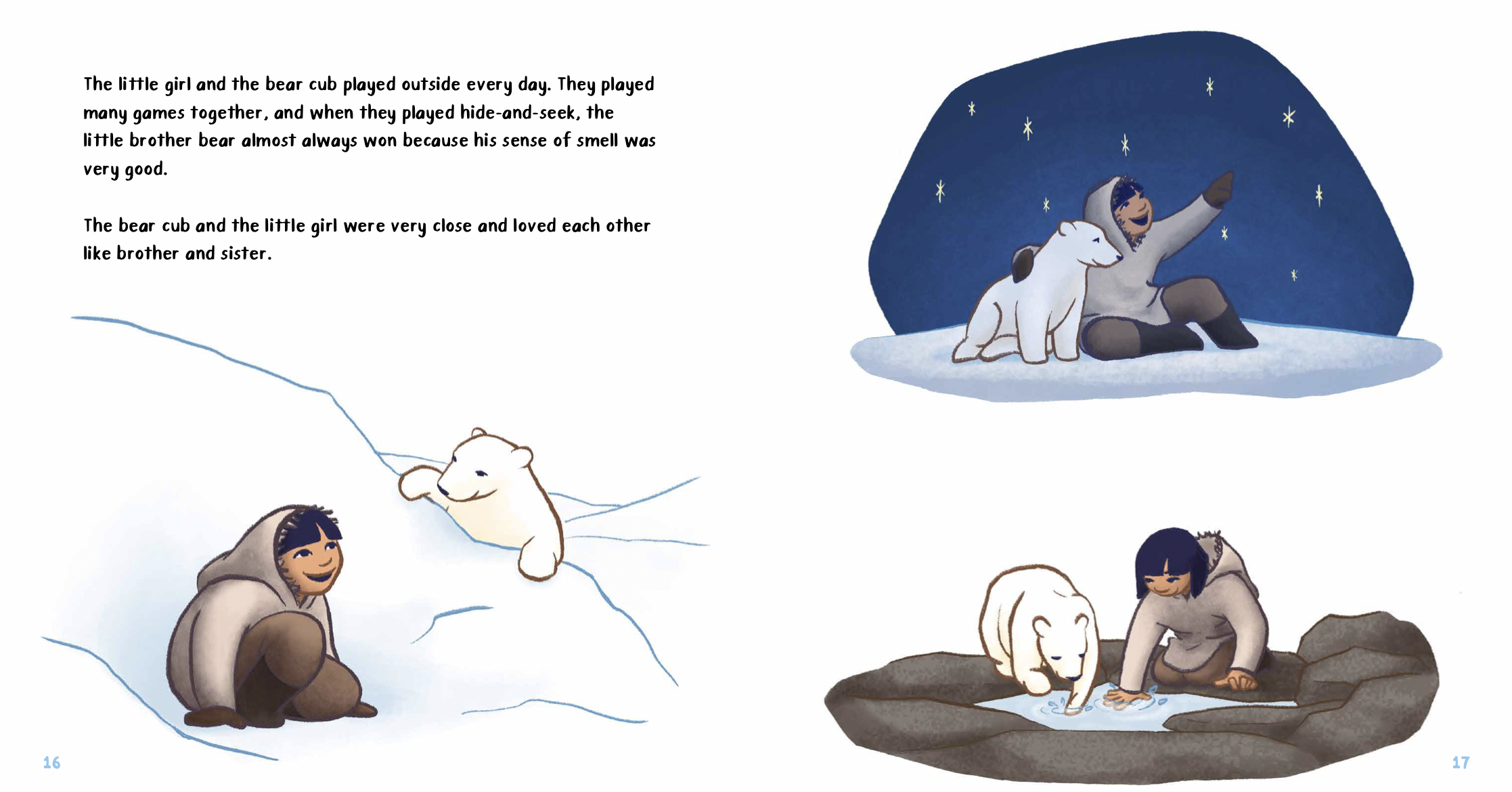
The child calls the cub her baby brother and their bond is as strong as siblings. They spend time together, playing and such, with the bear becoming an integral part of their family, even bringing back seals and fish that he has caught for them.
From The Woman and Her Bear Cub by Jaypeetee Arnakak, illus. by Dayna B. Griffiths
But when the cub is no longer a baby bear, and he becomes so big that the others in the village are concerned, the mother prepares her child for the time he would have to leave them. Still, it isn't until her brother bear returns from hunting one day with his own mother that the mother and child are able to say goodbye.
From The Woman and Her Bear Cub by Jaypeetee Arnakak, illus. by Dayna B. Griffiths
Jaypeetee Arnakak is a multi-talented Inuit linguist, translator, educator, and writer who grew up in Clyde River on Baffin Island. He has edited a collection of traditional stories from oral recordings of Inuit Elders and adapted several into picture books. The Woman and Her Bear Cub is one such traditional story and one that tells of compassion for living things and letting go when the time is right. There is no willful removal of a wild animal to provide companionship or entertainment. Neither is there a selfishness to take and keep what does not belong to them. The mother and her child give sanctuary to a lost bear cub only until he is reunited with his mother. It's not about their needs but about his needs. 

That quietness of purpose and landscape is portrayed in the illustrations of The Woman and Her Bear Cub by artist and designer Dayna B. Griffiths of Toronto. By creating art that appears stark, with a restrained palette of blue, white, and grey-brown, Dayna B. Griffiths makes the Arctic landscape of blue sky and white snow dotted with an occasional qarmaq (dwelling) very powerful. As such, the interjection of a white bear and grey-brown-clad people, with the occasional dog of both grey and white, in that landscape makes them both an important and insignificant focus.

As with most traditional stories, even those that may take on fantastical proportions, there is a germ of truth, and I suspect this one is based in reality. Adopting a lost animal and caring for it until care is no longer necessary is a story for all times. Here, a polar bear and an Arctic landscape may make this story unique, but its premise is grounded in the authenticity of compassion for those in need and dictated only by the one most affected. It is a lesson in selflessness and benevolence and a true reflection of the graciousness of Inuit values.

March 22, 2022

The Gift of the Little People : A Six Seasons of the Asiniskaw Īthiniwak Story

Written by William Dumas
Illustrated by Rhian Brynjolson
HighWater Press
978-1-553799924
48 pp.
Ages 8-12
February 2022
 
While many of us are not fortunate enough to hear a storyteller like William Dumas share the tales of his oral storytelling tradition, illustrated books like The Gift of the Little People are an ideal method for getting those stories told and for providing the visuals that our own experiences might not be able to provide. With words and art together, The Gift of the Little People transports us to the northern Manitoba community of South Indian Lake to see how a legendary people gave the Rocky Cree the medicine they needed for healing.
From The Gift of the Little People by William Dumas, illus. by Rhian Brynjolson
The narrator recalls growing up in remote South Indian Lake and hearing the elders tell stories in the evening. These stories included those of the 3 kinds of little people who were no taller than our knees: those who were static-voiced (mīmīkwīsiwak); those who were troll-like; and those that looked like tiny human beings (apiscithinīwak).

One story he remembers his father telling was of a man named âhâsiw (the Crow) of the Rocky Cree who lived along the Misinippi river (now known as the Churchill River). When there were reports of new people coming into mistiwāsahak (Hudson's Bay) with many new tools and items for trade, a delegation was sent. Upon their return, after numerous favourable trades, a feast was held. But a few days later, several members of that delegation fell ill and then person after person within the band became sick and died. âhâsiw did all he could to heal them but he also prayed for help. And help comes one night in the form of a little man who tells him that the medicine was available but he could only reach it by going through a solid rock face across the lake.
From The Gift of the Little People by William Dumas, illus. by Rhian Brynjolson
Though the task that the little person had given âhâsiw and oskâpêwis (his helper) seemed impossible, it was the means by which the Rocky Cree are able to connect with the little people and help heal themselves.

From The Gift of the Little People by William Dumas, illus. by Rhian Brynjolson
The Gift of the Little People is a companion book to William Dumas's Six Seasons of the Asiniskaw Īthiniwak series which explores the language, culture, knowledge, territory, and history of the Rocky Cree (Asiniskaw Īthiniwak) people. The first book in the series Pīsim Finds Her Miskanaw (2020) will be joined by a second, Amō's Sapotawan, later this year. With The Gift of the Little People, author William Dumas shares much about the Rocky Cree from both a historical and spiritual perspective. From life in a remote location without electricity to the devastation of first contact with Europeans, The Gift of the Little People reveals life of the Rocky Cree and the traditions upon which they prevailed. But within that framework, William Dumas tells readers of the little people. Whether it is folklore based in legends or otherwise–there are countless claims of evidence that the little people exist–the folklore of how the little people came to the aid of the Rocky Cree people when illness resulted from first contact with Europeans is a story worth telling. It's about trusting unlikely allies and accepting challenges for good. And with the artwork of Manitoba visual artist and educator Rhian Brynjolson honouring the First Nations with both its realism and style, without misappropriation, The Gift of the Little People has more than one story to tell of the Rocky Cree and their history and culture.

Six Seasons of the Asiniskaw Īthiniwak series

March 09, 2022

Giju's Gift (Adventures of the Pugulatmu'j)

Written by Brandon Mitchell
Illustrated by Veronika Barinova
HighWater Press
978-1-55379-947-4
88 pp.
Ages 6-9
February 2022

In a new series of graphic novels inspired by traditional stories, author Brandon Mitchell draws on his Mi'kmaq heritage and introduces the pugulatmu'j, the Little People who are guardians of the land.
From Giju's Gift by Brandon Mitchell, illus. by Veronika Barinova
While out strawberry picking, young Mali trips and loses her precious beaded hair clip that once belong to her grandmother (Giju'). But, though it seems no one believes her, Mali knows it was stolen, seeing a little person grab it as well as a basket of strawberries. Her auntie tells her of the pugulatmu'j, the Little People who live high in the mountains and like to play tricks on people to keep them alert. 
 
When she goes outside to play, she catches a little person about to steal a cooling pie. Puug, as he is called, is surprised that she can see him but promises to return her hair clip if she helps him gather some much needed supplies. During their scavenging, they see a jenu, a giant who is consumed by anger and determined to destroy all. 
 
With a little help from Mali's grandfather (Nemijgami) and an important, though chilling, stop at an abandoned residential school, the two new friends are able to put the spirit of jenu at rest and allow Puug his intention to protect the memories of the past.

It's our goal to collect as many moments as we can. (pg. 52)

From Giju's Gift by Brandon Mitchell, illus. by Veronika Barinova
Writing for early readers or early middle graders is a tough job in trying to tell a complete story while being sensitive and cognizant of the readers. Brandon Mitchell is able to create a story that shares elements of Mi'kmaq culture, including its folklore and history, as well as touching on the tragedy of residential schools. But, more than anything, Brandon Mitchell emphasizes the importance of holding onto the memories, whether it's by gathering items as the pugulatmu'j did or cherishing those inherited from our ancestors. To that end, Brandon Mitchell even includes instructions for young readers to create their own memories boxes to commemorate important times. 

Because Brandon Mitchell's story is told as a graphic novel, the visuals are important in conveying more of the story that cannot be told in the limited text of Giju's Gift. This is especially valuable for young readers as they transition from picture books to chapter books. Artist Veronika Barinova makes sure that her illustrations are relatively plain and uncomplicated, with the emphasis on the characters and their actions and vocalizations. She gives the right balance of creepy (jenu) and innocent (Mali) with settings of house and outdoors that are general enough to be familiar. 

With this easy blend of text and art, Brandon Mitchell and Veronika Barinova ensure that young readers will be coaxed to read more about the Adventures of the Pugulatmu'j (this is only the first book in the series) and perhaps learn about the Mi'kmaq, as well as appreciate the importance of memories and traditional stories.

May 05, 2020

The Walrus and the Caribou

Written by Maika Harper
Illustrated by Marcus Cutler
Inhabit Media
978-1-77227-256-7
32 pp.
Ages 5-7
2019

This traditional Inuit origin story from actress Maika Harper and illustrator Marcus Cutler reminds us of the richness of the storytelling tradition, the source of Maika Harper's tale, and the breadth of its narration on revealing culture, history and people.

From The Walrus and the Caribou by Maika Harper, illus. by Marcus Cutler
When Guk was breathing life into the world, she pondered how the different parts of the animals should be organized. The walrus was generated when Guk blew air into her sealskin parka and added some flippers and wrinkles and antlers. (Yes, antlers.) The caribou was created from breathing life into her sealskin pants. With the addition of some big hooves and hair, a snout and tusks, her caribou was complete.
From The Walrus and the Caribou by Maika Harper, illus. by Marcus Cutler
But Guk's enhancements did not all work. The walrus's antlers were not a good idea. When the walrus swam, its massive antlers would upend the hunters' kayaks. As for the caribou, its tusks were not much appreciated by the hunters.

In a mix-and-match situation, Guk swaps out the tusks and the antlers, creating the familiar walrus and caribou of today's Arctic, with a special touch of punishment for the caribou because of its irritability and brashness.
From The Walrus and the Caribou by Maika Harper, illus. by Marcus Cutler
Though Maika Harper tells a simple tale of how the walrus and the caribou came to exist in their present morphologies, she also explains why the caribou avoids humans and encourages young readers to think about what animals they might create. With illustrator Marcus Cutler's Arctic landscape, depicted in a minimal palette of snowy whites, of earthy sandy browns and taupes, and of blue waters and skies, the walrus and caribou and Guk and the few hunters portrayed are the stars. They rule the landscape, living as they do, and sharing the land and water as tradition expected them to do so.

The Walrus and the Caribou may be a creation story with some tongue-in-cheek humour but it is also a representation of some Inuit traditions and culture, from the Inuit's clothing and hair to their kayaks and hunting techniques.  This tale will definitely inform and satisfy young readers, especially by answering, at least partially, that perennial question about where animals came from.

January 17, 2017

The Caterpillar Woman

by Nadia Sammurtok
Illustrated by Carolyn Gan
Inhabit Media
978-1-77227-083-9
32 pp.
Ages 7-10
2016

Piujuq was a beautiful woman who loved to dance with the butterflies by the lake. One day she meets a woman with glowing, green-tinged skin who introduces herself as Tarraq and admits she has become lost and separated from her camp.  Wearing only a thin jacket of strange material, Tarraq shivers with cold and asks Piujuq if they could trade coats, to which the kindly Piujuq agrees.  Soon after the stranger leaves, Piujuq realizes her hair has become spiny and her skin has transformed, becoming prickly and fuzzy and green. Not wanting to frighten her family, Piujuq wanders the land before secluding herself in an abandoned tent.

When three men, on a search for wives, come across her, she offers them tea and mends their ripped clothing.  Though she is saddened when they leave, knowing she was not beautiful enough to become one of their wives, one of the men, an older man named Amaruq, returns and declares that she is very kind and he would like to have her as his wife.  The two fall in love and make a good life together, each caring for the other.  When Piujuq asks him to make a drum so that she might once again dance with the butterflies, Amaruq finds an abandoned drumbeater that makes magical music, ultimately transforming both husband and wife.
From The Caterpillar Woman 
by Nadia Sammurtok
illus. by Carolyn Gan
Inuit writer Nadia Sammurtok has written The Caterpillar Woman as a traditional Inuit tale. The legend which has a moral or message about seeing beyond skin-deep beauty is steeped in Inuit traditions from parkas to drums but with the supernatural element of a caterpillar woman and a magical drumbeater. Though the transformation of Piujuq to a caterpillar woman may be somewhat frightening, and Australian artist Carolyn Gan does this creepiness very well, it is Piujuq’s kindness and the inner beauty both she and Amaraq see in each other that uplifts the story to one of magic.  It’s a story of redemption, though had Piujuq and Amaruq never been transfigured to beautiful and youthful, The Caterpillar Woman would still have had a happy ending and a lesson in seeing beyond superficial appearances.

From The Caterpillar Woman 
by Nadia Sammurtok 
illus. by Carolyn Gan