Showing posts with label Book 5. Show all posts

July 30, 2026

Pipa:m̓: The Touch of the Frog


A green frog sits on a leaf on the book cover of "Pipa:m̓: The Touch of the Frog" 
Written by Joseph Dandurand
Illustrated by Elinor Atkins
Nightwood Editions
978-0-889715004
32 pp.
Ages 6–8
June 2026 
 
As part of his series Kwantlen Stories Then and Now, author Joseph Dandurand, himself a member of the Kwantlen First Nation, tells the story of a clever young girl who helps her community through her relationship with a frog.
Two boats rest on the shore with a bright sun in the background. There are baskets on the shore.
Illustration by Elinor Atkins from Pipa:m̓: The Touch of the Frog, written by Joseph Dandurand
The community is preparing for the first fish of the season. Fires are made and nets are mended. Tsa'kwi'ah is a small girl who tries to help but she is too small. After the men go out, Tsa'kwi'ah walks along the river and sees a green frog. She smiles at it and it at her. When she touches it, she becomes strong and tall. Now she can outrun the other children and she can carry heavy fish.
A bare-footed girl with long dark hair is wearing a blue dress and a red cape. She stands in a forest.
Illustration by Elinor Atkins from Pipa:m̓: The Touch of the Frog, written by Joseph Dandurand
Months later, when many of the villagers, including Tsa'kwi'ah's mother, are sick with red spots and high fevers, Tsa'kwi'ah recalls how the green frog helped her. Taking the frog to her mother and everyone in the village who was sick, Tsa'kwi'ah has them touch the frog and become healed. 
A green frog sits in a tree with pink flowers.
Illustration by Elinor Atkins from Pipa:m̓: The Touch of the Frog, written by Joseph Dandurand
It is known that there are naturally occurring antibiotics secreted from the skin of some frogs so the notion of the touch of a frog being therapeutic is not far-fetched. But, as in all storytelling, it's the germ of an idea that becomes a fuller story. As Pipa:m̓: The Touch of the Frog is told by a member of Kwantlen First Nation, I presume that this is traditional story that has been told many times and through many generations. Whether or not the details are exact—did Tsa'kwi'ah really become stronger and taller or just healthier and older?—is irrelevant. Joseph Dandurand tells the story about community, about healing from unusual sources, and about a connection with the natural world. It's about helping where and when you can, and finding your opportunities to be useful.  
A girl holds a green frog out to an elderly Indigenous woman as she sits among other community members.
Illustration by Elinor Atkins from Pipa:m̓: The Touch of the Frog, written by Joseph Dandurand
Pipa:m̓: The Touch of the Frog is a deeply traditional story, so Elinor Atkins's artwork complements it with her brightly coloured illustrations that blend the traditional with the organic. Elinor Atkins, also a member of the Kwantlen First Nation, tells more about the story and the community, using line, shapes and colour to take readers to Tsa'kwi'ah's home.

Though 
Pipa:m̓: The Touch of the Frog  is the first of the Kwantlen Stories Then and Now that I have reviewed, there are four earlier books with more stories to tell. I encourage young readers and those who teach them to look at the whole series. As traditional stories, they keep the stories of a people alive and put to paper that which is usually shared through oral storytelling. 
 
 • • • • • • •
 
Kwantlen Stories Then and Now
Five book covers, from left to right, of The Sasquatch, the Fire and the Cedar Baskets; A Magical Sturgeon; The Girl Who Loved the Birds; The Bears and the Magic Masks; and Pipa:m̓: The Touch of the Frog.
The Sasquatch, the Fire and the Cedar Baskets (2020)
A Magical Sturgeon (2022)
The Girl Who Loved the Birds (2023)
The Bears and the Magic Masks (2024)
Pipa:m̓: The Touch of the Frog (2026)

February 12, 2026

I'm Busy

Written by Michael Ian Black
Illustrated by Debbie Ridpath Ohi
Simon & Schuster Books for Young Readers
978-1-6659-1524-3
40 pp.
Ages 4–8
Releases February 24 2026 
 
Michael Black and Debbie Ridpath Ohi's remarkable trio—a little girl, a pink flamingo, and a potato—from I'm Bored (2012), I'm Sad (2018), I'm Worried (2019), and I'm Sorry (2021) have returned, and now one of them is struggling with overcommitment and a lack of life balance. Together they've always helped each other through their issues. Can they help this time? And will there be a time when they can fit it in?
From I'm Busy, written by Michael Ian Black, illustrated by Debbie Ridpath Ohi
Flamingo wants to play, but every time he asks his friend, the little girl with the darling yellow barrettes, if she wants to play superheroes or Hula-Hoop, she tells him that she's busy. She may be painting or coding or experimenting or practising her trumpet, but it's always something. And her reasoning? "I can't! School starts in two weeks and then I've only got twelve years before college applications are due!" (pg. 7) Yikes. This child has a lot on her mind and her calendar.
From I'm Busy, written by Michael Ian Black, illustrated by Debbie Ridpath Ohi
Flamingo is very understanding, as is the droll Potato ("I can't read," he says when she shows them her calendar. [pg. 9]), but their questions about when she'll have time disquiet her. They try to help her slow down by watching the clouds, and that finally makes her realize that she needs to find balance to her dilemma. (FYI, a dilemma is not like a soufflé as Potato suggests.)
From I'm Busy, written by Michael Ian Black, illustrated by Debbie Ridpath Ohi
This little girl isn't just busy. She's also stressing because of that busyness. But with the help of her friends, making time for herself, and maybe some playing in the mud, she finds some balance in her life. And she finds it with humour, companionship, and uncommon wisdom. 
 
The humour is courtesy of American comedian (and actor and writer) Michael Ian Black who manages to make readers laugh while guiding them through common childhood dilemmas. Here, taking on more than she can handle is the result of uncertainty about her future and whether she can accomplish all that she feels she must. Though there are no adults in Michael Ian Black and Debbie Ridpath Ohi's I'm books, I can't help but think that there are some adults in the little girl's life compounding her worries. (Mind you, she's already coding so all this could be a result of her own awareness of what she needs to do to be successful.) Her friends may be unusual, but with Flamingo's eagerness for play, and Potato's apparent inertia, Michael Ian Black has created a perfect trio of characters that children will appreciate, maybe even know, and from whom they can learn while laughing, right down to the last line.
 
But I'm Busy needs Debbie Ridpath Ohi's illustrations to bring the story to life. We know the book's characters through her art, as well as Michael Ian Black's voice, but she gives them the colour and shape and expression that makes them easily identifiable and wholly adored. There is never any question that this little girl is accomplished but frantic with busyness. Her eyes are focused, she has a strained or absent smile, and, when she's really anxious, there are despair lines around her eyes. Debbie Ridpath Ohi's artwork is so evocative that she can create deep emotions with just a few lines. (Look at Potato in the illustration below. With just two eyes and a mouth, it is evident that he is cringing at her trumpet playing.) Thanks to Debbie Ridpath Ohi's art, reading I'm Busy is a treat for the eyes as well as the spirit.
From I'm Busy, written by Michael Ian Black, illustrated by Debbie Ridpath Ohi
Help young children find balance in their lives with some humour, extraordinary friends, and an abundance of colour and joy with a reading of I'm Busy. Then read the other I'm books in the series to help them understand their feelings and handle them with self-assurance, with or without a flamingo or a potato by their side.
 
  •   •   • 
 
Read all five of the I'm books by Michael Ian Black and Debbie Ridpath Ohi. After all, it's important to make time for the good things in life. 
 
I'm Bored (2012)
I'm Sad (2018)
I'm Sorry (2021)
I'm Busy (2026)
 
Also, there are some fun resources 
at Debbie Ridpath Ohi's page for I'm Busy here
  •   •   • 

July 14, 2022

The Return of the Mummy (The Lunch Club #5)


Written and illustrated by Dom Pelletier
English text by Dina Ginzburg
Scholastic Canada
978-1-4431-9584-3
136 pp.
Ages 7-10
July 2022 
 
In Dom Pelletier's latest volume of his hysterical middle grade graphic novel series, the members of the secret Lunch Club a.k.a. the Philately Club must do some ingenious problem solving with time travel in order to help their teacher, Mr. Peabody, and the original founder of their club, Eglantine, from the nefarious actions of a trio of evil-doers.
From The Return of the Mummy (The Lunch Club #5) by Dom Pelletier
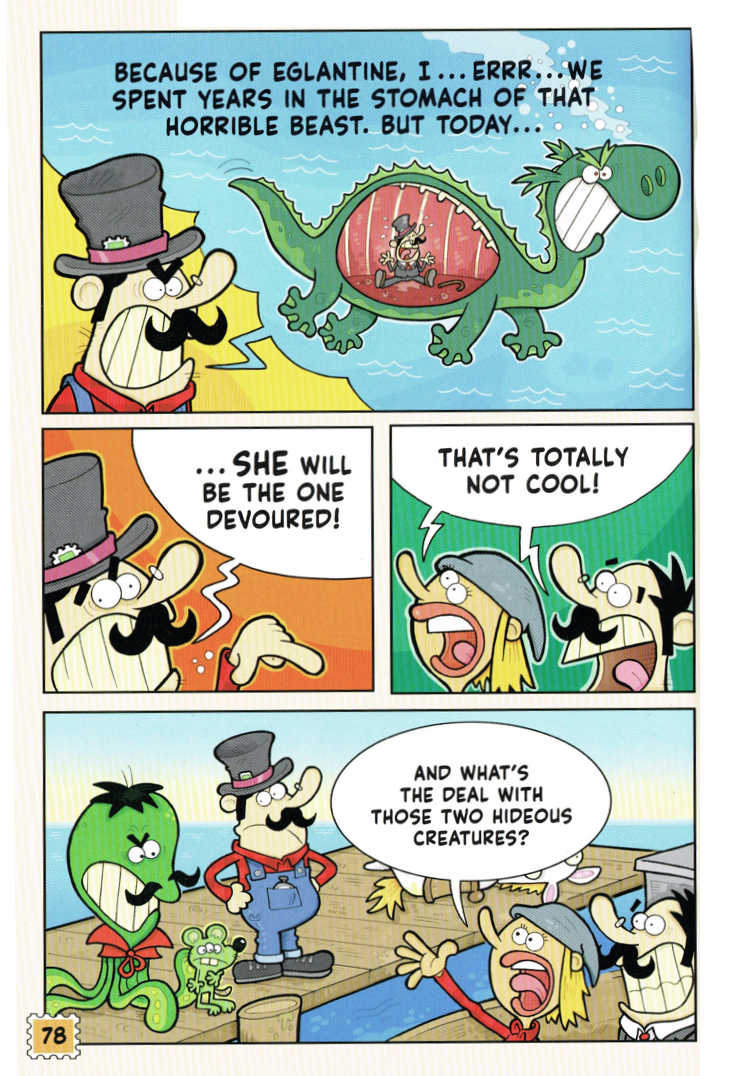
Determined to save himself from being eaten by Fluffy the sea monster in 1803, the villainous McSticky transports himself back in time, along with the huge moustachioed space monster Zaralgax and his mutant rat companion. Sadly Mr. Peabody is accidentally transported too. But time travel is not necessarily straightforward and the group ends up in various times before the bad guys end up where they want to be. 
From The Return of the Mummy (The Lunch Club #5) by Dom Pelletier
Meanwhile Tia and Leo end up bringing back to the school a mummy they release from a sarcophagus while on a field trip to the museum and discover, through some very funny circumstances, that it is actually someone they know who hoped to be discovered in the future. With a lot more laughs and some more time travel from the future and into the past, Tia and Leo are able to save Eglantine before McSticky changes the course of history and gets Fluffy to eat her instead.
From The Return of the Mummy (The Lunch Club #5) by Dom Pelletier
There will be belly laughs, quiet snickers and loud guffaws from kids as they again visit with Leo and Tia and Mr. Peabody in Dom Pelletier's The Lunch Club. Their teachers and parents will understand the irreverence of the stories but kids will just laugh. From Leo who is always getting into mischief like trying to wake up a mummy–"Hey, Mummy, wakey-wakey!"– or sticking fridge magnets to his braces, and Mr. Peabody who can sleep anytime and for long periods, courtesy of a radioactive mosquito, to the odd villains who annoy them, Dom Pelletier has created the weird and wonderful in The Lunch Club. Add a heavy dose of the fantastic, with time-travel, aliens, and wacky contraptions, and The Lunch Club is the place for middle grade readers to visit for a literary snack.
 
• • • • •

The Lunch Club (originally available in French as Les timbres):

#2 The Curse of the Scarewolf
#3 The Mutant Mouse from Outer Space
#4 Revenge of the Bigfoot
#5 The Return of the Mummy
 
Do check out the website dedicated to The Lunch Club, including activities, videos and learning to draw with Dom Pelletier, at Scholastic Canada here.

• • • • •

October 20, 2021

Halloween Mouse

Written by Philip Roy
Illustrated by Lisa Ferguson
Ronsdale Press
978-1-55380-653-0
32 pp.
Ages 2-6
October 2021
 
If the leaves are falling, then Halloween is on the horizon. Undoubtedly many children are already gearing up for the trick-or-treat holiday of costumes and candy, but there's one little mouse named Happy who's just learning of the spooky event and is ready to embrace it completely. 
From Halloween Mouse by Philip Roy, illus. by Lisa Ferguson
When Happy the Pocket Mouse, John's enduring purple-hued murine friend, sees the leaves falling and an elderly neighbour decorating her house with ghosts and such, he does what he always does: asks lots of questions. 

"Well, they dress up and go door-to-door to ask for treats."

"That sounds boring, John! I'm glad we don't do that. What are treats?"

"Candy."

"Candy? Treats are candy?"

Of course, with the intensity of a youngster, Happy decides they should dress up and go out for Halloween. Unfortunately, John is reluctant, claiming he's too old. But Happy, through a series of pointed questions, gets John to relent–after all, you're never too old for candy!–and helps with some surprise face-painting to make John scary-looking.
From Halloween Mouse by Philip Roy, illus. by Lisa Ferguson
Eager and impatient, Happy prods John into heading out before all the candy is gone. But being an adult going trick-or-treating, an activity generally limited to youth, John is not always welcomed with enthusiasm and is often questioned.
From Halloween Mouse by Philip Roy, illus. by Lisa Ferguson
Still, the friends return home with a cornucopia of candy and Happy dives in a little too enthusiastically, as children often do, and needs to recover while John discovers the nature of his disguise.

When Philip Roy introduced young readers to Happy the Pocket Mouse in Mouse Tales (2014), he gave us a unique friendship as the basis for positive messages about curiosity, adaptation, and sharing. John may act like the adult or even parent in the relationship, trying to educate Happy and help him understand so much of the human world but he's so much more, mixing companion, sidekick, and mentor into a congenial sage. And Happy is the bright spot of inquisitiveness and heart, eager to learn and experience new things, but always with John by his side for guidance.

This is the first Happy the Pocket Mouse book to be illustrated by Ontario's Lisa Ferguson (https://studioferguson.com/) who emulates the characters and landscapes of the original books with dexterity and feeling. Happy is still sweet and innocent and John is insightful and warm-hearted. Their touching relationship and honest explorations are portrayed with gentle colours and soft lines, even as related to potentially scary Halloween. 
 
But Halloween is anything but scary, something Happy is often concerned about, with Halloween Mouse because Philip Roy's words and Lisa Ferguson's art have given us the sweetness of a chocolate bar and the amusement that comes with dressing up wrapped up in a special friendship that the very young will appreciate. And, of course, there is candy!

🎃 🎃 🎃 🎃 🎃

There are now five books in the Happy the Pocket Mouse series from Philip Roy. Books 1 through 4 were illustrated by Andrea Torrey Balsara with Lisa Ferguson doing the artwork for Book 5.

Mouse Pet (2015)
Halloween Mouse (2021)

August 09, 2017

Crystal Storm: Falling Kingdoms, Book 5

Written by Morgan Rhodes
Razorbill
978-1-59514-822-3
379 pp.
Ages 12+
2016

At the conclusion of Book 4, Frozen Tides, the four Kindred, stone orbs possessing elemental magic, had been retrieved and possessed by four different entities.   Now Princess Cleiona has the earth Kindred, King Gaius possesses the air Kindred and Empress Amara has the aquamarine that is the water Kindred, while Kyan the fire god has already been released from the amber orb that is the fire Kindred. And everyone wants to possess all four so that they may unlock the power of the full Kindred.  But things are not that straightforward, as there are still power struggles for control, alliances made for breaking and allegiances in flux.

Now married to the Empress Amara, who killed off her whole family to reign the Kraeshian Empire, King Gaius has survived a fall that should have killed him but didn’t because of a potion for strength he’d been given years earlier by his mother.  He is determined apparently to right some wrongs and that includes defeating Amara, reclaiming the kingdom of Mytica and getting the Kindred, all by joining forces with his son Prince Magnus and his wife, Princess Cleiona, and seeking his sorceress daughter Lucia.  Though reluctant to join forces with him, Magnus and Cleiona have their own reasons to do so, including getting help to break a curse that would kill Cleo should she become pregnant.  With the help of  King Gaius’ mother, Selia, the King and entourage head to Paelsia.

Meanwhile, Lucia is looking to redeem herself after the role she played in aiding Kyan whose wrath led to the destruction of a Paelsian community.  She enters the Sanctuary of the immortals to learn that it is up to her to find and imprison Kyan and locate the other Kindred to return them to save the Sanctuary.  How she will do this with all of Paelsia seeing her as a dark witch who unleashed evil on their land and with her pregnancy progressing exponentially?

Yet another contingent is made up of the Paelsian rebel Jonas; Cleo’s childhood friend Nic; Felix Gaebras, the former assassin of King Gaius and recent victim of Amara; Taran Ranus, twin brother of the Paelsian killed by Magnus; and the newly-resurrected brother of Amara and love interest of Nic, Prince Ashur Cortas.

Everyone is heading to Paelsia, looking for Lucia and the Kindred.  That is, if they don’t all kill each other first.  But death seems to be an elusive state for many in Crystal Storm.  There are those who were killed or almost so who are seemingly resurrected by potion or magic.  Then there are others whose deaths were announced too hastily.  Staying alive is a lot harder when everyone is harbouring secrets and resentment and seeking retribution or justice or even power, determined not to let anything or anyone stand in their way.

Some may have thought this series was going to be a trilogy but thankfully it is not.  Falling Kingdoms continues to flourish under Morgan Rhodes' mastery of time and place and story, bringing characters to and from death and fighting for control in this fifth book in the series.  And if I’ve learned anything, it’s that every character is dynamic and ever-changing.  For me, Magnus has become a character for whom I will continue to cheer (and when you read the ending, you’ll understand why).  He has always been driven, initially by ego, having killed Cleo’s love interest in Falling Kingdoms (Book 1), but now by love and a desire to make things right.  Cleo, on the other hand, has become fickle, choosing whom to trust and whom to distrust seeming at whim.  She’s very quick to chastize some, especially Magnus, and forgive others, like Nic, but never recognize her role in the antagonisms she helps perpetuate between men like Magnus, Jonas and Nic.  I almost wished to be done with Cleo except for what she means to Magnus.  Of course, Morgan Rhodes could change everything in Book 6 (Immortal Reign, due out February 2018) and she probably will.

Thankfully the story is still being told. Long live Auranos and Limeros and Paelsia and the Kraeshian Empire and all the realms of the Falling Kingdoms.

Rebel Spring (2013)
Frozen Tides (2015)
Crystal Storm (2016)
Immortal Reign (for release 2018)

July 11, 2016

Door into Faerie: The Shards of Excalibur, Book 5

by Edward Willett
Coteau Books
978-1-550506549
196 pp.
Ages 13+
June 2016

Ariane Forsythe, the heir to the Lady of the Lake, and her  boyfriend Wally Knight, successor of King Arthur, are on their final quest to locate the fifth shard of Excalibur, the hilt, and reforge the legendary sword.  That is, unless computer magnate Rex Major a.k.a. Merlin and Wally’s sister Felicia a.k.a. Flish don’t discover the hilt first, allowing them to claim the whole sword.  With both sides endowed with magic and power and harbouring two shards, it’s anyone’s game in Door into Faerie, the final book in Edward Willett’s pentalogy.
Magical quests are easy; family is hard. (pg. 30)
Having been away for five months from his family, dysfunctional as it is–dad with his girlfriend, mom often off filming and his bullying sister now aiding Merlin–Wally convinces Ariane to transport them to Scotland where his mother is working on her lastest film project at Castle MacPhaiden, named for her side of the family.  Unfortunately, Rex Major and Flish are already there and Wally suspects that, because his mother is researching family legends, Rex Major believes she’ll discover something that will lead them to the hilt.  But Ariane and Wally are the first to realize that the treasure his Great Grandfather Knight had fled to Canada claiming to protect is actually that final piece of Excalibur.  So, the race to the grounds of the historic site Cannington Manor in Saskatchewan and unearthing of the hilt ensues, but not without a little frustration, a whole lot of magic, some familial obstacles, and a climactic battle.

While Edward Willett may not exactly conclude his Shards of Excalibur series with Ariane and Wally fulfilling their quest of retrieving the sword for the Lady of the Lake (you’ll need to read the book to understand that), Door into Faerie closes favorably in more ways than one and Excalibur is not the only entity that is rebuilt at its finale.  This fifth book is as forged with magic, conflict, action and travel, as well as a little history, as the earlier four books–Song of the Sword (Coteau, 2014), Twist of the Blade (Coteau, 2014), The Lake in the Clouds (Coteau, 2015), and Cave Beneath the Sea (Coteau, 2015)–but family, which has always been important, becomes paramount.  Brothers and sisters Merlin and the Lady of the Lake, and Wally and Felicia, as well as mothers Emily Forsythe and Jessica Knight, drive the story, and ultimately help resolve its plotlines, a monumental task in a fantasy based on the Arthurian legends.  Yet Edward Willett accomplishes this easily with his consistent intensity and fluidity of plot progression.  The rebuilding of Excalibur may be the final outcome but it’s the quest that is the journey that regales readers right through the series. 

May 26, 2016

Door into Faerie: Book launch (Regina, SK)

Author Edward Willett

concludes his YA fantasy series

The Shards of Excalibur  


with Book 5 


Door Into Faerie
Coteau Books
978-1-550506549
208 pp.
Ages 13+
May 2016

which launches

 on

Wednesday, June 8, 2016

at 

7 p.m. (CST)

at

Artful Dodger Cafe & Music Emporium
1631-11th Avenue
Regina, Saskatchewan 


From https://www.facebook.com/events/1711092289146493/

In the climactic fifth book of The Shards of Excalibur series, Ariane, Wally, Flish and Rex Major are on a collision course, converging on the resting place of the final piece of the sword: the hilt, long ago removed from its original hiding place by the descendants of King Arthur. When Wally uncovers its surprising location, far closer to hand than they’d ever guessed, it seems all Ariane and Wally have to do is claim it and reforge the sword to defeat Merlin forever.

Except...how, exactly, do you reforge a magical sword? Especially, how do you do it when the richest man in the world is on your trail and pouring all of his enormous resources into stopping you?

When the pieces of the sword are at last reunited, the results aren’t at all what Ariane and Wally imagined. With Excalibur whole again, the long-closed door into Faerie swings open wide. Who — and what — emerges from it may destroy everything and everyone Wally and Ariane have fought so hard to save — and allow Rex Major to snatch victory from the very jaws of defeat.

Fighting side by side, Ariane and Wally must draw on all their strength, courage, magic and love to save the world…and there’s no guarantee it will be enough.


April 25, 2015

Neil Flambé and the Bard's Banquet

Written and illustrated by Kevin Sylvester
Simon & Schuster Books for Young Readers
978-1-48141-0-380
320 pp.
Ages 8-12
January, 2015

Boy chef Neil Flambé, now 15, can't seem to keep himself out of trouble, not even when he tries.   He tries to ignore a jar of old honey with its mysterious note in it that was part of a case excavated at a demolition in London and now the basis for a meal extraordinaire he is preparing for Lord Lane of Liverpool.  But an unexpected shortage requires the ostracized jar to be opened, and the note– with a poem, some numbers and a drawing of a key–is taken by Lane, a Shakespearean aficionado and thespian supporter, but not before Neil's cousin and partner, Larry,  snaps some photos of it.  

As luck (?) would have it, Lord Lane disappears and Her Majesty "requires" that Neil and his Nose–he can sniff out anything–promptly travel to London to smell out the mystery and, of course, find Lane and the "jewel" alluded to in the note.  Neil may have the Nose but it's Larry with his limitless knowledge of Shakespeare's work–I know, go figure–and his sweet affection for the ladies who enables Neil to search out the right sources and decipher the multi-layered clues.

The two are soon partnered with Rose Patil, the uber-brilliant chemist and acquaintance of Neil's sweetie, perfumier Isabella Tortellini. The thorny Rose, who is working at recreating the actual scents that Shakespeare's wife may have worn, agrees to help them decipher the note, suggesting their investigation begin with Will Kemp, a comedic actor whose friendship with Shakespeare had mysteriously sour.  Following clues about Drake's voyage, the Globe Theater, a clock and more, Neil, Larry and Rose, and eventually Isabella and her bodyguard Jones, begin an action-packed foray into history, Shakespeare's work and Elizabethan cooking, while being pursued by the unsavoury Crayfish brothers, all in the hopes of discovering the "jewel" and finding Lord Lane, hopefully alive.

Neil Flambé and the Bard's Banquet is a full serving of epicurean delights, that infuses a mystery with history, action with education–do your homework, Neil!–and fromage with farce.  And the punning and word play is wonderfully inventive and flavourful! 
"So since food and Shakespeare are the themes of the day right now, I wondered what Shakespeare would call his plays if he were also a chef!" (pg. 212)
...
"Measuring Spoon for Measuring Spoon!"
"The Taming of the Stew!"
"Romeo and Omelet!"
"Twelfth Bite!"
"A Midsummer's Light Cream!"
"The Merchant of Venison!" (pg. 213)
The solution to the mystery is never, never evident, unless you are a scholar of food, Shakespeare and word play, and perhaps not even then.  It takes an assortment of characters, some sweeter than others, to separate the clues, then blend them together into something that is both recognizable, palatable and delicious. Kevin Sylvester does this easily in Neil Flambé and the Bard's Banquet, perhaps his most bountiful Neil Flambé Caper to date.  

  *  *  *  *  *  

Yes, I loved Neil Flambé and the Bard's Banquet but I must share with you a brief Twitter conversation I had with author Kevin Sylvester about the end of the book.  I hope that, if my review doesn't get this book into your hands or into your school, this might.


You'll need to read this book to see what I mean, and then we'll all have to wait for Book 6 for a more revealing answer.

June 24, 2013

The Sinking of the Wiley Bean

by Margaret J. McMaster
Mansbridge Dunn Publishers
978-0-981-052557
50 pp.
Ages 7-9
2013

It's very difficult to find engaging reads for children, usually ages 5 to 7, who want to move out of picture books and onto the novels of the older kids.  Although large-format picture books can be just as challenging as lengthier reads, many children see moving up to "chapter books" as a rite of passage.  But too often, they select titles about which they've heard e.g., The Hobbit and Twilight (but totally age-inappropriate) or with recognizable elements e.g., movie, TV or game tie-ins (which can be of questionable quality). A more appropriate choice for a transition book between juvenile picture books and novel-length fiction would be the length of a short-story, with age-appropriate vocabulary and a linear plot.  Margaret J. McMaster's Babysitter Out of Control series would fit well on this bookshelf.

In this fifth book of the Babysitter Out of Control series, our young narrator Stewart is in Mongo Tongo with his care-giver, Mrs. Alice Chairbottom, and Colonel Alfred Peabody to organize the seniors' wedding.  While Mrs. Chairbottom spends endless time with the wedding co-ordinator, Colonel Peabody and Stewart go beachcombing, finding a frightening ship's figurehead which Stewart takes back to his room.  Shortly thereafter, Stewart begins having vivid nightmares of being aboard a ship during a terrible storm in which the ship breaks apart.  And, in his waking life, everything for Mrs. Chairbottom's wedding seems to be falling apart just as easily: the weather is stormy; the airport gets closed; the clothes she's selected for her husband-to-be and best man are unavailable; and her wedding cake is ruined during an earthquake.  Without giving too much more away, the story lines are resolved happily and the premise for the next volume of Babysitter Out of Control is established.

I do love the stories in the two Babysitter Out of Control books that I've read, as they have some intrigue, some humour, and some real-life issues. The Sinking of the Wiley Bean will keep the young readers engaged with the shipwreck scenario, Stewart's nightmares, and the ill-timed troubles impacting the wedding.  I don't know if they will be as concerned as I was wondering who Ronald is, a character who keeps driving Mrs. Chairbottom here and there. Without any reminders or explanations as to his relationship to the other characters in the story, Ronald is a black hole to me, not something you want in a book which should be able to stand alone.

Don't let the triviality of my unease, however, sway you from giving this story a try.  Mrs. Chairbottom is the babysitter with whom most young children would enjoy spending time, as Stewart obviously does, leading him into unusual situations and providing atypical adult responses to most circumstances.  Stewart's parents both trust Mrs. Chairbottom to care and nurture his young mind.  I think you can safely do the same.