Showing posts with label word play. Show all posts

May 25, 2026

Still Friends

Book cover of "Still Friends" by Troy Wilson and illustrated by Mike Deas shows a dog on top of a statue of a sitting woman
Written by Troy Wilson
Illustrated by Mike Deas
Orca Book Publishers 
978-1-4598-4257-1
32 pp.
Ages 3–5
May 2026 
 
When a dog makes a new friend in the park, he can't help but compare her to his old friend. But is that really fair? After all, maybe his new friend has different stuff to offer.
A woman with a kite, coffee, and newspaper heads with her beagle towards a stone statue of a woman sitting
From Still Friends, written by Troy Wilson, illustrated by Mike Deas
When we first meet this adorable beagle, he's with a wonderfully quirky woman with a red ball cap who plays with him, speaks to him, walks him on a long retractable leash, and gives him treats and lots of scratches. But his new friend is a little different. She sits stoically on a bench-like plinth, never speaking and never moving. Just "stone-cold silence."
A dog looks up at a stone statue of a woman sitting beneath a tree in autumn
From Still Friends, written by Troy Wilson, illustrated by Mike Deas
He's a little put off by her silent treatment and soon realizes that she offers a different kind of friendship, to him and a group of pigeons. She offers shelter and support. She never scolds or frowns at him. She definitely doesn't dress him up in silly costumes. And she always listen.
A stone statue of a woman sits with a dog nearby beneath a tree as it changes through the four seasons
From Still Friends, written by Troy Wilson, illustrated by Mike Deas
This little beagle learns soon enough that none of them is perfect, including himself, and each offers something that makes them a dependable friend to have.

Troy Wilson, author of Liam Takes a Stand (2017), Little Red Reading Hood and the Misread Wolf (2019) and Goldibooks and the Wee Bear (2021), has written a picture book that is both subtle and candid. It reminds me of the old saying by Joseph Parry (and later adapted into a Girl Guide song) to "Make new friends, but keep the old; Those are silver, these are gold." This beagle has a person who is with him all the time, doing the fun stuff and the discipline stuff too. They are the friend and parent, companion and teacher. But for the beagle to expect his new friend, a stone statue of a girl or young woman seated with her hands in her lap, to be the same is just an innocent confusion of what makes a friend. With observation and insight, the beagle realizes that his still friend could still be his friend regardless of how different she is from his old friend. (Hope you're picking up on the puns and word play in Still Friends.) 
A park bustles with activity, including a stone bridge over a river, and a dog watching a stone statue
From Still Friends, written by Troy Wilson, illustrated by Mike Deas
Even though Troy Wilson likes to play with words, adding some humour to a story about accepting friends as they are, Still Friends asks readers to reflect on their own friendships, just as this beagle has. Because he has done so, through observation and with insight, his life is richer for his awareness. That same lightness and delicacy with a shade of circumspection comes through in Mike Deas's artwork which was created with pastel and pencil crayons with ink outlines. As in his many books in the Scholastic Canada Biography series (written by Elizabeth MacLeod), the early reader Two Tales of Twenty-Six: Liam and the Letters, Walter and the World (written by Stephanie Simpson McLellan, 2024), and his own SueƱo Bay Adventures with Nancy Deas), Mike Deas gives us texture and life, even in a story that has to balance brightness with gravitas. He is an illustrator whose style can give us the playfulness but with a sheen of weight in the messaging. It's that same juxtaposition of the beagle's two friends that shows up in Mike Deas's art and complements Troy Wilson's story so well.
 
Next time your child or a student is struggling with friends and wondering if they can be friends with others, give Still Friends a read. It will help them understand that there are many friends out there and by appreciating our differences, including our own imperfections, it will help us establish rock-solid relationships, not just win popularity contests.

October 01, 2024

Puffin and Penguin

Written by Helaine Becker
Illustrated by Kevin Sylvester
Kids Can Press
978-1-5253-0654-9
80 pp.
Ages 6-9
October 2024
 
Who knew that Puffin's life would change so much when his mom got a new job at the United Avian Nations in New Stork City?! But a move from Iceland to their new home in Brookloon must also include the making of new friends, so there is that. 
From Puffin and Penguin, written by Helaine Becker, illustrated by Kevin Sylvester
At his new school, Puffin is introduced to a diverse group of students, from Eaglet the nervous Nellie; King Penguin, the cool kid; Screech Owl,the coding whiz; and Canada Goose, the fashionista. When his teacher, Ms. Grey, buddies Puffin up with Penguin, it's not a perfect match. Penguin already has so many responsibilities and activities that taking on one more, especially the enthusiastic Puffin for whom he has little time, is just too much.
From Puffin and Penguin, written by Helaine Becker, illustrated by Kevin Sylvester
 Initially Puffin is annoyed about being abandoned and with everyone calling him a "funny-looking lil' penguin" (p. 27) but his father advises him that there's no need "to get so hot under the feathers" (p. 29) and to give his new classmates a bit of "puffin pedagogy." (p. 31)
 
So Puffin hatches a plan–lots of fun word play in Puffin and Penguin–to inform his classmates about himself and puffins and to make some new friends by joining the Drama Club. But his efforts come across as bragging and he realizes he often comes on too strong and appears to be trying too hard. Still when there's a glitch with the lighting during the performance of "King Midas and the Golden Pinkie," it's Puffin's fluorescent beak that saves the day. 
From Puffin and Penguin, written by Helaine Becker, illustrated by Kevin Sylvester
Puffin and Penguin has this amazing blend of science–who knew puffins' beaks fluoresced?–and word play and humour and plain old fun. Helaine Becker's story of two birds who are unlikely buddies shows young readers ways to make friends and to accept differences. And by telling her story with a plethora of puns, Helaine Becker actually makes you laugh while demonstrating ways to be a friend and make a friend while being true to yourself. (Puffin makes it clear, for example, how much he dislikes being called Puffy.)
 
And then there's Kevin Sylvester's artwork that adds even more humour. From making Penguin truly look overextended and weary to Puffin ranting about Penguin's neglect and Puffin's "Too Cool for School" backpack–highly relevant for a bird coming from Iceland–Kevin Sylvester's cartoon illustrations tell more about the story, intensifying the fun and revealing more about the characters than words alone could. 
From Puffin and Penguin, written by Helaine Becker, illustrated by Kevin Sylvester
Because it's an early reader graphic novel, Puffin and Penguin has to work for younger readers in the 6 to 9-years-old audience, giving them more than a picture book but less than a middle grade novel. But Helaine Becker and Kevin Sylvester have found a perfect combo of message and medium, giving readers a relatable story of moving to a new place and making friends with the chuckles and brightness of an illustrated book. Puffin and Penguin is a perfect bundle of everything to entertain and even inform. They don't need more Penguin and Puffin to complete their story but I think young readers would be delighted if Helaine Becker and Kevin Sylvester would take us on a few more adventures with our new avian friends. Do I see a cultural exchange in their future perhaps?

March 04, 2024

Hugo's Haunted Handbook

Written and illustrated by Dave Whamond
Owlkids Books
978-1-77147-587-7
32 pp.
Ages 5-8
Releases March 15 2024
 
Who better to help others get rid of their unwanted ghosts than Hugo? After all, he got rid of his ghost. Or did he?
From Hugo's Haunted Handbook, written and illustrated  by Dave Whamond
Hugo's first instruction is to ensure that you really have a ghost, so he has devised three simple experiments. The first involves cookie crumbs, the next uses a camera, and finally there's locating any ectoplasm.  (He also notes that the pros use EMF Readers.)
From Hugo's Haunted Handbook, written and illustrated  by Dave Whamond
So, if you have a ghost, the next step is to learn about them. Did you know that they watch us, have bad days, get static cling, and love practical jokes?
Darn! They short-sheeted me again! You guys...
The problem for Hugo isn't that ghosts are necessarily scary; they are just annoying. (No one wants to be interrupted in the bathroom!) So, Hugo has 5 useful tips that the reader can use to get rid of their ghost forever.

With Tip #1, to yell "Bam shicka lam shicka boom boom bam" three times, Hugo gets to work. Trouble is that the ghost doesn't seem to respond as Hugo wishes.
Yep, still here.
Now what? Hugo tries several other fixes, all things that kids can do. (Okay, cooking up the Ghoul Begone potion might be tricky if you can't get your hands on maggot snot or aardvark poop, though raisins always seem to be plentiful when you're a kid.)
From Hugo's Haunted Handbook, written and illustrated  by Dave Whamond
Sadly, Hugo's ghost gets his feelings hurt with Hugo's claims about the supernatural being. Will their relationship ever be the same? Or should it?

Hugo is so earnest in his endeavours that it's hard not to take him seriously. But, with his quirky suggestions, coupled with an uncooperative ghost who is always peeking out, listening, commenting, and just being present, Hugo doesn't quite cut it as an aficionado at ghost elimination. What's worse is that instead of getting rid of his ghost, Hugo has offended the little guy who thought they were friends. By turning the tables on Hugo and his ghost, author-illustrator Dave Whamond just adds another dimension to an already amusing interaction, taking Hugo's Haunted Handbook from funny to side-splitting.  
From Hugo's Haunted Handbook, written and illustrated  by Dave Whamond
Dave Whamond can always get his readers laughing, both through his text filled with word play, and his cartoon illustrations. (Check out Muddle School, Alien Nate, and Nick the Sidekick for three previous examples.) With a ghost who feels down–"You haven't said BOO all day!"– or who complains about getting Cheeze Doodles' orange dust all over his white outfit, or with Hugo remembering their game of Hide-and Ghost Seek, Dave Whamond plays with his words and makes us laugh. But then the words are accompanied with Dave Whamond's comic artwork and all the scenes become wilder and yet still familiar. Kids, and their parents, will laugh at the scary recorder practice, the "ghost slime" at the bottom of Hugo's backpack, and Hugo lamenting the ghost ruining his sales pitch. 

If you have a ghost, reading Hugo's Haunted Handbook might be helpful but it might just offer suggestions to being a good friend, still an admirable endeavour. Now, about those monsters.

April 08, 2023

The Weird Sisters: A Robin, a Ribbon, and a Lawn Mower

Written by Mark David Smith
Illustrated by Kari Rust
Owlkids Books
981-1-77147-459-7
93 pp.
Ages 7-10
April 2023

They're back! The Weird Sisters of Mark David Smith's early middle grade series are back in their second book, creating mayhem with their magic and their misinterpretations to solve their newest mystery: who vandalized the local tire swing?
From The Weird Sisters: A Robin, a Ribbon, and a Lawn Mower by Mark David Smith, illus. by Kari Rust
The three sisters, Hildegurp, Yuckmina and Glubbifer, who opened their pet emporium and detective agency in the first book in the series–The Weird Sisters: A Note, a Goat, and a Casserole (2022)–are lamenting their lack of business with their young neighbour Jessica who is missing going to school during the summer holidays. When the girl offers to teach them how to use the tire swing to cheer them up, they discover the rope frayed and the tire useless on the ground. They enlist the help of their friend Officer Nazeri who takes them to see Mayor Ronald Bombast who is desperate to attend another ribbon-cutting ceremony and deputizes the group to solve the crime. But there always seems to be another mystery in Covenly and the sisters and their friend are also drafted to help Chelsea Oh attract her local robin who'd been chased off by the Weird Sisters' cat, Graymalkin.

Following a promising lead involving their neighbour Cosmo Keene, creating a love potion for an unlikely pair, and enhancing the power of a souped-up lawn mower, the Weird Sisters and Jessica get to the bottom of the latest Covenly conundrums.
From The Weird Sisters: A Robin, a Ribbon, and a Lawn Mower by Mark David Smith, illus. by Kari Rust
Young readers who are transitioning from early readers to middle grade will appreciate the humour, the plotting and most definitely the characters in Mark David Smith's The Weird Sisters series. With a trio of wacky sisters who want to do good, a young girl who offers a bit of normalcy (though she does have a pet goat), and all manner of secondary characters who do everything from cook seed cakes for robins and are passionate about cutting ceremonial ribbons, there is much to tickle the funny bone. And, for me, the humour is paramount, especially when it revolves around idioms and the sisters' misinterpretations of them. Idioms are often tough for young children to appreciate so they will laugh at the Weird Sisters' confusion about giving someone a lift (we know superhuman strength is unnecessary), going undercover (blankets also needless) and being blue (which does not involve the colour or dye). Coupling the strong storytelling and amusing voice of Mark David Smith's text with a splattering of Kari Rust's quirky black-and-white illustrations, The Weird Sisters: A Robin, a Ribbon, and a Lawn Mower takes us for a wild and loony ride, with or without the swing or lawn mower for conveyance.

January 12, 2023

Sprout Branches Out

Written and illustrated by Jessika von Innerebner
Roaring Brook Press
978-1-250848789
40 pp.
Ages 3-7
January 2023
 
While some young people are happy to stay close to home, there are others who are driven to see what's out there, to take on a challenge of finding their own way and maybe something different and better. This story is for all who wonder about unimaginable opportunities and take the chance to find out.
From Sprout Branches Out by Jessika von Innerebner
Sprout lives on a porch with an assortment of other plants. But Sprout is not growing. She has only two leaves and she is convinced that if she were in the wild with bigger and wiser trees, real light and loads of water then she would flourish. One day, a flyer comes to the house promising a wonderful experience in nature and Sprout packs her bag and says, "Seed ya later!"
From Sprout Branches Out by Jessika von Innerebner
Sprout is encouraged by what she sees in the woods: loads of trees, some so leafy they have beards; animals; bushes; and grass. Then night comes.
She wanted the woods to put leaves on her chest, not make her shake like one!
From Sprout Branches Out by Jessika von Innerebner
 She heads out again, this time reaching an old growth forest where she is sure that with the knowledge of the tall and wise trees she will begin to grow. But their knowledge is far beyond her reach.
Let's dig in so you can hit a growth spurt. We'll start with math and square roots.
Again, Sprout moves on. This time she finds herself in a moist jungle, convinced the excess moisture will do the trick. But it, like the other places, is not what she expects or needs. Of course, this is when she realizes there is no place like home.

Kelowna's Jesssika von Innerebner has illustrated a number of picture books and chapter books, as well as written her own series, Kevin the Unicorn, but Sprout Branches Out is her first book for me to review on CanLit for LittleCanadians. If her wordplay and artwork in Sprout Branches Out is any indication of her talent, then I've been missing out. It's the playfulness of her art and her words that will tickle a young reader–and this old one–while telling a story about growing up and moving on but knowing that home can still be a pretty great place to be. Sprout's innocence is laced with hope for something better but her puns and those of her co-characters take the reader from the serious message to one of laughs. But, Jessika von Innerebner is first and foremost an artist and her illustrations reflect her expertise in bringing images to her message. They are lively and lighthearted and though she may stick primarily with a green palette–appropriate for a story characterized by plants and the wilds of the natural world–she gives us boldness and diversity of colour to show us the richness of Sprout's familiar and unfamiliar worlds.
 
We all know that the grass isn't always greener on the other side but sometimes you have to go take a look so that you can know how green your grass really is. For some, the journey will encourage us to seek out a new life but for others it will be a reminder that growth can happen at home too. (By the way, if your little one decides to start their own sprout, instructions are included.) For Sprout, she had to go out into the wild to come to the realization that home was a good place for her to grow. I guess branching out can sometimes lead to sticking to your roots.

May 18, 2022

Give Me a Snickle!

Written by Alisha Sevigny
Orca Book Publishers
978-1-4598-2870-4
20 pp.
Ages 0-4
April 2022
 
What's a snickle? It's a snuggle and a tickle at the same time. And I bet a lot of caregivers, whether parents, aunts, uncles, grandparents or others, have given many a snickle when it comes to babies and toddlers. With the joy of family and togetherness, Alisha Sevigny lets us share a snickle and a few other endearing touches with the children in this new board book for our very youngest.

From Give Me a Snickle! by Alisha Sevigny
There's a snickle and a tuggle, a higgle and a sniggle, and Alisha Sevigny has given these shared moments new terms. I think she's invented a whole series of new concepts that will have the Canadian Oxford Dictionary looking at inclusion.

From Give Me a Snickle! by Alisha Sevigny

By including everyone in these heartwarming actions, Give Me a Snickle! demonstrates that all young children deserve to be loved and cherished and that those who love them are as diverse as they are. It may not be a long book, though it's perfect for a concept board book, but Give Me a Snickle! shares plentiful affection and gives many an "Aww" moment to cherish. (And, I suspect, many a child will be asking for a snickle or a higgle for years to come.)

From Give Me a Snickle! by Alisha Sevigny

May 16, 2022

The Weird Sisters: A Note, a Goat, and a Casserole

Written by Mark David Smith
Illustrated by Kari Rust
Owlkids Books
978-1-77147-456-6
72 pp.
Ages 7-10
April 2022 

Once upon a time there were three weird sisters: Hildegurp, the round one; Yuckmina, the bony one; and Glubbifer, the one whose knuckles dragged along the ground. Along with their cat Graymalkin, they moved into an old house in the town of Covenly and lived above their pet emporium business.

One day, a young girl, Jessica Nibley, seeks their help to locate her missing baby goat. After all, they knew about animals. But, along with that mystery is a mysterious note found on their doorstep; a neighbour named Cosmo Keene who doesn't like troublemakers and is sure the Weird Sisters are those; and a missing casserole dish of Jessica's teacher Chelsea Oh.
The Weird Sisters may be unusual in their appearance but their behaviour is a little unusual too. What they can pull out of their hats–like a flying broom or the Eye which will point them in the direction of answers–will astound but sadly they reveal to Jessica that they are trying to learn to not be bad witches. 

Will the Weird Sisters solve a mystery or two or will they become the mystery, at least to their neighbours in Covernly?
 
Early readers or early middle grade novels are very challenging to write well. Authors must  be cognizant of giving young children a great plot in a limited word count without the benefit of illustrations that carry the story and Mark David Smith has done this very well in The Weird Sisters: A Note, a Goat, and a Casserole. (Readers will love Kari Rust's black-and-white illustrations that lighten the text and add another element of fun but the art does not tell the story as would happen in picture books.)  How does Mark David Smith do this? Let's start with the plot. It's simple, with the characters seeking to answer three simple questions: Who wrote the note?; Where is the goat?; and What happened to the casserole? Then he's created characters who are quirky and memorable. Beyond the titular Weird Sisters, each one-of-a-kind, there's the poncho-wearing Jessica with her pet goat, the black licorice-loving, justice-driven Cosmo Keene, and the myopic Chelsea Oh. There's also Officer Golsa Nazeri and realtor Rupert Flinch. But for this reader, it's the word play that brought me the most joy. Kids know how confusing homophones can be but in a story in which misinterpretations arise because of those homophones or dual-meaning words, like kid for child and baby goat, and pen for writing and a farm enclosure, it's just entertaining. 
 
Looks like there's more Weird Sisters to come as The Weird Sisters: A Note, a Goat, and a Casserole is just the first book in the new series for young readers. The next mystery has Jessica helping the newly formed Three Sisters Pet Emporium + Detective Agency to solve another town crime so I anticipate more merriment and another well-received tale (or is that tail?) for younger middle grade readers.

December 14, 2021

I Love You More

Written by Emil Sher
Illustrated by Barbara Reid
North Winds Press (Scholastic Canada)
978-1-4431-7580-7 
32 pp.
Ages 0-8
December 2021/January 2022

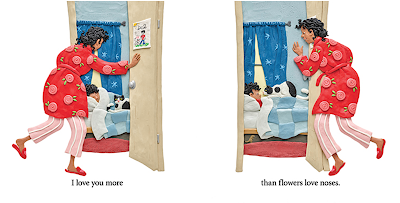
We know that telling someone you love them is special but how to express the measure of that love? In Emil Sher's newest picture book, which could only have been given the depth of emotion that Barbara Reid's textured art could convey, it's a game of whimsical comparisons and heartfelt declarations that demonstrate that there are so many ways to love.
From I Love You More by Emil Sher, illus. by Barbara Reid
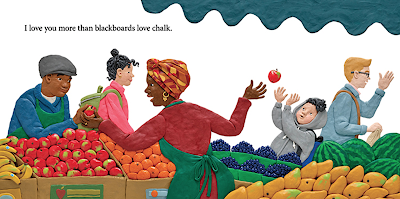
From an early morning greeting–"I love you more than flowers love noses" through breakfast and a walk to school, a mother and child express their love and witness those expressions by others. From the schoolyard to the classroom, and a mom's lunch on a park bench, there are so many vignettes that show connections and affection. Parents and caregivers are there for the children before school–"I love you more than laces love shoes"–and picking them up after school to return home, with everything showing closeness and linkages. ("I love you more than stars love wishes" and "I love you more than pianos love hands" were two of my favourites.) And as the day ends, with mum falling asleep on the couch, a child uses words and actions to express his love.
From I Love You More by Emil Sher, illus. by Barbara Reid
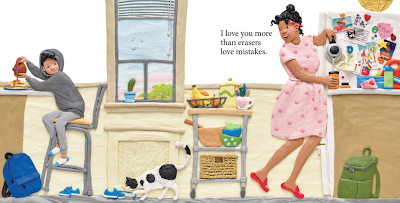
Emil Sher explains the word game that he and his family played comparing affection with a connected pairing like erasers and mistakes, runways and planes and answers and question marks. Not only does I Love You More communicate loads of messages of things that go together, it offers light-hearted word play off of which Barbara Reid's artwork bounces in delight. Using her trademark plasticine in bright colours and detailed settings inside homes, multi-storey buildings, schools and on streets, Barbara Reid gives life to Emil Sher's text. There a calico cat that cuddles, cleans and plays, neighbours that enjoy their balconies and children unique in their own ways. Not only do we see the city in all its glory, we see the life that gives and feels love.
From I Love You More by Emil Sher, illus. by Barbara Reid
The first reading of I Love You More will give young readers some laughs for the playful pairings and affection conveyed as well as the basis for playing their own word game. But subsequent readings–and there will be more readings–will give them opportunities to delve into the illustrations' details and give them food for thought about what it means to be connected.

November 22, 2018

Meet the Latkes

Written and illustrated by Alan Silberberg
Viking Books for Young Readers
978-0-451479129
36 pp.
Ages 3-6
October 2018

If it's American Thanksgiving, then you know that the holiday season, creeping upon us ever earlier, is here.  So, just in time for this year's Hanukkah, which starts on December 2, is Alan Silberberg's picture book Meet the Latkes about a family of fried potato pancakes who are ready to celebrate, dreidel and menorah in hand.

There's Mama and Papa, daughter Lucy and her dog, Applesauce, older son Lex, and Grandpa. 
They're just like you and me. Except they're potato pancakes!
As Lucy and Applesauce start to get excited for the first night of Hanukkah, grumpy Grandpa corrects Lucy's pronunciation of the celebration. She says Hanukkah. He says Chanukah. The ever wise Applesauce informs them both that since the holiday's name is Hebrew, it is said and spelled different ways in English. Lesson #1.

As the family, minus the sullen teen Lex, cooks and sings and decorates the house, their celebrations begin and Grandpa takes Lucy, his little latke, onto his lap to tell her about the miracle of Chanukah. His story may be a little different from those typically told. Grandpa's story starts with Mega-Bees "who buzzed and stung and fought to keep our people safe" and the bravest bee was Judah Mega-Bee who helped fight the alien potatoes from Planet Chhhhh. Applesauce, drawing from his font of knowledge, attempts to correct Grandpa Latke with every outlandish detail of his Chanukah story. He tries to set Grandpa, and avid listener Lucy, straight but his endeavours to mention the Maccabees and Judah Maccabee and king Antiochus are totally disregarded.
"Feh!" says Grandpa. "Whose story is this?"
In Grandpa's story, Judah and the Mega-Bees are trapped by "those evil tater tyrants" from Planet Chhhhh with only enough honey for one day. They construct a gigantic wooden dreidel, hiding inside, until they burst forth and "sliced and whipped and mashed those tater tyrants into tatters." And with some egg, onion and flour, Judah creates potato latkes.
From Meet the Latkes by Alan Silberberg
But with Applesauce telling the true story of Hanukkah, which Grandpa eventually acknowledges as a far better miracle, yet another miracle happens. (Parents of teens will understand.)
From Meet the Latkes by Alan Silberberg
Meet the Latkes may be a silly story of a potato latke family sharing the story of Hanukkah but it's actually very informative. By having Grandpa tell his story, as an alternative to Applesauce's correct version, as well as including an appendix with glossary about the true story of Chanukah, Alan Silberberg gives us many a laugh while teaching about this holiday. But forget for a moment the educational value of Meet the Latkes and instead think about the achievement Alan Silberberg has made by writing and illustrating a story in which potato pancakes are the stars. His characters have clear voices of senior drollness, youthful naïveté, canine frustration, teen moodiness and more. And they're potato latkes! It all comes through their words, eyes and smiles (or lack thereof) and Alan Silberberg's cartoons, filled with action and exclamations, bubble comments and commentaries, and colour and wacky shapes.

Take your children or students to Meet the Latkes for a Hanukkah, or Chanukah, like no other.

October 10, 2018

Ira Crumb Feels the Feelings

Written by Naseem Hrab
Illustrated by Josh Holinaty
Owlkids Books
978-1-771472982
32 pp.
Ages 5-8
October 2018

In Ira Crumb's first book, Ira Crumb Makes a Pretty Good Friend (Owlkids, 2017), author Naseem Hrab and illustrator Josh Holinaty introduced new kid Ira as he endeavoured to make a friend and start feeling like he belonged at his new school and neighbourhood. Malcolm became that friend to Ira. But now that friendship becomes the source of feelings that confuse Ira and overwhelm him. Feelings can be that way.

Though Ira and Malcolm love telling jokes, sharing pickles and playing together, when Ira wants to play hide and seek and Malcolm prefers to play tag, the two friends seem at an impasse. What's worse is that loads of other kids and even a pickle, a dog and a snail want to play tag and they carry Malcolm off for a game. Being the good friend he is, Malcolm still asks Ira to come but accepts his decline.
From Ira Crumb Feels the Feelings by Naseem Hrab, illus. by Josh Holinaty
Poor Ira.  Now his tummy hurts, his chin is wibbling and his eyes are leaking. There are those who admonish him for his feelings:
Chin up, kid. No one likes a wibbler.
and others who seek to distract him:
Forget your problems and just feel the music.
Even inanimate objects like houses, a hydrant and a car seem to be trying to cheer him up. But Ira's feelings are fully in control, evolving from sadness to explosive anger.  It's only when Malcolm reconnects with Ira, telling Ira he'd missed him and offers to be sad with him that the friendship is rekindled into a laughing extravaganza of fart jokes.
From Ira Crumb Feels the Feelings by Naseem Hrab, illus. by Josh Holinaty
While that which distresses Ira may seem insignificant to older readers, Naseem Hrab understands that being excluded or not having your game chosen is a very big deal for Ira and very young children. (Reminds me of a great folk song called Blues is Like Shoes.) Ira tries to understand his feelings but feelings are often incomprehensible except in hindsight. When feelings have you in their hold, it's tough to have perspective. And the vocabulary Naseem Hrab uses, like leaking eyes and wibbling chins, is so appropriate for the very young. The message is that feelings, though not always welcome, are normal. In fact, an engaging poster that came with the book shows Ira in all his feelings, good and bad and in-between.
Portion of poster accompanying Ira Crumb Feels the Feelings by Naseem Hrab, illus. by Josh Holinaty
Josh Holinaty's illustrations are more than appropriate for the very young who would benefit from reading a story about feelings. His artwork is emotive and still fun. Josh Holinaty, who illustrated Troy Wilson's Liam Takes a Stand (Owlkids, 2017), makes Ira effusive in his emotions from joy at play to overwhelmed with sadness and blistering with rage. Ira and his feelings are the stars of the book and Josh Holinaty ensures that, through colour, line and shape, nothing gets in the way of that focus.

I know that Ira Crumb Feels the Feelings is a fun but realistic take on friendship but I think teachers of preschoolers and kindergartners will appreciate its lessons on emotions, for children to recognize feelings in themselves and in others, to help everyone get along a little bit better.

•••••••••••••••
Look for the news tomorrow about the Toronto book launch for Ira Crumb Feels the Feelings for a chance to purchase your own copy, have some fun and nibble on a few cookies. (I heard there would be cookies though, if there aren't, disappointment is a feeling we can all accept as normal.)

May 01, 2018

Polly Diamond and the Magic Book

Written by Alice Kuipers
Illustrated by Diana Toledano
Chronicle Books
978-104521-5232-5
120 pp.
Ages 6-9
May 2018

Readers have always known that there is magic in the pages of books and the written word.  But little Polly Diamond, a positive and optimistic child with more joie de vivre than anyone since Pollyanna, finds a magic there like no other.

With the family anticipating a new baby, Polly will be moving into her little sister Sarah's bedroom.   To help ease the transition, Polly is gifted a turquoise book inscribed with "A Writing and Spelling Book for Polly Diamond" on the inside. To say that Polly is excited about this gift would be an understatement.
From Polly Diamond and the Magic Book by Alice Kuipers, illus. by Diana Toledano
But even more special is the magic with which the book is infused.  When Polly begins writing in it, the book writes back, speaking to her about its name, her baby brother and ultimately directing her in the process of writing a story.  And as Polly writes, the book makes it happen, like helping her paint the walls of the bedroom or making her invisible.  Polly is delighted to learn that anything she imagines can become real if she writes it down.  But, as the classic adage goes about being careful what you wish for, Polly learns that her imagination and her word choice must be harnessed especially as her book reads everything literally and not as Polly always intends.
From Polly Diamond and the Magic Book by Alice Kuipers, illus. by Diana Toledano
Suffice it to say that, after a number of whimsical calamities, Polly Diamond and the Magic Book still resolves with many happy endings including the arrival of Polly's new baby brother and Polly's naming of her book with a multifaceted title that demonstrates word power in yet another form.

Saskatchewan writer Alice Kuipers continues to impress with the breadth of her writing which spans from picture books and early readers to her forte, young adult novels. (See my reviews of Me (and) Me, The Death of Us, and 40 Things I Want to Tell You.)  All books inspire readers to be imaginative and answer the classic "What if?" directive of writing.  In Polly Diamond and the Magic Book, the question of "What if that which you wrote in a book could magically become real?" is asked and answered with playfulness, joy and affable mishap. Young readers will snicker as Anna is transformed into a tutu-wearing banana, the Aquarium Blue paint converts the walls to a living fishbowl, and the staircase is made of musical note steps.  The story is rich with imagery (and darling images courtesy of Spain's Diana Toledano) and the fantastic and, though things do awry, because sometimes your imagination can run a little wild (!), Polly Diamond and the Magic Book is an uplifting early reader that encourages creative writing and the spiritedness of words.  It's Super-Polly-tastic!

✎✎✎✎✎✎✎

Check out Alice Kuipers' Guest Post tomorrow
 here at CanLit for LittleCanadians

as part of the

Blog Tour
for Polly Diamond and the Magic Book 
 

April 15, 2018

Polly Diamond and the Magic Book: Book launch (Saskatoon, SK)

A tea party and a book launch!

Author
 Alice Kuipers

is launching her new

illustrated chapter book

Polly Diamond and the Magic Book
Written by Alice Kuipers
Illustrated by Diana Toledano
Chronicle Books
978-1-4521-5232-5
120 pp.
Ages 6-9
May 2018

on

 Sunday, April 22, 2018 

 2:30 p.m.

at

McNally Robinson
3130-8 St E.
Saskatoon, SK

This family and kid-friendly event 
will include 
activities for kids
and
refreshments from Prairie Ink Restaurant and Bakery.

✎✎✎✎✎✎

I have read this darling book about imagination, writing, word play and magic and will review it on May 1, 2018.  The following day, author Alice Kuipers has kindly offered to share a guest post about children writing, having created an free online course (available May 1) on her website for children who want to learn to write or to become better writers.


✎✎✎✎✎✎
Before that review comes out, here is a bit about the book from the publisher's website:

Polly loves words. And she loves writing stories. So when a magic book appears on her doorstep that can make everything she writes happen in real life, Polly is certain all of her dreams are about to come true. But she soon learns that what you write and what you mean are not always the same thing! Funny and touching, this new chapter book series will entertain readers and inspire budding writers.
Retrieved from

March 13, 2017

The Alphabet Thief

Written by Bill Richardson
Illustrated by Roxanna Bikadoroff
Groundwood Books
978-1-55498-877-8
40 pp.
Ages 5-9
March 2017

An alphabet thief is on the loose and she is creating mayhem with every letter she sneaks into her sack.  Bill Richardson, Canadian humourist and writer for all ages, tells a story of words ridiculously transformed with the loss of a letter, as depicted in the illustrations by Vancouver artist Roxanna Bikadoroff.
The Alphabet Thief stole all of the C’s,
And a cloud became loud in the sky.
My chair wasn’t there–it was turned into hair
And all of the spices were spies.
From The Alphabet Thief 
by Bill Richardson 
illus. by Roxanna Bikadoroff
Oh my.  As a little bespectacled girl and her dog Bill witness the thefts, beards become bears, horses become hoses and artists’ paints become pants.  But the young child who wears a beret or sometimes a deer-stalker is on the case and it’s up to her to make sure the thief is caught and the world of words is made sane again.

A new book from award-winning author and humourist Bill Richardson is always a joy to behold but the publication of The Alphabet Thief is even more notable because it’s for children.  Bill Richardson’s humour which has earned him four nominations for the Stephen Leacock Memorial Medal for Humour (he won in 1994 for Bachelor Brothers Bed and Breakfast) has the right touch for evoking subtle humour while giving young readers light but powerful wordplay to contemplate.  I wish I were in a classroom again so that I might do a sophisticated alphabet game of illustrating words that have lost certain letters.  The kids would laugh themselves silly with crops transformed into cops, soaps developing into saps, and brothers becoming bothers (though that last one is hardly a stretch)! Moreover, Bill Richardson writes this early reader in an entertaining rhyming text conducive to an imaginative wordplay that teachers and students and all readers will appreciate.

Roxanna Bikadoroff must have laughed her way through the illustration process, creating wild scenarios like a cafƩ scene in which bowls become owls, the dog Bill becomes ill and a brat walking by on his cellphone turns into a rat.
From The Alphabet Thief 
by Bill Richardson 
illus. by Roxanna Bikadoroff
Her pen and ink drawings with only hints of colour have a light and rushed feel to them, perfect for a book that portrays the mad antics of a thief.  Still the art of of Roxanna Bikadoroff, who has won awards for her magazine illustrations, tells the story of The Alphabet Thief with the silliness Bill Richardson’s rhymes evoke.

Do get The Alphabet Thief for your classroom or child’s library, and not just because of its possible lessons in the alphabet since the thief does take the letters in order, except for the tricky QU combo which disappear together.  Get the book because you’ll have fun reading the rhymes and picking out the transforming words via the art and don’t we all need a little more fun in our lives? Thanks Bill Richardson and Roxanna Bikadoroff for bringing it.

From The Alphabet Thief 
by Bill Richardson 
illus. by Roxanna Bikadoroff