Showing posts with label Roaring Brook Press. Show all posts

March 22, 2024

Butterfly on the Wind

Written by Adam Pottle
Illustrated by Ziyue Chen
Roaring Brook Press
978-1-250-821-97-3
40 pp.
Ages 3-6
March 2024 
 
The anticipation of presenting the fairy tale she'd written is making Aurora quite nervous. But for a Deaf child who will use ASL to tell her story, trembling hands will make for a challenging storytelling. When she sees a beautiful butterfly in the garden, she recalls her father telling her that a butterfly's wings could create a wind that could carry around the world. With that, she is inspired her to generate one with her hands and send it off into the world.
 
From Butterfly on the Wind, written by Adam Pottle, illustrated by Ziyue Chen
Her butterfly travels to a farm where a little boy Milos, who also speaks with his hands, watches it sway the raspberry bushes. He creates his own beautiful blue butterfly that joins Aurora's to travel to a cabin in the mountains where Abbey and her grandmother spot them.
From Butterfly on the Wind, written by Adam Pottle, illustrated by Ziyue Chen
Knowing the cold would be hard on the butterflies, grandmother and granddaughter make their own butterflies to create an even stronger wind that blows all four butterflies off to warmer climes and above an ocean.
From Butterfly on the Wind, written by Adam Pottle, illustrated by Ziyue Chen
With each step (or rather flutter) of their journey, the butterflies meet a new Deaf child who with their supportive friends and family sends the butterflies off with new ones until "a tornado of butterflies, a churning circle of color and beauty" travels back to Aurora. Emboldened by her small butterfly wind becoming a magnificent storm, she can step forward into the school for her presentation.
From Butterfly on the Wind, written by Adam Pottle, illustrated by Ziyue Chen
Saskatchewan writer Adam Pottle was born Deaf and raised in a hearing family, so his story Butterfly on the Wind has an authentic voice, and a voice that does not objectify Aurora or Miles's disability, or that of all the other Deaf children. They are not there to inspire us with overcoming their deafness. They are there to demonstrate that, like everyone, they will have struggles and must find a way to cope. Aurora's strategy of sending out a beautiful butterfly ultimately garners strength from others in the Deaf community and gives her the courage to step forward for a public performance. There is magic in her butterfly and in all the butterflies that follow, but that magic comes from within–even if she doesn't know it at the time–and has the power to unite and invigorate and sustain. 

The magic that Adam Pottle creates for Aurora and the other Deaf children is something special, and the art that Singaporean Deaf illustrator Ziyue Chen uses to carry that magic is sweet and yet powerful. She uses colour that is both soft and vibrant, ranging from pinks and purples to blues and yellows. Whether it's the butterflies or the landscapes, there is a vibe of life and happiness. 

Adam Pottle appends his story with an enlightening Author's Note– also a visual depiction of the ASL alphabet–that tells readers of the symbolic nature of the butterfly in Deaf culture, and the basis of his story. His motive to reach others–"May it travel around the world as swiftly and beautifully as Aurora's butterfly"–is a testament to his good intentions and the same spirit of strength and grace shown by butterflies.

 🦋 🦋 🦋 🦋 🦋
 
There will be a very special in-person (Saskatoon) and streamed (YouTube) book launch for Adam Pottle's new picture book Butterfly on the Wind

on

Saturday, April 6, 2024

at

2 PM

at

the Travel Alcove of McNally Robinson Booksellers
3130-8th Street East
Saskatoon, SK

and

streamed
via
McNally Robinson Saskatoon Events channel on YouTube

There will be live ASL interpretation and 
CNS transcription provided by Saskatchewan Deaf & Hard of Hearing Services


January 12, 2023

Sprout Branches Out

Written and illustrated by Jessika von Innerebner
Roaring Brook Press
978-1-250848789
40 pp.
Ages 3-7
January 2023
 
While some young people are happy to stay close to home, there are others who are driven to see what's out there, to take on a challenge of finding their own way and maybe something different and better. This story is for all who wonder about unimaginable opportunities and take the chance to find out.
From Sprout Branches Out by Jessika von Innerebner
Sprout lives on a porch with an assortment of other plants. But Sprout is not growing. She has only two leaves and she is convinced that if she were in the wild with bigger and wiser trees, real light and loads of water then she would flourish. One day, a flyer comes to the house promising a wonderful experience in nature and Sprout packs her bag and says, "Seed ya later!"
From Sprout Branches Out by Jessika von Innerebner
Sprout is encouraged by what she sees in the woods: loads of trees, some so leafy they have beards; animals; bushes; and grass. Then night comes.
She wanted the woods to put leaves on her chest, not make her shake like one!
From Sprout Branches Out by Jessika von Innerebner
 She heads out again, this time reaching an old growth forest where she is sure that with the knowledge of the tall and wise trees she will begin to grow. But their knowledge is far beyond her reach.
Let's dig in so you can hit a growth spurt. We'll start with math and square roots.
Again, Sprout moves on. This time she finds herself in a moist jungle, convinced the excess moisture will do the trick. But it, like the other places, is not what she expects or needs. Of course, this is when she realizes there is no place like home.

Kelowna's Jesssika von Innerebner has illustrated a number of picture books and chapter books, as well as written her own series, Kevin the Unicorn, but Sprout Branches Out is her first book for me to review on CanLit for LittleCanadians. If her wordplay and artwork in Sprout Branches Out is any indication of her talent, then I've been missing out. It's the playfulness of her art and her words that will tickle a young reader–and this old one–while telling a story about growing up and moving on but knowing that home can still be a pretty great place to be. Sprout's innocence is laced with hope for something better but her puns and those of her co-characters take the reader from the serious message to one of laughs. But, Jessika von Innerebner is first and foremost an artist and her illustrations reflect her expertise in bringing images to her message. They are lively and lighthearted and though she may stick primarily with a green palette–appropriate for a story characterized by plants and the wilds of the natural world–she gives us boldness and diversity of colour to show us the richness of Sprout's familiar and unfamiliar worlds.
 
We all know that the grass isn't always greener on the other side but sometimes you have to go take a look so that you can know how green your grass really is. For some, the journey will encourage us to seek out a new life but for others it will be a reminder that growth can happen at home too. (By the way, if your little one decides to start their own sprout, instructions are included.) For Sprout, she had to go out into the wild to come to the realization that home was a good place for her to grow. I guess branching out can sometimes lead to sticking to your roots.

July 28, 2022

Cold

Written by Mariko Tamaki
Roaring Brook Press
978-1-62672-273-6
240 pp.
Ages 12-18
February 2022

He was already getting used to being so much less than he was when he was alive. Maybe because there's something in death that makes being nothing feel natural. Maybe because he had somehow always been a sort of figment. (pg. 49)
On a cold January night, seventeen-year-old Todd Mayer died, naked except for a pair of hand-knitted pink mittens, and found in Rosemary Peacock Park by a dog the next morning. Now a ghost, Todd watches and remembers as his death is investigated by Detectives Greevy and Daniels, seemingly disregarded by classmates at his private boys' school, and considered by Georgia Walker who never even knew Todd. 
 
Georgia hears of Todd's death from Carrie Harper, a new friend who was the former friend of the uber popular Shirley Mason. The girls are still negotiating their newfound friendship and one thing they spend time talking about is Todd's death. In fact, they go to the scene of the crime, discuss alibis and such. But Georgia begins to get a bad feeling when she realizes Todd went to school with her older brother Mark and may have even visited their house. So, as Georgia starts to question her brother and others to learn more about Todd and perhaps his death, Todd, as a ghost, watches as detectives question his virtually-silent peers and his teachers, including Mr. McVeeter, a social studies teacher who offered Todd support and refuge from bullies. But, as he watches and recognizes the mistakes he made and the complexity of his choices and of his feelings, Todd remembers all that led to his death and those involved.

Told in the alternating voices of Georgia and Todd as Todd's death is revealed and investigated, Cold takes a hard look at how the lives of two teens unknowingly come together. Both had recognized they were gay and were finding ways to deal with it for themselves, sometimes with support from others. Still, they were struggling: Todd at a private boys' school where those who were deemed different were persecuted, and Georgia with her mother, a children's book author who tactlessly used her children as the basis for her stories. That may be their only obvious commonality, other than seeking to fit in and avoid harassment, a goal of many school-age young people, but it's their endeavour to find the truth and share that truth that supersedes all. Georgia needs to find out what happened to Todd and how her brother may or may not be involved. Todd needs to take responsibility for his actions which may or may not have led to his death and make things right for those who had trusted him. In Cold, Mariko Tamaki, who has never shied away from weighty issues of young people coming of age, including conflicts in friendship, questions of sexuality and balancing family with friends, tells a complex mystery wrapped in a story of trying to survive challenging social circumstances. While the solution to the mystery of Todd's death is never fully realized until the end, Mariko Tamaki has kept the teens' circumstances so familiar and common that her explanation sadly makes perfect sense.

The cold, hard facts of Cold are that a teen died because he was perceived as different while he was determined to make positive connections with others. He did what he could but others made choices that were ill-considered at best and thoughtless and despicable at worst. And Mariko Tamaki shows us, with hindsight, choices made, independent of intentions, have consequences and we can only hope that they hurt no one and can be endured and even survived.

June 13, 2022

Shadow Grave

Written by Marina Cohen
Roaring Brook Press
978-1-250-78300-4
288 pp.
Ages 8-12
May 2022
 
The trip to a New Hampshire bed-and-breakfast for twelve-year-old Arlo and his eight-year-old sister Lola with their mother for Thanksgiving is supposed to be a treat. With their father remarried with a new child and Mom dealing with health issues and Arlo managing anxiety, the family needs a break. And with money being an issue–they're driving Mom's old clunker of a car–everything is being done on a budget. But when something jumps into the road and they end up hitting a tree and totalling the car, their family trip takes an unexpected turn. 

The trio have no option but to seek help, especially as Mom's ankle may be broken and their one working cell phone cannot get a signal. Following the road that eventually becomes little more than a footpath, they reach the town of Livermore, an isolated community that almost feels deserted. In fact, when they finally get someone to open their door, the woman tells them, "You've come to the wrong place." (pg. 37) But Lovicia, with the urging of her young niece Hannah, lets them in and summons Doc Brown to tend to Arlo and Lola's mom. Everything's a little bit old-fashioned from the plaster cast Mom is given to the pot over a fire in the hearth but it's the lack of automobiles or phones that poses the greatest concern. And then Arlo hears some one say, "Leave now. While you still can." (pg. 46) With one last call to his Dad before their phone dies, the family is put up at the Samuels' B &B, a large mansion of Mr. Woodbridge Samuels, his young daughter Alice, and housekeeper Mrs. Hawthorn. They also meet all the community who join them for a Thanksgiving meal but, even though they are polite enough, Arlo feels the townspeople are somewhat reserved, perhaps even unwelcoming.
It was as though their warm smiles and formal manners hid their true feelings, like sweet perfume masks the stench of sweat. (pg. 87)
What their superficial politeness and old-fashioned natures hide is far more creepy than even Arlo and his family could anticipate, and whether or not they can get out of Livermore safely is part of the mystery of Shadow Grave.

Author Marina Cohen has always given us a little bit of creepy blended with the realism of family relationships, mental health, and more. With Shadow Grave, she again delivers us to a surreal world, this one the town of Livermore with its eerie inhabitants, time-frozen settings and dark unknowns, while integrating it with the familiar as Mom battles a life-threatening illness, Arlo struggles with his anxiety and the whole family is challenged with rebuilding after divorce. So while Marina Cohen has given us another solid middle-grade horror novel (check out my favourites The Inn Between, The Doll's Eye and Chasing the White Witch),  Shadow Grave has infused a story with ghost-like entities, monsters, and unknown dangers with the reality of a family's challenges, thereby also drawing in readers with the fears of every day life. She reminds us that some times the terrors we feel are both familiar and alien. 

Enter Livermore with caution. There are monsters of different kinds but, if you face them as Arlo does, with positive thoughts, trust and family, you may just get out alive.


March 30, 2020

Sunny

Written and illustrated by Celia Krampien
Roaring Brook Press
978-1-250-31660-8
40 pp.
Ages 4-8
February 2020

It may be raining outside but, with Sunny around, it's never dull and gloomy.

As all the children trudge to school in the rain "while the wind crawls up your sleeves and puddles soak your boats, making your footsteps squish and squash," Sunny sees the positive: she gets to use her big yellow umbrella.
From Sunny by Celia Krampien
Others might think it scary to be picked up by a huge gust of wind and carried high above the town but Sunny, with her joyful disposition, enjoys the feeling of flying like a bird.  And when she's flung above the sea, she enjoys watching the waves before she is dropped into a boat. Then when she's catapulted by a big wave onto a rock, she "thought things weren't that bad because at least she wasn't alone."

From Sunny by Celia Krampien
But, when her gull companion leaves her alone, it's the one moment when she almost loses that sunny attitude. Fortunately, he returns with some friends and rope and they carry her and the boat safely to the school yard.
From Sunny by Celia Krampien

Now, most people would say that being late for school was a bad kind of situation.
But not Sunny.
From Sunny by Celia Krampien
Sunny may be the story of a little girl who goes on an amazing adventure that causes her to be late for school but it's really a story about attitude. Debut author-illustrator Celia Krampien contrasts the glass half-empty and glass half-full attitudes for each scenario which Sunny finds herself in. Most of us would see rain while she sees the opportunity to use her umbrella. We might see only distress but she sees joy in what she is doing and with whom she is spending time. Celia Krampien's signature colour scheme (see her website at http://www.celiakrampien.com/) highlights that contrast of attitudes of most versus Sunny. Sunny's yellow umbrella, rain jacket and boots stand out from the teals and turquoises, sometimes darker and sometimes lighter, of the rainy day and tumultuous sea. The balance of light and dark keeps the story grounded, never too cheery or dismal, and the right blend of imagination with reality.

In our troubling times when many are worried and upset about everything from illness to the changes in their routines and way of doing things, seeing the world as Sunny does would make it a whole lot easier to weather. She still gets to school in the end, just as we'll get through this too. It may be a different way than we had planned but, with an optimism like Sunny's, it may be more manageable.

September 30, 2019

A Box of Bones: Guest blog post

Today's review has been submitted by Grade 6 student Bronte L.

Written by Marina Cohen
Roaring Brook Press
978-1-250-17221-1
288 pp.
Ages 8-12
May 2019

In Marina Cohen’s book A Box of Bones, the main character, Kallie, is very logical and intelligent for her age, yet she lacks imagination. When her beloved grandfather takes her to the Festival of Fools, she doesn’t enjoy it as much as the other visitors do. During the Festival, a faceless man in a fedora gives Kallie a wooden box. Later, she figures out that the box is a puzzle. Against her father's advice, she starts solving the puzzle, and uncovering secrets. Finally she finds the right combination and unleashes something that seems like magic.

While Kallie tries to figure out what’s happening to her world, Liah, a young bone carver, goes on a long journey with her master to sell bone carvings to the empress.  On the journey, she ends up accidentally wrecking a valuable cup that her master made.  She tries to hide this fact from her master along the way.  Although Kallie and Liah's worlds are far apart in time and place, their stories connect in many ways. 

A Box of Bones by Marina Cohen is great for readers in Grades 4-8 seeking a book full of adventure and suspense. It's a book on developing friendships and uncovering family secrets. The large font, short chapters and 281 pages makes it great for a light read. The cliff hangers will make you stay up past your bedtime. The emotional description is fantastic.

Out of ten, I would give A Box of Bones an 8. I loved how the two worlds intertwined. Trying to put together all of the clues and secrets made me feel like a sleuth. All of the characters are original and interesting, their back stories are emotional and deep. Both worlds had their share of drama and suspense. This book gives the reader many chances to draw connections and imagine a new and exciting world.  Once you read this book, you will be drawn into the magic of it all.

~ Bronte L.

May 29, 2019

A Box of Bones

Written by Marina Cohen
Roaring Brook Press
978-1-250-17221-1
288 pp.
Ages 8-12
May 2019

Sometimes people need lies. Little lies to help them deal with truths that are too huge and too difficult to face. (pg. 273)
Twelve-year-old Kallie is only interested in facts and the organized and logical world that she and her father, who works in risk management for an insurance company, live in. She has no appreciation for the arts, turning her nose up at music and seeing stories as "ugly little lies wrapped in pretty packages" (pg. 59), going so far as to refer to her dead mother only with disdain as "The Writer." Unfortunately, the world seems to want something different for her than she expects.

While at the buskers' Festival of Fools with her Grandpa Jess, Kallie is handed a small puzzle box seemingly made of bone. After much work to open it, nine smaller cubes fall out of the box, each with its own unique image. Strangely, no matter how she drops these cubes, they always land in the same order: an animal, a goblet, an oval with holes, a castle, a cylinder with flames, a coffin, a skull, a long pointed object, and a blank. Soon, Kallie's life, thrown off kilter by a new imaginative student named Anna and by secrets she is learning regarding her mother's death, is following a path based on those bone images, starting with a strange animal with amethyst eyes that appears to her.

Interspersed with Kallie's story is one of Liah, a bone carver's apprentice. In her story, distinguished to the reader by its italics font, Liah and the bone carver are heading to the evil Empress's palace to sell his carvings, travelling through an ancient forest haunted by those whose bones were buried without ancestral care. Heedless of the bone carver's warnings, Liah removes a skull, hopeful of carving something special from it. But their foray into the palace becomes something dangerous for the bone carver and Liah after a Lie-peddler they meet confronts the Empress with his stories.
There is such a thing as too much truth. (pg. 272)
How Kallie's and Liah's journeys are related is only revealed at the end of Marina Cohen's latest middle grade novel but they are entwined, both learning that
...a good story never really ends. It lives on inside you forever (pg. 222)
and that truths and lies are not very different, both necessary and still tenuous.

While Marina Cohen does creepy middle-grade really, really well–do check out several of her earlier novels such as The Inn Between (2016) and The Doll's Eye (2017)–A Box of Bones tells a great mystery without worries of keeping young readers up at night. There are eerie bits, both in Kallie's and Liah's stories, but they add to the mysteriousness, demonstrating that not everything is straightforward, logical or expected, just like life, and that stories give life as well as honour it.

March 10, 2017

The Doll's Eye

Written by Marina Cohen
Roaring Brook Press
978-1-62672-2040
208 pp.
Ages 8-12
February 2017

There’s a creepiness in the old house to which twelve-year-old Hadley Jackson and her mom, and mom’s new husband Ed Crenshaw and his six-year-old son Isaac have moved. 
A heaviness in the air seemed to press down on her.  And, despite the August heat, it was cold and clammy, like a years-unopened tomb. (pg. 2)
She even feels like she’s being watched, though it could simply be the doll’s eyeball she discovers beneath her bed.  But, with her mom giving the lion’s share of her attention to Isaac, a child with numerous food allergies, Hadley is feeling less than hospitable to Ed and Isaac.  When the girl discovers an old dollhouse, a replica of the actual house, with four carved dolls–a man, a woman, a little girl, and an older woman in the apartment over the garage– Hadley sees a perfect family, and wishes the same for herself.   But, as many a tale has taught us, you must be careful with wishes.

Though she still feels out of sorts–in fact, she’s feeling an odd numbness in her hand which is extending to other parts–Hadley meets a couple of individuals who make her start to feel at home: Gabe, a neighbour boy who knows everything about snakes and insects , and the elderly woman, Althea S. de Mone a.k.a. Granny, who lives over the garage.  Gabe comes over daily to play and take her on excursions into the ravine at the back and Granny invites her for tea and crumble and chats about the dolls which she admits to carving.

But things begin to get really strange when the people in her life begin to change as the dolls disappear and are replaced.  First, Ed and Isaac disappear like they’d never existed and all of Hadley’s mom’s attention is focused on her daughter.  Hadley knows it is related to her wish that Ed and Isaac had never come into her life and tries to make things right again but ends up with another more haunting scenario with a father she’d never known.  She knows it’s all tied to the doll’s eye and the dollhouse but making it right seems near impossible. 
Hadley barely made it to her bed before her knees gave out.  She lay for the longest time, thinking, rubbing her numb hands.  It was as though someone had wrinkled the fabric of reality, changing the pattern of its threads.  She closed her eyes.  Perhaps if she dozed off, she’d wake from the nightmare and things would be back to normal. (pg. 100)
As if.

In the subtle terror reminiscent of W.W. Jacob’s chilling short story "The Monkey’s Paw", Marina Cohen brings creepiness into making wishes and into a young girl’s desire for a perfect family.  Hadley is just a naïve young girl who thinks she knows what will make her life better, just like the young girl from the past whose reminiscences Marina Cohen includes throughout The Doll’s Eye. But, whether in the past or the present, the young girls in The Doll’s Eye make some selfish and poor choices that have impacts never imagined.

By implanting her story in the seemingly innocent entities of youth i.e., dolls and dollhouses, Marina Cohen will have young readers shocked when they enter the disturbing realm of horror. But I guess that’s what the genre is meant to do, frighten and disturb. Thankfully, it’s the right amount of fright for young readers, never too much or of the grotesque variety, and it will keep them edge-of-their-seats reading until the last page, never expecting the ending.  As a seasoned reader, I should have seen it coming, but I didn’t, and I expect younger readers won’t either, though they will be thrilled with Marina Cohen’s twisted take on making wishes and what a perfect family entails. But, more than anything, they will be beguiled with another offering by Marina Cohen to a genre rarely published for middle grade readers and a sensational and supernatural contribution at that.

October 31, 2016

Bera the One-Headed Troll

by Eric Orchard
First Second / Roaring Brook Press
978-1-626721067
128 pp.
Ages 7-14 
August 2016


With today being Halloween and Bera the One-Headed Troll being filled with pumpkins and trolls and witches, it seems only fitting to review this graphic novel today.  Written and illustrated by Eric Orchard, the illustrator of the recently reviewed If I Were a Zombie (Kate Inglis, Nimbus, 2016) –am I sensing a monstrous theme here?–Bera the One-Headed Troll is atmospherically perfect for a fun but teensy bit scary read.

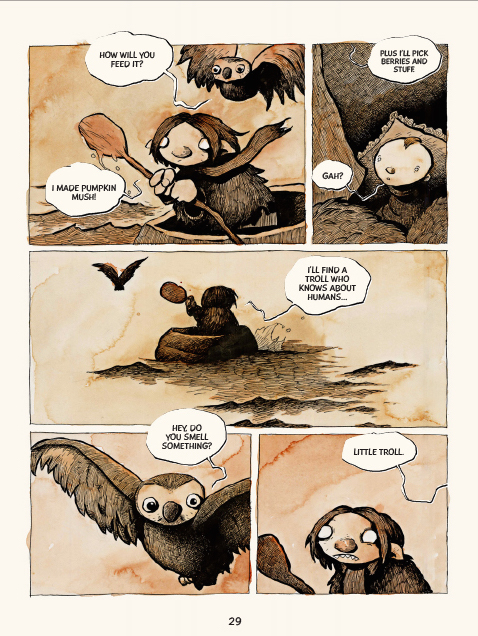
Bera, who lives on an isolated island with her owl companion Winslowe, is the official pumpkin gardener of the Troll King. (There’s the pumpkin connection for Halloween,  and, except for the cover and an occasional candle burning yellow, it’s the colour scheme of all the book’s graphics.)  When Bera rescues a human baby from three evil mermaids (they are not of the lean and lovely variety), she takes upon herself the task of returning the baby to its humans.  But that is contrary to the wishes of the malevolent Cloote, former  head witch of the Troll King, who wishes to use the baby to return to the good graces of the Troll King.
From Bera the One-Headed Troll 
by Eric Orchard
Bera who feels unprepared for dealing with the baby decides to seek a hero from her books, specifically choosing Wulf the Dragon Masher.  On their journey, Bera and the baby, with Winslowe scouting from above, encounter the mermaids again, as well as the Guardian, a sea monster as big as an island, and a bunch of hedgehog wizards.  Thankfully this last group whose mandate it is to protect the creatures of the wood already know firsthand of Cloote’s destruction and offer to steer Bera to Wulf’s tower.  Wulf, a troll of epic proportions and light-spirit (“Hey, is that a baby?”, “Well, look at that” and “Imagine that!”; pg. 52), has not been on an adventure in a very long time and, though willing of spirit, he succumbs to his epic sleepiness.

So Bera goes in search of another hero, finding both Duke Otig, the two-headed troll hero of the troll-giant war, and then the three-headed Nanna the Great.  But the reader will soon realize that heroes are not just those who undertake adventures and engage in battles.  Heroes are also those who make extraordinary sacrifices to do ordinary things, making their own quests in the spirit of goodwill, not glory.
From Bera the One-Headed Troll 
by Eric Orchard
Bera the One-Headed Troll is a offbeat graphic novel filled with trolls (one-, two- and three-headed varieties), goblins, witches, and rats (Vince is particularly helpful) and positive messages about offering assistance to those in need.  With only her want to do the right thing, Bera takes herself out of her comfortable pumpkin patch island and discovers new strengths and instincts, while making some new friends and good karma in the process.  I thought Bera the One-Headed Troll was going to be a dark, dark tale for a Halloween night, and its graphics would’ve supported that notion.  Eric Orchard’s trolls and witches and other creatures could be seen as darkly unnerving, as are the settings of straggly trees and murky swamps and stone edifices.  But Bera the One-Headed Troll is neither dark nor frightening.  It is a positive message wrapped in a dark cloak festooned with pumpkins.  Read it for Halloween but take its guidance beyond the day.

March 03, 2016

The Inn Between

by Marina Cohen
Roaring Brook Press
978-1-62672-202-6
208 pp.
Ages 8-12
For release March 2016

Don’t be deceived by the gold and green turquoise lightness of the cover of The Inn Between.  The story is nothing but dark and I believe that Marina Cohen has achieved her goal of a Stephen King novel for middle grade readers.

Eleven-year-old Quinn Martin is travelling by car with her best friend Kara Cawston and Kara’s family–parents and older brother Josh–to the family’s new home in Santa Monica.  The two girls had been inseparable in Denver and the linking of their two woven frienship bracelets, which seems to intrigue the non-Norm man running Norm’s Diner, shows how close the two really are.  After a weird bright light in the desert accosts the family car, they stop at the Inn Between, a gorgeous old-fashioned hotel straddling the border between California and Nevada, that promises “We’ve been expecting you.” (pg. 28)

As beautiful as the hotel is, the people within are very strange (and this is an operative word for everything at the Inn Between) and oddly overly hospitable.  There’s the desk clerk Persephone, the elevator operator Sharon (for the elevaor they are not allowed to use) and the valet-doorman, Aides.  And the guests are just as odd. From old Mr. Mirabelli who tells Quinn “They’re going to pull the plug” (pg. 34) to the little girl with the singed doll and Rico the guy who’d partied a little too hard and had come for a rest.  Most scary though is a tall, unshaven man in a black and yellow ball cap whom Quinn notices pursuing them.

After the first night, Kara’s parents are gone, apparently with the van that had to be towed for servicing, and the three kids spend the time swimming, enjoying the food and just hanging out.  But Quinn’s mind is perpetually troubled with memories of her little sister Emma and the guilt she harbours about her, and smells and sounds at the hotel continue to play on these memories.

When Josh goes awol too, Quinn and Kara go in search of Emma, convinced the crying Quinn hears is her young sister who had gone missing.  But what they find starts Quinn realizing who the guests at the Inn Between really are and why they must escape, without Kara’s parents and Josh.

The Inn Between is a mermerizing read of creepiness and suspense with a healthy dose of action and psychological tension.  Young readers who never get enough of spine-chilling drama (and it is very limited in youngCanLit) will be pleasantly disturbed by the eerie story, unnerving setting, and sinister atmosphere of The Inn Between.  Marina Cohen has done it.  She has written a spooky–but ghost-free–story about a place you wouldn’t want to visit and wrapped it in a cosy hotel robe of mystery and unsettling thoughts, without completely terrifying young readers, though there are some frightening scenes.  Best of all, Marina Cohen has something to say about friendship and grief and guilt but does so in a wonderfully unique and  horrific narrative.