Showing posts with label quest. Show all posts

November 14, 2022

Fly

Written by Alison Hughes
Kids Can Press
978-1-5253-0583-2
200 pp.
Ages 10-14
October 2022
 
...my body is not all that I am. (pg. 40)

Fly is what 14-year-old Felix Landon Yarrow (a.k.a. Fly per his initials) dreams of doing. In his dreams, he is no longer trapped in a wheelchair by cerebral palsy. He is free to spread his arms and soar.
            My disability,
                         my difficulties,
                                               my pain–
often on public display–
are
in fact
all my own.
                                       Private. (pg. 59)
But, Felix is in a wheelchair. And though he feels very much like his pain is often on public display, whether he is working with his aide Levi or being driven in the "special" school bus, he knows that he is invisible to many, especially his peers. Still, that invisibility becomes his superpower, with Felix becoming a "Fly on the Wall" and ready to emulate his literary guide, Cervantes's Don Quixote, and follow truth and justice. His quest: to save his classmate and damsel in distress, Daria, from the arrogant and dangerous Carter.

As Felix watches and learns, he becomes Knightwatch and emails warnings to Daria about Carter and to Carter that his heinous and potentially criminal behaviour has been observed. But, like Don Quixote, along with battles with enemies come inner battles of understanding of self. 

Fly, a novel in free verse, may have a contemporary setting but its story is as classic as that of Don Quixote. It's about finding inner strength and fighting against injustices. But author Alison Hughes makes sure the reader realizes that much of this is also about perception. Told in Felix's voice, the reader will sympathize with his constrained physical nature and applaud his courage to pursue chivalrous goals of protecting first Daria and then others from oppressors. Going after Carter gives Felix purpose, though he doesn't realize until the end that his manner of attack may leave others vulnerable. His goal is outward, to help others, but the learning he takes from his endeavour is all about him and what he needs to do to be fair. The growth that Felix experiences, moving from annoyance at how others judge and treat him to appreciation for efforts others make, is a monumental one. And Alison Hughes takes the readers along on that epic journey through her elegant free verse. The writing flows and has shape that comes with self-discovery, engagement with others and context of circumstances. Felix's story takes a form not unlike his own body, both vulnerable and combative, and we're there for the moment of battle, within and externally, when Felix realizes that some of the limitations to the freedom to fly may be those he's imposed on himself.

October 31, 2016

Bera the One-Headed Troll

by Eric Orchard
First Second / Roaring Brook Press
978-1-626721067
128 pp.
Ages 7-14 
August 2016


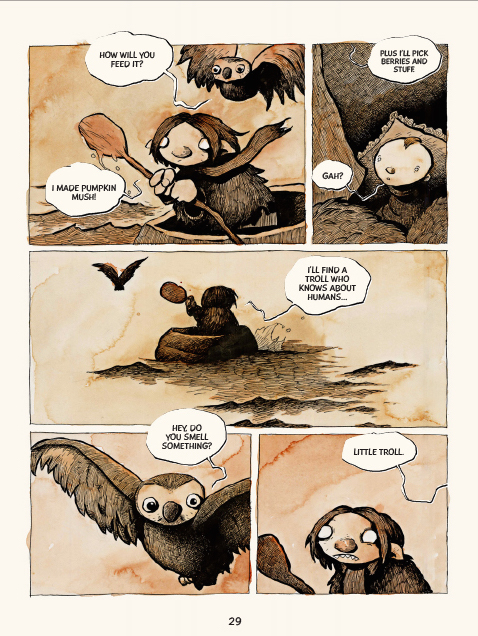
With today being Halloween and Bera the One-Headed Troll being filled with pumpkins and trolls and witches, it seems only fitting to review this graphic novel today.  Written and illustrated by Eric Orchard, the illustrator of the recently reviewed If I Were a Zombie (Kate Inglis, Nimbus, 2016) –am I sensing a monstrous theme here?–Bera the One-Headed Troll is atmospherically perfect for a fun but teensy bit scary read.

Bera, who lives on an isolated island with her owl companion Winslowe, is the official pumpkin gardener of the Troll King. (There’s the pumpkin connection for Halloween,  and, except for the cover and an occasional candle burning yellow, it’s the colour scheme of all the book’s graphics.)  When Bera rescues a human baby from three evil mermaids (they are not of the lean and lovely variety), she takes upon herself the task of returning the baby to its humans.  But that is contrary to the wishes of the malevolent Cloote, former  head witch of the Troll King, who wishes to use the baby to return to the good graces of the Troll King.
From Bera the One-Headed Troll 
by Eric Orchard
Bera who feels unprepared for dealing with the baby decides to seek a hero from her books, specifically choosing Wulf the Dragon Masher.  On their journey, Bera and the baby, with Winslowe scouting from above, encounter the mermaids again, as well as the Guardian, a sea monster as big as an island, and a bunch of hedgehog wizards.  Thankfully this last group whose mandate it is to protect the creatures of the wood already know firsthand of Cloote’s destruction and offer to steer Bera to Wulf’s tower.  Wulf, a troll of epic proportions and light-spirit (“Hey, is that a baby?”, “Well, look at that” and “Imagine that!”; pg. 52), has not been on an adventure in a very long time and, though willing of spirit, he succumbs to his epic sleepiness.

So Bera goes in search of another hero, finding both Duke Otig, the two-headed troll hero of the troll-giant war, and then the three-headed Nanna the Great.  But the reader will soon realize that heroes are not just those who undertake adventures and engage in battles.  Heroes are also those who make extraordinary sacrifices to do ordinary things, making their own quests in the spirit of goodwill, not glory.
From Bera the One-Headed Troll 
by Eric Orchard
Bera the One-Headed Troll is a offbeat graphic novel filled with trolls (one-, two- and three-headed varieties), goblins, witches, and rats (Vince is particularly helpful) and positive messages about offering assistance to those in need.  With only her want to do the right thing, Bera takes herself out of her comfortable pumpkin patch island and discovers new strengths and instincts, while making some new friends and good karma in the process.  I thought Bera the One-Headed Troll was going to be a dark, dark tale for a Halloween night, and its graphics would’ve supported that notion.  Eric Orchard’s trolls and witches and other creatures could be seen as darkly unnerving, as are the settings of straggly trees and murky swamps and stone edifices.  But Bera the One-Headed Troll is neither dark nor frightening.  It is a positive message wrapped in a dark cloak festooned with pumpkins.  Read it for Halloween but take its guidance beyond the day.

August 27, 2014

Tomorrow's Kingdom

nota bene: As Tomorrow's Kingdom is the final book 
in The Gypsy King trilogy, 
I adamantly recommend that, 
if you haven't read Books 1 and 2 already, 
please read them first 
to enjoy the full effect of The Gypsy King trilogy.  
It is so worth it!


by Maureen Fergus
Razorbill
978-0670067664
448 pp.
Ages 12+
July, 2014

Persephone's trajectory has been an extraordinary one from The Gypsy King (Razorbill, 2012) to A Fool's Errand (Razorbill, 2013) and now Tomorrow's Kingdom.  From slave to long-lost twin of King Finnius, then seeker of the healing Pool of Genesing and initially-reluctant bride of the gypsy Azriel, Persephone launches Tomorrow's Kingdom as the true Queen, and hostage of Regent Mordecai who intends to wed her and rule the kingdom himself.

In addition to Mordecai plotting Persephone's future with him, Lord Bartok is working with the other lords to liberate and return her to the throne, by attacking Mordecai's New Men army.  Of course, Bartok plans to wed Persephone himself, in case his daughter Aurelia, who is pretending to be pregnant with King Finnius' child, doesn't succeed in making it a pseudo-reality with some random man.

If Persephone is anything, she is amazingly strong and determined, first to save herself and then focus on her next steps. 
"All that was left to do was to find Azriel, prevent the slaughter of the tribes, save the Kingdom and take the throne." (pg. 113)
Yeah, that's all. 

But, just as Persephone has been transformed, so too has Azriel, from chicken thief and proud Gypsy and target of Mordecai's New Men army, to Persephone's devoted protector and amorous husband.  And when he learns that she is pregnant with his child, there is nothing he won't do to keep her safe.

It's a fight for tomorrow's kingdom, a kingdom which Persephone has promised will unite the five tribes–Erok, Gypsies, Khan, Marinese and Gorgishmen–of Glyndoria.  But, with so much plotting for the throne, it's not surprising that deception and battle may be deemed necessary.  But who is deceiving whom?  Well, it's not Persephone with Azriel or vice versa, and that is the sweetness in a battle-ridden conclusion to the trilogy.  While Books 1 and 2 have Persephone and Azriel doing some romantic sparring as they sort out their feelings for each other and attempt to interpret the other's actions (often incorrectly), Tomorrow's Kingdom releases the reader from worrying whether the two lovers will find their way to each other.  They have.  Now there's so much more to worry about: an angry Mordecai who is losing his grip on his New Men army; Lord Bartok whose plans for control are being thwarted by his hapless son and daughter; the tribes who all have some reservations about Persephone's prophesized reign; and the healthy birth of a baby that may mean everything to everyone.

Maureen Fergus is so adept at carrying readers away to a different land and time, of cultures and societies so different than our own, where their speech is different, from crass to formal, their lifestyles foreign (in more ways than one), and their spirits undefinable.  From vivid descriptions of scenery,
"...as she beheld the sprawling castle that rose up before her.  Built in the shadow of a barren mountain at the very edge of a high cliff, it was constructed of blackest stone.  Except for along the cliff edge, it was protected by a wall so thick that a brace of oxen could have pulled a wagon along the top if it hadn't been for the iron spikes set every few feet.  Several of these spikes were topped with heads that appeared to have been dipped in tar to slow the process of decay; the rest stood empty and waiting against a backdrop of low clouds scudding across the stormy sky." (pg. 65)
to experiences beyond my imagination,
"After shoving into her mouth a piece of meat so tender, juicy, fragrant and delicious that she almost started to cry, Persephone unenthusiastically handed the rotten-toothed man his share." (pg. 134) 
and the seasoned speech of any character, including the third-person speaking Gorgishman,
     "Miter has not pledged friendship!" reminded the Gorgishman shrilly. "Miter has pledged nothing but his eternal enmity if you take this tiresome war of yours anywhere near his beloved valley!"
     "Oh, stop," said the Gypsy dryly.  "You're making me feel all choked up inside."
(pg. 327)
the text becomes a part of the plot, enriching all elements of the story.  Every word spoken or not is fulfilling to the experience that is Tomorrow's Kingdom, as was in The Gypsy King and A Fool's Errand. But here we have the delight of a hard-earned happy finale, with a last-minute surprise or two, before ending with the words, "The Gypsy that would be king." (pg. 456)

January 08, 2014

A Fool's Errand

by Maureen Fergus
Razorbill
978-0-670-06765-7
528 pp.
Ages 12+
October, 2013 


(If you haven’t read the first book in this series, The Gypsy King, please do so before reading this review which contains a spoiler for the first book. A Fool’s Errand begins with the final revelation from The Gypsy King.)


With the final scene in The Gypsy King, a servant reveals that Persephone is the long-lost and older twin of the Erok king, King Finnius, and the true heir to the Erok throne. Fearful that this will threaten his claim as heir to the throne, the evil Regent Mordecai, who has been manipulating the king and the country to his will, has the servant killed. Likewise, the lives of Persephone and Azriel, as well as a Gypsy boy named Mateo, are at risk until Azriel claims to be the son of the former Gypsy King Balthazar and can locate the secret pool of healing.

Threatened with the death of her brother King Finnius, Persephone promises not to seek the throne, and shares one last wonderful day with her newly-discovered brother before heading off with Azriel on his quest to find the Pool of Genesing for the physically-deformed Regent Mordecai. Unbeknownst to them, Mordecai sends his henchman General Murdock and members of his New Men army to follow them, with strict orders to kill them if they find the Pool or if they are not diligently seeking it. But there is also a cloaked man with an unclear mission who follows all of them.

After a stop at the Gypsy camp where a momentous event passes, Azriel, Persephone, Rachel who is an Erok girl who looks like Persephone, and two Gypsies, Tiny and Fayla, head out on their quest, seeking the Khan Warriors first, then the Marinese and finally the Gorgishmen for any clues they may be able to provide about the Pool's location.

Though similar to the action-filled plot of The Gypsy King, A Fool’s Errand is based on a series of adventures that Persephone and Azriel undertake, hopeful that they are always one clue closer to finding the Pool. Pervasive in their quest is their romance which, while initially shaky due to Persephone’s lies, is catapulted to before the two can both acknowledge their deep caring for each other. Azriel’s honour and chivalry demonstrates his love for her far before Persephone even recognizes her’s for him. But readers can be reassured that, though their squabbling is endearing, Persephone and Azriel find their way to each other, eventually, and it is very sweet.

Perhaps some believe that the foolishness indicated in the title deals with Persephone and Azriel falling in love but there are many characters who could be seen as fools in A Fool’s Errand. There are those who believe in the Pool, those who believe they will find it, King Finnius who trusted Mordecai for years to rule the kingdom for him, Mordecai who continues to lust for Persephone and sees her actions as evidence that she cares for him, Mordecai who trusts the treacherous agreement he makes with Lord Bartok, General Murdock who is convinced he is always in charge of circumstances, and even those who believe the lies Mordecai speaks each time he opens his mouth. You'll need to judge for yourselves who are the fools but I'll follow Shakespeare's suggestions that, "A fool doth think he is wise, but the wise man knows himself to be a fool." (As You Like It, Act 5, Scene 1)

Sadly I may have to count myself as the fool, never expecting Maureen Fergus to end A Fool’s Errand on a cliffhanger, as she did with The Gypsy King. Of course, I was fortunate to have A Fool’s Errand at the ready to appease that longing for a happy ending. Now, while the reader may guess at Persephone’s "circumstances" at the conclusion of A Fool’s Errand, there is no way to see how Maureen Fergus will resolve the newest twist in her plotting. Waiting without anxiety until the third book is released seems a foolish endeavour right now. But, with an abundance of fools, I will at least be in good company.

≤≥≤≥≤≥≤≥≤≥≤≥≤≥≤≥≤≥≤≥≤≥≤≥≤≥≤≥≤≥≤≥≤≥

Relief! I've heard from Maureen Fergus who tweeted that Book 3 in the series is called Tomorrow's Kingdom and is scheduled for release in July of 2014.