Showing posts with label disabilities. Show all posts

July 30, 2025

T Is for Terry: An ABC of Courage

Written by Denise Dias
Illustrated by Noémie Gionet Landry
North Winds Press (Scholastic Canada)
978-1-0397-0679-8
32 pp.
Ages 3–8
July 2025 
 
Terry Fox's story of his cancer and of his Marathon of Hope is one that is firmly established in Canadian history. When he embarked on his cross-country run in 1980 in support of cancer research, he could not have imagined the impact his story and his undertaking would have on the world. For us, he was a champion and a warrior. And now his story is told in such a way that our youngest children, perhaps those who will still be having this book read to them, will understand who he was and what he accomplished. 
From T is for Terry, written by Denise Dias, illustrated by Noémie Gionet Landry
Denise Dias who is involved with the Terry Fox Foundation tells Terry's story using the alphabet as her guide. She begins pre-diagnosis with Terry enjoying play with his siblings and sports. With the letter C, readers learn that Terry became ill and had the courage to face losing part of one leg. (Thank you, Denise Dias, for not making Cc for cancer.) Then there is his treatment and his training, but the text is all about the positives: the dream, the effort, his friends, and his gratitude. 
From T is for Terry, written by Denise Dias, illustrated by Noémie Gionet Landry
With the letter H, Denise Dias begins Terry's Marathon of Hope, still always emphasizing the positives of the kindness people showed him, the pride they felt sharing in his marathon, and the example he was by inspiring people everywhere to carry on his dream. Sure, there were some details about his shoes and how tired he was, but the highlights of T is for Terry is the young man and his worthwhile efforts to help others who were sick through fundraising for cancer research.
From T is for Terry, written by Denise Dias, illustrated by Noémie Gionet Landry
T Is for Terry is a complete illustrated biography for young children, introducing them to this extraordinary young man and his mission in a way that is not scary and very inclusive.  Denise Dias may keep the text inspiring rather than disheartening but she gives everything to his story so it is thorough. What Denise Dias leaves out in the text New Brunswick's Noémie Gionet Landry includes but with care. Her digital artwork blends realism with cheerful illustrations that both inform and amuse. We see Terry and other cancer patients receiving chemo treatment, the solitude of his running through all kinds of weather, and his distinctive running gait. We also see the landscapes of Canada that Terry ran through, from the Atlantic Ocean through forests and neighbourhoods. Noémie Gionet Landry keeps the story but makes it more Terry.
 
I am often wary of themed alphabet books as they can seem contrived, trying to fit a story into the alphabet. T Is for Terry is not forced in its alphabetical storytelling. Terry's story is complete as an illustrated biography in T Is for Terry; it just happens that it is told with the use of the alphabet to organize information. With great honesty and philanthropy, Denise Dias tells how Terry Fox and his Marathon of Hope united a nation and committed us to working to fund cancer research. With all author royalties being donated to the Terry Fox Foundation—in fact, the text and illustrations copyrights are held by the Terry Fox Family—Denise Dias furthers that support now and in perpetuity. By encouraging discussions through T Is for Terry, I hope that teachers and parents will grab this book and further the support for the Terry Fox Foundation and the good work they do, and thus move us all closer to finding all the cures for cancer.

January 16, 2025

Playdate Surprise

Written by Karen Autio
Illustrated by Laura Watson
Scholastic Canada
978-1-4431-9981-0
24 pp.
Ages 3-7
September 2024
 
Remember the two friends Kayla and Piper from I Can, Too!? Karen Autio and Laura Watson have brought the two little girls, one with mobility issues, together again in a story of friendship and accommodation.
From Playdate Surprise, written by Karen Autio, illustrated by Laura Watson
Being a friend and having a friend are great opportunities for growing as a person with the fun and understanding that comes from being together. No wonder Kayla is so excited when Piper is able to come over to her house for a playdate. Although there are lots of accommodations that have been made for Kayla to get around outside and in her house, these are not the focus as the two girls play with Kayla's dog Roscoe, who is very well trained, and just having fun.
From Playdate Surprise, written by Karen Autio, illustrated by Laura Watson
But when it's time for Piper to leave and she wants to invite Kayla to their house the next day, Piper's mom realizes that their front step would be an obstacle to Kayla. So, the girls must wait until the weekend when Kayla's dad can help her get into Piper's house.
From Playdate Surprise, written by Karen Autio, illustrated by Laura Watson
Their next playdate is just as much fun. No wonder that the girls want to continue having playdates and Piper's family finds a way to help that happen with an unexpected surprise of accessibility.
 
Karen Autio's first story of Kayla focused on the different modes of mobility available to a child in a wheelchair, allowing her to do many of the same activities as her wheel-less peers. In Playdate Surprise, that same message of positivity is pervasive, with Kayla and Piper smiling with joy for their friendship and time to be spent together. And even though a concrete step is a real impediment to Kayla's visiting Piper's house, both families find a way or two to accommodate her wheelchair and support the girls' friendship. 
 
Laura Watson, who also illustrated I Can, Too!, uses her digital art to keep the story light and yet meaningful. Her bold colours and joyous characters make a story a positive one of camaraderie and reassurance, demonstrating that at its heart, Playdate Surprise is a story of two friends, one of whom just happens to be in a wheelchair.
 
Karen Autio's dedication suggests that there was such a family that modified their home to allow her daughter accessibility, for which she was very thankful, so she speaks from experience in Playdate Surprise. That alone makes this picture book special. But it's also a reminder to everyone that accessibility doesn't just happen. We have to make it happen, whether through policy or protest, training or grassroots actions at home. Because when everyone is included, there's a lot more smiling that happens for everyone.

November 24, 2023

Next Door

Written by Deborah Kerbel
Illustrated by Isaac Liang
Kids Can Press
978-1-5253-0658-7
32 pp.
Ages 3-7
October 2023
 
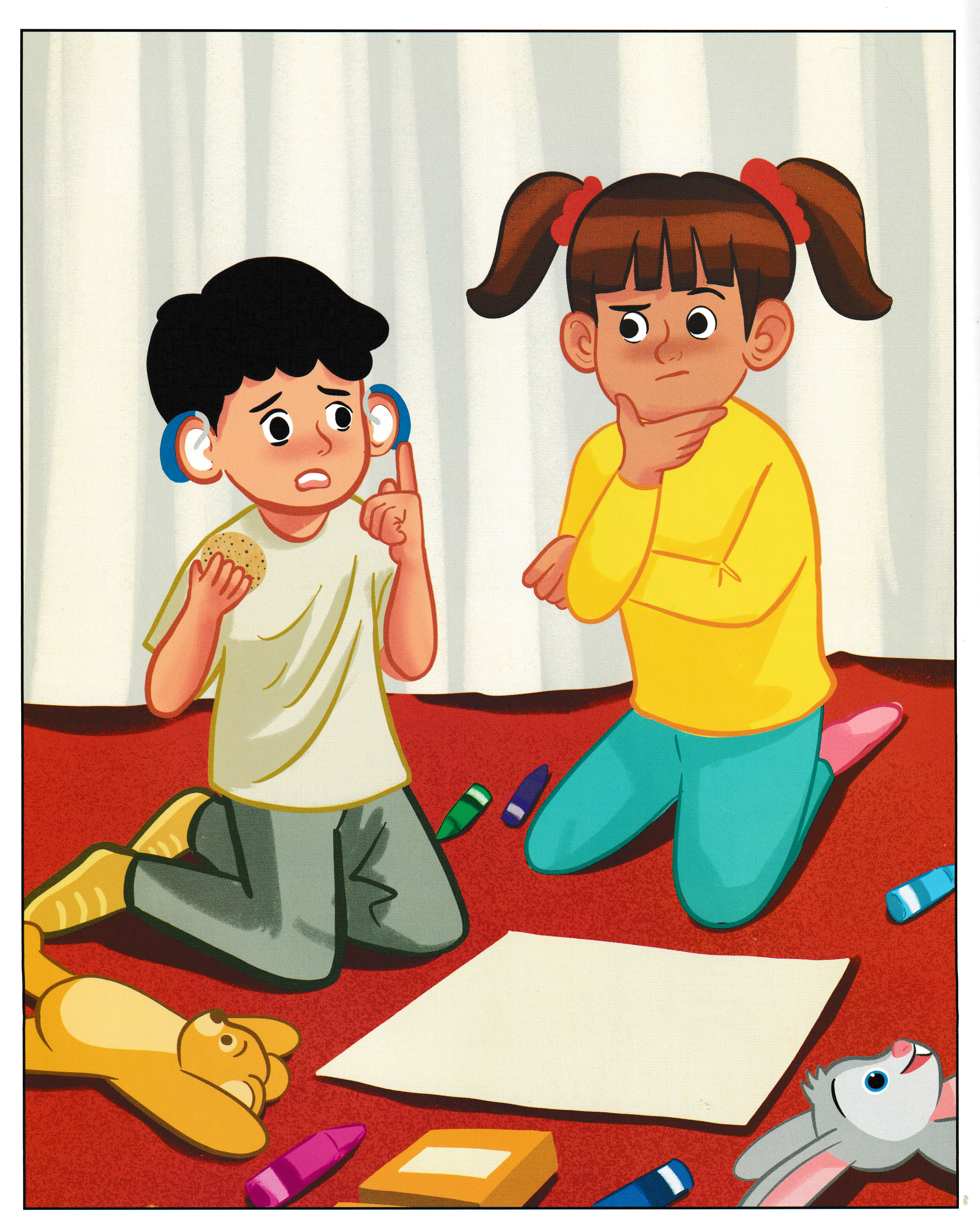
Wordless picture books have a general hush about them. In wordless books, i.e., ones in which the stories are told through illustrations alone, no one is speaking and there is no text to distract. It's all rather subdued. In fact, it's a perfect reflection of what the main character, a young boy with hearing aids, must experience much of the time. But don't be fooled into thinking that there is no story to be told or personal connection to be made.
From Next Door, written by Deborah Kerbel, illustrated by Isaac Liang
A boy and his mother head out from their home just as a moving van arrives and begins unloading boxes. It's evident these are not their goods as the boy is familiar with the places and people he encounters on their walk. Though he may have limited hearing, as evidenced by his hearing aids, he notices everything, from the musician busking, the construction workers at work, and even baby birds in a high nest. It's unfortunate when a cyclist races past the boy, startling him into dropping his teddy bear. But, after confirming he is okay, communicating via American Sign Language, his mother settles the boy.
From Next Door, written by Deborah Kerbel, illustrated by Isaac Liang
Returning to their building, they visit their new neighbours in the apartment next door. Using her own way of communicating, with hand movements and an Arabic/English dictionary, the woman welcomes them. But the boy spies a little girl hiding from them. When he approaches her, it is evident that neither can understand the other. But through the sharing of food and art, the two children find their own way to communicate.
 
This story is deeply personal for Toronto author Deborah Kerbel whose own sister had been born profoundly deaf. Deborah Kerbel's Author's Note speaks of her sister's abilities to connect, and Next Door's story reflects that ability for children who find different ways to communicate because of hearing and language differences. Undoubtedly a child who has a hearing impairment and one whose language is different than those around them may both feel at a disadvantage when trying to communicate. But, as the boy demonstrates, his disability is not a hindrance to living a good life, one in which he communicates with others, just in his own way. He successfully uses American Sign Language and his hearing aids to enable connection with others. But, when he meets the new little girl next door, he's on an equal playing field as she struggles to get him to understand her. But, with some effort and the common ground of art, along with a tasty cookie, a connection is made.
From Next Door, written by Deborah Kerbel, illustrated by Isaac Liang
Deborah Kerbel opens up about her sister's story to help convey the possibility that communication does not cease with hearing or a different language. We find new ways to communicate when the customary route is not available. By juxtaposing the boy's circumstances with that of his new young neighbour, Deborah Kerbel has found a way for any child for whom communication is challenging, because of, for example, cultural differences, emotional barriers, or physical barriers, to accept that different can still be effective. 
 
Isaac Liang is a deaf illustrator from Singapore who imbues the art of Next Door with knowledge and sensitivity. Because of his personal experiences with hearing impairment, Isaac Liang has found a way to bring the quiet and the connection for the children through his digital art. Because comprehension through the sense of hearing is compromised, his emboldens the story with colour and shape. Perhaps words are unnecessary but meaning still comes through with every building, person, and detail. 

Next Door is a great picture book for helping children develop their visual literacy skills and their empathy and acceptance for those who communicate differently. Hopefully it will help them to recognize that we do not all hear or see or understand the same way–the cyclist who almost collides with the child assumed the boy could hear him coming–and to find new ways of communicating that might work better for others. And, when it all comes down to it, kindness always works.

August 07, 2023

Dear Elsa

Written by Marco Fraticelli
Red Deer Press
978-0-889956865
240 pp.
Ages 8-12
May/July 2023
 

looking out the window
in his new school
the sad student (pg. 32)
 
As part of a school assignment, 10-year-olds Elsa of Boston and Leo newly of Toronto must write emails to each other as pen pals. Neither is initially keen, and Leo is especially so when he learns his pen pal is a girl. But, through revealing messages from September through the following August, the two go from strangers to something deeper.

At the outset, the differences between the two middle-graders are pronounced. Leo, who has newly moved from Montreal to Toronto for his parents' jobs as teachers, complains about everything, from not having any friends, his teacher, following rules, sending emails to Elsa of at least 250 words, and schoolwork writing poetry. Elsa, on the other hand, loves rules, has divorced parents, and, though Leo suggests she must be one of the popular kids based on the advice she gives him, calls herself an in-between kid who has a few good friends and is relatively quiet. But as she allows him to vent while still offering him a different perspective, Leo discovers some things about himself, like that he really likes writing poetry, especially haiku, which he often shares with her. Elsa is slower to reveal herself, probably because Leo is so busy complaining, but she too begins to divulge what her life is like, rather than just giving Leo the opportunity to share. Readers, and Leo, learn of her parents' relationship, her trip to Cancun, her aspirations, her prowess as an archer, and eventually her wheelchair. While Leo broadcasts about everything, Elsa holds back much about her own situation, and is delighted to be treated like she isn't someone with a disability.

Dear Elsa may be author Marco Fraticelli's first children's book but his decades of experience as a Grade 5 teacher as well as an award-winning poet have given him a strong foundation for an irresistible story of two children exploring their differences and finding common ground to be the friend the other needs at that time. Their writing relationship may continue past their Grade 5 year–that is not revealed at the book's conclusion–but it's almost irrelevant as the two derived safety, perspective, opportunity, and solicitude from their relationship.

In 2015, I prepared a post titled, Dearest readers...: A Letters in youngCanLit book list, which provided a list of books that featured characters writing letters or emails or texts as the vehicle for the plot. I will definitely be adding Dear Elsa to that list now to ensure that middle-grade readers (and perhaps their teachers) have an opportunity to visit with Leo and Elsa and witness how a friendship can develop from afar and with seemingly different individuals. All it takes is opening oneself up the opportunity, as Leo learns both in emails and at school, and perhaps some heartfelt poetry.

June 09, 2023

ThunderBoom

Written by Jack Briglio
Illustrated by Claudia Dávila 
Kids Can Press
978-1-5253-0496-5
128 pp.
Ages 9-12
May 2023
 
Going to the Santa Claus parade is a tradition that many families enjoy, even if they might worry about safety in the huge crowds. For Logan's family, those fears are far greater because Logan is nonverbal. So when Logan dashes away to see something and gets separated from his family, it is a scary situation for all. Thankfully ThunderBoom is around to help.
From ThunderBoom by Jack Briglio, illus. by Claudia Dávila
As the family prepares for their trip into the city for the parade, it becomes evident that Logan communicates with his parents and older sister Izzy in his own way. He uses hand and body actions, and occasionally speaks the first letter of the words he wants to say, and they get him. He loves playing with his tablet and he loves trains. And he's Mister Social speaking to everyone on the train. But he also is unaware of the dangers that might befall him when he's excited. Logan might understand that he's being told to listen more carefully but that doesn't stop him from bolting from his family when he wants a closer look at the parade.

He soon realizes he's in an uncomfortable situation, faced with a group of clowns. But when faced with a stressful situation, Logan's imagination kicks in to protect him. (Illustrator Claudia Dávila demonstrates this with a white haze that appears and displays Logan's thoughts in yellow boxes.) So Logan envisions himself as ThunderBoom, a superhero who can stomp his way into protection. Still, after getting away from the monstrous clowns, he finds a new dilemma to solve: the little girl he'd met on the train has lost her teddy bear and her parents. ThunderBoom springs into action once again.
From ThunderBoom by Jack Briglio, illus. by Claudia Dávila
After several more heroic adventures, Logan is finally reunited with his family, though he does have some moments of insight that his issues with discerning who is friend or foe, and hence his consequent reactions, may be him misunderstanding situations, just like others misunderstand him.

This may not be Jack Briglio's first book, but I suspect it's his most personal, as his "Author's Note" confirms. But that also means that his character Logan is more real, and Logan's alter ego of ThunderBoom evenmore genuine. Logan, modelled after Jack Briglio's son who has Angelman syndrome, has a great many fears and finds solace in his imagined superhero ThunderBoom for protection. He has found ways to communicate with his family but his ability to connect with others is limited, especially when he's anxious about those interactions. Thankfully his cheerful disposition seems to help him make friends, and also allies, who will help him become more independent and successful when he encounters challenges, whether it's a yappy dog or getting separated from his family.
From ThunderBoom by Jack Briglio, illus. by Claudia Dávila
The message from Jack Briglio is more about Logan's ability to successfully meet those challenges in his own way, whether it's using an imagined superhero or asking for help from others. Everyone is faced with challenges, but we all need to find strategies to confront and overcome those obstacles or hardships. Logan's strategy works for him –I do wonder what really happened to those clowns and baton twirlers he fights off–though he has undoubtedly learned other skills from his family to approach his difficulties with patience and confidence. He's just a kid who is learning, and Claudia Dávila's digital illustrations–appropriately using superhero colours of yellow and red, though subdued, like Logan himself–make him as real as Jack Briglio's characterization and story.

ThunderBoom tackles a lot of important issues, not the least of which is coping with challenges. Giving Logan a voice, both in ThunderBoom the superhero and ThunderBoom the book, Jack Briglio may help other children find their own voices. Moreover, with ThunderBoom  providing us with insight into individuals with Angelman syndrome and the families that love and support them, the story is an act of courage itself, much like that shown by the superhero depicted within.

November 14, 2022

Fly

Written by Alison Hughes
Kids Can Press
978-1-5253-0583-2
200 pp.
Ages 10-14
October 2022
 
...my body is not all that I am. (pg. 40)

Fly is what 14-year-old Felix Landon Yarrow (a.k.a. Fly per his initials) dreams of doing. In his dreams, he is no longer trapped in a wheelchair by cerebral palsy. He is free to spread his arms and soar.
            My disability,
                         my difficulties,
                                               my pain–
often on public display–
are
in fact
all my own.
                                       Private. (pg. 59)
But, Felix is in a wheelchair. And though he feels very much like his pain is often on public display, whether he is working with his aide Levi or being driven in the "special" school bus, he knows that he is invisible to many, especially his peers. Still, that invisibility becomes his superpower, with Felix becoming a "Fly on the Wall" and ready to emulate his literary guide, Cervantes's Don Quixote, and follow truth and justice. His quest: to save his classmate and damsel in distress, Daria, from the arrogant and dangerous Carter.

As Felix watches and learns, he becomes Knightwatch and emails warnings to Daria about Carter and to Carter that his heinous and potentially criminal behaviour has been observed. But, like Don Quixote, along with battles with enemies come inner battles of understanding of self. 

Fly, a novel in free verse, may have a contemporary setting but its story is as classic as that of Don Quixote. It's about finding inner strength and fighting against injustices. But author Alison Hughes makes sure the reader realizes that much of this is also about perception. Told in Felix's voice, the reader will sympathize with his constrained physical nature and applaud his courage to pursue chivalrous goals of protecting first Daria and then others from oppressors. Going after Carter gives Felix purpose, though he doesn't realize until the end that his manner of attack may leave others vulnerable. His goal is outward, to help others, but the learning he takes from his endeavour is all about him and what he needs to do to be fair. The growth that Felix experiences, moving from annoyance at how others judge and treat him to appreciation for efforts others make, is a monumental one. And Alison Hughes takes the readers along on that epic journey through her elegant free verse. The writing flows and has shape that comes with self-discovery, engagement with others and context of circumstances. Felix's story takes a form not unlike his own body, both vulnerable and combative, and we're there for the moment of battle, within and externally, when Felix realizes that some of the limitations to the freedom to fly may be those he's imposed on himself.

September 26, 2022

I Can, Too!

Written by Karen Autio
Illustrated by Laura Watson
Scholastic Canada
978-1-4431-9008-4
24 pp.
Ages 3-7
September 2022

In a a story about differences, Karen Autio and Laura Watson show us that we're all the same, or can be, when it comes to mobility.
From I Can, Too! by Karen Autio, illus. by Laura Watson
From birth, Kayla and Piper move the same: they're pushed in strollers, they roll and then they crawl. As they reach for new milestones like standing, they begin to do things slightly differently. Piper uses a chair to support her and Kayla uses a standing frame. Riding their tricycles, zooming around the streets, riding horses, gliding over ice and skiing are all the same and yet different. Still the joy that the girls get from movement is palpable in their smiles, cheers, and twinkling eyes.

Once they start to attend school, the girls participate fully in their play and learning. Whether outside on an inclusive playground with a raised sand table and accessible slides or field trips in nature, all the kids can enjoy a satisfying experience. Moreover, the others get to learn how Kayla moves in a wheelchair when her mom brings an extra chair for her classmates to try out.
From I Can, Too! by Karen Autio, illus. by Laura Watson
When it comes to the kids, they can all move and have fun, even if differently. 
The dedication to I Can, Too! suggests that Karen Autio's experiences come from those of her daughter Annaliis "who joyfully gave all mobility equipment that came her way a try" and it's evident that the range of adaptive equipment, from hand-propelled tricycles to hiking wheelchairs and sit-ski, is staggering. What is most important are the opportunities this equipment gives to those with mobility issues and it's fairly obviously that Kayla, and undoubtedly Annaliis, were able to enjoy all activities that children should experience wholeheartedly, from sports to trick-or-treating and beach play. (Yes, there is a beach wheelchair with oversized tires.) But, while BC author Karen Autio explains the use of these devices, appending her story with "Amazing Ways to Move!," her goal isn't to highlight the differences but rather the commonalities and connections children make through their play and learning.
 
Ontario illustrator Laura Watson brings that joy of movement and play to the children of I Can, Too! Her characters are full of life and colour, different in their clothing, skin, and abilities, same in their pleasure at connecting with others and engaging in fun.
 
I Can, Too! is an affirmation that, with accessibility, comes equity and opportunity. Whether it's Reciprocating Gait Orthoses or inclusive playgrounds, adaptive equipment helps everyone to find happiness.

July 16, 2021

Harley the Hero

Written and illustrated by Peggy Collins
Pajama Press
978-1-77278-195-3
Ages 4-7
32 pp.
June 2021
 
Most children are drawn to dogs. They want to pat them and hug them, call their names and get close. But service dogs must be treated differently so that they may help their human friends. Harley is one such service dog so he's a hero everyday for his person. But when there's a fire in the school where his person works, Harley proves he's able to share his strength with others when needed.
From Harley the Hero by Peggy Collins
Harley comes to school every day with Ms. Prichard "to help her feel safe so she can be the best teacher she can be." Harley is tethered to Ms. Prichard and the kids know that he is working, even when sleeping, and, though they've been cautioned to not distract him, he can't help but be tempted by feet which he loves to lick. Young Jackson enjoys getting a foot-lick from Harley but his best friend Amelia, a child with sensory processing issues, does not. Amelia, often seen wearing red noise-cancelling headphones, is very sensitive to noises and smells and touch, and Jackson helps protect her. In fact, he generously offers his feet for lick tickles so that Amelia, who wears two pairs of socks and red rubber boots in the classroom, can avoid them.
From Harley the Hero by Peggy Collins
Though they can't show Harley the love they might a non-service dog, Ms. Prichard has set up an Animail box where the kids can send him letters and gifts. (Surprisingly, vegetables often find their way to his Animail box!)

When a fire breaks out in the school, the class knows how to exit safely, but Amelia is thrown off by the sounds and the smells. Alerted by the panicked Jackson, Harley barks and pulls at his leash, discovering the girl cowering beneath the teacher's desk. By licking her boots, the big dog startles her into coming out and joining him and Ms. Prichard to crawl out of the school to safety.

From Harley the Hero by Peggy Collins
Needless to say, Harley is cheered as a hero and offered some well-deserved, though unusual, treats.

As mentioned in Peggy Collins's "Author's Note" and in a brief note from the teacher upon whom the story of Harley is based, Harley the Hero is a very real story. Because of that, Peggy Collins uses it to educate as well as entertain. The issues of individuals with invisible disabilities like PTSD and sensory processing disorder are addressed as are how to deal with service dogs. Not only does Harley the Hero teach about the diversity of disabilities and how some may be imperceptible, until they're not, as well as teaching about fire safety, it also enlightens students about the protocols for service animals in schools, especially as they become more common. But, beyond addressing these important issues, this picture book is simply an engaging story about an amazing dog who does a job and is loved by all. That's it. Peggy Collins highlights this with her cheerful digital illustrations rich in primary colours and diverse characters. Even when scenes are disturbed by the harshness of noise and smoke and fire, the brightness of the golden Harley and the colourfully-clothed Amelia and Ms. Prichard encourage and lift. 

Though school is still a number of weeks away, it will never to be too soon to prepare students and help develop their awareness of those with invisible disabilities, how to engage with service animals and what to do in the event of a fire. With Harley the Hero to assist, teaching and learning just became a whole lot more fun.

From Harley the Hero by Peggy Collins

May 13, 2020

Sophie Trophy Too

Written by Eileen Holland
Illustrated by Brooke Kerrigan
Crwth Press
978-1-7753515-7-3
96 pp.
Ages 6-9
March 2020


Sophie Trophy, the third grader from Eileen Holland's first early reader in the series (Sophie Trophy, 2019), returns with a story about learning to manoeuvre through school and social situations that regularly put her at odds with other students and even her principal.

When a new student, Hailey, joins their class, Sophie is intrigued, especially as Hailey seems not to be scared or shy. Sophie is perplexed by the ease with which Hailey is making friends, especially with Enoli, one of Sophie's best friends and the girl Hailey sits beside. But, as much as Sophie would like to be friends with Hailey, all she does seems to get her in trouble and give Hailey a bad impression.

Much of the poor impression is related to Sophie's enthusiasm for the class's upcoming assembly presentation. Their teacher, Miss Ruby, has planned on a performance of a song about the sun and the moon with all the students using flashlights to enhance the production. Sophie is so enthralled with her flashlight that she carries it with her and gets caught using it in the bathroom, the school's sick room and the staff room. Each time, the principal Mr. Homewood has to get involved.

Moreover, even when she's just being herself, painting in class, showing interest in Hailey's show-and-tell plant or trying to help Hailey when she drops her flashlight, things go awry, and Sophie causes more accidents and has Hailey declaring, "It's wrecked, because of you." (pg. 75) These are harsh words for a little girl who never intends to do harm but whose actions regularly bring about some upset. Happily Sophie's good nature and determination to make things right ultimately deliver Hailey's forgiveness and friendship.
From Sophie Trophy Too by Eileen Holland, illus. by Brooke Kerrigan
Though Eileen Holland never labels Sophie as a child with a learning disability or ADD/ADHD or on the spectrum, the child's actions suggest some character which may challenge her, particularly in her impetuousness or decision-making or social interactions. She is a bright and imaginative girl who is compassionate but whose complexity of thought sometimes gets her into trouble. Whether choosing to sneak into the school's sick room or into the staff room closet to play with her flashlight, or falling when she tries to sneak a peek at a box of surprises, Sophie's actions are seen as irresponsible or inappropriate. Her classmates may get a laugh from her antics but even Sophie wonders whether they are laughing at her or with her. That's something many parents and teachers forget about children who are dealing with some invisible disability like Sophie. These young people are confused by their peers' reactions, and those of the adults in their lives, regarding their actions which are done without malice but may have unfortunate repercussions. When Sophie gets paint on Hailey's new boots, it is an accident but one that could have been prevented. Unfortunately, Hailey just saw the consequences of that situation and Sophie could not look back and see what she could have done differently.

Eileen Holland keeps Sophie's story at the emotional level of children in the younger grades, making Sophie Trophy Too an exceptional early reader. Young readers will feel for the girl with joie de vivre who gets caught doing thinks she shouldn't be doing. They'll know that feeling, unfortunately. And they'll understand wanting to fit in and be liked and sometimes messing up. Still Eileen Holland takes a light approach to Sophie's foibles, something that illustrator Brooke Kerrigan depicts sweetly in her few sketches, and Sophie Trophy Too becomes the story of any child struggling to fit in.

April 01, 2015

Fragile Bones: Harrison & Anna

by Lorna Schultz Nicholson
Clockwise Press
978-0-993935107
217 pp.
Ages 13+
March 15, 2015

When the Best Buddies Program, a world-wide organization that aims to help individuals with intellectual and developmental disabilities integrate successfully into their communities, comes to his high school, fifteen-year-old Harrison Henry is instructed by his mother and encouraged by his older brother Joel to attend.  A high-functioning autistic, Harrison has OCD tendencies and a relentless focus on bones and diseases, making him the target of ignorant classmates.  But his partnering with Anna Leonard, a high-achieving senior who hopes to beef up her resumé for university (and med school) as well as become better acquainted with the Best Buddies chapter president and new student Justin, presents Harrison with a plethora of new opportunities, some welcome.

Fragile Bones is a lot about learning to deal, with others, with one's family, with one's own needs and wants.  Anna is a considerate young woman who is astute about interacting with Harrison, though even she has much to learn.  Harrison, who needs many reminders about appropriate responses and actions, is doing his fair share of learning, though he doesn't always interpret new information correctly, occasionally too literally. (Harrison's thoughts about kissing and a Halloween dance are especially ardent and very funny.) Anna and Harrison may be very different, as are Justin and Alan and other minor characters in Fragile Bones, but Lorna Schultz Nicholson ensures that they are all normal, just unique, and acceptance of these differences is the norm.

Lorna Schultz Nicholson's Fragile Bones: Harrison & Anna is an auspicious premiere for Clockwise Press and its One-2-One series, and I wouldn't expect anything less from Christie Harkin and Solange Messier.  I think they're well on their way to meeting their mandate "to publish high-quality young adult and children’s books featuring themes of diversity and global awareness" (Clockwise Press, March 16, 2015) Congratulations to Clockwise Press and Lorna Schultz Nicholson on Fragile Bones' positive contribution to youngCanLit and its furthering the building of supportive communities. Well done.

December 07, 2014

Rain Shadow

by Valerie Sherrard
Fitzhenry & Whiteside
978-1-55455-341-9
150 pp.
Ages 10+
November 2014

Yes, the book cover is beautiful.  And the beauty of Rain Shadow's cover is only surpassed by Valerie Sherrard's story within.

Valerie Sherrard takes the reader back to Junction, Manitoba, the setting for her multi-award-winning book, The Glory Wind (Fitzhenry & Whiteside, 2010), a poetic tale of friendship and tragedy.  Two years after The Glory Wind's events, twelve-year-old Bethany Anderson still only knows that something happened to Gracie, though her only memory involves a half penny she never was able to return to her schoolmate before she was gone.  Bethany has never shared that with anyone and certainly not her fourteen-year-old sister Mira who calls Bethany a "Retard" and tells her about scary places for children like Bethany "who have parts that do not work correctly." (pg. 19) Bethany may have difficulties learning, and cannot read, and takes things too literally, but she has the biggest heart and blames herself too readily for things that are never in her control. 
"But I did do wrong things lots of other days.  Mostly, I did not know they were wrong until after I did them.  That made me wish I knew how to write more words.  Then I could have made a list of things I should not do so I would not forget them and keep upsetting Mother.  At bedtime, I said the ones I could remember over and over in my head." (pg. 81)
Perhaps her gravest error, in her mind, was answering the door to a man and his family whose son later died of polio. Of course, no one knew he had polio at the time, and Bethany didn't invite them in or tell Mira to join them and Mother in the house; Mother did that.  But when Mira contracts polio and dies, Mother's grief lashes out at Bethany.
"That made me feel like something black and scary was inside me." (pg. 83)
Surprisingly, school becomes Bethany's salvation.  Without Mira around, the other students are generally kinder to her, and her efforts are recognized, and there is always someone to chastize those who might be mean to her.  So while Bethany might feel unwanted and inconvenient at home, a stone to Mira's jewel, at school she feels exactly like the others.  And it's only through the efforts of others in the community that Bethany is encouraged to see how strong and brave she has always been.

The polio epidemics of the 1940s and 1950s were all the more frightening for the lack of understanding and the tragic prognoses. But the loss of a favourite and "perfect"child to polio is obviously too much for Bethany's mother to bear. Already flawed, as indicated by her treatment of Bethany, Mother could do nothing less than destroy her relationship with her only surviving daughter. That doesn't excuse her.  But, by continuing to perpetuate the placement of her youngest daughter in Mira's (rain) shadow, her mother has actually nudged Bethany to explore everything she can be.

Valerie Sherrard is so adept at telling a story that could be anyone's tale.  At its foundation, Rain Shadow is just the story of a girl with challenges whose family doesn't know how to meet her needs, especially after a great tragedy engulfs all of them.  Though set in 1949, Rain Shadow encompasses the story lines of our lives: tragedy, relationships with siblings and parents, school life, the kindness of strangers, love, and self-awareness.  But, conceived and written by Valerie Sherrard, Rain Shadow becomes a triumph of the human spirit to weather life's challenges and to even transcend them.  It's a beautiful story amidst despairing circumstances.