Showing posts with label Fitzhenry and Whiteside. Show all posts

August 09, 2021

Water Water

Written and illustrated by Jessica Bromley Bartram
Fitzhenry & Whiteside
978-1-55455-556-7
32 pp.
Ages 5+
March 2021

Water Water is truly a summer book. It's about being on a lake, above and below, observing, feeling and imagining. It's about the known and the unreal, the contemporary and the old. And it's all from one young girl's perspective.

From Water Water by Jessica Bromley Bartram
As the child slips into the summer lake water, she experiences the slants of sunlight, the clouds of minnows and the striped rocks that contour the lake bottom. There's bass and crayfish below and swallows, loons and gulls above. Even as the day progresses into the night and sleep, the lake is her source of contemplation.
From Water Water by Jessica Bromley Bartram
She imagines the shoals as animals, whether an elephant or a pod of whales or even the Loch Ness monster. Moreover, though she cannot dive to the bottom of the deep lake, she pictures ancient sturgeon and musky among the ruins of steamships sunk by past storms. She is sure that she hears their whisperings.
Their words weave through every trough and crest until the lake is filled with stories that whisper around me into the night, telling of lighthouses and monster waves, ghost ships and black water.
Though the weather changes and the lake with it, she revels in its transformations, acknowledging them and those of its elements as part of the natural world around her.

From Water Water by Jessica Bromley Bartram

Water Water is a summertime tribute to the nature of a lake and a young girl's connection with it and its many elements, biological and physical and even imaginary. Like summer, it is leisurely, moving at a pace appropriate for warm weather. Even when the weather turns darker, cold and tumultuous, it's energetic but relaxed, as it cannot be changed and only be accepted. 
 
Though I've reviewed  Jessica Bromley Bartram's work previously as the illustrator of  Summer North Coming by Dorothy Bentley (2019), I think the Ottawa artist has enhanced her impression by connecting her artwork with her own words and personal experiences. (Her dedication includes a reference to "Georgian Bay, my heart's home.") There's an organic feel to her artwork, which appears to be primarily gouache and watercolour, and is perfectly in keeping with Water Water's raw nature. The water feels warm, the algae on the rocks is slimy and the wildlife skitter along above and below. 

For children who are fortunate enough to spend any time this summer on a lake, and for those who reminisce about the times they did, Jessica Bromley Bartram delivers us to that place for a sensory dip and a visit that is both hers and all our own.

March 01, 2018

Lucky Me

Written by Lora Rozler
Illustrated by Jan Dolby
Fitzhenry & Whiteside
9781554554102
32 pp.
Ages 8-12
February 2018

I always loved those posters that would communicate a single message in different languages, whether it be Welcome, Hello or Thank you.  Lucky Me is like an expanded and illustrated version of the Thank You poster, sharing the many events for which children might express gratitude in various languages.

The text of Lucky Me is a series of statements about experiences for which children in Canada might be  grateful, whether it be treasures big and small, being able to ask question, tasty pancakes , another candle on a birthday cake, playing in the snow, or having a friend by your side.  For each, the term for “thank you” is giving in another language, identifying how to pronounce it as well as the language used.  Lucky Me is like an international thesaurus of thanks.
From Lucky Me 
by Lora Rozler 
illus. by Jan Dolby
With 32 languages covered (English, Armenian, Romanian, Greek, Japanese, Tagalog, Hebrew, Cree, Spanish, Portuguese, Somali, Mandarin, Dutch, Finnish, Polish, Arabic, Hindi, Swahili, Tamil, Vietnamese, Korean, Hungarian, Russian, Albanian, Italian, Persian, Cantonese, Punjabi, German, Turkish, Urdu and French), Lora Rozler has covered most continents and the children from the diverse cultures within though the children are very much ensconced in a Canadian setting.  Still children will see themselves outdoors, at home, at school and the many places they experience life.  Jan Dolby, whose gave life to Joyce Grant’s Gabby in Gabby (Fitzhenry & Whiteside, 2013) and her follow up books (Gabby Drama Queen and Gabby Wonder Girl) energizes Lora Rozler’s text with children who are lively and effusive in their activities alone and with others.  They’re open to life and can see the worth in all their experiences.
From Lucky Me 
by Lora Rozler 
illus. by Jan Dolby
While I might have liked to have seen more children who appreciate the quiet of contemplation rather than always activity, the wide variety of experiences and ways of saying thank you demonstrate that we all have much for which we should be grateful and a single book would probably never be enough.  Fortunately, Lora Rozler and Jan Dolby have given children a very, very good start to seeing all for which they could be exclaiming “Lucky Me.”  
From Lucky Me 
by Lora Rozler 
illus. by Jan Dolby

May 26, 2015

Nut and Bolt

by Nicole de Cock
Translated by Margriet Ruurs
Fitzhenry & Whiteside
978-1-55455-364-8
32 pp.
Ages 3+
April, 2015


Nut is a mouse.  Bolt is a donkey. And they are friends.  Real friends.  And "real friends would do anything for each other!" is the message that Nut and Bolt shares with young readers.  

While the very simple story is based on the litany of Nut's generosity–providing games, shade, cleaning, entertainment– all provided with great effort, joy and efficacy, the young reader will start to wonder whether the friendship is one-sided.  Nut is working tirelessly for his friend and Bolt enjoys the fruits of Nut's labours, page after page, but what of Bolt and his friendship for Nut?

Margriet Ruurs, whose recent book A Brush Full of Colour (Pajama Press, 2014) demonstrates the breadth of her writing, keeps the message of Dutch author Nicole de Cock's text short, simple and powerful.  And just when the reader will start to wonder what Bolt does for Nut, Nicole de Cock provides a final illustration, an endearing rendition of what Bolt gives Nut.  It's Home. It's Shelter. It's Comfort. It's Life.

It's a Delight.

April 20, 2015

Tell-Me-More Storybooks: from Fitzhenry & Whiteside

A Tell-Me-More Storybook series from Fitzhenry & Whiteside is a set of picture books that focus on telling a delightful fictional story about an element of the natural world and then appending the story with informational text, activities and fun learning.  Currently, the series includes 6 stories that cover mammals, birds, reptiles, insects and gardening.  With Earth Day around the corner, the series would be a great addition to any school or home library.

Kazaak! 
Written and illustrated by Sean Cassidy
2011

Reviewed here
Tooter's Stinky Wish
Written by Brian Cretney
Illustrated by Peggy Collins
2011


Bye, Bye, Butterflies! 
Written by Andrew Larsen
Illustrated by Jacqueline Hudon-Verrelli
2012


Skink on the Brink 
Written by Lisa Dalrymple
Illustrated by Suzanne Del Rizzo
2013

Reviewed here
A Woodpecker's Tale 
Written and illustrated by Sean Cassidy
2014

Reviewed here
Charlie's Dirt Day
Written by Andrew Larsen
Illustrated by Jacqueline Hudon-Verrelli
2015

April 19, 2015

Charlie's Dirt Day

by Andrew Larsen
Illustrated by Jacqueline Hudon-Verrelli
Fitzhenry & Whiteside
978-1-55455-334-1
32 pp.
Ages 4+
January, 2015


Charlie's Dirt Day may sound like another story of messy play, but it's actually one for the onset of spring and the coming of Earth Day and could be so useful in teaching the value of composting and joys of gardening to little ones!

Charlie may think the "nannies and grannies and moms and dads and boys and girls and cats and dogs and wagons and wheelbarrows and buckets and bowls and babies" are the start of a parade but, when his dad–who bears an uncanny resemblance to author Andrew Larsen–and Charlie follow, the procession leads them to a big pile of dirt, resting in the middle of the park beneath a banner announcing "Dirt Day!"  Not just dirt, as a man in green overalls corrects, but "the richest, dirtiest dirt you'll ever see."

Though Mr. Martino has plans for the compost, including sharing it with Mrs. Lee and Mr. Patel, Charlie has no garden and is disappointed that he won't be able to share in this experience.  But Andrew Larsen allows Charlie, and all readers, to learn about growing cherry tomatoes from seed and the satisfaction of coming together to do something good for Mother Earth and enjoying the fruits of one's labour (pun fully intended!) as a community. The pleasure in the faces of Jacqueline Hudon-Verrelli's characters, especially that of young Charlie as he cradles his first potted seed, is wide and encompassing and joyous.  Bravo and yum too!

The activities and information included in Charlie's Dirt Day, as always appended to the story in Fitzhenry & Whiteside's Tell Me More Storybook series, includes differentiation between dirt, soil and compost; how nature composts; growing cherry tomatoes from seed; and making compost in a cup, a perfect hands-on activity for children.

Here's my only question:  where's the recipe for Martino's Marvellous Spaghetti Sauce?!  Tell me more!

March 15, 2015

Hungry for Math: Poems to Munch On

Written by Kari-Lynn Winters and Lori Sherritt-Fleming
Illustrated by Peggy Collins
Fitzhenry & Whiteside
978-1-55455-307-5
32 pp.
Ages 5-8
January, 2015

Teachers and parents will always be clamouring for new and innovative ways to introduce math concepts, and Hungry for Math: Poems to Munch On will surely work.  But forget the classroom and math instruction, or at least put them aside temporarily, and enjoy the rhyme and reason of the verses within and the varied illustrations of dragons, foxes, clockworks and race cars to add the jauntiness that numbers and operations and such can be.

You know that between the dramatic flare of Kari-Lynn Winters and the Tickle Trunk Players founder, Lori Sherritt-Fleming, Hungry for Math: Poems to Munch On has that special something to add spice to early math literacy learnings.  From unique poems like The Balanced Bee with its zen-like insect, the banging of the drum in Patterns Rock! and The Spendosaur in which a dinosaur goes a little crazy spending his coins in a candy store, the math lessons are neither obvious nor necessary to appreciate the silliness of the rhymes.
The Balanced Bee

Three circles, tall not wide.
Six legs – three per side.
Two plus two wings, on its back.
Bands of yellow, white, and black.
Compound eyes to spy the view.
Antennae, not one – always two.
Now fold your paper.
It's plain to see.
Bees are balanced.
It's symmetry! (pg. 5)

Even a poem like Move Around The Clock, that borrows from nursery rhyme Hickory Dickory Dock, takes on a unique flair with an active mouse in a dress changing her movements with the time amongst the clockwork gears.

Whether you want your child to count the five groups of ten fire-breathing creatures in Rot-TEN Dragons or the abundance of heart-shaped treats (which look very familiar) shelled out amongst the cats in That Kitty Counts is irrelevant. Little ones will want to count the assortment of delectables, determine the banana leaves needed to cover the treasure and learn to skip count in 2s or 5s, especially with Peggy Collins' fun characters, human and non, to accompany them along the way.  Kids won't even know they're learning. That adds up to a book full of promise.

January 31, 2015

One Hungry Heron

by Carolyn Beck
Illustrated by Karen Patkau
Fitzhenry & Whiteside
978-1-55455-361-7
32 pp.
Ages 3+
October 2014

If you're fortunate to have a cottage near water or access to a marshy area or pond, One Hungry Heron should accompany you and your littlest ones on your next trek there in off-winter seasons.  Carolyn Beck's newest book, expertly illustrated by Karen Patkau who excels at capturing the natural world in digitally-created collages, helps guide the eyes of children who are learning their numbers to see the heron, catfish, dragonflies, beavers, water walkers, snakes, frogs, snails, ducks and turtles and their interactions across the pond.

Carolyn Beck uses rhyming text to count each animal, from the solitary heron amongst the cattails to the ten tiny turtles on a log, as well as using evocative descriptors and action words to lend texture to each animal's double-spread.
Nine paddly ducks
dabble in the reeds.
They flap and quack
and snack on weeds.
(pg. 20)
Although One Hungry Heron is a counting book, for numbers 1 through 10, there's a complete turnaround when the rain comes, and zero is introduced, with the assortment of animals amalgamated in a final image.

Coupled with the distinct textures and subtle colours within the vegetation, water and substrates of Karen Patkau's collages, One Hungry Heron is a fluid visual and auditory composition linking outdoor scenes familiar to many Canadians with basic counting by one's, forwards and back. 

December 07, 2014

Rain Shadow

by Valerie Sherrard
Fitzhenry & Whiteside
978-1-55455-341-9
150 pp.
Ages 10+
November 2014

Yes, the book cover is beautiful.  And the beauty of Rain Shadow's cover is only surpassed by Valerie Sherrard's story within.

Valerie Sherrard takes the reader back to Junction, Manitoba, the setting for her multi-award-winning book, The Glory Wind (Fitzhenry & Whiteside, 2010), a poetic tale of friendship and tragedy.  Two years after The Glory Wind's events, twelve-year-old Bethany Anderson still only knows that something happened to Gracie, though her only memory involves a half penny she never was able to return to her schoolmate before she was gone.  Bethany has never shared that with anyone and certainly not her fourteen-year-old sister Mira who calls Bethany a "Retard" and tells her about scary places for children like Bethany "who have parts that do not work correctly." (pg. 19) Bethany may have difficulties learning, and cannot read, and takes things too literally, but she has the biggest heart and blames herself too readily for things that are never in her control. 
"But I did do wrong things lots of other days.  Mostly, I did not know they were wrong until after I did them.  That made me wish I knew how to write more words.  Then I could have made a list of things I should not do so I would not forget them and keep upsetting Mother.  At bedtime, I said the ones I could remember over and over in my head." (pg. 81)
Perhaps her gravest error, in her mind, was answering the door to a man and his family whose son later died of polio. Of course, no one knew he had polio at the time, and Bethany didn't invite them in or tell Mira to join them and Mother in the house; Mother did that.  But when Mira contracts polio and dies, Mother's grief lashes out at Bethany.
"That made me feel like something black and scary was inside me." (pg. 83)
Surprisingly, school becomes Bethany's salvation.  Without Mira around, the other students are generally kinder to her, and her efforts are recognized, and there is always someone to chastize those who might be mean to her.  So while Bethany might feel unwanted and inconvenient at home, a stone to Mira's jewel, at school she feels exactly like the others.  And it's only through the efforts of others in the community that Bethany is encouraged to see how strong and brave she has always been.

The polio epidemics of the 1940s and 1950s were all the more frightening for the lack of understanding and the tragic prognoses. But the loss of a favourite and "perfect"child to polio is obviously too much for Bethany's mother to bear. Already flawed, as indicated by her treatment of Bethany, Mother could do nothing less than destroy her relationship with her only surviving daughter. That doesn't excuse her.  But, by continuing to perpetuate the placement of her youngest daughter in Mira's (rain) shadow, her mother has actually nudged Bethany to explore everything she can be.

Valerie Sherrard is so adept at telling a story that could be anyone's tale.  At its foundation, Rain Shadow is just the story of a girl with challenges whose family doesn't know how to meet her needs, especially after a great tragedy engulfs all of them.  Though set in 1949, Rain Shadow encompasses the story lines of our lives: tragedy, relationships with siblings and parents, school life, the kindness of strangers, love, and self-awareness.  But, conceived and written by Valerie Sherrard, Rain Shadow becomes a triumph of the human spirit to weather life's challenges and to even transcend them.  It's a beautiful story amidst despairing circumstances.

November 18, 2014

The Fabulous World of Mr. Fred

by Lili Chartrand
Illustrated by Gabrielle Grimard
Fitzhenry & Whiteside
978-1-55455-346-4
32 pp.
Ages 5+
September 2014

The award-winning Monde fabuleux de Monsieur Fred (Dominique et Compagnie, 2012) has finally been translated into English, introducing new readers to the beautifully illustrated story of friendship, imagination and stories.

Pierrot is a daydreamer, a young boy who loves stories and using his imagination.  Coming across an older man sitting on a park bench and reading an invisible book, the boy introduces himself and joins the man, Mr. Fred.  Instead of treating the man as crazy, Pierrot encourages Mr. Fred to share the stories in his book.  Invited back, Pierrot enjoys Mr. Fred's magical stories, delighting in their mesmeric quality and the joy the story-teller derives.  Finally Mr. Fred feels comfortable to disclose his own story, revealing a tragedy that leads him to meeting Pierrot.  And, though Pierrot tries to excite other children about Mr. Fred and his book, they laugh at him.  That is, all but one little girl, Lila.  Sadly Lila never meets Mr. Fred.  But his friendship and stories become the catalyst for Pierrot and Lila's friendship and future.

Lili Chartrand's lovely story about the healing nature of friendship and the gift of imagination is enhanced with Gabrielle Grimard's expressive illustrations. Her use of watercolours gives the images an ethereal fluidity, though the intense gouache and definition with pencil help ground the story in bright reality.  The Fabulous World of Mr. Fred easily melds intensity and lightness of text and pictures to share a story of similar depth and tenderness.

July 26, 2014

Do You Know...Dinosaurs? Hyenas? Komodo Dragons? Praying Mantises?

Young readers of French non-fiction have been lucky to have Savait-tu...? books (from Éditions Michel Quintin) available since 2001 with at least 50 different titles available.  But since 2013, Fitzhenry & Whiteside has been publishing the series in English, called the Do You Know...? series, with the same authors and illustrator together.  I reviewed the first in September 2013 but here are volumes 9-12 and I'd like to remind readers about these non-fiction gems.  Non-fiction can be so...o...o dry but there are only a few authors that consistently present it in informative and entertaining formats.  Some key youngCanLit authors of non-fiction include Elizabeth MacLeod, Monica Kulling, Susan Hughes, Rob Laidlaw, Bill Swan, Keltie Thomas and Helaine Becker with each having their own specialty. History, biography, animal rights, justice, sports and trivia are usually well-covered but the trio of Alain M. Bergeron, Michel Quintin and Sampar bring a refreshing perspective to animal non-fiction and young readers love it. I'd love to get more teacher-librarians, teachers, parents and readers as excited about this series as I am!


Do You Know Dinosaurs?
Written by Alain M. Bergeron, Michel Quintin and Sampar
Illustrated by Sampar
Fitzhenry & Whiteside
64 pp.
Ages 7-11
May, 2014


Do You Know Hyenas?
Written by Alain M. Bergeron, Michel Quintin and Sampar
Illustrated by Sampar
Fitzhenry & Whiteside
64 pp.
Ages 7-11
May, 2014


Do You Know Komodo Dragons?
Written by Alain M. Bergeron, Michel Quintin and Sampar
Illustrated by Sampar
Fitzhenry & Whiteside
64 pp.
Ages 7-11
May, 2014


Do You Know Praying Mantises?
Written by Alain M. Bergeron, Michel Quintin and Sampar
Illustrated by Sampar
Fitzhenry & Whiteside
64 pp.
Ages 7-11
May, 2014


From Do You Know Hyenas?
by Alain M. Bergeron et al., 2014
The integration of key facts about the animal within a double-spread illustration of a humourous situation depicting that fact works so well for both verbal and visual learners who will remember that information better for that pairing. For example, in the illustration to the right, the hyena's very thorough feeding on a carcass is depicted by the few bits left over for the vulture who sarcastically thanks the hyena for, like, nothing! Eating habits, morphology, reproduction, behaviour, mobility and more are covered within these graphics. And, as a teacher, I appreciate the subtle humour that provides me with a perfect vehicle for looking at inferencing skills.

Don't read these because of their educational value, though it is there.  And don't purchase them because they're new and unlikely to be in school or children's collections.  But do purchase them for their unique presentation of information and the laughter that will have your little ones easily remembering and sharing what they've read with pleasure.

July 01, 2014

A Woodpecker's Tale

by Sean Cassidy
Fitzhenry & Whiteside
978-1-55455-284-9
32 pp.
Ages 4+
June, 2014


They grow up so young, don't they?  One minute they're little white eggs, and next they're looking out the hole of the nest, sure that getting food is as easy as mom and dad make it look.
"I've watched you, Mama. Find an old tree.  Hammer the wood.  Eat the yummy bugs.  I can do it." (pg. 9)
As much as Mama frets about Pierce setting out on his own feeding, he is convinced that it will be easy.  However, several encounters with animals who don't appreciate his selection of trees leave Pierce hungry and trembling.  It's only when he uses his head–rather large, in fact–that the young woodpecker is able to fill his tummy and return home to rest.  
A Woodpecker's Tale is all about the young taking initiative and becoming independent of their parents (a lesson some human parents might well heed). And even though Pierce makes some potentially hazardous mistakes along the way, Mama who seems to be watching from afar does not step in and take control.  She's wise enough to trust that what he has learned from her modelling will be sufficient to prepare him for whatever obstacles he might encounter.

The Tell-Me-More! Storybook series of which A Woodpecker's Tale is Sean Cassidy's second (his first, Kazaak!, was reviewed here) always enriches the sweet story with information about the animal featured.  Included at the back of the book is information about key features of woodpeckers (did you know their tongues are barbed?), the different kinds, how they care for their young, how they locate bugs, and even how to draw adorable Pierce.  There's even some info about the Virginia opossum, one of the animals that Pierce encounters.

Several years ago I had the privilege of visiting Sean Cassidy (posted on July 17, 2012) at his home and studio to witness the creative stages that go into producing a children's picture book.  It's evident from A Woodpecker's Tale that the diligence with which Sean creates his charming characters and illustrates the natural settings (reflective of the beauty of his surroundings) ensures that this story will not falter over time, entertaining our youngest readers whether they favour fiction or non-fiction.  

March 27, 2014

Pay It Forward Kids: Book Launch (Toronto)

Celebrate International Pay It Forward Day
April 24 

by joining

author Nancy Runstedler

for the official book launch of

Pay It Forward Kids:
 Small Acts, Big Change
 Fitzhenry & Whiteside
978-1-55455-301-3
64 pp.
Ages 10-14
2013


Saturday, April 26, 2014
at 
6:30pm - 8:30pm

Mabel's Fables Bookstore
662 Mount Pleasant Road
Toronto, Ontario

The book itself is enough reason to attend this book launch, 
but, for an added incentive, 
a percentage of all royalties from the book will be going to the Pay It Forward Foundation 
and 
all attendees (max. 300) will receive an official purple and white Pay It Forward bracelet. 

  Help Pay It Forward!  

March 10, 2014

Finding Melissa

by Cora Taylor
Fitzhenry & Whiteside
978-1-55455-274-0
184 pp.
Ages 14+
December 2013

In 1990, two-year-old Melissa Warren goes missing from her family's tent in the middle of the night while camping in northern B.C. The family dog has been found killed and the authorities suspect a sow grizzly may have taken Melissa who was prone to waking early.  Or she may have fallen in the river.  There is no definitive answer.  Melissa's five-year-old sister Clarice could offer no help, something that seemed to frustrate their mother.  Twelve years later, mom and dad have split, dad has remarried and has a new daughter.  Mom has spent much of those years volunteering at Child Find in the hopes of solving Melissa's disappearance.  Meanwhile Clarice has become the unmanageable teen who craves even a portion of the attention her mother still bestows on her missing child.

Finding Melissa alternates between Clarice's first person reminiscences of that June camping trip and her current struggles and two other narratives. One set of narratives, titled Leesa, shares the spring and summer happenings in the life of a young teen who lives in northern Alberta with her old-fashioned Aunt Rosie, having been deposited there after Leesa's mother and then her father, Rosie's brother Hector, abandoned the child.  But, a third set of accounts, appropriately in bold font, recount the twisted actions and thinking of Hector Weldon, focusing on his drug trafficking, his incarceration and his horrific plans for Leesa.

Each of their lives begin to unravel at the twelve year mark.  First, Clarice has flashbacks about seeing Melissa leave the tent that night and spotting an extra set of headlights in the campground. What better way to appease the guilt of not remembering those details earlier than volunteering at Child Find and establishing detailed databases to allow for cross-referencing?  For Leesa, who has been plagued by nightmares, a live-in babysitting stint for Rhonda and Peter Friesen and their two children, Aggie, 5, and Dawson, 1, has her exposed to the dysfunctional machinations of the Friesen family.  In response, Leesa is determined to be spunky and do what's right for both children, but especially Aggie.  But Leesa will also need that spunk to deal with Hector.  Newly released from prison, Hector, appropriately shortened to Heck, starts coming around, intending to take Leesa away from Aunt Rosie.

Finding Melissa is a riveting story that takes an old missing child case and escalates it to thriller as Clarice, Leesa and Heck's stories begin to converge.  However, the anticipation of that convergence is not rife with hope and a happy ending.  There are too many secrets and deceit and hard feelings at play to lead to a gratifying resolution for all characters.  Cora Taylor plays off her characters' needs for love and support, sometimes sincere, sometimes misplaced and occasionally manipulative.  And what if there is conflict between those who give you love and those who are family?  Clarice and her parents, Leesa and Aunt Rosie and Heck, Aggie and her parents–all their lives are in flux by virtue of their relationships, both perceived and real, and by choosing to move forward with that instability or fight it will make all the difference.  Cora Taylor gets it right for her characters, especially for the repugnant Heck.

February 11, 2014

When Children Play: The Story of Right To Play

by Gina McMurchy-Barber
Fitzhenry & Whiteside
978-1-55455-154-5
56 pp.
Ages 8-12
2013

Non-fiction books about organizations such as Right to Play can be incredibly tedious reads.  Their stories may be important and their messages undoubtedly need sharing, but good work does not always translate to good writing.  Many such books are poorly organized, heavy in text and light on non-fiction features of text like information boxes, maps, graphs, captioned photographs or illustrations and differentiated fonts that can enhance the message. With its well-organized format and text that informs as well as personalizes the story of Right to Play, Gina McMurchy-Barber's When Children Play hits all the marks.

A humanitarian organization that supports the United Nations Convention on the Rights of the Child to engage in play and recreational activities, Right to Play "uses sports and play to educate, improve health, and build confident youth who want to give back to their communities." (pg. 7) Derived from the earlier Olympic Aid group, Right to Play goes beyond fundraising to the development of programs that support its motto, "Look After Yourself, Look After One Another." (pg. 18) By evolving into an NGO that uses play to normalize the difficult lives of children, mentors and coaches are able to spread the important messages of staying healthy, resolving conflicts, gaining self-esteem, developing physical skills and improving mindfulness.  Just as the Olympics have their 5 rings, Right to Play has five coloured rings to represent their 5 key areas of focus: mind, body, spirit, peace, and health.

By telling the stories of children and adults, from Uganda to Thailand and Mali and Toronto, both volunteers and game participants, from refugee camps to impoverished communities to those willing to extend their help, Gina McMurchy-Barber provides a global approach to the story-telling of When Children PlayRight to Play is not about children who need relief and aid.  It's about everyone caring enough about everyone else to improve their lives.  Help others and you help yourself.  And, with the inclusion of instructions for games to try, like Batter Up and Tunnel, When Children Play becomes less of an educational non-fiction book and more an intermutual one that will engage readers and inspire them to play.

January 27, 2014

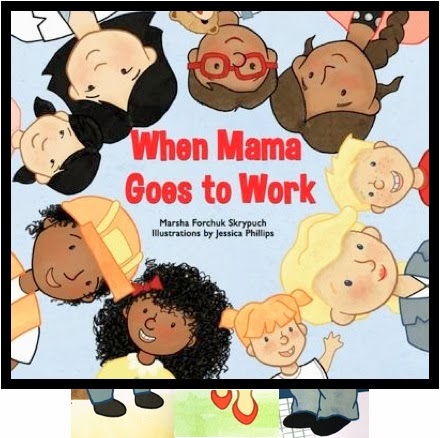
When Mama Goes to Work

by Marsha Forchuk Skrypuch
Illustrated by Jessica Phillips
Fitzhenry & Whiteside
978-1-55455-34-3
32 pp.
Ages 1-5
October 2013

We know that, in these days of economic instability, many children are part of households in which parents are out of the house at work each day.  It doesn't matter whether it is a single-parent household, one with both father and mother, or even one with two mothers–bills must be paid, careers to be realized and passions to be developed, and contributions to be made outside of the home.  As adults, we understand why we go to work, but do children always understand this? 

In When Mama Goes to Work, Marsha Forchuk Skrypuch ensures that they do understand, specifically that the days of working mothers and children are not that dissimilar.  Their days start the same, in preparation for the day: dressing appropriately, making lunches, tidying themselves, and packing their bags.  At work and school, the similarities continue, as they do when Mama and child are reunited.  Regardless of their day's activities, Mama and child know that they are each in the other's thoughts and hearts, and that when the "work" day is over, they will again be together.

This positive and reassuring message, which also communicates the variety of roles mothers may play within the community e.g., construction worker, medical professional, business person and care giver, is enhanced by illustrator Jessica Phillips' cheerful round-faced children and mothers.  All children will see themselves in her characters who range in their skin and hair colours, in gender, nationality, and activities.  When Mama Goes to Work is an inclusive story of everyday routines that may be unfamiliar and may seem mysterious but are reassuringly comparable and interconnected.

January 12, 2014

The Hidden Agenda of Sigrid Sugden

Written by Jill MacLean
Fitzhenry & Whiteside
978-1-55455-279-5
240 pp.
Ages 12+
October, 2013

Award-winning author Jill MacLean takes readers back to the Newfoundland communities of The Nine Lives of Travis Keating (Fitzhenry & Whiteside, 2008) and The Present Tense of Prinny Murphy (Fitzhenry & Whiteside, 2009) where living is not always easy, especially for the titular young people.

As a member of a trio of nasty girls hatefully called the Shrikes, Sigrid Sugden learns too soon how tough it can be when she attempts to anonymously save the life of a girl who Tate and Mel, the other two Shrikes, have put in grave danger.  Sigrid may not be the brains behind the violence or extortion like Tate, the daughter of horribly mean and devout parents, or the brawn like mother-less Mel, but Sigrid had found companionship with the two girls after her best friend moved away.  However, when Tate discovers that Sigrid is the one who called for help, she and Mel launch a series of relentless attacks against Sigrid.  Not yet thirteen, Sigrid's reputation as a Shrike leaves her friendless again.

So Sigrid is trying to find a way to make things right by distancing herself, emotionally and physically, from Tate and Mel and staying safe but, while her intentions are always good, her actions often backfire or cause more damage, especially after she tries to reinvent herself as an Avenger.  Sigrid even tries to help Hud, the fourteen-year-old tormentor of Travis Keating, after he comes to her aid.  But, a bully himself, Hud astutely recognizes that,
"Once you let your mean side off the leash, it runs you." (pg. 183)
Morever, while looking for some friendship and trying to remake herself, always looking over her shoulder, Sigrid worries that the family she knows may be falling apart. Mom who is involved heavily in eBay buying and selling spends most of her time, including nights, away.  Sigrid's older brother Lorne works and has a girlfriend, Sally, with whom he spends most of his time.  Her step-dad Seal, who seems to love Sigrid more than her real father who lives in Fort McMurray, acts responsibly about getting groceries and shopping with Sigrid whenever she asks, but he's spending a lot less time at home and is rumoured to be seeing another woman.

As she did in The Nine Lives of Travis Keating and The Present Tense of Prinny Murphy, Jill MacLean has created a preteen who is searching for the means to take control of her life.  When family members are making decisions that will unduly affect them and friends may be lacking, how does a young person manage? By making Sigrid a part of the Shrikes, Jill MacLean demonstrates that even those who appear flawed can be redeemed, though obviously not all can.  Knowing the wrath she will face if Tate discovers Sigrid's betrayal to save Prinny Murphy, Sigrid still finds a way to do it.  Finally standing up to Tate and Mel when they bully a much younger child and acknowledging the child abuse several peers may be experiencing are especially telling moments for Sigrid, particularly since putting herself out there without backup could be disastrous.

Sigrid's intentions may often seem centred on her own needs and wants (i.e., friends, family, companionship) but The Hidden Agenda of Sigrid Sugden is simply about making things right.  It may not be easy but it's always worthwhile. I think Jill MacLean has a similar agenda in her writing: show young readers that life can be difficult but nothing is ever final and there are ways to manage.  Luckily her agenda is as benevolent as her writing is compassionate.

January 04, 2014

Driftwood

Written by Valerie Sherrard
Fitzhenry & Whiteside
978-1-55455-305-1
200 pp.
Ages 10+
October, 2013

With the recent awarding of the Nobel Prize in Literature to Alice Munro, I think we can consider the short story as coming into its own.  And while Valerie Sherrard's Driftwood is not a collection of short stories, it has at its heart the telling of short stories as perfect vignettes of life lessons. 

Although eleven-year-old Adam's summer at a cottage on Schooner Point, Miramachi for two months has a rough start when his best friend Billy cancels the day before they're supposed to leave, it becomes a pivotal one for him.  It's a coming-of-age summer with Adam learning to see, not just look. While Mom tries to recharge her artistic juices (her popular paintings of their local covered bridge seem less inspired) and Dad works away on his computer, Adam explores the area, finding new acquaintances amongst the other cottagers.

Though Adam meets an assortment of kids, older and younger, male and female, friendly and arrogant, it's his first cottage friend, Joey, who introduces him to Theo, an older blind gentleman, who pays $5 for interesting pieces of driftwood.  Better than the money are the stories that Theo shares based on the wood's origins.  But as  entertaining as his stories are about the lychee, the oak, the mountain mahogany, the baobab and the mountain ash, it's what his audience derives from these tales that is the most significant.  Sometimes there are life lessons about telling the truth, or karma, or friendship, or secrets.  What the listener or reader can take from the stories depends on their own circumstances and whether they're listening.
"Our hearts hear the whispers they need to hear.  If we are wise, we take them in." (pg. 174)
The driftwood provides the impetus for life lessons to be taught but it is Adam who is the most significant driftwood, set loose by a no-show friend.  He goes into the summer with a disappointment chip on his shoulder and then drifts from one situation to another, never really taking root.  By melding these interactions–many endearing, some humourous, at least one frightening–with Theo's stories, Valerie Sherrard turns a summer vacation into a summer of growth for Adam, though it's unlikely that he recognizes it completely for what it is until he returns home.  In Driftwood, Adam finds his own story, beginning to understand himself and those around him, and discovering that he can control how he establishes himself with others.  He's looking and finally seeing, hearing and finally listening, and learning and finally understanding.  Similarly Driftwood encourages the reader to read beyond the words to discover the beauty of a boy's simple summer.

December 04, 2013

Gabby, Drama Queen

Written by Joyce Grant
Illustrated by Jan Dolby
Fitzhenry & Whiteside
978-1-55455-310-5
32 pp.
Ages 3-6
October, 2013

She may not be royalty but never question whether Gabby, the little alphabet miss from Joyce Grant and Jan Dolby's original book (reviewed here January, 2013), is anything but a drama queen!  She has the effervescence, the style, and the imagination, although it will be necessary for those pesky letters to rearrange themselves into the props she and her friend Roy will need.

When Gabby decides that they should put on a play, she brings out her special storybook, the one from which the letters that build words tumble out.  The S and T, A, G and E come together for their platform (though she did have to extract several letters from their previous words), as do other letters for their royal court-based performance.  But, when Roy wants to be a swordfish (yes, a swordfish), Gabby finds a way to adapt the production of "The Perils of Queen Gabriella" to make everyone happy.


Letters and consequently words should definitely be the staple of someone called Gabby, and Joyce Grant puts her orange-haired raconteur to work again with her characteristic spirit.  And Jan Dolby's quirky and colourful illustrations successfully convey the joy that comes from creative play and the amazement that letters go beyond their placement in the alphabet and can provide more inspiration for playful learning.  Gabby has graduated from simple letter recognition to constructing words and ideas as Gabby, Drama Queen and I look forward to her wordsmith skills maturing into bigger and brighter concepts.

November 04, 2013

Counting Back from Nine

by Valerie Sherrard
Fitzhenry & Whiteside
978-1-55455-245-0
198 pp.
Ages 14+
March, 2013

In Valerie Sherrard's "Acknowledgements" for Counting Back from Nine, she tells of originally writing the book in prose before proposing a rewrite in free verse to her editor, Christie Harkin, at Fitzhenry & Whiteside.  An astute choice, I believe, as Counting Back from Nine has the depth and fluidity and Valerie Sherrard has the fine touch that can create a story in which not all has to be written out for the reader.  Novels in free verse are sophisticated writing and appropriate for stories that surge beyond the page and into the hearts of readers, as does Counting Back from Nine. It's not surprising that Counting Back from Nine has been nominated for a 2013 Governor General Literary Award for Children's Text and for a Red Maple award.

Lauren Oliver has been secretly seeing her best friend's ex-boyfriend, Scott, since they broke up.  When she finally admits it to Nina, she is promptly and emphatically told, "I hate you."  And so with telling her parents about this situation, and getting a reassuring hug from her dad, Lauren acknowledges that the countdown from 9 has begun. 

Dealing with all her friends unfriending her, and Scott being quasi-attentive, Lauren is surprised to find herself invited to join a classmate, Christine Oakley, and her friend, Dee, at lunch and then elsewhere.  She realizes how critical their friendship is to her, especially when her father is involved in a car accident and, though he shows great positivity in vowing to spend more time with family (step 8), he dies. 

While recalling bright sparks of memories of her father, all steps in her countdown, Lauren works to resolve the discrepancy in the father she recalls with affection and the father who was apparently having an affair with the woman passenger in the car.
"It is the strangest feeling
when joy and sorrow both
have claws on your heart." (pg. 58)
Soon enough, the readers will recognize that the countdown of sections from 9 to 8 and so on are tracking the progress of Lauren's grief for the loss of her father, his love, and her family (which is reconfiguring itself), and forgiveness for his infidelity and weaknesses.  While resolving these issues for herself, Lauren also finds the means to resolve her tenuous relationships with Scott, Nina and other friends.

Cloud nine is a very nice place to be but the fall can be hard.  Lauren's family, friendships and clandestine relationship with Scott put her on that cloud but clouds are not solid ground and, as each bubble of joy bursts, Lauren falls closer to reality.  Valerie Sherrard exemplifies that contemplative descent through streaming verse, never allowing Lauren to hit bottom but instead helping her land softly.  Young readers of Counting Back from Nine, including those participating in the 2014 Red Maple reading program in which the book is nominated, will appreciate the gentle treatment for some harsh life lessons.

November 02, 2013

Marsha Skrypuch: Book Launch (Paris, ON)

Author Marsha Skrypuch 
 

will launch her two newest picture books


When Mama Goes to Work 
by Marsha Forchuk Skrypuch
Illustrated by Jessica Phillips
Fitzhenry & Whiteside
978-1-55455-314-3
32 pp.
Ages 3-6
 
 and

 
The Best Gifts
by Marsha Forchuk Skrypuch
Illustrated by Elly MacKay
Fitzhenry & Whiteside
98-1-55455-283-2
32 pp.
Ages 4-8
 

on


Thursday, November 21, 2013

at 7:00 p.m.

at the  
County of Brant Public Library,
12 William St.
Paris, Ontario