Showing posts with label kindness. Show all posts

June 22, 2026

The Great Gathering Place

Book cover of "The Great Gathering Place" depicts people around a fire with a spirit of the northern lights above
Written by Naomi McIlwraith
Illustrated by Onedove
Kids Can Press
978-1-5253-1010-2
32 pp.
Ages 4–8
June 2026 
 
We all need safe places. Whether it's a place to gather with others, to teach and learn, or to celebrate or honour our ancestors, a gathering place can be that safe place for Indigenous peoples. It enables connection with community and culture both spiritually and earthly. This is the story of The Great Gathering Place.
Two adults and two children travel along a river in their red canoe
From The Great Gathering Place, written by Naomi McIlwraith, illustrated by Onedove
Naomi McIlwraith, a Métis educator and writer, invites readers to join her to "meet our friends and relatives, and we'll visit and talk for hours and days, just as the breeze and the leaves talk for hours and days." (pg. 4) They'll travel by a big red canoe to visit and give thanks, to feast, to share lessons, and to be kind.
A canoe with people travel in the clouds over green fields
From The Great Gathering Place, written by Naomi McIlwraith, illustrated by Onedove
At the Great Gathering Place, there are opportunities to look back and forward. It's about recognizing those like Grandfathers, Sky and Buffalo; Grandmothers, River and Antelope; Cousins Moose and Sturgeon; and River and Fire. It's looking at learning from each other, even if it means disagreeing, but always with gentleness, kindness, and love. 
People look to the constellations and northern lights to see animals and footprints
From The Great Gathering Place, written by Naomi McIlwraith, illustrated by Onedove
The Great Gathering Place may be a concept of Indigenous cultures, but it is one that we all could recognize in our own ways. It's appreciating that which gave us life and which guides us. It's about lessons learned and still to be learned, and about gratitude which needs to be expressed. Naomi McIlwraith makes the journey to this safe spot accessible for all, even including Cree translations (with pronunciation guides) of key ideas. Her rhythmical text, though not rhyming, reflects the flowing nature of water and the heartfelt thankfulness for everyone and everything that impacts our lives. Naomi McIlwraith makes it seem very natural and yet gloriously profound.
 
The art by Onedove, a Cree and Métis illustrator, may have been created digitally but it feels traditional. I wouldn't have been surprised to read they'd used oil or acrylic, or gouache and watercolour. Onedove takes us to the rivers, lands, and skies where the Great Gathering Place brings people together. Their landscapes are rich in natural elements and colours, with much in reds and oranges, and their people are of diverse backgrounds. Inclusiveness through Onedove's art and Naomi McIlwraith's text is evident.
 
The Great Gathering Place may be a state of mind where we connect with others, but it's more than that. It is a place of safety where we can find ourselves, and others, and bring about healing, learning, and spiritual renewal. It's a place that makes us more of ourselves.

April 23, 2025

The Bigfoot Field Guide to Campers (and Other Mysterious Creatures)

Written and illustrated by Jami Gigot
Kids Can Press
978-1-5253-1263-2
36 pp.
Ages 4-7
Releases May 2025
 
Ah, the mysterious Bigfoot. Mythical beast or elusive recluse? Whatever it is, many fear an encounter with the massive creature. But what if it encountered us? Does it have a similar perspective?
From The Bigfoot Field Guide to Campers (and Other Mysterious Creatures), written and illustrated by Jami Gigot
In its field guide to mysterious creatures, Bigfoots believe that there "is one species that is so dangerous, and so treacherous, that Bigfoots have come to fear them above all others..." It's the nasty camper. Ever since campers invaded the home of the Bigfoots with their click-flashers, and moved their rock collections, peed in their gardens and contaminated their waters, Bigfoots have been forced to move deeper into the forests. But the Bigfoots have a guide to help each other deal with these troubling visitors. 
From The Bigfoot Field Guide to Campers (and Other Mysterious Creatures), written and illustrated by Jami Gigot
First step for Bigfoots is identification, easily accomplished by hairless faces and limbs, odours and noises. Once identified, the aim is to avoid being seen. In the case of the Bigfoot giving this advice, everything goes awry when a young camper spots the Bigfoot as he spots her. Guideline #3 recommends camouflage if spotted but he's kind of big, and the child finds him. And though he tries to remain calm and play dead–these are Guidelines #4 and #5–her tickling makes it difficult to remain secretive. 

Bigfoot knows to never eat a camper's food or let them use their click-flasher on you and to never let their guard down on a camper–they are NOT warm and cuddly creatures–but things take a turn when the camper becomes distressed recognizing the absence of the other campers. Can Bigfoot follow all the guidelines, or will he be able to show kindness to an upset child who sees a friend in the big guy and not a monster?
From The Bigfoot Field Guide to Campers (and Other Mysterious Creatures), written and illustrated by Jami Gigot
Vancouver's Jami Gigot may have meant this picture book as a tongue-in-cheek look at how we perceive the mythical Bigfoot but by turning it around and helping us see how Bigfoots may perceive us, Jami Gigot gives us a lesson in tolerance and kindness. It starts as a story of conflict between Bigfoots and campers, but it flips and opens up into a story of acceptance. Both Bigfoot and the child see beyond their fears and misconceptions and find something special that is mutually beneficial. 

Jami Gigot, who also wrote and illustrated Star Boy: Inspired by the Life and Lyrics of David Bowie, Imagination Vacation, and The World in Our Backyard, keeps the simplicity that would come of a homemade field guide. Her art, rendered in coloured pencil and digital paint, keeps a sweetness to Bigfoot–he looks more scared of the camper than she does of him– as well as to the goofy, young campers who may not have learned to be intolerant or fearful of others who are different from them. 

Whether Bigfoot or a camper, there may be a surprise in the woods for you. Be prepared with compassion and tolerance and you might just have an unexpected encounter with a new friend. But shhh! Let's keep that a secret.

June 19, 2024

Greetings, Floof!

Written by C. J. Hong
Illustrated by A. J. Smith
Kids Can Press
978-1-5253-0723-2
32 pp.
Ages 3-7
June 2024

A tiny pink fluff ball of an alien called Floof has arrived on our planet and scientific investigator Dr. Greta Goodnote is ready to meet and greet the explorer from Ploof. But it's going to take a little help from readers to really get to know the alien named Floof. 
From Greetings, Floof!, written by C. J. Hong, illustrated by A. J. Smith
First, though, Floof must come out of his spaceship. So, Dr. Greta encourages readers to give him a Ploofian hello by raising their arms and jiggling them. (Lucky we have a scientist to help guide us.) When Floof finally emerges, it's to cuddle a couple of bunnies the reader has pointed out to him. When the rain comes, readers are again enlisted, first to blow about the clouds and then to help a very fluffy Floof to return to his pre-ultra-poofing self. (This requires everything from blowing, and then closing and opening the book, and even shaking it gently.) And when he enjoys his first kiss, Floof is encouraged to pay it forward in his own Ploofian way.
From Greetings, Floof!, written by C. J. Hong, illustrated by A. J. Smith
By making readers part of the story, needing to help greet Floof, to locate animals to cuddle, to blow away rain clouds, to de-poof Floof, and more, C. J. Hong makes Greetings, Floof! an interactive story. While this is generally more difficult with picture books that are read aloud to children, rather than chapter books in which they might make choices of how the story continues, C. J. Hong keeps young readers enthralled, waiting for their next task in helping little Floof out. Not only are they learning empathy and cooperation, but they also see that science is something as basic as building knowledge through observation, experimentation, and application. 
 
American artist A. J. Smith has created an incredibly cute alien in his digital artwork but Floof is still very different. So Ottawa's C. J. Hong's story of the little guy inspires inquiry, coupled with open-mindedness for those who look and speak differently. Because of that, C. J. Hong ticks off all the boxes for a story of science, communication, compassion, and acceptance while demonstrating that kindness can bridge worlds, even planets.
From Greetings, Floof!, written by C. J. Hong, illustrated by A. J. Smith

October 03, 2023

We Belong Here

Written by Frieda Wishinsky
Illustrated by Ruth Ohi
North Winds Press (Scholastic Canada)
978-1-4431-9403-7
32 pp.
Ages 6-8
October, 2023  
 
Eve Bloom hated being called a greenhorn especially since, although she'd been born in another country, she'd lived here since she'd been little. She often found solace, and the privacy to cry, at a special place on a high rock in the park.
From We Belong Here, written by Frieda Wishinsky, illustrated by Ruth Ohi
When a new boy, Mark Nakamura, comes to her school, he is ridiculed for being Japanese. Eve goes to his defense to stop the bullies and takes him to her special rock. In gratitude, he gives her a small turtle he'd carved. Together the two enjoy imaginative storytelling and talk about their families. They became fast friends, spending time at the back of Eve's parents' store, Bloom's Delicious Foods, and at Mark's apartment. 
From We Belong Here, written by Frieda Wishinsky, illustrated by Ruth Ohi
But then Mark's father, a craftsman with wood, loses his job at the factory because a customer didn't want a Japanese man to make his furniture. Moreover, Eve's parents are shaken when a faulty shelf almost injures a customer who threatens that no one will shop there with a new market opening nearby. By bringing their families together, both the Blooms and the Nakamuras get what they need: support, work, customers, and the welcome that says they are appreciated in their community.
From We Belong Here, written by Frieda Wishinsky, illustrated by Ruth Ohi
We Belong Here may seem like a simple story of children and families of two different cultures, Jewish and Japanese, helping each other to be accepted by their community. But, because of Frieda Wishinsky and Ruth Ohi's back stories, We Belong Here is a much bigger story and one of great historical and contemporary relevance. The need to belong and be accepted is universal. And to not be accepted because of arbitrary qualities like place of birth, religion, language, physical differences, and such is unacceptable. But, differences are what create us and bond us. They improve our lives by opening our minds and our hearts. And with that comes understanding, compassion, and harmony. When Frieda Wishinsky and Ruth Ohi brought Eve and Mark and their families together, they could confront the prejudice both head on and discreetly. Whether challenging those who mistreat a classmate or supporting someone by hiring them for a work project, these efforts remind everyone that strength and courage come with compassion, not force.

This is a story borne of deeply personal stories. As readers will learn tomorrow in my interview with Frieda Wishinsky and Ruth Ohi, their connections are very real and make the story even more personal. But the way they tell the story, readers will not be left with remembering the nastiness but instead smell the rugelach in Eve's family's store, feel the smoothness of Mark's carvings, and appreciate the coming together of people to shop, to work, to play. Through Frieda Wishinsky's sincere words, I hear friendship, and through Ruth Ohi's art, I see kindness in a different time. Together they are melded into one story, one lesson in compassion, and one to uplift and reassure that intolerance can be overcome.
 
• • • • • • •
 
For a little something extra about We Belong Here, check back tomorrow for my interview with author Frieda Wishinsky and illustrator Ruth Ohi.
• • • • • • •

November 28, 2022

Cocoa Magic

Written by Sandra Bradley
Illustrated by Gabrielle Grimard
Pajama Press
978-1-77278-264-6
32 pp.
Ages 4-7
November 2022

There is much kindness in giving gifts in secret, in not expecting thanks or acknowledgement. It's giving for the sake of giving and not for reciprocity or reward. With the holiday season upon us, Sandra Bradley's book of Cocoa Magic, deliciously illustrated by Gabrielle Grimard, reminds us of the goodness of giving.
From Cocoa Magic by Sandra Bradley, illus. by Gabrielle Grimard
Daniel's Great Uncle Lewis is known as the Cocoa King of Charlottetown. From a very young child, Daniel learned the magic that came from a cocoa bean when vanilla, sugar and milk were added. By the time he is eight, he is spending an hour crafting chocolate into treasures at his uncle's shop before he is delivered to school.
From Cocoa Magic by Sandra Bradley, illus. by Gabrielle Grimard

When a new girl, Sarah, arrives at school, looking a little hesitant, Daniel comes up with a plan to make her feel more welcome. The day after her arrival, he slips a gold box with a single chocolate caramel into her desk. Like magic, when she opens the little box, Sarah smiles for the first time. He repeats this for several days, with a luscious vanilla fudge, a coconut cream and a piece of nougat. And each day Sarah seems less scared and more cheerful.

Then Daniel notices Ben watching Sarah enjoy her treat and decides to surprise the boy too with some magic. Was it the chocolate that made Ben a little kinder that day? Everywhere Daniel looks, it seems someone needs to be touched by a little cocoa magic. With a tearful classmate and an injured boy and more, Daniel enlists his uncle's help in delivering little boxes to the whole class.
From Cocoa Magic by Sandra Bradley, illus. by Gabrielle Grimard
Then his uncle goes away to the World's Chocolatiers' Conference in Switzerland and must close the shop for five days. Daniel is devastated. He misses his uncle, working in the shop and he worries that without their secret chocolate gifts, the joy would disappear from his classmates. He's wrong. In fact, his classmates bring the magic to Daniel when he needs it.

What a wonderful story of empathy! Daniel understands Sarah's nervousness at attending a new school, one which he himself finds cold and lonely, and then sees what his other classmates are feeling. He sees their distresses and finds a way, his way, to make them feel better. Sandra Bradley, a clinical social worker and therapist, makes the story of Cocoa Magic one of kindness without expectation of reciprocity. She shows the positive nature of giving both on the recipient and the giver. It is only when children feel safe and secure that they can appreciate the emotional needs of others and Daniel, embraced in the warmth of his uncle and his chocolate shop, has the capacity for that empathy. But by showing empathy for his classmates, Daniel gives them the capacity to feel for others. That is magic in itself.
From endpapers of Cocoa Magic by Sandra Bradley, illus. by Gabrielle Grimard
Gabrielle Grimard's illustrations, created with watercolour, gouache, coloured pencil and digital media, are filled with the sweetness of love, kindness, generosity and confections. (The endpapers are filled with an assortment of confectionary delectables too!) Though Gabrielle Grimard transports readers to the 1920s when boys wore knickerbockers, school desks had lift-tops and inkwell holes, and a special treat didn't need to be expensive or extravagant, she makes Sandra Bradley's story contemporary enough that young readers will see themselves in the diverse students who feel fear, sadness, pain and especially joy. 

There may be magic in the cocoa and the sugar but most of it comes from the empathy demonstrated through the gift giving. Perhaps at this time of year, that's the important message to cherish from Cocoa Magic.

October 22, 2022

The Brass Charm


Written by Monique Polak
Illustrated by Marie Lafrance
North Winds Press (Scholastic Canada)
978-1-4431-5758-2
32 pp.
Ages 5-9
September 2022
 
Everyone has troubles in their lives sometime. Some are horrific and life-changing, some are temporal but seem overwhelming.  Most of us cannot see past our own issues when we're immersed in them. It's that bubble of now. It is probably especially the case for young children many of whom, thankfully, have not had to endure great hardships. So, when the roof of their home is destroyed in a storm, Tali is devastated.
From The Brass Charm by Monique Polak, illus. by Marie Lafrance
As the family heads to stay with Oma while repairs may be undertaken, Tali's mother reminds her that "People survive worse" and to "Think of Oma." Tali knows her grandmother survived World War II but she never talks about it. Still Tali is "too sad to think of anyone" but herself, even when she meets a little neighbour girl who obviously craves some company. That is, until her Oma shows her a tiny brass charm of a monkey man and shares a memory of her own hardship.

From The Brass Charm by Monique Polak, illus. by Marie Lafrance
Telling her story in the third person, Oma tells of a girl forced to leave home and sent to a prison called Terezin. The people kept there were worked tirelessly and fed very little and on the day of her birthday, the child was overcome with how her life had changed for the worse. A woman, hearing her cry, bestows upon her a small brass charm of a monkey man that a stranger gave her when her own life had seemed stormy. Now Oma remembers that lady whose own life had been difficult and could still find "it in her heart to be kind to a stranger."
 
In a message of paying it forward, Monique Polak has Tali sharing the story of the brass charm with Elodie, the little neighbour girl, bolstering them both through their challenges.
From The Brass Charm by Monique Polak, illus. by Marie Lafrance
In a story within a story, Montreal author Monique Polak is actually telling her mother's own history of surviving Terezin as a child and receiving the charm. Because of Terezin's history and its common role as a transit camp for those moved onto other concentration camps, as Monique Polak's Afterword details, the woman who shared that charm was never seen again. Yet the kindness she extended in such trying circumstances, just as Tali's Oma did for her grandchild, speak to a strength of character beyond the typical. It speaks to empathy and compassion and feeling beyond self. And for Tali to listen and learn and then apply that lesson to another makes that small brass charm a greater gift than any gold or diamond trinket could replace.
From The Brass Charm by Monique Polak, illus. by Marie Lafrance
There is a lesson from history here with Tali's Oma remembering Terezin and an experience from World War II. But it is in the context of connecting with others and a grandmother-granddaughter relationship. Not surprising that, even with a story that includes both historical and contemporary scenes, Marie Lafrance whose artwork was rendered with graphite on paper before digitally coloured and texturized via collage, is able to meld the two time periods by focusing on the child in each. It's Tali's experience and then her oma's when she was a child. It is from their perspective: what they see, what they feel, how they respond. So when the two come together in the present, as elderly woman and young child, they are feeling and understanding as the same. And Marie Lafrance gives the two similarities in their physical appearances, with the golden curls of their hair and delicate chins and ears, and makes it clear they are related. But she also gives a softness to a hard story, a story of destruction and hatred, loss and generosity. By keeping the dark grey tones for the camp and the storm and using soft colours of blues and rose and such for everything else, Marie Lafrance emphasizes the tenderness of being there for others, not the damage of the negative.

I can't think of a gentler way to introduce children to the Holocaust and Nazi concentration camps than a reading and discussion of The Brass Charm, though its story is far greater than those historic concepts. Read for a memorial day such as the International Holocaust Remembrance Day (January 27) but also for lessons about empathy and the goodness of paying it forward. The best acts of kindness do not require recompense or recognition. They come from making someone's life a little easier, whether during storms, times of trouble or now.

• • • • • •

Author Monique Polak will be launching her new book on November 20, 2022 at 2 PM at the Gelber Conference Centre, Musée de l'Holocauste Montréal / Montreal Holocaust Museum. Reserve your free tickets at Eventbrite here

January 10, 2022

Arnold the Super-ish Hero

Written by Heather Tekavec
Illustrated by Guillaume Perreault
Kids Can Press
978-1-5253-0309-8
32 pp.
Ages 4-7
2021

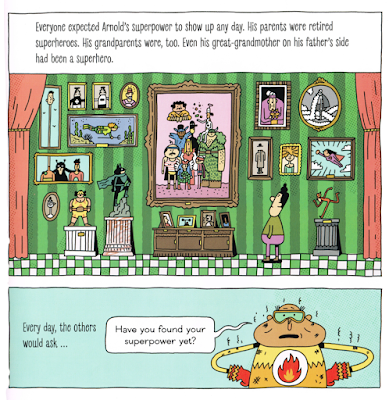
Arnold works in the family business, and that business is one of superheroes. They are superheroes like his super strong cousin and his super fast brother and his super bouncy uncle. But Arnold doesn't have a super power, yet, so, as they all wait for it to show up, Arnold is their phone guy.
From Arnold the Super-ish Hero by Heather Tekavec, illus. by Guillaume Perreault
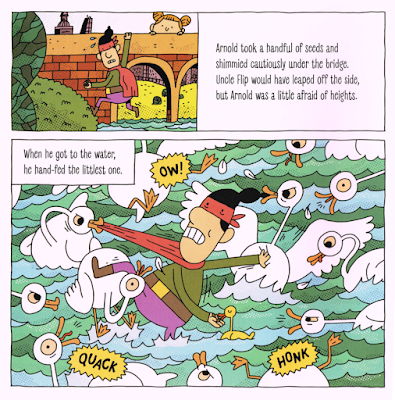
Then a call comes in for a superhero and no one responds when Arnold sounds the alarm. So, determined to follow the family motto of "Stop the bad guy from being a bad guy," Arnold dusts off his great-grandmother's mask and cape to find the crime. But just getting to the crime scene becomes problematic. As he speeds to the scene, as best he can after taking the bus, he comes across situations he misinterprets. A young man yelling at a woman in a wheelchair is actually a grandson trying to tell his grandmother who has lost her hearing aid to keep her hands off the tires so he can push her safely. Arnold's solution of giving the woman a stray kitten to hold works miracles for the grandson, grandmother and even the kitten. He sees a little girl throwing things in the water until she reveals she's trying to feed a baby duck before the more aggressive adults get the food. Arnold comes to the rescue again. 
From Arnold the Super-ish Hero by Heather Tekavec, illus. by Guillaume Perreault
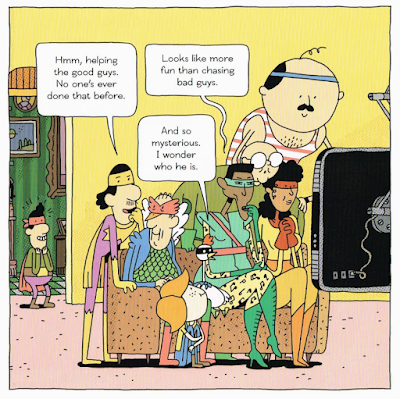
When Arnold finally gets to the called-in crime scene, he realizes that he can use his phone message-taking skills to good use to solve the problem and make two little girls very happy, with one declaring him a super-ish hero. After a few more good deeds, Arnold returns home to witness his efforts lauded on TV, with his family unaware that the Super Nice Guy superhero was their own family member. And that's a secret he's happy to keep to himself. (Oh, look, another superpower: keeping secrets!)

Kids love the idea of superheroes who can do beyond the norm, usually to fight crime and evil. But, if the past two years have shown us anything, it's that heroes come with all kinds of abilities, and goodness and kindness may be the greatest of all of these. As such, BC's Heather Tekavec has given us a humble character in Arnold, one who just wants to emulate his superhero family, but learns unintentionally that kindness is his strength. Even without trying for the spotlight, just stopping to offer assistance wherever help is needed, Arnold has become a hero. He's every guy and, with him, Heather Tekavec has shown us that anyone can be a hero.
From Arnold the Super-ish Hero by Heather Tekavec, illus. by Guillaume Perreault
Quebec illustrator Guillaume Perreault gives Arnold a banal look that works with the common person image. Except for a top-knot, there's not much to distinguish Arnold from anyone, including the reader. He doesn't stand out except when he does something kind. Guillaume Perreault may make Arnold's family members unique in their dress and skills but he makes Arnold stand out for his originality. In fact, Guillaume Perreault gives the whole book an understated feel with his choice of colours-no emphasis on bold primary colours–and blend of picture book illustrations with graphic novel boxes. Unlike most comic books about superheroes that bombard you with flash and action, Arnold the Super-ish Hero has the same restrained and easygoing appearance as does Arnold himself.

With a message that kindness is a superhero talent available to anyone, even Arnold, young readers will cheer for him and anyone who does good, knowing that the goodness comes in the doing, not from the recognition or the celebrity.

November 29, 2021

Birds on Wishbone Street

Written and illustrated by Suzanne Del Rizzo
Pajama Press
‎ 978-1-77278-219-6
40 pp.
Ages 5-8
November 2021

Wishbone Street is more than just a bunch of houses. It's a multicultural community, welcoming and supportive of all. And when a cardinal is injured, that community brings them all, newcomers and long-time residents, together to do good.
From Birds on Wishbone Street by Suzanne Del Rizzo
Moe loves her street, her neighbours, the parkette and all the things she can do there: bird-watching, tree-climbing, and treasure-finding. There's the elderly Ms. Francesca and her caregiver Ms. Frieda, Mei and her little brother Omari, and Mable, the massive maple tree in their neighbourhood parkette. When Syrian refugees Sami and his family (from Suzanne Del Rizzo's My Beautiful Birds) arrive on the street, Moe drops off a welcome box for the young boy. Moe and Sami realize soon enough that they share a love of birds so when winter's first snowfall comes and they discover a female cardinal stunned in the snow, they and their neighbours spring into action: Sami provides the box, Moe brings a blanket, and Ms. Frieda drives them to the vet.
From Birds on Wishbone Street by Suzanne Del Rizzo
Taking the bird home to recuperate, Sami shares with Moe his story and his treasures, memories from his homeland, and he teaches Moe and her friends to make suet treats and roosting pockets. (Directions are included at the end of the book.) With a happy ending, Moe and Sami and all their friends on Wishbone Street demonstrate that good things happen when we work together and show compassion for everyone.

Suzanne Del Rizzo's polymer clay art has always impressed, giving new textures and colours to already-strong stories. But when she illustrates her own stories, Suzanne Del Rizzo shines. There is a synergy of her words and art that elevates both into something truly extraordinary. In Birds on Wishbone Street, Suzanne Del Rizzo honours her own family and those of all immigrants to Canada, and upholds the idea that communities are based on an appreciation for our differences and acknowledgement of our commonalities. With that sense of community, great things can happen: a newcomer feels at home, a bird is helped, and important learning can happen. And with her magnificent art, created with polymer clay, acrylic glaze and other mixed media, Suzanne Del Rizzo takes us to Wishbone Street, into the parkette and into the snow, to bird-watch with Sami and Moe, to yearn for cannoli and churros shared between neighbours, and to feel those first snowflakes on our faces. We're there on Wishbone Street, watching as a world unfolds and enfolds, making one community out of many.

From Birds on Wishbone Street by Suzanne Del Rizzo

There may be snow in Birds on Wishbone Street and on our streets today but this picture book will serve as inspiration year round to promoting the joys of including everyone in our communities to the benefit of all.

November 06, 2020

Alice & Gert: An Ant and Grasshopper Story

Written by Helaine Becker
Illustrated by Dena Seiferling
Owlkids Books
978-1-77147-358-3
24 pp.
Ages 3-7
August 2020 

There’s a reason that fables and parables are so timeless as literary vehicles: their messages are enduring. It doesn’t matter whether the fable is from Aesop’s time, as is the basis for Alice & Gert, or of a contemporary setting. The messages are strikingly worthwhile and sadly still needing to be reinforced.
 
From Alice & Gert by Helaine Becker, illus. by Dena Seiferling
Alice is an ant and Gert, a grasshopper. It’s summer, with the lily of the valley out, and Alice is “ferrying bits of grain and seeds to her nest.” Gert, on the other hand, just thinks they should be enjoying the fine weather because “Winter is YEARS away.” In fact, Gert serenades Alice as she toils, recommending  through song that the ant should rest, laugh, play and sip tea. Even as Alice tells Gert that she’ll relax in January and continues to work, she finds herself humming Gert’s tune. Though she persists in her endeavours, she is charmed by Gert’s playing at pirate and a decorative pathway of flowers and leaves Gert makes for her. 

From Alice & Gert by Helaine Becker, illus. by Dena Seiferling
But when fall arrives and Alice panics for Gert about the ever-nearing winter, Gert dances a sarabande for her. Of course, winter does come and Gert finally becomes unnerved realizing that there are no stores of seeds in her own nest. Although Alice does take a moment to remind Gert that she should have planned better, her compassion helps her acknowledge how Gert’s work of singing and dancing lightened her own efforts and the ant is pleased to repay the grasshopper’s kindness by sharing her own stores of food.
 
From Alice & Gert by Helaine Becker, illus. by Dena Seiferling
Messages in books may sometimes become preachy if told in a heavy-handed way. Those is Alice & Gert are not. Written by award-winning author Helaine Becker, Alice & Gert is in no way moralizing or sanctimonious. Helaine Becker could have written Alice to be self-righteous, knowing that her hard work would allow her to survive the winter and Gert as flighty and irresponsible but she does neither. While Helaine Becker’s retelling of "The Ant and the Grasshopper" recognizes that hard work is beneficial to all and that responsibility is virtuous, she still acknowledges the worth of creativity.

Calgary’s Dena Seiferling, whose illustrations helped earn her first picture book nominations for the Marilyn Baillie and Elizabeth Mrazik-Cleaver awards, carries the two characters through the seasons with only slight changes in her palette, from the greens of summer to the browns and golds of fall to the greys, browns and white of winter. Her illustrations are as classic as the fable, having used her pencil to create profound scenes that are steeped in atmosphere and characters evocative with feeling. From the dramatic Gert who never looks silly as she enjoys her creative pursuits to the tireless Alice who takes the time, amidst her work, to feel, Dena Seiferling makes us appreciate the depth of the story through her characters and the setting.

Hard work may drive survival but creativity makes it endurable. Besides, with a dose of kindness, hard work and creativity can be balanced, as Alice and Gert learn.

August 03, 2020

Trail of Crumbs

Written by Lisa J. Lawrence
Orca Book Publishers
978-1-4598-2121-7
247 pp.
Ages 13+
2019

We all hope a trail of crumbs will lead us to safety and maybe even home, but both are sadly elusive for seventeen-year-old Greta in this young adult novel of trauma and abandonment.
 
After their mom died from breast cancer when Greta and her twin brother Ash were just eight, their dad Roger fell apart. He lost his truck driving job because of a DUI, had to sell the house and sent the kids to live with a relative. Though he remarried and got the kids back, the turmoil of their lives becomes one of emotional abuse with their stepmom Patty always yelling, complaining and blaming Greta and Ash for everything. After another altercation, Patty convinces Roger to abandon the kids and they sneak off in the night.
Seven years he'd made excuses for Patty's anger, tried to make them share the blame in her tornado of drama. They'd been kids–imperfect, noisy, messy. He'd played middle man between a wolf and two sheep, trying to justify why the wolf always tore at them. Trying to please that rabid wolf. (pg. 89-90)
Left alone in their cold basement apartment in Edmonton with limited money of their own, Greta and Ash consider their options. A plan to confront their father falls apart, though it does find them a new ally in a classmate and neighbour, Nate. They look for jobs. They approach their landlord, Elgin Doyle, an older man who lives in the upper part of the house, about deferring the rent but instead he offers to let them stay in a spare room he has in return for chores like shovelling snow.

Though initially uncomfortable with their new living situation, the normally-withdrawn Ash seems to come out of himself, cooking with Elgin and standing up for the older man to his hostile adult daughter Alice. But, while Greta grapples with their abandonment, she is also trying to clarify the traumatizing circumstances involving a sexual encounter with Dylan.
She could never make sense of those shards still rattling loose inside her. They dug in, but no matter how long she looked at them, they never formed a whole picture. A grotesque kaleidoscope. When she tried to sort through it, all the colors mixed together until it turned into swamp brown. (pg. 124)
Trail of Crumbs is a story of finding a way to survive the trauma of parental abandonment and of sexual assault. It's about finding family and friends in unlikely allies and trusting those who would support you no matter what. It's not an easy story to read because the trauma is so raw. Even when Greta and Ash try to logically deal with their abandonment, and Greta tries to sort out the events with Dylan, you know they're just struggling to endure, to get through it, to survive. There is a visceral fear about stopping to give in to the anguish and hopelessness. But Lisa J. Lawrence, who wowed critics with her debut novel, Rodent (Orca, 2016), writes with power and intrepidness, never letting us question whether Greta and Ash are real. They are, as are their problems. They've survived trauma after trauma and keep on going. They don't even know how brave they are. They are their own heroes.

That trail of crumbs may be elusive and often invisible, but I was consoled that Greta and Ash found sufficient to keep them bound as siblings with enough left over to lead them to a new support family.

March 23, 2020

Rain Boy

Written and illustrated by Dylan Glynn
Chronicle Books
978-1-4521-7280-4
40 pp.
Ages 3-7
April 2020

Rain Boy is not popular. When he's around, kids have to stop doing fun activities.
From Rain Boy by Dylan Glynn
But when the new child, Sun Kidd, arrives, everything is bright. She's very popular, especially at barbecues, at the beach and other outdoor events.
From Rain Boy by Dylan Glynn
Sadly, when Sun invites Rain Boy to her birthday party, something he'd never experienced before, the other kids freak out that he's ruining everything and shout at him, "Rain, rain, go away!" Sun Kidd is appalled by their behaviour and secludes herself in her bedroom while humiliated Rain Boy leaves. Then, "A storm began to brew."

At first the other children are negative and blaming, but as time passes, they "learned to live with wetness." They find beauty in the rain and puddles and natural world that comes alive with rain. And they find that "they were talking to each other a lot more."
From Rain Boy by Dylan Glynn
Eventually, Rain Boy, tired, peeks out, sees the world and the thunder and lightning stop. And even though there is still rain, it appears that people actually like having him around, and he is bold enough to go outside and play with other children.

Dylan Glynn is an award-winning artist of animation, illustration and fine art. In Rain Boy, the complexity of his art, rendered in watercolour, cut paper, pastels and coloured pencils, manifests in the emotional scenes and characterizations of Rain Boy and Sun Kidd who must be themselves, though they do attempt to hide away from others who label. There is anger in some illustrations, and brightness and joy in others. But when Rain Boy and Sun Kidd come together, something glorious arises.
So the next time you're feeling down and your world is dark and gray...
just look up.
Though Dylan Glynn's picture book is set for release in a few weeks, just in time for April showers, I think that it's a book we need to think about today. Many of us are trepidatious about something that is impacting the normal course of our lives. Some people are lashing out and showing insensitivity and selfishness when we should be extending kindness to everyone in these times of emotional thunderstorms and fears. Let's celebrate our differences not as challenges but as opportunities and come together to weather the storm as a united front.  And look up. Somewhere there is a rainbow.
From Rain Boy by Dylan Glynn

April 15, 2019

The Cold Little Voice

Written by Alison Hughes
Illustrations by Jan Dolby
Clockwise Press
978-1-988347-11-0
32 pp.
Ages 5-9
February 2019

Listening or not listening to the voices in your head is a skill that we develop with time, practice and experience. Telling the difference between valuable instinct and unproductive doubts is crucial and The Cold Little Voice is all about helping children know how to silence a negative one.
From The Cold Little Voice by Alison Hughes, illus. by Jan Dolby
The purple-haired child in The Cold Little Voice could be any child. It's a child whose bad-tempered blue voice, like a black cloud raining on a child's joy, points out anything that might be perceived as a weakness.
It points out that I bite my nails, laugh too loudly, trip when I run upstairs, talk too much, blush, cry too easily, make smacking sounds when I chew, sing off-key, get the hiccups too often, and have sloppy writing.
From The Cold Little Voice by Alison Hughes, illus. by Jan Dolby
The child plugs their ears and tries not to listen but sometimes that voice is far too insistent.  In response, the child stops being who they are.
I become small and still and grey.
And not me.
Fortunately, a new voice, a warm voice of yellow is heard, encouraging the child to look for goodness in cuddles with creatures, in the sun in the blue sky and in a supportive community. And if that cold little voice tries to speak again? Well, the child pities it and soothes it until it can become a big, warm, kind voice that whisper-shouts affirmations and helps turn others' cold little voices into big warm ones too.
From The Cold Little Voice by Alison Hughes, illus. by Jan Dolby
Just like the warm voice that sends positive messages and encouragement, The Cold Little Voice, the book, is transformative, inspiring light from dark thoughts and support rather than isolation.  Alison Hughes, who has helped children deal with anxious thoughts in her picture book The Creepy-Crawly Thought (2019), recognizes that there are voices in most of us that tell us that we're not good enough as we are and that these voices prey on our insecurities and fears. But Alison Hughes doesn't just negate those thoughts. She helps transform them into positives and reassurances.
A voice that says:
"You can do it!" 
or "Who cares if it's silly – 
you're having fun!" 
or "Everybody makes mistakes!"
Similarly, Jan Dolby, who illustrated Lucky Me (Fitzhenry & Whiteside, 2018) and Gabby, Wonder Girl (Fitzhenry & Whiteside, 2016) among others, brings that metamorphosis to her artwork. From the sombre blues and greys of the cold, little voice to the yellows and lime greens and pinks of the warmth of good thoughts, Jan Dolby carries young readers from a dark place to one of hope.

Negative thoughts that become doubts and apprehension cannot always be silenced immediately. But The Cold Little Voice will be very reassuring to children as they learn that it is possible to influence those thoughts to becoming good ones that can boost not belittle.
From The Cold Little Voice by Alison Hughes, illus. by Jan Dolby