Showing posts with label interactive. Show all posts

March 29, 2026

Raven & Friends: A Roy Henry Vickers Colouring Book for Kids

Written and illustrated by Roy Henry Vickers
Harbour Publishing
978-1-998526543
60 pp.
Ages 6–8
February 2026 
 
Raven & Friends is more than a colouring book. It's an invitation to learn how to draw in the style of Northwest Coast art. It's an offer to visit the animals of the land, water, and sky that inhabit this area. And it's a promise to help us see more than just ourselves.
From Raven & Friends: A Roy Henry Vickers Colouring Book for Kids
written and illustrated by Roy Henry Vickers
While the emphasis is on Raven and other animals like Hummingbird, Sealions, and Salmon, Roy Henry Vickers also takes us to see the sun and a Pacific sunset, and as well as a Raven Dancer and our place in the world. With Raven & Friends, Roy Henry Vickers helps us appreciate his Northwest Coast as he sees it: beautiful, natural, and part of something bigger.
From Raven & Friends: A Roy Henry Vickers Colouring Book for Kids
written and illustrated by Roy Henry Vickers
Roy Henry Vickers, with whose art I first became familiar through his First West Coast Book series with Robert "Lucky" Budd, will inspire young readers to colour but to also draw. He instructs them how to make shapes used in Northwest Coast art and allows them to practise before helping them put the shapes together into a stylized animal. But even if they aren't interested in trying their hand at drawing—though that would surprise me—Raven & Friends offers an opportunity for colour creativity and relaxation, even stress reduction. The act of putting paint, marker or crayon, pencil or wax, to paper brings calm. But with Roy Henry Vickers's artwork, that calm is sublime, transporting us to the Northwest Coast, compelling us to see beyond our own worries and intrusive thoughts, and inviting us to be present and mindful of the beauty within Raven & Friends and its subject locale.
From Raven & Friends: A Roy Henry Vickers Colouring Book for Kids
written and illustrated by Roy Henry Vickers
Roy Henry Vickers's first colouring book, Inspired (2025), was more complex, appropriate for all ages, young and adult. Raven & Friends may be considered more straightforward, less detailed in line and context, but the beauty in his art is accessible to all. For me, a retired teacher librarian, I see such elegance in Roy Henry Vickers's lines and shapes and how they merge into stunning reflections of his home, his cultures and his ancestry—Haida, Heiltsuk, Tsimshian and European—that I'm tempted to visit the Northwest Coast with my own colours and his art. I hope that whether you're six or sixty, you'll let Roy Henry Vickers guide you to a place of organic charm with his art and your colouring tools.
 
 
Check out the First West Coast Book series that Roy Henry Vickers created with Robert "Lucky" Budd.
 

June 23, 2025

This is How a Ball Rolls: The Science of Wobbling, Bouncing, Spinning Balls

Written by Heather Tekavec
Illustrated by Suharu Ogawa
Kids Can Press
978-1-5253-0968-7
32 pp.
Ages 5-8
June 2025 
 
Tell most children you're going to be talking about physics, and you'll hear groans. Tell them that they're going to play with balls, and you'll hear the cheers. So, let them play with the balls and they'll learn about the physics painlessly.

This is no ordinary book of nonfiction. Heather Tekavec, who has written both playful picture books (e.g., Arnold the Super-ish Hero) and books of nonfiction (e.g., Same? Different?), always leads with playfulness, and This is How a Ball Rolls has that same whimsy of text, with art by Suharu Ogawa, to lighten the science basis of how different balls work.

From This is How a Ball Rolls, written by Heather Tekavec, illustrated by Suharu Ogawa
For each type of ball, and Heather Tekavec covers everything from a marble to a tennis ball, a bowling ball and a beach ball, she teases readers with a hint to the type of ball she'll be highlighting in the following double-spread. By doing so, she gets young readers interacting with the text, guessing what the ball will be. For example, before her focus on the marble (see illustration above), she writes,
There is a little ball–
A teeny ball–
A glossy, smooth and swirly ball...
The next pages include a five-line poem filled with appropriate verbs and adjectives for that ball–for the marble, words like "clinking,""plinking," and "trading" are used–and then an information box about the type of ball. Information included may deal with how the ball is used in play, the composition of the balls, and even the physics of wind resistance. (Heather Tekavec extends this information in a section called "The Science of (Wobbling, Bouncing, Spinning) Balls" with discussions about the sphere, elasticity, aerodynamics, gravity, trajectory, drag force and speed along with some fun trivia.
From This is How a Ball Rolls, written by Heather Tekavec, illustrated by Suharu Ogawa
This is How a Ball Rolls is anything but boring science. It's playful and colourful and yet informative. It's even more so because of Suharu Ogawa's digital artwork that is as colourful as the balls which she depicts. The brightness of her art is only secondary to the diversity of her characters and the fun that they have in their play. Because she has to represent each type of ball in the scenes in which it would be used, be it a yoga studio, a beach, or a bowling alley, Suharu Ogawa makes every illustration rich in quirky details to draw the young reader's smile and interest. (I'm especially curious about the animated knitted duck head (?) and ball of yarn.)
From This is How a Ball Rolls, written by Heather Tekavec, illustrated by Suharu Ogawa
I know the audience for This is How a Ball Rolls is listed as five to eight years of age so it would work well with Grade 3 students studying forces, but I'd also use it with older students too. They'll appreciate the fun and the interactive nature of the book, but they'll also take away a lot of science that they can apply to new situations.
Moreover, they'll never look at any ball again as just a play thing. It will be recognized as much more, and they'll have a ball sharing what they've learned. (Pun intended.)

February 28, 2025

Do Not Turn the Page!

Written by Jane Blondie
Illustrated by Marcus Cutler
North Winds Press (Scholastic Canada)
978-1-0397-0206-6
32 pp.
Ages 3-8
February 2025 
 
Charlie is outside playing in the sand and dirt when he notices the reader has appeared. And so, begins a one-sided conversation as Charlie speaks to the reader about what he's doing, what he doesn't want to do, and what he expects of the reader. Unfortunately, the reader will do exactly what Charlie does not want and that is to turn the page. (After all, it is a book.)
From Do Not Turn the Page!, written by Jane Blondie, illus. by Marcus Cutler
Listen. Turning the page gets me closer to the bathtub and there will be NO bath for me. Not today. Nopey, nope, nope!
Charlie is adamant that he wants to play in his sand fort and so instructs the reader to close the book and never turn a page again. And yet with each progression in reading, Charlie is disappointed because the reader is not listening to his directives. It just gets worse.
Ugh! You turned the page again.
This. Is. Serious. 
From Do Not Turn the Page!, written by Jane Blondie, illus. by Marcus Cutler
 
With each turning of the page, the reader is chastised by Charlie for leading him from his sand box to inside the house, into the mudroom, through the living room, the kitchen and up the stairs. Accompanied by his cat and pig stuffie, the dirty child is forced by the reader turning the pages to hide from his mother who is already running the bath water. And even though Charlie makes many lingering stops along the way, from having a snack, doing art, and hiding in a toy box, ultimately his fate has been sealed by the reader and their need to turn pages. 
There is absolutely NO WAY you are getting me into that tub.
From Do Not Turn the Page!, written by Jane Blondie, illus. by Marcus Cutler
Well, the reader may get Charlie into his bath but a kajillion bubbles and rubber duckies help keep him there before he has one more routine to try to avoid.
 
I'm impressed by Jane Blondie's ability to write a one-sided dialogue that engages and interacts with the young reader so naturally. They will be delighted with the possibility that they control the story and where it leads, even though the adults may know otherwise. To connect so effortlessly with the reader in her debut picture book is an accomplishment but one that undoubtedly stems from Jane Blondie's teaching experiences. Still, it's the humour of Charlie as he pleads with the reader not to turn the page and then his disgust that they have done otherwise. The annoyance is evident but so is his good nature in understanding that this is how it usually goes i.e., he's going to get a bath no matter what. Charlie may be a little cheeky but he's still polite and more than appreciative to have the young readers along for the ride.
From Do Not Turn the Page!, written by Jane Blondie, illus. by Marcus Cutler
Marcus Cutler, who also illustrated The Walrus and the Caribou which I reviewed a few years back, gives a playful nature to his digital artwork. From a messy play area outside, littered with everything from an empty box to a discarded crown and a toy dump truck to a sticky snack of blueberry jam on crackers–and on his hands, on the table, and on Charlie's clothing–this could be any family home with children. Even the end papers are rife with yarn, muddy handprints and paw prints, bubbles, and more. Marcus Cutler gives a vitality to Charlie at play and in his routines and, rather than appearing to be unruly or ornery, Charlie charms, taking direction from the reader who moves him from outdoors to a bath, recognizing the inevitability of his story.
 
If you're an adult reading this book to some young readers, be prepared for the howls of laughter when they realize the character is conversing with them. They may be able to tell where the story will end up, probably having experienced similar events, but they'll be pleased to have been invited to participate. I foresee many, many readings of Do Not Turn the Page! just so the page can be turned, and children can witness the impact of their actions.

July 05, 2024

The Museum of Very Bad Smells: A Dare to Scratch 'n' Sniff Mystery

Written and illustrated by Monica Arnaldo
Katherine Tegen Books
978-0-063271449
32 pp.
Ages 4-8
July, 2024
 
Though we might all pooh-pooh a museum of very bad smells, I'll bet the premise will delight young readers who enjoy a frisson of irreverence in their stories. And if irreverence comes in the form of farts and toilet humour, all the better.
From The Museum of Very Bad Smells, written and illustrated by Monica Arnaldo
Yes, there is a Museum of Very Bad Smells, and it has suffered a great loss: the World Famous Rotten Egg has been stolen! The hamster gallery attendant or perhaps docent, has a mystery to solve and readers are invited to help. Throughout the book, there are spots where readers are invited to scratch and sniff. But what will the clues tell us? And who are the suspects?
From The Museum of Very Bad Smells, written and illustrated by Monica Arnaldo
The possible suspects include a busy dung beetle curator named Beetle; TJ, a mouse who works in the gift shop; Pickles, the wet dog; and Herman, a hermit crab and the docent's boss. Using his very fine nose for smells, the kepi-wearing hamster begins to follow the clues, and they are some very stinky ones, according to his telling comments. (I'm reviewing this book from an epub so cannot attest to the malodorous whiff that might arise from scratching the spot clues.) And though the hamster detective initially eliminates all the suspects, his sense of scents leads him to each of his museum colleagues. 
From The Museum of Very Bad Smells, written and illustrated by Monica Arnaldo
But in a Museum of Very Bad Smells there is a plethora of stinky exhibits, from onions and Pickles the farting dog, to dirty socks and wet sneakers, and loads to throw our intrepid detective and his assistants, the readers, off the scent. (Or is it onto the scent?) Fortunately, his very capable sniffer finds the culprit and a new exhibit for the Museum.
From The Museum of Very Bad Smells, written and illustrated by Monica Arnaldo
I recently lauded Monica Arnaldo for her picture book Mr. S, a perfect first-day-of-school book. Just as she got into the heads of very young children heading to school for the first time and not knowing what to expect, including the possibility that a sandwich might be their teacher, Monica Arnaldo knows that kids will love, love, love The Museum of Very Bad Smells and laugh, laugh, laugh as they scratch and sniff and solve the mystery of the missing rotten egg. Her story is hysterical and, while I'm thankful I didn't need to scratch and smell anything, I know children will find it a hoot to do just that. (Be prepared: there's no lavender or bubble gum smells here.) 
From The Museum of Very Bad Smells, written and illustrated by Monica Arnaldo
Her art is as playful as the text. This museum is a blend of bold and busy, colour and shape. Monica Arnaldo makes us look at and into each exhibit, follow the detective's progress, and sniff for clues, always helping readers find those sniffing spots with a tiny pointing hand. And her characters have so much individuality. From the sullen hermit crab carrying his herring tin around–for mystery lovers, you'll notice it's a red herring tin–and the defensive TJ and guilty-looking Pickles, so big and so loved and so much a dog, Monica Arnaldo makes us see a motley group of potential suspects and become part of her story of mystery.
 
The Museum of Very Bad Smells has everything a kid would want in a picture book: laughs, stinks, animals, illustrations with lots of details, colour, and a puzzle to solve. They might not be able to find the missing rotten egg on their own, but they'll be pleased to be part of the investigation. It might even encourage them to visit a real museum, though I think they'll be hard-pressed to locate one dedicated to offensive odours.

June 19, 2024

Greetings, Floof!

Written by C. J. Hong
Illustrated by A. J. Smith
Kids Can Press
978-1-5253-0723-2
32 pp.
Ages 3-7
June 2024

A tiny pink fluff ball of an alien called Floof has arrived on our planet and scientific investigator Dr. Greta Goodnote is ready to meet and greet the explorer from Ploof. But it's going to take a little help from readers to really get to know the alien named Floof. 
From Greetings, Floof!, written by C. J. Hong, illustrated by A. J. Smith
First, though, Floof must come out of his spaceship. So, Dr. Greta encourages readers to give him a Ploofian hello by raising their arms and jiggling them. (Lucky we have a scientist to help guide us.) When Floof finally emerges, it's to cuddle a couple of bunnies the reader has pointed out to him. When the rain comes, readers are again enlisted, first to blow about the clouds and then to help a very fluffy Floof to return to his pre-ultra-poofing self. (This requires everything from blowing, and then closing and opening the book, and even shaking it gently.) And when he enjoys his first kiss, Floof is encouraged to pay it forward in his own Ploofian way.
From Greetings, Floof!, written by C. J. Hong, illustrated by A. J. Smith
By making readers part of the story, needing to help greet Floof, to locate animals to cuddle, to blow away rain clouds, to de-poof Floof, and more, C. J. Hong makes Greetings, Floof! an interactive story. While this is generally more difficult with picture books that are read aloud to children, rather than chapter books in which they might make choices of how the story continues, C. J. Hong keeps young readers enthralled, waiting for their next task in helping little Floof out. Not only are they learning empathy and cooperation, but they also see that science is something as basic as building knowledge through observation, experimentation, and application. 
 
American artist A. J. Smith has created an incredibly cute alien in his digital artwork but Floof is still very different. So Ottawa's C. J. Hong's story of the little guy inspires inquiry, coupled with open-mindedness for those who look and speak differently. Because of that, C. J. Hong ticks off all the boxes for a story of science, communication, compassion, and acceptance while demonstrating that kindness can bridge worlds, even planets.
From Greetings, Floof!, written by C. J. Hong, illustrated by A. J. Smith

July 28, 2021

Complete the Quest: The Poisonous Library

Written and illustrated by Brian McLachlan
Imprint
978-1-250-26829-7
128 pp.
Ages 8-12
June 2021

For those middle-graders who want an adventure that is uniquely their own, or for those who love RPGs and have been told to get off their tech, or for those who love a good story with amazing characters, humour, and fantasy worlds of surprising elements, Brian McLachlan's Complete the Quest: The Poisonous Library ticks all the boxes.
From Complete the Quest: The Poisonous Library by Brian McLachlan
To undertake their quest in the world of Chimeria, readers are invited to pick a team of three heroes from Javen the Elven Druid; Coran the Human Priest; Blade the Flowerkin Sneak; Zix the Dragonfolk Wizard; and Crax and Tonk the Dwarven Barbarian Brothers. Each has unique powers and optional backstories about family, fears and habits which will help the reader complete the quest.
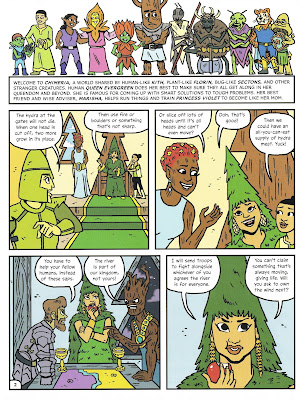
From Complete the Quest: The Poisonous Library by Brian McLachlan
And the quest? Queen Evergreen, who rules over Chimeria, with her friend and advisor Marisha and daughter Princess Violet, has been gifted with a poisonous book, imbued with bad magic. Instead of working towards keeping harmony with all the people of Chimeria as she has always done, she begins to see Marisha as tricking her into discriminating against the human-like Kith. She tries to fight it but she slips into a deep sleep. While her people look for the source of the book, the heroes of the story, i.e., whoever readers have chosen, are tasked with searching out the five ingredients needed to cure her of the book's poison. These include a star diamond, a blank lotus, a ghost cloud, a dragon lime and a skrim (a water creature).

Like the original pen-and-paper role-playing game of Dungeons and Dragons, it's advised that young readers keep track of their characters and their abilities as well as the items they acquire or lose, including different coloured pearls. 
From Complete the Quest: The Poisonous Library by Brian McLachlan
As they enter realms that include caverns and a maze, a jungle, the mountains, the sky and a spheramid, your heroes meet centaurpedes, phantomcap mushrooms, rock blobs, dragonfolk bandits and more. There are opportunities to join forces with others like the Flowerkin Glowvin or the bard Harmony but it's all up to the reader how the quest will be completed.
From Complete the Quest: The Poisonous Library by Brian McLachlan
The fun thing about Complete the Quest: The Poisonous Library is that Brian McLachlan has set it up so that the quest is always completed and young players (readers?) don't have to worry that they will be killed off before achieving their mission. Even better, they can complete the mission repeatedly but with different combinations of heroes with different backstories while altering their selections along the way. There will always be laughs with riddles and jokes, a fart elemental or a ghost barf, and much play with words like the Widow the Wisp and the Hot Steppers.
 
But the artwork is what will draw young readers in. It's vibrant and imaginative, fantastic in its diversity of characters and elements, landscapes and stories. Brian McLachlan bases his characters in animals, plants, humans and otherwise. They use different pronouns, i.e., she/her, he/him and they/them, and are coloured everything from purple or brown to green and pink. These differences, in fact, are what the poisonous book wants to use to separate Chimeria, encouraging discrimination and strife between distinct creatures. Thankfully the Queen recognizes that the book was a mask "to hide the truth and frighten us with a false image" (pg. 102) and that "We might look different, but we share universal needs and feelings." (pg. 103)

He will get kids reading and imaginatively playing with Complete the Quest: The Poisonous Library while paying homage to books and book people–there are books everywhere and librarians and readers galore–but Toronto cartoonist Brian McLachlan has made some powerful statements about diversity and inclusiveness and done so with colour and whimsy. This is certainly a quest worth undertaking.

September 07, 2012

Middle Ages (Medieval Times) Book List III

Clip art from www.teacherfiles.com

This is the third list of Canadian titles that deal with Medieval Times or the Middle Ages, which is generally accepted to have occurred from about 500 to 1500 C.E., after the fall of the Roman Empire until the Renaissance Era (14th c. to 16th c.). Only exceptional non-fiction is included here.

Non-Fiction

Adventures in the Middle Ages
by Linda Bailey
Illustrated by Bill Slavin
Kids Can Press
48 pp.
Ages 8-12
2000
Part of the Good Times Travel Agency series by author Linda Bailey and illustrator Bill Slavin, Adventures in the Middle Ages follows siblings Josh, Emma and Libby into medieval times of battles, catapults and unsanitary conditions.


Archers, Alchemists and 98 Other Medieval Jobs You Might Have Loved or Loathed
by Priscilla Galloway
Illustrated by Martha Newbigging
Annick Press
96 pp.
Ages 9-13
2003
Read about the wide variety of occupations by folks in the middle ages, far beyond the knights and castle folk most children know.


Clay Man: The Golem of Prague
by Irene N. Watts
Illustrated by Kathryn E. Shoemaker
Tundra
84 pp.
Ages 9+
2009
A retelling of the classic tale of a man formed of clay by the Jewish people in Prague in the late 1500's.


The Serpent Bride: Stories from Medieval Danish Ballads
by K. V. Johansen
Thistledown Press
187 pp.
Ages 13+
1998
Ten stories from Medieval Denmark include witches or trolls, love stories, dark magic and sailing the high seas.


The Seventh Expert: An Interactive Medieval Adventure
by Mark Oakley
Illustrated by John Mantha
Annick
96 pp.
Ages 10-12
2008
Following violent weather in the 1300's, a medieval village must be rebuilt, with the help of the reader and the expert advice and tools of those who lived in the middle ages.