Showing posts with label drawing. Show all posts

June 24, 2026

If I Could Draw...

Book cover of "If I Could Draw" by Patricia Storms shows a child with paper and pencil surrounded by colourful toys, candy, and animals
Written and illustrated by Patricia Storms
 ‎ DC Canada Education Publishing
978-1-834140667
36 pp.
Ages 4–8
April 2026 
 
A boy is bored. He is dismayed that he can't draw and that's what's holding him back from eliminating that boredom. If only he could draw, all would be well.
A child unhappily draws sketches of robots and more.
From If I Could Draw..., written and illustrated by Patricia Storms
 He then imagines all the wonderful things he would draw if he could draw. There would be dancing skyscrapers, unicorns playing ukuleles, and robots that served desserts. (Yum!) But as he imagines all the things he would draw, his little brother interrupts him, wanting to play. 
Robots present various sweet desserts.
From If I Could Draw..., written and illustrated by Patricia Storms
In fact, he's so delighted to hear his big brother's ideas that he draws them, giving his brother the tangible art he so longs to create. What comes from that is a mutual admiration of their skills to imagine and to draw making a collaboration to chase away any boredom.
A young child imagines a kind world.
From If I Could Draw..., written and illustrated by Patricia Storms
Patricia Storms's story is one of creativity and self-awareness. It's reminds young children to identify the skills they have and not focus on the ones they don't have. (There will always be things we can't do.) Even better, she lets a younger brother help his older sib recognize what he himself cannot see. This lovely sibling relationship is one of support, not competition. And even though the older brother is initially reluctant to engage with his younger sib, he is moved by his words and takes the time to listen. By doing so, he learns to see his little brother's drawing skills and accept appreciation for own imagination. 
A boy throwing out a ideas while his little brother draws them
From If I Could Draw..., written and illustrated by Patricia Storms
Patricia Storms has both written and illustrated her own picture books (e.g., Never Let You Go, 2013), written picture books illustrated by others (e.g., The Dog's Gardener, 2021), and illustrated those authored by others (e.g., Moon Wishes, 2023). She obviously has no problems with the drawing component or the writing part. Still she reminds us that sometimes we forget what we can do when we can't do something else. And Patricia Storms helps us see the misery of not being able to do something—those illustrations lack colour and life—but also the brightness and fun when one is free to visualize and create.
 
I'm glad that Patricia Storms continues to delve into her creativity by exploring her art, both written text and visual art, to give colour and shape to the joy of a child's imagination. By showing us the different skills of two siblings, Patricia Storms reminds us to try, to play, and to collaborate if we are to find inventiveness.

March 29, 2026

Raven & Friends: A Roy Henry Vickers Colouring Book for Kids

Written and illustrated by Roy Henry Vickers
Harbour Publishing
978-1-998526543
60 pp.
Ages 6–8
February 2026 
 
Raven & Friends is more than a colouring book. It's an invitation to learn how to draw in the style of Northwest Coast art. It's an offer to visit the animals of the land, water, and sky that inhabit this area. And it's a promise to help us see more than just ourselves.
From Raven & Friends: A Roy Henry Vickers Colouring Book for Kids
written and illustrated by Roy Henry Vickers
While the emphasis is on Raven and other animals like Hummingbird, Sealions, and Salmon, Roy Henry Vickers also takes us to see the sun and a Pacific sunset, and as well as a Raven Dancer and our place in the world. With Raven & Friends, Roy Henry Vickers helps us appreciate his Northwest Coast as he sees it: beautiful, natural, and part of something bigger.
From Raven & Friends: A Roy Henry Vickers Colouring Book for Kids
written and illustrated by Roy Henry Vickers
Roy Henry Vickers, with whose art I first became familiar through his First West Coast Book series with Robert "Lucky" Budd, will inspire young readers to colour but to also draw. He instructs them how to make shapes used in Northwest Coast art and allows them to practise before helping them put the shapes together into a stylized animal. But even if they aren't interested in trying their hand at drawing—though that would surprise me—Raven & Friends offers an opportunity for colour creativity and relaxation, even stress reduction. The act of putting paint, marker or crayon, pencil or wax, to paper brings calm. But with Roy Henry Vickers's artwork, that calm is sublime, transporting us to the Northwest Coast, compelling us to see beyond our own worries and intrusive thoughts, and inviting us to be present and mindful of the beauty within Raven & Friends and its subject locale.
From Raven & Friends: A Roy Henry Vickers Colouring Book for Kids
written and illustrated by Roy Henry Vickers
Roy Henry Vickers's first colouring book, Inspired (2025), was more complex, appropriate for all ages, young and adult. Raven & Friends may be considered more straightforward, less detailed in line and context, but the beauty in his art is accessible to all. For me, a retired teacher librarian, I see such elegance in Roy Henry Vickers's lines and shapes and how they merge into stunning reflections of his home, his cultures and his ancestry—Haida, Heiltsuk, Tsimshian and European—that I'm tempted to visit the Northwest Coast with my own colours and his art. I hope that whether you're six or sixty, you'll let Roy Henry Vickers guide you to a place of organic charm with his art and your colouring tools.
 
 
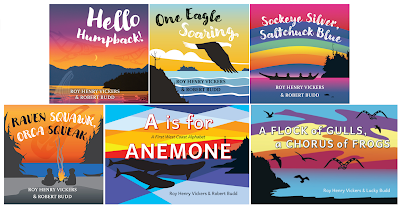
Check out the First West Coast Book series that Roy Henry Vickers created with Robert "Lucky" Budd.
 

April 25, 2025

Jackie's Drawing

Written by Andrew Katz
Illustrated by Tony Luzano
CrackBoom! Books (An imprint of Chouette Publishing)
978-2-898025679
32 pp.
Ages 3-6
May 2025 

There have been more than several novels, picture books, and short story collections that have been based during in the early months of the COVID-19 pandemic with its lockdowns (stay-at-home orders) and other measures. Though never mentioning the pandemic, Jackie's Drawing sees a child's perspective on the resulting isolation and a rebound to normal in terms of nature's response and her own inspiration for creativity.
From Jackie's Drawing, written by Andrew Katz, illustrated by Tony Luzano
Jackie's story begins with a rusty haze befalling her community. This haze forces everyone to stay indoors and to isolate from everyone and everything, including the mountain she'd often visit for inspiration for her art. At first, Jackie is still able to draw, gathering ideas from memory and her own experience. But, with time, it becomes more difficult as she had "lost the heart to do anything."
From Jackie's Drawing, written by Andrew Katz, illustrated by Tony Luzano
But one day a flash of silver in the canal beneath her window gets her attention. An unexpected dolphin has appeared, and with it a menagerie of other animals, from a bald eagle to moose and deer and foxes who have begun to make their way onto the streets, into the air, and into the water where only people had ventured. Jackie is enthralled and takes up her drawing pencils, determined to draw them all.
From Jackie's Drawing, written by Andrew Katz, illustrated by Tony Luzano
But as she draws them all, a wonderful dragon with antlers, a tail fin and feathers appears and transports her to the mountain where her drawing inspiration always lived.
From Jackie's Drawing, written by Andrew Katz, illustrated by Tony Luzano
While Jackie's Drawing speaks to a child's loss of enthusiasm for her drawing with her separation from nature, Andrew Katz's note at the conclusion of the story reminds us that the natural world too responded to the pandemic or could have. So, as Jackie had lost her creative muse the longer the "haze" drenched her community, the animals who normally would have been relegated to outside that community were able to find their way onto the quiet waterways, skies and land within. And for Jackie to find that nature was coming to her to awaken her imagination was a lovely positive during a dark time. Of course, it is still Jackie's imagination that helps her create a chimera–Andrew Katz discusses this in his appended note too–of the animals she sees, allowing her to travel in a flight of fancy to her beloved mountain to re-experience the joy of drawing outdoors.
 
Andrew Katz and Tony Luzano have previously collaborated on a picture book, I Want to Be Super!, so there seems to be a harmony of styles that works. Jackie's Drawing is again about an imaginative kid and Tony Luzano's digital art reflects every nuance of a child who is enthusiastic but then loses that enthusiasm when troubled with isolation and then finds a way to regain that passion for her art. His use of bold colours and distinct animals places the emphasis on the wonders outside and in Jackie's artwork, not on the grim haze that permeates their world for such a long time. He finds the light for her and for the reader to get beyond that haze of bleakness. 

The first year of the pandemic was especially difficult for many people but for children whose creativity was stifled, it might have been more challenging. Finding new things to do helped many but only coming after feeling the loss of their routines and familiar activities. Finding their new normal involved grief, courage, and imagination. Thankfully for Jackie, she found her ability to express herself from the very same source of encouragement she'd always relied upon, just in a different configuration.

April 09, 2019

The Pencil

Written by Susan Avingaq and Maren Vsetula
Illustrated by Charlene Chua
Inhabit Media
978-1-77227-216-1
36 pp.
Ages 5-7
April 2019

Maybe you think a pencil is just a pencil, a utensil that is easily replaced and should be thrown away when it becomes too difficult to manipulate. But, for Susan Avingaq whose story this is, a pencil is so much more.
From The Pencil by Susan Avingaq and Maren Vsetula, illus. by Charlene Chua
When Susan's mother leaves their iglu to help a neighbour with a birth, she and her sister Rebecca and brother Peter are left in the care of their father. Play for the children includes having a jumping contest, a game of hide-and-seek and the two older girls practising their letters on the frost surface of the ice window. But when Ataata pulls out the pencil from the special box of Anaana's things, everything changes.
From The Pencil by Susan Avingaq and Maren Vsetula, illus. by Charlene Chua
The pencil is already very short from Anaana's writing of letters to people in other camps, using whatever paper she might save including from tea boxes and sugar bags, but it is still gold.
Anaana always said that we needed to be very careful with the pencil and that it wasn't a toy.
Ataata also gives Susan a piece of paper and suggests she draw pictures for her brother. Though nervous, she draws seals and caribou and her family. Then Rebecca practises her writing, and Peter draws some scribbles and their father draws different inuksuit.  The pencil gets shorter and Ataata has to sharpen it with his knife.

When their mother returns and is somewhat taken aback by their use of her pencil, she still cheers their efforts and is pleased that they'd had a good day.
From The Pencil by Susan Avingaq and Maren Vsetula, illus. by Charlene Chua
Susan Avingaq's reminiscence of that special day with a pencil is so charming. The children's reverence for that pencil is absolutely palpable. They know how important it is to their mother and that it is not a trifle. With every stroke of that pencil, they showed knowledge of their culture and respect for Anaana and her need to be frugal.  Together Susan Avingaq and Maren Vsetula, who'd first collaborated on Fishing with Grandma (Inhabit Media, 2016) which was also illustrated by Charlene Chua, bring Inuit life on the land into a meaningful but genuine depiction in The Pencil. I have no doubts that Susan and her family, like many, had to be resourceful and careful with what they had and how it was used but The Pencil goes beyond a lesson in frugality and becomes a story of family, of play and of culture, which many children will appreciate. Charlene Chua, whose art has enhanced the stories of Akilak's Adventure (2016) and Elisapee and Her Baby Seagull (2017) among others, always finds a way to illustrate the love of family and the cultural wisdom of the storytellers.  Children will see the delight in Charlene Chua's characters when the pencil is brought out, when their father pretends to be a polar bear and the children's regret when their mother reminds them about using the pencil.
 "You know the reason we have to use our things very wisely is because they are quite difficult to get. We have only one pencil right now, and we won't be able to get another until we return to the trading post," she said.
A pencil may only be a pencil to many people, but it's an opening to a new world of connection to Susan and her family and deserving of being treasured.
From The Pencil by Susan Avingaq and Maren Vsetula, illus. by Charlene Chua

September 24, 2018

Inkling

Written by Kenneth Oppel
Illustrated by Sydney Smith
HarperCollins
978-1-44345-028-1
256 pp.
Ages 8-12
September 2018

When  a splotch of ink pulls itself out of the sketchbook of graphic artist Mr. Rylance, only the cat Rickman sees it roaming and exploring until it hides itself within the drawing efforts of sixth grader Ethan. In fact, while the talented Mr. Rylance, known for his Kren graphic novels, struggles with writer's and artist's block undoubtedly stemming from the death of his spouse, his son is just struggling to contribute the artwork to a class project. (His peers are convinced he should be able to draw like his dad.) But after Ethan discovers the ink splotch which he calls Inkling is able to absorb the ink from books, newsprint and even photographs and complete incredible illustrations, he begins to use the inky entity to build on his own clumsy stick figure drawings and submit the artwork as his own.
From Inkling by Kenneth Oppel, illus. by Sydney Smith
While Inkling feeds on a variety of print which affects its voice and behaviour–violent comic books are the worst!–and draws Ethan's homework, the boy struggles to keep his secret advantage safe and undercover. But, like all good secrets, it is revealed, first to one friend and then to his father, before being discovered by Ethan's archenemy, the daughter of Dad's publisher.  Too soon, Ethan is scrambling to keep Inkling safe and stop those who wish to enslave it. 
From Inkling by Kenneth Oppel, illus. by Sydney Smith
What starts out as an imaginative creation story of a splotch of ink soon becomes a cautionary tale against finding an easy way out of work and taking advantage of those who might help you. And you'll be astonished when you feel like cheering for a blob of ink who expresses itself wildly in terms of whatever text it has most recently consumed, including L.M. Montgomery's Anne of Green Gables, Roald Dahl's The BFG and Hemingway's The Old Man and the Sea, and then feel angst for it when Inkling writes, in inky bold writing, that "I AM ALONESOME" (pg. 82). Kenneth Oppel has made us care for bats, a fostered chimp and now a blob of ink. Too soon the reader will see Inkling as a living thing, even before given a name, and I defy any science teacher to do a lesson on the characteristics of living things and not struggle with Inkling's classification. It's all in Kenneth Oppel's ability to give life through his words, invigorating Inkling with needs and wants and free will.

Though Inkling is not a picture book or a graphic novel, it is illustrated, here by Governor General award-winning artist Sydney Smith who takes Kenneth Oppel's story and sugars it with artwork that adds but doesn't explain. From chapter heading panels to ink splats small and large on every double-spread and the occasional expression of Inkling's work, Sydney Smith guides us to understanding the evolution of Inkling from static ink on a page to living being, absorbing, learning and feeling. Remember: Inkling is composed solely of ink.

I suspect teachers will be jumping on Inkling (please don't hurt him!) to use in class for everything from writing voice and setting to writing "What If?" stories as the basis for plot. But don't disregard Inkling's magic as a blob of ink restores life to a family disintegrating in grief and offers hope through the art of its dynamic efforts.

December 04, 2017

Woodrow at Sea: Book launch (Toronto, ON)

The wonderfully talented author and illustrator

Wallace Edwards
is set to launch his newest picture book of youngCanLit


Woodrow at Sea
Written and illustrated by Wallace Edwards
Pajama Press
978-1-77278-029-1
24 pp.
Ages 3-5
November 2017
Review here

on

  Saturday, December 9, 2017

11 a.m. -12:30 p.m.

at

Queen Books
914 Queen St. East
Toronto, ON


In addition to book sales and signing by Wallace Edwards,
there will be:
• story time
• a drawing lesson
• crafts
• light refreshments


Look for my review of this special wordless picture book tomorrow!

October 05, 2015

Ben Says Goodbye

by Sarah Ellis
Illustrated by Kim La Fave
Pajama Press
978-1-927485-79-8
32 pp.
Ages 3-6
October 1, 2015

Last time (A+ for Big Ben) darling preschooler Ben had to deal with being the only one in the family not getting a report card and feeling like a little kid.  This time he has another challenge to overcome: the moving away of his best friend Peter.  Desolate, Ben moves away too, under the table to become a caveboy, with only his teddy bear for companionship.  There he eats with his fingers and plays with rocks, and responds to offered food with the occasional "guh." And, most importantly, he is able to to recreate his time with Peter in amazing petroglyphs that provide him with closure and appreciation for their friendship.
Sarah Ellis' latest Ben story focuses on a common upset for children: the moving away of a friend.  Her text shows how a child doesn't recognize all the efforts of others to distract from the potential trauma but instead allows him to immerse himself in his memories, giving them texture in the drawings he produces within his cave.  Kim La Fave, who gets little Ben's shy or determined face spot on, illustrates Ben Says Goodbye so expressively that Ben's angst and ultimate release and acceptance are remarkably visible.  Using the simplest of lines, Kim La Fave gets the angles of the faces, hands and bodies with their tiny feet so right that their intentions are always plain, allowing even the youngest readers to see more into the artwork than might be expected.  And the cave drawings are so evocative of boys having fun and making adventures from their limitless activities. It's not surprising that Ben will miss his compadre when they've already lived so many lives in a few short years.

Best of all is the culminating picture and text that, without saying much, say everything, providing a hopeful future of friendship, albeit with someone of the opposite gender.  A happy ending to a story that demonstrates that even the very young can work their way through difficult situations on their own and come out smiling.  Ben has so much to teach all of us, even if he is just a preschooler!

July 19, 2014

The Boundless

by Kenneth Oppel
HarperCollins Canada
978-1-443410328 
336 pp.
Ages 10-16
April, 2014

"ALL ABOARD... The Boundless for a mesmerizing adventure of historical proportions, with death-defying leaps of faith, Sasquatch encounters, illusions of the fourth dimension and murderous employees looking for the gold after death.  Leaving now for its first journey. Get on board now to be one of the first to enjoy this newest series by award-winning author Kenneth Oppel."

Life changes for Will Everett and his family after Will helps in the hammering of the last spike of the CPR railway in British Columbia and his father saves the life of Cornelius Van Horne, president of the CPR, in an avalanche.  Three years later James Everett is in charge of the Boundless, the seven-mile long train of spectacular design created by Van Horne, who is now ensconced in a secured and guarded funeral car near the front of the train.  And, on its maiden voyage, Will is enjoying the amenities of first class and looking to reacquaint himself with a young wirewalker/escape artist, Maren, travelling with Zirkus Dante, the circus of Mr. Dorian, the man who'd captured a young sasquatch after that avalanche years earlier.

Beyond the incredible opportunity of travelling on the longest and most powerful train in the world, essentially pulling a city of nine hundred and eighty-seven cars, Will enjoys the opportunity to experience the towns of vendors that arise to service the train's passengers, the wilds of the Canadian landscape with its supernatural creatures including the muskeg hag, the Wendigo and the sasquatch, and convince his father that he should be allowed to attend art school in San Francisco.  But Will places himself in a dangerous position when, at a stop, he recovers a key dropped by the funeral car's guard moments before the man is stabbed by a man Will recognizes.  Barely catching the caboose at the end of the train, Will must use all his skills and wits and trust a few new friends if he is to stay alive and find his way back to his father in the locomotive.

The Boundless is an endless adventure of hopping train cars, outsmarting murderous fiends, marvelling at unforeseen inventions, surviving encounters with mythical creatures and trusting some and not others, including a first love.  Never does Kenneth Oppel make you believe that Will can easily survive this drama.  Readers will be holding their breaths wondering which fall will kill Will or leave him in the Boundless' wake. Or whether Mr. Dorian's plan will save him or put others in jeopardy.  Or whether every brakeman on the Boundless is a threat.  Or whether Will's father, miles away at the front of the train, knows anything of the goings-on in the funeral car and beyond.  And I'll be surprised if you don't start wondering which pieces of Canadian history are valid and accurate. Cornelius Van Horne, Sam Steele, Simon Fraser and Donald Smith and others make appearances in The Boundless, though they are legitimate characters who helped in the making of our nation.  But what of the golden spike?

Yep.  The Boundless has all that and more. And only reading Kenneth Oppel's newest steampunk will allow you some opportunity to answer those questions or at least make an attempt at it. So get on board with reading The Boundless, a phenomenon of engineering and text, courtesy of the imagination and pen of one of Canada's finest writers for young people. 

May 06, 2014

I Wish I Could Draw

Words and (Bad) Pictures by Cary Fagan
Groundwood Books
978-1-55498-318-6
32 pp.
Ages 6-10
Release May 13, 2014

I did not label the illustrations in Cary Fagan's I Wish I Could Draw as "(Bad) Pictures"; that was all Cary Fagan's doing.  Like so many of us, it takes some effort and practice before Cary Fagan, the illustrator, can accept that he has some artistic skill.  Of course, he does have to stop wishing and start doing before he realizes that, with a little practice, some effort and an interest in his subject, he can draw. 

From the onset, Cary Fagan, the illustrator, states unequivocally and even takes the time to show the reader how crummy an artist he is, from a self-portrait to a series of still-life pictures.  It's only when he begins to draw things he actually likes, e.g., a double-scoop chocolate ice cream cone, does Cary start to see some promise in his artistry.  And then, when he makes his illustrations purposeful i.e., part of a story, he admits that he likes drawing and encourages readers to go and pursue their own "stinky" drawings!

In these days of nurturing resilience and grit in children, I Wish I Could Draw lends itself so well to encouraging young readers not to give up when they are challenged.  In a notebook-style format, I Wish I Could Draw could be any child's doodle book of sketches, cartoons and reproductions of superheroes or characters with which they are familiar.  Maybe they won't be drawing teapots (though I think Cary's is rather quaint) but you can be assured that they'll be practising those troublesome fingers and landscape elements of trees and houses that always seem to show up in some school drawing.  With Cary Fagan's signature dry humour (we've read it in Danny, Who Fell in a Hole and Oy Feh So?), I Wish I Could Draw will make readers point and chuckle and then stop wishing and start drawing for themselves.  After all, their drawings couldn't be any worse than Cary Fagan's (bad) pictures.